

A tenant has moved out, the keys are back, and the unit is sitting empty. Rent stopped on the first, the furnace filter needs changing, three inquiries are unanswered, and the move-out photos are still on a phone. That gap between tenancies is where real estate management earns its keep, because every unanswered inquiry, delayed repair and missing document turns into lost rent or a dispute that didn't need to happen.
Table of Contents
- What Real Estate Management Covers and Why It Matters Now
- Core Services From Leasing to Compliance
- Property Management Versus Brokerage Services
- How Management Protects Your Returns in Calgary
- Alberta Rules Every Landlord Must Follow
- Balancing Tenant Retention With Rent Growth
- How to Hire a Licensed Property Manager
- Confirm Your Management Plan Before You Sign
What Real Estate Management Covers and Why It Matters Now
An empty condo in Calgary doesn't pause its costs. Condo fees, property tax, insurance and mortgage interest keep running while the owner arranges cleaning, answers inquiries and books showings around a day job or from another province.
Real estate management is the ongoing operation of a rental property after it's bought and leased. It answers four practical questions: who finds the tenant, who books the furnace repair, who collects the rent, and who can prove the file is compliant if a tenant, auditor or tribunal asks.
Every answer lands somewhere on the month-end statement. A slow leasing answer becomes vacancy days, and vacancy days are rent that never comes back. A slow repair becomes a larger invoice, or a tenant who doesn't renew. A thin file becomes a dispute that costs more than the problem that started it. The owner holds the asset, and the manager runs the daily system that decides whether those lines stay small.
Who Typically Needs It
- Single-property owners: One house or condo where one vacant month erases a large share of the year's profit.
- Small plex landlords: Several doors, several tenants, and not enough hours to coordinate trades and notices properly.
- Out-of-province investors: Owners who can't attend a showing, meet a plumber or complete an inspection in person.
- Buy-and-hold portfolio owners: Owners who need consistent records across properties rather than a different system for each door.
The work carries more weight now because tenants have more choice. New construction has added competing rental listings in Calgary, and Canada's vacancy rate has risen amid historically high rental construction, according to CMHC's 2025 rental market release. An empty unit that is priced or presented poorly sits longer, and every extra week on the market comes straight out of net operating income.
Done properly, management is financial control. The four areas, leasing, maintenance, accounting and compliance, work as one system that keeps vacancy days, repair bills and disputes from compounding on the statement.
Core Services From Leasing to Compliance
Owners often ask for a simple list of tasks. The better question is what happens if a task is late, because the four areas below feed into each other.
| Service area | What it includes | Owner workload without a manager | How often it recurs |
|---|---|---|---|
| Leasing | Listing photos, advertising, showings, screening, lease drafting | Write ads, answer inquiries, check references, sign leases | With each vacancy |
| Maintenance | Vendor selection, work orders, cost approval, emergency routing | Find trades, get quotes, track invoices, respond after hours | Monthly and during emergencies |
| Accounting | Rent collection, arrears follow-up, deposit ledger, owner statements | Chase payments, reconcile accounts, keep trust records | Monthly, with a year-end summary |
| Compliance | Notices, lease terms, move-in and move-out inspections, record-keeping | Know the Residential Tenancies Act, time each notice, file evidence | Each tenancy change, plus annual record review |
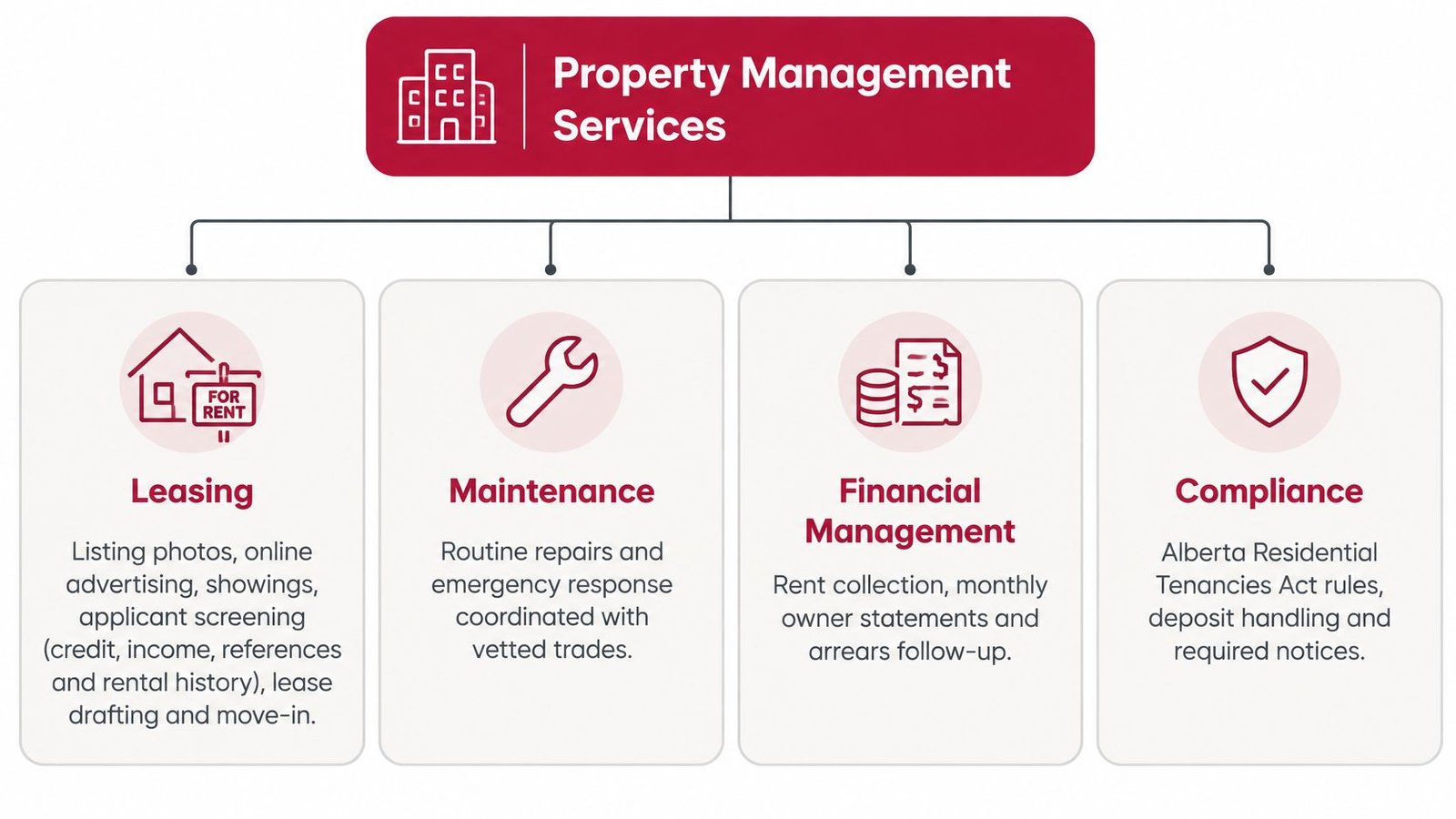
Leasing Sets the Quality of Everything After It
Leasing covers listing photos, online advertising, showings, and applicant screening against credit, income, references and rental history. It ends with lease drafting and move-in documentation. Weak screening doesn't save time. It moves the cost forward into arrears, property damage and early turnover.
Maintenance is less visible until it fails. A manager selects vendors, issues work orders, enforces cost approval thresholds and routes emergencies to the right trade. Owners exploring the preventive side can review the main types of maintenance to separate planned upkeep from reactive repairs.
Accounting runs monthly. Rent collection, arrears follow-up, the security-deposit ledger, owner statements and a year-end income summary for tax filing all sit here. Day-to-day management by Dreamhouse Realty includes rent collection, maintenance coordination, inspections, and tenant communication, which is a useful baseline for what "full service" should actually contain.
How the Four Areas Interlock
Say rent is late. Accounting flags the missed payment and starts follow-up. If the tenant doesn't pay, compliance governs the notice and its timing. Tenant communication creates the dated record of what was said, and the deposit settlement at move-out depends on that same record.
A late payment is never only an accounting problem. It's also a notice, a paper trail and, eventually, a deposit question.
That chain is why piecemeal help often disappoints. Hiring someone only to place a tenant leaves the owner holding the notice, the ledger and the midnight plumbing call.
Property Management Versus Brokerage Services
Owners are often told to "list with a broker" when what they really need is someone to run the rental every month. The two services solve different problems, and confusing them produces the most common hiring mistake in this market.
| Criterion | Property management | Real estate brokerage |
|---|---|---|
| Core mandate | Run the rental after it is leased | Buy, sell or lease a property as a transaction |
| Client relationship | Owner, for the life of the tenancy | Buyer, seller or landlord, per deal |
| Time horizon | Months to years | Weeks to months per transaction |
| Main deliverable | Rent collected, condition reports, compliance file | Signed sale or lease agreement |
| Compensation | Recurring fee, often tied to rent collected | Commission on the completed transaction |
| Licensing | Confirm the credential the individual holds | Licensed broker or associate registered with RECA |
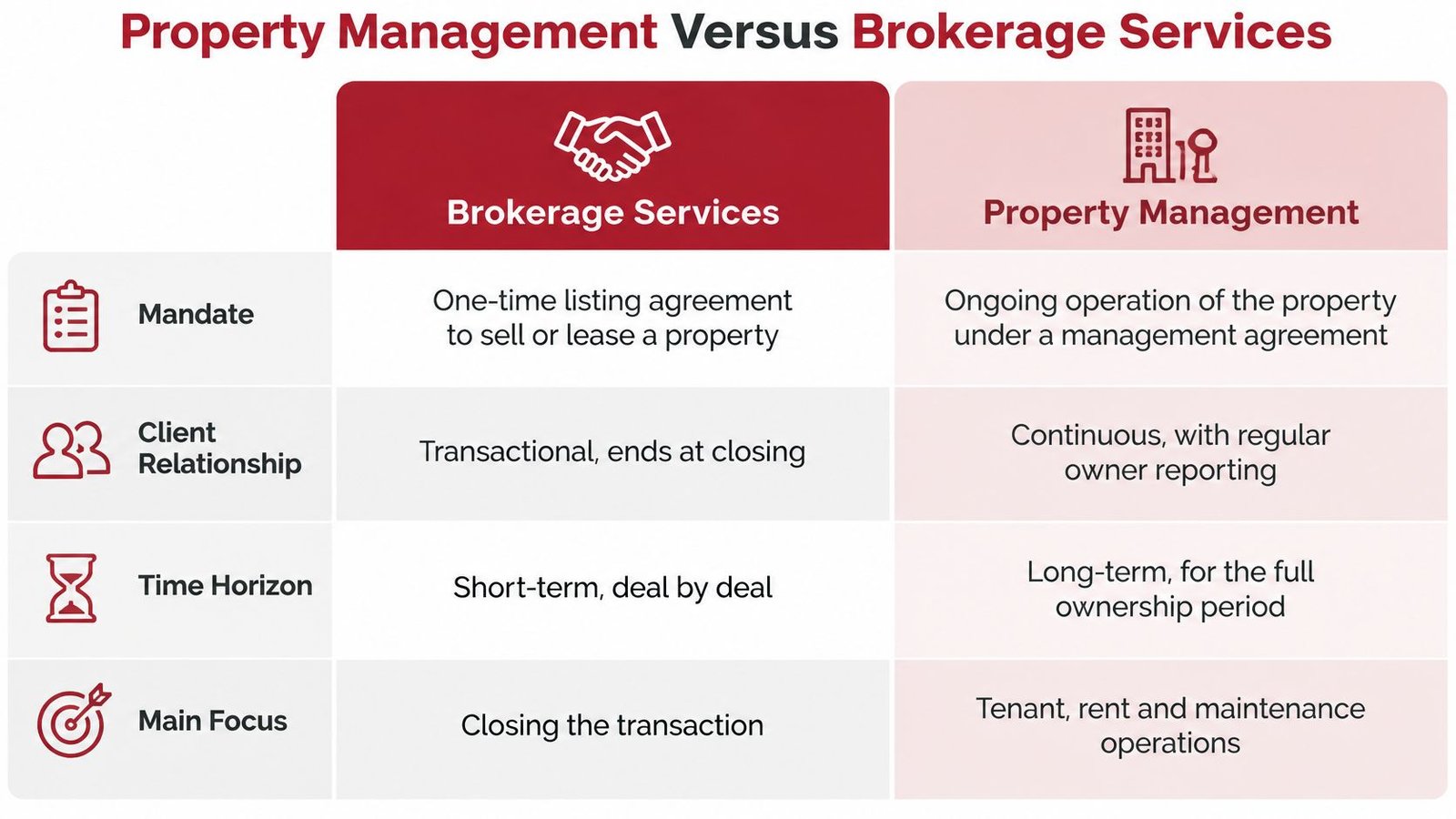
Brokerage is the moving truck. It delivers the property to a new owner or tenant and then leaves. Management is the caretaker who stays for the life of the lease, handling the furnace call, the late payment and the inspection. Facility Management Insights offers useful context on distinguishing building operations from property administration, which helps owners avoid assuming that looking after a building's systems is the same job as managing its tenancies.
Two Misconceptions Worth Correcting
- A brokerage licence means ongoing tenant management: It doesn't. Transactional licensing authorises trading in real estate, and many brokerages offer no monthly operations at all.
- A leasing commission buys an operating service: It buys a placed tenant. Rent collection, repairs and notices after move-in are separate work under a separate agreement.
Which One Fits the Situation
Buying or selling an investment property points to brokerage. A remote owner with one rental who needs rent, repairs and compliance handled monthly needs management. An investor who acquires a property, leases it and holds it benefits from both, ideally under one firm with a written agreement naming each service and its fee.
Before signing anything, the owner should verify the licence through the Real Estate Council of Alberta. The check takes minutes and confirms who is authorised, rather than relying on a logo or a verbal assurance.
How Management Protects Your Returns in Calgary
Citywide averages are a poor pricing tool. In 2025, Calgary's purpose-built rental vacancy rate was 5.0% citywide, and CMHC's Calgary rental market data breaks that figure down by unit type: 6.0% for studios, 4.4% for one-bedroom units, 5.7% for two-bedroom units, and 4.4% for units with three or more bedrooms.
| Unit type | Vacancy rate, 2025 |
|---|---|
| Studio | 6.0% |
| One-bedroom | 4.4% |
| Two-bedroom | 5.7% |
| Three or more bedrooms | 4.4% |
| All units, citywide | 5.0% |
A studio owner and a four-bedroom owner are operating in different markets inside the same city. Pricing, marketing and concessions should track the specific unit type and neighbourhood. A two-bedroom townhome with parking in a low-supply suburb competes differently than a downtown studio surrounded by new towers.
What One Vacant Month Actually Costs
Say a unit rents for $2,000 a month and turnover costs $1,500 for cleaning, repairs and advertising. One vacant month costs $2,000 in lost rent plus that $1,500, a $3,500 swing against annual income. Even shaving the gap matters: a listing that sits three weeks instead of one loses roughly $920 more in rent.
Net operating income is rent collected minus vacancy loss, repairs, management fees, insurance and property tax. Owners reviewing the insurance line can consult Duncan & Associates Insurance Brokers on insurance coverage for property managers to see which risks sit with the manager and which remain with the owner. Vacancy loss is the line a manager can move fastest.
The method is weekly measurement. Tracking inquiry-to-showing and showing-to-application conversion shows where a listing is failing. Plenty of inquiries but few showings points to slow responses or poor scheduling. Plenty of showings but no applications points to price, condition, or listing photos that oversold the unit. The fix follows the diagnosis: adjust asking rent, improve presentation, or offer a targeted concession.
Practical rule: Change one variable at a time, then watch conversion for a week. Dropping rent and adding a concession on the same day wastes money and teaches nothing.
Retention is the cheapest vacancy control available: every renewal skips the turnover bill and the empty weeks entirely. The same control mindset applies to deposit handling and inspection deadlines, where a missed date can turn a recoverable cost into a permanent loss.
Scale changes the stakes. A 50-unit operator absorbs one vacant month across many doors. A single-condo owner loses a twelfth of annual gross rent to the same event, before turnover costs.
Geography matters just as much. In 2025, Edmonton's purpose-built rental vacancy rate was 3.8%, according to CMHC's Edmonton rental market data. An owner with units in both cities cannot price off one Alberta-wide assumption. Calgary's softer market calls for sharper positioning, while Edmonton pricing can be set against tighter conditions.
Alberta Rules Every Landlord Must Follow
Collect a deposit on Friday and move it into trust the following Thursday, and the owner is already out of compliance. That kind of miss is pure cost. It produces no rent, it weakens the owner's position in any later dispute, and the hours spent answering a tenancy claim are hours not spent leasing.
Three rules govern most deposit disputes in Alberta, and all three involve amounts or deadlines. The security deposit cannot exceed one month's rent at tenancy start and cannot be raised when rent later increases, and the landlord must place it in an interest-bearing trust account at an Alberta bank, treasury branch, credit union, or trust company within two banking days of collection, as set out in Alberta's information for landlords guidance.
The province publishes a deposit interest rate for each year, and the rate that applies is the one in effect while the deposit is held. A compliant workflow records the collection date, trust placement date and applicable rate in a deposit ledger for each tenancy. Deductions are limited to documented unpaid rent, damage beyond normal wear and tear, and excessive cleaning. The deposit cannot be treated as the tenant's final month's rent.
Alberta's Residential Tenancies Act requires landlords and tenants to complete move-in and move-out inspections within one week before or after the tenant takes possession or gives it up, according to Alberta's information for tenants guide. That requirement applies across Alberta, including Calgary, Edmonton, Red Deer, condominiums, townhomes, and single-family rentals.
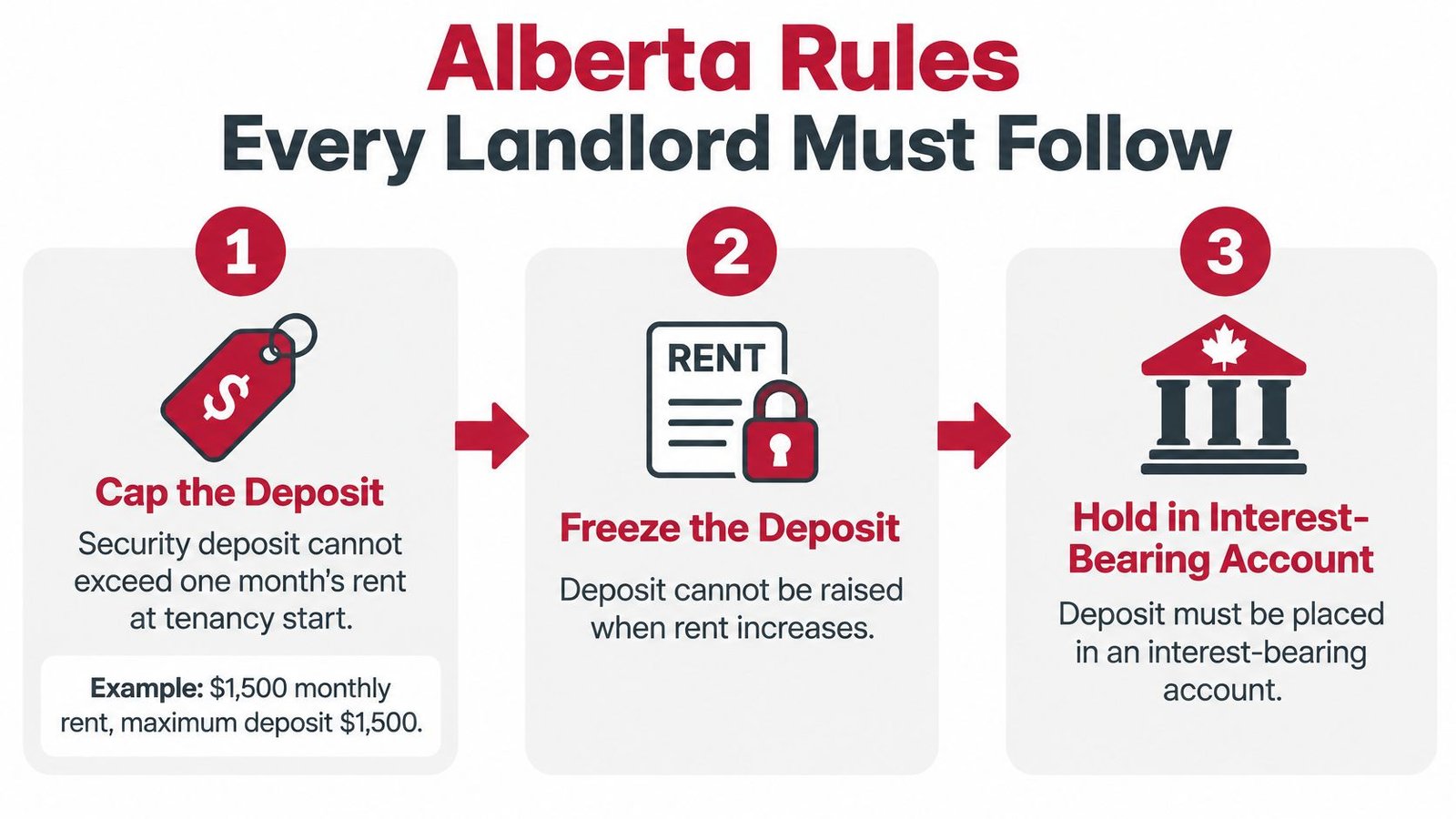
| Requirement | Alberta rule | What the manager does |
|---|---|---|
| Deposit amount | No more than one month's rent at tenancy start; not increased when rent rises | Check against the initial rent before collecting |
| Trust placement | Interest-bearing trust account within two banking days of collection | Record the collection date and placement date |
| Interest rate | The annual rate the province publishes for deposits held that year | Apply the published rate to the ledger |
| Inspection window | Move-in and move-out within one week before or after possession | Schedule both inspections against the possession dates |
| Permitted deductions | Unpaid rent, damage beyond normal wear, excessive cleaning | Attach invoices and photos to each deduction |
| Final release | Accounting tied to documented evidence | Second-person review before funds are released |
The Nine-Step Deposit and Inspection Workflow
- Collect the deposit at signing and receipt it separately from rent.
- Check the amount against the initial rent, not any future rent.
- Place the funds in trust at an Alberta bank, treasury branch, credit union or trust company.
- Record everything in the deposit ledger, including collection date, placement date, tenant, property and interest rate.
- Complete the move-in inspection with dated photos and room-by-room descriptions.
- Log tenancy events as they occur, including repairs, notices and payment issues.
- Complete the move-out inspection and compare condition directly against the move-in report.
- Require a second-person review of every proposed deduction and its supporting invoice.
- Issue the final accounting so the tenant sees exactly what was kept and why.
The critical detail is the clock. The two-banking-day deadline runs from the date the deposit is collected, not the lease signing date and not possession day. A ledger that captures both dates is the difference between proving compliance and asserting it. Owners who want the broader provincial framework can review the guide to Alberta landlord and tenancy rules before their next lease-up.
Every deduction needs the same evidence set: signed inspection reports, dated photographs, invoices and written notices. A deduction without that file is an opinion, and opinions lose disputes. Each lost dispute hands back money the owner already counted, which makes the paperwork itself a revenue line, not an administrative chore.
Balancing Tenant Retention With Rent Growth
A Calgary owner raises rent sharply on a two-bedroom townhome at renewal. The tenant, who has paid on time for two years, gives notice and takes a comparable unit nearby. The home then sits through cleaning, repainting and relisting, and a month of empty days erases what the increase would have earned over a full year.
The wider market rewards that caution. Statistics Canada reported Calgary's average asking rent for a two-bedroom apartment at $1,900 in Q1 2026, down 1.0% year over year, in its June 2026 Daily release on asking rents. Sitting tenants, meanwhile, are carrying heavier housing-cost burdens than they were earlier in the decade, so a renewal increase lands harder on them than the advertised rate implies.
Those two facts pull in opposite directions. A new applicant shops softer advertised rents while the tenant already in the unit faces real cost pressure. Owners who price renewals off listings alone misread both sides.
Three Distinctions That Prevent Bad Decisions
- Advertised rent versus paid rent: Listings show asking prices. What your tenant actually pays, and what the unit would fetch after a vacant month, are different numbers.
- Renewal pricing versus new-tenant pricing: A renewal skips turnover cost, so a slightly lower figure than a fresh listing still wins on net operating income.
- Temporary difficulty versus chronic non-payment: A tenant who flags a short setback early is a different risk from one who goes silent.
Rent tier changes the math. The City of Calgary reports vacancy of 6.7% in the highest rent quartile versus 4.4% in the lowest quartile in 2025, in its housing trends research. Pricier units sit empty longer, so at the top end a held renewal price usually beats an aggressive increase followed by a vacant month.
A Calm Escalation Path for Arrears
- Documented communication: Every conversation about payment goes into writing the same day.
- Written payment plan: Temporary hardship gets specific dates and amounts, signed by both sides.
- Lawful notices: Chronic arrears move to formal notices on the statutory timeline, without exceptions or informal threats.
- Clean inspection records: Condition documentation continues throughout, so a payment dispute never contaminates a deposit claim.
Keeping a reliable tenant at a fair rent is a cash-flow decision.
Retention is margin defence. It avoids vacancy days, cleaning, repairs, relisting work and a rent reset in a softening market, all of which hit net operating income before a single new cheque arrives. A slightly lower rent that holds a proven tenant for another year frequently outperforms a higher asking price that triggers a move-out. My rule of thumb: never let a renewal increase cost you a tenant you would re-sign today. Rent growth still matters, but it works best when it is gradual, explained early and weighed against the full cost of replacing the tenant it might push out.
How to Hire a Licensed Property Manager
Interviews with property managers often drift into vague promises about responsiveness and care. The table below keeps the conversation on evidence. Each criterion comes with the question that tests it and the answer that should end the discussion.
| Criterion | Question to ask | Red flag |
|---|---|---|
| Licence and credentials | Are the managers licensed, and under which credential? | Vague answers or no verifiable licence |
| Deposit handling | Where and when are deposits placed in trust? | Deposits held in general accounts |
| Inspection process | How are move-in and move-out inspections scheduled? | No written inspection timeline |
| Maintenance approval | What cost triggers owner approval? | No approval threshold stated |
| Owner reporting | Can I see a sample monthly statement? | No sample available |
| Vacancy tracking | How are inquiries and showings measured? | No tracking, only verbal updates |
| Tenant screening | Which checks are run on every applicant? | Screening skipped for speed |
| Fees and exit terms | What is the fee base and cancellation notice? | Fees unclear or exit penalties hidden |
| After-hours response | Who handles an emergency, and how fast? | No named emergency contact |
Dreamhouse Realty's property managers are licensed, and Dreamhouse Realty's compliance work includes accurate documentation and routine inspections of the property. Those are the kinds of verifiable answers the first three rows are designed to surface, from any provider.
For the deposit and inspection rows, the question isn't whether the provider knows the rules. It's how the provider proves each duty was met, with a ledger, dated photographs and a file the owner can inspect. Proof separates a system from a promise.
Three Practical Checks Before Signing
- Request samples first: A sample owner statement and a sample lease show reporting quality and lease drafting standards before any commitment.
- Test the after-hours claim: Ask who answers the phone at night, whether it's staff or a call centre, and how quickly a trade gets dispatched.
- Read the exit terms: The cancellation notice period and any exit fee determine how costly a wrong choice becomes.
Remote owners should add one more question: whether the provider offers a digital owner portal showing statements, inspection files and open work orders. Distance makes documentation the owner's only real window into the property.
Finally, ask for every answer in writing. Written answers let the owner compare providers on identical facts, and they become the baseline when service later falls short.
Confirm Your Management Plan Before You Sign
A signed agreement sets the terms for years, so the last step is matching the paperwork to the plan. Hire a brokerage for a transaction, management for ongoing operations, and both under one written agreement when the plan is to buy, lease and hold. Before signing, an owner should review the terms in a property management agreement and confirm the services, fee structure and responsibilities match what was discussed.
A Short Self-Check
Three questions settle most of the decision.
- Distance: Does the owner live within driving distance for showings, inspections and emergencies?
- Portfolio size: Is this one door or several, and does the record-keeping still fit in a spreadsheet?
- Next step: Is the immediate goal a sale, a purchase, or running rentals well for years?
An owner who lives nearby with a single door can often self-manage, at least until a second property or a new job changes the math. An out-of-province investor with several rentals pays for vacancy days and missed deadlines whether or not a management fee appears on a statement.
Dreamhouse Realty Ltd. is a licensed property management and real estate brokerage serving Calgary, Edmonton, Red Deer and surrounding Alberta communities. Its property managers are licensed, and the team works with local landlords and out-of-province investors across single-family homes, condos, townhomes and small multifamily buildings.
A free rental consultation and market analysis gives the owner a realistic rent figure and lease-up timeline before any commitment. To start, request a rental consultation through the Dreamhouse Realty Ltd. website. Bringing the property address, the current lease or rent roll and any open maintenance items makes the advice specific from the first conversation.
Dreamhouse Realty Ltd. provides licensed, full-service real estate management for Calgary and Alberta owners who want vacancy days, deposit deadlines and tenant retention handled as one financial-control system. Owners ready to compare their current setup against a structured alternative can visit Dreamhouse Realty Ltd. to review services for houses, condos, townhomes and small multifamily properties and request a rental consultation.