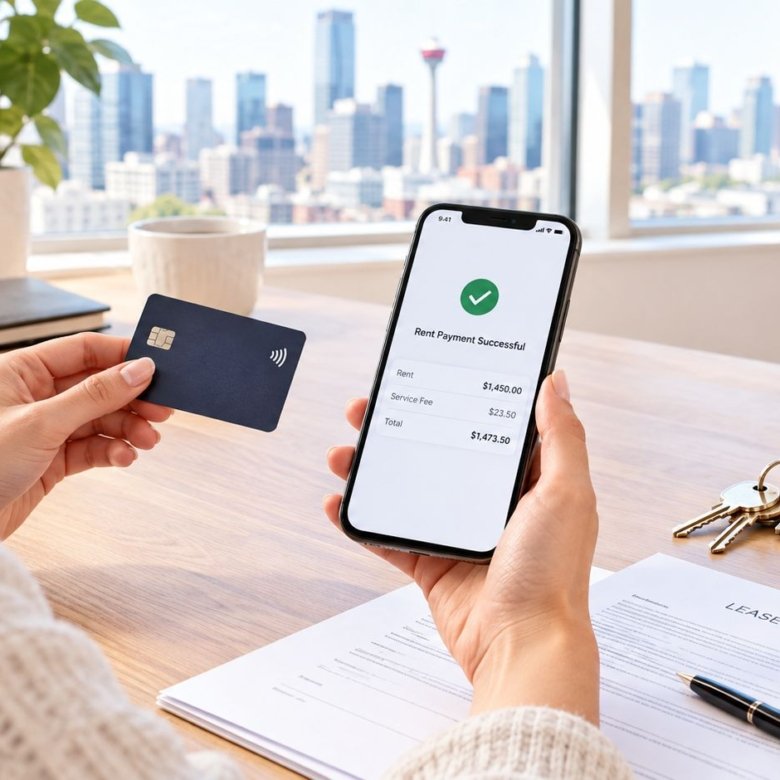

The rent is due in three days, and the tenant wants to put it on a credit card. The Calgary lease lists pre-authorized debit. The owner lives outside Alberta and wants cleared funds, not a pending authorization that might reverse next week.
Rent payment with credit card is a recurring cash-flow and reconciliation decision. The percentage repeats every month. Rewards only help if they beat that fee and the statement is paid in full. Owners still need a written rule for who pays, what the ledger shows, and what happens when settlement fails.
Table of Contents
- Rent Payment Options and Their Real Fees
- What Card Fees Cost on Calgary Rents
- How to Pay Rent by Credit Card Step by Step
- Card Rent Records, Controls and Failed Payments
- What Card Acceptance Costs the Landlord
- Decide Whether to Accept Card Rent
Rent Payment Options and Their Real Fees
| Payment route | Fee rate | Monthly fee on $2,000 rent | Annual fee |
|---|---|---|---|
| Third-party platform, card at 1.75% | 1.75% | $35 | $420 |
| Third-party platform, card at 2.99% | 2.99% | $59.80 | $717.60 |
| TenantPay, Visa credit card | 1.75% | $35 | $420 |
| TenantPay, Mastercard credit card | 2.75% | $55 | $660 |
| Landlord card surcharge at 2.4% ceiling | up to 2.4% | $48 | $576 |
| Pre-authorized debit or e-transfer | Usually none | Usually none | Usually none |
Canadian card rent became easier through third-party bill-payment platforms, but the Milesopedia cash-back rent guide puts the historical processing fee at 1.75% to 2.99%, before possible delivery charges. On $2,000 monthly rent, that range is $35 a month ($420 a year) or $59.80 a month ($717.60 a year).
NerdWallet Canada lists 1.75% for Canadian-issued Visa, Mastercard, or American Express through Chexy, 2.99% through Plastiq plus possible delivery fees, and TenantPay pricing of 1.75% for Visa credit cards and 2.75% for Mastercard credit cards. On $2,000, those TenantPay rates equal $35 and $55 before any extra charge.
Who pays changes with the route.
- Platform fee: The tenant pays the platform. The platform forwards rent by a supported delivery method, so the landlord doesn't have to accept cards directly.
- Absorbed fee: The owner can agree to cover processing. Net rent then drops by that amount.
- Surcharge: A landlord surcharge reaches the tenant only when it is disclosed before authorization. The 2.4% row, $48 a month on $2,000, is a ceiling, not a silent add-on.
- Bank methods: Pre-authorized debit and e-transfer usually carry no card fee, which is why they stay the default for routine collection.
Delivery charges sit on top of the percentage. A quote that shows only the card rate is incomplete.
A tenant earning 1% cash back receives $20 on that $2,000 payment, a net monthly loss of $15 at 1.75% or $39.80 at 2.99%. The card route makes sense only when rewards, a sign-up bonus, or a real liquidity need beat the fee, and only when the rent money is already available and the statement is paid in full. Interest wipes the reward quickly.
Practical rule: Choose the lowest-fee route unless the card's reward rate clearly exceeds the fee and the full balance will be paid on time.
What Card Fees Cost on Calgary Rents
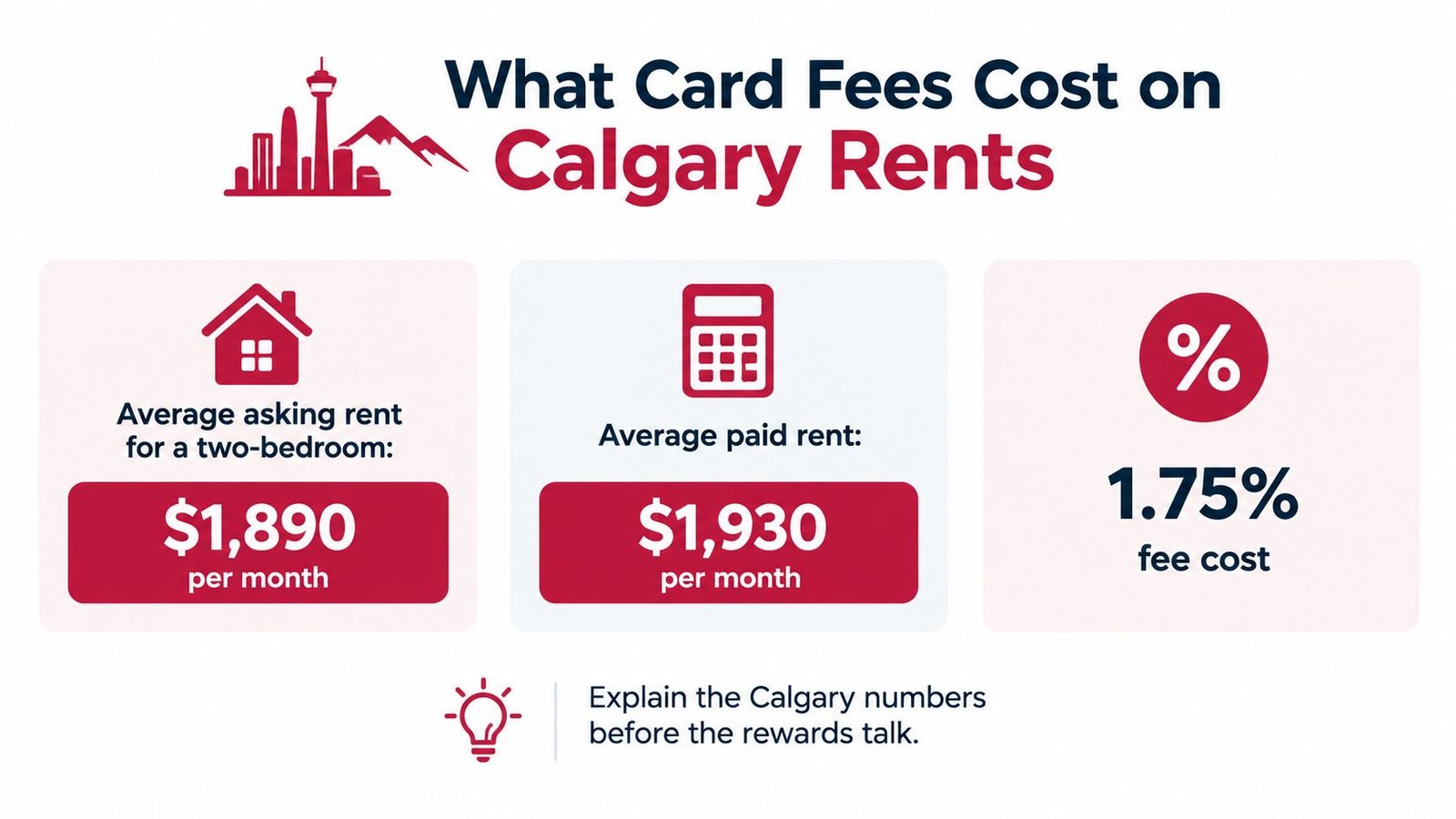
A card fee of a few percentage points can cost hundreds of dollars over a year. For a Calgary rent of $1,890, the difference between a 1.75% and a 2.75% fee is $18.90 each month, or $226.80 over a year.
TenantPay's Calgary rent-by-card breakdown, drawing on Statistics Canada, reports average two-bedroom asking rent of $1,890 and average paid rent of $1,930 in the second quarter of 2026.
| Calgary rent average | Fee rate | Monthly fee | Annual fee |
|---|---|---|---|
| Asking rent $1,890 | 1.75% | $33.08 | about $397 |
| Asking rent $1,890 | 2.75% | $51.98 | about $624 |
| Paid rent $1,930 | 1.75% | $33.78 | about $405 |
| Paid rent $1,930 | 2.75% | $53.08 | about $637 |
At 1.75%, the fee runs from $33.08 to $33.78 monthly, or roughly $397 to $405 annually. At 2.75%, it is $51.98 to $53.08 a month, or about $624 to $637 a year. These are recurring cash-flow costs, not a one-time charge.
Where a 2% reward actually lands
A 2% reward would return $37.80 on $1,890 or $38.60 on $1,930. At a 1.75% fee, the $1,890 payment leaves just $4.72 after the fee. At 2.75%, the fee exceeds that reward by about $14.18. A reward rate that looks attractive on its own can still leave the tenant paying more.
Before treating a surcharge as harmless, review credit card convenience fee rules. The fee should be disclosed before payment, and its label does not change the break-even calculation.
A card balance adds to existing non-mortgage debt, which a credit bureau may report. If interest accrues, it can quickly outweigh any reward.
Use this check: reward rate minus processing fee minus expected interest must stay above zero. If the result is negative, paying by bank debit costs less.
How to Pay Rent by Credit Card Step by Step
A clean rent payment with credit card leaves three things behind: a saved confirmation, a matched ledger, and a statement paid in full. Skip any one of them and the payment is still open.
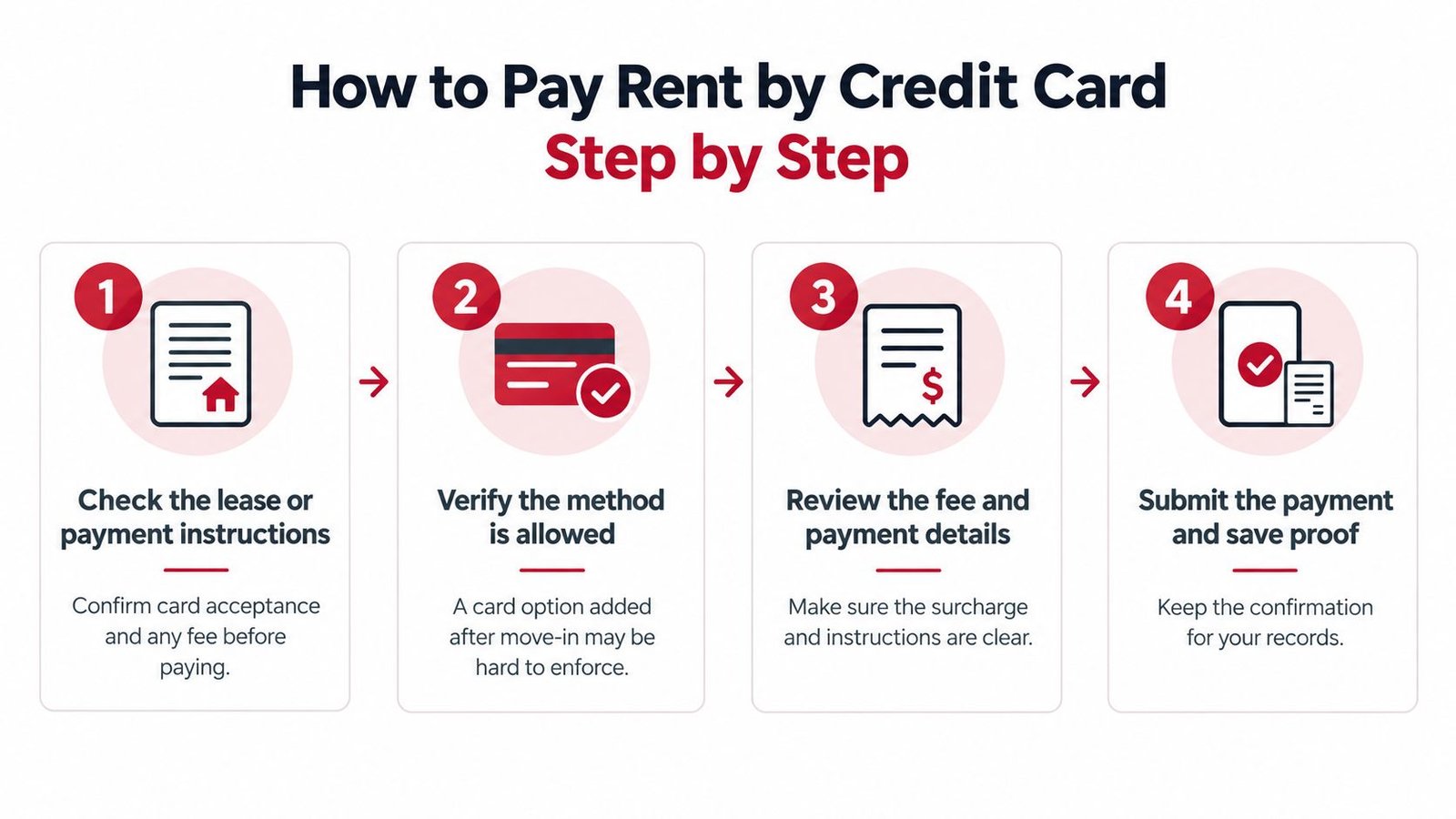
- Check the lease or the payment instructions for card acceptance and any fee. A card option that was never written down is hard to rely on later, especially if the manager changes.
- Confirm the rent is already in the chequing account that will cover the card statement. An authorization is not cleared funds, and rewards don't help if interest starts.
- Choose the platform and enter the rent amount, due date, and landlord details exactly as they appear on the lease. A mismatched payee is how a "paid" charge never reaches the right ledger. Portals that support online rent payment should show the same payee name the lease uses.
- Read the total with the fee before you authorize. If the fee is undisclosed or the amount changes on the last screen, cancel and ask for a non-card alternative. Moving a balance between cards to "cover" rent creates a second fee problem, which is why it helps to understand card-to-card payment fees and risks before you shuffle limits.
- Save the confirmation and the transaction ID, and take a screenshot. That file is your proof of payment if the portal and the landlord's books disagree.
- Check that the landlord or manager ledger shows the payment inside the timeframe the lease sets. "Submitted" on your phone isn't the same as "received" on the rent account.
- Pay the card statement in full by its due date. That's the only way the reward survives. A partial payment turns the fee into the start of a debt, not a points strategy.
A finished payment looks ordinary: confirmation saved, ledger matched, statement cleared. Anything short of that is still a collection problem.
Card Rent Records, Controls and Failed Payments
A card charge can show as approved while the rent ledger remains unpaid. Keep the payment terms, processor records, and tenant ledger aligned so a failed settlement or reversal is visible before the account falls further behind.
Alberta's guidance on starting a tenancy says the tenancy agreement should state the rent amount, where and when it is paid, and the required payment method. Put any card option and related payment instructions in the agreement or provide them in writing. Changing the method informally after move-in can create avoidable disputes.

Dreamhouse Realty Ltd. manages rental applications, leases, and tenant communication. Keeping the accepted method, disclosed fee, and payment-failure notices with the lease record makes it easier to track what was agreed and what happened.
What a lawful surcharge looks like
The Financial Consumer Agency of Canada's guidance on credit-card surcharges says surcharges are permitted outside Quebec, must not exceed the merchant's actual acceptance cost, and are subject to a 2.4% network cap. The surcharge must be disclosed before the transaction is processed.
On monthly rent of CAD 2,000, a 2.4% surcharge is CAD 48. If the actual processing cost is 1.9%, the ceiling is CAD 38, not $48. Charging an arbitrary add-on rather than tying the fee to the actual cost can lead to disputes.
A workable file records five things:
- Payment method: State that credit card is an available payment option.
- Surcharge: Show the amount or calculation and when it applies.
- Total before authorization: Present rent and fee together before the tenant pays.
- Alternative method: Let the tenant cancel before processing and choose another payment method.
- Receipt and reconciliation: Match settlements to the tenant ledger and retain processor statements.
Set up the payment flow so the fee appears before authorization. Then compare settlement reports with the ledger on a regular schedule.
When the card doesn't settle
CPLEA's renting guidance identifies credit cards as a possible rent payment method and advises tenants to keep proof of payment. The Residential Tenancies Act framework still requires rent in full when due. A card attempt or receipt does not establish that funds settled.
On a CAD 2,000 charge, a reversal can leave the ledger short by the full CAD 2,000, plus any bank or administrative costs. The surcharge is not the main exposure.
- Check the cardholder against the tenant named on the lease before the first charge.
- Track the full rent obligation against the contractual due date. A partial card payment does not change the amount owing.
- Keep processor records showing authorization, settlement, refunds, and chargebacks.
- Match settled funds to the tenant account and review failed transactions promptly.
- Request another payment method if settlement fails instead of waiting for the next statement cycle.
Keep payment-failure notices and follow-up in writing, and apply the agreed terms consistently. A rent payment ledger that separates rent, fees, and reversals helps show whether the tenant's balance matches the processor's settlement records.
What Card Acceptance Costs the Landlord
Interchange is a merchant-side cost that may or may not reach the owner, depending on the processing arrangement. The Canadian interchange schedule published by Fiserv lists residential rent as a category in its displayed Mastercard rates: 1.08% for electronic transactions and 1.38% for card-not-present transactions. On $1,500 rent, those rates equal $16.20 and $20.70, before processor margin, platform fees, or other assessments. Ask the processor which rate applies to portal and payment-link rent.
| Rate category | Rate | Cost on $1,500 rent |
|---|---|---|
| Residential rent, electronic | 1.08% | $16.20 |
| Residential rent, card-not-present | 1.38% | $20.70 |
| Visa Canada domestic consumer credit average (reference) | 1.40% | $21.00 |
Visa Canada's domestic consumer-credit interchange information gives an average of 1.40% under its voluntary commitment, or about $21 on $1,500. That is a reference rate, not the merchant's final cost. The merchant discount may also include transaction processing, terminal rental, customer service, and the processor's margin.
What the owner statement should show
Get the applicable residential-rent rate from the processor and confirm in writing whether the tenant or owner pays it. If the owner absorbs the cost, net income falls by roughly $16 to $21 a month on $1,500 rent, before processor margin. The agreement should state how that cost is handled.
Show three distinct amounts on the owner statement: gross rent, processing deduction, and net owner disbursement. Rental income is deposited directly into the owner's account, and Dreamhouse Realty provides detailed financial reporting. To validate gateway fees and deductions, match each deduction to a settlement ID rather than relying on a combined “rent received” total.
Keep the cost visible in the cash-flow record. Compare the processor's deductions with the agreed fee terms and the amount deposited, so a fee or adjustment does not disappear inside the rent total.
Decide Whether to Accept Card Rent
Accept card rent only when three conditions are already true. The tenant pays the fee, or the owner has agreed in writing to absorb it. The lease documents the method and any surcharge. The processor returns full settlement records.
Landlords should check three things before the first charge:
- Card is a choice, not a requirement. The tenant can still use a bank method.
- The fee is disclosed before authorization. The total on screen matches the lease.
- The ledger can match every settled amount, including reversals, to the right tenancy.
Tenants should check three things of their own. The reward value exceeds the fee. The full statement balance will be paid by its due date. The rent cash is already available, so the card isn't a loan.

Owners who want a manager to set the method, the fee language, and the ledger can book a rental evaluation at dreamhouse.rentals. Dreamhouse Realty Ltd. is a property management and brokerage serving Calgary, Edmonton, Red Deer, and surrounding Alberta communities. Service fees, commissions, and payment schedules are set out in each individual management or service agreement, including how card costs are shown to the owner. The property management agreement is where accepted payment methods and fee responsibility should be written before the first tenant pays.
Contact GURIQBAL CHAHAL, MBA, PMP, REAL ESTATE BROKER, Phone 403-966-6072, if you want the card option drafted into the lease and the owner statement before the next due date.
Dreamhouse Realty Ltd. handles rent collection, owner reporting, and Alberta lease documentation so card fees, reversals, and bank payments show up as separate lines instead of a mystery shortfall. If you own a rental in Calgary or another Alberta city and want that payment rule in writing, talk with GURIQBAL CHAHAL, MBA, PMP, REAL ESTATE BROKER, at 403-966-6072, or visit Dreamhouse Realty Ltd. to book a rental evaluation.