

Alberta residential management is commonly 8%–12% of rent collected, about $160–$240 a month on a $2,000 Calgary rent, and turnover plus repairs can push a nominal 8% contract toward an effective 12%–15% of gross rental income.
That spread is where a tidy proposal stops being the bill. Placement, a renewal, and a cut of a trade invoice can land in the same year as the monthly percentage. The useful comparison is the full schedule against the tenancy an owner expects, not the smallest number on the first page.
A detached house that is likely to turn over is a different purchase from a condo whose tenant stays. Remote owners in Calgary and nearby Alberta cities are paying for documented collection, showings, and tenancy paperwork, not only for a lower rate on a quote.
Table of Contents
- Alberta Fee Ranges at a Glance
- What the Monthly Percentage Usually Buys
- Fee Models and the Properties They Fit
- Worked Annual Costs for Calgary Rentals
- Matching the Fee to Calgary Market Risk
- How to Compare and Negotiate the Contract
- Review Your Fee Against a Real Calgary Rent
Alberta Fee Ranges at a Glance
In Alberta's residential rental market, recurring residential property management fees are commonly quoted at approximately 8%–12% of monthly rent collected, according to Alberta property management cost guidance. On a Calgary home at $2,000 a month, that band is about $160–$240 monthly, or $1,920–$2,880 a year, before leasing, renewal, inspection, maintenance, or administrative charges.
The same guidance puts a second layer on a new tenancy. Tenant-placement fees are commonly about $400–$700, while leasing-only work may run 50%–100% of one month's rent. Lease-renewal charges are frequently about $100–$500. Calgary quotes often widen the monthly band slightly and narrow the renewal band. Rank companies only after both proposals fill the same boxes.
| Fee layer | Usual range | On $2,000 monthly rent | When it is billed |
|---|---|---|---|
| Ongoing management, Alberta | 8%–12% of rent collected | $160–$240 per month | Every month rent is collected |
| Ongoing management, Calgary references | 7%–12% of collected rent | $140–$240 per month | Every month rent is collected |
| Tenant placement, flat guidance | About $400–$700 | $400–$700 per new tenancy | When a new tenant is placed |
| Tenant placement or leasing-only | 50%–100% of one month's rent | $1,000–$2,000 | At lease-up, or as the whole leasing-only fee |
| Lease renewal | About $100–$500; Calgary often $150–$300 | $150–$300 in many Calgary quotes | When an existing tenant renews |
| Maintenance markup | About 10%–20%, or none | 10%–20% of the vendor invoice, or $0 | Added to vendor invoices |
| Condominium-style management | About $30–$50 per unit per month | Not a percentage of $2,000 | Monthly flat per unit |
| Small multifamily, five or more units | About $75–$125 per unit per month, or a lower percentage | Custom per building | Monthly per unit or tiered percentage |
The advertised percentage is not the annual bill. A nominal 8% contract can produce an effective annual cost nearer 12%–15% of gross rental income in a year with tenant turnover and repairs.
What every proposal must answer
Treat the table as the checklist, not as a quote.
- Percentage basis: Collected rent or scheduled rent. Collected rent drops when the suite is empty or the tenant is far behind. Scheduled rent does not.
- Monthly minimum: A dollar floor can wipe out the vacancy discount an owner thought the percentage included.
- Leasing and renewal: A flat amount, a share of one month, or both stacked on the same event.
- Markup and inspections: A percent on trades, a fee per extra visit, or included in the monthly charge.
- Cancellation: Notice, and any fee if the owner sells or moves back in.
Two headline rates are not comparable until both agreements answer those points in writing. Turnover frequency changes the effective fee more than a one-point gap on the monthly line.
What the Monthly Percentage Usually Buys
Think of the monthly percentage as a grocery membership. It pays for the regular shop. Special orders sit on a separate slip.
For a typical Alberta house, condo, or townhome, the recurring fee is meant to buy rent collection, arrears follow-up, owner statements, day-to-day tenant communication, routine inspections, maintenance coordination, and orderly Residential Tenancies Act notices and records. Advertising a vacant unit, professional photos, showings, screening, lease drafting, and move-in paperwork are often a separate leasing or placement charge. Renewals, extra inspections, after-hours call-outs, tribunal preparation, and a markup on trades commonly sit outside the percentage as well.
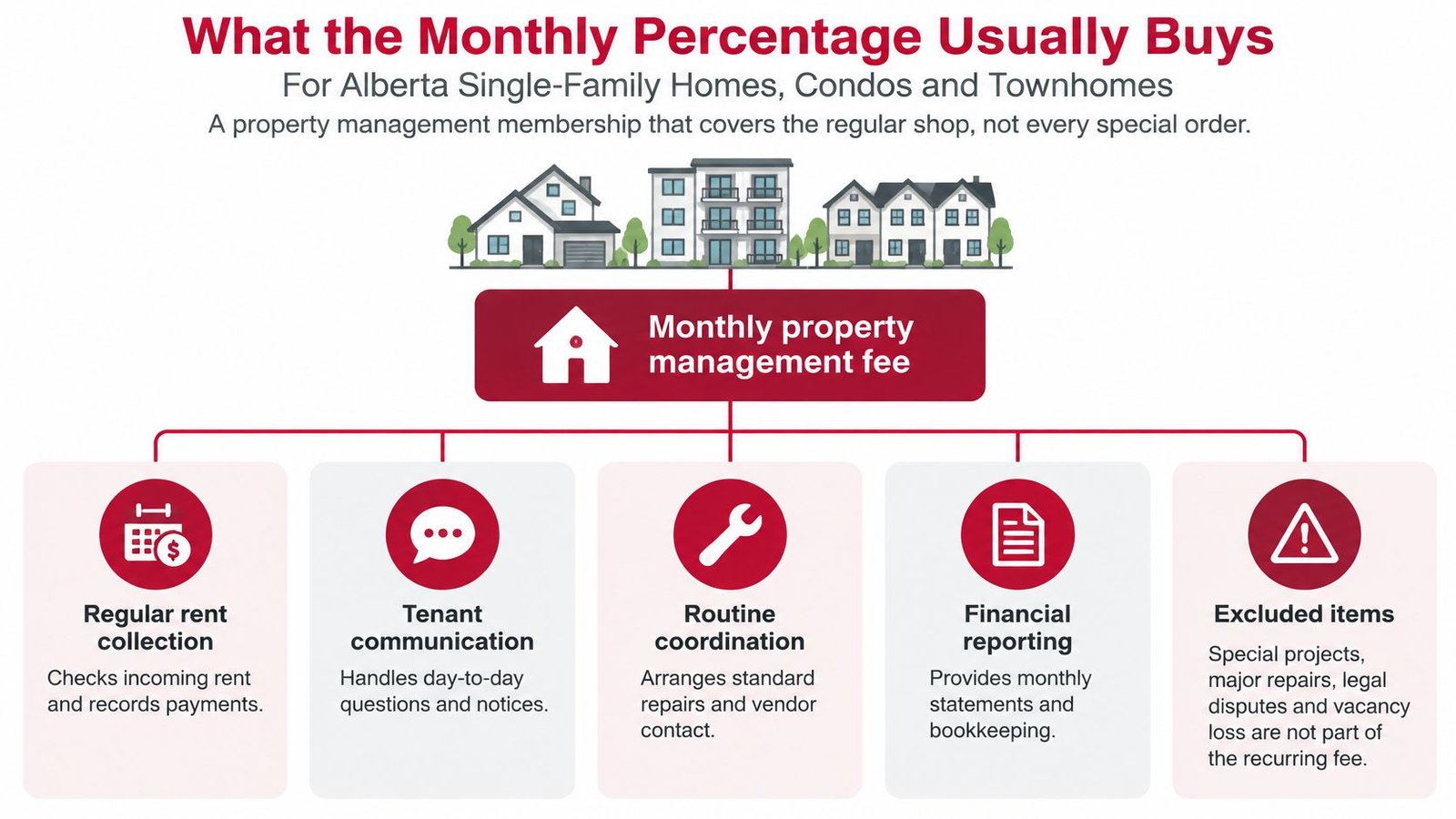
The monthly fee is payment for oversight while the tenancy runs, not a promise that turnover is free.
Collected rent versus scheduled rent
Alberta property management basics describe recurring fees as 8%–12% of monthly rent collected, rather than rent merely scheduled. At a $2,000 Calgary rent, that is about $160–$240 a month before leasing and repair charges. If the unit is vacant or the tenant is materially behind, a percentage of collected rent usually falls with the owner's income. A fee on scheduled rent, or a monthly minimum, does not.
Owners should compare effective cost as the management percentage times actual collected rent, plus fixed and event-based fees. At 95% collection of a $2,000 monthly rent, a 10% fee produces $2,280 a year, not $2,400. The same guidance prices condominium management on a flat basis of roughly $30–$50 per unit per month, which can make a percentage look expensive on a lower rent and reasonable on a higher-touch house.
Condo corporation fees, utilities, insurance, and the actual repair invoices remain the owner's costs even when the manager coordinates the work. A markup, where the schedule has one, is a fee. The plumber's invoice is not.
| Work item | Usually inside the monthly percentage | Often billed separately | Owner still pays the underlying cost |
|---|---|---|---|
| Rent collection, arrears follow-up, and owner statements | Yes | No | No |
| Day-to-day tenant communication | Yes | No | No |
| Routine inspections and condition reports | Often yes | Extra or move-out inspections sometimes | No |
| Maintenance coordination and work orders | Yes | After-hours response sometimes | Yes, the vendor invoice |
| RTA notices and record-keeping | Usually yes | Tribunal or dispute administration sometimes | Any filing costs |
| Photos, advertising, showings, and screening | Rarely | Leasing or placement fee | Advertising if not included |
| New lease preparation and move-in | Rarely | Placement or leasing fee | No |
| Lease renewal and rent review | Sometimes | Renewal fee of about $100–$500 | No |
| Vendor invoices | No | Markup of about 10%–20% on some schedules | Yes |
Ask for the include-and-exclude list
Before two percentages are lined up, the owner needs that split in writing. A lower rate that excludes inspections, renewals, and after-hours calls is not the cheaper contract. It is an incomplete one.
Owners of a plex should also see how suite-level work is staffed. The Axis Meter Solutions multifamily operations guide is a useful contrast for buildings where accounting and vendor contact are shared across many doors, which is a different workload from one Calgary house. For a single dwelling, the practical map of daily tasks sits in this note on what a property manager does. Match the fee to that list, not to the percentage alone.
Fee Models and the Properties They Fit
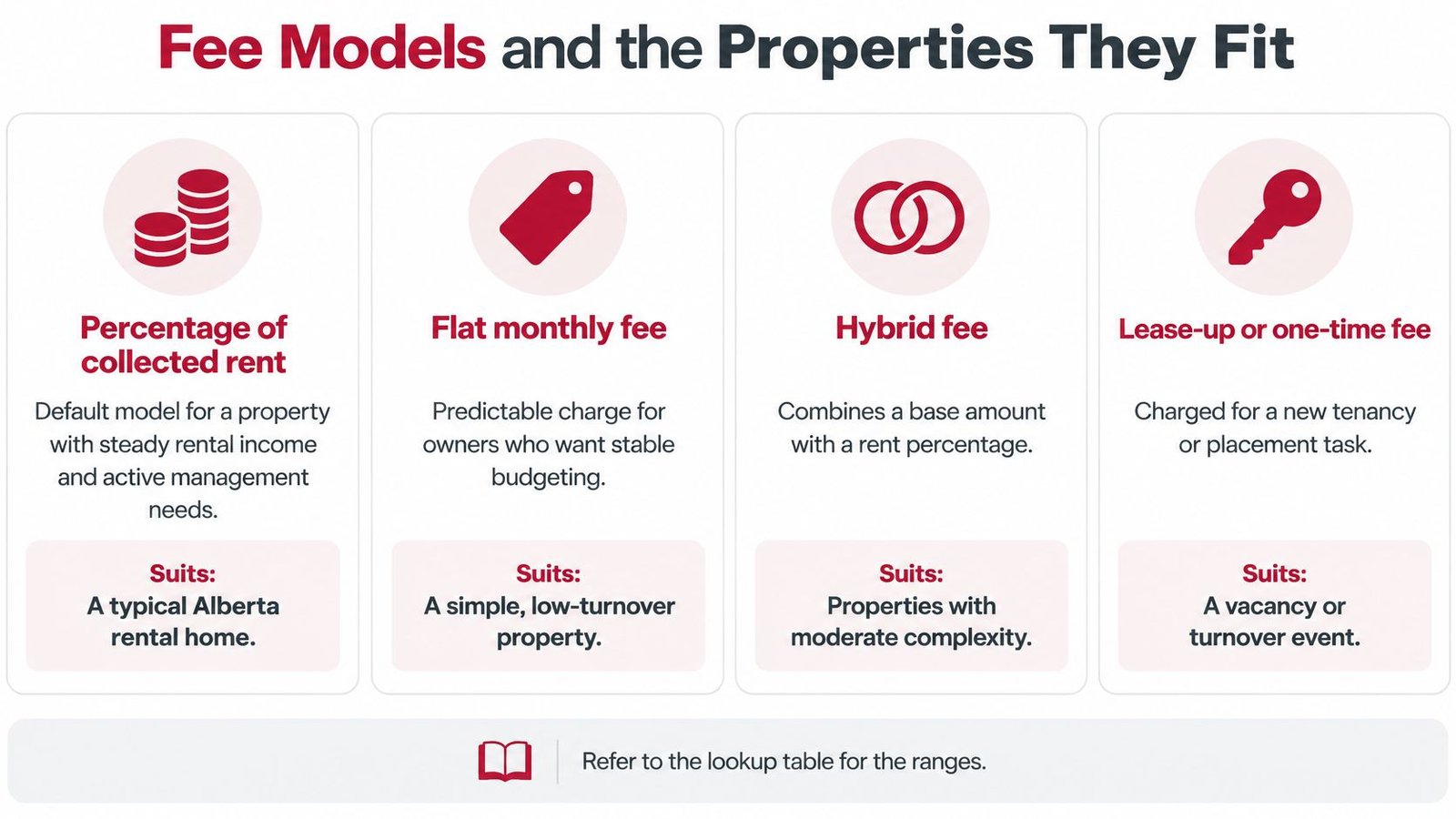
Calgary cost references put ongoing residential management at about 7%–12% of collected rent, tenant placement at 50%–100% of one month's rent, and renewals often around $150–$300, as described in Calgary property management cost notes. On $2,000 monthly rent, that management range works out to $140–$240, or $1,680–$2,880 over a full year before one-time charges. The right model depends on the property's workload and vacancy risk, not just the advertised rate.
Percentage of collected rent
For a Calgary house or townhome, percentage pricing ties the monthly fee to rent collected. It can suit a single property where leasing and maintenance work rise and fall with rental income. Vacancy matters: if the agreement charges a percentage only on collected rent, the management fee falls during an empty month, while leasing costs may still apply.
Flat monthly fee
A flat fee gives the owner a predictable charge, which can suit a condo or a straightforward rental suite. The trade-off is that the fee may continue during vacancy. Against percentage pricing, compare the annual flat charge with the expected rent and the work included, especially if the property needs frequent vendor coordination.
Per-unit or tiered pricing
Per-unit and tiered fees can fit a plex or apartment building where similar suites share accounting, showings, and vendor coordination. Some schedules reduce the percentage as the number of units grows. That structure is less suited to a lone house, where there are no other units to share the work.
Leasing as an event charge
A placement fee is charged when a manager finds a tenant, whether or not that manager also handles ongoing operations. At $2,000 monthly rent, the commission-style range above means a one-time charge of $1,000–$2,000. It has the greatest effect in a turnover year and may be absent when a tenant stays.
Maintenance markups
Some agreements add a markup to trade invoices; others charge none. Check how the agreement treats vendor costs alongside the management fee. A markup can outweigh a small difference in monthly percentages when repairs are frequent, while it has less effect on a property with few maintenance jobs.
Renewal, inspection, and after-hours fees
Renewal charges, additional inspections, and after-hours call-outs can change the annual cost even when the monthly rate looks competitive. These fees matter most when a tenancy lasts long enough to renew or when the property needs extra attention. Compare their triggers and amounts in the agreement.
The advertised percentage is not the annual bill. Add leasing, renewals, inspections, and any maintenance markups to see what the agreement may cost for your property.
A slightly higher all-in rate can cost less than a lower headline percentage with separate charges. Owners with one or two rentals can use this guide to property management for small landlords to identify which service model fits their properties. For another overview of the typical costs of hiring property managers, compare the fee structure as well as the rate.
Worked Annual Costs for Calgary Rentals
These three cases use the same $2,000 scheduled rent where the home is a house, so turnover is the swing factor. They are illustrations built from published Alberta ranges, not a quote. Each agreement sets its own schedule.
| Scenario | Add-on fees |
|---|---|
| Stable detached or townhome | 10% of rent collected for 12 full months is $2,400. A $200 renewal is the only add-on. No placement fee. Management-related cost is $2,600, about 10.8% of $24,000 gross rent. The owner still pays a $3,000 repair invoice with no markup. |
| Same home, one turnover | Two vacant months, so collected rent is $20,000. 8% of collected rent is $1,600. Placement at 75% of one month is $1,500. A 15% markup on $4,000 of repairs adds $600. Fee stack is $3,700, about 15.4% of the $24,000 that was scheduled. |
| Condo at $1,600, tenant stays | $40 flat per month and no placement. Management is $480 for the year. |
| Same condo, tenant leaves | The $480 flat fee plus a $1,200 placement. Turnover, not the monthly line, sets the year. |
Why the 8% year costs more
Case A, the stable house. Twelve full months at 10% is $2,400. Add a $200 renewal. There is no placement fee. Repairs of $3,000 carry no markup, and the owner still pays that invoice. Management-related cost is $2,600, about 10.8% of $24,000 gross rent. The percentage and the effective rate nearly match because nothing expensive happened.
Case B, one turnover. Two vacant months leave $20,000 collected. Eight percent of that is only $1,600, which looks like a win until the rest of the file is added. Placement at 75% of one month is $1,500. A 15% markup on $4,000 of repairs adds $600. The fee stack is $3,700, about 15.4% of the $24,000 that was scheduled, even though the headline rate was 8%. The cheaper percentage lost to the events around it.
Case C, the condo. At $1,600 rent and a $40 flat monthly fee, management is $480 if the tenant stays. If the tenant leaves and placement is $1,200, that one event can exceed what a percentage would have cost on a low rent. If the tenant stays, the flat fee looks inexpensive next to a house-style percentage on a higher rent.
What to compare instead
Line up proposals on expected collected rent plus placement, renewal, and markup for the turnover that is likely. A remote owner should also count time saved on calls, showings, and invoice checks, without turning that into a score of one company against another. The arithmetic above is a test of the schedule, not a promise of next year's bill.
Matching the Fee to Calgary Market Risk
Calgary's overall rental vacancy rate reached 5.1% in 2025, up from 4.6% in 2024. Vacancy was 6.7% in the highest-rent quartile and 4.4% in the lowest, according to the City of Calgary housing trends. The City also reported year-over-year rent changes ranging from a 9.6% decline for multi-residential units to a 16.5% increase for detached homes. Townhouses and duplexes were up 1.0%.
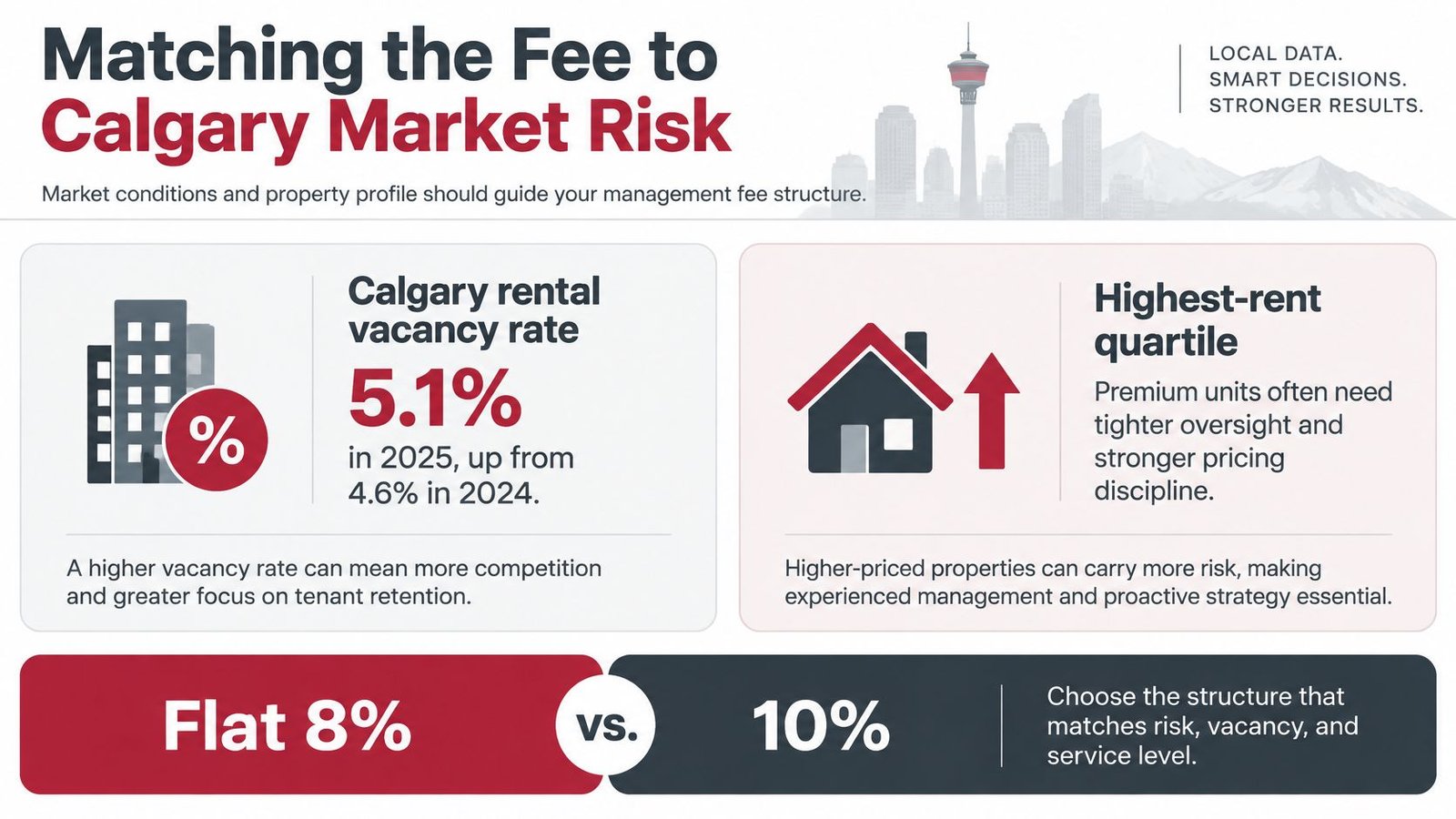
The advertised management percentage is not the annual bill.
Property type and vacancy exposure shape the total cost. A lower monthly rate can cost more if leasing, turnover, or maintenance charges sit outside the agreement.
Detached homes
For a detached home in a softer rental pocket, effective pricing, professional photos, showings, and tenant selection can help reduce vacancy. A leasing charge plus a percentage of collected rent may fit when the agreement clearly defines those services and fees. The City's reported 16.5% rent increase for detached homes is a market-wide change, not a forecast for any individual property. Set rent based on local competition and the cost of leaving the home vacant.
Condominiums
A condo's fee should reflect both ongoing management and the less frequent cost of finding a new tenant. If the tenant stays, a flat monthly charge may cost less than a percentage of rent. If the tenant leaves, a separate placement fee can outweigh those monthly savings. Check whether the agreement also covers coordination with the condo corporation.
Townhouses, duplexes, and the high-rent quartile
Townhouses and duplexes saw a 1.0% year-over-year rent increase, while vacancy in the highest-rent quartile was 6.7%. Setting rent at the top of the market can raise both the potential fee base and the risk of a longer vacancy. Compare the likely collected rent with the cost of time empty before choosing a rent target. Multi-residential units had a different pattern, with rents down 9.6% year over year, so a house-style percentage may not suit every building.
Remote owners
For owners managing a Calgary-area rental from another city, the fee also buys local handling of tenant and property issues. Dreamhouse Realty's licensed property managers handle day-to-day work including rent collection, maintenance coordination, inspections, and tenant communication. Compare the agreement's fee with the responsibilities it assigns to the manager and owner.
A simple fit test
- Expect turnover: Include the placement charge when comparing annual costs.
- Expect a long tenancy: Check whether renewals and rent reviews are included or charged separately.
- Own several similar suites: Compare per-unit pricing with percentage-based fees across the whole property.
Match the agreement to the property's rent, likely vacancy, and expected turnover. A slightly higher all-inclusive percentage can cost less than a lower headline rate once extra charges are counted.
How to Compare and Negotiate the Contract
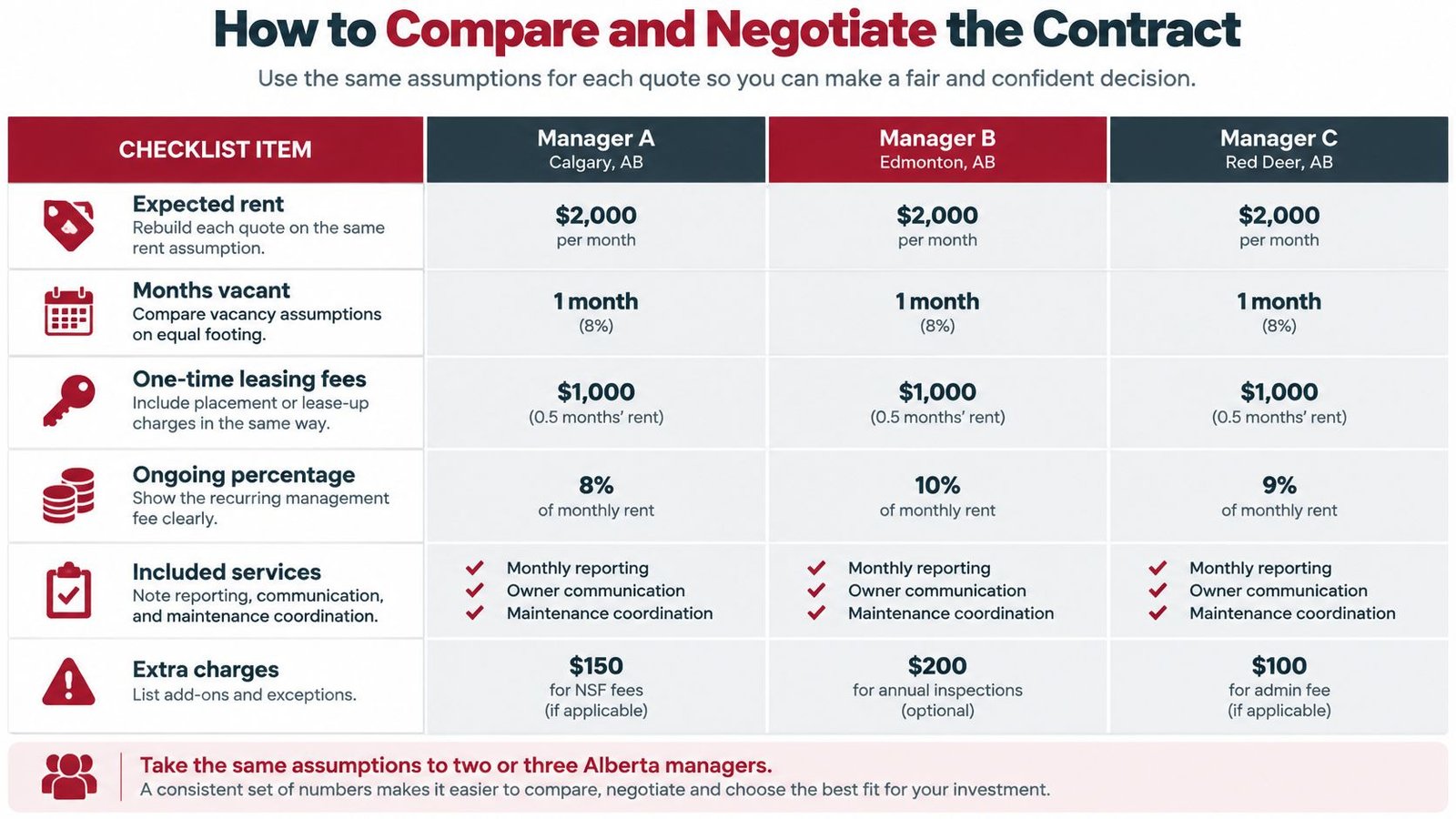
Take two or three Alberta proposals and rebuild each one on the same assumptions. Use the same expected rent, the same months vacant, one turnover or none, the same repair spend, and the same yes or no on a renewal. Then score value past the percentage. Look at days vacant, renewal rate, arrears, approval limits on repairs, inspection photos, and compliance errors.
CMHC reported that Calgary's average same-sample rent for two-bedroom purpose-built units increased 6.7% in 2025, after 3.8% the year before, in the CMHC rental market report for major centres. The report tied part of that movement to the gap between rents paid by existing tenants and rents from new tenants. That is a prompt for the renewal conversation, not a promise that the next suite will move by the same amount.
What to ask about renewals
A manager has to separate an initial market rent, a renewal recommendation, and Alberta rules on rent increases. Ask whether rent reviews and renewal talks sit inside the monthly fee or cost extra, in the range often quoted around $150–$300. Ask how often local comps are checked, and how a lawful increase is timed and documented so it doesn't become an avoidable vacancy. The work is the comp check, the notice, the tenant conversation, and the file, not a slogan about maximising rent.
Negotiate in this order
- Percentage on collected rent, with any minimum stated in dollars.
- Placement and renewal as fixed dollars or a share of one month, not both on the same event.
- Maintenance markup at zero or a capped percent, with an owner approval threshold before work proceeds.
- Inspections, after-hours calls, advertising, and tribunal help listed as included or priced.
- Cancellation notice, and any fee if the owner sells or moves back in.
- Monthly statements that separate rent, fees, and invoices so the year can be checked.
A cheaper headline rate with a 15%–20% markup loses to a clear all-in percentage when repairs are likely. Insurance, reserve funds, and vendor choice stay owner decisions. The contract should not blur them. Read the property management agreement against that list before anyone signs. Service fees and payment timing belong in that document, not in the advertisement.
Review Your Fee Against a Real Calgary Rent
Pick the scenario closest to the property. House, condo, townhome, or plex. Write down expected monthly rent, likely vacancy, and whether the tenant is expected to renew. Then ask for the complete fee schedule before signing.
Total the monthly percentage, placement, renewal, markup, and inspection charges for that scenario. Compare the result with expected collected rent. One transparent percentage is meant to cover day-to-day management. Dreamhouse Realty Ltd. prices that way. A single percentage covers day-to-day property management. Exact fees, commissions, and payment timing still belong in the individual management agreement, so read that document rather than the headline.
Dreamhouse Realty Ltd. manages residential rentals for Alberta owners, including single homes and small multi-unit buildings, and including owners who live out of province. The free landlord consultation shows how a property compares with competing rentals, which is the right starting point for a fee talk. Bring the current agreement or a competing quote. Contact GURIQBAL CHAHAL, MBA, PMP, REAL ESTATE BROKER, Phone 403-966-6072.
Dreamhouse Realty Ltd. manages Calgary and Alberta rentals with licensed managers, clear day-to-day fees, and a consultation that tests a quote against a real local rent. Owners of a house, condo, townhome, or small plex can bring a current agreement or a competing proposal and see the full-year cost before they sign. Visit Dreamhouse Realty Ltd. to book that review.