

Real estate market analysis is a structured local read of supply, demand, prices, construction and rents for a defined place and time period. For an Alberta landlord, its job is to estimate achievable rent, likely vacancy and cash flow for one property, rather than rely on one citywide average.
That distinction matters in Calgary, Edmonton, Red Deer and smaller Alberta cities. A headline can describe a whole city while a landlord owns one condo, townhouse or detached home on one street, competing with a specific set of listings and carrying a specific set of costs.
Table of Contents
- What Market Analysis Answers for an Alberta Landlord
- Where Calgary and Alberta Numbers Come From
- How to Build Comparable Sales and Rents
- Neighbourhood Drivers That Split Identical Properties
- Vacancy Absorption and the Rent You Can Count On
- Why a Balanced Resale Market Is Not a Rental Verdict
- Alberta Rules That Change the Income Forecast
- Check Your Calgary Rent Against the Local Evidence
What Market Analysis Answers for an Alberta Landlord
A property-type split can change the story behind Calgary's headline numbers. Real estate market analysis is a structured assessment of supply, demand, prices, sales activity, construction, affordability and rental conditions for a defined area and time period. It replaces a broad label such as “hot” or “cold” with figures a landlord can test against one property.
For a rental owner, the questions are practical: What rent might tenants pay for this type of home in this neighbourhood? How long could it take to find a tenant, how much vacancy should the budget allow, and does the property still perform after expenses? Those answers depend on the property and the period being examined.
The province is not the property
A provincial weather forecast can warn of rain across Alberta, but it cannot predict whether one street will flood. Market analysis has the same limitation, so the first split is asset class.
The City of Calgary housing research shows that annual sale prices in 2025, compared with 2019, increased by 30.2% for apartments, 54.2% for row and townhouse properties, 57.8% for semi-detached homes and 52.3% for detached homes. A condo owner and a detached-home landlord therefore face different price patterns, even within the same city.
Calgary sale-price change by property type, 2019 to 2025
| Property type | Sale price change, 2025 vs 2019 | Who should not use a citywide average |
|---|---|---|
| Apartments | 30.2% | Condo and apartment landlords |
| Row and townhouse | 54.2% | Townhouse investors |
| Semi-detached | 57.8% | Side-by-side and duplex-style owners |
| Detached | 52.3% | Single-family landlords |
Suppose a landlord prices a one-bedroom apartment using a blended city gain influenced by semi-detached homes. The expected property value, rent and refinance assumptions may all be too high. Comparing like with like helps prevent that mistake before the figures enter a spreadsheet.
What the other inputs add
Affordability measures how much of a household's income goes toward rent or a mortgage. For a landlord, it helps indicate how many prospective tenants can manage a particular rent. A price that fits only a narrow group may take longer to lease and be harder to renew.
Construction is another supply clue. New homes can add competition for tenants, so a landlord should consider upcoming and recently completed supply alongside existing rental options. The effect depends on which homes are being built and whether they compete with the property in question.
Practical rule: Name the property type, neighbourhood and time period before quoting any number. Without those labels, a figure cannot show whether it applies to the home being assessed.
A useful analysis connects these inputs to the property's rent, vacancy and expenses. Citywide averages provide context; they do not decide whether one apartment, townhouse or detached rental will meet its owner's financial expectations.
Where Calgary and Alberta Numbers Come From
Sources aren't interchangeable. Each one answers a different landlord question, and each one misleads when it's used for the wrong job.
City of Calgary housing research and its quarterly housing review cover local sales, inventory, months of supply and longer price trends. That's the right place to see whether the resale market is tightening or loosening. It's the wrong place to set rent on one basement suite, because a city sales report doesn't know that suite's condition, parking or walk to transit.
CMHC rental market reports cover purpose-built rental supply, vacancy and rent conditions in major centres. That's the right place to see whether new apartment buildings will compete with an existing rental. It's still a broad lens, so it can't replace a neighbourhood-level look at one property type.
What listings and lease files add
Current rental and resale listings show what a tenant can choose this month, including incentives a published average will hide. Free parking, a month of free rent or included utilities all affect the actual price. Tools that organise location-based listing data, such as RealtyAPI.io location search for Realtor.ca, can help a landlord sort competing properties by area before judging them one by one. One asking rent still isn't a closed comparable, because a landlord can ask for any number.
A landlord's own lease file holds what no public report contains, including contractual rent, the last increase date and whether the tenancy is fixed-term or periodic. Without it, an analysis can mistake theoretical market rent for rent that's collectable right now.
Canadian sources and the question each one answers
| Source | Best question it answers | Do not use it to |
|---|---|---|
| City of Calgary housing research and quarterly review | How sales, prices and resale supply moved | Set the rent on one suite |
| CMHC rental market report | Purpose-built supply, vacancy and rent direction | Ignore property type or neighbourhood |
| Current rental and resale listings | What a tenant can choose this month | Treat one asking rent as a closed comp |
| Owner lease file | Contract rent, last increase and tenancy type | Assume market rent is collectable now |
For Edmonton, Red Deer and smaller Alberta cities, the same stack applies at the local scale rather than borrowing a Calgary average. Comparing returns across those cities only works when each market is read on its own evidence, as a comparison of rental returns in Calgary, Edmonton and Red Deer illustrates. Out-of-province owners are especially exposed when they price from a national headline, because they can't see the competing building opening two blocks away.
Every number that follows should be traceable to a source, a date and a property type. If a figure can't meet that test, it belongs in a conversation, not in a pro forma.
How to Build Comparable Sales and Rents
Comparable properties, or comps, are recent rentals or sales similar enough to the subject property that tenants and buyers would consider them substitutes. Building a comp set is a matching exercise first and a pricing exercise second.
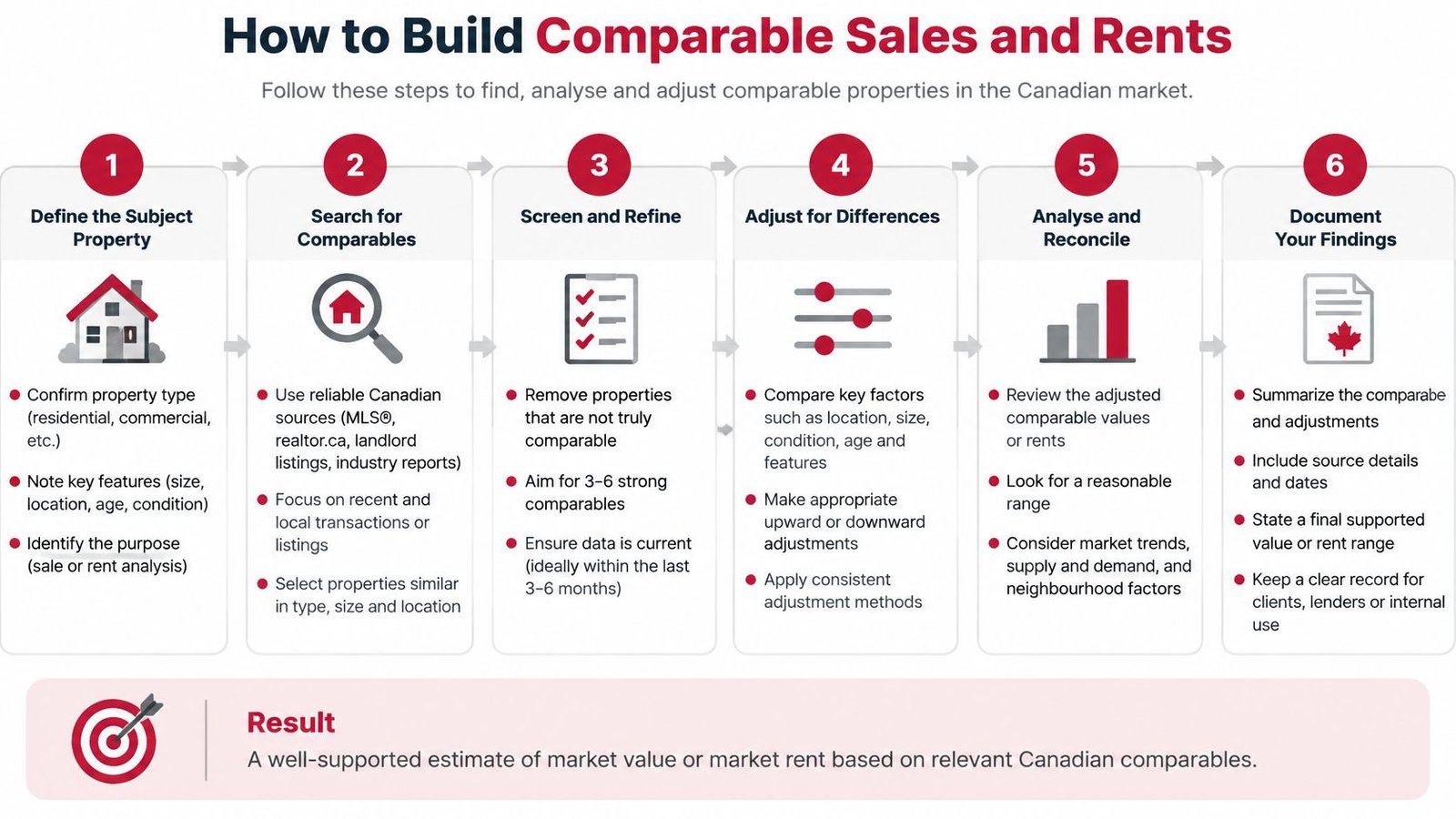
A seven-step method for one property
- Lock the subject: Record property type, bedrooms, condition, parking, laundry, whether utilities are included or excluded, and the neighbourhood. Don't widen the search to the whole city to find a better-looking number.
- Pull recent rent comps: Use the same property type within a tight area, and note whether each figure is an asking rent or a leased rent. Asking rents show hope, while leased rents show what tenants agreed to pay.
- Adjust in dollars: Price the differences tenants pay for, such as a second bathroom, in-suite laundry, a garage, a newer kitchen, included heat or a shorter walk to transit. Write each adjustment as a dollar amount, not a vague premium.
- Drop outliers: Remove renovated showpieces and distressed units unless the subject matches them. Keeping them flatters or punishes the estimate for no real reason.
- Read the cluster: Set a range for achievable rent from where the adjusted comps group together, not from the highest listing. A range is honest about uncertainty, and it gives the landlord room to price for speed or patience.
- Repeat for a purchase: If the decision involves buying, match sold prices the same way so the purchase price and the rent come from the same asset class. A detached purchase price tested against condo rents produces nonsense.
- Write the lease-up assumption: Count how many competing listings a renter sees and estimate how many weeks a realistic asking rent should take to lease. That timeline belongs in the cash-flow model beside the rent itself.
A quick worked sketch
Think of a fitting room. A shopper doesn't judge a jacket by the most expensive coat on the rack, and a landlord shouldn't price a home by the priciest listing on the screen.
Say the subject is a three-bedroom detached home in an inner suburb. Its comps are other detached homes nearby with similar parking and yard space. A one-bedroom condo near new purpose-built towers belongs to a different comp set entirely, because its tenants compare it with new buildings offering gyms, parcel rooms and move-in incentives.
A good comp set fits on one short list, ends in a rent range, and notes what would change that range.
That last note matters more than landlords expect. If the range depends on a renovated kitchen the subject doesn't have, or on utilities the subject doesn't include, the range should move before the property is advertised. Clear assumptions turn pricing from a guess into a decision that can be revisited.
Neighbourhood Drivers That Split Identical Properties
Two houses with the same bedroom count can lease at different rents and sit empty for different lengths of time. Neighbourhood drivers explain most of that gap, and they should be scored beside the comps rather than guessed at later.
Start with a map of the immediate area and mark five things. The exercise takes minutes and often changes the rent range.
- Purpose-built completions nearby: New towers within a short walk or drive pull tenants before a city average moves.
- Transit access: Walking distance to a C-Train station or frequent bus route matters heavily to tenants without cars.
- Employment nodes: Hospitals, post-secondary campuses, downtown offices and industrial parks produce steady, long-stay demand.
- School catchments: Family renters choose houses and townhouses around schools they want, which supports longer tenancies.
- Carrying costs beside rent: Condo fees, parking availability and snow-clearing responsibilities change what a tenant can afford overall, a trade-off visible when weighing condos against houses as rentals.
Score each driver as supportive, neutral or negative for the subject property. A home with three negative drivers shouldn't borrow the rent of a comp with three supportive ones, even on the same street.
Finish by naming the one driver most likely to change during the lease term, such as a new building opening nearby or a zoning change. That single risk should shape the vacancy case the landlord models next, because local change reaches one property long before it reaches a citywide rate.
Vacancy Absorption and the Rent You Can Count On
Vacancy and absorption get confused often, so a hotel analogy helps. Occupancy is beds filled tonight. Absorption is how fast new rooms get filled after a tower opens. A landlord needs both, because strong occupancy today can still weaken if new supply arrives faster than tenants do.
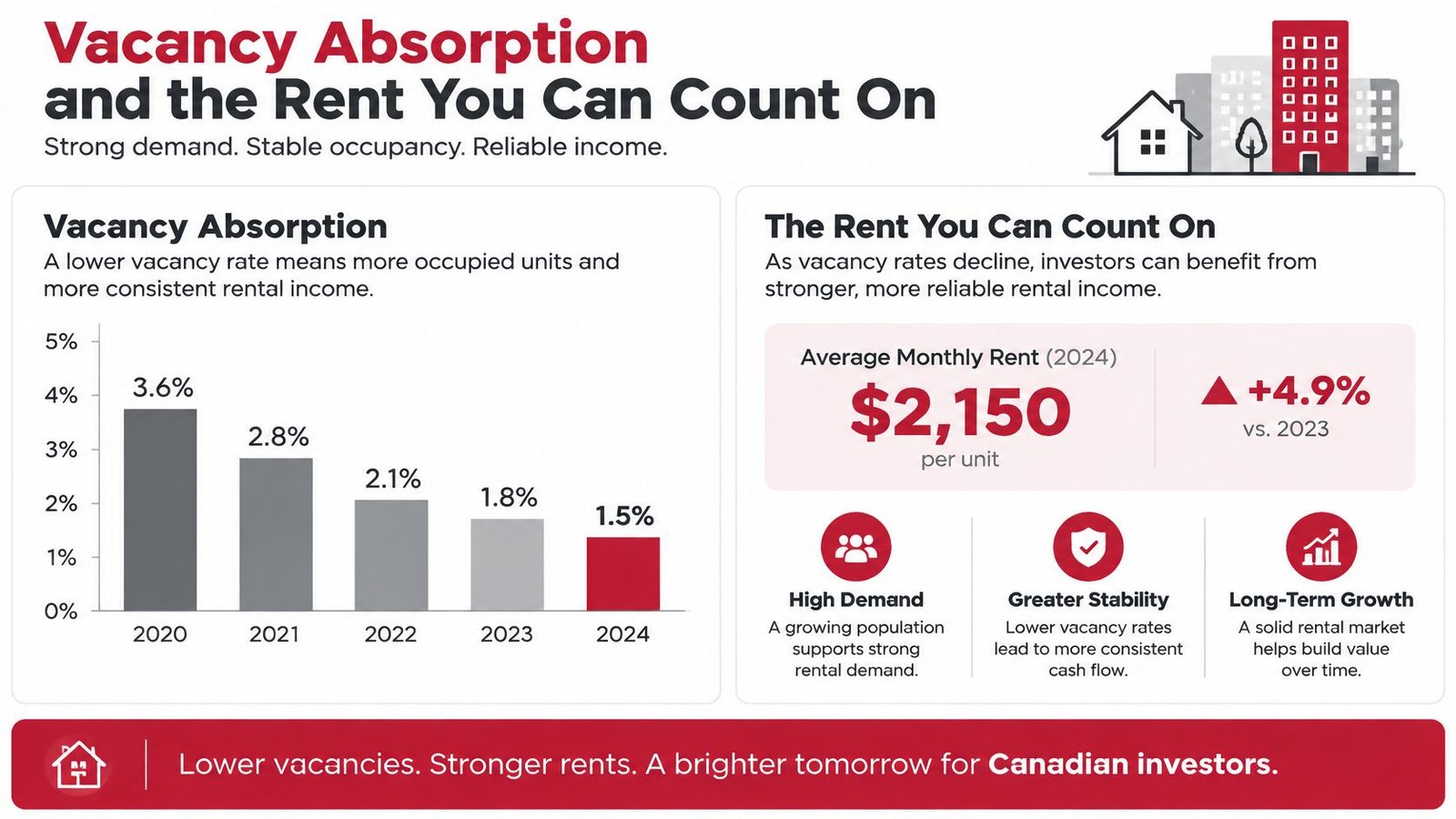
Calgary is living that tension now. The CMHC rental market reports for major centres reported that Calgary's purpose-built rental supply grew by 11% in 2025, described as the fastest growth in decades, while the average vacancy rate for purpose-built rentals remained 5%. City of Calgary housing data recorded a broader market vacancy rate of 4.6% in 2024, rising to 5.1% in 2025, with CMHC projections indicating rates of 5.7% in 2026, 6.2% in 2027 and 5.9% in 2028.
Calgary vacancy path landlords should test
| Year | Vacancy figure | What it describes |
|---|---|---|
| 2024 | 4.6% | Broader Calgary market vacancy |
| 2025 | 5.1% | Broader market vacancy; purpose-built average also 5% after 11% supply growth |
| 2026 | 5.7% | CMHC projection |
| 2027 | 6.2% | CMHC projection |
| 2028 | 5.9% | CMHC projection |
Turning a percentage into lost rent
The math is simple and worth doing in the open. A property expected to earn $2,000 per month produces $24,000 in scheduled annual rent at full occupancy, but a 5.1% vacancy assumption reduces effective gross rent to approximately $22,776 before operating expenses. That's a gap of about $1,224 a year, gone before property tax, insurance or a single repair bill arrives.
A second case deserves the same honesty. Several extra vacant weeks at turnover can hurt more than a small change in asking rent, because an empty home earns nothing while still carrying a mortgage, utilities and insurance. Pricing slightly lower to lease sooner often beats holding out for a higher figure and losing a month.
Modelling habit: Test at least the current vacancy rate and a higher one. A budget built on 100% occupancy isn't a forecast, it's a best case.
Absorption belongs next to new completions near the property, not just in a city report. A landlord competes with the building opening down the road before those units move any published average. Comparing the subject's lease-up timeline with the pace of nearby completions tells the owner whether a vacancy allowance needs to grow.
Presenting rent comparisons, vacancy scenarios, competing listings and lease-up timelines together gives a defensible income figure. Quoting a single asking rent, by contrast, hides exactly the risks that determine whether the year ends in profit.
Why a Balanced Resale Market Is Not a Rental Verdict
A balanced resale market describes how homes are selling. It does not show whether a particular rental can cover its costs or deliver an acceptable return.
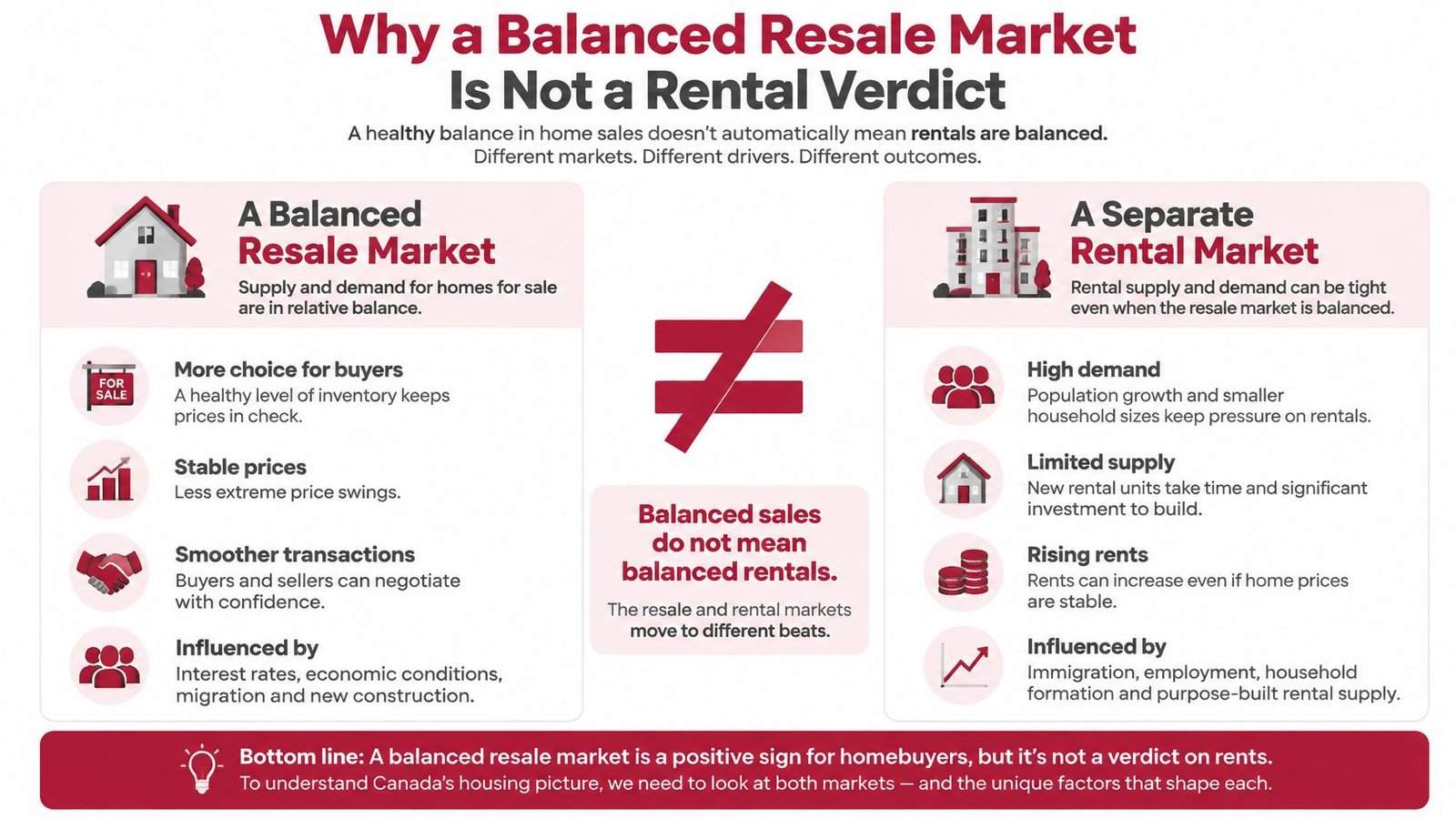
The City of Calgary Q1 2026 housing review showed sales down 13% year over year, inventory up 13%, and months of supply at 3.2, while the sales-to-new-listings ratio remained near 52%. These figures suggest buyers have more choice in a resale market closer to balance. They do not determine whether a detached home, condo, townhome, or small multifamily property will earn enough rental income to justify its risks.
Rental conditions are splitting by type
Rental results can differ sharply between property types. Demand and achievable rent for detached homes may move differently from those for smaller multi-residential or other units. A citywide headline can therefore hide weaker performance in the category an investor is considering. Buying into that category based on strength elsewhere is like using a neighbour's budget to judge whether your own mortgage fits.
New purpose-built rentals also affect the competition a landlord faces. As more units become available, tenants have additional options, and older or less competitive rentals may take longer to lease. Average rents can still rise if newer, higher-priced units influence the average. That does not mean every property can command more or lease quickly.
A sound purchase test puts the price beside the costs and risks a resale headline leaves out:
- Property-specific rent: Use comparable rentals in the same asset class, not a citywide average.
- A vacancy case: Account for current conditions and a more difficult leasing scenario, rather than assuming full occupancy.
- Financing and carrying costs: Use the mortgage payment, property tax, and insurance figures for the property.
- Maintenance and capital repairs: Include routine upkeep and reserves for items such as roofs, furnaces, and appliances.
- Management and regulatory duties: Allow for leasing, inspections, notices, and record-keeping under Alberta rules.
Then test the downside. Consider a 5% to 10% rent reduction, several additional vacant weeks, and one major repair. If the property only works when rent stays high, it leases immediately, and nothing breaks, the expected return is fragile.
Neighbourhood conditions help explain why two homes with the same bedroom count can perform differently. Nearby purpose-built supply, transit, schools, employment nodes, condo fees, parking, and appeal to long-stay tenants can all shape a property's prospects. The decision comes down to this: Will this specific property still cash-flow if Calgary's market normalizes?
Alberta Rules That Change the Income Forecast
Market rent and collectable rent are different numbers in Alberta. An analysis that treats them as identical will overstate near-term income, sometimes by a full year.
The Alberta guidance on common landlord and tenant problems states that rent cannot be increased until at least 365 days have passed since the beginning of the tenancy or since the last rent increase, whichever is later, and rent cannot be increased during a fixed-term tenancy. For periodic tenancies, the landlord must provide written notice containing the date, effective date and landlord's signature.
Notice periods a forecast must respect
- Week-to-week tenancy: 12 full tenancy weeks of written notice.
- Month-to-month tenancy: Three full tenancy months of written notice.
- Other periodic tenancies: 90 days of written notice.
A comparable-rent survey may show a unit could command more at turnover, but that figure can't be applied to a sitting tenant tomorrow. A sound forecast names the tenancy type, the last increase date, the earliest lawful effective date, the required notice period and the probability of turnover. Landlords working through those mechanics can review the broader framework in a guide to Alberta landlord and tenancy rules, and the Dreamhouse Realty Ltd. team understands the city's rental market and Alberta's Residential Tenancies Act.
The security deposit is a separate pot
The Alberta Residential Tenancies Act handbook limits a security deposit to no more than one month's rent at the beginning of the tenancy, and the deposit cannot be increased later merely because rent increases. If first-month rent is set at $2,000, the maximum deposit at the start of that tenancy is $2,000.
Landlords must place collected deposits in an interest-bearing trust account in an Alberta bank, treasury branch, credit union or trust company within two banking days of collection. The deposit may be applied to unpaid rent or other permitted tenant obligations, but it cannot be used to charge for normal wear and tear.
That handling has modelling consequences. Gross rent, effective rent after vacancy and the deposit should sit in separate lines, with time budgeted for move-in condition reports, deductions and deposit statements. It's also why the opening rent matters twice, since it sets both first-year income and the deposit ceiling.
Ignoring the 365-day rule or the deposit cap produces a pro forma that looks tidy and performs badly. This is educational context, not legal advice for a specific notice, so landlords facing a disputed increase or deduction should get advice on their own facts.
Check Your Calgary Rent Against the Local Evidence
A landlord can test a rent or purchase price with five clear lines. Start with the property, then check the income and downside assumptions.
- Asset type: Record the exact property class and neighbourhood, rather than relying on a citywide figure.
- Rent range from comparable properties: Adjust for features tenants pay for, and keep asking rents separate from leased rents.
- Vacancy case: Model income below full occupancy and test a higher-vacancy scenario.
- Earliest lawful rent change: Check the tenancy type and timing rules under Alberta's Residential Tenancies Act.
- One downside: Put a cost on extra vacant weeks, a rent reduction or a major repair.
If these lines support the asking rent or purchase price, the analysis has done its job. If not, consider repricing, waiting for turnover or walking away from the purchase. Each option follows from the property's numbers, not a prediction about the market.
A local comparison can help put the assumptions in context. Dreamhouse Realty Ltd. offers landlords a free landlord consultation that shows how a property compares with competing rentals. The consultation covers rental demand, market trends and pricing in Calgary and surrounding areas. Owners can also ask about property management for leasing and day-to-day care.
The review can be requested through the Dreamhouse Realty Ltd. website at dreamhouse.rentals. Published market figures are general education, not legal, tax or investment advice for a specific property. Services are subject to separate agreements.
Before setting a rent or signing a purchase, book a free landlord consultation to compare the property with competing Calgary rentals and discuss rental demand, market trends and pricing. Visit Dreamhouse Realty Ltd. to request the local review, and ask about property management if you want leasing and day-to-day care handled after the analysis.