

A vacant Edmonton rental can turn into a full-time problem quickly. A landlord may be waiting for inquiries, answering messages between work commitments, arranging showings, checking applications, and trying to complete the right paperwork before the next tenant moves in. If the owner lives outside Edmonton, even a routine repair or inspection can require a long trip and careful coordination.
Edmonton also isn't a market where one citywide rent figure answers every pricing question. Purpose-built apartments, condominium rentals, larger homes, and different neighbourhoods can experience different levels of demand. A sound property management plan therefore needs local market review, organised leasing, accurate records, and a clear understanding of Alberta tenancy requirements.
Table of Contents
- Introduction to Property Management in Edmonton for Busy Landlords
- What Full Service Property Management Actually Includes
- How the Edmonton Rental Market Shapes Your Strategy
- Alberta Tenancy Rules Every Edmonton Landlord Must Follow
- Self Managing Versus Hiring a Property Manager in Edmonton
- How Dreamhouse Realty Solves Common Edmonton Landlord Pain Points
- Next Steps to Secure Reliable Property Management in Edmonton
Introduction to Property Management in Edmonton for Busy Landlords
A landlord with one condominium may expect a quick listing and an easy move-in. Then an applicant asks about parking, another needs a different possession date, and an inspection reveals a repair. Each decision affects the next one, so leasing works more like an operations schedule than a single advertisement.
Edmonton's vacancy swings make that schedule more important. Purpose-built apartment vacancy moved from 4.3% in 2022 to 2.4% in 2023, then increased to 3.1% in 2024 and 3.8% in 2025, according to CMHC rental-market reporting. That change can affect how an owner sets rent, prepares the listing, plans showings, and decides whether to renew or turn over a unit. A tighter market may support firmer pricing, while rising vacancy can make presentation, response time, and realistic pricing more important.
Unit type also matters. A condominium, apartment, or larger home may attract different tenants and follow a different leasing pace. Pricing should therefore reflect the property's condition, features, neighbourhood, and current competition rather than relying on one citywide figure.
A property manager works like an operations hub. Leasing, screening, lease execution, inspections, rent collection, maintenance, and reporting stay connected in one record. Missing an inspection can weaken move-out documentation. Delaying a repair can affect tenant satisfaction and renewal decisions.
Alberta tenancy deadlines add another layer. Notices, inspections, records, and maintenance tasks must be handled on time and documented clearly. This guide explains how those requirements shape daily management, compares self-management with professional support, and outlines how to assess a management company.
The practical test is whether an owner can act consistently, promptly, and with complete documentation while protecting occupancy and the property.
What Full Service Property Management Actually Includes
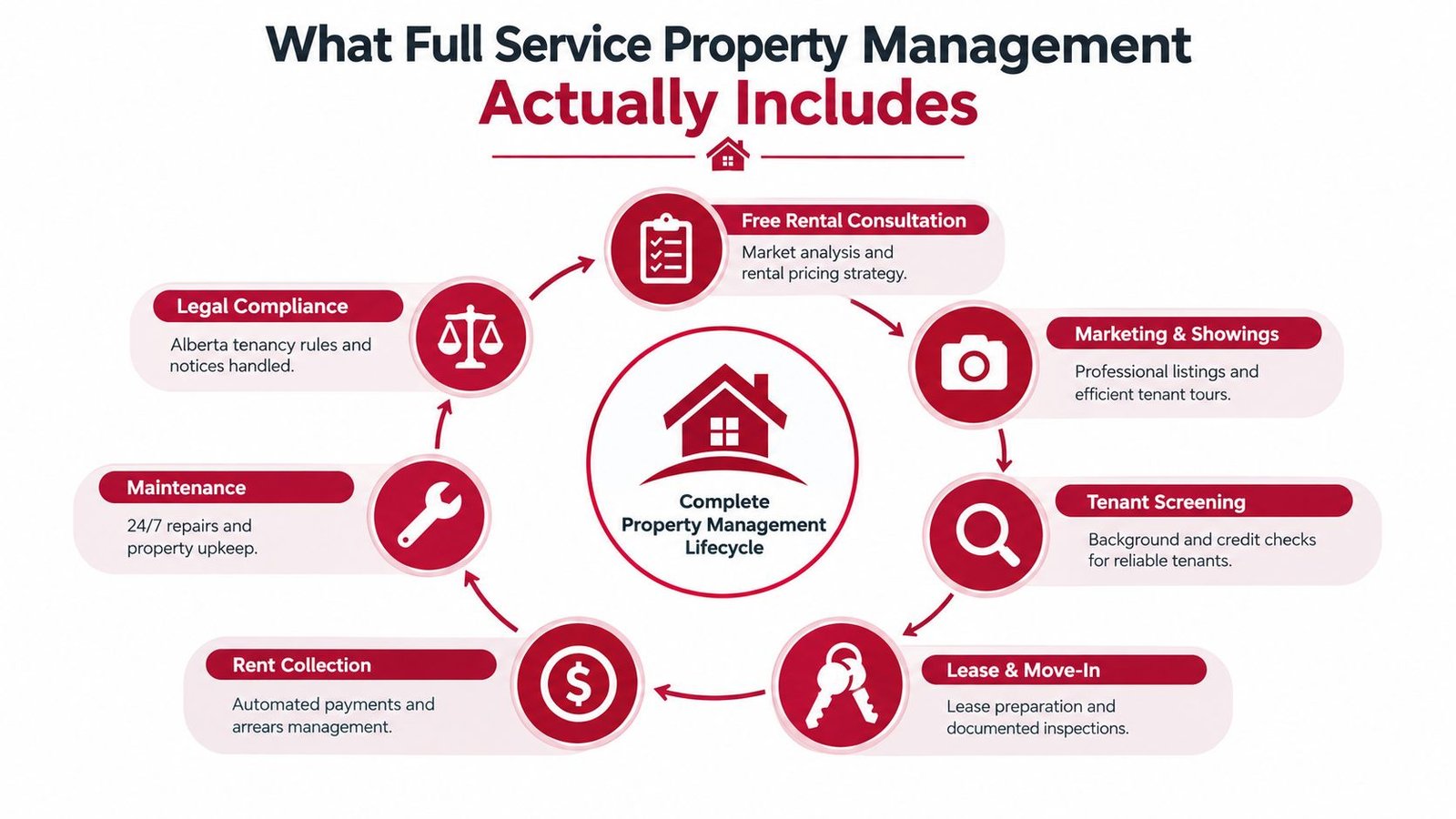
A landlord may start the morning with an empty unit, a tenant repair request, and an applicant waiting for an answer. Full-service property management connects those tasks into one operating process, from pricing and marketing to tenant placement, inspections, repairs, renewals, and move-out.
Leasing begins with property-specific preparation
A rental consultation and market review should examine the building type, layout, condition, parking, amenities, and neighbourhood. Those details help set a price that fits the unit rather than copying a broad city average. A condominium, apartment, and larger home can attract different renters and move at different speeds, especially as Edmonton vacancy conditions change.
The manager prepares accurate advertising, suitable photographs, and clear copy across relevant channels. Showings involve answering questions, arranging access, recording feedback, and updating the listing when needed. Quick replies matter because a qualified applicant may contact several properties at once.
Screening and lease execution establish the record
Screening may include credit information, income verification, references, and rental history. The aim is a consistent, documented review of whether an applicant appears able to meet the lease obligations, not a promise that any tenant will be risk-free.
After approval, the manager prepares and executes the lease, coordinates deposits and payments, and schedules the move-in inspection. The file should contain signed documents, condition reports, photographs, notices, and relevant correspondence. These records work like a timeline. If a question arises later, the owner can see what happened and when.
Owners seeking a broader risk review can also learn how to protect rental properties as part of their asset-protection planning.
Daily operations continue after possession
Rent collection, arrears follow-up, and owner disbursements need a dependable schedule. Statements should show income and expenses clearly, so an owner does not have to rebuild the account history from separate emails.
Maintenance coordination links a tenant report to vendor scheduling, work-order tracking, approval limits, and completion records. Tenant communication continues through routine access, repair updates, questions, and renewal discussions. Those renewal decisions should account for the unit's condition, leasing demand, and the time required to prepare a turnover.
Portals can keep documents, updates, and statements in one place. For a practical explanation of what a property manager does, review the duties across the full rental cycle.
Practical rule: A management system is only as strong as its records. Every important decision should leave a clear trail.
Full-service value comes from continuity. One operational file follows the property from marketing through move-out, helping the landlord coordinate deadlines, maintenance, communication, and turnover without personally connecting every loose end.
How the Edmonton Rental Market Shapes Your Strategy
An Edmonton landlord can price a two-bedroom apartment correctly for the city and still miss the local market. A purpose-built rental and a condominium apartment may share a neighbourhood, yet compete on different features, tenant expectations, and rents. Strategy starts with the property segment and neighbourhood, not one metro-wide average.
Vacancy changes the leasing playbook
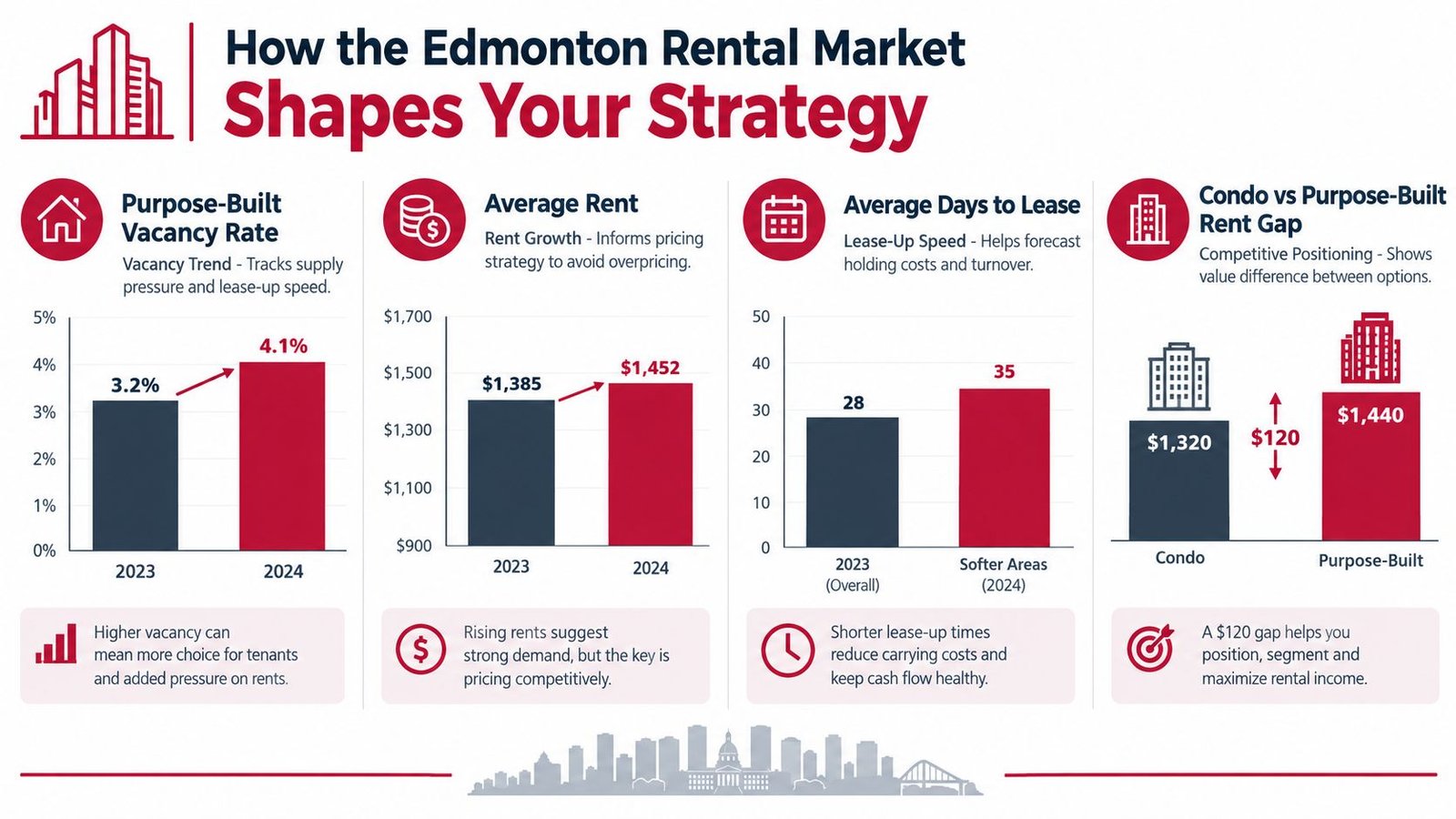
Purpose-built vacancy moved from 4.3% in 2022 to 2.4% in 2023, then rose to 3.1% in 2024 and 3.8% in 2025, according to CMHC data (CMHC rental-market data). A tight segment may support firmer pricing and fewer incentives. A softer segment calls for stronger listing photos, prompt replies, accurate screening, and closer attention to days on market.
CMHC projected Edmonton vacancy at 4.5% in 2026, compared with 3.8% in 2025, as reported in coverage of its outlook (Edmonton rental outlook coverage). That remains a projection. Another tracker reported 2.7% vacancy across 4,088 active listings in more than 80 neighbourhoods in September 2026 (Real IQ Edmonton market data).
These figures are not interchangeable. Before changing rent, a manager should check the source, unit type, building, neighbourhood, and nearby listings. A citywide number can hide a building where comparable homes lease quickly and another where listings remain available.
Unit type affects achievable rent
In 2024, CMHC reported an average purpose-built two-bedroom rent of $1,603, with annual growth of 3.5%. Condominium apartments recorded 1.7% vacancy and an average two-bedroom rent of $1,655 in the same reporting.
Those amounts are reference points, not automatic prices for every home. The comparison should include finishes, parking, utilities, building services, pet rules, and the quality of competing listings. A stronger property may justify a modest premium. A higher asking rent without a clear advantage usually extends vacancy.
Turnover and renewals influence income
CMHC reported a 28.1% turnover rate for purpose-built units in 2023. It also reported turnover rent changes of 6.6% for two-bedroom units, compared with 5.0% for non-turnover two-bedroom units (Edmonton rental-market reporting).
The practical choice is a calculation, not an automatic rent increase. Turnover brings cleaning, repairs, advertising, showings, screening, and possible vacancy. In a softer segment, a reasonable renewal may protect income better than a sharp increase followed by an empty unit. Larger homes may attract demand differently from smaller units, so pricing, renewal terms, and turnover timing should follow the specific property and its competing listings.
Alberta Tenancy Rules Every Edmonton Landlord Must Follow
A tenant moves in, a repair request arrives, and an owner discovers that one missing document can make a simple disagreement harder to resolve. Alberta compliance works better as a calendar than as a legal document left in a drawer. Use templates, reminders, signatures, photographs, and dated records so each step can be checked later.
Build the move-in file correctly
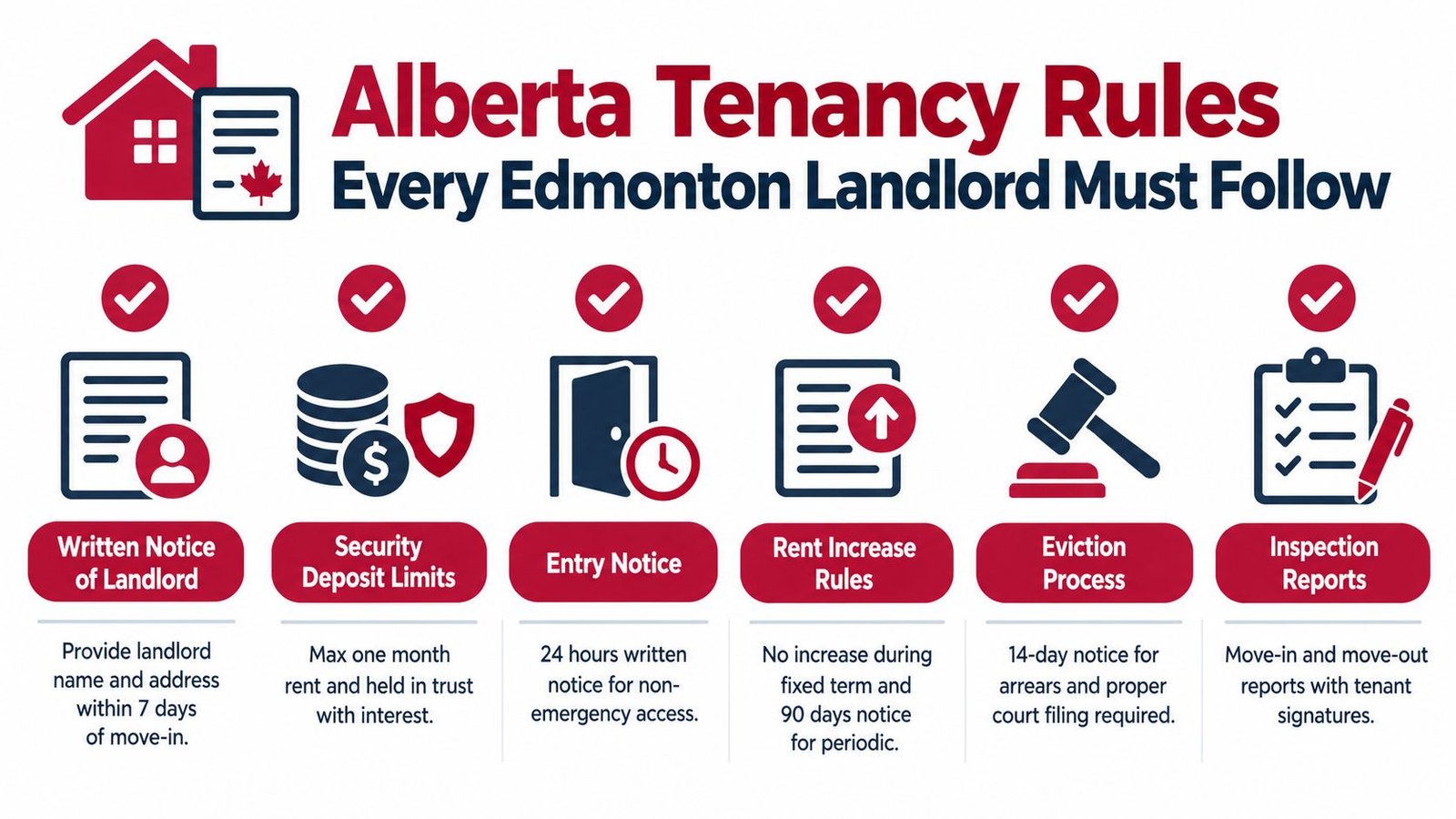
Alberta requires written notice of the landlord within 7 days of move-in. Move-in and move-out inspection reports must be completed within one week before or after possession changes. The premises should be vacant during those inspections unless both parties agree otherwise, as explained in the Alberta tenancy handbook.
A practical move-in file should contain:
- Landlord information: Provide the required written details within the prescribed timeframe.
- Inspection report: Record rooms, fixtures, appliances, walls, floors, and exterior areas.
- Photo evidence: Date and organise photographs so someone can understand the condition later.
- Signatures and delivery: Keep proof that the report and related documents were provided.
This record works like a shared baseline. At the end of the tenancy, both parties can compare the property with its documented starting condition instead of relying on memory.
Control access through written notice
A landlord generally must provide at least 24 hours' written notice before entering. The notice must state the reason, date, and time, subject to rules for emergencies and other permitted circumstances. Use a consistent process and retain the notice in the property file.
Verbal arrangements are difficult to verify when a maintenance contractor, owner, and manager are all involved. A written notice gives everyone the same schedule and reason for entry.
For an Alberta-focused reference on landlord duties and tenant rights, review Alberta landlord and tenancy information.
Follow the correct ending notice
For month-to-month tenancies, the tenant must give one full tenancy month of notice, while the landlord must give three full tenancy months. For week-to-week tenancies, both parties must give one full tenancy week. For yearly tenancies, the tenant must provide notice at least 60 days before the last day of the tenancy year, and the landlord must provide at least 90 days' notice before that date, according to Alberta's tenancy-ending guidance.
A correct notice delivered late can still disrupt the intended possession date. Work backward from that date, then schedule advertising, showings, repairs, and inspections around the legal deadline.
Matching lease dates with notice periods helps Edmonton landlords plan turnover during changing vacancy conditions. It also creates a clearer record for deposit questions and property-condition disagreements.
Self Managing Versus Hiring a Property Manager in Edmonton
A landlord in Edmonton may manage one nearby unit successfully, then struggle when work, travel, or several properties compete for attention. Self-management suits an owner who can answer inquiries, arrange repairs, and keep tenancy deadlines visible. Professional management suits an owner who wants local operations handled through a consistent system.
The cost comparison should include more than the monthly fee. Consider the owner's time, lost rent during a vacancy, applicant screening, inspection records, maintenance coordination, and the consequences of a late notice. Edmonton vacancy swings can make a short delay more expensive for one unit type than another, so pricing and turnover decisions need regular attention.
A practical decision matrix
| Decision Factor | Self Managing | Professional Management |
|---|---|---|
| Local or remote owner | Works best when the owner is nearby and available | Provides local oversight for remote owners |
| Single unit | May suit an engaged owner with a simple property | Useful when the owner wants fewer daily tasks |
| Small multifamily property | Requires repeatable systems and more coordination | Centralises leasing, maintenance, and reporting |
| Marketing and showings | Owner handles inquiries and appointments | Manager coordinates listings, tours, and follow-up |
| Screening | Owner must apply a consistent process | Manager uses an organised screening workflow |
| Maintenance | Owner finds vendors and tracks completion | Manager coordinates work orders and communication |
| Compliance | Owner monitors notices and inspections | Manager builds deadlines into standard procedures |
| Reporting | Owner gathers income and expense records | Owner receives organised statements and updates |
Unit type also changes the decision. A condominium, townhouse, single-family home, and small plex may attract different renters and respond differently to Edmonton's vacancy shifts. An owner who prices without checking comparable units can extend vacancy, while an owner who delays renewal planning may face avoidable turnover work.
Self-management gives the owner direct knowledge of the property. That benefit weakens if an urgent furnace problem arrives during work hours, an applicant's information is incomplete, or the move-out inspection is delayed. A manager provides a second set of operating controls, much like a checklist that keeps small omissions from becoming larger problems.
Before hiring, confirm the service scope, approval limits, communication schedule, inspection process, and reporting format. Owners comparing the fee with the work involved can review property management company costs.
The practical choice depends on capacity. If the landlord can respond consistently and follow Alberta's deadlines, self-management may work. If the owner wants investment ownership without daily leasing and maintenance duties, professional management separates ownership decisions from Edmonton operations.
How Dreamhouse Realty Solves Common Edmonton Landlord Pain Points
A landlord can lose several days of rent because a listing misses the right price, an applicant review stalls, or a repair request sits unanswered. Dreamhouse Realty Ltd. connects these separate tasks so each decision supports the next.

From vacancy pressure to a controlled lease-up
Edmonton vacancy conditions can shift, so pricing should be reviewed against comparable homes rather than carried forward automatically. A condominium, townhouse, single-family home, and small plex may attract different renters and respond differently to the same market change. A manager can adjust the asking rent, photographs, listing copy, advertising channels, and showing schedule to suit the unit.
Renewal timing matters as well. Planning early gives the owner more room to compare the current rent with similar units, assess the tenant's record, and reduce the chance that a preventable vacancy turns into rushed turnover work. Screening then reviews credit, income, references, and rental history through a consistent process instead of a quick conversation.
From paperwork risk to an organised file
Lease preparation, possession records, notices, inspections, and photographs should tell one clear story. Dreamhouse Realty Ltd. provides licensed property management and real estate brokerage services across Alberta, with processes covering leasing, Residential Tenancies Act compliance, inspections, maintenance coordination, and owner reporting.
For a remote owner, local oversight means fewer trips for showings, repairs, or possession changes. Owner and tenant portals can place statements, documents, maintenance updates, and service requests in one location. Vendor coordination also records the work scope, approval, and completion, much like a checklist that prevents a small omission from becoming a larger dispute.
From unpredictable maintenance to accountable follow-through
A tenant's repair message should enter a defined work-order process. The manager assesses urgency, communicates with the tenant, selects an appropriate vendor, records the work, and reports the expense. Documented scopes and approval limits help separate routine upkeep from work that requires the owner's decision.
Rent collection, arrears follow-up, direct-deposit disbursements, and statement reporting improve cash-flow visibility. The owner keeps control of investment decisions while Dreamhouse Realty Ltd. handles the daily Edmonton operations, including leasing, tenant placement, compliance support, maintenance coordination, and communication. Owners comparing the fee with the work involved can review property management company costs.
Next Steps to Secure Reliable Property Management in Edmonton
A landlord evaluating property management in Edmonton should start with the property, not a generic service list. The manager needs the address, unit type, current condition, lease status, expected availability, parking details, and any known maintenance concerns before giving useful leasing guidance.
The following questions help separate a structured operation from an informal arrangement:
- Licensing: Is the company properly licensed for the services it provides in Alberta?
- Local experience: Can the manager explain how the property's neighbourhood and unit type affect pricing?
- Screening: Are credit, income, references, and rental history reviewed through a consistent process?
- Inspections: Are move-in and move-out reports supported by photographs and clear delivery records?
- Communication: How often does the owner receive leasing, maintenance, and financial updates?
- Portals: Can the owner access statements, documents, and service information without searching through email?
- Maintenance controls: When does the manager obtain approval, and how are emergencies handled?
A free rental consultation should give the landlord a practical starting point, including a market-informed pricing discussion, likely leasing considerations, property preparation needs, and the documents required to begin management. Owners in Edmonton, Calgary, Red Deer, and surrounding Alberta communities can use that conversation to decide whether full-service support fits their time, risk tolerance, and investment plans.
Dreamhouse Realty Ltd. offers Edmonton landlords coordinated leasing, tenant screening, rent collection, maintenance management, inspections, compliance workflows, and owner reporting. Contact GURIQBAL CHAHAL, MBA, PMP, REAL ESTATE BROKER at 403-966-6072, or visit Dreamhouse Realty Ltd. to arrange the next conversation about managing the property.