
You're probably dealing with a rental that's only half working for you right now. Maybe the unit is sitting vacant while you're out of town, maybe a tenant has started asking questions you can't answer fast enough, or maybe the next repair call will land on a Saturday night when you'd rather not be the person arranging a plumber. That's the moment when Calgary property management services stop sounding like a brochure term and start looking like an operating system for a rental asset.
In Calgary, that matters more than it used to. CMHC reported the city's vacancy rate fell from 2.7% in 2022 to 1.4% in 2023, and one Calgary market review said average rent reached $2,111 in July 2024 after a 4% year-over-year increase, with rents up 18.4% from July 2022 to July 2023 in the earlier comparison period source. When vacancy tightens and rents move quickly, leasing pace, pricing discipline, and turnover management stop being side tasks. They become the job.
Table of Contents
- What Calgary Property Management Services Actually Look Like Day to Day
- The Core Services Explained in Plain English
- How the Full-Service Workflow Runs From Listing to Monthly Statements
- Which Owners Benefit Most From Professional Help
- Pricing, Fees, and the Total Cost of Choosing a Manager
- Emergency Response and After-Hours Obligations You Should Insist On
- Why Local Licensing, Portals, and Integrated Brokerage Matter
- Next Steps and Getting a Free Rental Consultation
What Calgary Property Management Services Actually Look Like Day to Day
A Calgary landlord with a vacant townhouse in February doesn't need a slogan. They need someone to answer leads, schedule viewings, screen applicants, check the lease paperwork, and keep the place moving until possession happens. If a tenant then reports a furnace issue on a cold evening, the same manager has to decide whether it's an emergency, which vendor gets called, and how that repair gets documented for the owner.
That's the daily rhythm behind property management services. The work is part leasing desk, part coordinator, part records office, and part problem solver. It's not a single transaction, and it's not just rent collection. It's a sequence of decisions that keeps a property occupied, compliant, and financially readable.
The work is operational, not just administrative
Most owners first think about management when something goes wrong. Good management starts before there's a problem, with pricing, photos, listing copy, and showing coordination that reduce empty days. It continues with tenant questions, application review, lease preparation, move-in condition notes, and ongoing communication that prevents small issues from turning into expensive ones.
Practical rule: if a service provider can't explain what happens from first inquiry to month-end reporting, they're selling a label, not a process.
That process is where Calgary-specific knowledge matters. Rental data, municipal records, and the pace of leasing all affect the next move. The City of Calgary's property research tools can help with due diligence before lease-up or purchase, but the manager has to turn that information into action at the door, in the listing, and in the file City of Calgary property details and research tools.
A working manager's day also includes the less visible parts, such as confirming deposit records, chasing signatures, updating owners, and keeping inspection notes attached to the right unit. None of that looks dramatic. All of it protects the asset. When owners hear Calgary property management services, they should think of a controlled workflow, not a promise to “take care of everything.”
The Core Services Explained in Plain English
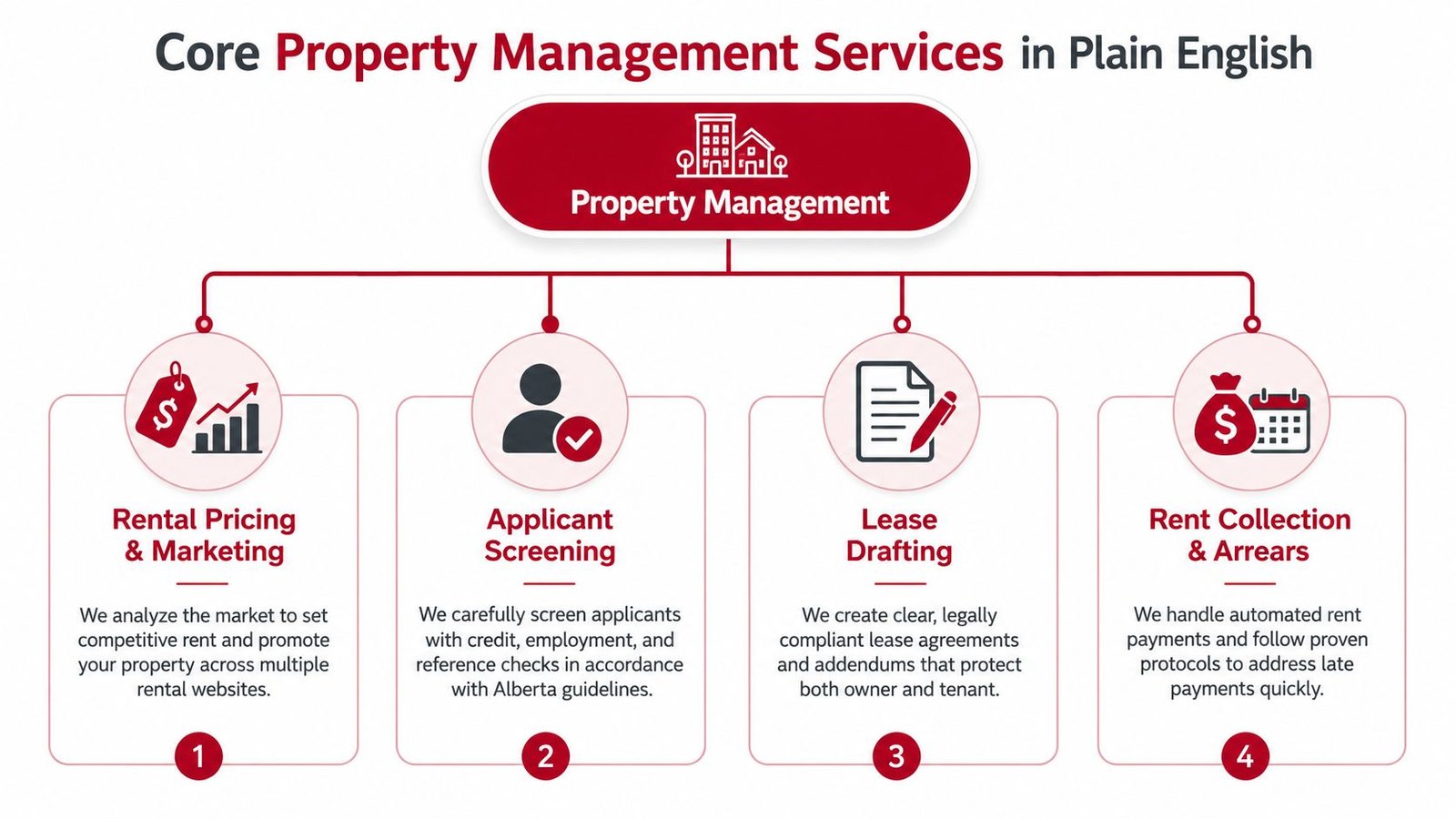
A good manager does not hide behind a vague “full service” label. The work breaks into separate operating decisions, and owners should be able to see how each one is handled in the file. That is the cleanest way to judge quality.
Rental pricing and marketing
Pricing starts with local demand, property type, condition, and timing. In Calgary, a detached house, condo, townhouse, and small plex do not lease the same way, even on the same street. The manager should use market evidence to set rent, then package the listing with strong photos, accurate copy, and syndication to the channels that bring inquiries.
The trade-off is straightforward. Push the price too high and the unit sits, which can cost more than a modest adjustment would have. Price too low and the owner leaves rent on the table. Good management is not just about getting attention, it is about setting a price that supports showings and still makes sense for the asset.
Applicant screening
Screening is more than collecting a form and taking the first decent story. A serious file usually includes credit review, income verification, references, and rental history checks. The point is not only to fill the vacancy, it is to reduce future arrears, conflicts, and avoidable turnover.
A manager also has to decide how strict the screening standard should be. Tight screening can protect cash flow, but it can also narrow the applicant pool and slow the lease-up if the criteria are too rigid for the property and the market. The right balance depends on the unit, the rent level, and how much risk the owner is willing to carry.
Lease drafting
Lease drafting means converting the deal into a document that fits Alberta tenancy requirements and the property's actual rules. A condo unit may need bylaws, move-in procedures, and building-specific instructions layered onto the lease. A detached home may need different language around yard care, utilities, or maintenance expectations.
This part matters because the lease is where day-to-day expectations become enforceable. If the document is too generic, disputes become harder to resolve. If it is too aggressive or inconsistent with the property, it creates problems before the tenancy really gets started.
Rent collection and arrears
Rent collection should feel boring in a good way. Automated payment flow, clear due dates, and prompt follow-up on missed rent are part of that. If arrears do appear, the manager needs a repeatable escalation path, because delay usually helps the wrong party.
Owners should also ask how the manager documents partial payments, late notices, and payment promises. Those details matter when the file has to support a later decision. A loose collection process can leave an owner with money missing and very little clarity about what happened.
Maintenance, inspections, and compliance
Maintenance coordination is not just forwarding a tenant email to a contractor. It means identifying urgency, choosing the right vendor, setting approval limits, and keeping records of what was done. Inspections and condition reports help establish what changed, while compliance work keeps notices, documents, and records aligned with Alberta rules and the tenancy file.
There is also a practical judgment call here. Some repairs should be handled immediately because waiting creates larger damage. Other items can be grouped and scheduled so the owner is not paying for repeated call-outs. A manager adds value by making that call with the file, the property, and the budget in view.
A strong file should tell the story of the property without anyone having to guess what happened last month.
For owners who want a structured service model rather than ad hoc help, firms such as Dreamhouse Realty Ltd. build the process around leasing, records, and ongoing oversight rather than one-off tasks.
How the Full-Service Workflow Runs From Listing to Monthly Statements
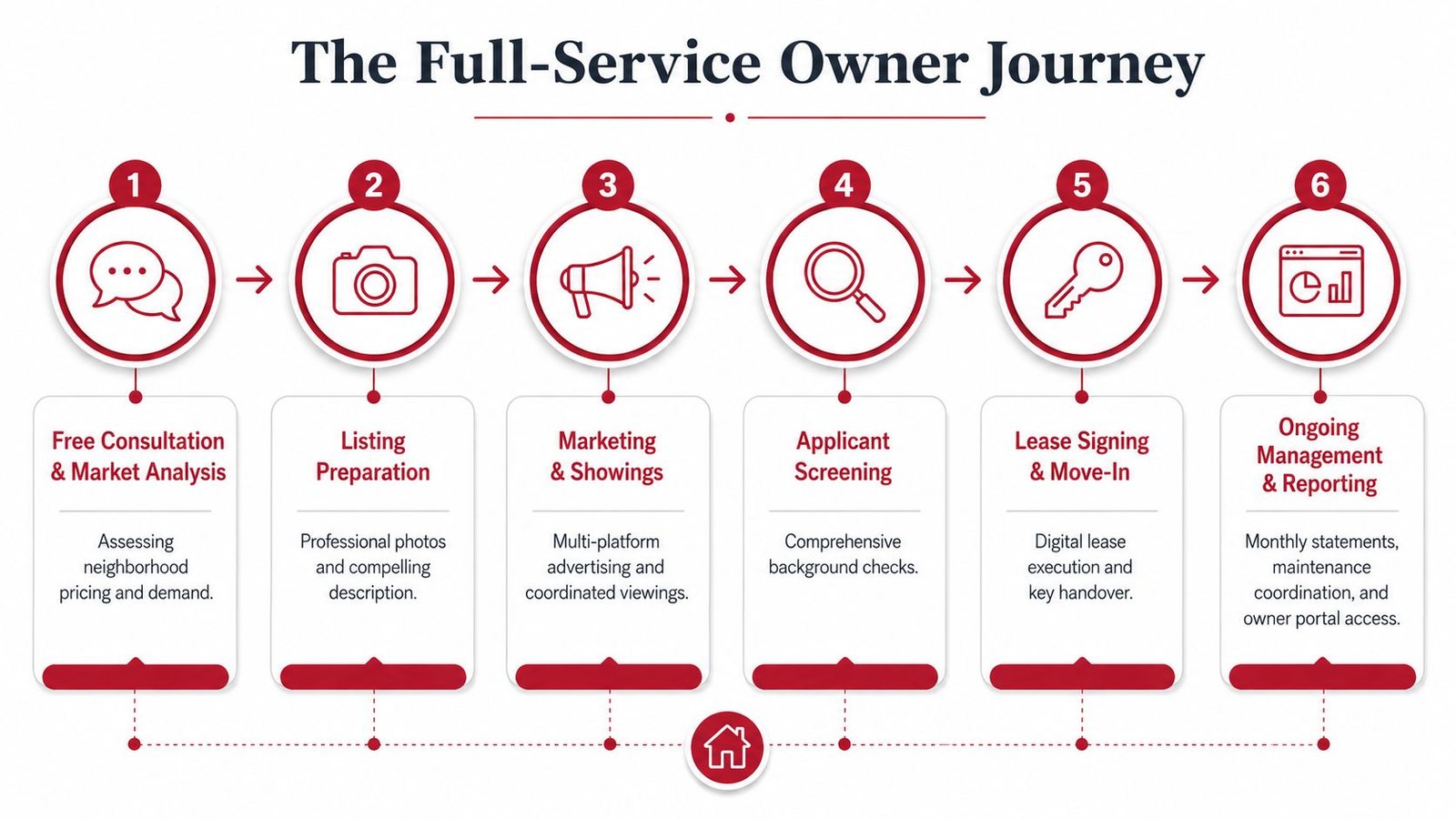
The owner journey usually starts long before a tenant moves in. A manager reviews the property, checks comparable demand, and decides whether the unit needs small prep work before it goes live. That front-end decision affects how quickly the property shows, how many qualified leads arrive, and how confidently the listing can be priced.
From listing prep to lease execution
Once the unit is ready, the manager handles photos, listing copy, and showing coordination. Inquiry handling matters here, because slow replies can waste momentum even in a tight market. After applications arrive, the manager screens them, presents the result to the owner if needed, then prepares the lease and move-in documents.
From move-in to reporting
At possession, the manager records the condition of the unit and confirms that the file matches the handover. After that, the job shifts into recurring operations, rent collection, maintenance coordination, inspections, and owner reporting. Monthly statements should show money in, money out, and the status of the file in a way an owner can use.
The reason this sequence matters is simple. A property manager is not just reducing landlord tasks, they're moving decisions to the point in the workflow where they're least costly. A pricing decision made before listing is cheaper than a vacancy correction later. A screening decision made before approval is cheaper than an arrears problem after move-in.
Calgary's rental environment makes that sequencing more important than usual. The Alberta property-management sector is large and mature, with IBISWorld estimating a 2026 market size of $762.0 million, 2,987 businesses, and 2,878 employees in the province, while Statistics Canada reported Canada's real-estate rental and leasing and property management industries generated $141.6 billion in operating revenue in 2023, up 6.3% from 2022 IBISWorld Alberta property management industry profile. The scale tells you this is a structured service line, not a side hustle.
Which Owners Benefit Most From Professional Help
The answer depends on the owner's situation and where the work is breaking down.
A Calgary landlord with one detached house and a full-time job usually feels the strain in the gaps, evening calls, weekend showings, and repair follow-up that keeps slipping behind everything else. For that owner, management is mostly about time control and reducing decision fatigue. The property still needs attention when the owner is unavailable, and a manager handles those recurring tasks in a way that keeps the file moving.
Remote owners face a different kind of exposure. They cannot inspect the furnace, meet the contractor, or check whether a vacant unit is ready to lease. That makes documentation, portal access, and clear escalation rules more useful than a vague promise of responsiveness. For owners in that position, this Calgary resource for remote owners gives a practical sense of the questions to ask before handing over the file.
Condo owners deal with bylaws, building rules, and coordination with boards or site staff. Small multifamily owners deal with more moving pieces, more turnovers, and more maintenance touchpoints. In both cases, management becomes more valuable once the property has rules that sit outside the lease itself, because those extra layers create decisions that need to be handled consistently.
Owner fit matters: the more moving parts a property has, the less useful “I can handle it myself” becomes as a long-term plan.
For buy-and-hold investors, the issue is scale. Once someone starts accumulating units, the question stops being whether a manager can collect rent. The question becomes whether the manager can standardise records, lease-up, maintenance, and communication across properties without turning the investment into a second job for the owner.
That is also where brokerage support can matter. A manager tied into leasing and listing processes can move faster on showings, application handling, and file setup, which matters when an empty unit is costing time on market. The practical trade-off is simple, a stronger workflow can shorten vacancy, but only if screening standards stay tight and the manager keeps owners informed instead of making decisions behind a closed file.
Calgary's market reinforces that point. One independent Alberta dataset counts 346 property management firms in Calgary and another counts 378, so owners have enough choice to compare operating process, not just whether a company exists Calgary property management company listings. In a crowded field, the better fit is usually the manager whose process matches the property, the tenant profile, and the owner's tolerance for risk.
Pricing, Fees, and the Total Cost of Choosing a Manager
Fee conversations go wrong when owners look only at the monthly management charge. That leaves out the rest of the cost stack. Tenant placement fees, renewal charges, maintenance mark-ups, statement fees, and admin costs all matter, but so do the harder-to-see expenses tied to vacancy, weak tenants, and repairs that slow down because nobody had a vendor ready.
What a quote should really tell you
A useful proposal should make the following clear.
- Monthly management fee: what ongoing oversight costs and what it includes.
- Leasing or placement fee: what the manager charges to source and place a tenant.
- Maintenance handling: whether vendor coordination includes any mark-up or admin handling.
- Renewal or admin fees: what happens when a lease renews or paperwork needs to be prepared.
- Reporting and access: how statements, receipts, and documents are delivered.
The point is not that low fees are bad. The point is that a cheaper quote can become expensive if it leaves too much work on the owner's desk or if it does not protect against vacancy and tenant turnover. That matters in a market where lease-up speed and screening discipline affect cash flow.
The hidden costs show up in practical ways. Every extra vacancy day delays rent. Every weak screening decision raises the chance of arrears or early turnover. Every maintenance delay can turn a manageable repair into a bigger interruption. Those are operating costs, not abstractions.
For owners weighing self-management against professional help, this Calgary cost comparison on self-managing a rental is a useful way to assess the trade-off. The lowest management fee is not always the lowest total cost, especially once time, vacancy, and vendor coordination are counted properly.
Emergency Response and After-Hours Obligations You Should Insist On
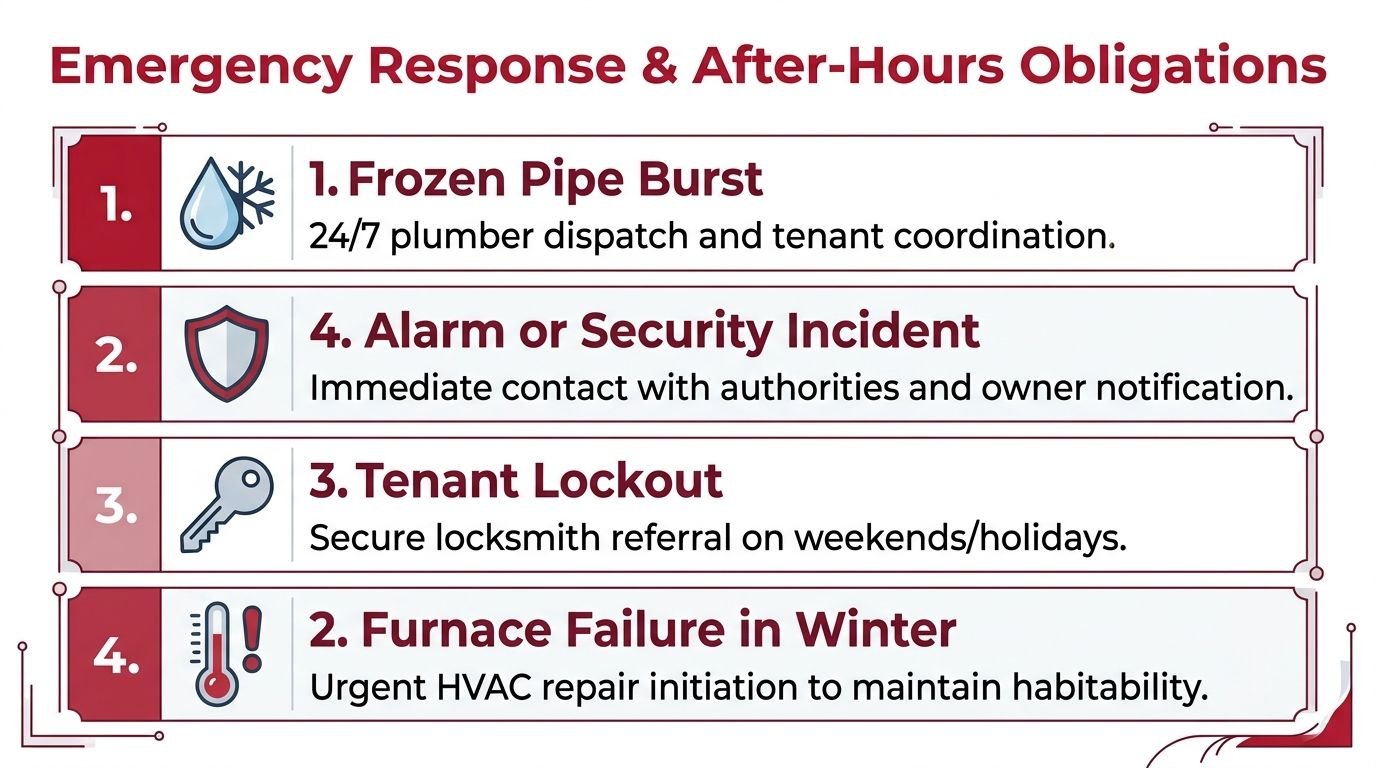
A manager earns or loses trust fastest in these situations. A winter pipe issue, furnace failure, lockout, or security incident is not the moment to discover that “24/7 support” just means voicemail. Owners should ask what counts as an emergency, who answers, who can approve spending, and how the repair trail gets documented.
What should be spelled out before you sign
A management agreement should say how emergencies are triaged, how fast the first response happens in practice, and what the approval threshold is for vendors. It should also clarify who gets called first, the tenant, the owner, or both, and how updates are recorded if the issue happens at night or on a holiday. That matters because Alberta landlords still carry habitability responsibilities, so ambiguity usually benefits nobody.
Neutral Calgary-facing listings show firms advertising everything from weekday office hours to 24/7 maintenance lines, which means service levels vary widely and shouldn't be assumed from a marketing page Calgary office and service examples. The practical takeaway is simple. Emergency response is a process, not a slogan.
Owners should ask a prospective manager a few direct questions.
- What qualifies as an emergency?
- Who is on call after hours?
- What amount can you approve without calling me?
- How do you document night or weekend repairs?
- Which vendors do you dispatch for plumbing, HVAC, and access issues?
For Calgary rentals, winter makes these answers more than administrative. Frozen pipes, inaccessible units, and heating failures create urgency fast. If a provider can't describe the workflow clearly, they're not ready for the part of the job that matters most.
Why Local Licensing, Portals, and Integrated Brokerage Matter
A Calgary owner often needs three things at once, local knowledge, clean records, and a faster path from vacancy to lease-up. That's where licensing and brokerage integration start to matter in a practical way. A locally licensed team that also handles real estate can move between leasing, compliance, and acquisition support without forcing the owner to stitch together separate providers.
The operating advantage is in the hand-offs
If a property needs to be leased, maintained, and eventually sold or repositioned, the hand-off quality matters. Owners lose time when one company handles the listing, another handles management, and a third holds the property history. An integrated brokerage and management model keeps the file closer to the asset and reduces re-explaining the property at every stage.
Portals matter for a different reason. They centralise statements, documents, and service updates, which is useful when owners are remote or just don't want records scattered across email threads. That lines up with the broader local demand for clear, structured communication in a market where paperwork, inspections, and maintenance all need to be tracked.
The Calgary property market also benefits from local familiarity with municipal data tools, condo rules, and provincial tenancy expectations. If a manager knows where to check permits, how to read a building history, and what records need to be preserved, the owner gets better due diligence and less guesswork. A tech-supported approach such as Dreamhouse Realty Ltd.’s portal-driven management model fits that kind of workflow.
The practical difference is not flashy. It's fewer missed hand-offs, better visibility, and less confusion when something changes mid-lease. For owners, that usually feels like fewer surprises.
Next Steps and Getting a Free Rental Consultation
A good first conversation shouldn't feel like a sales pitch. It should feel like a diagnostic. Bring the address, the property type, your current rent or target rent, the lease timing you're working with, and any known issues like repairs, condo rules, or tenant turnover plans.
That consultation should cover neighbourhood pricing, likely demand, timing, and the management tasks that fit your unit. For some owners, the right answer is full-service management. For others, it's a tighter leasing-only plan or a short-term fix before relisting. The point is to match service to the asset, not to force every property into the same box.
After the review, the owner should know what happens next, who prepares the listing, how showings get handled, what screening looks like, and how the monthly reporting will work if they decide to move forward. That's also the moment to ask how the company handles maintenance approvals, inspections, and communication cadence so there are no surprises later.
If you're weighing self-management against a professional option, use the consultation to compare the full workload, not just the fee line. Calgary owners don't need more vague promises, they need a clear plan for pricing, screening, lease-up, and after-hours response that fits the property they own.
Dreamhouse Realty Ltd. handles Calgary rental management, tenant placement, and compliance for single-family homes, condos, townhomes, and small multifamily buildings, with local oversight and structured communication. If you want a rental review that's grounded in the actual property, not a generic pitch, visit Dreamhouse Realty Ltd. and book a free rental consultation.
Composed with Outrank app