You're staring at a long list of listings, a mortgage pre-approval in one tab, and a spreadsheet that still doesn't tell you which Calgary or Edmonton property is worth buying. The trouble isn't a lack of options. It's that most property investment properties look fine until you test them against real vacancy, rent growth, and neighbourhood-level demand.
That's where a disciplined Alberta buy-and-hold process helps. The right rental isn't the one with the prettiest photos or the highest asking rent. It's the one that still performs after vacancy, maintenance, insurance, taxes, and tenant turnover are all counted properly.
Table of Contents
- Why Property Investment Properties Are a Smart Move in Alberta
- How to Identify High-Potential Neighborhoods for Rentals
- Evaluating Financial Returns Without Getting Burned
- Choosing the Right Property Type for Your Portfolio
- Due Diligence Steps That Protect Your Investment
- Scaling Your Portfolio with Professional Property Management
Why Property Investment Properties Are a Smart Move in Alberta
A lot of landlords start in the same place. They have a budget, a city in mind, and too many listings that all seem close enough to work. The problem is that “close enough” is how investors end up overpaying for a place that looks strong on paper but carries weak tenant demand or too much maintenance drag.
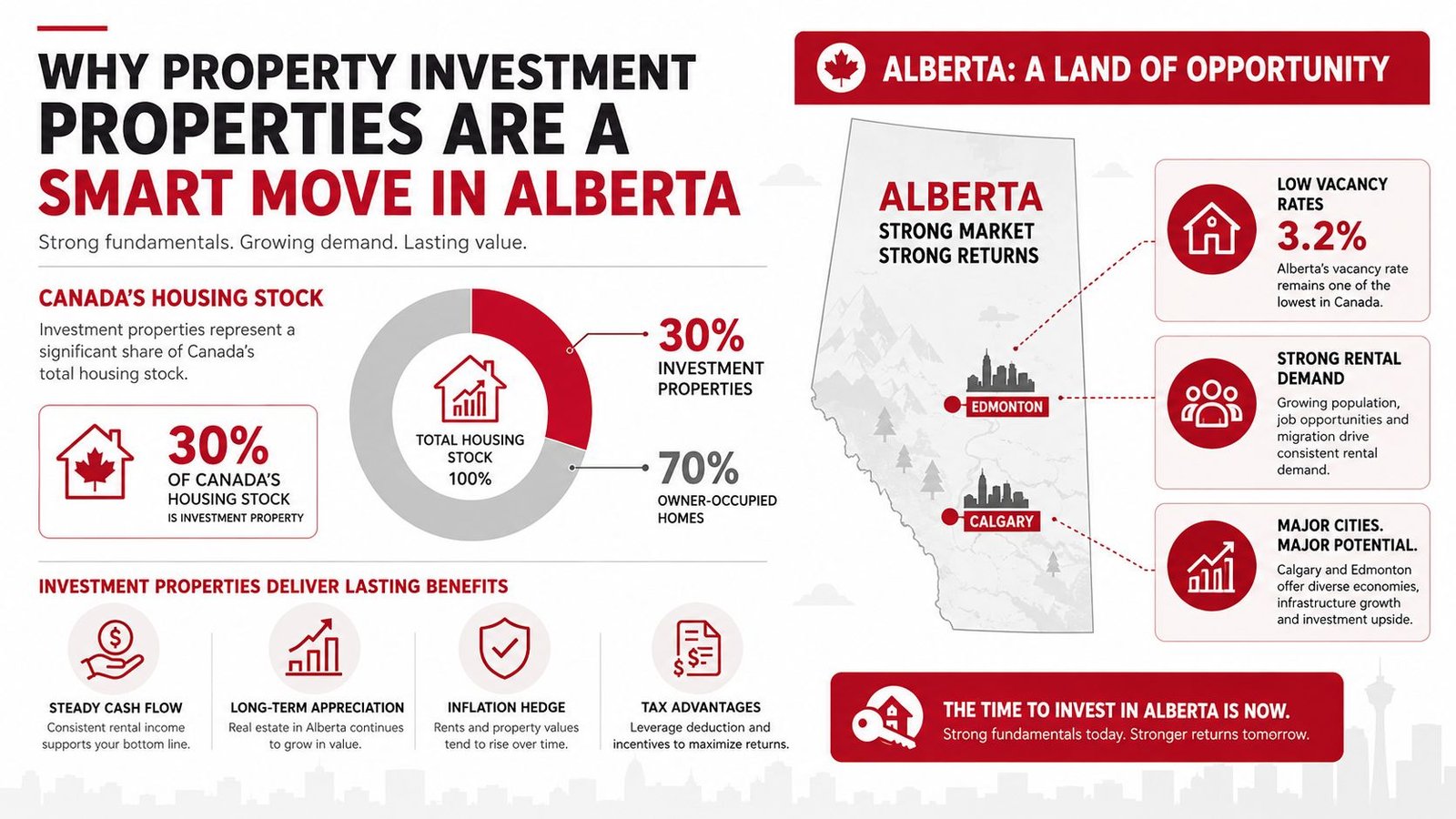
Most property investment properties look fine until you test them against real vacancy, rent growth, and neighbourhood-level demand. That is where Alberta rewards disciplined buyers. In Canada, 24.8% of housing assets were classified as investment properties in 2022, according to Statistics Canada's provincial analysis of residential real estate investors, and Nova Scotia was the highest provincial share at 29.5% in that study. Property investment properties are part of the structure of housing supply itself, which affects acquisitions, leasing, and competition in Alberta markets as well. Statistics Canada's provincial analysis of residential real estate investors
Why small owners still matter most
The ownership structure matters even more for landlords in Calgary, Edmonton, and Red Deer. Statistics Canada's later provincial analysis shows that small-scale investors own the largest share of investment properties by assessed value across the provinces studied, which matches what I see on the ground, the market is still driven by individual owners and small portfolios, not just institutions. Statistics Canada's provincial analysis of residential real estate investors
That matters because the management problems are usually human, not abstract. A tenant calls about a leak, a renewal needs negotiating, a move-out needs documentation, and the place still has to cash flow after those frictions are paid for. A landlord who understands that from day one is already ahead.
Alberta also gives you real choice at the submarket level. Calgary can offer depth of demand, Edmonton can offer a different tenant mix and pricing profile, and Red Deer can work when the numbers fit a more targeted hold strategy. For a practical comparison of those markets, this Calgary vs Edmonton vs Red Deer return comparison is a useful place to start.
Practical rule: buy the property you can still defend after the first vacancy, not the one that only works in a best-case spreadsheet.
How to Identify High-Potential Neighborhoods for Rentals
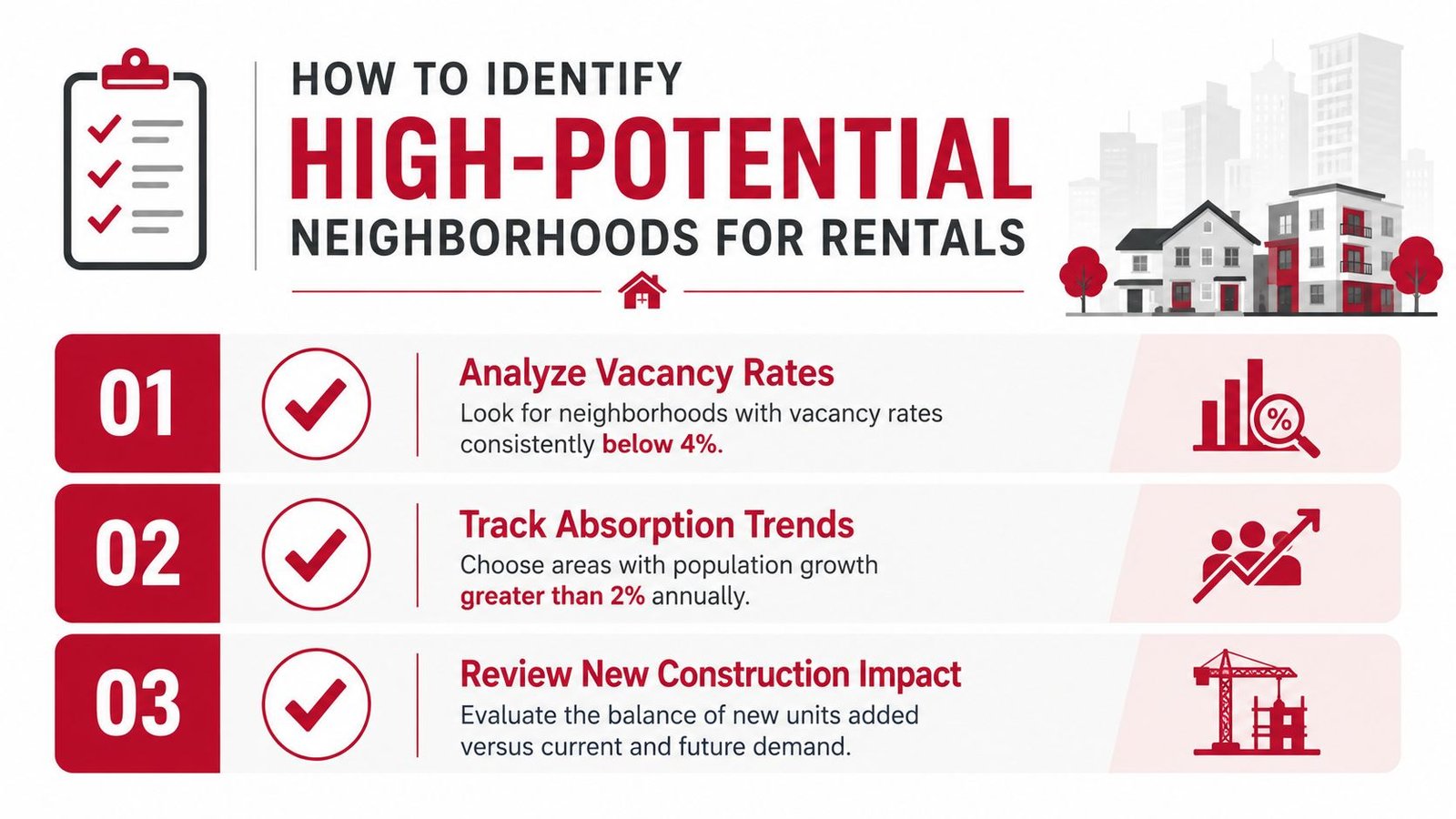
The best rental neighbourhoods don't just look busy, they behave well under stress. The signal you want is demand outrunning supply, not a short-lived rent spike caused by one tight month of listings. In Alberta, that means paying attention to vacancy, absorption, and the construction pipeline before you ever fall in love with a property.
Start with vacancy, then test the demand story
Vacancy is your first filter because it tells you how hard the market is working to absorb available homes. For Calgary and Edmonton, CMHC rental market reporting is the benchmark source for market conditions, so it should sit at the top of your screening process when you're narrowing a submarket. A neighbourhood with weak demand can still produce a flattering asking rent, but asking rent is not the same thing as realised rent.
The better move is to examine whether a submarket is supported by genuine tenant movement. Industry analysis points to vacancy rates, absorption rates, lease-rate trends, NOI, demographic shifts, and construction pipelines as the key signals for spotting underserved segments, because low vacancy plus positive absorption usually means demand is outpacing supply. Underserved CRE segment metrics
Compare neighbourhoods, not cities
Many landlords get sloppy. They say they are buying in Calgary or Edmonton, but those are broad markets made up of very different micro-markets. One part of the city may lease quickly because it sits near transit, schools, or employment nodes, while another part looks fine on a map but drags because new supply is landing nearby.
The practical workflow is straightforward. First, screen with vacancy and rent benchmarks. Then verify at least five comparable rentals or sales from the same submarket. After that, adjust for condition, location, and unit features before you commit to a number. That funnel approach cuts down on overconfidence and keeps one bad assumption from infecting the whole deal.
Operator's note: a property can be “cash-flow positive” today and still be the wrong buy if the neighbourhood has more supply coming in than it can absorb.
What to watch before you tour
- Vacancy pressure: If the area feels soft, expect longer lease-up time and lower renewal confidence.
- Absorption behaviour: Strong movement through listings usually supports healthier pricing power.
- New construction: A heavy pipeline can cap rent growth even when today's numbers look acceptable.
The point isn't to avoid growth areas. It's to understand whether growth is being supported by real tenant demand or just by recent marketing momentum. That distinction is what keeps a landlord from buying the wrong side of a good city.
Evaluating Financial Returns Without Getting Burned
A rental property should be judged on income after expenses, not on gross rent alone. That sounds obvious, but plenty of investors still get seduced by top-line rent and forget to price in vacancy, maintenance, insurance, management, and property taxes. That's how a decent-looking deal turns into a thin one.
Underwrite the income, then stress it
The cleanest technical sequence is to estimate net operating income, or NOI, from rent less vacancy and operating costs, then compare that figure to the purchase price and debt terms before you offer. Valuation practice commonly blends market comparison, income, and cost approaches, and that combination matters because a single method can mislead you if the local data is weak. The same discipline also means verifying your rent assumptions against the submarket, not against the highest asking price you found online. MSCI property indexes methodology
A simple way to think about it is this. Gross rent tells you what the unit might collect. NOI tells you what the property earns after the operating drag is removed. Cash flow then tells you what is left after debt service.
| Sample Rental Property Financial Analysis | Monthly Amount | Annual Amount |
|---|---|---|
| Gross rent | ||
| Vacancy allowance | ||
| Management and leasing | ||
| Maintenance and repairs | ||
| Insurance and taxes | ||
| Net operating income |
Don't let “self-managing” hide the real cost
Many owners underestimate the hidden cost of their own time. If you're self-managing, you still spend time on leasing, showings, move-outs, arrears follow-up, maintenance calls, and record keeping. That's not free, and it shouldn't be treated like free labour in a return model. If you want a practical cost checklist for that side of the equation, this guide on what rental property self-management really costs is worth reading.
Practical rule: if the deal only works when vacancy is perfect and repairs are minimal, it doesn't really work.
A cleaner way to compare offers
Use market comparison to check whether the asking price is in range, then use the income approach to test whether the asset deserves your capital. If the income model says “no” and the market comparison says “maybe”, the answer is still no until the numbers improve.
The point of the analysis is not to make the property fit. It's to keep you from paying full price for a unit that needs a perfect operating year to deliver average returns. Alberta landlords don't get paid for optimism, they get paid for disciplined underwriting.
Choosing the Right Property Type for Your Portfolio
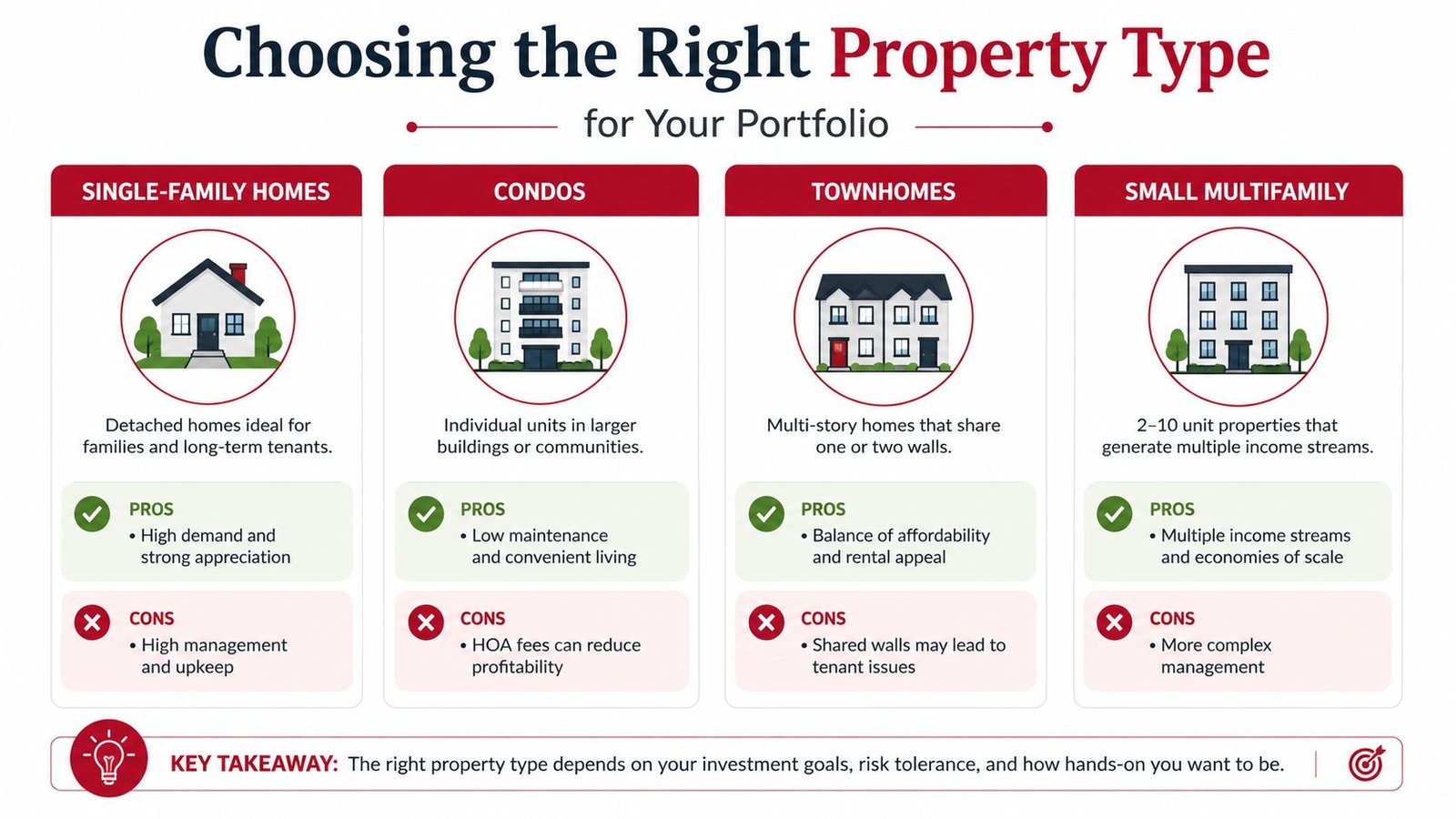
Single-family homes, condos, townhomes, and small multifamily buildings all behave differently once tenants move in. The right choice depends less on general preference and more on how much management you want to own, how concentrated you're comfortable being, and how much operational complexity you can absorb.
Single-family homes and condos
Single-family homes usually attract broad tenant demand and are straightforward to understand. The trade-off is that one vacancy can wipe out the income stream until the unit is re-leased, and a bigger lot or detached structure can also mean more maintenance variables over time.
Condos often feel easier to own because exterior upkeep is lighter and the footprint is smaller. The cost side shows up differently, though, since condo fees and building rules can narrow your room to manage the asset the way you want. That matters most when your strategy depends on flexibility, lease terms, or a quick turn between tenants.
Townhomes and small multifamily
Townhomes sit in the middle. They can offer a balance between simple tenant appeal and manageable upkeep, but shared walls and shared systems can create more neighbour-driven noise or maintenance issues than some buyers expect.
Small multifamily tends to appeal to investors who want multiple income streams in one asset. It can spread vacancy risk better than a single-unit property, but it also demands tighter systems, more detailed inspections, and clearer vendor coordination. The more units you hold in one place, the more your management process needs to behave like a business.
Matching the asset to the strategy
- Hands-off hold: single-family or a well-run condo can work when simplicity matters more than maximum income density.
- Balanced portfolio growth: townhomes often suit owners who want practical tenant appeal without jumping straight into complex operations.
- Active cash flow focus: small multifamily can fit owners who are ready for more oversight and better process discipline.
The right property type is not the one that sounds most “investor-like”. It's the one that matches your tolerance for work, your financing plan, and the kind of tenancy you want to manage for years. For most Alberta landlords, that fit matters more than any generic rule about what “always performs better.”
Due Diligence Steps That Protect Your Investment
A property can look clean on a spreadsheet and still turn into a problem after closing if the legal, physical, or operating side is weak. Alberta buyers need to verify compliance, inspect the asset properly, and keep records that can stand up if a tenant dispute comes later. That matters even more when the neighbourhood is already showing softer absorption, new supply is coming online, or rent growth depends on a narrow tenant pool.
Confirm the legal and operational framework
Statistics Canada describes an investment property as a residential property owned by at least one investor that is not the primary residence of any of the owners. That definition fits the landlord side of the business, but Alberta owners still have to make the file work on the ground. Lease wording, notices, move-in steps, and record keeping need to align with provincial tenancy obligations, because small compliance errors can become expensive distractions later. Statistics Canada's definition of an investment property
A thorough screening process checks credit, income, references, and rental history. A rushed one checks whatever the applicant sent first. The gap usually shows up later as late payments, avoidable conflict, and extra turnover, which is hard to absorb in a building or neighbourhood where vacancy is already tight.
Local rent assumptions need the same discipline. In parts of Calgary, Edmonton, and Red Deer, a unit can appear to underwrite cleanly on asking rent while the actual lease-up window tells a different story. If nearby construction is adding supply or older rental stock is competing on price, the underwriting should reflect that pressure instead of assuming every advertised rate will hold.
Inspect like you expect a dispute later
Move-in documentation is not just admin. It protects both sides when a tenant moves out and the condition is remembered differently. Routine inspections and move-out inspections, with photo evidence and written condition notes, should be standard on every rental, especially when the purchase is an older unit or a property that has changed hands recently.
Use the inspection record to identify deferred maintenance before it becomes a vacancy problem. A worn roof, failing appliance, moisture issue, or tired common area can pull down tenant quality and make renewal conversations harder. In a submarket with weaker absorption, that kind of drag matters because it can lengthen vacancy and reduce the rent you can realistically hold.
The best time to solve a documentation problem is before the tenant gets the keys.
Build your operational controls early
Use a lease that matches the property, the tenancy, and the way you plan to manage the unit. Set up rent collection, maintenance reporting, and escalation paths before possession day, not after the first issue lands in your inbox. Remote owners need this even more, because distance makes every weak process harder to correct once the unit is occupied.
A practical due diligence checklist looks like this:
- Legal review: confirm lease documents, notices, and record keeping line up with Alberta requirements.
- Physical review: inspect the structure, systems, finishes, and any signs of deferred maintenance.
- Tenant workflow: verify screening standards, deposit handling, and move-in documentation before closing.
The aim is simple. Remove ambiguity before it turns into cost, and pressure-test the rent you expect against what the neighbourhood can support. In Alberta, the best acquisitions usually hold up because the owner understood local vacancy risk, tenant demand, and operating detail before the deal closed.
Scaling Your Portfolio with Professional Property Management
Once you own more than one rental, the main bottleneck stops being acquisition and starts being execution. Rent collection, leasing, maintenance, inspections, and compliance can either run in a repeatable system or eat your time one issue at a time. The owners who scale successfully are usually the ones who stop trying to improvise every decision.
Why process matters more as you grow
A professional manager protects returns by keeping vacancy low, screening tenants consistently, and handling the day-to-day work that owners underestimate until they're living it. For Calgary, Edmonton, and Red Deer landlords, that often means local oversight, documented communication, and maintenance coordination that doesn't rely on memory alone. The more properties you own, the more expensive casual management becomes.
If you're comparing managers, the most useful question is whether they connect leasing, compliance, and accounting in one operating rhythm. This Calgary landlord guide to choosing a property manager is a sensible benchmark for what to ask.
Where Dreamhouse Realty Ltd. fits
Dreamhouse Realty Ltd. offers residential rental management, tenant placement, compliance oversight, inspections, maintenance coordination, and investor-focused sales and acquisitions support across Alberta. That mix matters because a buy-and-hold owner doesn't just need a broker or just a manager, they need someone who understands how the purchase, lease-up, and long-term hold decisions affect each other.
The scale advantage
- Less owner friction: fewer late-night calls and fewer loose ends.
- Cleaner reporting: better visibility on rent, arrears, and maintenance.
- Stronger continuity: a more repeatable process from one property to the next.
When the portfolio is small, you can sometimes survive with a loose system. When it grows, loose systems become expensive fast. A management partner can't make a bad acquisition good, but it can help a good acquisition stay good.
If you're buying or already holding rental property in Calgary, Edmonton, or Red Deer, Dreamhouse Realty Ltd. can help with acquisition support, tenant placement, inspections, rent collection, maintenance coordination, and compliance-focused management. Visit Dreamhouse Realty Ltd. to discuss your rental goals and see how local property management can support a cleaner, more predictable hold strategy.