A working Alberta rental lease agreement example covers the parties, premises, term, rent, deposit, and signatures, and it has to align with the Residential Tenancies Act to be enforceable. In Alberta, that framework has governed most residential landlord-tenant relationships since May 4, 2004.
If you’re staring at a generic template from a US site, that’s usually where the trouble starts. Calgary landlords need a lease that matches Alberta rules, not one that only looks complete on the page.
Table of Contents
- Why Alberta Landlords Need a Province-Specific Lease Template
- Parties, Identification, and Property Information Fields
- Premises, Possession, and Included Items
- Lease Term, Renewal, and Periodic Tenancy Conversion
- Rent Payment, Late Fees, and NSF Charges
- Security Deposit, Pet Deposit, and Key Deposit Rules
- Maintenance Responsibilities, Utilities, and Addenda Clauses
- Notices, Entry, Default, and Termination Provisions
- Adapting the Template for Condos, Suites, and Shared Housing
- Quick Reference Clause Map to the Residential Tenancies Act
- Pre-Signing Checklist and Common Landlord Questions
Why Alberta Landlords Need a Province-Specific Lease Template
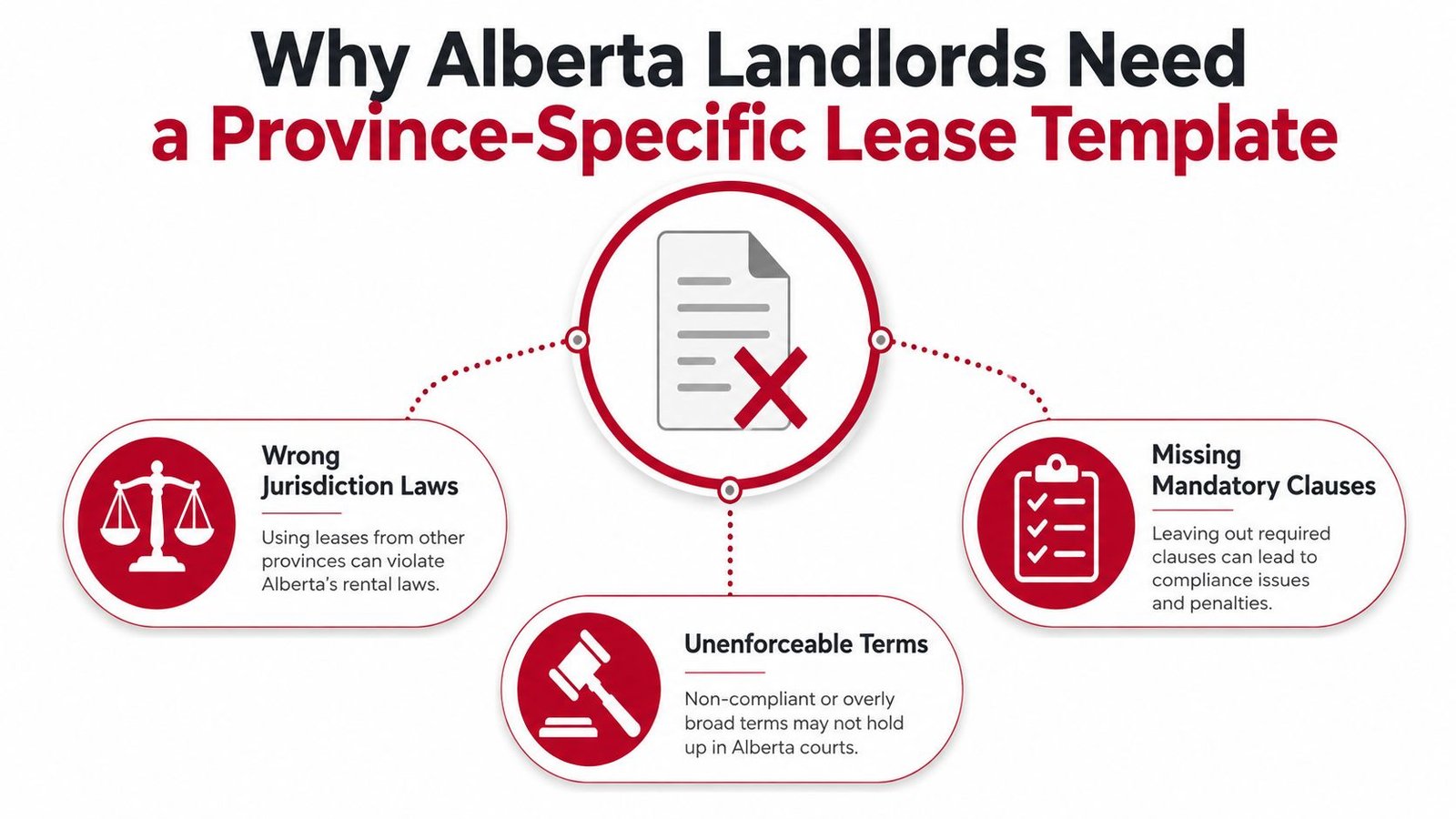
You’ve probably searched for a rental lease agreement example and found a polished template that looks usable at first glance. The problem is that many of those templates are written for another province or for the United States, so they leave out Alberta’s actual tenancy structure and notice rules.
In Alberta, the lease is not just a private understanding between landlord and tenant. It sits inside the Residential Tenancies Act, which sets the legal floor for notices, deposits, inspections, and dispute handling, and Alberta government guidance also groups leases around standard clauses like rent, security deposits, fixed terms, and periodic tenancies. A lease that ignores that structure can create arguments later, especially when a tenancy ends or a repair dispute turns into evidence.
What has to be in the document
A usable Alberta lease needs the minimum structural pieces, including rent amount, lease term, parties, property description, and security deposit terms. Those aren’t decorative fields. They’re the base information that lets you prove who agreed to what, when possession starts, where notices go, and what the rental unit is.
Practical rule: If a clause would matter in a dispute, it belongs in the signed lease or a properly attached addendum, not in a hallway conversation.
The best Alberta leases use the statute as the baseline and then add property-specific detail where it provides clarity. That means your document should be written as a province-wide legal instrument first, then customized for the building, the unit, and the way you manage it in Calgary. The annotated template below follows that logic clause by clause.
Parties, Identification, and Property Information Fields
Start with the people, not the rent. A solid rental lease agreement example begins by identifying every adult tenant, the landlord, and any property manager or agent who is authorised to receive notices and handle day-to-day communication.
Fill in the identification block carefully
The lease should list the legal names of the landlord, all adult tenants, and, where applicable, the managing brokerage or property manager acting on the owner’s behalf. For multi-tenant households, naming everyone matters because the lease should bind the adults jointly so the landlord isn’t left trying to chase separate agreements for the same unit. Use the full legal name, not a nickname or first name only.
The property description needs to be just as exact. Include the civic address, unit number, postal code, parking stall assignment, storage locker number if there is one, and any other area the tenant is entitled to use. If the unit has one parking stall and one locker, say so. If parking is not included, state that plainly instead of leaving the tenant to assume it is.
Notice addresses and service details
The lease should also include a proper notice address for both sides. That’s the place where formal notices, rent notices, and termination documents are sent, and it should be different from the rental unit if the landlord wants a separate mailing address. This is especially useful for out-of-province owners or Calgary landlords who use a manager to handle legal paperwork.
Important: Service details belong in the lease because later disputes often turn on whether the other side had a valid address for delivery.
A clean identification block also helps with screening and move-in coordination. When the tenant record matches the rental unit record exactly, you reduce confusion about who was approved, who is authorised to occupy, and which mailbox, stall, or locker belongs to the tenancy.
Premises, Possession, and Included Items
The premises clause should answer one question clearly, what exactly is being rented. If that answer isn’t obvious from the lease, arguments start before move-in day.
Describe the unit, not just the address
Use the full unit description, then list what comes with it. That can include appliances, window coverings, assigned parking, storage, furnished items, shared laundry, or access to common facilities in the building. If something is excluded, say that too. A tenant shouldn’t have to guess whether the patio furniture, garage stall, or second fridge was part of the bargain.
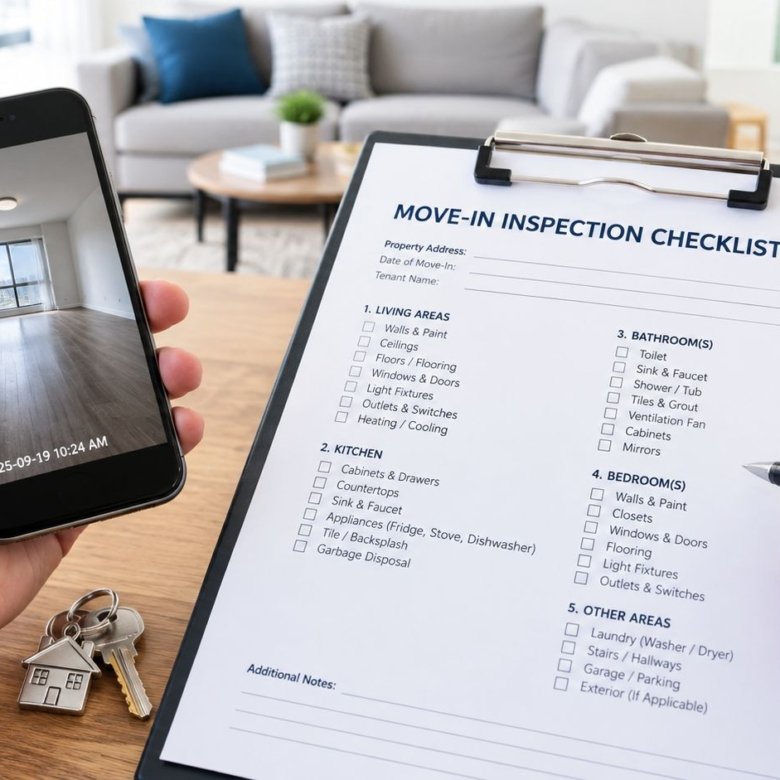
Possession details matter just as much. Record the possession date and the condition expected at handover, then cross-reference the move-in condition report or inspection form. That way, the lease and the inspection evidence support each other if there’s a dispute about damage, cleanliness, or missing items after the tenant moves in.
Match the lease to the real property
For furnished homes, list the furnishings in enough detail that they can be checked off later. For basement suites, clarify whether shared hallways, laundry, or exterior storage are included. For condo units, make sure the lease doesn’t promise use of areas the condominium rules don’t allow.
A good premises clause does one job well. It removes uncertainty about what the tenant actually rented.
The practical test is simple. If a new tenant, a manager, or a later decision-maker can’t tell what’s included by reading the lease, the clause isn’t tight enough. Clear possession language also makes turnover easier because you know exactly what should be in the unit at the start and what should still be there at the end.
Lease Term, Renewal, and Periodic Tenancy Conversion
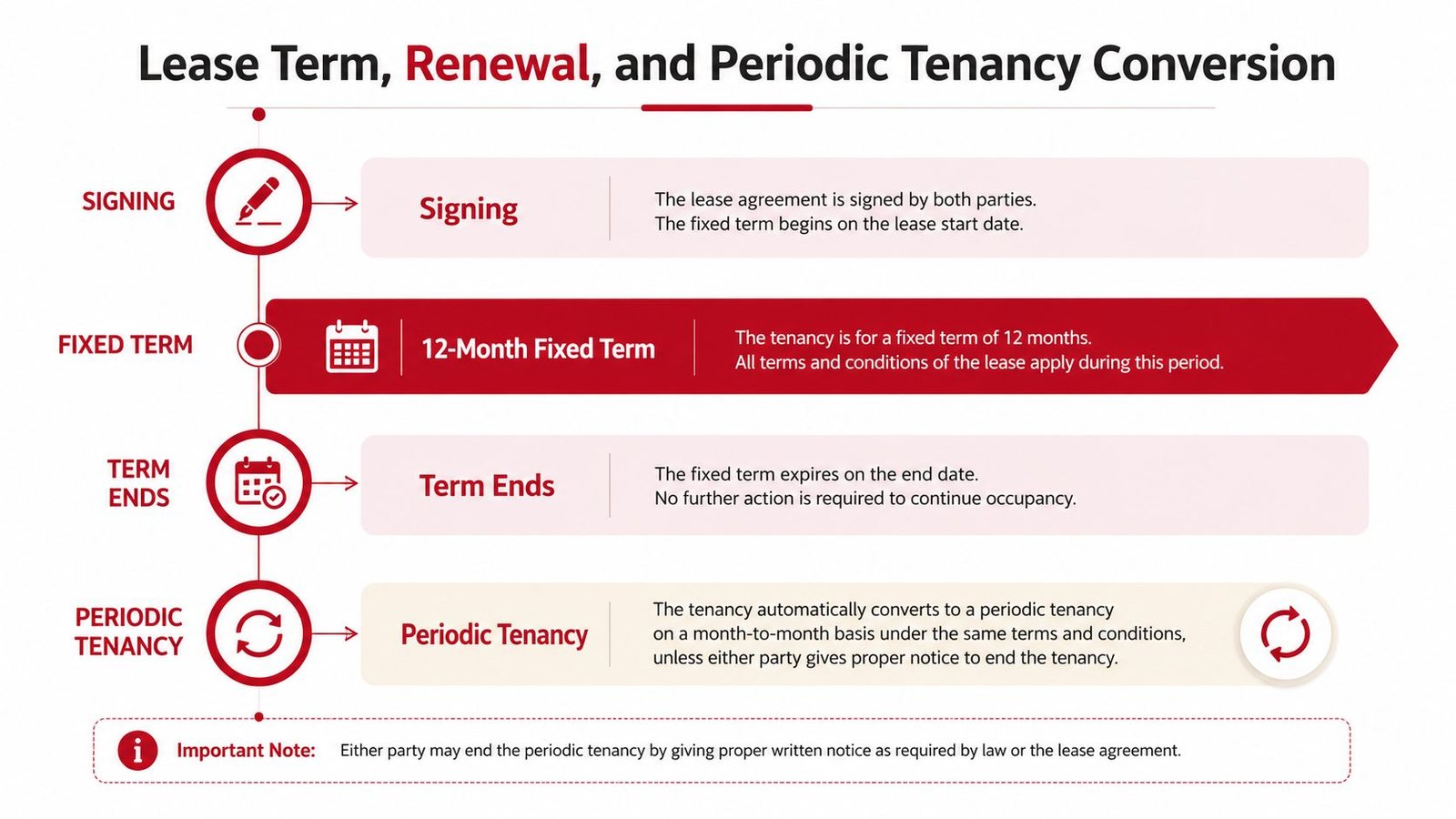
The term clause is the clock that drives the rest of the tenancy. In Alberta, a one-year fixed term with rent paid monthly in advance is a common standard example in government sample agreements, and that structure gives both sides a predictable start and end date. A sound rental lease agreement example should state the dates in full, not just say “one year.”
Fixed term versus periodic tenancy
A fixed term starts on one date and ends on another. A periodic tenancy continues from period to period, often month to month, until properly ended according to the lease and the law. In Alberta practice, many leases begin as fixed terms and then convert to periodic tenancy unless they’re renewed or ended properly at expiry.
That conversion point matters because notice deadlines flow from it. If you get the term wrong, you can miscalculate when possession can be recovered or when the tenancy continues. That creates problems for booking contractors, advertising the unit again, and coordinating move-out inspections.
Renewal language should be specific
If you want a renewal option, state the renewal process in writing. Say whether the tenant must give written notice, whether the landlord will issue a new fixed-term lease, or whether the arrangement automatically rolls into periodic tenancy. If you allow a holdover, define what happens if the tenant stays past the end date without a new agreement.
For a deeper look at renewal timing in Calgary practice, see the lease renewal strategy Calgary landlords ignore.
Practical rule: Put the end date and renewal path in the same clause. Scattered term language causes the most avoidable disputes.
Rent Payment, Late Fees, and NSF Charges
The rent clause should be boring in the best possible way. It needs to say exactly how much is due, when it’s due, how it can be paid, and what happens if payment doesn’t arrive on time.
Make the payment instructions unambiguous
State the monthly rent amount, the due date, and the accepted methods, whether that’s pre-authorised debit, e-transfer, cheque, or another method you use. Name the landlord or property manager the payment should be made to, and include the payment address or email in the lease or payment schedule. That prevents the “I sent it somewhere else” defence later on.
Late fees need care. Don’t copy a penalty clause from another province and assume it will stand. In Alberta, a landlord is safer when the lease focuses on the contractual consequence of non-payment and on recovery of actual banking or processing costs where a payment is refused.
Treat NSF charges as reimbursement, not punishment
If you want to charge for a dishonoured payment, phrase it as recovery of the bank fee or processing cost you incurred. That keeps the clause tied to the expense instead of turning it into an arbitrary fine. It’s the same reason landlords should avoid overloaded penalty language when a clean fee recovery clause will do the job.
Write the rent clause as a collection tool, not a punishment clause. Courts and tenants both read those differently.
The payment block should also say whether the landlord may change payment instructions later by written notice. That matters for managers who switch bank accounts or move from paper cheques to digital systems. Clean rent language reduces friction and gives you one document to point to when a payment goes missing.
Security Deposit, Pet Deposit, and Key Deposit Rules
Deposits are where too many old templates go wrong. A security deposit is not the same thing as a pet deposit, a key deposit, or last month’s rent, and Alberta landlords need to draft those distinctions carefully.
Keep the deposit categories separate
The lease should identify the security deposit amount, when it’s collected, and how it will be handled at move-out. If you charge a pet deposit or pet-related amount, make sure it’s clearly tied to the pet clause and not buried inside the security deposit section. If you charge for keys or fobs, describe that amount as a refundable deposit only if that’s how you handle it.
At move-in, record what was paid and what was issued. At move-out, document what’s being returned, what’s being retained, and why. A clean paper trail matters more than a clever clause because deposit disputes usually turn on evidence, not wording alone.
Avoid imported wording that conflicts with Alberta practice
Some out-of-province forms describe deposits in a way that doesn’t fit Alberta’s tenancy rules. Don’t copy language about non-refundable fees unless you’ve checked that the fee is permitted in your situation. The safer approach is to keep the deposit clause narrow and transparent, then handle any tenant-specific charges through properly written addenda and inspection records.
| Deposit Type | Typical Treatment | Compliance Note |
|---|---|---|
| Security Deposit | Collected at move-in and tracked through the tenancy | Keep the amount and return process clear in writing |
| Pet Deposit | Used only if pets are permitted and documented | Tie it to the pet addendum, not the general rent clause |
| Key or Fob Deposit | Tracks the replacement value of access items | State whether it's refundable and when deductions apply |
| Last-Month Rent | Often misused in generic templates | Don't assume it works like a security deposit |
For landlords handling a file after a dispute, the key question is whether the lease and the receipts tell the same story. If they do, your position is much stronger.
Maintenance Responsibilities, Utilities, and Addenda Clauses
A maintenance clause shouldn’t be a generic promise that “tenant keeps property clean.” It should divide responsibilities in a way you can enforce, then connect those duties to inspection reports and move-out documentation.
Separate ownership duties from day-to-day duties
The landlord should handle the structural and building-side obligations. The tenant should handle routine cleanliness, prompt reporting of defects, and care of the unit and fixtures. If a tenant is expected to change light bulbs, replace batteries, or report water damage immediately, say so in the lease rather than assuming common sense will fill the gap.
Utilities should be listed one by one. If the tenant pays electricity and internet but the landlord pays water, don’t bundle everything into one vague line. That kind of phrasing creates billing arguments later, especially in suites or small multifamily properties where utility arrangements can be unusual.
Use addenda for property-specific rules
Pets, smoking, utilities, parking, and occupancy limits are better handled in addenda when they need detail. A pet addendum can describe the approved animal and care expectations. A smoking addendum can prohibit smoking and vaping in the unit and common areas. A utilities addendum can set out who opens the accounts and who reimburses shared charges.
If the unit sits in a condominium, attach the condo rules that affect the tenant. If the home has shared laundry or a common yard, define use rights clearly. The master lease should stay consistent with every addendum, because contradictions are where disputes thrive.
For a practical maintenance workflow, this reference video is useful when you’re comparing what should be in writing against what gets handled through inspections and work orders.
Landlord rule: If the lease says one thing and the addendum says another, the tenant will point to the version that helps them most. Keep one consistent record set.
Notices, Entry, Default, and Termination Provisions
Notice language has to be precise because it controls how the landlord communicates legally. A tenant can’t be expected to comply with deadlines that weren’t written clearly, and a landlord shouldn’t have to guess how notice is delivered.
Build the notice block around real delivery practice
List the notice addresses, acceptable delivery methods, and when a notice counts as given. If you use email for routine communication, separate that from formal legal notice unless the lease expressly allows it. Keep the legal notice address stable so there’s no confusion if the tenant changes phone numbers or moves mail forwarding.
Entry rights should be written with similar discipline. State when the landlord may enter for inspections, repairs, or emergencies, and require proper notice where the law demands it. That protects privacy and gives contractors a clear path when access is needed.
Tie default to actual breaches
The default clause should cover rent arrears, material lease breaches, and failure to cure problems after notice where the law allows cure. Don’t overstuff the clause with threats. Focus on the conduct that matters: the payment failure, the unauthorized occupant, the damage, or the repeated breach of a written term.
For landlords dealing with abandoned possessions after a tenant leaves, keep the process separate from the default language and follow a lawful inventory and storage workflow, as discussed in how to handle abandoned tenant property legally in Calgary.
The strongest termination clause is the one that names the breach, the notice method, and the timeline in the same document.
A well-written termination block also distinguishes between end-of-term non-renewal and termination for cause. Those are not the same event, and treating them as if they are invites challenge. Keep them separate in the lease so the paperwork matches the legal reason you’re ending the tenancy.
Adapting the Template for Condos, Suites, and Shared Housing
A single Alberta lease template can work across several property types, but the addenda and occupancy language need to change. A condo unit is not handled the same way as a basement suite, and a shared house is not handled the same way as a self-contained single-family home.
What stays the same and what changes
The core fields stay fixed. You still need the parties, property description, term, rent, deposit, notice addresses, and signatures. What changes is the use-right section, the addenda package, and the way rules are aligned with the property type.
A condominium lease usually needs stronger reference to building bylaws, parking assignments, and amenity restrictions. A basement suite lease should spell out access routes, noise expectations, and whether any exterior space is shared. A rooming or shared-housing arrangement needs careful occupancy wording so the common areas, bathroom access, and kitchen use are not left open to assumption.
For Alberta landlords comparing these formats, legal vs illegal basement suites in Calgary is worth keeping in mind when the suite arrangement affects the tenancy structure.
Don’t cross the line into the wrong contract type
A residential lease is not a commercial lease, and a rooming house arrangement can raise issues a standard family tenancy doesn’t. If you draft the wrong template, you can accidentally promise use rights or responsibilities that don’t fit the property. The fix is simple, but it has to be deliberate, which means matching the template to the actual occupancy model.
Decision check: If the tenant shares a kitchen, bath, or entry, reread every clause that assumes exclusive possession.
The safest habit is to keep a master Alberta residential lease, then attach property-specific schedules. That lets you reuse the structure without rewriting from scratch every time a unit type changes.
Quick Reference Clause Map to the Residential Tenancies Act
Here’s the fast audit sheet I’d use on any rental lease agreement example before it goes out for signature. It helps you spot missing clauses quickly and tells you which part of the Alberta tenancy framework the clause is serving.
| Lease Clause | RTA Concept | Why It Matters |
|---|---|---|
| Parties and tenants | Named occupants and responsibilities | Establishes who is bound by the lease |
| Property description | Rental premises | Removes confusion about what was rented |
| Term and end date | Fixed term or periodic tenancy | Drives renewal and termination timing |
| Rent payment clause | Rent obligations | Sets payment amount, timing, and method |
| Security deposit clause | Deposit handling | Supports move-in and move-out accounting |
| Maintenance addenda | Repair and care obligations | Clarifies who handles routine issues |
| Notice clause | Service and delivery | Helps notices count as valid |
| Entry clause | Landlord access rules | Protects privacy and access rights |
| Default and termination | Breach and ending the tenancy | Creates a lawful response path |
A quick audit like this is especially useful when you inherit an older lease from another owner or manager. It also helps when you brief a new property manager, because the manager can see where the statutory concepts sit inside the contract.
Pre-Signing Checklist and Common Landlord Questions
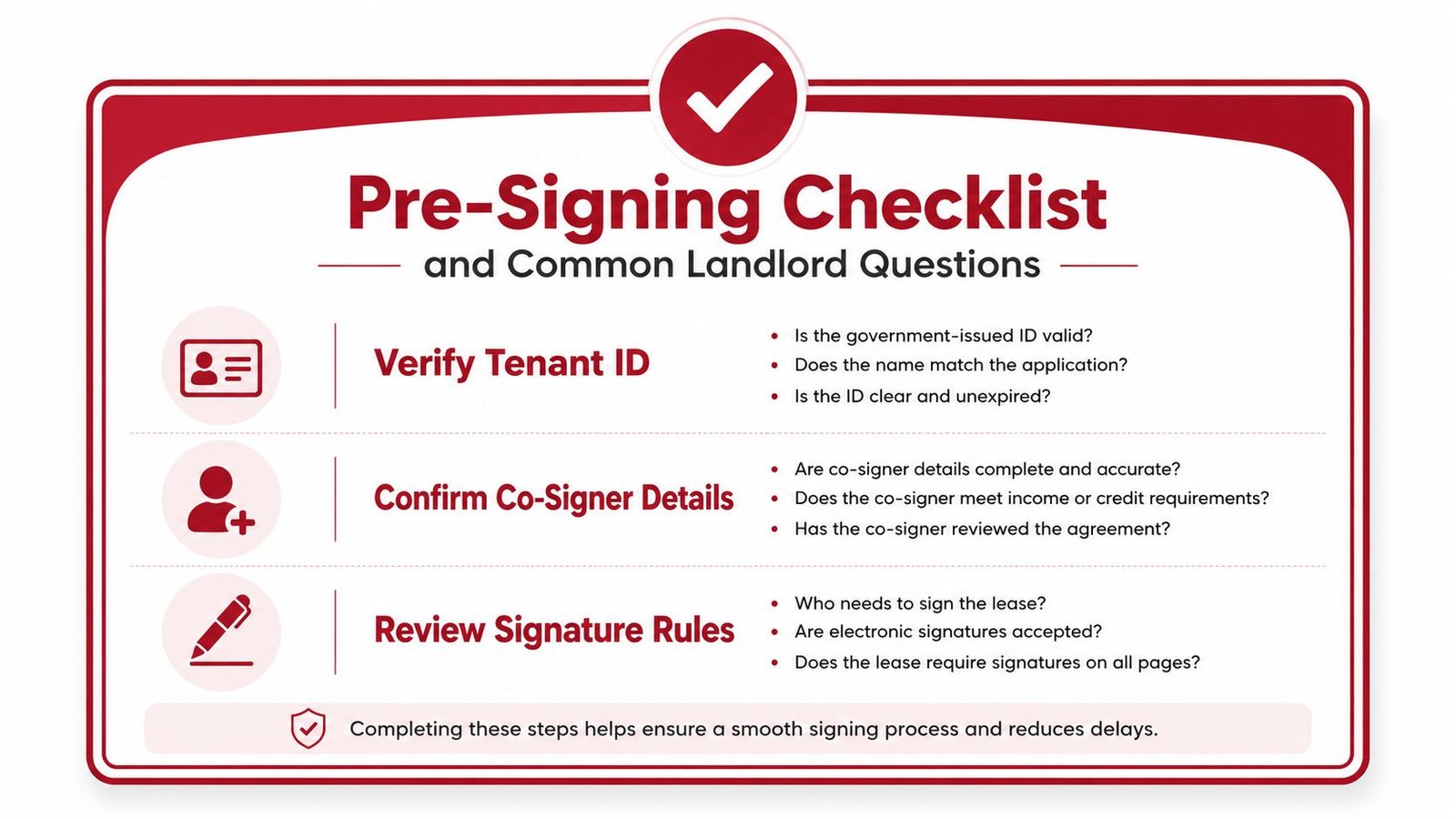
Before you sign, verify identity, confirm every addendum, and read the lease as if you were the tenant. If any field depends on a handshake understanding, it isn’t finished yet.
Pre-signing checklist
- Verify tenant ID: Make sure the adults named in the lease match the people you screened and approved.
- Confirm co-signer details: If you’re using a guarantor or co-signer, put the full name and signature terms in writing.
- Review signature rules: Use the proper signing method for your workflow, and keep the signed copy with the tenancy file.
- Attach every addendum: Pets, smoking, utilities, parking, and condo rules should be attached before signature.
- Check notice addresses: Confirm where formal notices and payment instructions must go.
- Match the dates: The possession date, start date, and rent due date should line up cleanly.
Common landlord questions
Does the lease have to be in writing? For Alberta landlords, yes, a written lease is the practical standard because it gives you one record for rent, term, notices, deposits, and move-in evidence.
Can a landlord refuse pets? Yes, if the lease and building rules are written that way and the restriction doesn’t conflict with any applicable legal obligation. Put the rule in the pet clause, not in a casual side note.
Can rent increase mid-term? Not just because you want it to. The lease term controls the rate until the agreement ends or changes in a lawful way.
What happens if a tenant stops paying? Use the default clause, document the arrears, give the required notice, and keep every communication in the file.
If you want a Calgary-focused team to turn this kind of lease into a working tenancy file, Dreamhouse Realty Ltd. can help with lease drafting, move-in documentation, screening, and compliance support across Calgary, Edmonton, Red Deer, and surrounding Alberta communities.
Want to buy a rental or investment property? Visit Dreamhouse Realty Ltd. to get local rental properties listings.