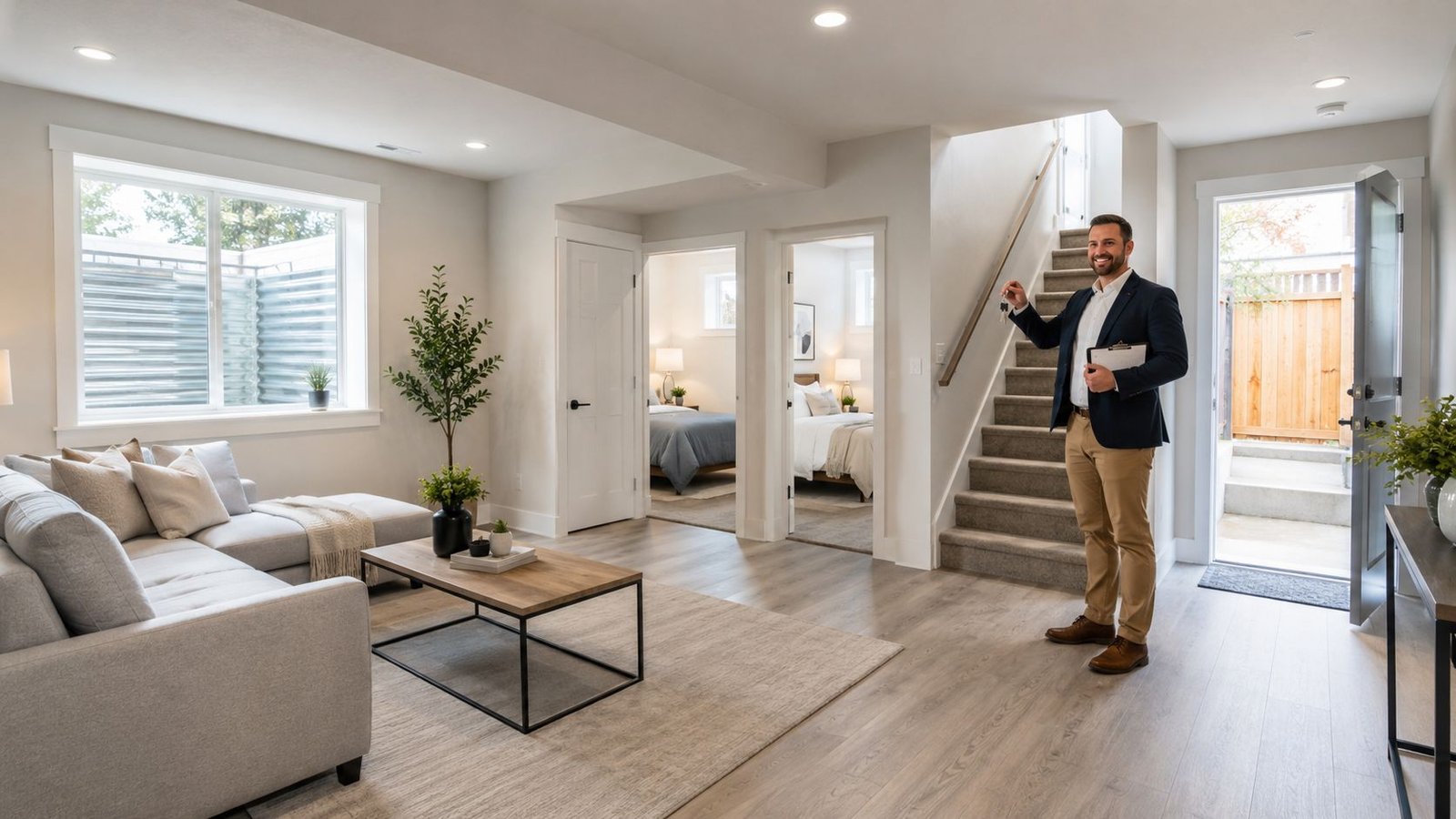
You've just finished the basement suite. The paint is dry, the kitchen looks sharp, and the second bedrooms finally feel usable. The temptation is to post 2 bedrooms basement for rent on Kijiji or Facebook Marketplace that same day, but that's usually where problems start, not where they end.
A basement suite that looks finished is not always a legal secondary suite, and that distinction affects everything from insurance to tenant risk to how confidently a landlord can set rent. In Alberta, the practical mistake is not underestimating demand, it's assuming a nice renovation automatically means the suite is ready to lease. It doesn't.
Table of Contents
- Why Your 2 Bedroom Basement Suite Needs a Strategy Before Listing
- Current Alberta Rental Market for Two-Bedroom Units
- Legal Requirements for a Basement Secondary Suite in Alberta
- Bedroom Size and Layout Code Compliance
- Setting the Right Rent for Your Basement Suite
- Tenant Screening That Protects Your Investment
- When to Bring in Professional Property Management
Why Your 2 Bedroom Basement Suite Needs a Strategy Before Listing
A Calgary landlord can spend months turning a basement into a polished two-bedroom unit, then hit a wall when the paper trail doesn't match the build. The suite may have proper flooring and new appliances, but if there's no completed permit history, weak fire separation, or missing egress details, the listing becomes a liability instead of an asset. That's the point where a “ready to rent” project turns into a delay, a rework, or an awkward conversation with an insurer.
The fastest way to lose money is to market too early
The market rewards the landlord who lists a compliant suite with clear features, not the one who posts first and hopes to fix issues later. If the unit is non-compliant, the rent figure becomes hard to defend, because tenants compare visible value while the owner carries hidden risk. Even a short vacancy gets expensive when the suite sits empty while work, permits, or inspections are sorted out.
A better approach starts with three questions. Is the suite legal? What rent does the local market support? What kind of tenant is likely to stay without constant conflict?
Practical rule: A finished basement is not a leasing strategy. A compliant, well-priced, well-screened basement suite is.
That sequence matters because the legal status influences everything else. A landlord who knows the suite is compliant can price more confidently, answer tenant questions directly, and avoid the uncertainty that comes with vague listing language. A landlord who skips that groundwork often ends up negotiating from a weak position once a serious tenant asks for documentation.
The biggest operational mistake is treating a basement suite like a standard apartment. It sits inside a building, often shares utilities or walls with the main home, and can create friction if the layout, screening, or lease terms are sloppy. That's why the smartest move before advertising is to check the suite against code, assess the local rent baseline, and decide who the right long-term tenant is.
Current Alberta Rental Market for Two-Bedroom Units
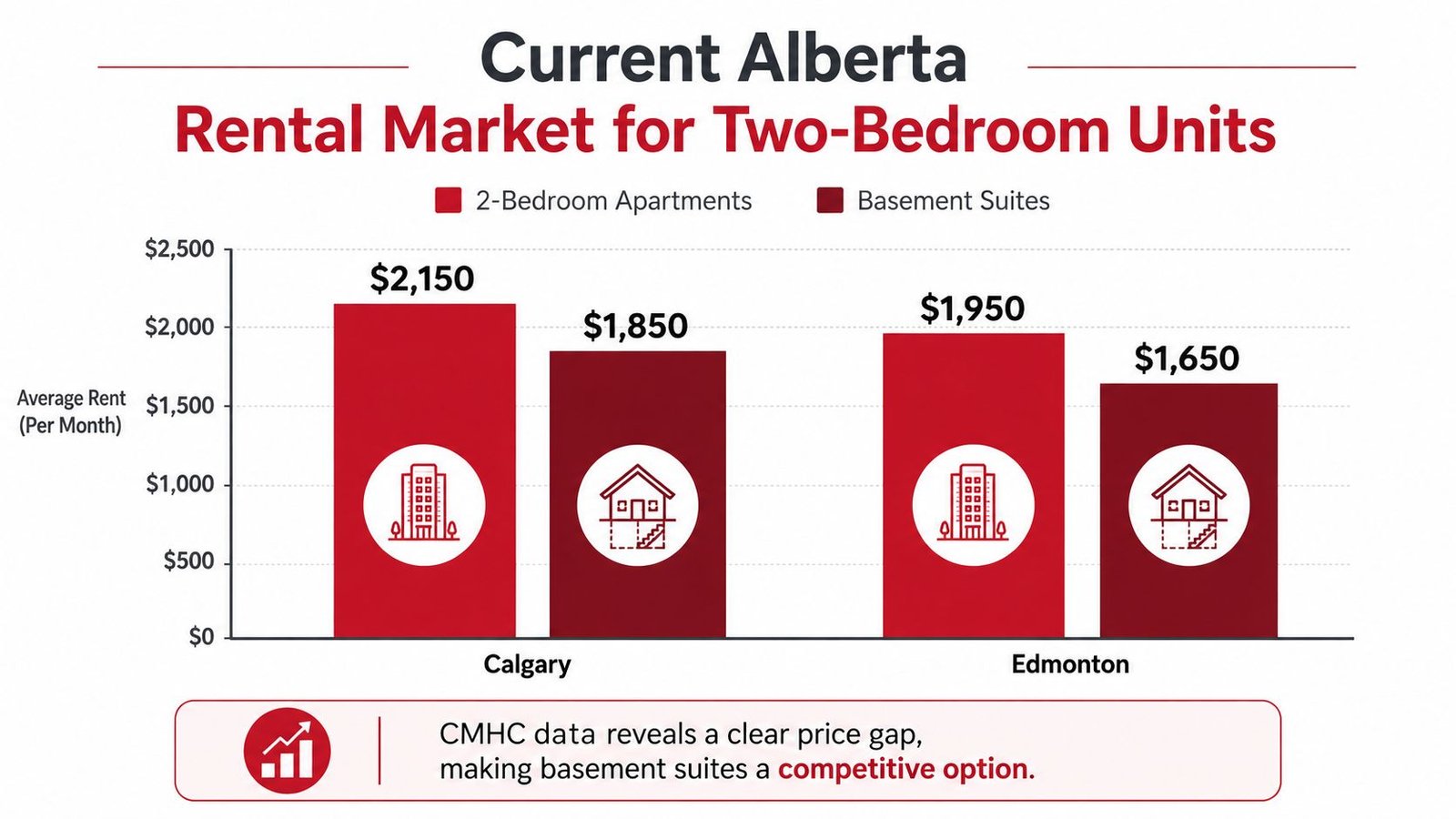
CMHC's Alberta rental-market figures show why basement-suite pricing can't be guessed. In 2023, Calgary's purpose-built rental vacancy rate fell to 1.4% from 4.6% in 2022, while Edmonton's fell to 4.3% from 5.4% over the same period, a clear sign of tighter supply in both cities. CMHC also reported average asking rents for a two-bedroom apartment of $1,777 in Calgary and $1,489 in Edmonton in 2023, which gives landlords a usable benchmark when they evaluate a 2 bedrooms basement for rent listing in Alberta. CMHC rental-market data as reported in Alberta coverage
What those benchmarks mean for basement suites
A basement suite usually doesn't compete head-to-head with a purpose-built apartment on every feature. The apartment benchmark is still useful, because it shows what tenants are already paying for a conventional two-bedroom layout in the same market. A basement suite has to earn its place with price, privacy, access, parking, and condition.
That's why a clean, legal suite with separate entry and decent light can still perform well even when it isn't identical to an above-grade apartment. Tenants often trade square footage and elevation for lower rent, more flexibility, or a quieter neighbourhood setting. But if the suite feels dark, cramped, or awkwardly planned, the rent ceiling drops quickly.
In a tight market, presentation matters, but the baseline still comes from comparable two-bedroom housing.
How to position the suite against the market
The right pricing conversation compares your suite to both apartment data and other basement listings, then adjusts for what the tenant gets. Separate laundry, a proper kitchen, parking, and a practical floor plan all support stronger interest. Poor natural light, low ceilings, and awkward bedroom placement push the other way.
For Calgary and Edmonton landlords, the most useful mindset is to price for occupancy quality, not just maximum rent. A well-kept legal suite that attracts a stable tenant is usually more valuable than a slightly higher number that leaves the unit vacant. That's especially true when the listing is competing against many other basement suites that all claim to be “bright” and “spacious.”
The market signal is simple. If the suite is legal, tidy, and easy to live in, renters will compare it against the broader two-bedroom pool. If it's not, the rent needs to reflect the discount created by risk and uncertainty.
Legal Requirements for a Basement Secondary Suite in Alberta
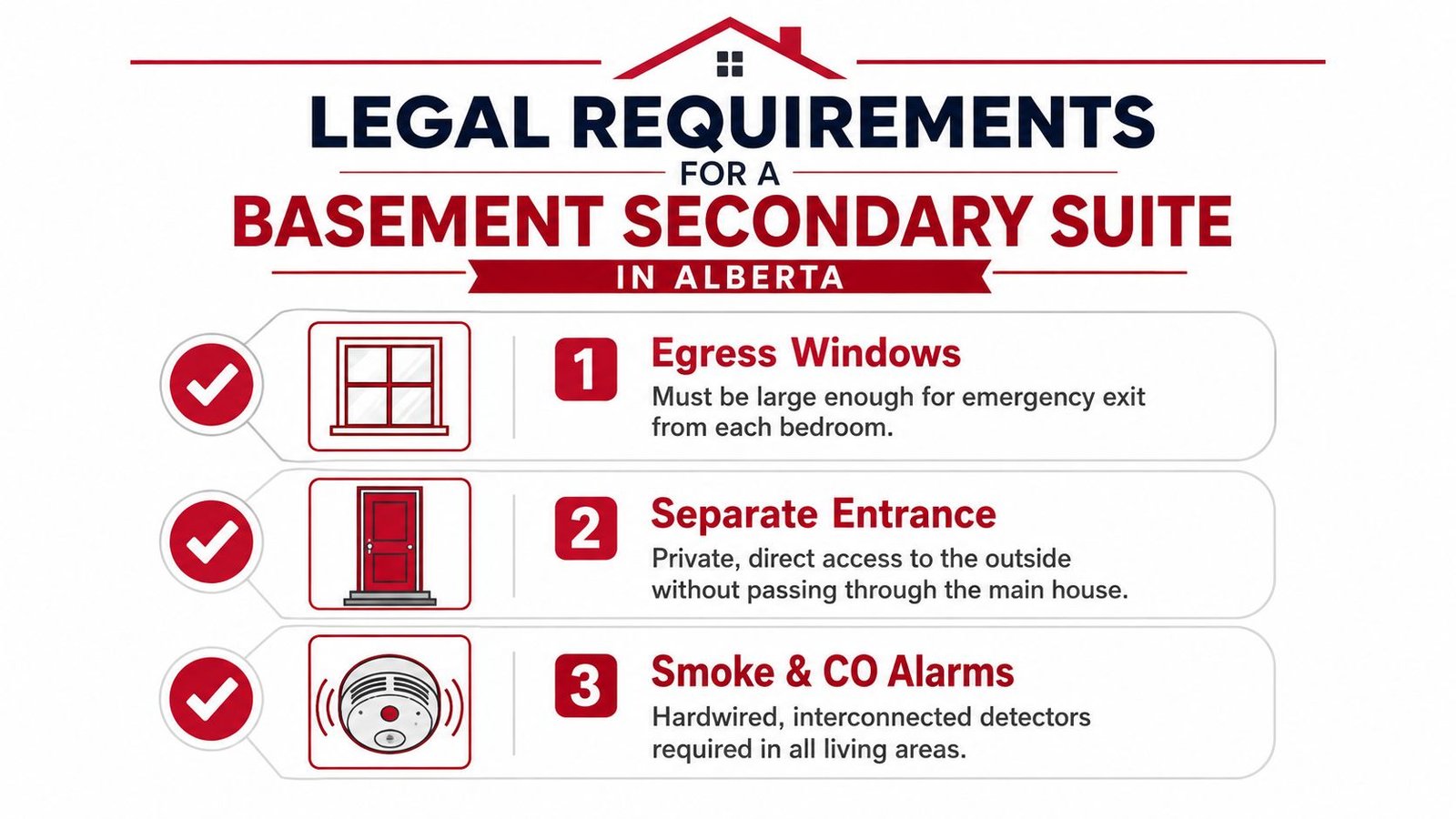
A basement suite becomes a real rental asset only when it clears the life-safety bar. In Alberta, that means landlords need to think in terms of egress, fire separation, smoke and CO alarms, ventilation, heating, and the permit trail that proves the work was approved. Alberta's framework also means a landlord should verify final inspections and confirm that each bedroom has a compliant escape window before advertising the suite as rentable. Alberta basement suite safety and compliance guidance
The permit trail matters more than the listing description
A unit can be marketed as a basement rental, but that doesn't make it a legal secondary suite. In Calgary, city guidance says a legal suite generally requires development approval, building permit approval, and a separate address. Once the tenant moves in, the tenancy still falls under Alberta's rental rules, which means compliance issues don't disappear just because a lease is signed. Alberta landlord and tenancy information
That permit history is important because many listings mention a separate entrance or utilities while leaving out whether the suite was approved. If the approvals were never completed, the landlord is carrying a larger risk than the ad suggests. Insurance and liability exposure are rarely front and centre until a claim or dispute happens.
The core life-safety checklist
The Canadian compliance rules commonly referenced for secondary suites focus on whether people can get out safely and whether fire can be contained long enough to escape. The minimum ceiling height for habitable rooms is commonly cited at 1.95 m, along with continuous fire separation, proper doors, smoke alarms, CO alarms, and escape provisions. Legal basement apartment requirements in Canada
A compliant suite should also satisfy the broader code logic used across Canadian jurisdictions. That includes proper means of egress, bedroom escape windows, and fire separation from the main dwelling. The National Building Code provisions commonly applied in Canada also require bedrooms to be at least 6.5 m² (70 sq. ft.) and prevent a bedroom from being the only access route to other habitable space. Canadian secondary-suite requirements overview
If the suite cannot be safely exited, separated, and documented, it isn't ready to advertise, no matter how good the finishes look.
That's the practical divide between a legal suite and a non-conforming one. A legal suite can be priced, insured, and managed with more confidence. A non-conforming suite can still exist, but it changes the risk profile and should never be treated like a standard apartment.
Bedroom Size and Layout Code Compliance
A two-bedroom label only works if both rooms function as bedrooms under the code logic that applies to secondary suites. That's where many basement projects get exposed, because the plan looks tidy on paper but falls apart once dimensions, circulation, and emergency access are checked against reality. A narrow room with a bed in it is not automatically a legal bedroom.
Measure the rooms, not the furniture placement
The first check is simple. Each bedroom needs to meet the relevant size threshold, which is commonly cited at 6.5 m² (70 sq. ft.) for Canadian basement-suite guidance. That measurement should be taken as usable floor area, not as the area left after a closet, bulkhead, or awkward jog eats into the room.
Then look at how each room connects to the rest of the suite. Bedrooms can't be the only route into another habitable space. If a tenant has to pass through one bedroom to reach another room that's part of the suite's living area, the layout is a problem, not a clever use of space. Bedroom layout and rental-basement guidance
Egress windows and honest marketing
Egress matters because a basement bedroom has to give occupants a real way out in an emergency. If the window is too small, blocked by landscaping, or awkwardly placed behind a fixed screen, the room may not function as a legal bedroom no matter what the listing says. That's why a “2 bedroom” ad should only be used when both rooms satisfy the safety and access requirements.
A landlord should document the measurements and keep them with the file. That includes room dimensions, window sizes, and photos of the finished layout. If one room comes up short, the honest move is to market the suite differently, maybe as a 1-bedroom plus den or a flexible layout, rather than overstating the compliance status.
Useful habit: Measure the suite like an inspector would, not like a marketer would.
That approach prevents disputes later. Tenants who move in expecting two full legal bedrooms get frustrated quickly if one room turns out to be a compromise space. A precise listing protects both sides and keeps the lease aligned with the actual unit.
Setting the Right Rent for Your Basement Suite
Pricing a basement suite works best when the landlord starts with facts, then adjusts for the suite's actual liveability. The benchmark from the Calgary and Edmonton apartment market gives a ceiling of sorts, but the suite's condition, compliance status, and layout determine where the rental lands under that ceiling. A legal, well-finished basement can compete. A cramped or uncertain one cannot.
Compare the suite to real listings, not assumptions
A landlord should check Kijiji, Facebook Marketplace, and dedicated rental platforms for similar basement units in the same neighbourhood. The point is not to copy one asking price. The point is to see how the market responds to suites with similar light, access, parking, and bedroom quality.
The strongest pricing arguments usually come from features tenants can feel immediately. A bright walkout, solid ceiling height, modern finishes, and a practical layout all support stronger demand. A unit with limited natural light, shared laundry headaches, or tight parking usually needs to sit lower.
Decide how utilities fit into the number
Utilities are part of the pricing decision, not an afterthought. Including them can make the listing easier to market, but it also increases the owner's exposure to usage swings and bookkeeping. Separating utilities can reduce ambiguity, yet it may narrow the pool of applicants who want simple all-in rent.
Either way, the rent needs to be defensible. A tenant who asks why the price is what it is should hear a straightforward answer tied to the suite's condition, the legal status, and the local market. That's easier to do when the landlord knows how the unit compares to the apartment benchmarks already in play.
A practical pricing framework looks like this:
- Start with comparables: Use nearby basement and two-bedroom apartment listings to find the local band.
- Adjust for legal status: A documented, compliant suite supports stronger confidence than a grey-area unit.
- Account for features: Light, ceiling height, parking, and separate entry all change the value.
- Test the response: If qualified inquiries are weak, the price is likely too high for the suite's condition.
The best pricing strategy is rarely the highest one. It's the one that attracts a stable tenant without leaving the landlord stuck in a long vacancy cycle.
Tenant Screening That Protects Your Investment
Basement-suite screening has to account for proximity. A tenant in a basement unit often shares a building envelope, a yard, parking, or even utility systems with the owner or another occupant, so compatibility matters as much as payment history. A strong applicant who respects the space is worth more than a fast-approving one who creates constant tension.
Screen for stability, not just interest
A solid screening file should include credit, income verification, previous landlord references, and identity confirmation. For income, a common rule of thumb is gross income of at least three times the rent, but the broader point is to confirm the applicant can sustain the lease without strain. A clean credit score alone doesn't tell the full story if the household is overextended elsewhere.
The interview matters too. Ask how the applicant uses rental space, how many occupants will live in the suite, and whether anyone works from home or plans frequent visitors. That reveals whether the tenant's lifestyle fits the basement setting or will create conflicts.
Watch for basement-specific red flags
Some issues show up early if the screening process is structured. Applicants who want to sublet rooms, run a business from the unit, or squeeze extra occupants into the space can quickly turn a manageable basement rental into a problem property. The same applies to applicants who avoid direct answers about previous rentals or pressure for exceptions before the lease is even signed.
A separate reference check helps confirm the story. Previous landlords can flag noise issues, arrears, unauthorized occupants, or early move-outs that never appear in the application form. That information is especially valuable in a basement suite, where one difficult tenant can affect the daily living experience of the whole property.
For a deeper checklist on tenancy vetting, use the landlord screening process described in credit checks for tenants. The goal is not to be rigid for its own sake. The goal is to reduce the odds of arrears, conflict, and turnover in a unit where small problems are harder to ignore.
Screening rule: If the applicant creates uncertainty before move-in, the lease is likely to create more uncertainty after move-in.
That's why good screening protects the investment. It keeps the basement suite occupied by someone who pays on time, respects shared spaces, and stays long enough to make the renovation worthwhile.
When to Bring in Professional Property Management
A basement suite can look simple from the outside and still demand a surprising amount of work once it's listed. Showings have to be coordinated, applicants have to be screened, lease documents need to align with Alberta rules, and maintenance issues arrive on their own schedule. For a landlord living upstairs or managing remotely, that load gets heavy fast.
The value is in the process
Professional management helps because it turns scattered tasks into a repeatable system. That includes rental photos, listing copy, multi-channel advertising, coordinated showings, lease drafting, rent collection, arrears follow-up, inspections, condition reports, and maintenance coordination with trusted vendors. Those are the parts that keep a basement suite operating cleanly after the renovation glow wears off.
The legal side matters too. Lease language, notices, records, and inspection notes all have to stay organised if the tenancy is ever challenged. That's where a licensed brokerage adds structure, because it isn't just trying to fill a vacancy, it's managing the file behind the vacancy. What to look for in a property manager
Why basement suites benefit more than most rentals
Basement rentals are not difficult because they are small. They are difficult because they're close. The owner can hear issues sooner, tenants can feel uneven treatment faster, and maintenance needs often affect more than one part of the property. A professional manager reduces those pinch points by handling communication, documentation, and follow-through.
That matters even more when the landlord is unsure about the suite's compliance history. A manager can help keep the listing aligned with what the unit can legally support, which protects both pricing and risk management. For owners who want local oversight without living in the middle of every repair call, that separation is worth a lot.
Dreamhouse Realty Ltd. serves Calgary, Edmonton, Red Deer, and surrounding Alberta communities with rental management, tenant placement, and compliance-focused operations. For landlords who want a practical review of a basement suite, or a clean path from finished renovation to qualified tenant, contact GURIQBAL CHAHAL, MBA, PMP, REAL ESTATE BROKER at 403-966-6072.
Dreamhouse Realty Ltd. helps Alberta landlords turn finished basement suites into compliant, well-managed rentals with stronger tenant screening and cleaner day-to-day operations. If you've just completed a 2 bedrooms basement for rent project and want a practical review of legality, pricing, and tenant fit, visit Dreamhouse Realty Ltd. and speak with GURIQBAL CHAHAL, MBA, PMP, REAL ESTATE BROKER at 403-966-6072.