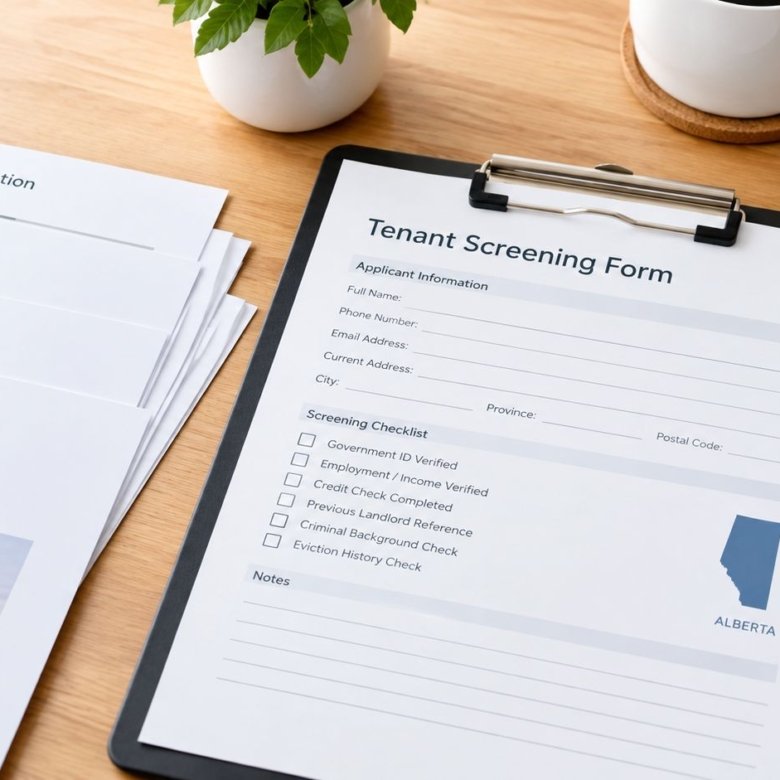

A Calgary landlord dealing with unpaid rent or serious damage usually needs to make two decisions quickly: which notice fits the problem, and what evidence will support it if the tenant challenges it. Getting those decisions wrong can delay enforcement and force the landlord to start again with a corrected notice.
Alberta's eviction process turns on details that can seem small in the moment: the reason stated, the termination date, the signature and proof of service. This is a practical guide for Alberta landlords and property managers, not a US-style eviction playbook. The safest approach is to match the notice to the legally recognised situation, check every required detail before service, and keep an organised record from the first report of a problem.
Table of Contents
- When a Calgary Landlord Realizes the Notice Has to Be Right
- What Makes an Eviction Notice Valid Under the Act
- Notice Types and Timelines Side by Side
- The 14 Clear-Day Rule and Why 14 Is Often 16
- The Cure Clause for Unpaid Rent Notices
- Serving the Notice So It Holds Up Later
- Self-Help Mistakes That Void a Valid Notice
- Inspection Reports and the Closing Compliance Picture
When a Calgary Landlord Realizes the Notice Has to Be Right
A Calgary owner hears from a tenant that the rent won't be paid on time. Another landlord discovers damage during a visit and wants the tenant out immediately. In either situation, the first impulse may be to download a form, fill in a date and send it. That's where a manageable problem can turn into a disputed notice.
The notice is not just a warning. It has to identify the rental property, state the reason for ending the tenancy, give the correct termination date and time, and carry the landlord's or authorised agent's signature. The notice period also depends on the type and seriousness of the alleged breach. Alberta's Residential Tenancies Act guidance on ending a tenancy sets out these requirements for landlords across the province, including Calgary, Edmonton, Red Deer and surrounding communities.
The practical test is simple: could someone reviewing the file understand exactly what happened, why this notice applies and how the landlord served it?
A landlord also needs more than a strong opinion about a tenant's conduct. The file should contain the lease, relevant communications, records supporting the breach and a clear service record. If the notice contains the wrong reason or date, or the landlord can't establish when and how it was delivered, enforcement may be delayed. A fresh notice may be necessary.
This is a working process for owners and property managers who need decisions they can put into practice. Legal advice may also be useful when a dispute involves complicated facts. For example, a landlord comparing how tenancy disputes are handled in different jurisdictions might consult Olson & Sons' Kealakekua tenant lawyer resource, while keeping the Alberta rules and process as the guide for an Alberta property.
What Makes an Eviction Notice Valid Under the Act
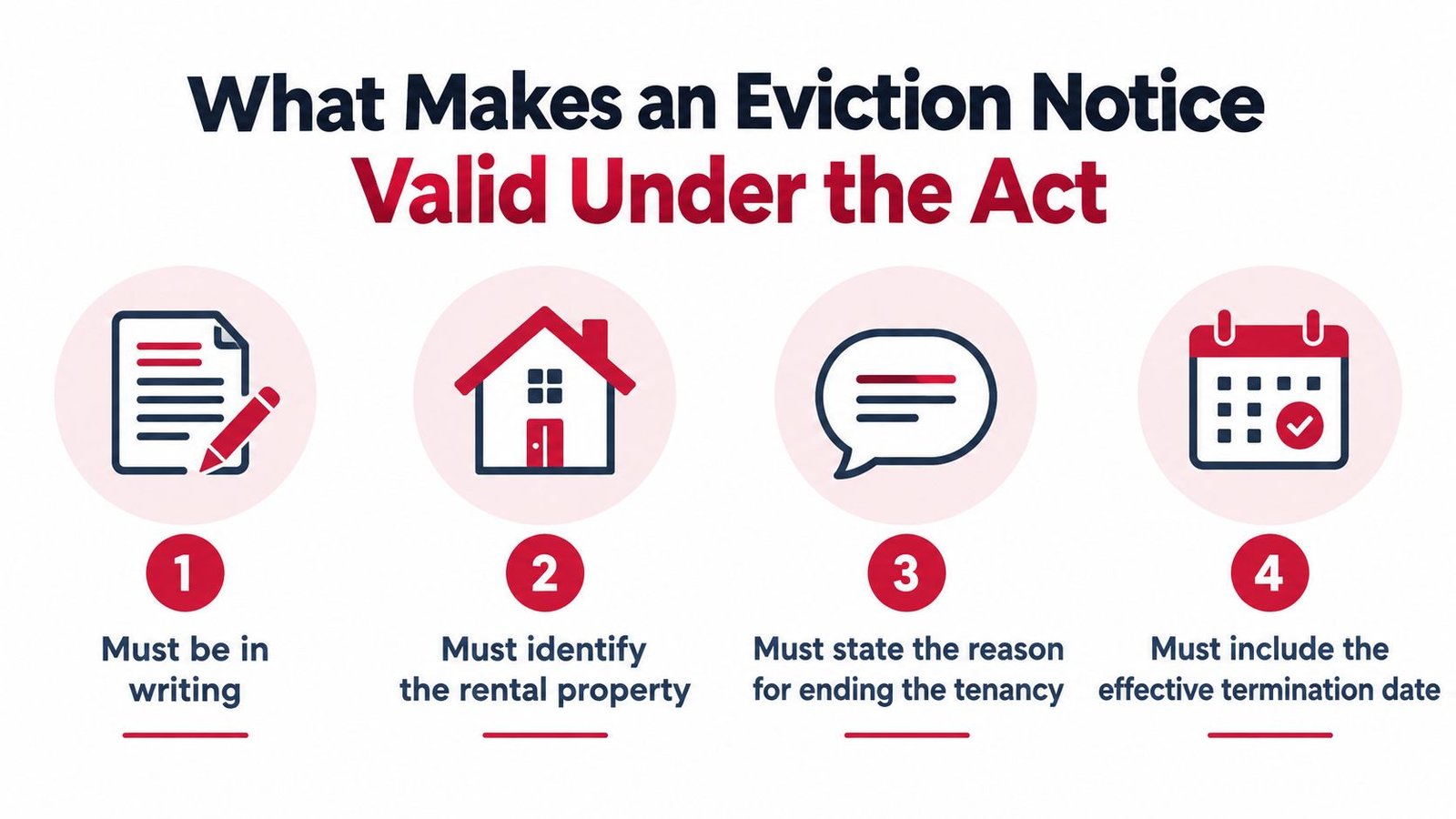
A valid Alberta notice needs to tell the tenant, in writing, what property is affected, why the tenancy is ending, when it ends and who issued the notice. The landlord or the landlord's authorised agent must sign it. Leaving out a required detail can give the tenant grounds to challenge the notice, even when the underlying complaint is genuine.
Check the document before it leaves the office
Identify the rental property. Use enough detail to make clear which tenancy the notice concerns. A vague reference to “the unit” can invite avoidable arguments, especially when an owner manages several properties.
State the reason plainly. “You have breached the lease” doesn't explain what the tenant allegedly did or why the landlord is ending the tenancy. Name the breach and describe it clearly. The reason in the notice should match the reason the landlord relies on if the dispute goes to a hearing.
Specify the termination date and time. The tenant needs to know when the tenancy is stated to end. Calculate the date using the applicable notice rules rather than estimating from the day the form is drafted.
Include the required signature. The landlord can sign, or an authorised agent such as a property manager can sign on the landlord's behalf. Keep the authorisation and a copy of the signed notice in the tenancy file.
The notice must be written and signed, identify the property and reason, and specify the termination date and time under Alberta's landlord and tenant common-problem guidance. Those elements belong on the notice itself, not in a separate explanation that the tenant may never receive. Landlords can also use the Alberta RTA handbook as a reference when organising their tenancy documents.
A landlord dealing with a payment dispute may find it useful to understand how an eviction notice differs from a demand to pay. Mediation & Negotiation Services' dispute settlement support on eviction notices and payment notices offers context on that distinction. For an Alberta tenancy, though, the notice must still satisfy Alberta's statutory requirements.
Notice Types and Timelines Side by Side
The right notice depends on the situation, not on how urgently the landlord wants the tenant to leave. Alberta has distinct periods for specific grounds. Treating a short notice as a general shortcut is a fast way to weaken the case.
| Notice Type | Minimum Period | Qualifying Situation | Common Misuse Risk |
|---|---|---|---|
| Serious damage or violence | At least 24 hours | Significant damage to the rental property, physical assault, or a threat to physically assault the landlord or another tenant | Using it for ordinary arrears or a routine conduct dispute |
| Certain unauthorised occupants | At least 48 hours | An unauthorised occupant, where the tenant has moved out | Using it when the tenant still occupies the property |
| Substantial breach | At least 14 days | A substantial breach of the tenancy agreement | Counting days incorrectly or describing the breach vaguely |
The 24-hour notice is for serious safety or property-damage situations. It applies when a tenant assaults or threatens to assault the landlord or another tenant, or causes significant damage to the residential premises. It is not a general response to unpaid rent, noise complaints or a difficult relationship with a tenant. Alberta's landlord information on ending a tenancy explains the narrow circumstances for this option.
The 48-hour notice addresses an unauthorised occupant when the tenant has moved out. It doesn't fit a situation where the tenant remains in possession and the dispute concerns a guest or other occupant.
For most ordinary breach disputes, the 14-day notice is the relevant tool. A substantial breach can arise from one failure to meet an obligation or from multiple breaches whose combined effect is substantial. The landlord must be able to describe and support the breach, not just label it “substantial.”
These are for-cause notices. They're different from ending a periodic tenancy: a landlord generally gives written notice on or before the first day of the relevant three-month notice period for a month-to-month tenancy, while a yearly tenancy generally requires 90 days' written notice effective on the last day of the tenancy year. Don't use a breach notice when the landlord's actual purpose is to end a periodic tenancy.
The 14 Clear-Day Rule and Why 14 Is Often 16
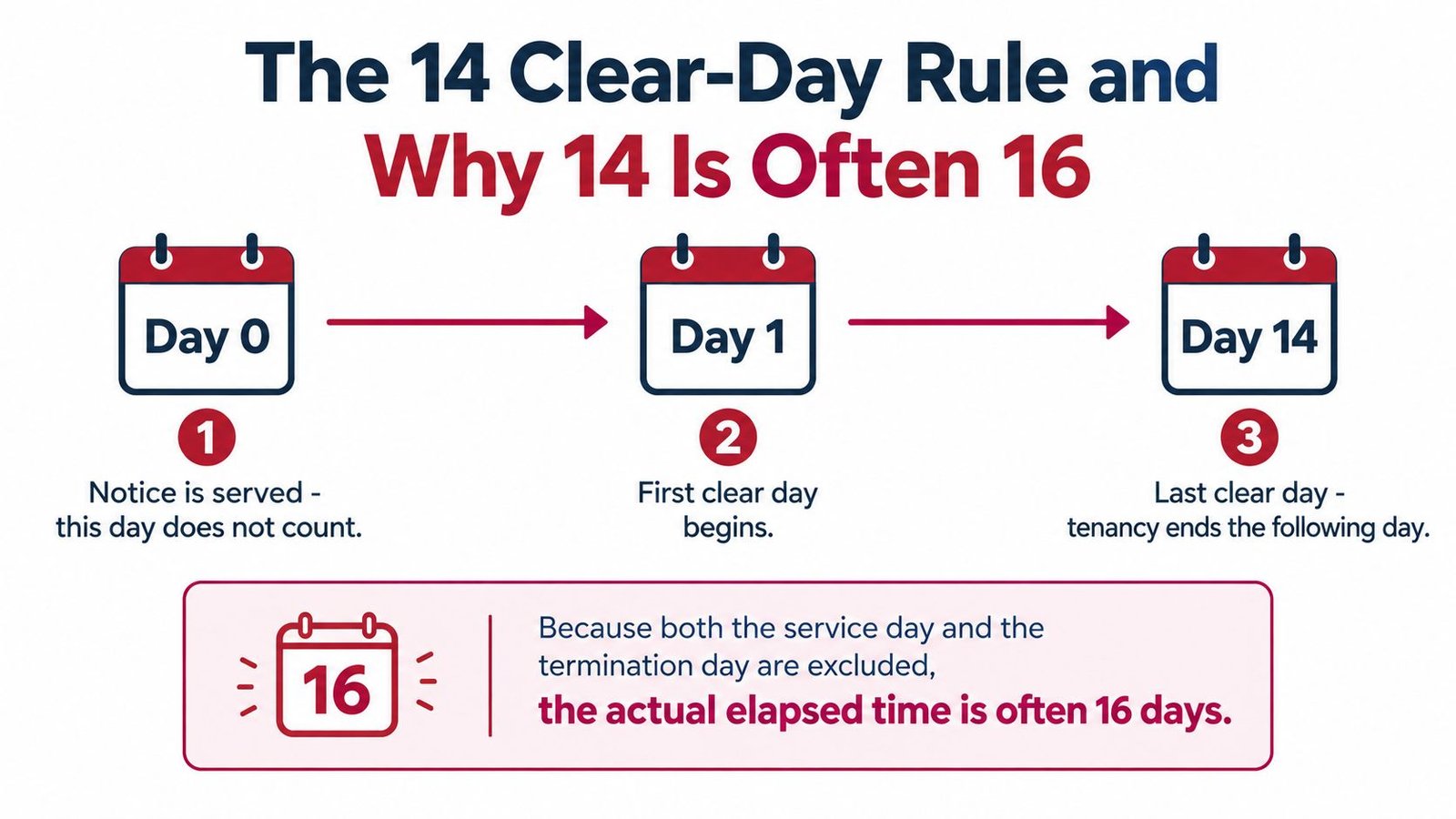
A 14-day notice doesn't mean counting fourteen calendar dates inclusively from the day it's served. Alberta's rule requires 14 clear days. The service day and the termination day don't count toward that period, so the elapsed span can be 16 calendar days. Alberta's tenant information on notice periods explains this distinction.
Calculate from the service date
Suppose a landlord serves a notice on a Monday. That Monday is not a clear day. The termination date also doesn't count. The first clear day begins after service, and the landlord needs to allow the full required period before the tenancy ends. Operationally, plan for at least 16 calendar days between service and the stated move-out date to avoid an invalid notice.
A practical scheduling formula is:
Service date + 16 calendar days = earliest safe termination date.
That's a planning safeguard, not a substitute for checking the actual calendar and notice details. If a property manager serves the notice, record the service date immediately and calculate the termination date from that documented date. A one-day mistake can mean the notice has to be served again.
Don't mix this calculation up with periodic-tenancy termination rules. A month-to-month tenancy generally requires written notice on or before the first day of the relevant three-month notice period. A yearly tenancy generally requires 90 days' written notice, effective on the last day of the tenancy year. These rules apply to a different kind of termination than a substantial-breach notice.
Count the clear days from the date the tenant receives the notice, not from the date someone drafted or signed it.
When the substantial breach is unpaid rent, accurate timing is only part of the job. The notice also needs the statutory payment condition that lets the tenant cure the arrears.
The Cure Clause for Unpaid Rent Notices
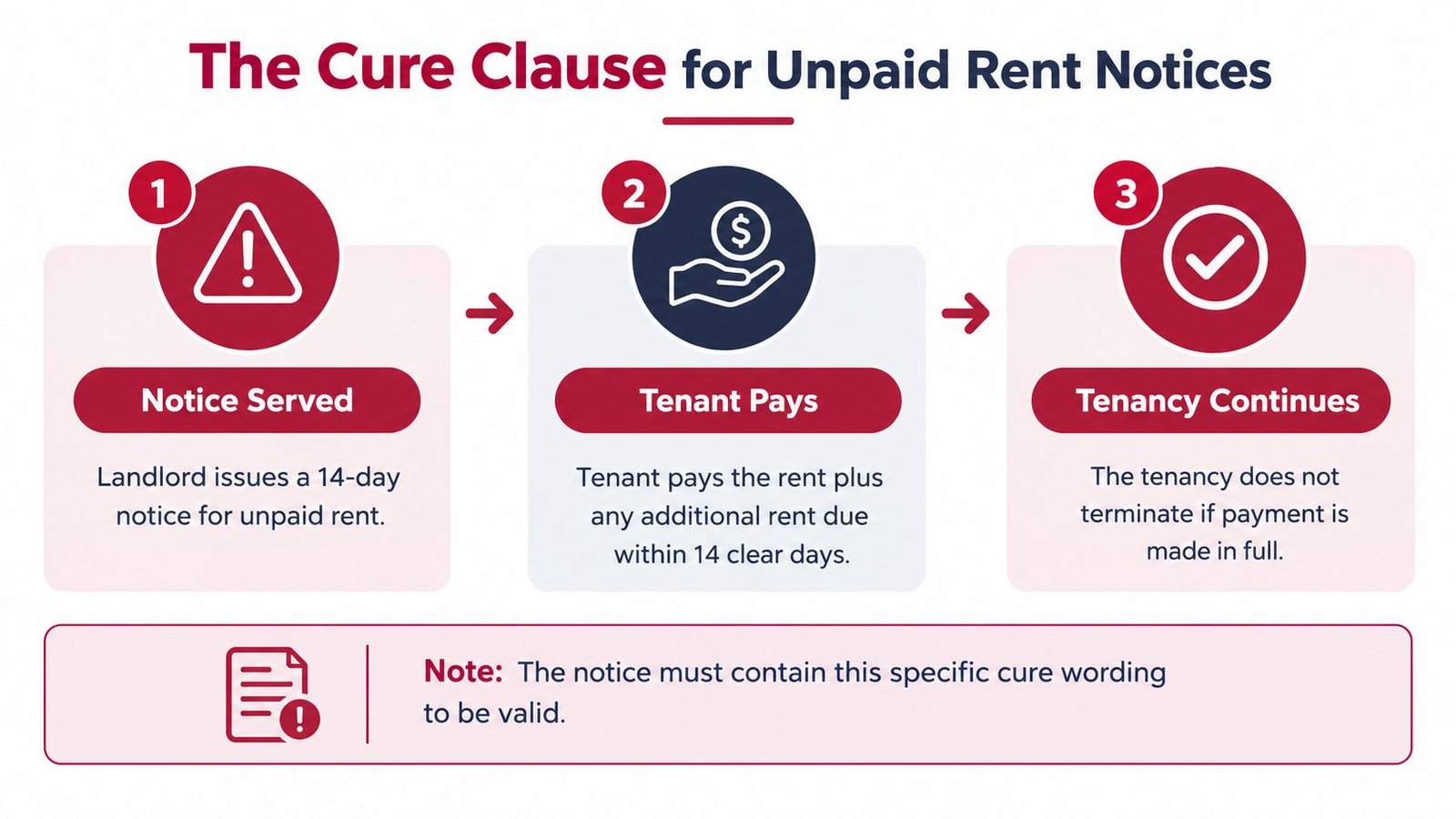
An unpaid-rent notice is conditional. It must say that the tenancy won't terminate if, on or before the termination date, the tenant pays the rent and any additional rent that has become due as of payment. That wording matters because the tenant has a chance to pay and keep the tenancy in place. Alberta's tenant information on ending a tenancy sets out this cure requirement.
Run the rent file like a live account
Before service, the landlord or manager should reconcile the ledger and confirm what remains unpaid. The notice should accurately state the arrears and include the required condition about rent and additional rent becoming due. A notice that omits the cure language, understates the balance or gives too little time can undermine the termination process.
A reliable workflow is straightforward:
- Reconcile the ledger: Confirm the balance and note the date through which it's calculated.
- Identify the rent due: Include the rent and any additional rent covered by the statutory condition.
- Draft and sign the notice: Use the correct breach description, termination date and cure wording.
- Document service: Keep the signed notice and a record of when and how it was delivered.
- Recheck payment status: Track the account through the termination date. If the tenant pays the amount required under the notice, the tenancy doesn't terminate on that notice.
A working rent payment ledger helps a property manager connect charges, payments and the notice balance. The ledger should remain current while the cure period runs. Don't treat the initial balance as fixed if further rent becomes due or the tenant makes a payment.
If the facts, arrears or possession dispute call for an enforceable order, the landlord can apply to the Residential Tenancy Dispute Resolution Service (RTDRS) or court rather than relying solely on a notice. The notice route and an application for an order are different paths, and the file should show why the chosen one fits the dispute.
Serving the Notice So It Holds Up Later
A correctly drafted notice is only useful if the landlord can show that it was served. For a Calgary-area owner, the service record should identify who delivered the notice, when it was delivered and how. Keep the signed copy with the record, not in a separate inbox that may be hard to retrieve during a dispute.
Build proof at the time of delivery
Use a method permitted for the tenancy and the circumstances, and keep evidence that fits that method. A witnessed hand delivery can be supported by a dated note recording the time, place and person who received it. If the tenant acknowledges receipt in writing, save that acknowledgment with the notice.
For any delivery method, don't rely on a later recollection as the only proof. A manager should record the date immediately, retain relevant correspondence and preserve any available delivery confirmation. If the landlord uses a property manager as an authorised agent, the file should also show that the manager had authority to sign and serve notices on the landlord's behalf.
A clean service record connects the notice to the tenant. Without it, the landlord may struggle to establish when the notice period began.
Property managers should use a consistent file structure: the signed notice, the service record, relevant messages and documents supporting the alleged breach. That makes it easier to locate the evidence if the tenant disputes the date or claims the notice never arrived. It also gives an owner who lives outside Alberta a clear record of what the local manager did.
A delivery method can't fix a defective notice. The property, reason, signature and termination information still need to be correct. Service is the bridge between a properly prepared notice and a defensible file, so it deserves the same care as drafting.
Self-Help Mistakes That Void a Valid Notice
A tenant refusing to leave doesn't give a landlord permission to force them out. Changing the locks, shutting off heat or power, removing doors, moving the tenant's belongings or pressuring them verbally to vacate can create a new dispute and undermine the original notice.
The safer course is to keep the property in the tenant's possession until the termination date has passed and to seek an RTDRS or court order if the tenant doesn't leave. If an order grants possession, the sheriff can enforce it where required. A landlord should not try to replace that process with a lock change or a utility shutoff.

Keep the response lawful and documented
If safety or serious damage is involved, preserve evidence and contact the appropriate emergency services where needed. Don't use a serious incident as a reason to take control of the unit without following the applicable process. Alberta's guidance for landlords dealing with serious violence or damage describes the available notice or application route for those circumstances.
Patience after service protects the file. Self-help can turn a documented breach into a separate complaint about the landlord's conduct, making the path to possession more difficult instead of faster.
Inspection Reports and the Closing Compliance Picture
Ending a tenancy is only one part of the compliance record. Alberta requires landlords and tenants to complete both move-in and move-out inspection reports. Those reports matter when a landlord alleges significant damage because they help establish the property's condition and provide context for what changed during the tenancy. Alberta's guidance on responsibilities during a tenancy identifies these inspections as mandatory.
A useful damage file brings related evidence together. Keep the inspection reports with dated photographs, repair invoices, relevant tenant communications and the lease terms. This can help distinguish ordinary wear and tear from damage and support the factual reason given in a notice. A bare allegation is less persuasive than a clear record made close to the event.
Keep the process joined up
For Calgary-area landlords, a managed workflow should connect the notice to the evidence and the next decision:
- Document the condition: Complete and retain the required inspection reports, with dated photographs where useful.
- Match the notice to the facts: State the supported breach and use the applicable notice process.
- Record service: Keep the signed notice and evidence of delivery in the same tenancy file.
- Track the next milestone: Monitor the cure period or termination date, then assess whether the tenant has complied or left.
- Escalate when needed: Apply to the RTDRS or court when possession or another enforceable decision is required.
A move-out file should remain connected to the earlier condition record. Landlords can use this Alberta move-out inspection guide to organise the inspection side of the process. For owners managing remotely, a local property manager can coordinate inspections, communications, records and appropriate escalation while keeping the owner informed.
Owners in Calgary, Edmonton, Red Deer and surrounding Alberta communities who want help managing notices, inspections and tenancy compliance can contact GURIQBAL CHAHAL, MBA, PMP, REAL ESTATE BROKER, at 403-966-6072.
Dreamhouse Realty Ltd. provides residential property management, tenant placement, rent collection, inspection coordination and compliance support for Alberta rental owners. To discuss a notice workflow or ongoing management for a Calgary-area property, visit Dreamhouse Realty Ltd..