

A Calgary landlord can start the week with an empty condo, spend the afternoon answering applicant questions, and end the evening dealing with a leaking faucet. A confusing notice or missed inspection record can add another layer of worry, especially when the owner lives outside Alberta or has a full-time job.
That's why the question what does a property manager do deserves more than the usual answer, “collects rent and handles repairs.” In Alberta, the role combines leasing, tenant communication, maintenance, accounting, documentation, and legal process. A capable manager acts like the operating system behind the rental, keeping each moving part connected.
For owners in Calgary, Edmonton, Red Deer, and surrounding communities, this guide explains the work in practical terms. It follows the rental lifecycle from marketing and screening to move-in, maintenance, renewals, and reporting, then shows how Alberta's changing vacancy conditions affect the manager's priorities. Dreamhouse Realty Ltd. supports owners with local oversight and structured residential rental management across these Alberta markets.
The manager ultimately serves as the bridge between the owner's financial goals and the tenant's everyday experience. When that bridge is organised, the property is easier to operate, the tenant receives clearer service, and the owner has better information for decisions.
Table of Contents
- Introduction Why Alberta Landlords Ask What Managers Really Do
- Understanding the Core Role of a Property Manager in Alberta
- Key Responsibilities From Marketing to Accounting
- Alberta Compliance Duties Every Manager Must Handle
- Benefits of Hiring a Property Manager Versus Self Managing
- Real World Examples of Property Management in Calgary and Alberta
- Choosing the Right Property Manager and Next Steps in Alberta
Introduction Why Alberta Landlords Ask What Managers Really Do
A Calgary condo can sit vacant while its owner pays the mortgage, insurance, utilities, and maintenance costs. After a tenant moves in, the workload changes rather than disappears. A late payment, urgent repair, access request, or disagreement about the unit's condition may still demand a quick response.
A property manager handles that operating workload through a connected process. The manager markets the home, answers inquiries, arranges showings, screens applicants, prepares leasing documents, communicates with tenants, coordinates repairs, and maintains records. Each task supports the next stage of the tenancy, much like a relay where a missed handoff affects the entire race.
Small gaps can create larger problems. An incomplete listing may attract unsuitable inquiries. Inconsistent screening can lead to payment or communication difficulties. Weak move-in documentation can make a condition dispute harder to resolve, while a missed notice deadline can create a compliance concern.
Practical insight: A property manager does not remove every decision from an owner. The manager builds a reliable process and gives the owner complete information for decisions.
Calgary's rental market also changes the job's priorities. Conditions have shifted from the exceptionally tight market seen earlier in the cycle toward a more balanced situation. CMHC data recorded purpose-built rental vacancy rising from 1.4% in 2023 to 5.0% in October 2025, with average rents of $1,582 for a one-bedroom and $1,914 for a two-bedroom. The figures are reported in CMHC's Calgary rental market dashboard. With more choice for renters, managers must price carefully, present the property well, respond promptly, support tenant retention, and limit vacancy time. The role is therefore a vacancy-risk operator as well as a rent and repair coordinator.
The discussion ahead focuses on Alberta landlords with single-family homes, condos, townhomes, or small multifamily properties. It explains what professional management involves across the rental lifecycle, from the owner's first decision to the tenant's ongoing experience.
Understanding the Core Role of a Property Manager in Alberta
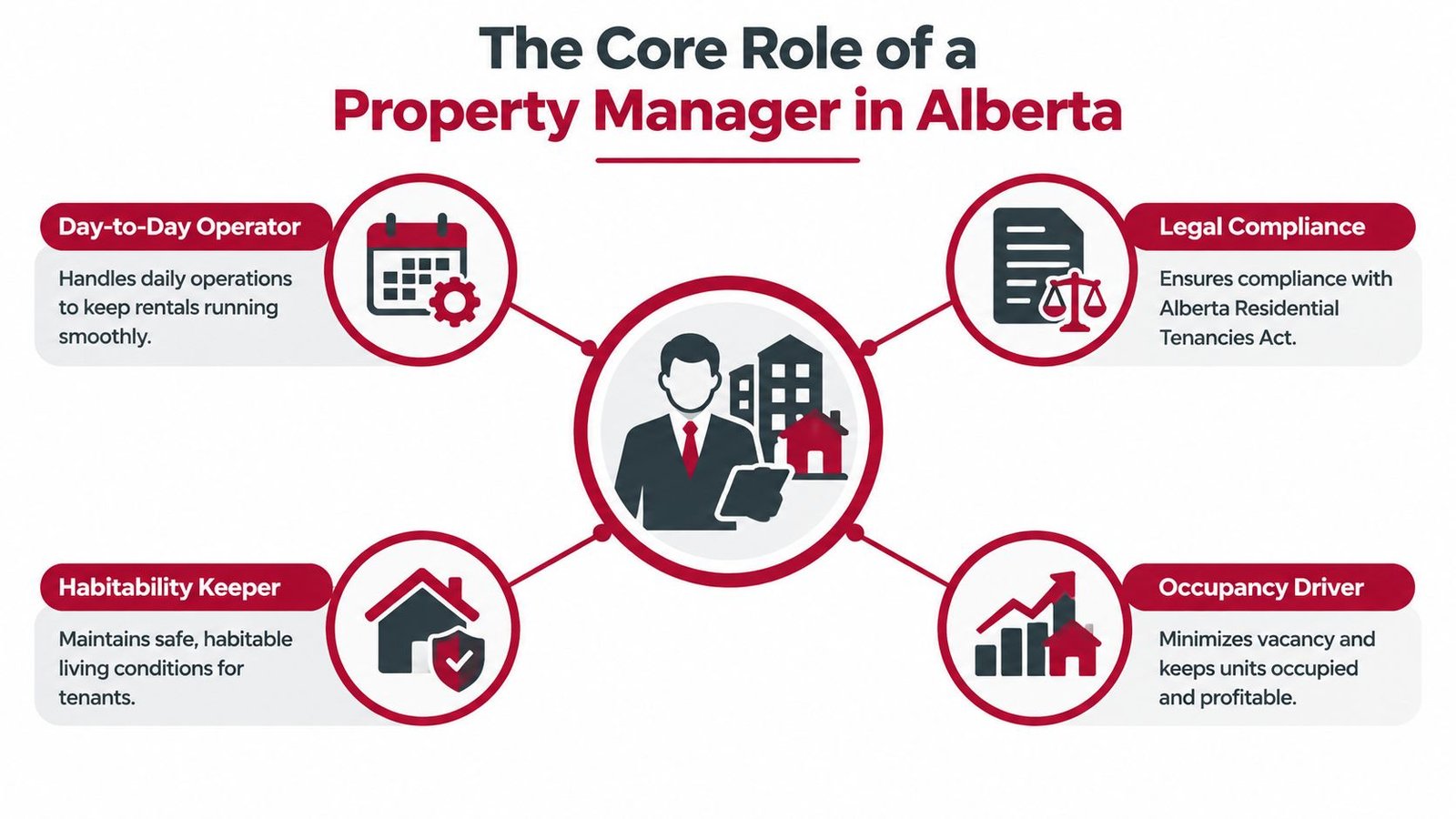
A Calgary rental sits empty after a tenant leaves. At the same time, a repair request arrives from another unit and an owner needs a clear update. A property manager coordinates these details as the day-to-day operator of the rental. The role combines building superintendent duties with business administration: keeping the home functional while managing leasing, records, notices, rent, vendors, and owner reporting.
Alberta's Residential Tenancies Act framework sets the operating baseline. The landlord must make the premises available on the move-in date, provide written notice identifying the landlord within 7 days, respect the tenant's peaceful enjoyment except where access is needed for the landlord's business, and keep the unit habitable under the Minimum Housing and Health Standards. Alberta rental and landlord-tenant guidance explains these responsibilities. A manager turns them into scheduled actions, documented communication, and follow-up.
The operating system behind a tenancy
A manager's process connects each stage of the tenancy:
- Leasing: The manager prepares the listing, handles inquiries, and reviews applicants through a consistent process.
- Move-in: The manager arranges access, required information, inspection records, and documentation.
- Property care: The manager responds to maintenance requests and arranges work that keeps the unit suitable for living.
- Compliance: The manager records notices, inspections, rent activity, and communications so the file can be checked later.
- Owner reporting: The manager organises income, expenses, work orders, and tenancy events for the owner.
Calgary's market conditions change how this system is used. Purpose-built rental vacancy rose from 1.4% in 2023 to 5.0% in October 2025, with average rents of $1,582 for a one-bedroom and $1,914 for a two-bedroom, according to CMHC's Calgary rental market dashboard. In a more balanced market, a manager must reduce vacancy risk through accurate pricing, clear presentation, prompt responses, and tenant retention. A condo, studio, and detached home may each require a different leasing and renewal approach.
Applicant review also needs a repeatable process. Owners can browse Alero Background & Identity real estate screening resources to see how identity and background checks fit within broader review. Screening must still follow applicable privacy and human rights obligations.
The central idea is practical: a manager builds routines that prevent missed steps, keep the premises suitable, and give the owner a defensible record of what happened.
Key Responsibilities From Marketing to Accounting
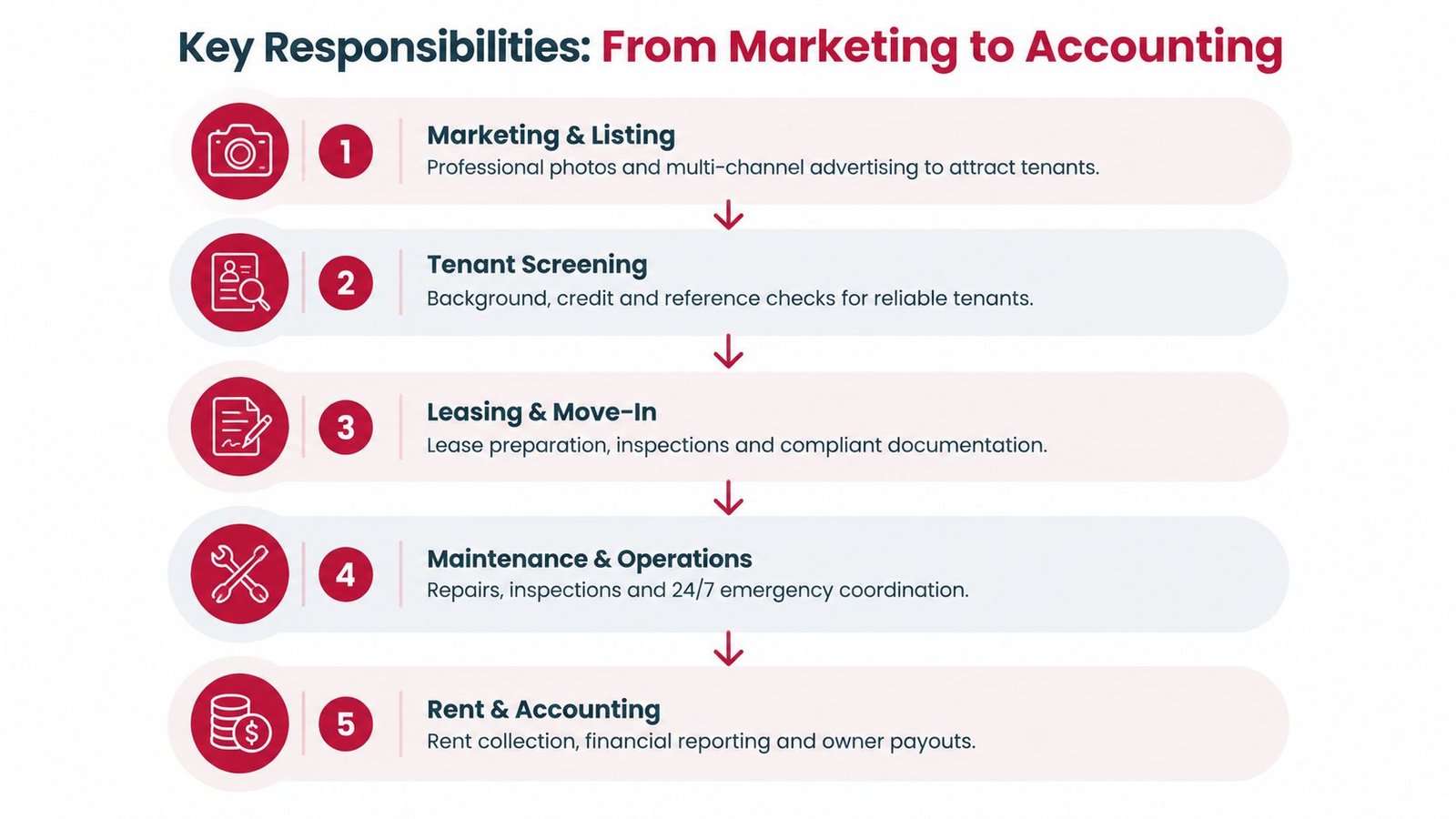
A Calgary rental can sit empty while an owner is still arranging photos, answering inquiries, and comparing applicants. A property manager runs these steps as one operating system, adjusting the plan when the market shifts from tight to balanced and vacancy becomes a larger concern.
Marketing and listing preparation
The manager starts by checking the home's condition, preparing accurate photos, writing clear listing copy, choosing suitable advertising channels, and recommending rent based on the property type and current demand. A condo, studio, and detached home may need different pricing, presentation, and renewal approaches. The listing should explain useful features without promising something the property does not offer.
Inquiry handling protects that marketing work. The manager answers questions, checks basic suitability, schedules showings, and records follow-up. Prompt, consistent replies help serious applicants progress while giving the owner a clear record of activity. Owners who want to strengthen the educational side of rental marketing can review this VideoTour.ai content marketing guide. The practical point is simple: accurate information and clear presentation help applicants understand the home before they book a viewing.
Screening and leasing
Screening brings together credit information, income verification, rental history, references, and identity information. The manager uses written criteria consistently instead of relying on a quick impression at a showing. This creates a clearer decision process and helps reduce avoidable disputes.
After approval, the manager prepares and signs the lease, confirms required details, coordinates the move-in, and records the property's initial condition. That starting record works like a baseline. Later repair questions or move-out concerns can be compared with it.
Rent, maintenance, and records
Rent administration covers payment tracking, arrears follow-up, documented communication, and consistent application of lease terms. Owner accounting connects those activities to statements showing rent received, expenses paid, and funds disbursed.
Maintenance coordination joins tenant service with protection of the property. The manager receives a request, assesses urgency, assigns a suitable vendor, tracks the work order, checks completion, and contacts the owner when approval is needed. Routine and move-out inspections add written reports and photographs.
Owner and tenant portals can hold leases, inspection reports, statements, work orders, and service updates in one place. That shared file reduces scattered email searches and shows what was requested, completed, and paid. For an Alberta landlord, the value is not only collecting rent. It is keeping the vacancy, service, and financial decisions connected.
Alberta Compliance Duties Every Manager Must Handle
A Calgary landlord may receive a tenant's request to enter, a late-rent message, and a repair call on the same morning. Each item has a different legal and operational response. A property manager turns those responses into a repeatable system, so a busy period or a softer rental market does not lead to missed notices, inconsistent treatment, or an incomplete file.
Entry rules show why timing matters. Alberta tenancy materials require a landlord to give 24 hours' notice before entering a rental premises, with the reason and intended time stated. The manager coordinates the access request, tenant communication, vendor schedule, and delivery record. The file should make it possible to confirm what notice was given and when.
Security deposits and inspections also run on defined timelines. The deposit must be banked within 2 banking days of receipt. The move-in inspection report should be completed within 1 week before or after the move date, according to Alberta residential tenancy timelines.
Alberta tenancy notice and handling timelines
| Requirement | Timeline | Why It Matters |
|---|---|---|
| Notice to enter premises | 24 hours, with the reason and intended time specified | Gives the tenant proper notice and creates a record of lawful access |
| Banking a security deposit | Within 2 banking days of receipt | Keeps deposit handling timely and documented |
| Move-in inspection report | Within 1 week before or after the move date | Establishes a shared record of the unit's condition |
| Rent increase for a week-to-week periodic tenancy | 12 full tenancy weeks' notice | Aligns the change with the tenancy cycle |
| Rent increase for a month-to-month periodic tenancy | 3 full tenancy months' notice | Prevents an improperly timed adjustment |
| Rent increase for another periodic tenancy | 90 days' notice | Applies the correct period to the applicable tenancy type |
The Alberta guidance on ending a tenancy explains that rent increase notice periods depend on the type of periodic tenancy. A manager must identify the tenancy cycle before preparing the notice. Treating every increase as “one month” or “90 days” can produce an invalid or poorly timed adjustment.
Why records protect owners
For a remote or out-of-province owner, documentation acts like a second set of eyes at the property. The file should contain the lease, notices, inspection reports, payment history, maintenance messages, invoices, and actions taken when a problem arises. This record supports decisions during a vacancy, a repair dispute, or a tenancy change.
Alberta's occupational profile includes administration, accounting, maintenance, operations, insurance claims, lease administration, notices, market-rent recommendations, and familiarity with the Residential Tenancies Act among property manager duties. The Alberta property or condominium manager occupational profile reflects that wider operating role.
Owners can consult the Alberta RTA handbook for reference. The manager's daily value is applying the requirements consistently, recording each step, and adjusting operations as Calgary shifts between a tight and more balanced rental market. Compliance then becomes part of ordinary work, rather than a rushed response after a dispute starts.
Benefits of Hiring a Property Manager Versus Self Managing
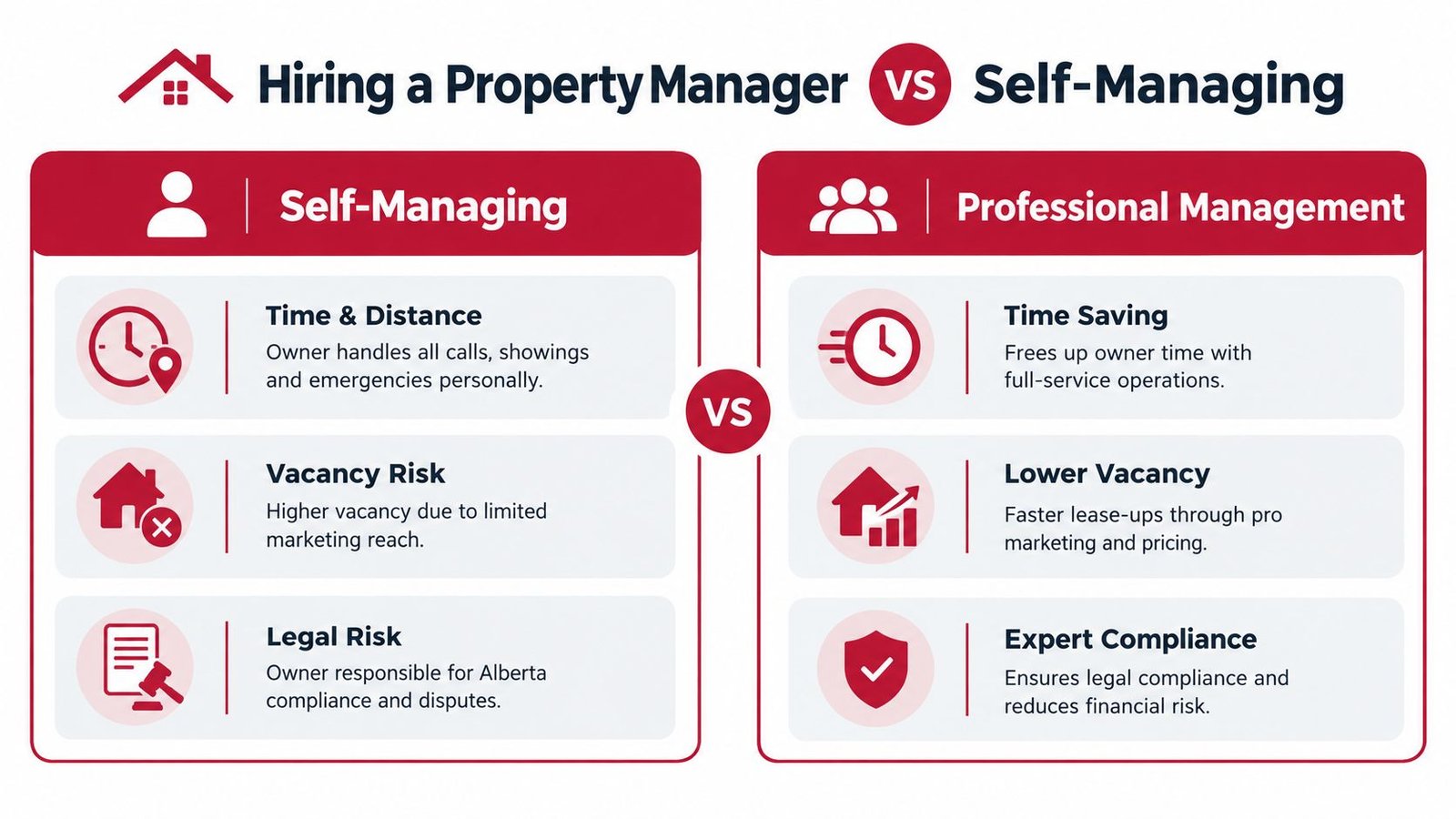
Self-management can work for an owner who lives close to the property, has flexible availability, understands Alberta tenancy requirements, and can coordinate vendors without delay. Professional management becomes more useful when the owner is remote, manages several units, has limited time, or wants consistent records and communication.
The market environment also changes the calculation. Calgary's market vacancy rate increased from 4.6% in 2024 to 5.1% in 2025, while the city's rental supply grew at its fastest pace in decades, according to City of Calgary housing trend research. When more units compete for tenants, owners need accurate pricing, effective presentation, responsive showings, and a retention plan.
The practical trade-off
| Self-managing | Professional management |
|---|---|
| The owner handles inquiries, showings, tenant calls, and emergencies. | The manager becomes the operational contact for tenants and vendors. |
| The owner must track notices, inspections, deposits, and records personally. | The manager uses established compliance and documentation workflows. |
| Vendor selection and repair follow-up remain with the owner. | The manager coordinates vendors, work orders, approvals, and completion records. |
| The owner monitors rent, expenses, and statements directly. | The manager provides structured accounting and owner reporting. |
A professional manager doesn't guarantee that every vacancy disappears immediately. The advantage is control over the factors the owner can influence, including listing quality, response speed, screening consistency, pricing review, and renewal communication.
Owners should also assess the accounting workload separately. A practical guide to outsourced accounting can help explain why organised financial administration matters beyond collecting rent.
Management fees are only one part of the decision. Owners should compare the service scope, approval process, reporting quality, maintenance controls, and time commitment involved. The property management company cost guide can help frame that comparison without treating price as the only measure of value.
Real World Examples of Property Management in Calgary and Alberta
A Calgary condo, an Edmonton house, and a Red Deer townhome can each create a different day-to-day workload. A property manager adjusts the operating plan to the building, neighbourhood, tenant profile, and current rental conditions. In a balanced market, that may mean reducing vacancy risk through faster responses, clearer listings, and earlier renewal conversations rather than relying on rent collection alone.

A Calgary condo lease-up
For a Calgary condo, the manager may arrange professional photos, describe the layout and amenities accurately, and advertise the unit to applicants who value location, parking, or building features. The manager answers questions about access and rules, schedules showings, records applicant communication, and reviews the listing if inquiries are weak.
The process continues after signing. The manager coordinates move-in documentation, access arrangements, building requirements, and tenant communication so the tenancy starts with clear expectations. If a vacancy lasts longer than planned, the manager can review presentation, response times, and pricing with the owner.
An Edmonton single-family home
An Edmonton single-family home calls for a complete screening file. The manager reviews income information, rental history, references, and household suitability against the property's requirements. This supports a consistent decision process instead of rushing to fill the home.
After move-in, tenant communication and maintenance follow-up remain connected. A report about a minor plumbing issue can become a work order, vendor appointment, completion record, and owner update, helping address the problem before it disrupts the household.
A Red Deer townhome
A Red Deer townhome may require regular attention to exterior areas, plumbing, appliances, and ordinary wear. The manager assigns the appropriate vendor, records the approved scope, follows up on the work, and keeps inspection evidence with the property file.
Those records help compare conditions over time and support security deposit administration when the tenant leaves. The examples show the practical value of local coverage. The principles are similar across Alberta, but listing decisions, tenant communication, vendor response, and renewal planning still need to fit the property and neighbourhood.
Choosing the Right Property Manager and Next Steps in Alberta
A Calgary rental can shift from a tight market, where homes fill quickly, to a balanced market, where pricing, presentation, and response time affect vacancy. Choose a manager who operates the property through both conditions, rather than focusing only on rent collection.
Confirm the manager's Alberta regulatory knowledge, local coverage, screening process, maintenance controls, accounting practices, and communication standards. Ask:
- Service scope: Are leasing, screening, inspections, maintenance, rent collection, notices, and tenant communication included?
- Compliance process: How are entry notices, rent changes, inspection reports, deposits, and dispute records handled?
- Maintenance control: Who approves work, selects vendors, and sends invoices or updates?
- Reporting: Which statements, documents, and portal records will the owner receive?
- Local coverage: Can the team respond in Calgary, Edmonton, Red Deer, and nearby communities?
- Communication: Who handles urgent issues, and how often are updates provided?
A useful guide to what to look for in a property manager helps organise these questions before comparing proposals.
The next step is a rental consultation and market analysis. The manager can review the property's condition, recommend its likely market position, prepare the listing, and explain the path from advertising through screening, leasing, inspection, and reporting. Dreamhouse Realty Ltd. provides these functions for residential owners across Alberta, including single-family homes, condos, townhomes, and small multifamily properties.
Owners seeking guidance on what does a property manager do can contact GURIQBAL CHAHAL, MBA, PMP, REAL ESTATE BROKER, at 403-966-6072 about leasing, tenant management, maintenance, compliance, and reporting. Visit Dreamhouse Realty Ltd. to request a consultation.