A Calgary landlord is staring at a long tenancy agreement while the tenant is already asking when the security deposit will be returned. A repair request is waiting, a move-in condition report is somewhere in an inbox, and the owner is searching “RTA handbook Alberta” hoping for a clear answer instead of another legal maze.
The official handbook is the starting point, not the entire operating system. It tells landlords what Alberta requires, but successful rental management also depends on correct notices, reliable service records, organised inspections, and evidence that can survive an RTDRS hearing. The practical approach is simple: use the handbook for the rule, use a disciplined process for the tenancy, and never rely on memory when a form or deadline matters.
Table of Contents
- What the RTA Handbook Alberta Is and Where to Get It
- How the Handbook Is Organized
- Official Forms and Notices Every Alberta Landlord Should Know
- Security Deposits and Interest Rules for 2024 to 2026
- Rent Increase Notices and Timing Rules
- Right of Entry and Landlord Access Standards
- Ending a Tenancy Under the Residential Tenancies Act
- Filing Disputes Through RTDRS in Alberta
- Alberta Landlord Compliance Checklist
- Where the Handbook Stops and Practical Risk Management Begins
- Get Personalized Help From a Calgary Property Manager
What the RTA Handbook Alberta Is and Where to Get It
The Alberta RTA handbook is the provincial reference for landlords, tenants, and agents operating under the Residential Tenancies Act and related regulations. Service Alberta and Red Tape Reduction produce it in Edmonton, and the official government listing identifies the current 2023-to-current edition as updated as recently as March 31, 2026. The handbook covers tenancy agreements, inspection reports, security deposits, rent increases, entry, termination, and abandoned goods, making it the foundational compliance reference for residential rentals in Alberta. The official Open Government Portal listing is the right place to verify the current edition.
This isn't a general consumer brochure. It is a working reference for the routine decisions that create landlord exposure. A Calgary owner deciding whether a notice is valid, how a deposit should be handled, or whether entry was lawful should start with the handbook before relying on a template, social media advice, or an informal answer.
Use the current digital version
The government listing states that printed versions aren't available. That matters because a physical copy can become stale while the legislation and regulations change. The digital handbook is intended to remain continuously accessible, and Alberta legislation can be downloaded free in PDF or HTML through the province's publishing resources.
Landlords should keep three reference points:
- Current handbook: Use the official Open Government Portal listing for the latest version and revision information.
- Older editions: Check archived versions when a dispute concerns wording that applied during an earlier tenancy period. An older indexed edition from 2018 was expressly replaced by the 2023-to-current handbook, showing that Alberta refreshes the publication as rules develop.
- Service Alberta guidance: Use official consumer tip sheets for focused issues such as termination, entry, deposits, and notices.
The handbook also provides the Consumer Contact Centre numbers, 780-427-4088 in Edmonton and 1-877-427-4088 toll-free in Alberta. The official handbook PDF ties the guide to the province's wider dispute-resolution and information system, including the Residential Tenancy Dispute Resolution Service and companion regulations.
Before relying on a clause, a landlord should check the footer revision date and save the official PDF used for the file. That small habit prevents an avoidable argument about which version governed the decision.
How the Handbook Is Organized
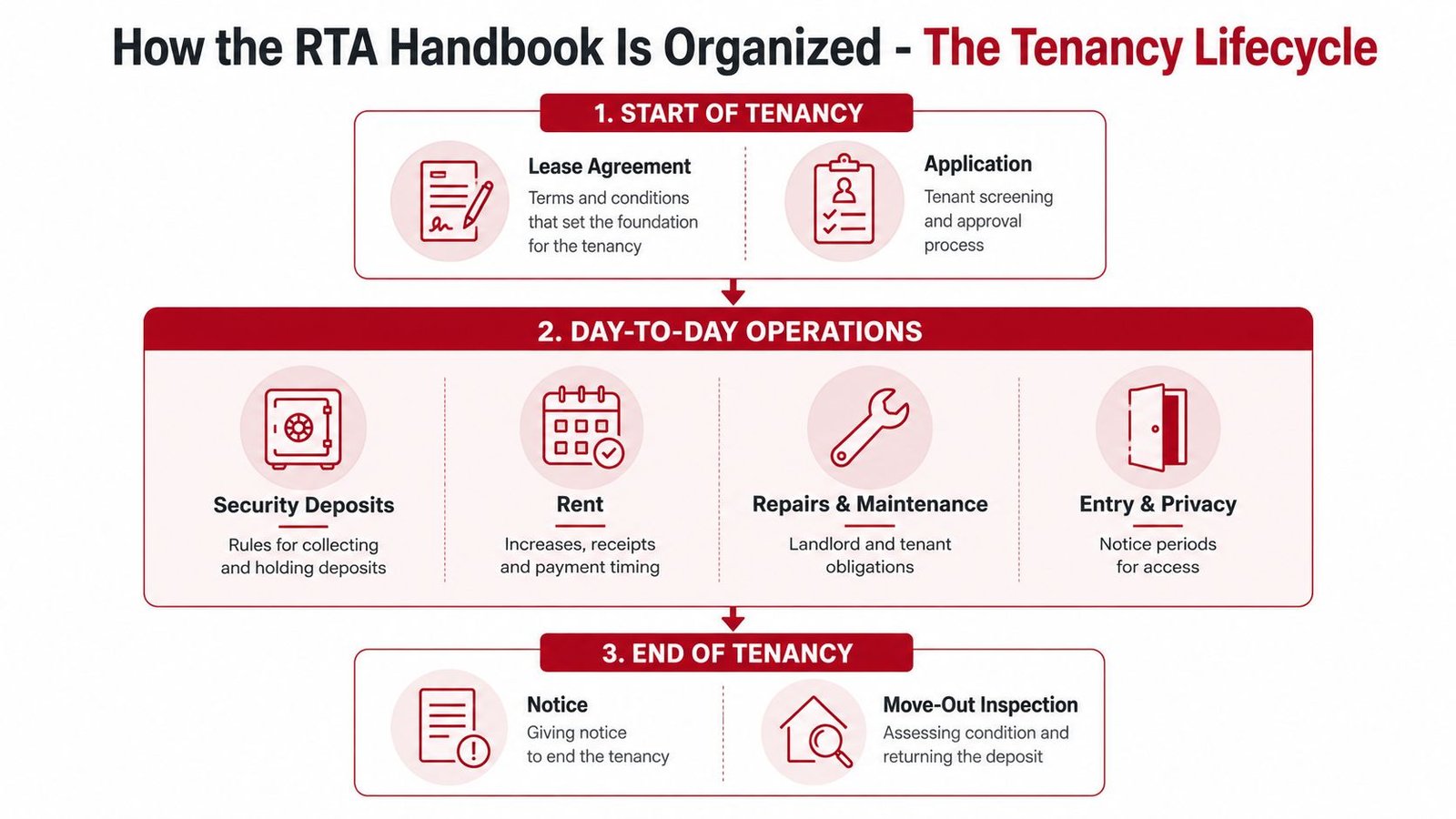
The handbook follows the rental relationship from start to finish. A landlord doesn't need to read every page in sequence, but the table of contents should become a regular navigation tool because the important rules are spread across the tenancy lifecycle.
The operational chapters deserve priority. Security deposits, rent increases, repairs, right of entry, inspection reports, and ending a tenancy affect nearly every occupied property. The glossary also deserves more attention than most landlords give it. Terms such as “substantial breach” and “service of notice” carry tighter legal meaning than they do in everyday conversation, and casual wording can cause a notice to fail.
Read the working chapters first
A practical reading order looks like this:
- Start of tenancy: Read tenancy agreement, inspection report, and deposit material before signing or collecting money.
- Day-to-day operations: Bookmark rent, repairs, maintenance, entry, privacy, and communication requirements.
- End of tenancy: Review termination, abandoned goods, move-out inspections, and deposit accounting before serving a notice.
- Dispute reference: Keep the RTDRS material and evidence guidance available when a tenant challenges an action.
The Schedule 1 fee matrix and dispute-resolution appendix are useful reference shelves, but they aren't where a landlord should spend most routine reading time. The mobile home site material can also be skipped unless that asset class is part of the portfolio. It doesn't help an owner manage a Calgary condo or detached rental.
Bookmark the navigation points
The table of contents and index should be saved with the PDF. Search terms such as security deposit, entry, rent increase, termination, and abandoned goods help a landlord reach the relevant material quickly, but search shouldn't replace reading the surrounding section. Definitions, exceptions, and procedural details often sit close to the rule that appears in the search result.
Practical rule: The handbook answers what the province requires. A property file must still show when the landlord acted, how the tenant was served, and what happened afterward.
That distinction is important. The guide is a compliance foundation, while the landlord's forms, logs, photos, receipts, and correspondence turn the rule into defensible practice.
Official Forms and Notices Every Alberta Landlord Should Know
Landlords lose time when they treat every tenancy problem as a generic letter. The right document depends on the trigger, the tenancy type, the information required, and the proof that the notice reached the tenant. A landlord should download the official forms once, save a controlled PDF bundle, and avoid rewriting statutory language from memory.
The most common forms and notices fit into distinct situations:
| Form or Notice | Situation That Triggers It | Form Reference |
|---|---|---|
| Notice to Terminate for substantial breach | The tenant commits a substantial breach that supports termination | Form 5A |
| Notice to Terminate for non-payment | Rent remains unpaid and the statutory non-payment process applies | Form 5B or 5C, depending on the notice process |
| Notice to Quit for repeated late payment | The tenant repeatedly pays late under the applicable statutory process | Three-Day Notice to Quit |
| Landlord's Notice to Enter | The landlord needs lawful access for an authorised reason | Official entry notice |
| Notice of Rent Increase | The landlord is increasing rent after the permitted interval and notice period | Prescribed rent-increase form |
| Notice of Change of Terms | The landlord is changing a permitted tenancy term | Applicable change-of-terms form |
| Application for Dispute Resolution | The landlord or tenant needs an RTDRS order | RTDRS application |
| Condition Inspection Report | The unit's condition is recorded at move-in or move-out | Official condition report |
The 14-day substantial breach notice is for a serious lease violation, not a convenient substitute for a rent notice. Non-payment requires the rent amount and the statement that the tenancy continues if the full amount is paid by the termination date. An entry notice needs the reason, date, and time. A condition report needs detailed observations and supporting photographs.
Service proof is part of the form
RTDRS problems often arise because a landlord can show the notice but can't prove service. The file should identify the date, delivery method, recipient, and any supporting communication. A signed acknowledgement is useful, but a landlord should also preserve the original notice and a dated service record.
Landlords dealing with an eviction issue can review the Alberta eviction notice form guidance before selecting a document. The form still needs to match the facts of the tenancy, and no template fixes a notice that misstates the breach or lacks service evidence.
A landlord should never stack notices casually. One notice should identify the correct legal route, the facts supporting it, and the remedy available to the tenant. If the issue reaches RTDRS, clarity is more valuable than aggressive wording.
Security Deposits and Interest Rules for 2024 to 2026
A security deposit is trust-held money, not a landlord's operating cushion. Alberta's framework addresses the deposit itself, lawful deductions, interest, and the documentation required when the tenancy ends. The deposit is generally capped at one month's rent, and separate pet-related charges must be assessed under the applicable tenancy rules rather than treated as a blank cheque for future damage.
The move-in file should contain the signed agreement, deposit receipt, condition report, and photographs. At move-out, deductions should relate to unpaid rent, damage beyond normal wear and tear, or another lawful claim supported by a clear statement of account. Normal ageing, ordinary carpet wear, and routine repainting shouldn't be turned into tenant charges.
Interest is an annual obligation
Alberta's official rate table records the following security deposit interest rates:
| Year | Annual Rate | Effective Period | Calculation Method |
|---|---|---|---|
| 2024 | 1.6% | 2024 | Simple interest, no compounding, paid at each anniversary |
| 2025 | 0.5% | 2025 | Simple interest, no compounding, paid at each anniversary |
| 2026 | 0% | Effective January 1, 2026 | Simple interest, no compounding, paid at each anniversary |
The rates are confirmed in Alberta's security deposit interest guidance. The 2026 rate is 0%, but that doesn't remove the need to calculate, record, and communicate the result. A zero calculation should still appear in the tenancy file.
Common RTDRS weaknesses include failing to pay interest when required, deducting ordinary wear and tear, and retaining the deposit without a valid claim. Landlords should provide a deposit receipt at move-in, disclose the applicable interest treatment, and preserve proof of every payment or credit.
A useful move-out process is to pair the final inspection with photographs, a written account of deductions, and a record of any amount returned. Landlords who need a practical inspection workflow can review this Alberta move-out inspection resource. Records should be retained for at least three years, so the landlord can answer a later question without reconstructing the file from memory.
Rent Increase Notices and Timing Rules
Rent increases fail most often because landlords guess at dates. Alberta requires written notice, and the minimum period depends on the tenancy type. The notice should be served early enough that the tenant receives the full required period, and the increased rent should begin only on the normal rent-due date.
The provincial rules require 12 full tenancy weeks for a week-to-week tenancy, three full tenancy months for a month-to-month tenancy, and 90 days for other periodic tenancies. Alberta's landlord and tenant guidance also confirms that a tenant must receive at least 14 clear days when a termination notice is being used.
| Tenancy Type | Minimum Notice | Required Form | Frequency Limit |
|---|---|---|---|
| Week-to-week | 12 full tenancy weeks | Written prescribed notice | Not more than once in the permitted interval |
| Month-to-month | Three full tenancy months | Written prescribed notice | Not more than once in the permitted interval |
| Other periodic tenancy | 90 days | Written prescribed notice | Not more than once in the permitted interval |
| Fixed-term | No mid-term increase unless the agreement provides for it | Written agreement or valid contractual clause | Follow the agreement and applicable law |
Count from service, not from drafting
The landlord should record when the notice is served, then count the required period from the legally effective service date. The three-month period for a month-to-month tenancy must be treated as full calendar months, not as an informal estimate. The increase should take effect on the day rent is normally due.
Verbal notice is a weak shortcut. So is sending the wrong form, applying an increase halfway through a fixed term without a specific escalation clause, or trying to raise rent more than once within the permitted period. Alberta doesn't have statutory rent control, but landlords still need to follow the notice and timing rules.
Retaliatory increases are unacceptable. The landlord should be able to explain the increase as a normal business decision and preserve the notice, calculation, and service record in the tenancy file.
Right of Entry and Landlord Access Standards
A tenant's home is not open for informal walk-throughs, even when the landlord owns the property. For routine access in Alberta, serve written notice at least 24 hours in advance. State the specific reason, date, and time, and schedule the visit between 8 a.m. and 8 p.m., unless an emergency requires immediate entry.
Use the purpose of the visit. Inspection, repairs, showing the unit to prospective tenants or purchasers, and responding to an emergency are permitted reasons. “Property matter” is too vague, and “inspection” is misleading when a contractor, buyer, or prospective tenant will attend.
Entry without consent
The exceptions are narrow:
- Emergency: A burst pipe, fire, or similar urgent event justifies immediate action.
- Suspected abandonment: The landlord has a reasonable basis to believe the tenant has left the unit.
The official Alberta landlord entry guidance explains the written-notice requirement, permitted entry hours, and circumstances allowing entry without consent. It also identifies RTDRS as the main dispute forum for tenancy matters.
For a sale, group showings into practical time blocks, issue proper notice for each access period, and record every visit. The log should show when notice was delivered, the stated reason, the scheduled time, and what occurred. If a tenant repeatedly refuses lawful access, do not force entry or change the locks. Preserve the written refusals and seek an order when needed.
A tenant who feels harassed can apply to RTDRS for an order or compensation. A reasonable visit can still become difficult to defend when the notice and delivery records are incomplete.
Access standard: Keep the dated notice, delivery proof, and follow-up log together in the property file. The paperwork supports the reason for entry and protects the landlord if the visit is challenged.
Ending a Tenancy Under the Residential Tenancies Act
A landlord serving the wrong notice can lose time and weaken an otherwise valid possession claim. Start by identifying the actual default: a substantial breach and non-payment of rent follow separate tracks under Alberta's rules.
A substantial breach is a serious violation of the tenancy agreement or the Act. Examples include significant property damage, unauthorised occupants, illegal activity, or repeated conduct that breaks a central lease obligation. Describe the conduct precisely, connect it to the relevant lease term where possible, and give the tenant the statutory opportunity to correct it when the notice requires correction.
For this type of breach, Alberta permits a written 14-day notice. It must state the reason, include the residential address, carry the landlord's or agent's signature, and specify the termination date and time. The province treats 14 clear days strictly. The service date and move-out date are not counted. Use The official termination tip sheet to check the required process before serving the notice.
Match the notice to the default
Rent arrears require their own notice. State the exact rent owing as of the notice date, include rent that becomes due during the notice period, and explain that the tenancy continues if the tenant pays the full amount by the termination date. Alberta's quick reference guide sets out that payment language.
Do not relabel unpaid rent as a substantial breach because the payment was late. The form, amount, dates, and remedy must correspond to the actual problem.
| Checkpoint | Substantial Breach, Form 5A | Non-Payment, Form 5B or 5C |
|---|---|---|
| Trigger | Material breach of the tenancy or agreement | Rent remains unpaid |
| Description | Specific act, omission, damage, or conduct | Exact rent amount owing and required payment statement |
| Tenant's remedy | Stop the conduct, repair damage, or correct the breach where applicable | Pay the full amount by the termination date where the notice provides that route |
| Common defect | Vague facts or missing termination details | Wrong amount, dates, or cure language |
| Supporting records | Lease clause, photographs, communications, inspection records | Rent ledger, payment history, served notice, proof of service |
Keep the two tracks separate. Do not attach a Form 5A to a Form 5B for the same rent problem. A Form 5A that fails to identify the breach can fail at RTDRS before the underlying conduct is considered.
Use this working sequence:
- Reconcile the rent ledger or incident record.
- Identify the legal trigger.
- Select the matching form.
- Describe the facts and dates precisely.
- Serve it through a traceable method.
- Keep the original, service proof, and follow-up messages together.
A lock change is not a shortcut. If possession is the goal, follow the formal process and preserve the file. Clear records give the landlord a defensible path if the tenant challenges the notice.
Filing Disputes Through RTDRS in Alberta
A tenant ignores a valid notice, rent remains unpaid, or a deposit dispute cannot be resolved. RTDRS gives landlords and tenants a formal route to request possession, unpaid rent, deposit returns, damage compensation, or compensation for a breach. Either party can file, and legal counsel is not required.
Start with the order you want. Then build the evidence around it. The application should explain the remedy, identify the relevant dates and amounts, and attach records that support each point. A bare narrative leaves the decision-maker to search for proof that should have been organized before filing.
Use a working file with these sections:
- Signed lease: Mark the relevant clauses and include every applicable addendum.
- Served notice: Keep the exact version delivered to the tenant.
- Proof of service: Record the date, method, recipient, and confirmation.
- Rent ledger: Reconcile each payment and the balance claimed.
- Inspection evidence: Add condition reports and dated photographs.
- Communication record: Save repair requests, notices, responses, and follow-up messages.
Keep the file in the same order as the facts. If the claim concerns unpaid rent, the ledger and service record should be easy to find. If it concerns damage, place the move-in condition report, photographs, invoices, and related communications together.
The official handbook and Alberta's tenancy resources and referral information direct users to RTDRS, Calgary and Edmonton filing locations, and the toll-free 310-0000 access line. That line helps owners outside Alberta obtain provincial information without dialing an area code.
Claims under $5,000 are typically filed at no cost, according to the provided RTDRS guidance. Scheduling can take three to six months, so preserve rent records, communications, and property evidence after submitting the application. Decisions are generally issued within days of the hearing, but the result depends on the record presented.
Remote owners should maintain one consistent digital folder that an agent or representative can review without rebuilding the file. At the hearing, lead with dates, documents, amounts, photographs, and the precise order requested. Leave emotional summaries out.
Alberta Landlord Compliance Checklist
A compliance checklist works only when every item is verifiable. “Manage the property properly” isn't a control. A signed document, dated photograph, payment record, or completed log is a control.
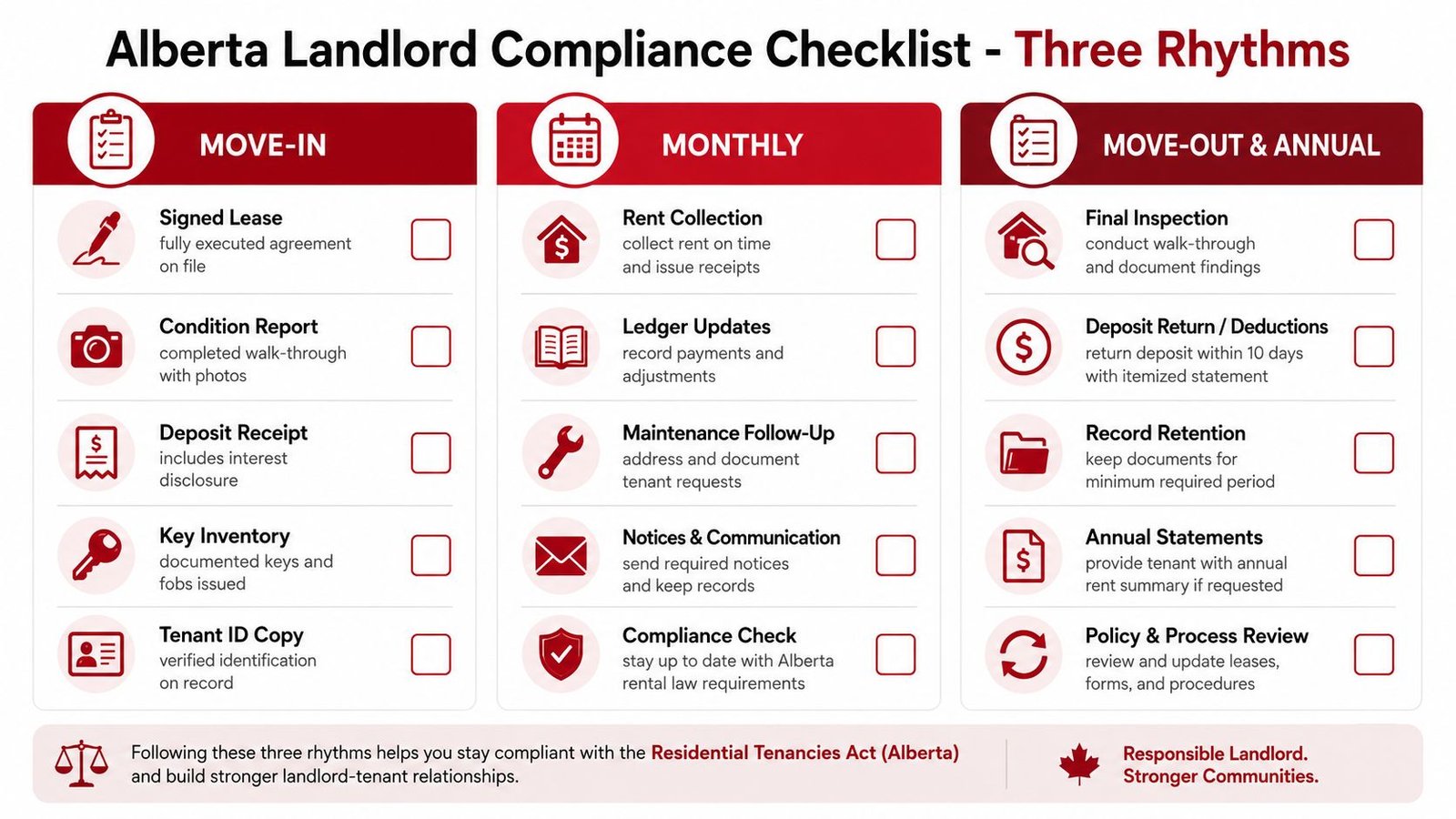
Move-in rhythm
- Signed lease: Keep the fully executed agreement and all addenda in the property file.
- Condition report: Complete the walk-through, record defects, and attach dated photographs.
- Deposit receipt: Record the amount, receipt date, and applicable interest treatment.
- Key inventory: List every key, fob, garage remote, and access device issued.
- Tenant identification: Keep the identification record in a secure location and limit access.
- Contact details: Record the landlord or agent information provided to the tenant.
Monthly rhythm
- Rent ledger: Post each payment against the correct tenancy and reconcile the account.
- Maintenance log: Record the request, response, contractor, access arrangement, and completion.
- Communication file: Save material emails, messages, notices, and follow-up notes.
- Late-payment record: Document the date, amount, communication, and payment outcome when rent is late.
- Inspection schedule: Track planned inspections and preserve the notices used to arrange access.
Move-out and annual rhythm
- Final inspection: Compare the move-out condition with the move-in record and take photographs.
- Deposit accounting: Prepare the return or deductions statement with supporting evidence.
- Interest review: Calculate and pay or credit the required annual interest by the applicable anniversary.
- Lease review: Check renewal dates, rent timing, insurance terms, smoking clauses, pet provisions, and guarantor terms.
- Alarm checks: Record smoke and carbon monoxide alarm checks.
- Fire safety review: Confirm that the property's fire-safety obligations and municipal requirements are being addressed.
- Tax records: Organise rental tax documents and filing information.
The costly mistakes are usually basic. A landlord who doesn't pay required interest can lose the benefit of the deposit claim, and incomplete condition reports make damage claims difficult to prove. The file should be audited before a dispute, not after an application has been filed.
Where the Handbook Stops and Practical Risk Management Begins
The handbook establishes the regulatory floor. It doesn't tell a Calgary owner how to screen an applicant, which lease addendum will prevent a recurring dispute, or how to organise daily evidence so a hearing doesn't become a memory contest.
That gap matters in a changing rental environment. Alberta's own guidance describes the handbook as a minimum-standards reference, while landlords still face practical questions about vacancy, turnover, screening, lease design, and dispute-resolution delays. The answer isn't to invent stricter rules. The answer is to build a consistent process that stays within human-rights and tenancy requirements.
Screen for fit without drifting into discrimination
A pay stub alone doesn't explain rental risk. Landlords can use consistent, lawful criteria involving credit, income, references, and rental history, but the same criteria should be applied to every applicant. Questions should relate to the tenancy, not personal characteristics or assumptions about family, age, culture, disability, or another protected ground.
Design the lease around recurring disputes
The agreement should address maintenance reporting, pet responsibilities, smoking, insurance requirements, occupants, guarantor terms, and access arrangements in clear language. A clause isn't useful because it sounds forceful. It is useful when it is lawful, specific, and supported by a management process that the landlord follows.
Document the asset, not just the conflict
Move-in photographs, repair logs, contractor invoices, entry notices, and written tenant communications create a timeline. That timeline protects the landlord when a tenant disputes damage or access, and it also helps the owner identify maintenance problems before they become expensive.
The handbook remains the contract layer. Screening discipline, lease design, photo records, and daily follow-through form the operational layer around it.
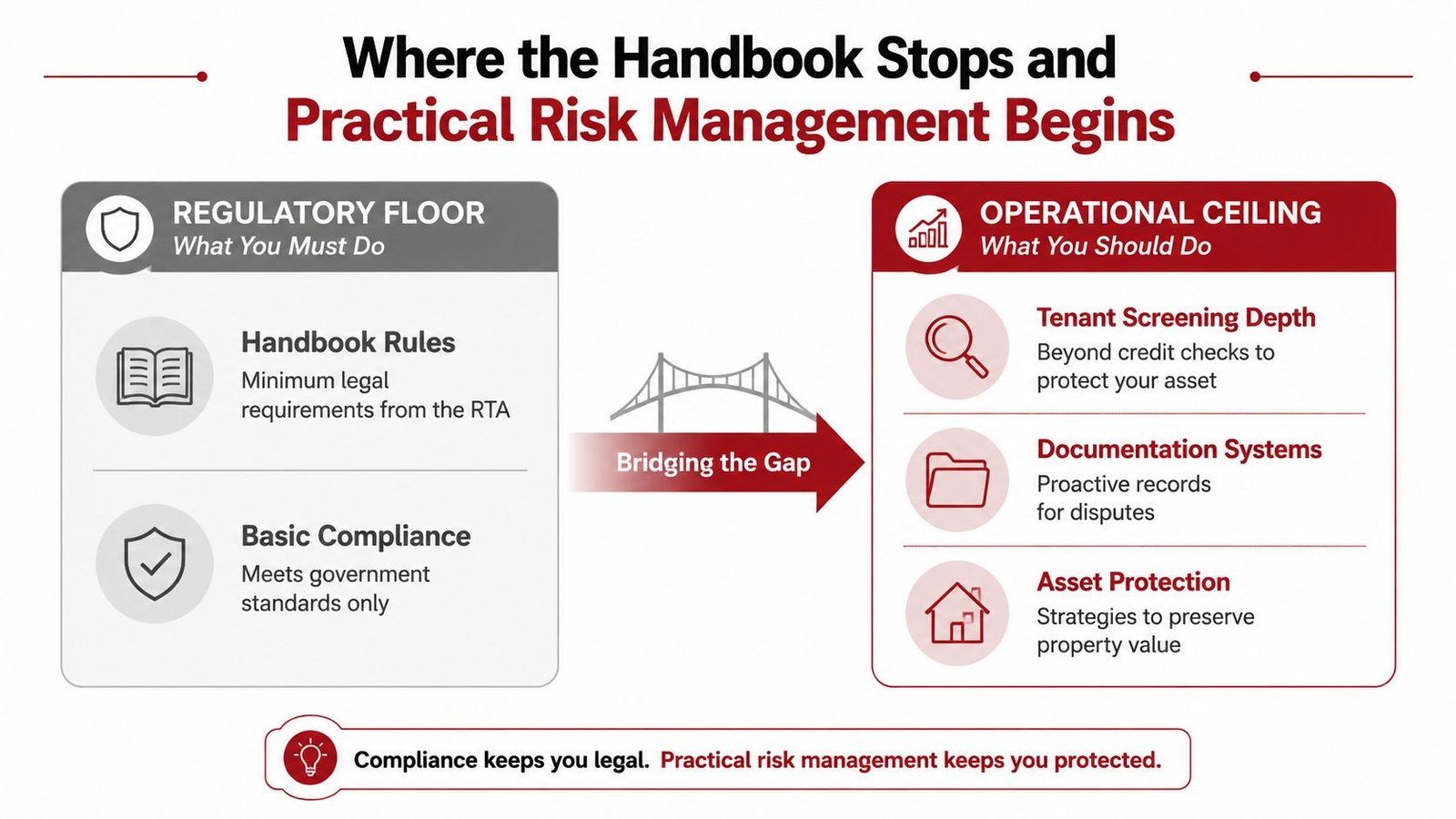
A Calgary landlord managing a duplex, condo, or single-family property should review both layers before handing over keys. Compliance prevents obvious process failures. Risk management protects the property when the facts become disputed.
Get Personalized Help From a Calgary Property Manager
The handbook is the reference. Execution is where landlords usually need help.
An out-of-province owner may understand the RTA but still struggle to coordinate inspections, serve a notice, collect rent, or assemble an RTDRS package from a distance. A first-time landlord may have a sound lease and still miss the service record that proves a notice reached the tenant. A portfolio owner may need a repeatable process across several homes instead of a separate improvised system for every tenancy.
A Calgary property manager can provide the operating layer around the official rules:
- Local market awareness: Pricing, listing preparation, showings, and tenant communications are handled with local conditions in mind.
- RTDRS filing discipline: Notices, ledgers, service records, inspection reports, and photographs are kept in a form that can support a dispute application.
- Continuous maintenance oversight: Vendors and inspectors are coordinated before small issues become larger habitability or cost problems.
- Structured owner reporting: Rent collection, maintenance activity, inspections, and documents remain visible to the owner.
Residential property management in Calgary can include tenant placement, screening, lease execution, inspections, maintenance coordination, rent collection, compliance oversight, and owner communications. Dreamhouse Realty Ltd. serves Calgary, Edmonton, Red Deer, and surrounding Alberta communities with licensed property management and real estate brokerage services for homes, condos, townhomes, and small multifamily properties.
The right next step is a file review. Guriqbal Chahal can assess whether a single property or a wider portfolio has the correct lease documents, deposit process, inspection records, notice workflow, and RTDRS-ready evidence.
Dreamhouse Realty Ltd. provides Calgary rental management, tenant placement, inspections, rent collection, maintenance coordination, and Alberta compliance support built around the RTA handbook. Contact GURIQBAL CHAHAL, MBA, PMP, REAL ESTATE BROKER at 403-966-6072, or visit Dreamhouse Realty Ltd. to arrange a portfolio review or single-property consultation.