
Leasing a whole house means renting a self-contained dwelling, such as a detached house, semi-detached home, townhome or duplex, to one household for its exclusive use. The owner rents the entire property, not individual rooms.
A detached home can attract a higher monthly rent than an apartment, but that figure does not guarantee a quick lease. If it sits empty for a month, the owner collects no rent while carrying costs and upkeep continue. The tenant pool may also be smaller at a higher asking price.
Calgary's rental vacancy rate declined from 6% in 2020 to 3% in 2022, according to the City of Calgary's Housing Needs Assessment. That figure describes the wider rental market, not whole-house vacancy. Owners should assess detached homes as their own rental segment, with distinct vacancy exposure and maintenance responsibilities, rather than assume apartment demand predicts how quickly a house will lease.
Table of Contents
- What Whole House Rent Means and Which Homes Qualify
- Pros and Cons for Landlords and Tenants
- What Sets Whole House Rent Prices in Alberta
- How to Price a Whole House Against Alternatives
- Marketing a Whole House Rent to Fill It Faster
- Alberta Deposit and Rent Increase Rules Owners Must Follow
- Insurance and Upkeep Duties on a Detached Home
- Self-Manage or Hire a Property Manager
- Decide Whether Whole House Rent Fits Your Property
What Whole House Rent Means and Which Homes Qualify
Leasing a whole house is like leasing a complete vehicle rather than one seat in a shared van. The tenant household gets the property for its own use, and the owner remains responsible for the asset as a whole. That responsibility can mean a higher rent than a room generates, but it also means the roof, furnace, yard and other parts of the home need a clear maintenance plan.
The key distinction is exclusive use of a self-contained dwelling. A home rented to one household is different from renting individual rooms or a suite inside a house where the owner lives in the main home. In those shared arrangements, tenants may share a kitchen, bathroom or entrance, and the rented space isn't the whole property.
Which dwelling types qualify
| Dwelling type | Counts as whole house rent? | Reason |
|---|---|---|
| Detached house | Yes | Entire self-contained home leased to one household |
| Semi-detached home | Yes | Entire unit with its own entrance, leased as one property |
| Townhome | Yes | Entire unit leased as one property; shared walls and strata or condo rules still apply |
| Duplex | Yes, if both units go to one tenant | Two units leased together to one household; otherwise each unit is a separate rental |
| Condo unit | Yes | Entire unit leased as one property; condo bylaws govern use |
| Basement suite in an owner-occupied home | No | Tenant has a separate entrance, but the owner lives in the main home |
| Room in a shared home | No | Tenants share a kitchen, bathroom or entrance |
A whole-house lease should spell out what the tenant can use, including the yard, garage, storage areas and any basement space. If an area is excluded, the agreement should identify it clearly. Shared walls or condominium rules don't change the basic test, but they can affect how the property may be used.
The quick self-check is straightforward: can one household live there without sharing a kitchen, bathroom or entrance with the owner or another tenant? If yes, the property qualifies as a whole-house rental, and the landlord duties discussed below apply.
Pros and Cons for Landlords and Tenants
Whole house rent usually earns a higher monthly rent than a single room or apartment, but one vacancy stops all of the income. That trade-off matters: a larger rent cheque doesn't automatically mean a better return once the owner accounts for leasing time, upkeep and the possibility of a costly repair.
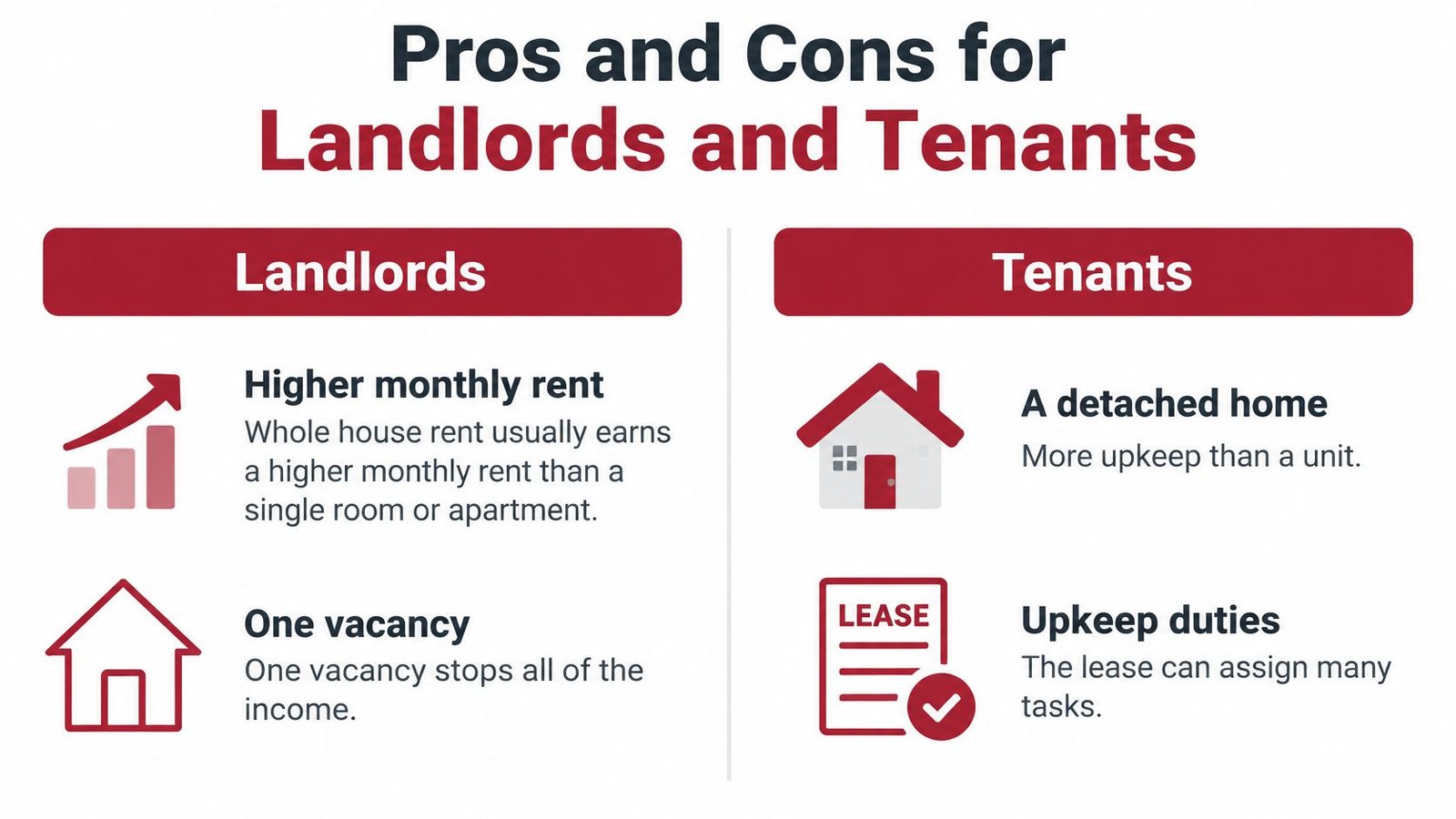
Landlord trade-offs
- One household, one lease: One screening process and one lease can be simpler than managing several room renters.
- Potentially steadier occupancy: Family tenants may stay longer, which can reduce turnover work and leasing costs, though every household is different.
- A larger rent on a larger asset: A whole home can earn more than a single room, but the owner also carries the property's full costs.
- Full income loss during vacancy: When the home is empty, rent stops entirely.
- Concentrated repair exposure: A roof, furnace or sewer-line failure affects one property and can require a substantial repair.
- A narrower applicant pool: Qualified households looking for a whole home may take longer to find than applicants for smaller units.
- More cost while empty: An unoccupied house still needs protection, upkeep and attention.
Tenant trade-offs
- More privacy: The household doesn't share a kitchen or bathroom with other tenants.
- Room to live: A private yard, parking, storage and space for children or pets can be valuable.
- Higher total housing costs: Rent and utilities can be greater than for an apartment.
- More household work: Snow, lawn and gutter duties may fall to the tenant if the lease assigns them.
- More space to maintain: A whole property takes more care than a unit within a larger building.
A family of four moving from a two-bedroom apartment to a detached home may gain separate bedrooms, a yard, parking and space for belongings. The same family may give up the apartment's smaller utility footprint and fewer exterior chores, while taking on a larger rent payment and responsibility for maintaining more space. For the owner, the balance depends on vacancy risk and property condition.
What Sets Whole House Rent Prices in Alberta
A detached home's rent is set by the alternatives a household would consider: apartments, condos, townhomes and other detached houses. Those segments can move in different directions. The City of Calgary reported year-over-year rent growth of 16.5% for detached homes, compared with 1.0% for townhouses and duplexes, while multi-residential rents declined 9.6%. These figures are from the city's housing research and trends data.
Apartment construction adds another point of comparison, but it does not add detached homes at the same pace. CMHC reported 8,897 purpose-built apartment rental completions in Calgary in 2024, compared with a previous 10-year average of 2,060. In 2025, purpose-built apartment vacancy was 5.0%, and the average two-bedroom apartment rent was $1,914. Condominium rental vacancy was 2.2%, according to CMHC's Calgary rental market data. These numbers describe apartment competition, not the rent a particular house can command.
| Pricing factor | Effect on rent | Example |
|---|---|---|
| Neighbourhood and commute | Often defines the price range | Similar detached homes may rent at different levels if one is near transit and the other is farther out |
| Bedrooms and bathrooms | Functional space can appeal to family households | A third full bathroom may support a stronger rent than an extra half-bath |
| Parking and garage | Matters to households with multiple vehicles | A double detached garage may be more attractive than street parking |
| Yard and outdoor space | Can appeal to families and pet owners | A fenced yard may draw more interest than a larger unfenced lot |
| Furnace, roof and window condition | Deferred maintenance can limit achievable rent | A home with a newer furnace and roof may compare well with one needing both |
| Utilities included or tenant-paid | Changes the advertised rent and the household's total cost | Including water and waste may raise the listed rent while reducing separate bills |
| Property type | Detached, townhouse and duplex rents can follow different trends | Calgary's recent comparison showed stronger growth for detached homes than for townhouse and duplex rentals |
| School and transit access | Convenience can influence household demand | Proximity to a sought-after school or transit may strengthen the applicant pool |
A larger layout does not guarantee a shorter vacancy. CMHC reported a 4.4% vacancy rate for three-bedroom-plus apartments in Calgary, showing that households seeking more bedrooms have alternatives. If an oversized detached home is priced above comparable properties without a clear advantage in layout or condition, the added rent may not compensate for time spent vacant.
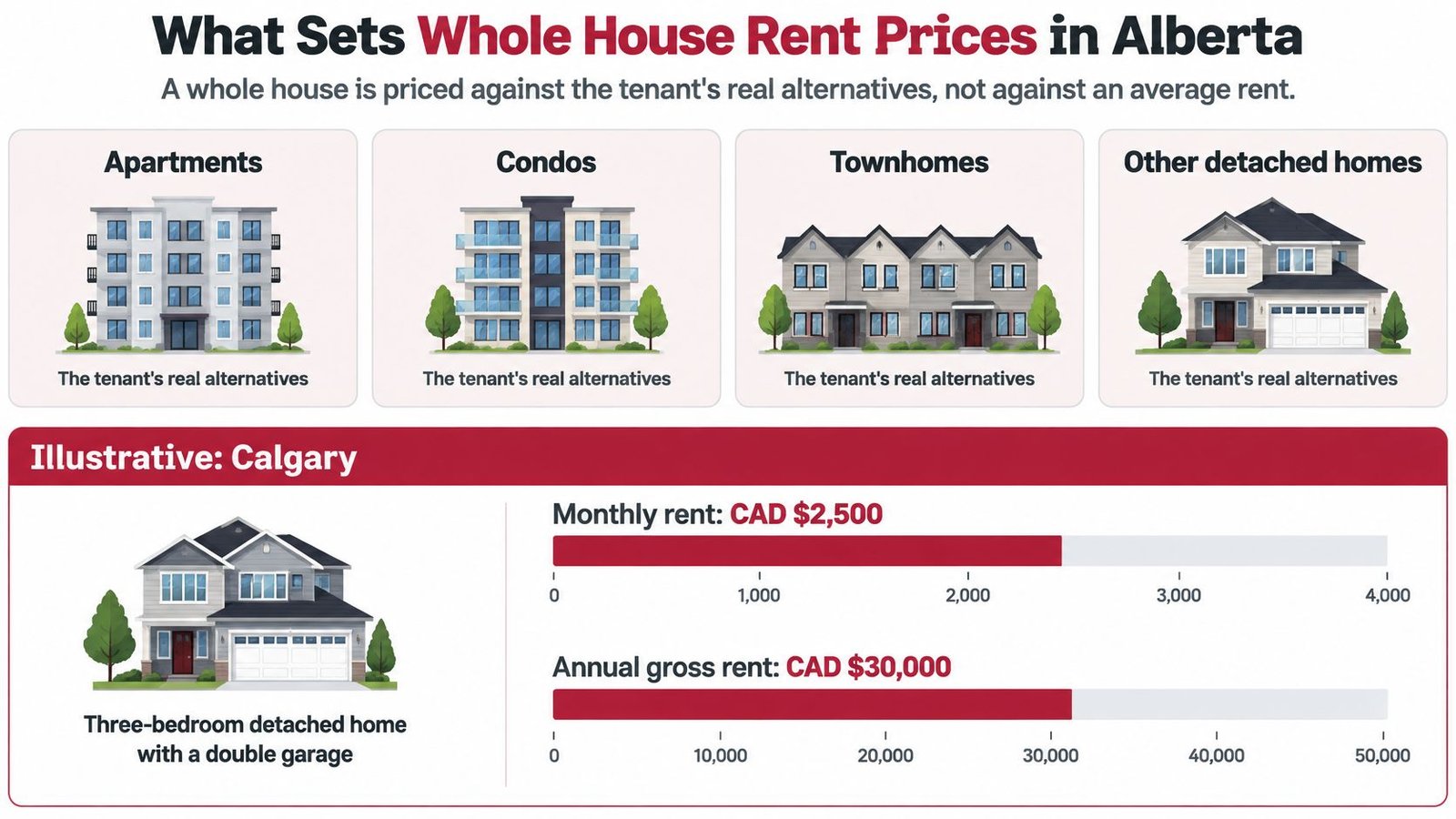
Compare the house with properties in the same neighbourhood and of similar type, size and condition. Then account for the features that affect a tenant's decision, including the garage, yard, utilities and repair needs. The infographic showing factors influencing whole house rent prices in Alberta with a Calgary illustrative example. summarizes the main comparisons.
How to Price a Whole House Against Alternatives
A Calgary detached home listed at $2,500 per month would bring in $30,000 a year gross if occupied all year. Allowing 5.0% for vacancy reduces that to $28,500 before costs, or $1,500 less. This is an illustrative calculation, not a market quote or a prediction for a specific house. The higher rent may come with a longer wait for a tenant, so price the empty period into the decision.
The 5.0% vacancy allowance uses Calgary's purpose-built apartment vacancy rate as a stress test. Apartment vacancy rates varied by unit type, from 4.4% for one-bedroom and three-bedroom-plus units to 5.7% for two-bedroom units and 6.0% for studios. Average apartment rents were $1,582 for one-bedroom units and $1,914 for two-bedroom units. Calgary's purpose-built rental supply grew 11% in 2025, according to CMHC market data. These figures help gauge competing rental options, but they do not set the rent for a detached home.
A practical pricing procedure
- Find close comparables. Review five to eight recent detached, semi-detached and townhome listings or leases in the same neighbourhood and size range. Prioritize close matches over a citywide average.
- Adjust for differences. Consider how the garage, yard and condition affect what tenants can choose nearby.
- Price the vacancy risk. Apply the 5.0% apartment figure as a stress test, equivalent to about 18 days vacant in a year. Allow for a longer gap where nearby supply is growing or demand is weaker.
- Count owner-paid costs. Deduct insurance, repairs, included utilities, and snow or lawn care if those expenses stay with the owner.
- Compare net returns. Check the result against a nearby apartment or townhome after vacancy and owner-paid costs, not just its advertised rent.
- Test one practical change. A flexible move-in date or fresh paint may help the home compete for tenants. Weigh the likely rent or leasing benefit against the cost.
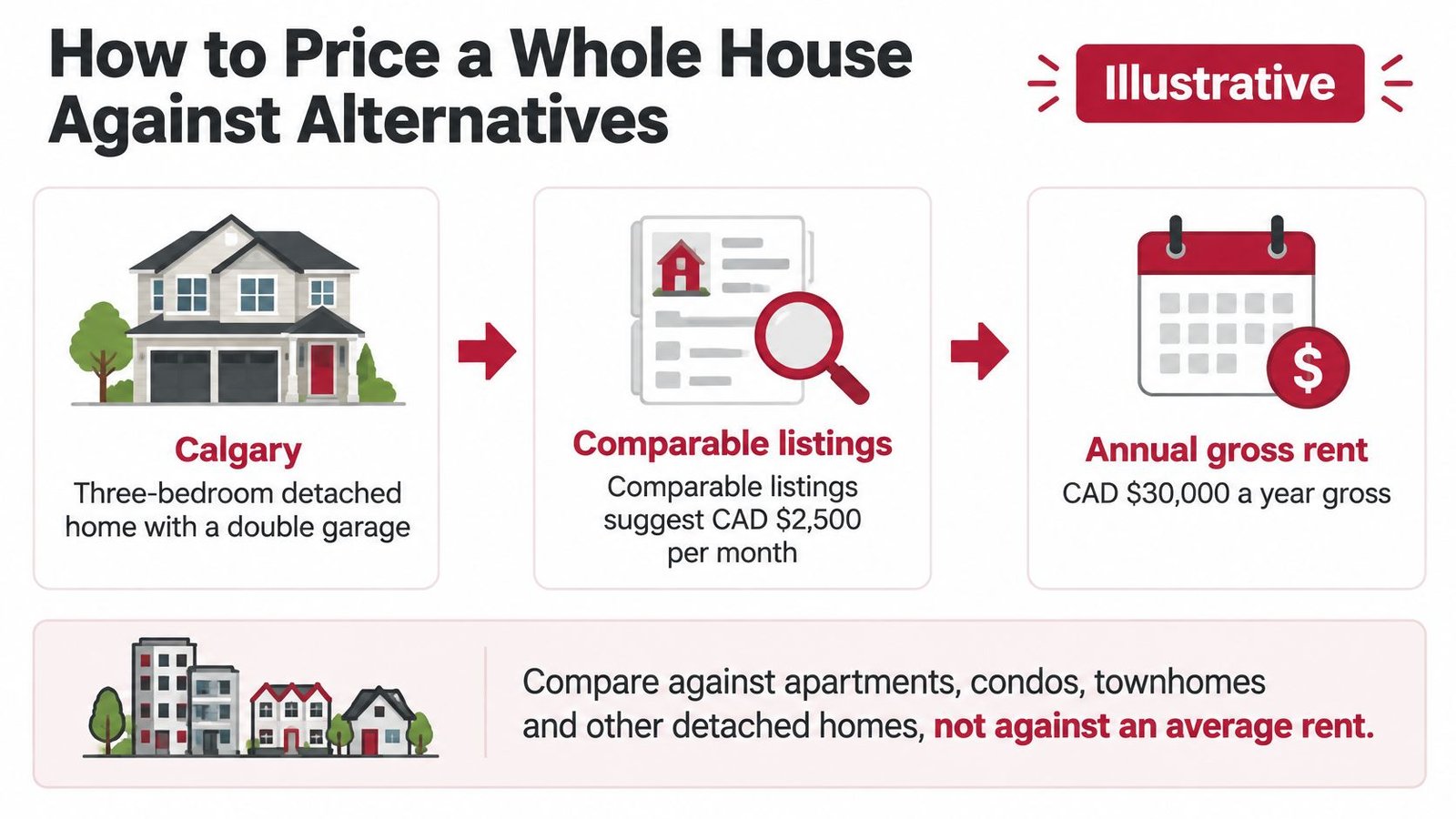
The asking rent is only the starting point. Net effective rent accounts for expected vacancy and the costs the owner carries.
Marketing a Whole House Rent to Fill It Faster
A detached home can earn more than an apartment and still sit vacant longer. Calgary's purpose-built rental vacancy rate was 5% in 2025, and purpose-built rental stock grew 11%. Those figures describe the apartment market, not demand for a particular house. CMHC's rental construction and vacancy update is useful context, but owners should market to the household looking for a whole home and budget for the risk of extra vacancy.
- Show the layout and upkeep clearly. Photograph each bedroom, bathroom, storage area, garage and yard. A floor plan helps applicants judge whether the rooms suit their household before booking a visit. Use a process to improve your property photography workflow, so no key area is missed.
- Explain what the rent includes. State who handles lawn care, snow clearing and utilities. These details affect both the tenant's monthly cost and the owner's ongoing workload.
- Make the whole-house advantages specific. Note the bedroom count, private yard, parking and nearby schools or transit. These features help households compare the property with apartments and townhomes.
- Set the asking rent against detached-home alternatives. If comparable houses lease for less, an ambitious price can cost more in vacancy than it gains in monthly rent. For example, one empty week erases a week's rent, while owner-paid utilities and yard care continue.
- Offer practical viewing options. Set viewing blocks and provide a virtual tour for applicants who are out of town. Whole-house showings take more coordination than apartment visits, so clear times reduce back-and-forth.
- Consider a flexible start date. A household may need a different move-in date or lease length. Flexibility can widen the pool, provided the timing works for the owner.
A strong listing brings the right details forward, but it cannot compensate for an unsuitable rent or unresolved maintenance. Reply promptly, then screen applicants carefully. The first person to book a viewing is not necessarily the right fit for a property with a yard, multiple rooms and more upkeep.
Alberta Deposit and Rent Increase Rules Owners Must Follow
Rent increases affect cash flow, but Alberta limits when an owner can make one. Under the Residential Tenancies Act framework, rent generally can't increase until 365 days have passed since the tenancy began or the last increase, whichever is later. A fixed-term tenancy can't have its rent increased during the term. Alberta sets the timing and procedure, not a specific dollar cap, and an increase can't be used unfairly to force a tenant out. The Alberta guidance on common landlord and tenant problems outlines the rules.
| Rule | Alberta requirement | What the owner does |
|---|---|---|
| Security deposit cap | No more than one month's rent at the start of the tenancy | Set the deposit at or below one month's rent and don't raise it later |
| Deposit holding | Place it within two banking days in an interest-bearing trust account at an Alberta bank, treasury branch, credit union or trust company | Open the trust account before the tenant moves in |
| Deposit return | Provide the deposit, a statement of account or an estimated statement within 10 days after the tenant leaves; don't deduct for normal wear and tear | Compare move-in and move-out photos before making a deduction |
| Rent increase timing | No increase until 365 days after the tenancy began or the last increase; none during a fixed term | Record the last increase date and fixed-term expiry for each tenant |
| Rent increase notice | Written notice with the effective date and landlord's signature; at least three full tenancy months for month-to-month, 12 full weeks for week-to-week or 90 days for other periodic tenancies | Serve notice early and keep proof of delivery |
For a periodic tenancy, the notice needs the effective date and the landlord's signature. A missed deadline can push an intended increase later, even if comparable rents have already changed. Renewal planning should account for insurance, utilities, maintenance and municipal charges, rather than treating a rent increase as an immediate response to rising costs.
An owner can use this Alberta landlord and tenancy overview as a starting point for reviewing lease administration. The practical safeguard is a compliance calendar for each tenant that records the last increase date, fixed-term expiry, notice-service date, effective date and proof of delivery.
Insurance and Upkeep Duties on a Detached Home
A whole-house tenant may pay more rent than an apartment tenant, but the owner still carries a separate vacancy and upkeep risk. If a furnace fails between tenancies, the owner pays for the repair and loses rent while the home is unoccupied. A lease can assign routine tasks to a tenant, but it cannot transfer the landlord's responsibility to keep the premises habitable. For Alberta tenancy requirements, use the Alberta landlord and tenancy overview, rather than a housing data dashboard.

Write each assigned task into the lease, including who reports problems and who arranges service. Clear terms help prevent disputes over snow clearing or contractor access; the owner remains accountable for the home's condition.
| Task | Common lease arrangement | What the landlord still owns |
|---|---|---|
| Snow and ice removal | Assign to the tenant in clear lease terms | Safe, usable access to the home and entrances |
| Lawn and yard care | Assign to the tenant with a seasonal clause | The property's condition at move-in and repairs to the grounds |
| Furnace and water heater servicing | Landlord books service; tenant reports faults promptly | Functioning heat and hot water during the tenancy |
| Smoke and carbon monoxide devices | Landlord supplies and tests; tenant reports low batteries | Working devices at move-in and during the tenancy |
| Basement areas | State in writing whether they are included; name excluded areas | Habitability of any area the tenant can use |
| Emergency access | Set out key-holding and entry procedures in the lease | Entry that respects the tenant's peaceful enjoyment |
Insurance and handover
A standard homeowner policy may not cover a home once it is rented. Ask the insurer whether a rental dwelling policy covers liability and lost rent during repairs. Check the unoccupied-property clause too, and get written confirmation of how long the home can sit empty before coverage changes. The PostDamage guide to water damage coverage can help owners prepare questions, but the policy itself determines coverage.
Require tenants to carry renter's insurance for their belongings and liability. At handover, record keys, utilities, smoke and carbon monoxide devices, seasonal maintenance, inspection records and emergency contacts. Include the agreed reporting and service procedures so a tenant knows whom to call when a leak or heating problem appears.
Use a whole-house maintenance guide to organise recurring work. A missed seasonal check can turn a small repair into an urgent call while the property is vacant, so assign responsibility and track completion. Keep the lease clear about who reports a fault, who contacts the contractor and how emergency access is arranged.
Self-Manage or Hire a Property Manager
Self-managing a whole house means handling applicant screening, showings, rent collection, repairs and every notice. That can be manageable for one property, but the work grows across several homes. A property manager acting as the owner's agent takes on operational duties, and the owner should document who is responsible for each one.
Illustrative fee comparison: at $2,500 monthly rent, an assumed 8% management fee equals $200 a month, or $2,400 a year, before any leasing fee. These are example calculations, not a quoted market rate. Owners should replace the assumption with actual written quotes and compare the cost with the vacancy and repair expenses the manager is expected to help control.
Ask each company to define its scope in writing:
- Screening: What criteria are used for credit, income, references and rental history, and how does the process follow Alberta and human rights requirements?
- Leasing and marketing: Who prepares the listing, answers enquiries, conducts showings and documents the selected applicant?
- Money and notices: Who collects rent, handles deposit trust-account requirements and manages rent-increase notices?
- Repairs: What emergency work can be authorised, and what dollar limit requires owner approval?
- Inspections: What move-in and move-out reports, photographs and maintenance records will the owner receive?
- Ending the relationship: What does the management agreement say about termination and transfer of records?
A Calgary owner comparing service scopes can also review property management for small landlords before requesting proposals. Compare three quotes against the same whole-house duties, rather than comparing headline fees alone.
Decide Whether Whole House Rent Fits Your Property
Whole house rent can suit a property when privacy, space, a yard or parking set it apart, and local comparables support the rent the owner needs. It's a weaker fit when deferred repairs, an above-market asking price or a thin cash reserve leaves the owner exposed to a long vacancy or a major repair.
When the approach fits
- The home offers clear advantages: Its layout, yard, parking or privacy gives households a reason to choose it over an apartment or townhome.
- Comparable rents support the target: Similar homes in the neighbourhood provide evidence for the asking range.
- The owner can carry a vacancy: The property's costs remain manageable if rent pauses temporarily.
- Major systems are sound: The furnace, roof and wiring don't need deferred work that could undermine the home's condition.
When to reconsider
- The price depends on wishful thinking: Comparable homes don't support the asking rent.
- Repairs are waiting: A failing furnace, roof or other major issue could undermine the lease-up.
- There's no repair reserve: One large repair would put the owner under financial strain.
- Tenants have cheaper substitutes: An apartment or townhome nearby offers a lower total cost without giving up features that matter to the likely tenant.
Three steps can turn the decision into a working plan. First, calculate net effective rent using comparable properties, vacancy and owner-paid costs. Second, check the lease and operating calendar against the Alberta deposit and rent-increase rules above. Third, request a rental-property insurance quote that states the vacancy terms in writing. Owners who want to assess a property's rental return can use a calculator as a starting point, then test the result against actual costs and local comparables.
Dreamhouse Realty Ltd. provides rental consultations and market analysis, tenant placement, leasing, inspections, maintenance coordination and compliance support for owners in Calgary, Edmonton, Red Deer and nearby Alberta communities. For a free rental consultation and market analysis, contact GURIQBAL CHAHAL, MBA, PMP, REAL ESTATE BROKER at 403-966-6072, or visit Dreamhouse Realty Ltd..