

A Calgary landlord has two strong applications on the table, a duplex vacancy is already costing money, and both applicants appear capable of paying rent. The temptation is obvious: choose the one who responds first, pull a quick report, and move on.
That shortcut creates problems when the file later needs to withstand an applicant's questions, a privacy complaint, or a Human Rights complaint. A tenant screening background check in Alberta isn't just a credit score or a broad search for anything negative. It's a documented process that connects consent, necessary information, rental risk, and consistent decision-making.
The strongest process combines credit information, income verification, references, occupancy details, and, where justified, court or criminal-record information. Landlords who also keep organised financial records may find a resource such as virtual bookkeeping for landlords useful, because screening decisions and property finances both become easier to defend when records are complete and retrievable.
Table of Contents
- Why Screening in Alberta Feels Harder Than It Should
- What Alberta Law Actually Lets You Ask For
- Building the Screening Workflow From Application to Decision
- Reading the Credit Report and Verifying Income
- Criminal and Court Record Checks Without Overreaching
- Reference Checks and the Red Flags That Matter Most
- Record-Keeping, Retention, and Privacy Obligations
Why Screening in Alberta Feels Harder Than It Should
The pressure usually arrives before the application is fully reviewed. One applicant has a stable-looking job and a polished application. Another offers a convincing explanation for a thin credit file and has a previous landlord who speaks warmly about them. Meanwhile, the Calgary duplex has been empty long enough for the owner to consider skipping reference calls.
That's where screening becomes more than a leasing task. Alberta landlords operate within the Residential Tenancies Act, privacy obligations, and human-rights expectations at the same time. A landlord needs enough information to assess payment reliability and tenancy responsibility, but not so much information that the process becomes intrusive, inconsistent, or disconnected from the rental decision.
The pressure points that cause weak files
Competing applicants make consistency difficult. A landlord may ask one applicant for extra documents because something feels unusual, then approve another applicant after a shorter review because the person seems familiar or personable. That difference can be difficult to explain later.
Time pressure also encourages informal research. Social-media searches, comments from neighbours, and assumptions based on an applicant's name or personal circumstances can introduce information that has no proper place in the decision. They can also expose protected personal details that should never influence an application outcome.
A better process starts before applicants apply. Written criteria should identify the information required, the checks that may be completed, and the reasons a file could be approved, declined, or held for clarification. The criteria should apply to every applicant in the same rental competition.
Practical rule: Decide what evidence matters before seeing the applicants, not after developing a preference.
That approach doesn't remove judgment. It gives judgment a defensible boundary. The landlord can still consider explanations, resolve inconsistencies, and assess the whole file, but each conclusion should relate to tenancy obligations rather than instinct.
What Alberta Law Actually Lets You Ask For
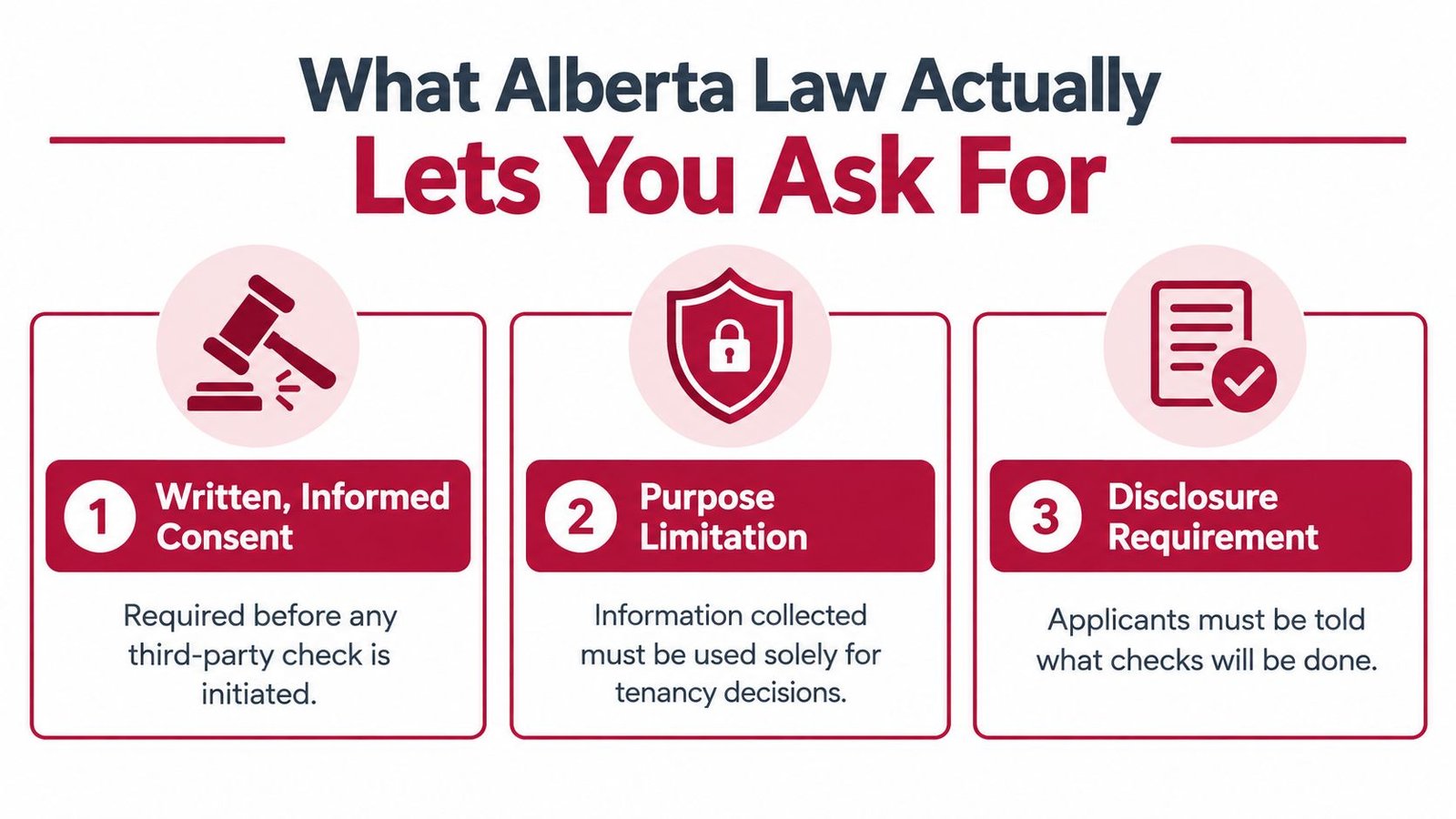
Alberta landlords should treat consent as the starting point for every third-party check. The province's tenant-verification guidance says a landlord can request a credit report only where there's a direct business requirement and the applicant gives express, verifiable consent. The guidance says consent may be provided in writing, by email, or through an audio recording. Alberta's tenant-verification guidance also recognises references and intended-occupant information as relevant screening tools.
The privacy question is just as important as the tenancy question. Alberta's Office of the Information and Privacy Commissioner says landlords generally need consent to collect, use, or disclose personal information, and landlords must explain the purpose at or before collection. Information should be necessary for the rental decision, used for that purpose, and handled securely.
Information that normally belongs in the application
With appropriate consent and a clear tenancy purpose, a landlord may generally ask for:
- Identity confirmation: Enough information to confirm the applicant's identity and match the application to verification records.
- Credit information: A credit report obtained for the rental decision, rather than for general curiosity.
- Income and employment details: Documents or contacts that help verify the applicant's stated ability to meet rent obligations.
- Rental references: Previous landlords or other people who can speak to rental history.
- Occupancy information: The number and names of intended occupants, as recognised in Alberta's tenant-screening guidance.
- Limited court or criminal context: Only where the check has a reasonable connection to the tenancy purpose and the applicant has consented.
The Alberta RTA handbook is a useful reference point for landlords reviewing the provincial tenancy framework, but it shouldn't replace advice specific to an unusual dispute or screening situation.
Information that should stay out
Medical information generally has no place in a routine rental application. A social insurance number shouldn't be collected casually or retained when it isn't needed for a defined credit-bureau process. Questions about race, religion, family status, disability, gender identity, or other protected characteristics can create serious human-rights risk when they influence the decision.
Broad social-media profiling is also poor practice. It produces inconsistent information, often captures protected or irrelevant details, and makes it hard to show that the same process was used for everyone.
The application form itself is part of the compliance system. It should identify the purpose of collection, describe the checks that may occur, record consent clearly, and avoid requesting information that the landlord cannot explain or protect.
Building the Screening Workflow From Application to Decision
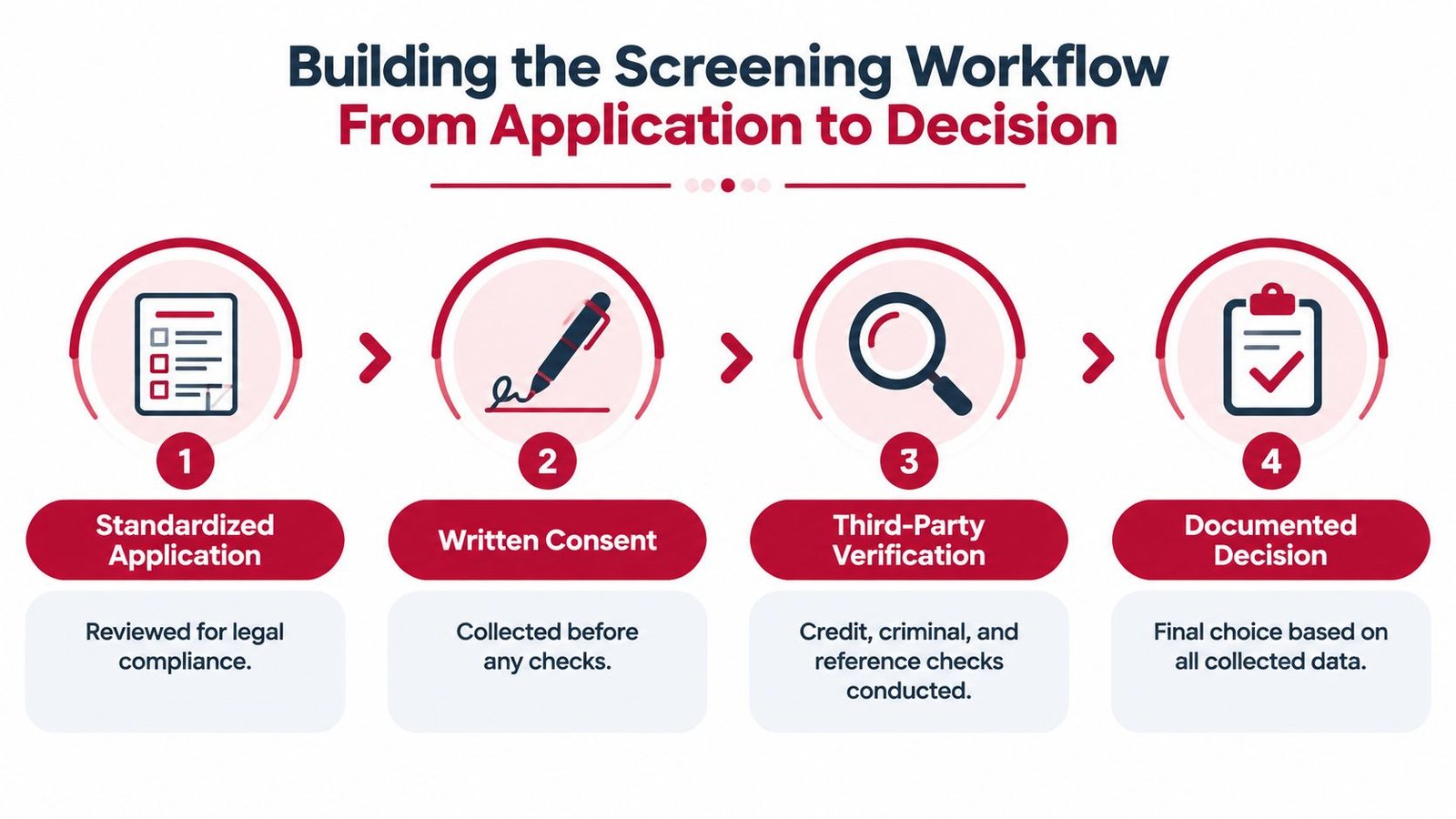
A defensible workflow has a sequence. It doesn't begin with a report and end with a gut feeling. It begins with an application designed for Alberta rentals and finishes with a written explanation tied to pre-set criteria.
The order of operations
Review the standard application. Confirm that the form asks only for information connected to the tenancy decision and explains its purpose.
Capture written consent and verify identity. Consent should be recorded before a credit bureau or other third-party provider is contacted. The file should show when consent was obtained and who reviewed it.
Verify the core financial and rental information. Order the credit report, review income documents, contact employment references where appropriate, and call previous landlords using the same questions for each applicant.
Use additional checks only when justified. A court search or criminal-record check shouldn't be an automatic part of every file. The reason for using it, the consent obtained, and the result should be recorded separately.
Complete a written decision matrix. Compare each applicant against criteria established before applications arrived. The matrix should show what was reviewed, what was confirmed, what remained unresolved, and why the final decision followed.
Each action needs a basic audit trail: timestamp, person completing the check, source reviewed, relevant finding, and outcome. A landlord should be able to hand the file to a regulator, judge, or Human Rights panel and explain the decision without relying on memory.
Calgary operators often weaken this process by skipping reference calls, treating one report as decisive, or allowing one enthusiastic reference to outweigh contradictory financial information. A workflow prevents those shortcuts from becoming the default.
Secure identity and consent handling matters too. Landlords evaluating tools may research options such as setup auth without vendor lock-in when they need a way to manage authorisation without making the screening record dependent on one provider.
The goal isn't to create unnecessary administration. It's to ensure the landlord can distinguish between a missing document, a verified concern, and an irrelevant personal detail.
Reading the Credit Report and Verifying Income
A credit report should be read as a collection of signals, not a verdict. Once consent is in place, an Alberta landlord may review the score band, open and closed accounts, payment behaviour, credit utilisation, collections, and recent inquiries. The underlying account history usually explains more than the headline score.
An Alberta-oriented Calgary screening guide recommends treating 650 or higher as broadly safe, 600 to 649 as borderline, and a score below 600 as requiring explanation. The same guide identifies recent hard inquiries within the last 90 days, rent or utility collections, and an active consumer proposal as stronger warning signs than score alone. It also recommends looking for no eviction in the last 5 years and no more than 2 unexplained moves in 24 months. These thresholds come from Calgary tenant-screening guidance, not from Alberta law, so they should be treated as operational benchmarks rather than mandatory rules.
| Credit Signal | What It Suggests | How to Respond |
|---|---|---|
| Score of 650 or higher | Broadly lower concern within the guide's framework | Review the full report and confirm income and rental history |
| Score from 600 to 649 | A borderline file that needs context | Examine payment patterns, collections, and explanations |
| Score below 600 | Greater uncertainty | Request relevant clarification and weigh the complete application |
| Rent or utility collections | A direct tenancy-related concern | Verify dates, amounts, outcome, and the applicant's explanation |
| Recent hard inquiries | Possible financial pressure or new borrowing | Ask only for relevant context and avoid treating the signal alone as decisive |
| Active consumer proposal | Current financial restructuring | Consider documented affordability and the complete risk picture |
A soft inquiry is different from a hard inquiry. Landlords who want a plain-language explanation can review what is a soft credit check, while still confirming how their chosen screening provider obtains consent and reports the inquiry.
Income verification should match the applicant's work pattern. T4 employees may provide current pay documentation and an employer contact. Hourly workers require attention to variable hours. Gig workers and self-employed applicants may need a broader package, such as tax documentation, business records, or bank statements, limited to what's necessary for the decision.
The final memo should state the evidence, not personal impressions. For example, it can record that the credit file was reviewed after consent, income documents were checked, employment contact was completed, the previous landlord was reached, and the decision followed the published criteria. A landlord can also consult the Alberta tenant credit-check resource when refining the credit portion of the workflow.
The Calgary guide reports that credit-only screening misses about 30% of risky tenants, while its combined credit, identity, and landlord-reference process is reported to reduce non-payment by 67% on average across its user base. Those figures reinforce the practical point: credit is one part of the file, not the whole decision.
Criminal and Court Record Checks Without Overreaching
More information doesn't automatically produce a better tenancy decision. Criminal-record checks and court searches should be separate, justified steps, not routine background fishing attached to every application.
A standard Canadian criminal record check can identify record information within the scope of the service and consent provided, but it doesn't measure rent-payment reliability or property care. A vulnerable-sector check is a specialised process connected to work or service involving vulnerable people, not a default rental-screening product. A civil court search can reveal proceedings available through the court system, but a filing isn't the same as a judgment or proof that an applicant failed as a tenant.
Alberta's guidance requires consent for these kinds of checks and a reasonable basis related to the tenancy purpose. It also notes that members of the public can search civil actions in the Alberta Court of King's Bench by party name. The provincial framework is therefore compatible with court-based screening, but it doesn't turn every available record into relevant evidence.
When an additional check may be justified
A family-oriented building, shared accommodation, or housing arrangement involving vulnerable occupants may create a clearer reason to consider a narrowly defined check. A standalone condo application from a professional tenant, where the decision can be made from verified income, credit, identity, and rental history, may not justify adding a criminal search.
Any result requires context. The nature of the record, its relationship to the tenancy, its age, its outcome, and the applicant's explanation all matter. A blanket rule that rejects every applicant with any record can create legal and ethical problems while failing to identify the actual rental risk.
Consent should name the check and its purpose. The result should be stored separately with restricted access, and unnecessary copies shouldn't remain in the main application file. Alberta privacy attention involving Certn, a tenant-screening and background-check provider, shows why landlords must scrutinise vendors as well as applicants. The question is not whether a vendor can collect more information. It's whether the landlord needs that information for this tenancy.
Reference Checks and the Red Flags That Matter Most
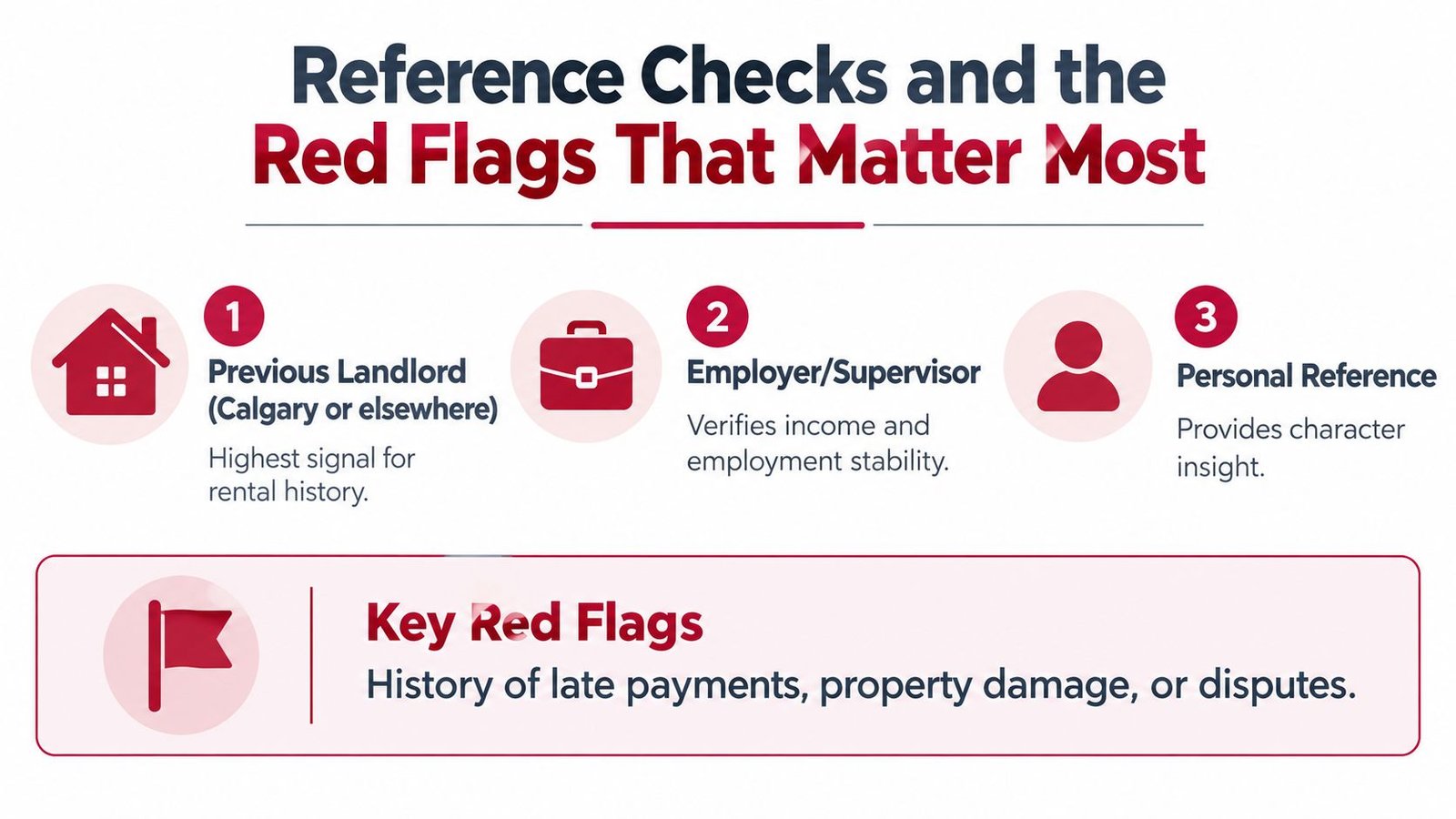
Reference calls often reveal what a credit report cannot. A landlord should contact references in a consistent order, beginning with previous landlords in Calgary or elsewhere, followed by an employer or supervisor, and then one personal reference. The order matters because rental history provides the closest evidence of how an applicant handled a tenancy.
A short, neutral script keeps the call focused:
- Confirm the relationship: Ask whether the person was the applicant's landlord, employer, supervisor, or personal reference.
- Verify the period: Confirm when the applicant lived or worked there.
- Ask about payment: Ask whether rent was paid as agreed and whether arrears occurred.
- Ask about care: Ask whether the property was returned in acceptable condition and whether damage or disputes arose.
- Ask about notice: Ask whether the applicant gave appropriate notice before leaving.
- Confirm the reason for leaving: Record the reference's answer without embellishment.
- Check re-rental willingness: Ask whether the reference would rent to the applicant again, where that question is appropriate.
An employer or supervisor can help confirm employment and income information, but the call should remain limited to tenancy-relevant verification. A personal reference can provide character context, although it shouldn't outweigh direct rental evidence.
Red flags that deserve follow-up
The meaningful warning signs are patterns and contradictions, not a nervous telephone manner. Inconsistent employment details, unreachable landlord references, refusal to permit contact with the current landlord, Alberta court eviction filings, and mismatched addresses all warrant clarification.
A filing still needs context. The landlord should identify the court source, date, parties, case type, and available outcome rather than recording a vague label such as “eviction issue.”
Every concern belongs in a dated log:
Record the fact, source, and response. “Previous landlord contacted on 2026, confirmed tenancy period, reported payment concern, applicant asked for clarification, explanation reviewed against other documents.”
Landlords refining their interview process can use these tenant-screening questions as a starting point, then adapt them to the property and apply them consistently.
Record-Keeping, Retention, and Privacy Obligations
A screening decision is only as defensible as the record supporting it. Under Alberta's privacy framework, the landlord needs to show what information was collected, why it was collected, what consent was obtained, how it was used, and how it was protected. The Alberta OIPC's guidance for landlords and tenants places consent and purpose at the centre of personal-information handling.
What belongs in the file
A complete application record should contain only material connected to the tenancy decision:
- Signed application: The submitted form, including identity and occupancy information that the landlord needs.
- Consent record: The signed consent, email authorisation, or audio-recording details, including the date and scope.
- Credit summary: A decision-relevant summary rather than unnecessary duplication of the entire report where a full copy isn't needed.
- Income verification: The documents and notes used to confirm the applicant's stated income or employment.
- Reference notes: Date, contact method, person reached, questions asked, answers received, and any follow-up.
- Decision rationale: The criteria applied, unresolved issues, explanations considered, and final outcome.
- Vendor record: The provider used, check requested, and result received, particularly for specialised searches.
A file shouldn't contain casual comments about an applicant's appearance, accent, family, health, religion, or personality. Those observations don't establish tenancy performance and can become damaging evidence if a decision is challenged.
Retention should follow purpose
Alberta law doesn't provide one universal practical retention period for every landlord screening document. The appropriate period depends on the record, the purpose for retaining it, the possibility of a dispute, and the landlord's documented privacy policy. A landlord shouldn't promise a fixed period without confirming the applicable obligation for the specific file.
| Document Type | Retain For | Destroy / Return When |
|---|---|---|
| Signed application | Only while needed for the stated tenancy, legal, or dispute purpose | Securely destroy when the purpose and any legitimate need to retain it have ended |
| Consent record | With the related screening record while the use of that screening information remains necessary | Destroy securely when the associated information is no longer required |
| Credit report or summary | The shortest period needed to document the decision and address a legitimate dispute | Securely destroy unnecessary full reports and retain only a justified summary if appropriate |
| Income documents | While needed to verify the decision or meet a documented obligation | Securely destroy when verification is complete and continued retention has no clear purpose |
| Reference notes | While needed to support the application outcome or resolve a complaint | Delete or destroy once the documented purpose has ended |
| Court or criminal-record result | Only for the narrow, stated purpose that justified the check | Destroy separately when that purpose ends, with access limited in the meantime |
| Decision memo | While needed to explain the approval or decline and meet applicable obligations | Securely destroy under the landlord's documented retention policy |
The table is a management framework, not a substitute for legal advice. Rejected applicants' documents shouldn't sit indefinitely in an email inbox, shared drive, or paper folder. Digital records need access controls and secure deletion. Paper records need a destruction method that prevents reconstruction.
Why the paper trail protects the landlord
Good records help answer four difficult questions:
- What did the landlord ask for?
- Did the applicant consent before the check?
- Was the information relevant to the tenancy decision?
- Did the landlord apply the same criteria to competing applicants?
A Human Rights complaint may focus on whether protected grounds influenced the decision. A privacy complaint may focus on over-collection, unclear purpose, excessive retention, or disclosure to a vendor. A tenancy dispute may require the landlord to explain how the applicant was evaluated. The record doesn't guarantee the landlord's conclusion was correct, but it demonstrates how the conclusion was reached.
Compliance principle: Keep the evidence needed to explain the decision, not every piece of information that happened to be available.
How a managed Calgary workflow can operate
Dreamhouse Realty Ltd. uses a structured intake funnel for Calgary and Alberta owners. The process begins with a standardised application, followed by written consent captured before any credit pull. An Equifax report is ordered through a landlord portal, income is checked against two months of pay stubs plus an employer call, and references are contacted using a consistent script.
A decision memo is written before an applicant is approved or declined. That memo ties the outcome to the information reviewed rather than to personal impressions. The same operating logic can support inner-city Calgary rentals, managed properties across Alberta, single-family homes, condominiums, townhomes, and small multifamily buildings.
GURIQBAL CHAHAL, MBA, PMP, REAL ESTATE BROKER, oversees a licensed property management and real estate brokerage serving Calgary, Edmonton, Red Deer, and surrounding communities. Owners can book a free consultation to review their current screening process, identify gaps in consent and record handling, or hand the workflow over to a team that manages applicant intake, verification, leasing, inspections, rent collection, and compliance documentation.
Dreamhouse Realty Ltd. can manage the tenant screening background check process through documented credit, income, reference, and rental-history verification, while keeping the decision record organised for Alberta privacy and tenancy requirements. Visit Dreamhouse Realty Ltd. to book a free consultation with GURIQBAL CHAHAL, MBA, PMP, REAL ESTATE BROKER, at 403-966-6072 and review whether the current process should be improved or fully managed.