

A first-time Calgary landlord often starts with one simple plan, keep the property rented and stay out of trouble. Then the messages slow down, the vacancy stretches, the repair quote lands in the middle of a workday, and Alberta's notice rules turn a “quick fix” into a paperwork job. That's usually the moment when property management for small landlords stops sounding like a luxury and starts looking like a practical way to protect time, cash flow, and peace of mind.
The tricky part is that Calgary isn't one flat market. A condo, a townhouse, a detached home, and a small plex can each face different demand, different vacancy pressure, and different tenant expectations. In 2025, the City of Calgary reported that overall rental vacancy moved from 4.6% in 2024 to 5.1% in 2025, and the highest-rent quartile sat at 6.7% vacancy compared with 4.4% in the lowest-rent quartile (City of Calgary housing trends). That kind of split is exactly why owners need local judgment, not a one-size-fits-all rent guess.
Table of Contents
- Why Small Landlords in Alberta Consider Help
- What Full Service Management Covers Day to Day
- Self Managing Compared With Hiring a Manager
- Understanding Cost Models and Vacancy Math
- How Onboarding Works From First Call to Steady Income
- Alberta Rules and Checklists by Property Type
- How to Choose the Right Manager in Alberta
Why Small Landlords in Alberta Consider Help
A Calgary owner with one rental usually isn't trying to build a giant portfolio. They're trying to keep a tenant happy, stay compliant, and avoid losing money between leases. The problem is that each of those tasks shows up at the same time, often with no warning.
A unit can look “easy” on paper and still absorb hours of follow-up. One showing turns into three, a repair needs a vendor, and a lease renewal date lands right when work or travel gets busy. In a market where vacancy is moving up and higher-priced homes can sit longer, the cost of a slow response gets real quickly.
Practical rule: if the landlord's calendar is already full, the rental will usually be managed reactively instead of proactively. That's where missed rent, weak screening, and avoidable vacancy begin.
For a local owner, help often means more than just collecting rent. It means someone else is watching the listing, answering calls, checking competing units, confirming paperwork, and keeping the lease files straight. For an out-of-province owner, the value is even clearer because every inspection, signature, and maintenance decision is harder from a distance.
Calgary's 2025 vacancy data also suggests that the upper end of the market may need a more careful leasing approach than a lower-priced unit. The same citywide average won't tell a landlord whether a specific condo, detached house, or plex should be held firm on rent or repositioned. A manager's job is to narrow that gap by looking at the property, the neighbourhood, and the current competing listings together.
For many owners, the question becomes simple, keep self-managing, delegate the day-to-day, or bring in support before a problem grows. That's the decision this guide helps clarify.
What Full Service Management Covers Day to Day
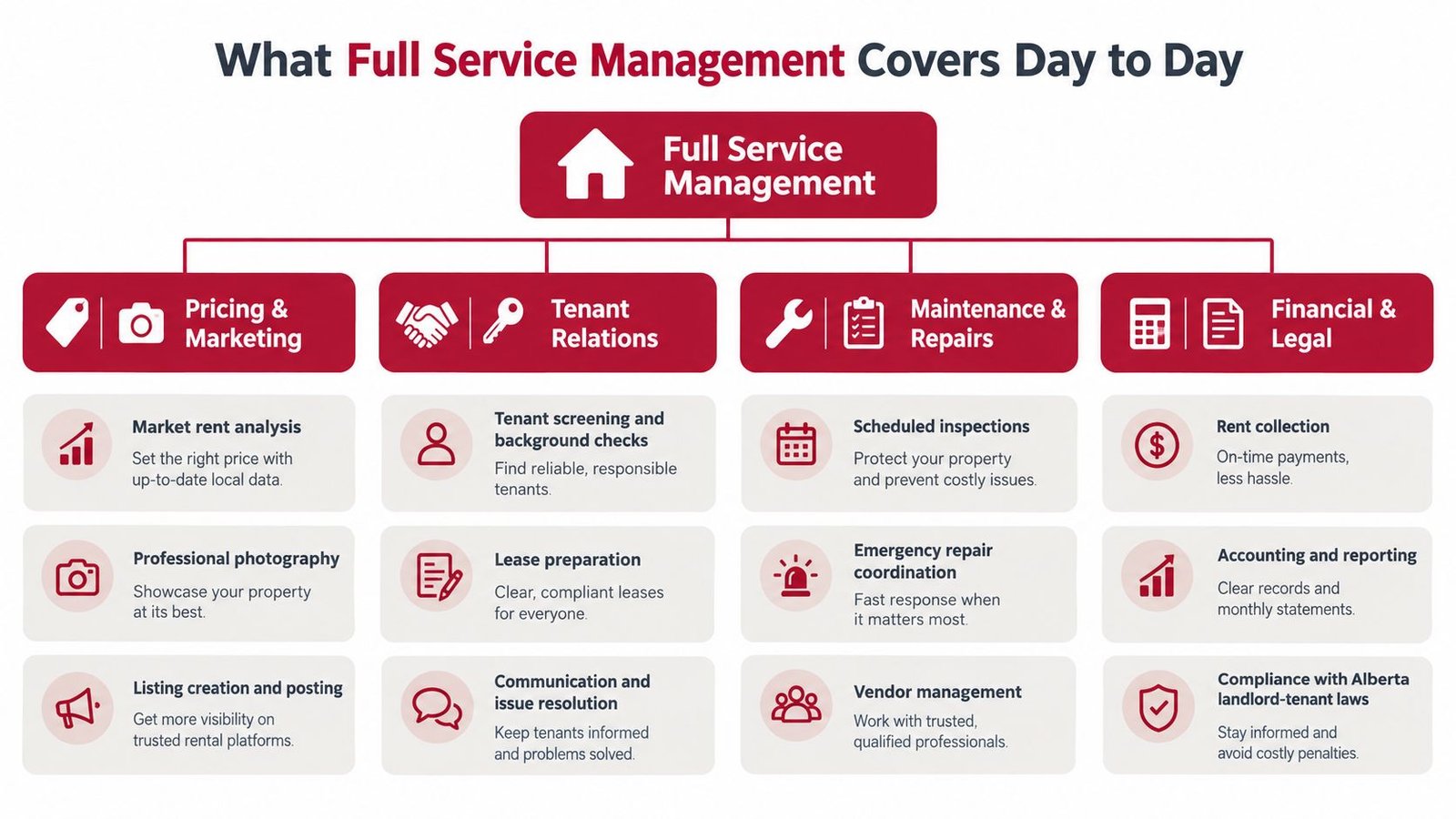
A full-service manager is not just a rent collector. The work starts before a tenant moves in and continues after the lease is signed, with each step feeding the next.
Pricing and marketing
The first task is market rent analysis. That means checking competing listings, likely tenant demand, and the property's own strengths before a price is posted. Strong photos and a clear listing then do the heavy lifting, because a poor first impression usually leads to weak inquiry volume and more time on market.
Tenant relations
Tenant screening, lease preparation, and issue handling sit together for a reason. A screened tenant and a clear lease reduce friction later, but only if communication stays prompt and documented. A manager handles that bridge between the owner and the tenant so small issues do not become bigger ones.
Maintenance and repairs
Inspections, vendor coordination, and repair follow-up are part of the same workflow. If a request comes in, someone has to triage it, choose the right contractor, confirm access, and verify the work. Owners who try to do this piecemeal usually spend more time chasing updates than solving the actual problem.
Financial and legal
Rent collection, accounting, reporting, and Alberta compliance are the back office that keep the front-end rental business alive. Lease files, notices, ledgers, and inspection reports all have to line up. Dreamhouse Realty Ltd. is one Alberta option that combines rental management, tenant placement, and compliance support for Calgary, Edmonton, Red Deer, and surrounding communities, and its service overview is laid out in this explanation of what a property manager does.
Good management is mostly coordination. The tenant sees one clear process, while the owner sees fewer surprises and better records.
The value of the system is that it doesn't treat leasing, maintenance, and compliance as separate chores. They're one operating rhythm, and that rhythm is what keeps a small rental from becoming a second full-time job.
Self Managing Compared With Hiring a Manager
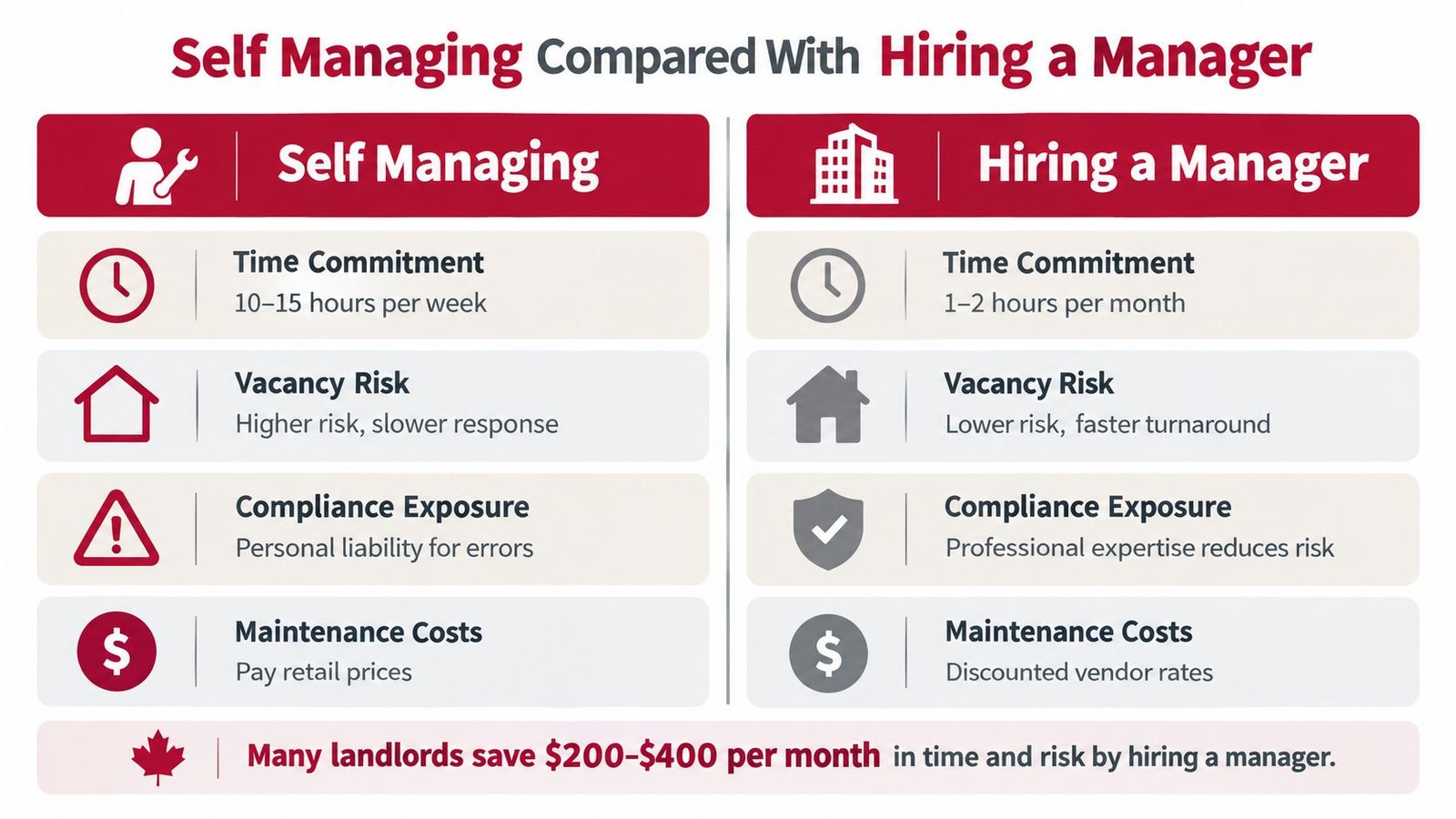
Self-management works best when the owner has time, lives close by, and enjoys detail work. Hiring a manager makes more sense when the owner values consistency, wants better separation from tenant issues, or can't keep up with the admin load.
| Area | Self-Managing | Hiring a Manager |
|---|---|---|
| Time | Nights, weekends, and interruptions | More delegated, fewer owner touchpoints |
| Vacancy | The owner handles calls and showings directly | One process for marketing, screening, and follow-up |
| Compliance | The owner carries the paperwork and timing burden | The manager tracks notices, reports, and records |
| Maintenance | The owner coordinates vendors and access | The manager coordinates the repair chain and documentation |
A self-managed unit can work well when the landlord already knows the local market and can respond quickly. It gets harder when the property is in another city, when the tenant relationship is tense, or when the unit needs frequent vendor visits.
Decision rule: if the owner can't respond quickly, document carefully, and keep consistent records, delegation usually protects revenue better than trying to do everything alone.
Some owners want direct control over every decision. That's understandable, especially with a single rental. But control without time can become a liability, because missed notices, delayed repairs, and inconsistent screening are expensive in ways that don't always show up on a spreadsheet right away.
A manager is not a magic fix, and not every owner needs one. The right question is whether the owner can run the rental like a business, week after week, without letting important tasks slip.
Understanding Cost Models and Vacancy Math
A landlord should not compare management fees only against the monthly rent on paper. Before comparing fee models, review what a property management company actually costs in Alberta. The question that matters is whether the property earns more, or loses less, once vacancy, re-leasing time, and admin strain are part of the picture.
A quick check of your rental deal numbers helps keep that decision grounded. A strong asking rent still matters little if the unit sits empty too long.
Calgary segment data changes the math
Calgary is not one rental market in practice. A studio, a one-bedroom, and a two-bedroom each face different vacancy pressure, so pricing and management choices should match the unit type, not just the neighbourhood. CMHC's Calgary CMA dashboard shows an overall apartment vacancy rate of 5.0%, with 6.0% for studios, 4.4% for one-bedroom units, 5.7% for two-bedroom units, and 4.4% for units with three or more bedrooms. The same dashboard reports average apartment rents of $1,582 for one-bedroom units and $1,914 for two-bedroom units, and it shows Calgary's secondary condominium rental market at 2.2% vacancy (CMHC Calgary rental market dashboard).
| Calgary Vacancy and Rent by Segment | Segment | Vacancy Rate | Average Rent |
|---|---|---|---|
| Calgary CMA apartments | Overall apartment market | 5.0% | Not stated in verified data |
| Calgary CMA apartments | Studio units | 6.0% | Not stated in verified data |
| Calgary CMA apartments | One-bedroom units | 4.4% | $1,582 |
| Calgary CMA apartments | Two-bedroom units | 5.7% | $1,914 |
| Calgary CMA apartments | Three or more bedrooms | 4.4% | Not stated in verified data |
| Calgary secondary condos | Condo rentals | 2.2% | Not stated in verified data |
A two-bedroom rented at $1,914 loses that month's scheduled rent if it sits vacant for one month. That is why owners should review price, photos, and showing activity often, especially early in the listing cycle. If inquiry volume is weak, showings are thin, or applications are not coming through, the price or presentation may be off.
The cost side matters too
Higher rent is not always the better outcome. In softer segments, a lower asking rent can bring in a tenant faster and reduce the cost of waiting. A manager's job is to test that trade-off against current competing listings and demand, not habit or instinct.
For a Calgary owner, the practical question is whether the unit is priced in the right rent quartile for its type. A one-bedroom near the middle of the market may need a different approach than a two-bedroom competing at the top end. Smaller units can move differently from family-sized units, and condominium rentals can behave differently again.
The most useful operating signals are the ones that show trouble early. Inquiry volume, showing-to-application conversion, and days on market tell the owner whether price, photos, or presentation need adjustment before the listing goes stale.
How Onboarding Works From First Call to Steady Income

The first conversation should feel practical, not salesy. A good manager wants to understand the property type, current condition, tenancy status, and the owner's goal, whether that's faster leasing, less stress, or better documentation.
The early steps
The usual starting point is a consultation and market review. The owner shares the basics, and the manager compares that unit against local supply, likely tenant demand, and the property's condition. After that comes the property assessment, which is where photos, repair needs, and any lease-ready issues get identified.
The listing and screening phase
Once the property is ready, the listing goes live, showings begin, and inquiries are handled. Owners often lose time with DIY management because every message, viewing, and application needs a response. Screening then narrows the field through rental history, income verification, and reference checks so the wrong tenant doesn't move in just to fill a vacancy.
The handoff into steady income
Lease signing, move-in documentation, and rent collection setup come next. Good onboarding doesn't stop at the signature page, because the owner still needs a reporting rhythm, a statement trail, and photo-backed records. The portal and statement package matter most for remote owners, since they need visibility without chasing people for updates.
A clean onboarding process should leave no mystery about who holds the paperwork, who answers the tenant, and who approves the repair.
A practical manager will also explain what the first 30 days should look like. If a landlord is still waiting for photos, statements, or lease copies weeks later, that's not a good sign. The work should feel orderly from the start, not improvised after move-in.
Alberta Rules and Checklists by Property Type

Alberta compliance is where a lot of small landlords get caught off guard. The province requires both move-in and move-out inspection reports, and if those inspection requirements aren't met, a landlord can't deduct damage or cleaning costs from the security deposit (CMHC Calgary landlord guidance).
Timing and notice rules
Rent increases also have strict timing. A landlord can't increase rent during a fixed-term or periodic tenancy until at least 365 days have passed since the last increase or the start of the tenancy, whichever is later. If the 365th day falls inside a fixed-term agreement, the increase has to wait until that agreement ends. Written notice must include the date, effective date, and landlord's signature, and the notice period depends on the tenancy type, with 12 full weeks for week-to-week, three full months for month-to-month, and 90 days for other periodic tenancies (Alberta tenancy information for tenants).
Different property types need different checklists
A single-family house usually needs a sharper focus on exterior condition, smoke and carbon monoxide detectors, and a clean inspection trail. A condo adds another layer because bylaws, board rules, and common-area expectations can affect what the tenant is allowed to do. A small plex or multi-unit building needs more attention to shared systems, unit-by-unit inspections, and building-wide safety routines.
- Single-family homes: move-in photos, move-out photos, detector checks, and any municipal licensing requirements.
- Condos: bylaw review, board approval if needed, move-in photos, and clear sharing of common-area rules.
- Multi-unit buildings: fire safety planning, per-unit inspection reports, move-in and move-out photos, and Residential Tenancies Act compliance.
For Calgary owners, the habit that prevents the most pain is simple: document condition early, document condition again at the end, and keep both records in one place. That makes dispute handling cleaner and gives remote owners a paper trail they can trust.
How to Choose the Right Manager in Alberta
The right manager should be easy to verify. Licensing, local coverage, screening discipline, maintenance controls, fee clarity, and regular reporting matter more than a polished pitch.
A good starting point is what to look for in a property manager, then comparing each candidate against the same questions. If a company can't clearly explain how it handles inspections, notices, and rent collection, that's a red flag.
For Alberta owners, one practical option is a firm that manages Calgary, Edmonton, and Red Deer, keeps photo-backed records, and uses structured communication instead of ad hoc texts. Dreamhouse Realty Ltd. fits that profile as one such local provider, but the key is still fit, not hype.
Ask direct questions. Who screens tenants, who approves repairs, how often are owner statements sent, and how are inspection photos stored? A competent manager answers those questions plainly and doesn't get defensive when the process is tested.
For a small landlord, the best decision is usually the one that removes uncertainty without removing visibility. That means a manager who can handle the daily work while still keeping the owner informed enough to make good calls.
If the rental is starting to feel like a second job, Dreamhouse Realty Ltd. offers Calgary-focused property management, tenant placement, inspections, rent collection, and Alberta compliance support for small landlords who want a clearer system. For a straightforward conversation about your property and the next best step, visit Dreamhouse Realty Ltd. or contact GURIQBAL CHAHAL, MBA, PMP, REAL ESTATE BROKER, Phone 403-966-6072 for a free rental consultation.