

A licensed property manager in Alberta is a RECA-authorized professional who handles leasing, rent collection, compliance, and trust-account management on behalf of landlords. That work cannot legally be performed for others without the required licence, even when the helper is a relative, neighbour, or on-site contact.
A Calgary landlord often reaches the same point after a vacancy, a late rent payment, or a maintenance call arrives while work and family obligations are already competing for attention. The tempting solution is to ask a cousin to show the property, have a superintendent collect deposits, or pay a local contact to handle the paperwork. Those arrangements can look informal, but Alberta draws a meaningful line between managing an owner's property personally and providing property-management services for someone else.
Table of Contents
- What a Licensed Property Manager Actually Is in Alberta
- RECA Licensing Requirements and Trust-Account Obligations
- Typical Services a Licensed Property Manager Provides
- When Self-Management or Unlicensed Help Is Not Enough
- The Economic Case for Licensed Management in Today's Market
- How to Evaluate Credentials and Service Agreements
- Why Professional Management Matters for Every Alberta Landlord
What a Licensed Property Manager Actually Is in Alberta
Under Alberta's Real Estate Act, property management is a regulated activity. A person who trades in real estate or provides property management services on behalf of others must hold a real estate licence issued through the Real Estate Council of Alberta. Alberta guidance also identifies a RECA licence as a requirement for property or condominium managers, so “property manager” is not just a marketing label.
A licensed property manager acts as an agent for the owner. The work can include advertising a rental, arranging leasing, negotiating or approving rental agreements, collecting rent, handling deposits, and managing compliance-related administration. A real estate salesperson or broker may have broader real estate responsibilities, but the relevant point for a landlord is whether the individual and brokerage are authorized to perform the property-management activities being offered.

Why the distinction matters locally
A Calgary, Edmonton, or Red Deer owner isn't dealing with an unregulated service line. The provincial framework covers the professional handling of leases, rent, trust money, and records. That creates a baseline of accountability before a manager ever takes possession of a client's funds or communicates binding rental terms.
The owner still needs a written service agreement and clear authority limits. Licensing doesn't remove the landlord's responsibility to choose carefully, but it gives the relationship a regulatory structure that an informal helper cannot provide.
Practical rule: If another person is acting as the owner's agent in leasing, rent collection, or related property-management work, verify the RECA licence and the supervising brokerage before handing over access, documents, or client money.
RECA Licensing Requirements and Trust-Account Obligations
The difference between a licensed property manager and an unlicensed operator starts with education. RECA's pre-licensing pathway includes a Practice of Property Management course, with tracked results that show the technical threshold. One provider group recorded 72 candidates, with pass rates of 85% and 76% in the reported cohorts, while another set recorded 34 candidates, with pass rates of 65% and 73%. These figures come from RECA's pre-licensing education results, and they demonstrate that entry involves structured learning and assessment.
Applicants also face eligibility checks, a criminal record check, and the required RECA education sequence before a brokerage can initiate licensing. The purpose isn't to make property management bureaucratic for its own sake. A manager handling rentals needs working knowledge of Alberta tenancy rules, brokerage supervision, record keeping, and client-money controls.
A useful overview for landlords comparing the qualification path with day-to-day responsibilities is this property management licence guide. The licence is the starting point, not proof that every manager offers the same quality of service.
Trust money requires disciplined systems
RECA's rules require complete and accurate financial records, including a separate record for each owner or client. Trust money must be deposited into an interest-bearing trust account at a designated financial institution, kept separate from the brokerage's own money, and disbursed only according to the rules and the trust terms. The Real Estate Act requirements make reconciliation, documentation, and retention central operating duties.
For a landlord, this reduces commingling risk and makes rent and deposit activity easier to audit. For a manager, it means a spreadsheet alone isn't a compliance system. The brokerage needs defined approvals, transaction records, reconciliations, and a clear trail showing when funds came in, where they were held, and why they were paid out.
Security deposits illustrate why this matters. A licensed manager's trust-account obligations sit alongside Alberta's tenancy rules, so operational teams must connect financial controls with lease administration rather than treat bookkeeping as a separate task.
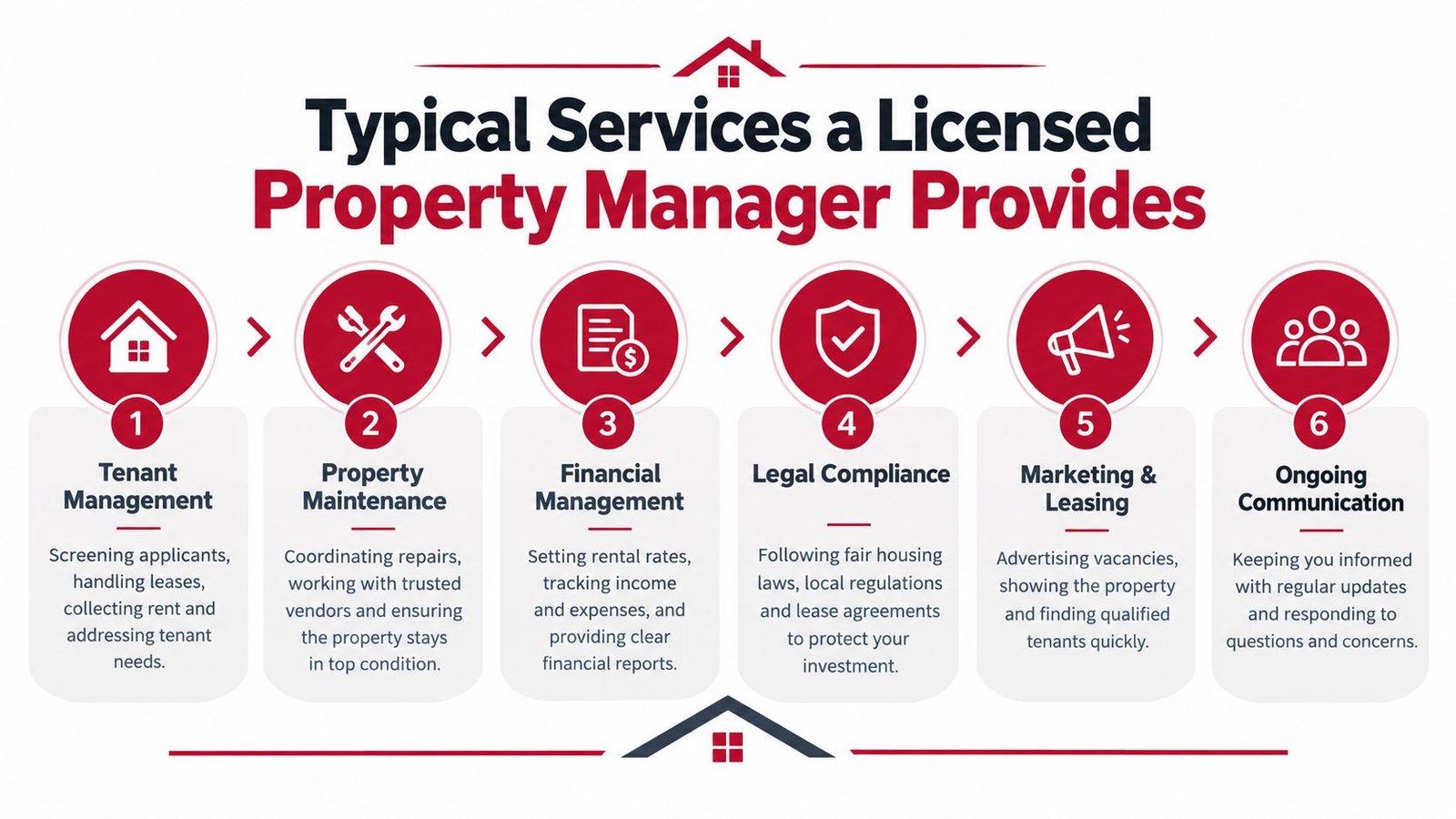
Typical Services a Licensed Property Manager Provides
A strong management relationship begins before the listing goes live. The manager reviews the home, building, neighbourhood, condition, likely tenant profile, and rental positioning during a consultation and market analysis. The owner should receive a practical discussion about preparation, expected demand, showing access, approval authority, and the timeline for making the property available.
The listing then needs more than a copied description. Professional photos, accurate copy, channel selection, inquiry handling, and coordinated showings determine how consistently qualified applicants move through the process. For owners interested in visual presentation and remote property communication, this 3D property management guide provides useful context on how immersive property materials can support the rental journey.
From applicant to occupied home
Once inquiries arrive, the manager coordinates access and applies a consistent screening process. That can include credit, income, references, and rental-history verification, followed by documented approval and lease execution aligned with Alberta tenancy requirements. A move-in inspection records the condition of the property, supported by written notes and photographs.
The work continues after possession:
- Rent administration: The manager collects rent, follows up on arrears, prepares statements, and arranges direct-deposit disbursements to the owner.
- Maintenance coordination: Tenants have a defined contact path, while vendors receive documented scopes, approval limits, and work-order instructions.
- Inspections: Routine and move-out inspections create condition records that support fair decisions about repairs and deposit accounting.
- Tenant relations: Clear communication and timely issue resolution reduce avoidable escalation and keep responsibilities visible.
- Compliance records: Notices, leases, inspection reports, and financial documents remain organised for future reference.
The full operating picture is broader than finding a tenant. A detailed property manager responsibilities guide can help owners compare a proposed service agreement with the actual work their property requires.
When Self-Management or Unlicensed Help Is Not Enough
Self-management and third-party management are different legal situations. An owner managing the owner's own rental can make the operational decisions directly. The risk appears when a cousin, friend, assistant, or on-site contact starts acting as the owner's agent in regulated activities such as leasing, negotiating rental agreements, collecting rent, or handling deposits.
An on-site person may be able to perform limited physical or administrative duties within an authorised structure, but the owner shouldn't assume that living in the building creates a broad exemption. The question is what the person does, for whom, and whether the activity advances a regulated property-management service.
| Activity | Requires RECA Licence? | Risk of Unlicensed Assistance |
|---|---|---|
| Owner advertises and manages the owner's rental | Generally self-management | The owner remains responsible for tenancy compliance and records |
| Third party advertises or arranges leasing for the owner | Yes, where the activity is property management on behalf of another | Unlicensed activity and weak accountability for representations |
| Third party negotiates or approves rental agreements | Yes | Lease disputes, unclear authority, and regulatory exposure |
| Third party collects or holds rent or deposits | Yes | Misapplied funds, poor records, and trust-handling risk |
| On-site contact coordinates physical repairs only | Depends on the actual duties and agency arrangement | The role can cross the boundary if it begins leasing or handling client money |
| Licensed manager oversees leasing and rent administration | Yes, through the appropriate licensed structure | Stronger documentation, supervision, and trust controls |
The protection issue owners overlook
Alberta's landlord guidance warns that owners using an unlicensed manager may lose access to the Consumer Protection Fund if fraud or breach of trust occurs. That doesn't mean every dispute will produce a loss, but it changes the risk calculation before an owner delegates control of rent, deposits, leases, or notices.
A lower-cost helper isn't a lower-risk arrangement if the helper is performing regulated work without the required authority.
Owners who want to keep control can self-manage and use contractors for clearly defined non-regulated tasks. Owners who want another person to act as an agent should use a licensed property manager and document the scope of authority.
The Economic Case for Licensed Management in Today's Market
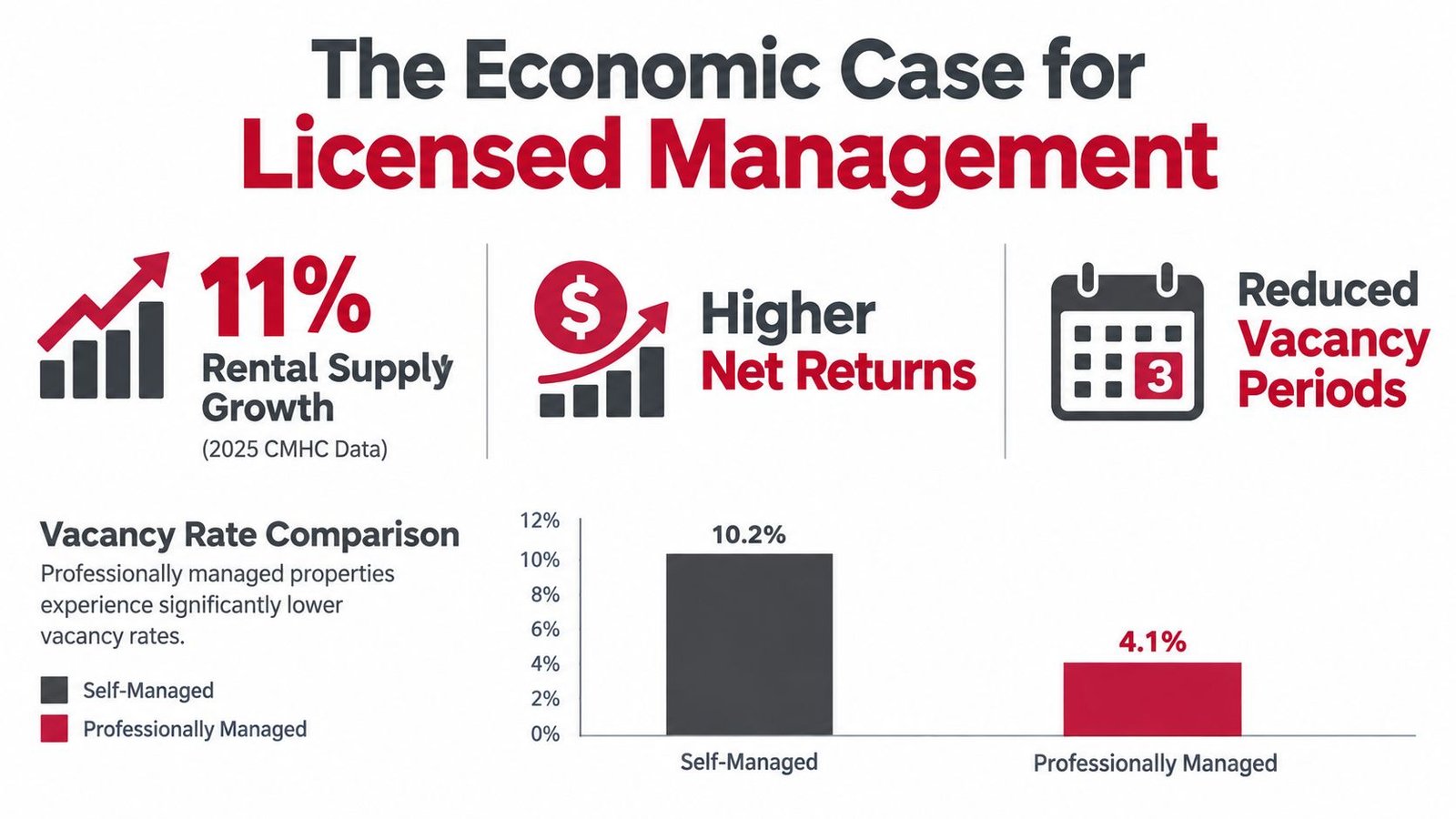
The financial case for a licensed property manager isn't just “the owner saves time.” Calgary's purpose-built rental supply grew 11% in 2025 while vacancy remained at 5.0%, according to CMHC's rental market reporting. Edmonton's vacancy rate reached 3.8% in 2025, as completions rose and household formation slowed, according to the same CMHC source.
Those conditions make leasing execution more important. Owners can no longer assume that limited supply will carry an underpriced listing, slow response time, weak presentation, or inconsistent screening process. A manager may add economic value through pricing discipline, faster lease-up, better inquiry handling, and stronger compliance controls, but the result depends on the property and the owner's starting position.
The right decision depends on the asset
A local owner with one stable single-family rental, reliable contractors, flexible availability, and confidence with Alberta tenancy administration may reasonably self-manage. The owner pays with time rather than a management fee, and that trade-off can make sense when turnover and maintenance demands are modest.
A condo owner may need help coordinating building rules, access, tenant communication, and move-in documentation. A small multifamily owner faces more frequent operational decisions, while an out-of-province investor lacks the local visibility needed for showings, inspections, emergency coordination, and vendor oversight.
The practical test is net performance after fees, not the fee in isolation. A manager may be financially sensible when better pricing, reduced vacancy exposure, consistent screening, and fewer preventable compliance errors outweigh the cost. No manager can guarantee a particular return, and owners should ask for a transparent explanation of assumptions rather than accept a generic profitability promise.
How to Evaluate Credentials and Service Agreements
Landlords should verify the manager before comparing service packages. Start with the active RECA licence, the supervising brokerage, the scope of the proposed services, and experience with the relevant property type. A manager serving Calgary may understand one neighbourhood well but have limited operating knowledge in Edmonton or Red Deer, so local coverage should be specific rather than implied.
A practical evaluation can follow this order:
- Confirm authority: Ask who will sign leases, approve applicants, collect funds, issue notices, and supervise the account records.
- Review operations: Request a sample owner statement, inspection report, maintenance approval process, and communication schedule.
- Test screening quality: Ask which documents are reviewed and how decisions are recorded consistently.
- Read the exit terms: Check notice requirements, post-termination duties, outstanding invoices, and transfer of keys and records.
- Clarify money handling: Confirm where rent and deposits are held, how disbursements are authorised, and how questions are escalated.
The property manager selection guide can help structure consultations around credentials, communication, technology, and service expectations.
Compare process, not just promises
| Evaluation area | Strong evidence | Warning sign |
|---|---|---|
| Local knowledge | Specific neighbourhood and building experience | Broad claims without operational examples |
| Tenant screening | Written criteria and documented verification | Informal approval decisions |
| Technology | Owner and tenant portals with accessible records | Statements delivered inconsistently |
| Maintenance | Vendor controls, approval limits, and work orders | Open-ended repair authority |
| Communication | Defined updates and escalation paths | “Available anytime” without a process |
| Agreement terms | Clear fees, duties, and termination rules | Ambiguous charges or unilateral discretion |
The right manager won't resist detailed questions. Clear answers show whether the brokerage has a repeatable system or relies on one person's memory and availability.
Why Professional Management Matters for Every Alberta Landlord
A licensed property manager gives an Alberta landlord more than a leasing service. The manager operates within a provincial framework that addresses authority, education, brokerage oversight, client funds, and property-management conduct. That structure helps reduce the chance that an informal arrangement turns into an expensive dispute.
For a Calgary landlord who lives nearby, licensed oversight can provide consistency when work or family commitments make daily follow-up difficult. For a remote or out-of-province owner, local showings, inspections, maintenance coordination, tenant communication, and documented reporting address the visibility gap directly. Small multifamily owners gain a more organised process for recurring leasing, rent, maintenance, and record-keeping decisions.
Security deposits deserve particular care. Alberta limits a residential security deposit to one month's rent, prohibits increasing it later solely because rent increases, and requires the deposit to be placed in an interest-bearing trust account in Alberta within two banking days of collection. The government lists the minimum annual interest rate as 0.0% for January 1 to December 31, 2026, as stated in its starting-a-tenancy guidance.
After move-out, Alberta guidance gives landlords 10 days to provide the deposit, a statement of account, or an estimated statement of account. The security deposit guidance also limits deductions to valid charges such as damage, unpaid rent, cleaning, or other obligations, not normal wear and tear.
A licensed property manager makes the most sense when the owner needs local execution, repeatable compliance, or reliable control of tenant and financial administration. The decision should be based on the property's complexity, the owner's capacity, and the cost of preventable mistakes.
Dreamhouse Realty Ltd. provides licensed residential property management, tenant placement, rent collection, maintenance coordination, inspections, lease administration, and owner reporting across Calgary, Edmonton, Red Deer, and surrounding Alberta communities. Contact GURIQBAL CHAHAL, MBA, PMP, REAL ESTATE BROKER at 403-966-6072, or visit Dreamhouse Realty Ltd. to request a free rental consultation and discuss whether licensed management fits the property.