
A tenant has handed over the keys in Calgary, the unit looks mostly clean, and a few damaged surfaces seem obvious. The landlord plans to photograph everything later, return the deposit after deducting repair costs, and move on to the next tenancy. That approach is exactly how a defensible claim becomes an unrecoverable loss.
A proper move out inspection in Alberta connects the unit's condition, the tenant's departure, the security deposit, and the evidence a landlord may need in a dispute. The process applies whether the property is a Calgary duplex, an Edmonton condominium, a Red Deer townhouse, or a rental in a surrounding Alberta community.
Table of Contents
- Why Move Out Inspections Matter for Alberta Landlords
- Legal Timing and the Residential Tenancies Act
- Walkthrough Checklist for the Move Out Inspection
- Photos and Paperwork That Hold Up in a Dispute
- Returning the Security Deposit the Right Way
- Handing the Process to an Alberta Property Manager
Why Move Out Inspections Matter for Alberta Landlords
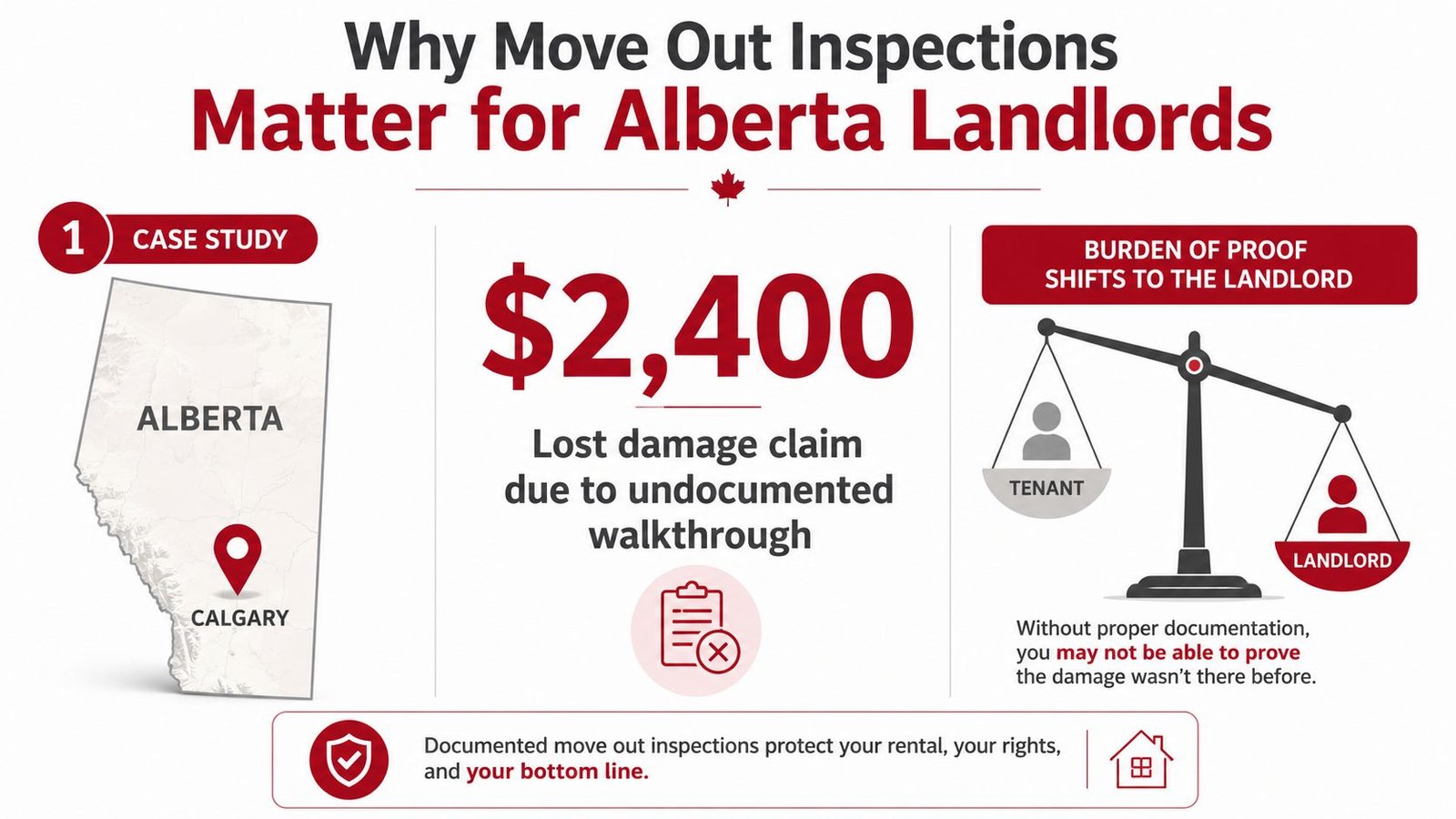
A Calgary landlord once treated the final walkthrough as an informal handover. The tenant left, the landlord found substantial damage, and a claim was prepared against the security deposit. Without a properly completed inspection report comparing the condition at move-in and move-out, the landlord couldn't establish the evidence needed to support the deduction. The practical result was a lost damage claim, not because the repair issue was imaginary, but because the required inspection process had not created a reliable record.
That distinction matters. Alberta's government guidance says landlords and tenants must complete both a move-in and move-out inspection report, and each inspection must occur within one week before or after the tenant takes or gives up possession. If the inspection-report requirements aren't met, the landlord can't deduct damage or cleaning costs from the security deposit when the tenant moves out. The Alberta Residential Tenancy Agreement and inspection guidance also emphasises giving the tenant a copy immediately after the inspection.
The inspection creates the evidence
A verbal account says what someone remembers. A completed report shows what was observed, where it was observed, and how the condition compared with the earlier record. That difference becomes important if a tenant challenges a deduction through the Residential Tenancy Dispute Resolution Service, or RTDRS.
Without the required report, a landlord may lose more than the amount of a disputed repair. The landlord may lose the legal ability to deduct for damage or cleaning from the deposit at all. The landlord also loses the strongest practical response to a tenant who says an issue was pre-existing, ordinary wear and tear, or unrelated to the tenancy.
Practical rule: A damage claim should never be prepared from memory, a contractor's complaint, or a single close-up photograph. It should begin with the signed move-in and move-out reports.
The deadline adds pressure
The inspection report and deposit process work together. Alberta guidance says the landlord must return the security deposit, with interest if applicable, or provide a written statement of account within 10 days after the tenant gives up possession. Missing the inspection requirements can remove the right to deduct. Missing the deposit-accounting deadline creates a separate procedural problem.
That's why the final walkthrough shouldn't be treated as a courtesy appointment. It's the point at which the landlord records the condition that supports, limits, or defeats a deposit claim. The rest of the process, from room-by-room checks to photos and delivery records, should be organised around preserving that evidence.
Legal Timing and the Residential Tenancies Act
The safest approach starts before the inspection date is selected. The landlord should confirm the possession date, arrange the walkthrough inside Alberta's permitted inspection window, use the move-in report as the comparison document, and prepare a method for giving the tenant the completed report immediately afterward.
Alberta guidance requires the move-out inspection to occur within one week before or after the tenant gives up possession. The inspection should be completed with the tenant where possible, and scratches, burns, broken fixtures, or other changes should be recorded during the walkthrough rather than reconstructed later. The Alberta inspection report guide says both parties should sign the report and the tenant should receive a copy immediately.
Pair the two reports
The move-in report establishes the baseline. The move-out report records the later condition. A landlord who never completed the required move-in inspection has a serious evidentiary problem because there's no reliable starting point for distinguishing tenant-caused damage from pre-existing condition.
The comparison also needs to respect normal wear and tear. Alberta guidance describes normal wear and tear as deterioration that occurs over time despite reasonable care and maintenance. The Alberta tenant information guide explains that a tenant is entitled to the deposit, with interest owing, where there's no damage beyond normal wear and tear, the premises are properly cleaned, and no rent or other costs are owing.
Keep timing visible
The following table gives a practical operating view of the statutory requirements.
| Requirement | Statutory Anchor | Deadline | Consequence of Missing |
|---|---|---|---|
| Complete the move-in inspection report | Alberta tenancy inspection guidance | Within one week before or after possession begins | The landlord may lack the baseline needed to support later damage deductions |
| Complete the move-out inspection report | Alberta tenancy inspection guidance | Within one week before or after possession ends | The landlord can't deduct damage or cleaning costs from the security deposit if the inspection requirements aren't met |
| Conduct the report with the tenant and record condition changes | Alberta inspection report guidance | During the scheduled inspection | Disputed observations become harder to prove |
| Give the tenant the signed report | Alberta inspection report guidance | Immediately after the inspection | The landlord loses a clear record of transparent delivery |
| Return the deposit or provide a written statement of account | Alberta tenancy guidance | Within 10 days after possession ends | The landlord risks losing procedural control over the deposit claim |
Landlords who need a broader operational reference can review this Alberta landlord and tenancy guide before setting inspection dates, preparing notices, or drafting deposit correspondence.
Walkthrough Checklist for the Move Out Inspection
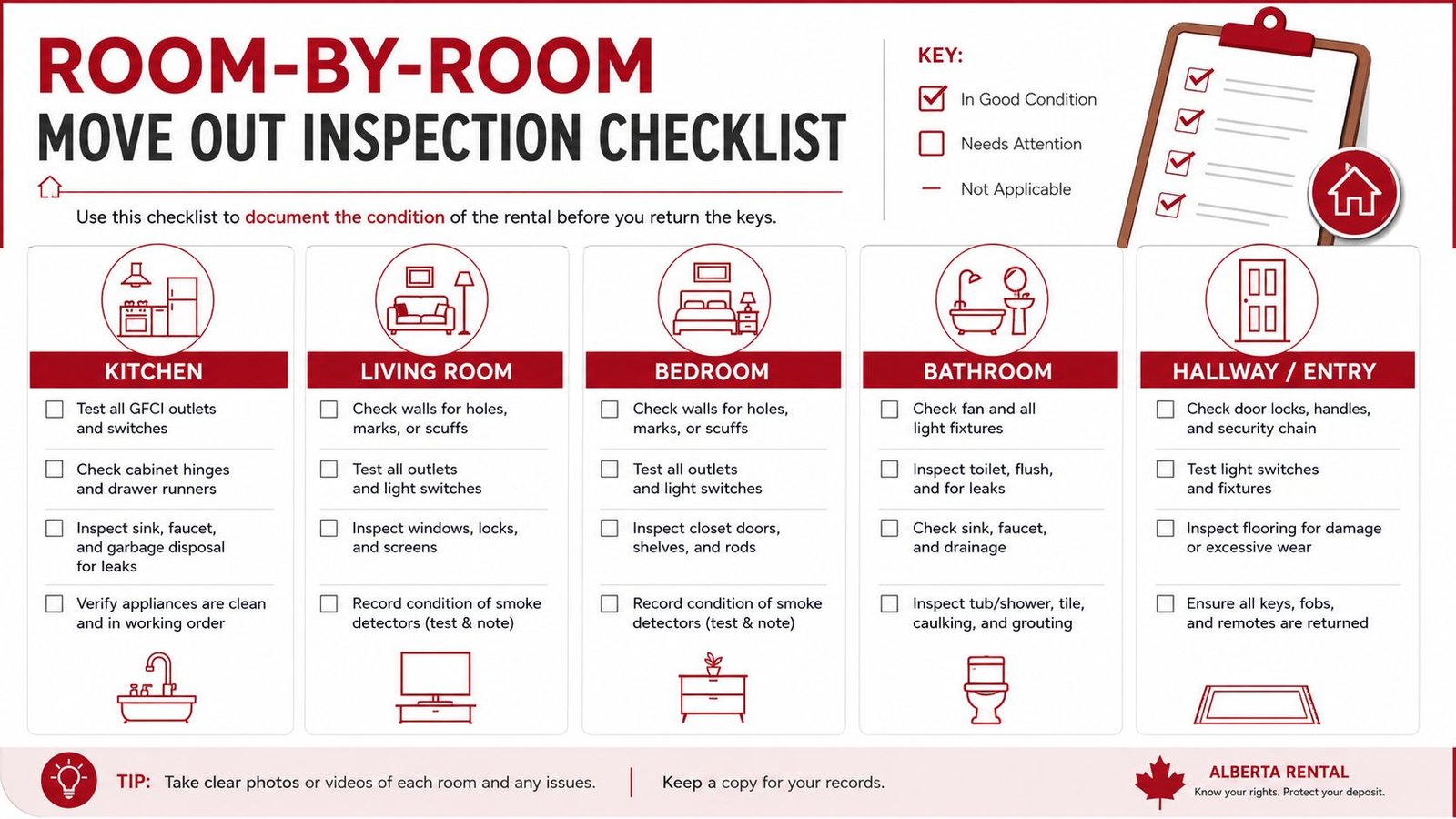
A useful walkthrough isn't a rushed cleaning review. It's a controlled comparison between the move-in condition and the condition on the day possession ends. The property manager or landlord should carry the signed move-in report, a blank or digital move-out report, a phone or camera, a flashlight, and a way to test fixtures safely.
Start at the entry and living areas
Record the entry door, locks, flooring, baseboards, walls, windows, screens, blinds, light fixtures, and visible odours. Open closets and pantry doors, inspect shelves, and check whether personal property or garbage remains. A missing window screen, broken door track, or large wall gouge should be recorded as a specific condition, not a general note such as “unit damaged.”
The key question is whether the condition exceeds ordinary deterioration. A few minor scuffs may be consistent with reasonable use. Several large holes, deep gouges, staining, or damage that changes the function of a fixture requires a clearer description and photographs. For wall marks, the report should identify the wall and describe the size and type of damage rather than relying on a vague label.
Test the kitchen instead of just looking at it
Run appliances through normal functions where safe. Check the oven interior, racks, glass, stovetop, burner components, refrigerator shelves and seals, dishwasher filter, cabinet hinges, drawer runners, countertops, backsplash, sink, taps, and drain flow.
A landlord should note whether an appliance works under ordinary use, not merely whether it looks clean. A blocked drain, broken shelf, damaged seal, or cracked countertop needs a location and description. Caulking around the sink should be checked for separation, and flooring should be photographed where scratches or swelling appear beyond normal wear.
Landlords and managers who want a reusable starting document can adapt this move-in inspection checklist so the move-out report follows the same room sequence.
Inspect bedrooms, bathrooms, and service areas
In bedrooms, check walls, flooring, closet doors, shelving, windows, screens, light fixtures, and smoke or carbon monoxide detectors. Test detector function according to the device's normal test procedure and record missing, damaged, or non-functioning units.
Bathrooms require a slower inspection. Run taps, test drain flow, inspect the tub or shower seals, look at caulking, check the toilet base and bowl, open the vanity, and examine flooring around plumbing fixtures. Staining caused by a maintenance issue shouldn't automatically be treated as tenant damage, while a broken fixture or clear tenant-caused defect should be described separately.
For a duplex or single-family property, add the garage door opener, storage areas, exterior doors, yard, fencing, and visible exterior damage to the report. The final step is joint review. Both parties should sign the inspection report, record any tenant comments, and provide the tenant with a copy immediately. Tools such as PDFWix real estate tips can help a manager organise inspection documents and produce consistent PDF records, but no software replaces an accurate on-site inspection.
Photos and Paperwork That Hold Up in a Dispute
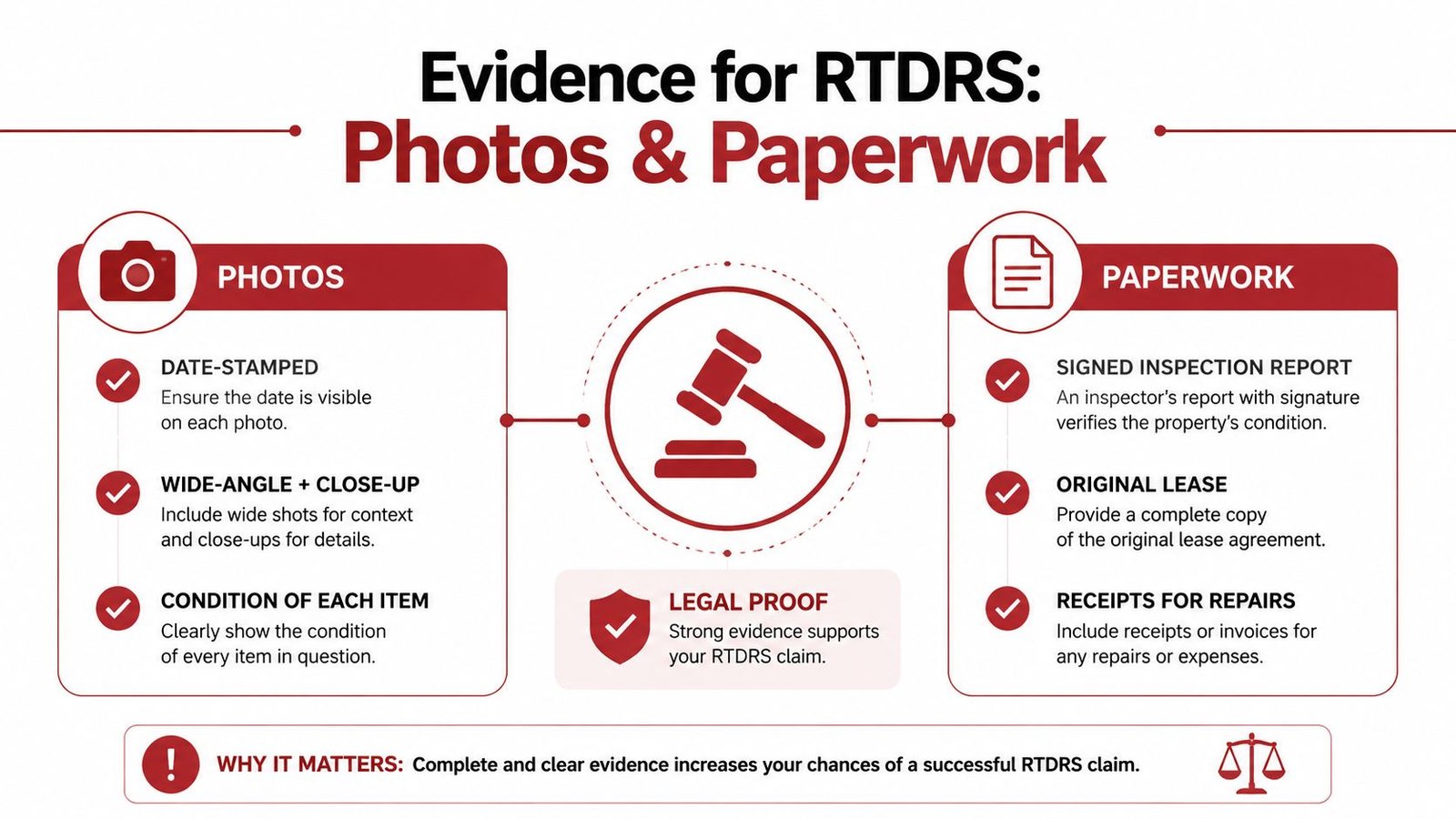
Photographs should answer three questions without explanation: what is damaged, where is it, and how does it compare with the earlier condition? A single close-up of a scratched floor rarely answers all three. It may show the defect, but not the room, wall, appliance, or fixture involved.
Start with wide photographs of each room before the walkthrough begins. Capture the full wall, floor, ceiling, major fixtures, and built-in appliances. During the inspection, take close-ups of each defect and include a coin or ruler when scale matters. The same areas should be photographed consistently at move-in and move-out so the comparison is meaningful.
Build a file that tells one consistent story
The report, photos, lease, tenant communications, repair records, and deposit statement should use the same descriptions. If the report identifies “deep scratch on living-room laminate near the patio door,” the photo folder and repair invoice should use that same wording or a clear reference number.
Short video clips can be useful for running taps, draining sinks, opening garage doors, or demonstrating appliance operation. Metadata timestamps can support the chronology, but they shouldn't be the only date record. The inspection report should state the inspection date, the people present, the observations made, and any tenant comments.
A disciplined file commonly includes:
- Room photographs: Wide views followed by close-ups of each relevant condition.
- Functional evidence: Short clips or written test notes for appliances, drains, detectors, and doors.
- Item identification: Serial numbers or model details for damaged equipment where a repair or replacement claim may follow.
- Signed report: The move-out report should mirror the move-in report room by room.
- Delivery record: Retain evidence showing when the tenant received the completed report.
Deliver the report immediately
Alberta guidance emphasises immediate delivery of the inspection report to the tenant after the inspection. Email delivery, hand delivery with a signed acknowledgement, or another traceable method can help establish what was provided and when. A manager should keep the original report unchanged, preserve the photo files, and avoid editing images in a way that removes relevant information.
A persuasive file doesn't contain more paperwork for its own sake. It contains matching records that lead from the reported condition to the photograph, then to the repair evidence and deposit accounting.
Returning the Security Deposit the Right Way
The deposit decision should follow the inspection report, not precede it. Alberta guidance says the landlord must return the security deposit, with interest if applicable, or provide a written statement of account within 10 days after the tenant gives up possession. The Alberta ending-a-tenancy guidance also explains that deductions are limited where there's no damage beyond normal wear and tear, the premises are properly cleaned if the lease requires it, and no rent or other costs are owing.
A written statement should connect each deduction to a documented condition. It should identify the room or location, describe the damage, state the repair or cleaning cost, and refer to the supporting photograph or invoice. “General damage” or “cleaning” is too vague to help a tenant understand the claim or a decision-maker assess it.
Separate wear from chargeable damage
Painting, carpet cleaning, or minor surface marks may reflect ordinary deterioration rather than tenant-caused damage. Alberta's guidance defines normal wear and tear as deterioration over time despite reasonable care and maintenance. A landlord should therefore avoid treating every visible change as a deposit deduction.
The stronger method is to compare the move-in and move-out descriptions, identify the actual change, and match the claimed remedy to that change. Repair invoices, contractor quotes, replacement records, and photographs should support the amount claimed. The report shouldn't claim a full replacement where a documented repair addresses the damage.
Use a clear accounting sequence
| Step | Deadline | Required Action | Evidence to Keep |
|---|---|---|---|
| Finalise the condition record | During the move-out inspection | Complete the report with the tenant and record comments or disagreements | Signed report and photographs |
| Decide whether a deduction is permitted | After comparing both reports | Exclude ordinary wear and unsupported items | Move-in report, move-out report, lease |
| Issue the refund or statement | Within 10 days after possession ends | Return the deposit, with interest if applicable, or provide a written statement of account | Copy of refund or statement |
| Support each deduction | With the written accounting | Match the amount to the reported condition and repair evidence | Invoices, quotes, receipts, photo references |
| Respond to a dispute | After receiving the tenant's objection | Review the file and pursue the appropriate Alberta dispute process if needed | Communications and delivery proof |
If the tenant disputes the deduction, the signed inspection report, photographs, repair records, and proof of delivery become the landlord's working evidence. A manager should avoid informal arguments and preserve every communication. The RTDRS process may be appropriate when the parties can't resolve the accounting, but the outcome depends on the quality and consistency of the records.
Handing the Process to an Alberta Property Manager
A landlord can complete a move-out inspection personally, but the process demands more than a quick visit with a phone camera. Someone must schedule the inspection within the required window, compare the correct reports, document normal wear separately from damage, obtain signatures, give the tenant the completed report immediately, and complete the deposit accounting on time.
A licensed Alberta property manager turns those tasks into a repeatable operating process. For an owner in Calgary who travels, an Edmonton condo owner who can't attend, or a Red Deer investor managing several homes, local attendance reduces the chance that a key date or disputed condition will be missed. The manager can coordinate the tenant appointment, use standardised condition reports, organise room-by-room photographs, and maintain the file for later reference.
What outsourcing should include
A property management agreement should make the inspection responsibility clear. Owners should ask whether the manager:
- Attends the walkthrough: The manager should be prepared to meet the tenant and document the condition on site.
- Uses paired reports: The move-out record should be compared with the original move-in report.
- Creates a photo package: Images should identify rooms, defects, and relevant fixtures.
- Handles deposit accounting: The written statement should match the report and supporting repair documents.
- Maintains delivery records: The file should show when the tenant received the inspection report and accounting.
- Escalates disputes: The owner should know who reviews objections and prepares the evidence if RTDRS involvement becomes necessary.
Owners can compare service models through an Alberta property management service review, including inspection coverage, reporting, maintenance coordination, and compliance administration. The right arrangement isn't just the lowest fee. It's the one that clearly assigns responsibility for the steps that preserve the deposit claim.
For landlords who own more than one rental, live outside Alberta, or can't reliably attend the final walkthrough, professional management can provide continuity between move-in records, turnover inspections, repairs, and tenant communication. That continuity gives the owner a cleaner operational record and fewer opportunities for a procedural mistake to undermine an otherwise legitimate claim.
Dreamhouse Realty Ltd. provides Alberta property management, tenant placement, routine and move-out inspections, condition reports, photo documentation, maintenance coordination, and compliance support for rental owners in Calgary, Edmonton, Red Deer, and surrounding communities. Contact GURIQBAL CHAHAL, MBA, PMP, REAL ESTATE BROKER at 403-966-6072 or visit Dreamhouse Realty Ltd. to discuss a documented move-out inspection process for the property.