

A landlord in Calgary finishes a full workday, checks messages from a basement-suite tenant, then receives a late-night call about water coming through the ceiling. The owner also has a condo in Edmonton, so the emergency isn't only about finding a plumber. It involves travelling, authorising repairs, documenting the event, communicating with tenants, and checking whether the response complies with Alberta tenancy requirements.
That's the operating reality behind Alberta property management. A rental portfolio can look simple on a spreadsheet while demanding constant attention across different cities, tenant markets, contractors, leases, inspections, and legal deadlines. Professional management isn't suitable for every owner, but distance, a demanding career, multiple properties, and regulatory complexity can quickly make informal self-management expensive.
Table of Contents
- Why Alberta Landlords Are Turning to Professional Property Management
- What Full-Service Property Management Covers
- Navigating Alberta Tenancy Law and Compliance Requirements
- How Rental Markets Differ Across Calgary, Edmonton, and Red Deer
- Common Landlord Problems That Professional Management Solves
- How to Choose the Right Property Management Company in Alberta
- Next Steps for Alberta Rental Property Owners
Why Alberta Landlords Are Turning to Professional Property Management

The Calgary landlord with a basement suite and an Edmonton condo may manage both properties successfully for a while. The trouble starts when a tenant needs an urgent response during work hours, a move-out inspection falls on a travel day, or an apparently minor dispute requires a complete paper trail. A landlord who lives outside Alberta faces the same problems with an added delay, especially when a contractor, tenant, and property owner are all waiting for decisions.
The market also requires more active operating decisions than a province-wide rent rule of thumb can provide. CMHC reported a 5.0% purpose-built rental vacancy rate in Calgary and 3.8% in Edmonton in 2025, while Calgary's purpose-built rental supply expanded by 11% in 2025, described by CMHC as its fastest pace in decades. CMHC's national rental-market release connects those conditions with strong demand that absorbed much of the new supply.
Those figures don't tell an owner exactly what to charge for a particular basement suite, condo, or townhouse. They do show why leasing speed, tenant screening, presentation, renewals, and turnover control matter. A vacant unit still incurs carrying costs, and a rushed placement can create a different form of financial exposure through arrears, damage, or early lease problems.
Where self-management begins to strain
Self-management can work when the property is nearby, the owner has time, and the tenancy remains straightforward. It becomes less reliable when several operational demands arrive together:
- Distance: A remote owner can't inspect a property, meet a contractor, and respond to a tenant as quickly as a local operator.
- Volume: More units create more renewal dates, inspection reports, invoices, notices, and follow-ups.
- Compliance: Alberta's tenancy framework has changed over time, including a 2025 amendment allowing notices to be delivered by electronic communication. The Alberta tenancy-law history published by the Alberta Law Reform Institute shows how the framework developed from early legislation adopted in 1964 to the Residential Tenancies Act adopted in 2004 and later targeted reforms.
- Availability: A landlord with a full-time job may not be able to answer a burst-pipe call, a lockout, or a tenant complaint promptly.
Professional management turns those recurring demands into a system. The owner retains decisions about capital improvements, refinancing, and sale timing, while a local team handles leasing, maintenance coordination, tenant communication, records, and routine compliance.
Practical rule: The management fee should be judged against the cost of preventable vacancies, delayed repairs, weak documentation, and lost working time, not against rent collection alone.
What Full-Service Property Management Covers
A rental in Calgary may need a different operating plan from a townhouse in Edmonton, a duplex in Red Deer, or a property in a smaller Alberta community. Full-service management begins with that local context, before a listing is published, and continues throughout the tenancy.
A manager reviews comparable rentals, condition, location, parking, utilities, amenities, and likely tenant demand before recommending a price and leasing plan. Local MLS information, rental-board listings, and competing inventory help show whether the property is positioned to attract qualified applicants or collect views without applications. In smaller markets, limited contractor availability and a narrower tenant pool can matter as much as the advertised rent.
Marketing includes professional photographs, accurate copy, online advertising, inquiry handling, and coordinated showings. RentFaster, Kijiji, and MLS may suit the property and market. Distribution cannot correct an unrealistic price, weak presentation, or slow response to inquiries.
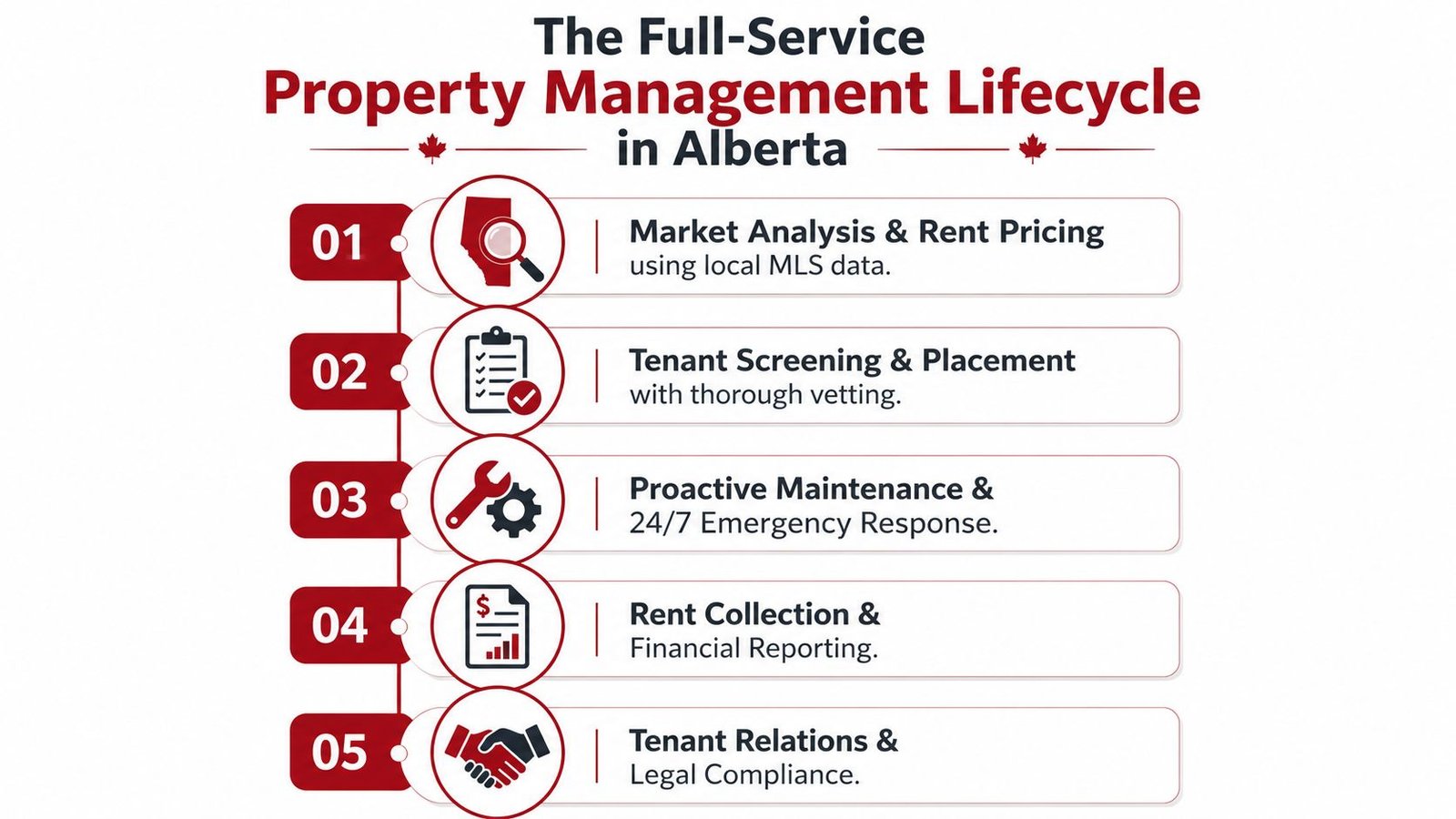
From applicant to signed tenancy
Screening should follow consistent, documented standards:
- Identity and credit review: With the applicant's consent, the manager reviews identity information and credit details through lawful procedures.
- Income and employment verification: The manager confirms whether the stated income and employment support the proposed tenancy.
- Rental references: Former landlords can provide context about payment history, property care, communication, and lease compliance.
- Tenancy-history review: Where legally accessible and appropriate, relevant Residential Tenancy Dispute Resolution Service information may be considered with the full application, rather than treated as the entire decision.
- Written approval standards: Consistent criteria reduce arbitrary decisions and make the file easier to explain if questions arise.
The approved applicant receives an Alberta Residential Tenancy Agreement with terms that match the actual property and tenancy. Move-in records then establish the starting condition. Alberta requires move-in and move-out inspections, and each report must be completed within one week before or after each move-in and move-out, according to Service Alberta's tenant information.
Daily operations and owner control
After possession, the manager collects rent, follows up on arrears, coordinates repairs, responds to tenant concerns, and reports to the owner. Maintenance procedures should identify the problem clearly, record approval limits, use suitable contractors, and verify completion. In a smaller community, arranging a qualified trade may require more lead time than it would in Calgary or Edmonton, so practical planning protects both the tenant and the property.
A reliable record system supports every market tier. Leases, notices, inspection reports, invoices, photographs, and communications should remain organised and retrievable. Owners reviewing their workflow can use this guide to real estate document management.
Full-service management leaves strategic decisions with the owner. The owner can approve significant repairs, set improvement priorities, review statements, and decide on investment direction. The manager handles the recurring administration and creates a documented operating process around those decisions.
Navigating Alberta Tenancy Law and Compliance Requirements
Alberta's Residential Tenancies Act governs the core landlord-tenant relationship, but compliance usually fails through ordinary administrative mistakes rather than dramatic legal questions. A landlord may use the wrong notice date, forget an inspection report, rely on a lease clause that doesn't operate lawfully, or fail to preserve the evidence needed to support a deduction or termination.
Rent increases illustrate why calendar discipline matters. A landlord can't increase rent until at least 365 days have passed since the last increase or since the tenancy began, whichever is later. For a periodic tenancy, the written notice must include the amount, the effective date, and the landlord's signature. The required notice period varies by tenancy type, including 12 full tenancy weeks for week-to-week tenancies, 3 full tenancy months for month-to-month tenancies, and 90 days for other periodic tenancies, as set out in Alberta's during-a-tenancy guidance.
The records that protect a landlord
Inspection reports establish the condition of the premises at the beginning and end of the tenancy. Photographs, signed reports, invoices, notices, delivery records, and tenant communications should support the same factual timeline. Without that record, a landlord may have a genuine concern but still struggle to prove the condition, notice, cost, or tenant responsibility.
| Requirement | Rule / Timeframe | Common Mistake |
|---|---|---|
| Rent increase | At least 365 days since the previous increase or tenancy start, whichever is later. Written notice requirements apply. | Treating increases as an automatic annual calendar event. |
| Periodic-tenancy notice | Notice varies by tenancy type, including 12 full tenancy weeks, 3 full tenancy months, or 90 days. | Counting partial periods or selecting the wrong notice window. |
| Move-in inspection | Complete the report within one week before or after move-in. | Relying on undated photographs or an informal text message. |
| Move-out inspection | Complete the report within one week before or after move-out. | Waiting until after repairs to document the original condition. |
| Electronic notices | A 2025 amendment allows notices to be delivered by electronic communication. | Using electronic delivery without a reliable record of what was sent and when. |
The Alberta landlord and tenancy guide is a useful starting point, but a landlord handling a contested notice or deposit issue should verify the current rule and obtain appropriate legal guidance. The Residential Tenancy Dispute Resolution Service provides a specialised dispute process, and a well-organised file gives a landlord a stronger basis for presenting the facts.
Security deposits and trust handling also require care. RECA states that licensees required to maintain trust accounts must operate them under the Real Estate Act and its Rules, which makes RECA's real-estate legislation and trust-account information relevant when evaluating a brokerage's accounting controls. A management arrangement should explain who holds funds, how transactions are recorded, how owner disbursements occur, and how statements are supplied.
How Rental Markets Differ Across Calgary, Edmonton, and Red Deer
A Calgary condo, an Edmonton university-area unit, and a Red Deer townhome require different pricing and operating decisions. Tenant demand, competing supply, employment conditions, property type, and contractor access all shape the plan. A manager who treats Alberta as a single rental market risks missing the difference between a unit that needs a prompt pricing adjustment and one where a vacancy is costly because replacement inventory is limited.
For a broader comparison of rental returns across Calgary, Edmonton, and Red Deer, owners can review market-level conditions before assessing their own property. CMHC reported Alberta's average purpose-built apartment vacancy rate at 3.1% in 2025, up from 2.2% in 2024. City-level reporting cited 3.3% for Calgary and 3.4% for Edmonton in 2025 in its major-centre rental reporting. CMHC's major-centre rental market reports provide context, while property-level comparisons still guide the rent decision.
Calgary demands close attention to neighbourhood, unit type, employment conditions, and incoming supply. Its 2025 purpose-built apartment vacancy rate was 5.0%, ranging from 4.4% for one-bedroom units to 6.0% for studios. The secondary-market condominium vacancy rate was 2.2%, according to CMHC's Calgary rental dashboard. Those differences support separate tactics for studios, one-bedrooms, and condos. Managers should track presentation, price, response time, and renewal risk instead of applying one city-wide figure.
A practical city and community comparison
| Market | Avg. Vacancy Rate | Dominant Tenant Profile | Key Market Driver | Management Complexity |
|---|---|---|---|---|
| Calgary | 5.0% purpose-built apartment vacancy rate in 2025 | Households seeking apartments, condos, basement suites, and family rentals | Employment cycles, migration, and new rental supply | High, because unit types and neighbourhoods behave differently |
| Edmonton | 3.8% purpose-built rental vacancy rate in 2025 | Students, public-sector workers, families, and apartment tenants | Stable employment anchors and distinct submarkets | High, because university-area and suburban demand differ |
| Red Deer | Not specified in the verified data | Local workers, families, and residents connected to regional employers | Smaller tenant pool and local economic conditions | Hands-on, particularly for leasing and vendor coordination |
| Smaller Alberta communities | 3.0% vacancy in smaller towns in 2025 | Highly local tenant populations | Uneven demand, employer concentration, and limited liquidity | High for remote owners because vendor and screening depth varies |
Calgary and Edmonton have larger pools of prospective tenants, but owners still need fast replies and accurate pricing. Red Deer relies more heavily on local knowledge, property condition, and community relationships. Lethbridge, Medicine Hat, Fort McMurray, and other smaller centres may require extra planning for vendor availability, seasonal demand, and applicant depth.
Small-town vacancy data can mislead owners if treated as a guarantee. A CBC report on Alberta apartment vacancy rates described smaller-town vacancy falling to 3.0% in 2025 from 5.3% in 2024, compared with 14.1% in 2018, while individual communities still recorded substantial swings. The practical lesson is clear: local pricing, screening, maintenance planning, and renewal retention matter more than a provincial average.
Common Landlord Problems That Professional Management Solves
Most landlord losses don't begin with a spectacular event. They start with a unit priced slightly above its competitive range, a showing that isn't answered quickly, a repair that waits for a convenient weekend, or a notice that uses the wrong date. Professional management earns its place by controlling these repeated points of failure.
Vacancy is the clearest example. A Calgary owner may hold firm on a rent that looked reasonable when the listing was prepared, even as competing units improve their incentives or presentation. A manager uses comparative market analysis, monitors inquiries, adjusts the listing when evidence changes, and coordinates showings so the property doesn't sit idle while the owner waits for a perfect applicant.
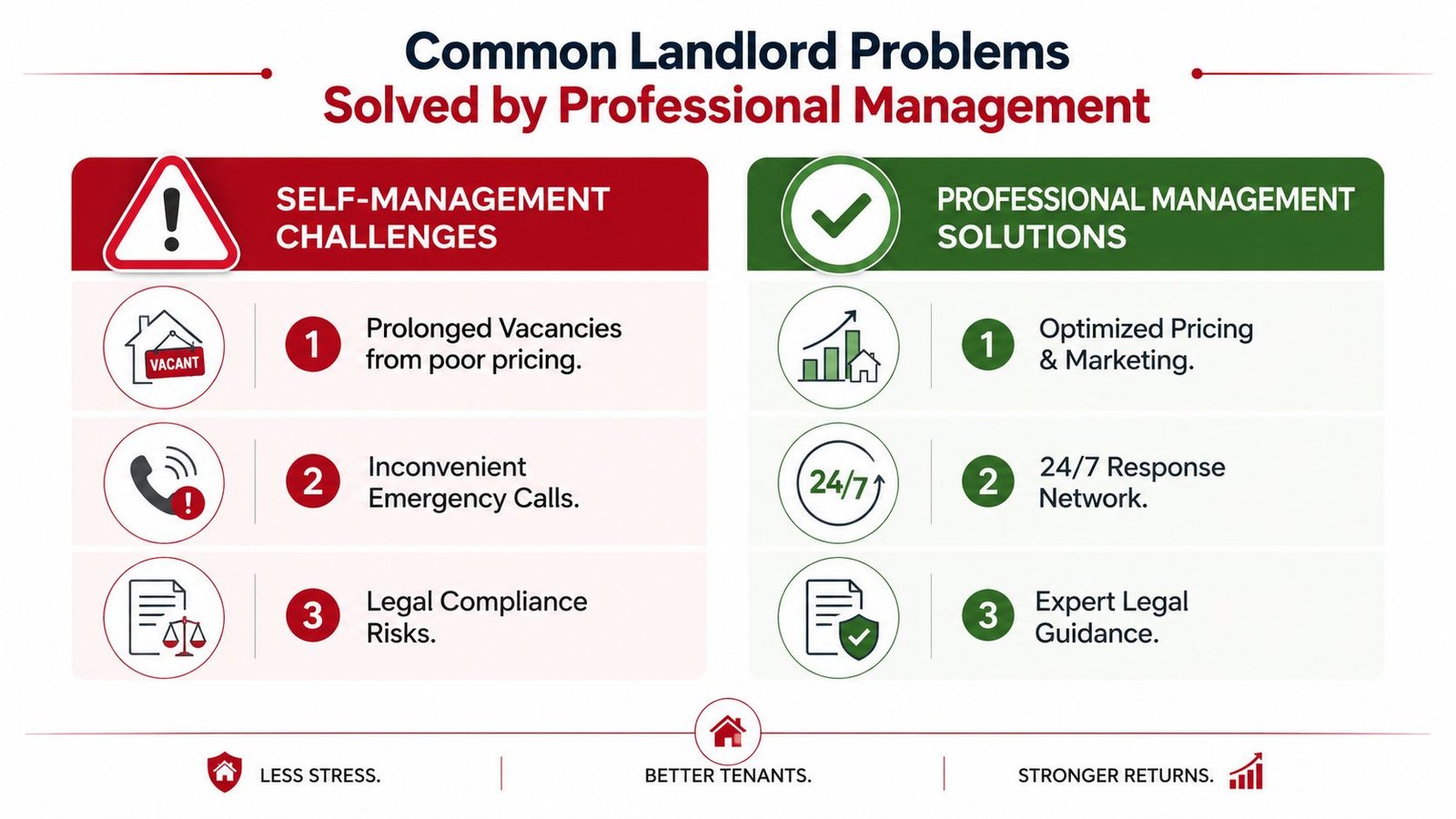
The operational problems behind the invoice
A basement-suite owner may receive a late-night leak report and have no contractor relationship, no repair approval protocol, and no way to determine whether the tenant should shut off a valve immediately. A professional operator maintains an emergency response process, a vendor network, work-order records, and escalation rules. That doesn't eliminate every repair cost, but it can reduce confusion and shorten the path from report to action.
Tenant disputes create a second category of exposure. A landlord who communicates only by informal messages may remember the conversation differently from the tenant. Standard notices, documented delivery, inspection evidence, photographs, and a central file create a more dependable record for arrears, damage, access, or termination issues.
- Vacancy control: Market analysis, clear listing copy, professional photographs, multi-channel advertising, and organised showings support a deliberate lease-up.
- Maintenance control: Vetted vendors, written scopes, approval limits, and completion checks reduce cost creep and unresolved work orders.
- Compliance control: Templates and calendars help track inspection deadlines, rent-increase dates, notice periods, and electronic delivery records.
- Cash-flow control: Consistent rent collection, arrears follow-up, trust-account procedures, and owner statements improve visibility.
- Relationship control: A manager gives tenants a defined contact point, which can prevent small concerns from becoming hostile disputes.
The real service isn't answering every call. It's creating a repeatable response before the call arrives.
Self-management remains a reasonable choice for an attentive local owner with one property and sufficient time. It becomes less attractive when the owner is remote, works full-time, owns properties in several cities, or lacks the systems to defend decisions later. The question isn't whether a landlord can perform each task once. It's whether the landlord can perform them consistently when several problems occur at once.
How to Choose the Right Property Management Company in Alberta
A landlord comparing management companies should assess the operating system, not just the advertised fee. A low rate can become costly when inspections, emergency coordination, leasing, statements, or compliance work are excluded and return to the owner's workload.
Licensing comes first. The Real Estate Council of Alberta regulates relevant real estate activities, so ask which licensed brokerage is responsible for the management relationship. Trust accounting also requires a clear explanation. Brokerages required to operate trust accounts must follow the Real Estate Act and Rules. The company should explain how it handles tenant funds, security deposits, rent receipts, and owner disbursements.
Questions that expose the operating standard
A useful consultation produces specific answers:
- Who handles the property locally? Confirm actual coverage in Calgary, Edmonton, Red Deer, or the smaller community where the rental is located. Service expectations can differ sharply between a central Calgary condominium and a rural property that requires longer travel for inspections or trades.
- What happens after an emergency report? The answer should cover triage, contractor contact, owner approval limits, documentation, and escalation.
- What does the fee include? Request a written schedule for leasing, renewals, inspections, maintenance coordination, statements, and additional charges.
- How are applicants assessed? Ask about consent, credit information, income verification, references, rental history, and consistent decision criteria.
- How are records stored? Leases, reports, photographs, invoices, notices, and communications should be organised and accessible.
- How can the agreement end? Review termination clauses, notice requirements, unpaid charges, file transfer, and responsibility for active tenancies.
Local coverage matters more than a large unit count. A company active in Calgary may have limited oversight in Red Deer or a smaller community. Remote owners should identify who attends inspections, meets trades, documents property condition, and communicates with tenants. Those details affect response time, records, and compliance when a problem reaches the Residential Tenancy Dispute Resolution Service.
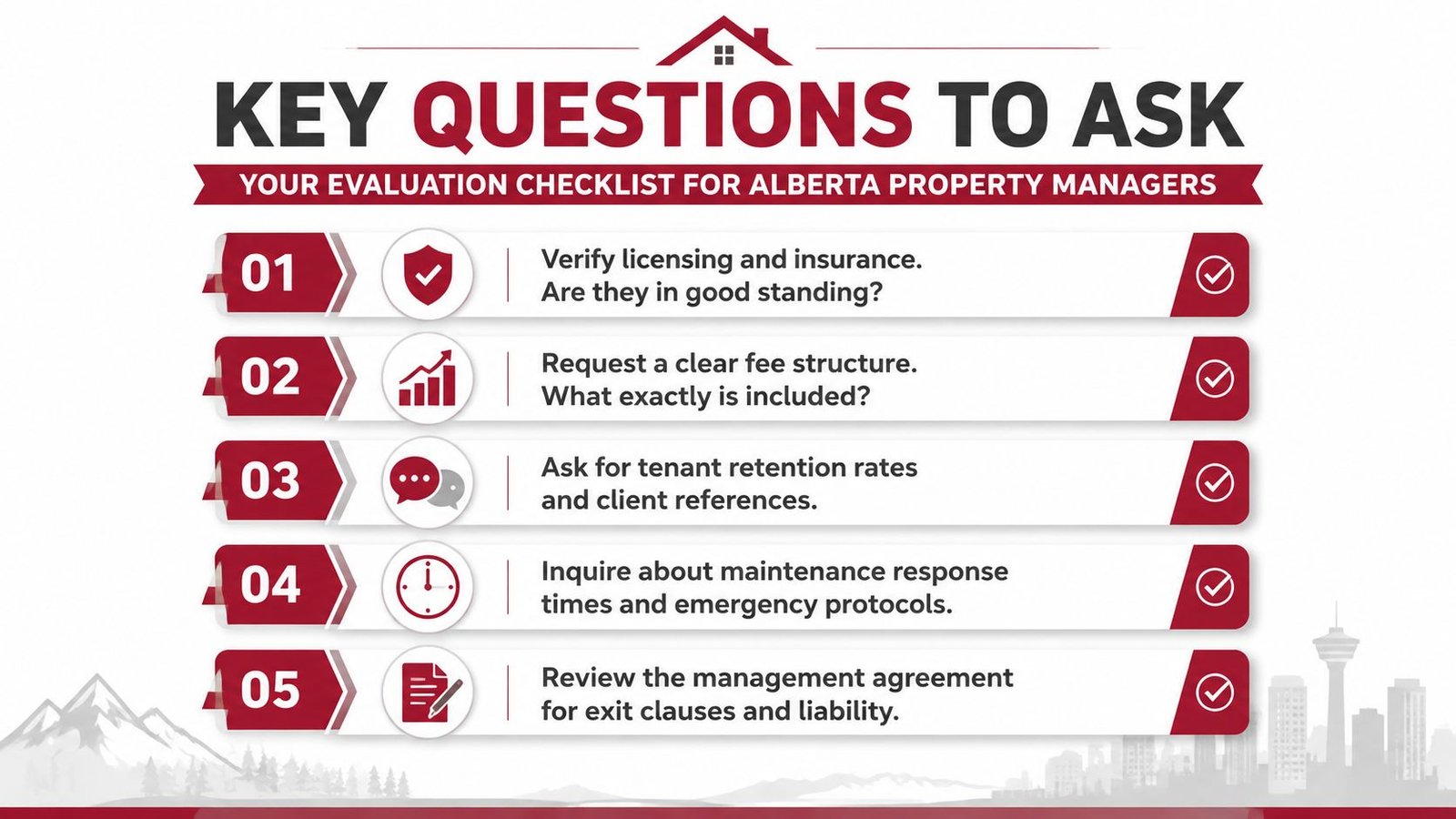
Landlords can use this property manager evaluation guide before meeting prospective companies. References should involve owners with comparable properties, such as a basement suite, condominium, townhouse, single-family rental, or small multifamily building. Ask how the manager handled a difficult repair, communication breakdown, or tenancy dispute, rather than relying only on an easy rent-collection experience.
Next Steps for Alberta Rental Property Owners
Alberta rentals demand three forms of discipline at the same time: local market judgement, documented operations, and tenancy-law compliance. Calgary, Edmonton, Red Deer, and smaller communities don't respond to identical pricing or leasing tactics. A professional manager must understand the property type and neighbourhood, not merely the province.
The decision also depends on operating capacity. An owner who can respond promptly, document every event, coordinate contractors, track notices, and manage renewals may prefer self-management. An owner balancing a career, distance, or a growing portfolio may value a system that reduces vacancy exposure, maintenance delays, cash-flow uncertainty, and legal risk.
A no-obligation consultation with Dreamhouse Realty can be used diagnostically. The discussion can review the portfolio, current lease structures, property condition, local positioning, tenant-service expectations, and the records needed for better oversight. Landlords should leave with practical observations about their rental's performance potential whether or not they appoint a manager.
Dreamhouse Realty Ltd. provides full-service rental management, tenant placement, maintenance coordination, inspections, rent collection, owner reporting, and Alberta compliance support for properties in Calgary, Edmonton, Red Deer, and surrounding communities. Landlords can visit Dreamhouse Realty Ltd. to request a consultation, or call GURIQBAL CHAHAL, MBA, PMP, REAL ESTATE BROKER, at 403-966-6072 to discuss the next step.