

The popular advice is simple: put the rental on a local board, wait for applications, and let a licensed agent handle the rest. That advice is outdated for many Alberta landlords. Real estate agents handling rentals can still provide useful leasing support, but a listing and a lease aren't the same as a rental operation.
Calgary has moved from extreme tightness to a more balanced market, while Alberta's tenancy rules continue to place real financial responsibility on the owner. A landlord now needs more than a quick placement. The right professional must price accurately, present the property properly, screen consistently, coordinate the move-in, protect the record trail, and manage the tenancy after the keys change hands.
Table of Contents
- The Shifting Reality of Alberta Rental Placements
- Real Estate Agents vs Property Managers
- Understanding the New Supply and Vacancy Conditions
- Alberta Tenancy Compliance and Financial Risks
- How to Choose the Right Rental Professional
- The Dreamhouse Approach to Rental Management
- Securing Your Investment with Expert Guidance
The Shifting Reality of Alberta Rental Placements
A licensed agent's ability to fill a unit quickly is no longer a reliable rental strategy in Calgary. The City of Calgary reported that the vacancy rate rose from 1.4% in 2023 to 4.6% in 2024 and 5.1% in 2025 in its housing trends reporting (Calgary housing research and trends). Tenants have more choice, and competing landlords have more opportunities to win qualified applicants.
A basic listing could work when suitable homes were scarce. In a more balanced, higher-supply market, a vague headline, weak photography, incomplete details, slow replies, or an unrealistic rent can leave a property vacant while nearby units attract stronger prospects. The leasing professional must manage the full path from online inquiry to a properly documented tenancy.
Practical rule: A rental placement succeeds when the right tenant signs, moves in, pays reliably, and receives consistent service. An inquiry alone proves nothing.
Why listing speed isn't the whole strategy
Owners often judge an agent by how quickly the property appears online. Speed matters, but the stronger questions concern pricing, presentation, and follow-through. Is the asking rent supported by comparable local inventory? Does the listing clearly explain parking, utilities, pet terms, storage, appliances, and move-in conditions? Are inquiries answered in a way that qualifies prospects rather than filling showing appointments?
Market balance raises the cost of weak execution. A landlord may need to respond to competing units, improve the property's presentation, arrange repairs before launch, and keep an applicant informed while screening is completed. An agent focused only on the initial placement may lack a process for the operating issues that follow possession.
Professional management now outperforms a basic agent placement because it connects leasing decisions with the tenancy that follows.
The owner value proposition has changed
A landlord is buying more than access to advertising activity. The owner is buying risk control, vacancy discipline, documentation, and continuity. That distinction applies to Calgary condos, townhomes, single-family homes, and small multifamily properties, since each property type competes differently and carries different maintenance and tenancy obligations.
Owners should ask a direct question: “Who will manage the tenancy after move-in, when rent is late, a repair is urgent, or a notice must be served?” The answer should identify a clear operating process, not only the person who posted the listing.
Real Estate Agents vs Property Managers
A standard leasing agent and a full-service property manager perform different jobs. The agent usually concentrates on the transaction, while the property manager remains responsible for the operating relationship. Confusing those roles creates a hand-off that can leave the landlord carrying every post-placement obligation.
A leasing agent may prepare photographs and advertising, arrange showings, communicate with applicants, and help draft or execute the initial lease. That service can be appropriate for an owner who has the time, local access, compliance knowledge, and systems to manage everything after possession.
A property manager handles the rental as an ongoing business process. That typically includes rent collection, arrears follow-up, tenant communication, inspections, maintenance coordination, record-keeping, and compliance workflows. The manager also gives the owner a consistent contact point, which prevents the tenant from having to chase a new person every time an issue arises.
Responsibility comparison
| Service Area | Standard Leasing Agent | Full-Service Property Manager |
|---|---|---|
| Pricing and launch | Prepares a listing and assists with initial pricing | Reviews market position, listing quality, launch timing, and ongoing leasing strategy |
| Marketing | Arranges advertising and showings | Manages advertising, inquiries, showing coordination, and follow-up |
| Applicant review | May collect applications and supporting documents | Applies a documented screening process covering credit, income, references, and rental history |
| Lease setup | Helps prepare and execute the initial lease | Coordinates lease execution, move-in records, and tenancy documentation |
| Rent collection | Usually ends involvement after placement | Collects rent, follows up on arrears, and provides owner reporting |
| Maintenance | May refer the owner to a contractor | Coordinates vendors, work orders, approvals, and completion records |
| Inspections | May assist with an initial condition report | Arranges routine and move-out inspections with documented evidence |
| Compliance | Provides transaction support | Manages notices, records, timelines, and Residential Tenancies Act workflows |
Where the hand-off fails
The hand-off model becomes fragile when the owner assumes the agent will continue informally. A tenant may still call the agent about a repair, a rent question, or a move-out notice, even though the agent's service ended at possession. The owner then has to reconstruct the file, determine what was promised, and respond under pressure.
A management-focused arrangement avoids that ambiguity. The landlord knows who receives rent questions, who tracks vendor access, who stores documents, and who communicates with the tenant. Owners evaluating Alberta property management services should ask for a written explanation of what happens from listing preparation through move-out, not just a summary of leasing fees.
The right choice depends on the owner's capacity. A hands-on local landlord may only need placement support. A remote owner, busy professional, or investor building a portfolio usually needs an integrated operation that doesn't end when the lease is signed.
Understanding the New Supply and Vacancy Conditions
Finding a tenant is no longer the whole leasing strategy. More supply gives renters room to compare condition, location, price, incentives, and responsiveness, so owners must compete with the full rental offering. CMHC-based Calgary reporting states that the rental universe reached 67,980 units by October 2025, an 11% increase from the prior year, while Calgary delivered roughly 7,000 purpose-built rental units in 2024, about 165% above the historical annual average (Calgary rental market reporting based on CMHC data).
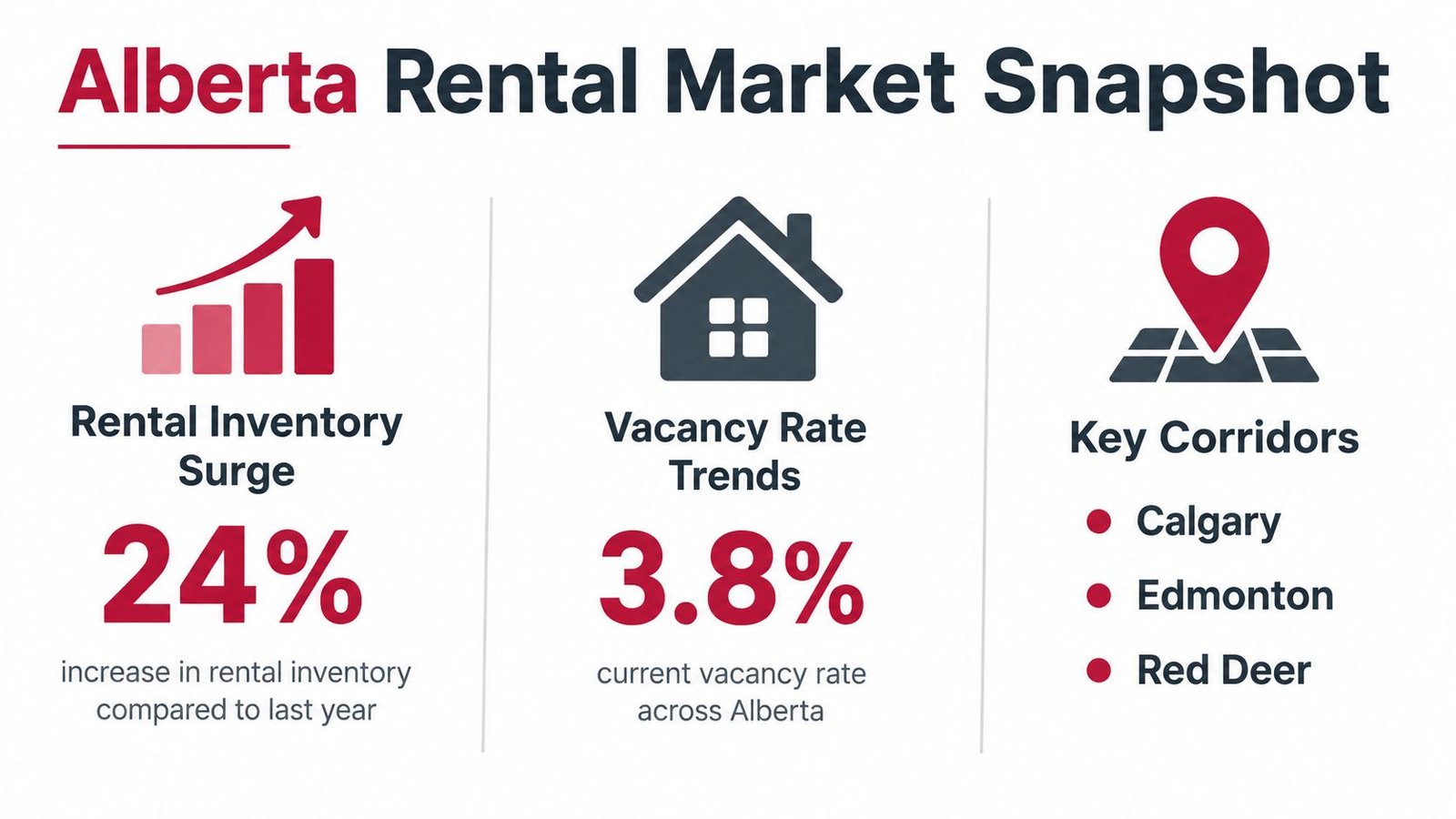
The Calgary CMA primary rental vacancy rate was 5.0% in 2025, with meaningful variation by unit type. CMHC reported 6.0% for studios, 4.4% for one-bedroom units, 5.7% for two-bedroom units, and 4.4% for three-bedroom-plus units. Average apartment rents were $1,582 for a one-bedroom and $1,914 for a two-bedroom (CMHC rental construction and vacancy release). These figures provide a starting benchmark, not a final price for an individual property.
Price the property against its competitors
A landlord pricing from mortgage costs alone is likely to miss the market. The property competes with available listings, not the owner's preferred return. Before recommending a launch price, the leasing professional should review the building, condition, floor plan, parking, amenities, neighbourhood, lease terms, and comparable listings.
Calgary's condo vacancy was reported at 2.2% (Calgary rental market reporting based on CMHC data). That figure shows why property class and submarket matter. Owners should reject citywide averages as a final pricing decision and adjust based on the unit's actual advantages.
Edmonton needs a separate leasing response
Alberta does not operate as one rental market. CMHC reported Calgary's purpose-built rental vacancy at 5.0% in 2025, alongside an 11% increase in rental supply, while Edmonton's purpose-built vacancy rose to 3.8% as completions outpaced household formation. Owners need local pricing, targeted marketing, and regular lease-up reviews rather than a province-wide script.
Professional management now earns its fee through execution. Strong photography, accurate copy, prompt inquiry handling, organised showings, consistent screening, and prospect feedback help an owner compete when renters have choices. A basic agent placement can fill a vacancy, but an experienced manager keeps refining the leasing approach until the property performs.
Alberta Tenancy Compliance and Financial Risks
A landlord can lose money through a compliance error even when the property is occupied. Alberta rules affect notice periods, rent increases, deposits, and move-out accounting. A leasing agent who disappears after possession may leave the owner to manage those details without a reliable calendar or documented workflow.
Notice periods and deposit accounting
For a periodic tenancy, the tenant must give at least 28 days' notice, rent remains payable during that notice period, and, if the tenant requests it, the landlord must apply the security deposit as payment of rent for that notice period (Alberta landlord guidance). The owner needs the notice, ledger, deposit record, and move-out reconciliation to agree.
That means the management file should record the date notice was received, the tenancy type, the required end date, rent due during the notice period, and any deposit application. Informal text messages and incomplete ledgers make disputes harder to resolve.
Rent increases require a controlled calendar
An Alberta landlord can't increase rent until at least 365 days have passed since the tenancy began or since the last increase, whichever is later. For periodic tenancies, the required written notice is 12 full tenancy weeks for week-to-week, 3 full tenancy months for month-to-month, or 90 days for any other periodic tenancy (Alberta rent increase guidance).
Rent can't be increased during a fixed-term tenancy. A periodic-tenancy notice must be in writing and include the date, effective date, and landlord's signature (Alberta tenancy guidance). A manager should calculate the timing from the tenancy record, prepare the notice correctly, and preserve proof of delivery.
Deposits and move-out recoveries
The security deposit can't exceed the equivalent of the first full month's rent at the start of the tenancy, and it can't be increased later if the rent rises (Alberta Residential Tenancies Act handbook). The owner should also maintain condition reports, photographs, invoices, and communications that support any permitted deduction.
Landlords considering Alberta landlord and tenancy support should look for a process that connects legal timelines with accounting. Compliance isn't a separate administrative task. It directly affects possession dates, cash flow, deposit handling, and the owner's ability to defend a decision.
How to Choose the Right Rental Professional
A sales record doesn't prove that a candidate can manage a tenancy. Owners should interview the person who will handle applications, tenant communication, maintenance escalation, inspections, and reporting. If the person in the meeting won't perform those tasks, the owner should meet the operations contact as well.
Ask questions that expose the process
The following checklist separates a real operating system from a promise of personal attention:
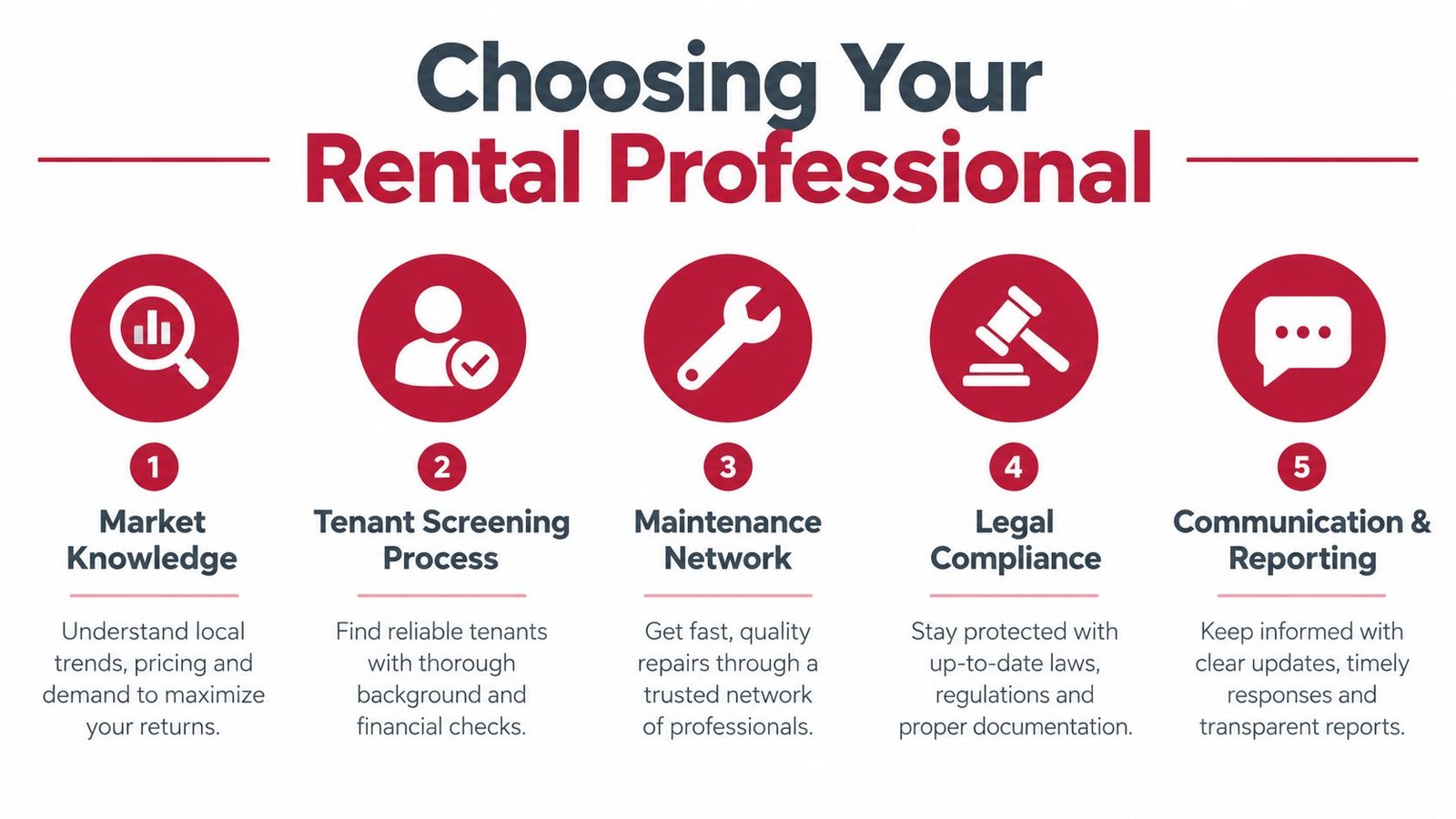
- Market Knowledge: Ask how the candidate sets rent for a specific building, unit type, and neighbourhood. The answer should address current competing inventory and the property's condition, not only a broad city average.
- Tenant Screening Process: Ask which documents are reviewed and how the professional verifies income, credit, references, and rental history. Screening should be consistent and documented, with decisions based on lawful, relevant criteria.
- Maintenance Network: Ask who responds when a repair is reported, how vendors are selected, how access is arranged, and how the owner receives the scope and completion record.
- Legal Compliance: Ask how the firm tracks rent increase eligibility, notice periods, deposits, fixed terms, periodic tenancies, and move-out documentation.
- Communication and Reporting: Ask what the owner receives, how often updates are issued, and where statements, invoices, inspection records, and tenancy documents are stored.
Test the handover before signing
The most revealing question is what happens when the owner is unavailable. A credible firm should explain who handles an urgent maintenance request, who contacts the tenant, how authorization is obtained, and how the event is recorded. The answer should not depend on one salesperson remembering a conversation.
Owners should also request a sample owner statement, a sample inspection report, and a sample listing. Those documents reveal whether the company communicates in useful detail or relies on vague updates. A local provider serving Calgary, Edmonton, Red Deer, and surrounding communities should explain how coverage works outside its main office area.
For landlords comparing rental real estate agent services, the deciding factor should be continuity. A professional who treats placement, compliance, maintenance, and reporting as connected responsibilities is better aligned with a long-term rental investment than one who measures success only by lease signing.
The Dreamhouse Approach to Rental Management
Dreamhouse Realty Ltd. combines brokerage and property management functions for Alberta owners who need support beyond tenant placement. Its stated service model covers Calgary, Edmonton, Red Deer, and surrounding communities, with residential management for single-family homes, condominiums, townhomes, and small multifamily buildings.
The operating approach connects four stages that owners often separate: acquisition planning, listing preparation, lease-up, and ongoing management. That continuity matters because the purchase decision, the property's presentation, the applicant profile, and the long-term maintenance plan all affect the investment's performance.
What the operating model includes
The service structure includes professional listing preparation, rental photography, copywriting, multichannel advertising, coordinated showings, and inquiry management. Applicant screening uses credit, income, references, and rental history verification, followed by lease execution and move-in documentation aligned with Alberta requirements.
After possession, the work continues through rent collection, arrears follow-up, direct deposit disbursements, statement reporting, tenant communication, inspections, and maintenance coordination. Owner and tenant portals centralise records, documents, and service updates, while work-order tracking and vendor coordination help preserve a clear maintenance trail.
Why integration helps owners
An integrated brokerage and management relationship gives an owner one operating framework for a buy-and-hold property. The same organisation can discuss acquisition suitability, rental positioning, applicant quality, condition reporting, and ongoing expenses without forcing the landlord to restart the conversation with a separate provider.
This model doesn't remove the owner's investment decisions. It gives the owner clearer information for those decisions. A landlord can review statements, service updates, inspection records, and maintenance scopes while the manager handles the routine coordination required to keep the tenancy moving.
The practical standard remains the same regardless of provider. The professional should be proactive, transparent, organised, and familiar with Alberta compliance requirements. Dreamhouse Realty Ltd. is one option for owners seeking that combination of rental placement and continuing management.
Securing Your Investment with Expert Guidance
The Alberta rental decision is no longer just a choice between advertising the property personally or hiring an agent to find a tenant. Owners need to choose between a short transaction and a continuing operating relationship. Calgary's higher supply, unit-level vacancy differences, and detailed tenancy rules make that distinction financially important.
CMHC-linked reporting projects Calgary's purpose-built vacancy rate at 5.7% in 2026, while Edmonton's projected rate is 4.5%, so owners should treat those figures as projections rather than current results (CMHC's 2026 rental market update). The sensible response is disciplined pricing, polished presentation, qualified screening, accurate move-in records, and fast resolution of tenant and property issues.
Listing quality deserves particular attention. Owners and professionals who want a practical visual workflow can review this resource on step-by-step photo editing for listings, then apply the same discipline to room consistency, lighting, colour accuracy, and honest representation.
The strongest management relationship gives the owner visibility without requiring daily involvement. It connects leasing strategy to rent collection, notices, inspections, maintenance, and reporting. That is the standard landlords should use when comparing real estate agents rentals services and property management companies across Alberta.
Dreamhouse Realty Ltd. provides rental consultations, market analysis, tenant placement, screening, lease coordination, rent collection, inspections, maintenance management, and owner reporting for Alberta rental properties. Contact GURIQBAL CHAHAL, MBA, PMP, REAL ESTATE BROKER at 403-966-6072 to discuss the property's pricing, leasing timeline, and management needs, then visit Dreamhouse Realty Ltd. to arrange the next step.