

A Calgary landlord can do everything right on paper and still lose money through a slow lease-up. An out-of-province owner might discover that a Beltline condo has sat vacant for 23 days, applications have stalled, and nobody local is available to verify an applicant, coordinate a showing, or respond to a maintenance call. The problem isn't finding a tenant. It's managing the sequence of pricing, marketing, screening, documentation, and follow-through without leaving gaps.
A capable rental real estate agent acts as the operating partner behind that sequence. In Calgary's changing market, the agent's value comes less from putting a listing online and more from making sound decisions quickly, following Alberta tenancy rules, and giving the owner a written record of what happened.
Table of Contents
- Why Calgary Landlords Need a Rental Real Estate Agent in 2026
- What a Rental Real Estate Agent Actually Does for Your Property
- Pricing and Lease-Up Strategy in a Softer Calgary Market
- Key Questions to Ask Before You Hire a Rental Real Estate Agent
- Red Flags That Signal the Wrong Agent for Your Rental
- Choosing the Right Service Model for Your Situation
- Your Next Step With a Calgary Rental Real Estate Agent
Why Calgary Landlords Need a Rental Real Estate Agent in 2026
Calgary's rental environment no longer gives every landlord an easy lease-up. CMHC's 2025 Rental Market Report recorded a 5.0% vacancy rate for purpose-built rental apartments, while the secondary condominium apartment market was considerably tighter at 2.2%. The same report breaks purpose-built vacancy down by unit type, including 6.0% for studios, 4.4% for one-bedroom units, 5.7% for two-bedroom units, and 4.4% for three-bedroom-plus units. Those differences make broad city-wide pricing assumptions unreliable. CMHC's rental market data for major Canadian centres gives owners a useful starting point, but a building-level review still matters.
The owner of that vacant Beltline condo needs more than optimistic feedback from an agent trying to win the listing. The owner needs someone to compare competing suites, identify whether the asking rent fits the building's current position, schedule showings around applicant availability, and explain why a slightly different price or presentation may attract better-qualified interest.
Practical rule: A rental agent should be judged by the quality of the operating process, not by the highest rent quoted during the sales conversation.
Compliance adds another layer. Alberta's rental framework has developed over decades. The province adopted its first landlord-tenant statute, The Landlord and Tenant Act, in 1964, replaced it with The Landlord and Tenant Act, 1979 after a 1977 Alberta Law Reform Institute review, and amended and renamed the legislation again in 1991, introducing stronger security of tenure by limiting when periodic tenancies could end. The Alberta Law Reform Institute explains how many features of today's Residential Tenancies Act trace back to that earlier review in its historical review of Alberta landlord-tenant legislation.
That history explains why professional rental operations depend on proper notices, inspection records, lease terms, and documented decisions. A local Calgary residential property management service can help an owner manage those details while also handling the practical work that vacancy creates.
What a Rental Real Estate Agent Actually Does for Your Property
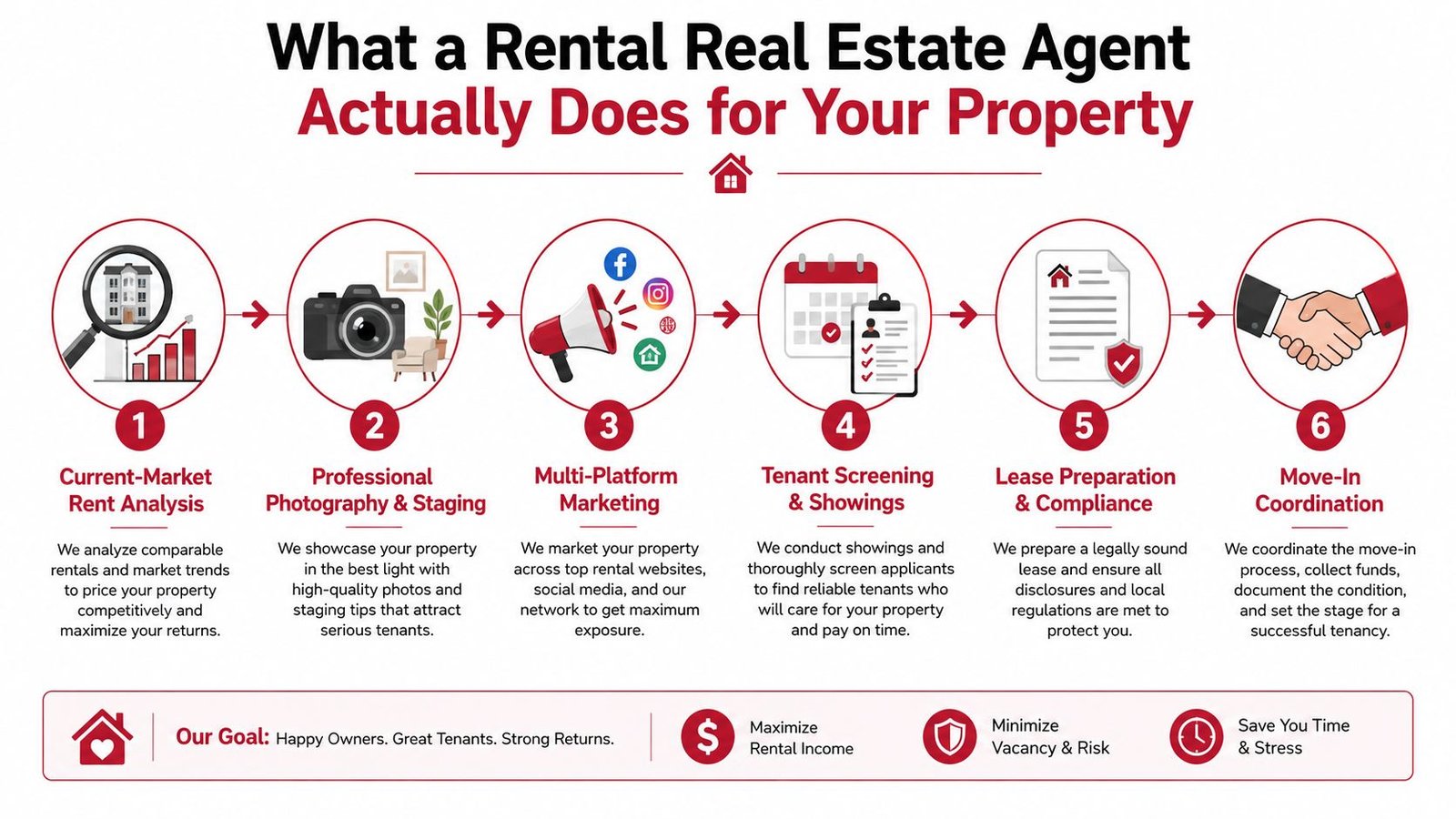
A good rental real estate agent owns a workflow. The owner should be able to see who is responsible at every stage, what document is created, and when an update will arrive.
Pricing starts with the actual property
The first step is a current-market rent analysis based on the unit's building, neighbourhood, condition, parking, storage, appliances, outdoor space, and lease terms. A useful analysis compares active listings with recently leased properties where reliable information is available. It shouldn't rely only on what another owner is asking.
Listing preparation follows. Strong photographs, accurate copy, floor-plan details where available, and clear information about utilities and building rules reduce avoidable questions. The agent should place the property across appropriate rental channels, including MLS where suitable, and manage enquiries rather than leaving the owner to respond from a distance.
Screening should be consistent and documented
The agent should apply the same screening framework to every applicant. That normally includes identity verification, credit review, income or employment confirmation, rental references, and a review of the application's completeness. The process must respect Alberta human rights obligations and avoid decisions based on protected characteristics.
Showings also require control. The agent should confirm appointments, provide lawful notice where the home is occupied, secure the property afterward, and record applicant communication. A busy showing schedule isn't useful if no one follows up with qualified applicants.
Lease and move-in records protect the owner
The agent should prepare an Alberta Residential Tenancy Agreement suited to the property and explain the important terms before signing. Alberta's Residential Tenancies Act handbook is a useful reference for the responsibilities of landlords and agents involved in residential renting.
The security deposit must remain within Alberta's legal limit. At the start of the tenancy, it can't exceed one month's rent, and it can't be increased later solely because rent rises, as explained by Student Legal Services of Edmonton's security deposit guidance.
Before possession changes hands, the agent must complete the move-in inspection report within the required window. The report has to be completed within one week before or after possession changes hands, provided to the tenant immediately, and retained for three years after the tenancy ends. Alberta's inspection report requirements also make clear that missing or incomplete reports can affect the landlord's ability to deduct for damage.
Once the tenant moves in, the operational work continues through rent collection, arrears follow-up, maintenance coordination, periodic communication, renewal planning, and move-out documentation. Placement is only the beginning.
Pricing and Lease-Up Strategy in a Softer Calgary Market
Landlords often focus on the highest advertised rent. That approach becomes risky when comparable properties are competing for the same tenant. Calgary's city housing research reports that the market vacancy rate moved from 4.6% in 2024 to 5.1% in 2025, with projections of 5.7% in 2026, 6.2% in 2027, and 5.9% in 2028. Those are projections for future years, not guaranteed outcomes, and they point to a market where owners may need to make pricing decisions before a vacancy becomes expensive. Calgary's housing trends research provides the local context.
The purpose-built apartment vacancy rate and condominium vacancy rate also tell different stories. Purpose-built apartments recorded 5.0% vacancy in the 2025 CMHC report, while condominium apartments recorded 2.2%. A landlord with an older apartment unit may face more direct competition than an owner with a well-positioned condominium, even if both properties are in the same broad area.
| Indicator | Calgary 2025–2026 Reading | Implication for Landlords |
|---|---|---|
| Purpose-built apartment vacancy | 5.0% in 2025 | Pricing and presentation need to reflect active competition. |
| Purpose-built studio vacancy | 6.0% in 2025 | Smaller units may need sharper positioning and faster follow-up. |
| Purpose-built one-bedroom vacancy | 4.4% in 2025 | Building quality, location, and included features can determine lease-up speed. |
| Purpose-built two-bedroom vacancy | 5.7% in 2025 | Owners should monitor competing family-oriented and roommate-suitable units. |
| Condominium apartment vacancy | 2.2% in 2025 | Condo supply was tighter than purpose-built apartment supply, though each building still differs. |
| City market vacancy projection | 5.7% in 2026 and 6.2% in 2027 | Owners should plan for a less forgiving leasing environment. |
A rental real estate agent should present a price range, explain the trade-off between nominal rent and vacancy time, and define when the listing will be reviewed. Incentives can sometimes preserve the headline rent more effectively than an immediate reduction, particularly where parking or storage has genuine value. The agent should also distinguish between a detached home, townhouse or duplex, condominium, and multi-residential unit rather than applying one city-wide formula.
Marketing quality matters because weak presentation magnifies price resistance. Landlords who want a practical overview of listing preparation and promotion can review marketing rental properties effectively before evaluating an agent's proposed plan.
Fees should be assessed against the work promised, not in isolation. Owners comparing property management fees in Calgary should ask whether the quoted service includes leasing, inspections, maintenance coordination, renewal work, reporting, and vacancy follow-up.
Key Questions to Ask Before You Hire a Rental Real Estate Agent
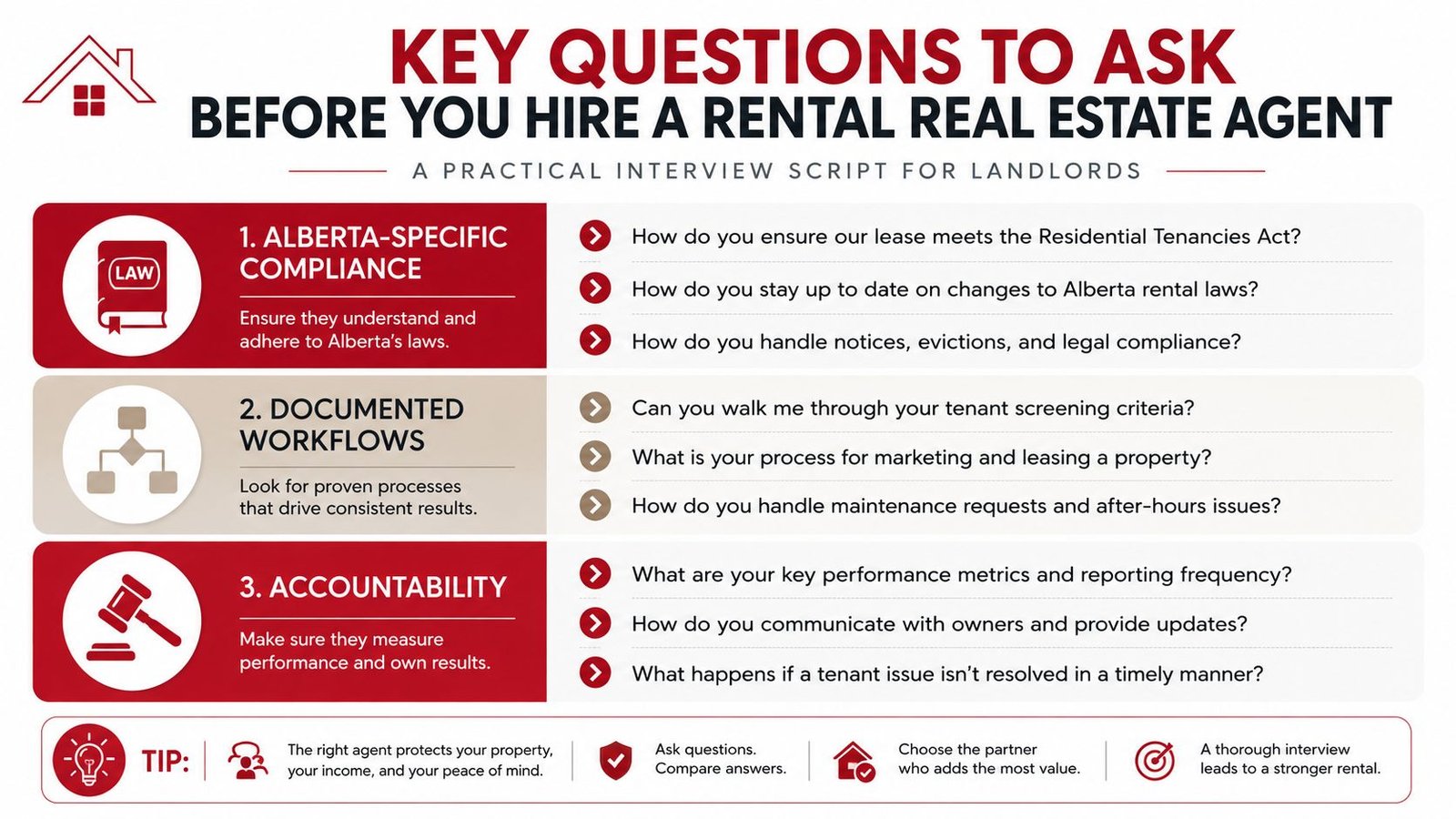
An interview should test the agent's process under ordinary pressure. A polished presentation doesn't prove that applications are screened consistently or that inspection reports are completed correctly.
Ask questions about compliance first
The candidate should be able to answer these without vague reassurance:
- Lease preparation: Who prepares the Alberta Residential Tenancy Agreement, and how are property-specific terms checked for compliance?
- Rent changes: How does the team track the date of the last increase or the start of the tenancy?
- Security deposits: How is the deposit received, recorded, held, and reconciled within Alberta's cap of one month's rent?
- Inspection reports: Who completes the move-in and move-out reports, and how does the team meet the one-week inspection window?
- Notice delivery: How are notices dated, signed, served, and stored so the owner can prove what occurred?
Alberta's rules during a tenancy state that rent can't be increased until at least 365 days have passed since the last increase or the beginning of the tenancy, whichever is later. For periodic tenancies, the written notice must include the date, effective date, and landlord's signature. The notice period is 12 full tenancy weeks for a week-to-week tenancy, 3 full tenancy months for a month-to-month tenancy, and 90 days for other periodic tenancies.
Test the screening and reporting system
Ask the agent to explain the applicant journey from inquiry to approval. The answer should cover credit information, income or employment verification, references, rental history, identity checks, privacy practices, and the decision standard. Asking for a sample redacted screening checklist is more useful than accepting a general statement that the team “screens carefully.”
Marketing and showing questions matter as well. Ask which channels are used, who attends showings, how access is controlled, how quickly inquiries receive responses, and how the agent handles an occupied property. The candidate should also explain how advertising complies with Alberta human rights requirements.
Demand written accountability
Ask what the owner receives each month. A useful report may include rent received, arrears, invoices, work orders, inspection records, vacancies, applications, lease expiries, and owner disbursements. Confirm who handles after-hours calls and which repairs the agent can authorize without separate approval.
Finally, request the full fee schedule, renewal charges, termination clauses, markups, leasing fees, and insurance details. A landlord should ask whether the agent carries errors and omissions insurance and should review what to look for in a property manager before signing.
Red Flags That Signal the Wrong Agent for Your Rental
A real estate licence doesn't automatically make someone an effective rental operator. Leasing requires local pricing judgement, consistent applicant screening, Alberta-specific documentation, and operational availability after the agreement is signed.
The first warning sign is an inflated rent promise with no comparable support. Some agents quote the number an owner wants to hear, secure the listing, and start negotiating downward only after the property has remained vacant. In a softer market, that delay can cost more than an honest price recommendation would have.
Other concerns are easier to identify in writing:
- Unclear fees: The proposal uses phrases such as “standard leasing fee” without stating what triggers the charge, who pays vendors, or whether renewal work costs extra.
- No marketing plan: The agent promises exposure but doesn't identify listing channels, photography standards, showing coverage, or follow-up responsibilities.
- Weak screening language: The candidate says every applicant is “fully checked” but can't show a consistent process for credit, income, identity, and reference verification.
- Missing inspection workflow: The agent treats the move-in Condition Inspection Report as optional or leaves it to the owner and tenant without a documented handoff.
- Poor account handling: The candidate can't explain how security deposits, rent receipts, owner funds, and vendor invoices are recorded and reconciled.
- Post-placement silence: The agent focuses on finding a tenant but has no clear plan for maintenance calls, renewal notices, arrears, or move-out records.
A rental agent who avoids paperwork during the easy part of the tenancy won't become more organised when a dispute begins.
Owners should also be cautious when a team outsources applicant communication to an offshore call centre but can't identify who makes the final screening decision. Cash payments outside the contract, pressure to sign immediately, guaranteed-rent promises without clear conditions, and resistance to a Calgary-specific property management agreement all deserve scrutiny.
The “list it and see” approach is especially weak when competing listings are visible and vacancy is rising. A competent agent sets a review date, tracks inquiry quality and showing activity, and recommends a change before the owner has lost another stretch of rent.
Choosing the Right Service Model for Your Situation
The right service model depends on proximity, time, risk tolerance, and the owner's willingness to handle tenant communication. A remote investor needs a different arrangement from an experienced Calgary landlord who can attend a showing or meet a contractor during the day.
| Service Model | Typical Cost | Best For |
|---|---|---|
| Full-service property management | Typically 8–12% of monthly rent plus a leasing fee | Out-of-province owners, multi-unit landlords, busy owners, and anyone who doesn't want maintenance calls at inconvenient hours. |
| Leasing-only placement | Often a flat fee equal to 50–100% of one month's rent | Hands-on Calgary landlords who want professional marketing and screening but will manage the tenancy afterward. |
| Self-management with agent support | Fee depends on the selected task | Experienced owners who need periodic rent reviews, renewal support, or help with a difficult compliance or maintenance issue. |
Full-service management usually makes sense when the owner values continuity. The same operating file can contain the lease, inspection reports, maintenance history, notices, rent records, and tenant communications. That structure is useful for a remote owner or an investor scaling across Calgary, Edmonton, Red Deer, and other Alberta communities.
Leasing-only placement can suit an owner with local availability and a clear understanding of ongoing obligations. The handoff must be precise. The agreement should specify who collects the deposit, who signs the lease, who completes the inspection, who receives keys, and who answers the first maintenance call.
Self-management with agent support works when the owner wants control but recognises that certain tasks benefit from specialist input. A rent review before renewal or assistance with a notice may prevent a costly mistake. However, on-demand support isn't a substitute for a standing response plan if the owner is unavailable.
Owners should compare the scope behind each fee. A lower price may reflect fewer inspections, limited after-hours coverage, no renewal administration, or no maintenance oversight rather than a more efficient operation.
Your Next Step With a Calgary Rental Real Estate Agent
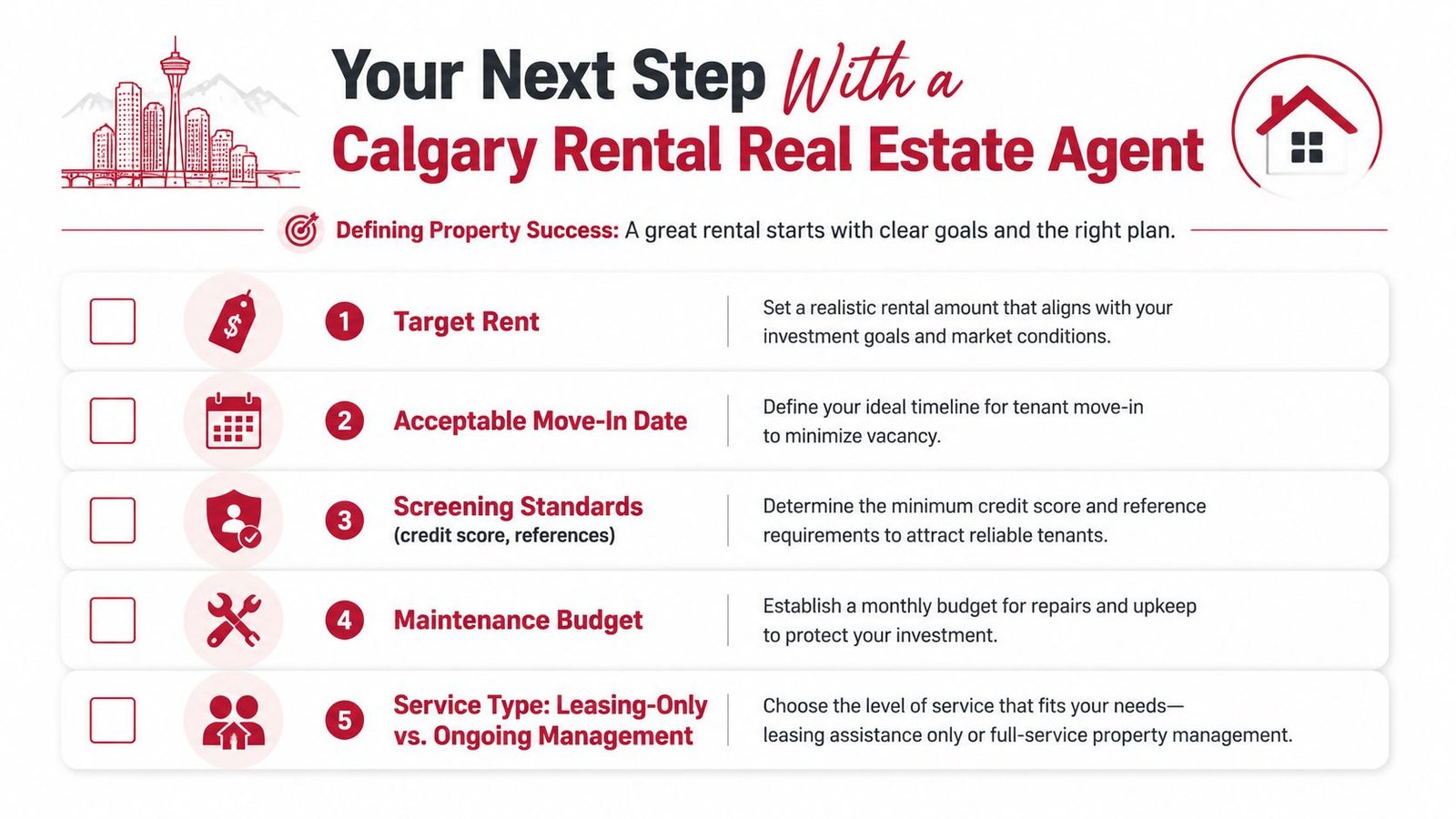
The first meeting should begin with the property's definition of success. The owner should record the target rent, acceptable move-in date, screening standards, maintenance budget, and preferred service type before asking an agent for a proposal.
Prepare the same questions for every candidate
Request proposals from at least two or three agents and compare the same scope of work. Each candidate should explain who handles:
- Showings and inquiries: Identify the person responsible for access, follow-up, and applicant communication.
- Application review: Confirm how income, identity, credit, references, and rental history are checked.
- Move-in administration: Clarify who collects the deposit, signs the lease, completes the inspection report, and hands over keys.
- Ongoing operations: Ask about rent collection, maintenance response, notices, renewals, and owner statements.
- Vacancy reporting: Require updates that distinguish inquiries, showings, qualified applications, and signed leases.
The agent should be able to explain Alberta's 365-day rent-increase rule, the security-deposit limit, and the timing requirements for move-in and move-out inspection reports. The agent should translate those rules into a written workflow rather than reciting them as abstract legal points.
Verify the agreement before signing
Check references from current Calgary landlords and review sample listings, redacted inspection reports, leases, financial statements, and owner updates. Be cautious about guaranteed-rent promises, large upfront charges, vague vacancy claims, or pressure to accept the first applicant without a documented screening rationale.
The management agreement should state its term, termination rights, placement and renewal fees, vendor markups, repair-authority limits, notice procedures, account handling, and reporting schedule. The owner should also gather current photos, utility information, insurance details, condominium or community rules, keys, and renovation records before the agent begins.
A practical first review should occur after the first 30 days, focusing on days vacant, qualified applications, maintenance response, and reconciliation accuracy. The strongest candidate isn't necessarily the cheapest. It's the one who supports a defensible price, documented compliance, and communication the owner can rely on.
Dreamhouse Realty Ltd. provides rental management, tenant placement, maintenance coordination, inspection documentation, lease administration, and owner reporting for residential properties in Calgary, Edmonton, Red Deer, and surrounding Alberta communities.
Calgary and Alberta landlords can speak with GURIQBAL CHAHAL, MBA, PMP, REAL ESTATE BROKER at 403-966-6072 about rental pricing, tenant placement, Alberta compliance, and ongoing property management, then visit Dreamhouse Realty Ltd. to request a consultation. A written proposal can clarify the service model, fee structure, inspection workflow, reporting schedule, and next steps for the property.