
A tenant has moved into a Calgary property, the rent is due, and the landlord is still searching through email for the fully signed lease. The deposit was collected, but nobody recorded when it entered the trust account. A few weeks later, the tenant disputes a utility charge and asks for the agreement. The landlord has a template, but not a reliable document trail.
That situation is common among busy owners, remote investors, and landlords managing a condo or townhome from outside Alberta. A residential lease agreement in Alberta isn't just a form to download and sign. It's an operating record that must align with provincial law, reflect the actual tenancy, and move through a controlled process from drafting to delivery, inspection, notices, and storage.
The practical risk sits in the handoffs. A clause can be incomplete, a deposit can be handled late, or a signed agreement can remain in an inbox. Alberta landlords in Calgary, Edmonton, Red Deer, and surrounding communities need a system that treats lease administration as compliance work, not paperwork.
Table of Contents
- The Legal Foundation of Alberta Leases
- Mandatory Clauses and Market Pricing
- Security Deposits and Rent Increase Rules
- Choosing Fixed-Term or Periodic Tenancies
- The 21-Day Delivery Rule and Execution
- Move-In Inspections and Condition Reports
- Special Rules for Condominium Rentals
- Professional Lease Administration and Management
- Quick Reference for Alberta Lease Compliance
The Legal Foundation of Alberta Leases
A landlord who copies a generic lease from another province may create a document that looks professional but fails when a dispute arises. Alberta tenancy rules govern the agreement regardless of what a private template says. The Residential Tenancies Act is the foundation for residential leases, notices, deposits, and dispute procedures across the province.
The Government of Alberta identifies the Act as an actively maintained statute. The current publication was updated on May 15, 2025, and the Act originally came into force on November 1, 2004, replacing earlier landlord-tenant legislation. Landlords can consult the Alberta Residential Tenancies Act publication as the primary statutory reference, while a practical Alberta RTA handbook can help organise the operational implications.
The agreement cannot override the Act
A private lease doesn't give a landlord permission to contract out of statutory tenant protections. If a clause conflicts with the Residential Tenancies Act, the legislation controls and the conflicting term may be unenforceable. Signing a clause doesn't repair that problem.
That matters when an owner uses a downloaded form containing unfamiliar rules on entry, deposits, repairs, fees, or termination. A clause that appears landlord-friendly may create false confidence, especially if it promises a right the Act doesn't provide. The better approach is to use an Alberta-specific form and have unusual provisions reviewed before execution.
Alberta permits written, verbal, or implied tenancies, but written documentation gives both parties evidence of what they agreed to. For a landlord, that evidence should identify the premises, payment obligations, responsibilities, and agreed rules without relying on memory or informal messages.
Practical rule: A lease should record the agreement, not attempt to replace the law.
Compliance is an ongoing process
The statutory framework has been in force for more than two decades and continues to be updated. A template that worked for an earlier tenancy may not reflect current guidance, deposit administration, notice rules, or the property's actual operating arrangements.
A remote owner faces additional exposure because local tasks are often delegated. The lease may be signed by one person, the deposit received by another, and the inspection completed by a contractor. Without a central record, the landlord may struggle to prove what happened and when.
A compliant lease therefore has two parts: accurate terms and disciplined administration. The form matters, but so do signatures, delivery, payment records, inspection reports, notices, and retained communications.
Mandatory Clauses and Market Pricing
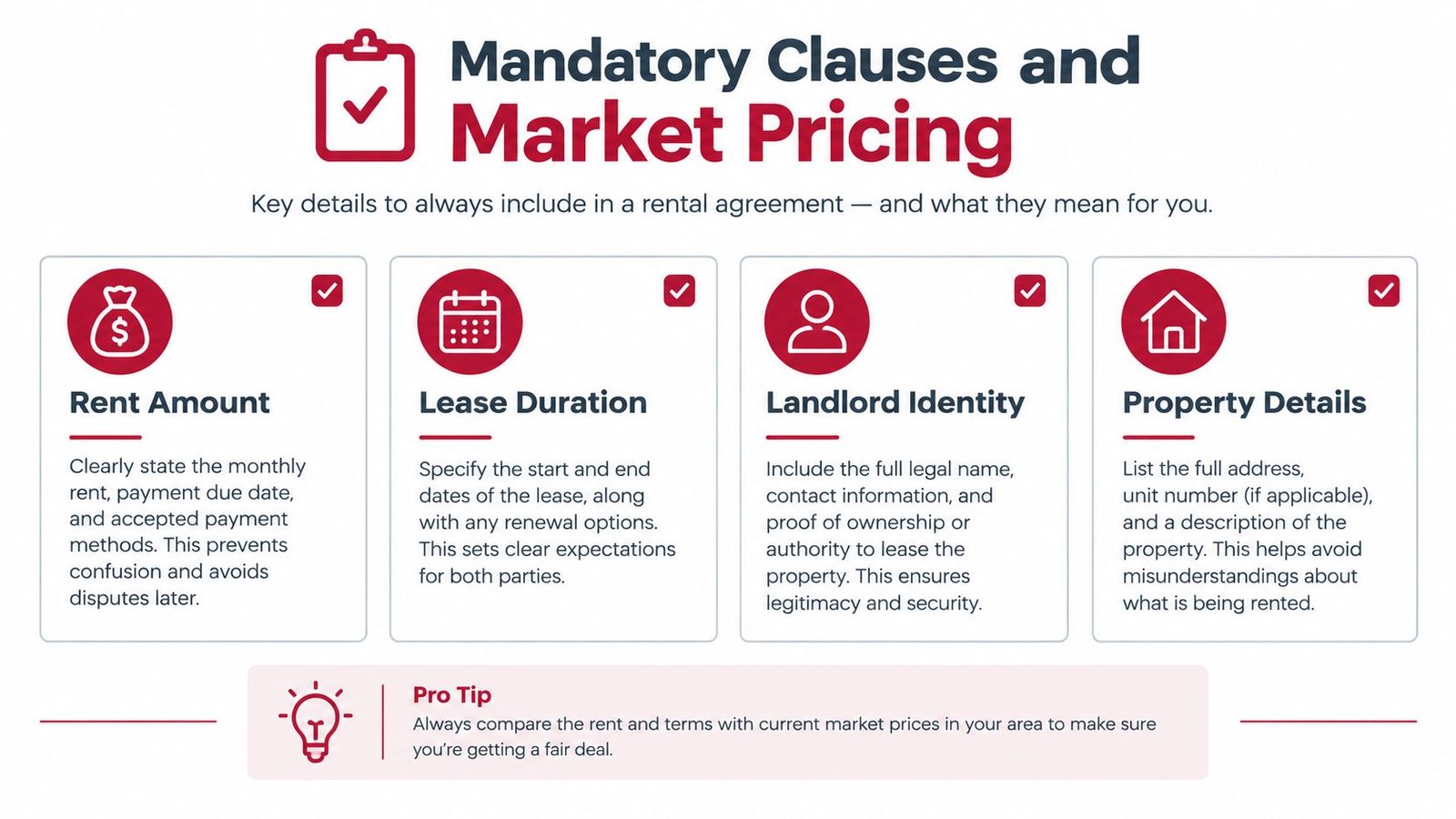
A complete Alberta tenancy agreement answers the questions that usually cause disputes: who is bound, what premises are covered, how much is payable, who handles services, and what happens during the tenancy. Alberta guidance recommends a written agreement containing the key commercial and operational details rather than leaving important arrangements to conversation.
Build the agreement around the actual property
The agreement should include:
- Parties and addresses: Record the full names and addresses of the landlord and tenant. If a company owns the property, identify the contracting entity and the person authorised to act for it.
- Residential premises: State the rental address clearly, including the unit, parking stall, storage area, appliances, or furnished items that form part of the arrangement.
- Term and rent: Identify whether the tenancy is fixed-term or periodic, the relevant dates, the rent amount, payment method, and payment timing.
- Utilities and services: Assign responsibility for electricity, gas, water, internet, waste services, snow removal, lawn care, and other agreed obligations.
- Occupants: List authorised occupants and distinguish them from guests. This prevents later disagreement about who was approved to live in the property.
- Deposit and deductions: State the security deposit and the permitted deductions process without exceeding Alberta's legal limits.
- Maintenance and repairs: Separate the tenant's ordinary care duties from the landlord's obligations for the premises and building systems.
- Insurance, pets, guests, and fees: Write clear rules that fit the property and comply with the Act and applicable human rights protections.
- Signatures: Obtain dated signatures from the landlord and every tenant who is a party to the agreement.
The goal isn't maximum length. It's precision. A short, Alberta-specific clause that identifies who pays for water is more useful than several pages of copied boilerplate.
Set rent using local evidence
Rent should reflect the property, neighbourhood, condition, amenities, and current local demand. Alberta's official housing statistics include municipal rent data and vacancy surveys for communities such as Calgary, Edmonton, and Red Deer, so owners shouldn't rely on a generic national average.
Market conditions can move in different directions. Alberta's economic housing analysis reported an urban rental vacancy rate of 2.1% in 2023, the lowest level in a decade, while average two-bedroom rents rose 11% year over year to $1,448. A later 2025 market report placed the average monthly rent for an unfurnished one-bedroom unit at $1,427, down 4.6% year over year, while a separate 2024 report placed that figure at $1,496 with 7.98% year-over-year growth. These figures come from the Alberta housing demand analysis.
Those differing snapshots show why lease pricing needs local interpretation. A manager should assess comparable homes, expected vacancy, lease length, and the property's condition before inserting the rent amount into the agreement.
Security Deposits and Rent Increase Rules
Deposit and rent errors create avoidable disputes because both involve money, timing, and written records. Alberta landlords should treat each transaction as a controlled process, not as an informal adjustment to the tenant's first payment.
Handle the deposit in two stages
Alberta limits a security deposit to no more than one month's rent at the start of the tenancy. The landlord cannot increase the deposit later just because rent rises. The relevant Alberta tenancy handbook also states that the deposit must be placed in an interest-bearing trust account in Alberta within two banking days of collection.
The operational sequence should be clear:
- Record the amount received. Match the deposit to the signed agreement and payment record.
- Record the collection date. The deadline runs from collection, so an owner shouldn't rely on a vague month-end reconciliation.
- Transfer the funds promptly. Keep evidence of the trust-account transaction and identify the tenancy in the internal ledger.
- Retain the supporting documents. Store the agreement, receipt, bank evidence, and related communication together.
A landlord who collects a deposit through a leasing agent or property manager should confirm who is responsible for each step. Remote ownership makes this especially important because the person holding the payment may not be the person responsible for compliance.
Plan rent changes before sending notice
Rent can't be increased during a fixed term. Alberta also prohibits an increase until at least 365 days have passed since the later of the last increase or the start of the tenancy. For periodic tenancies, the landlord's written notice must include the date, effective date, and signature.
The notice period depends on the tenancy type:
- Week-to-week: 12 full tenancy weeks.
- Month-to-month: 3 full tenancy months.
- Other periodic tenancies: 90 days.
These rules are set out in the Government of Alberta guidance on common landlord and tenant problems. A spreadsheet or property management system should track the last increase date and the tenancy structure before anyone prepares a notice.
A profitable rent decision can still be a poor compliance decision if the timing or notice format is wrong.
The practical trade-off is straightforward. A landlord may want to respond quickly to market movement, but an invalid increase creates friction and may undermine the credibility of the wider rent ledger. Accurate dates and signed notices protect the owner's position more effectively than aggressive wording.
Choosing Fixed-Term or Periodic Tenancies
The tenancy structure should match the owner's plan for the property. A fixed term creates a defined commitment, while a periodic tenancy provides continuing occupancy without a predetermined end date. Neither structure is automatically superior.
A fixed term often suits a newly renovated property where the owner wants predictable occupancy through a planned investment period. It can also help a remote owner coordinate financing, travel, or a future sale. The trade-off is reduced flexibility during the term, and the owner must understand exactly what the agreement says about continuation after the end date.
A periodic tenancy may suit an owner who expects changing circumstances or wants the tenancy to continue without repeatedly signing a new fixed-term document. It offers flexibility, but the landlord must manage notice rules carefully and cannot treat a periodic agreement as if it had a fixed end date.
Compare the practical consequences
| Feature | Fixed-Term Tenancy | Periodic Tenancy |
|---|---|---|
| End point | Has an agreed start and end date. | Continues by rental period until properly ended. |
| Rent changes | Rent can't increase during the fixed term. | Any increase must comply with Alberta's timing and notice rules. |
| Owner flexibility | Less flexibility during the agreed term. | More ongoing flexibility, subject to lawful termination requirements. |
| Tenant planning | Provides a defined commitment. | Provides continuing occupancy but requires attention to notice. |
| Administration | Requires a renewal, extension, or clear next-step process. | Requires a reliable notice calendar and tenancy-period records. |
| Best fit | Planned occupancy, renovation timing, or a defined investment horizon. | Stable ongoing occupancy where future timing remains uncertain. |
End the tenancy with the correct record
When a periodic tenancy ends, either party must provide written notice. The notice must include the rental address, termination date, and signature of the person giving notice, as described in Alberta's tenancy-ending guidance.
A fixed-term agreement still deserves an administrative review before its end date. The landlord should confirm whether the parties intend to renew, whether the agreement sets out what happens next, and whether the property's pricing or condition has changed. A reminder isn't a substitute for a legal notice, but it can prevent last-minute confusion.
The most common failure is choosing a tenancy type casually and then discovering that the owner's planned sale, move, renovation, or rent adjustment doesn't fit the signed terms. The structure should be selected before marketing and explained clearly to the tenant.
The 21-Day Delivery Rule and Execution
A landlord can collect signatures, hand over keys, and still have an incomplete lease file. Alberta requires the landlord to provide the tenant with a copy of the signed residential tenancy agreement within 21 days after the tenant signs and returns it. Alberta guidance also states that the tenant can withhold rent until receiving the agreement, so a missed delivery deadline can affect both compliance and cash flow.
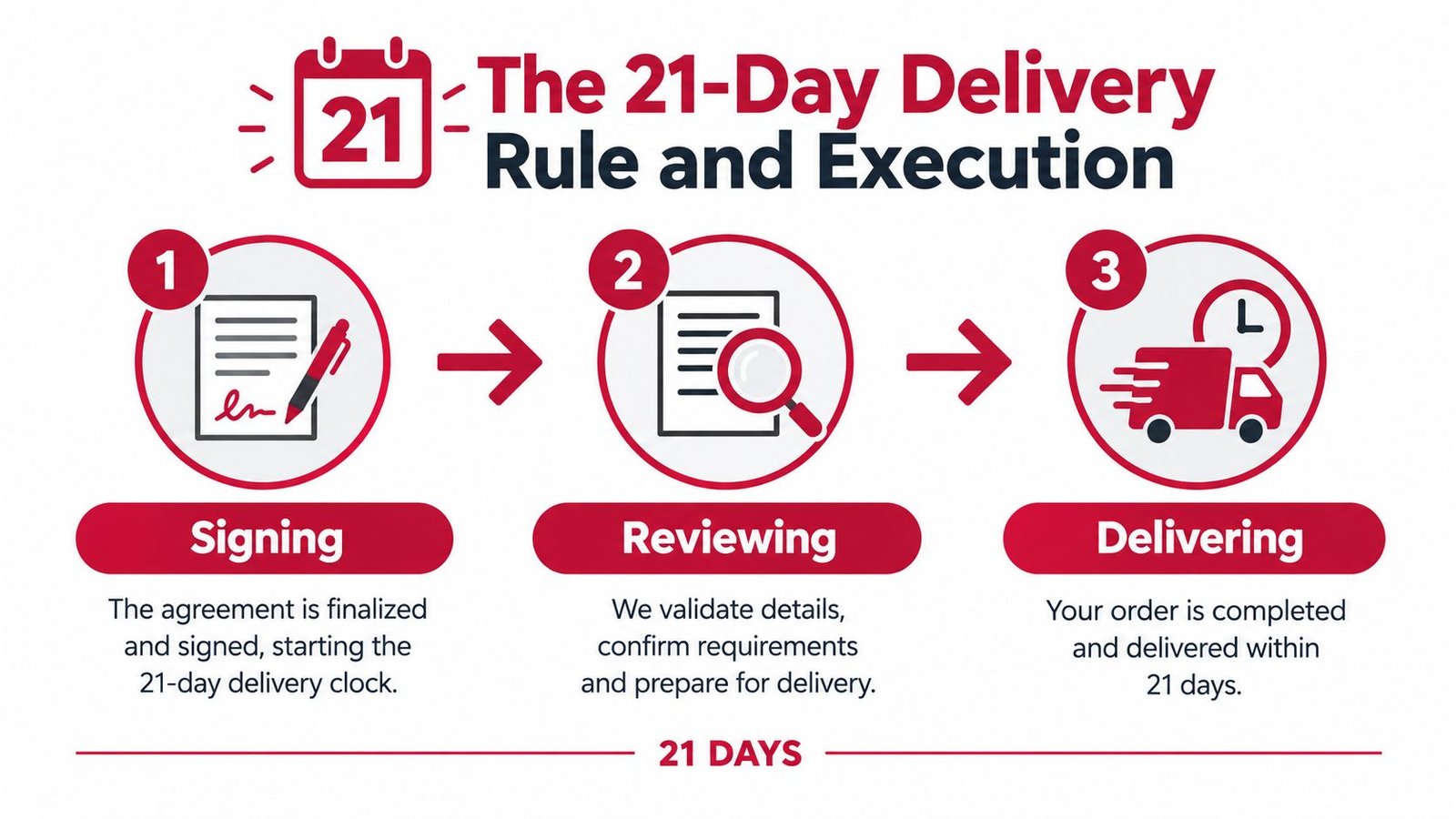
Treat the deadline as a tracked operational task, not an informal reminder. The tenant's signature date should start the countdown, with responsibility assigned to a specific landlord, manager, or administrator.
Control the handoff from signature to delivery
Before sending the agreement, verify the Alberta-specific terms, including the parties, premises, tenancy term, rent, deposit, occupants, services, rules, and required signatures. Then check that every page is present, initials appear where required, and the final document matches the terms offered.
A tenant's partial signature or an unsigned landlord copy does not complete the file. Once both parties have signed, deliver the complete version through the agreed channel and retain evidence, such as an email timestamp, portal log, or delivery confirmation. Store that evidence with the lease and related payment records.
Digital signing tools reduce handling, but they do not transfer the landlord's responsibility. A remote owner should confirm that the tenant received the complete executed agreement rather than assuming a showing agent, leasing assistant, or tenant portal completed the handoff.
The landlord should retain the same version delivered to the tenant. Drafts, unsigned copies, or later revisions without clear identification of the final agreement create avoidable disputes about the terms in force.
The lease file is complete when the executed copy has been delivered and the delivery is recorded.
For an out-of-province owner, local property management can close this administrative gap. Staff can coordinate signatures, inspect the final file, deliver it within the deadline, and flag missing information before it affects rent collection or day-to-day tenancy administration.
Move-In Inspections and Condition Reports
The lease describes the parties' obligations. The move-in condition report records the physical starting point of the property. Without a dependable baseline, a landlord may struggle to distinguish tenant-caused damage from pre-existing wear when the tenancy ends.

A professional Alberta move-in inspection report should be completed before the tenant settles into the unit, with enough detail to identify the condition of rooms, fixtures, appliances, flooring, walls, windows, doors, and supplied items.
Follow a repeatable inspection sequence
Start with access and identity. Confirm the property address, inspection date, participants, and the tenancy file. A report attached to the wrong unit or missing the tenant's details weakens the record.
Walk room by room. Inspect the entrance, living areas, bedrooms, kitchen, bathrooms, storage spaces, balconies, parking areas, and any included outdoor areas. Record existing marks, stains, chips, dents, broken hardware, missing items, and cleanliness concerns rather than using broad language such as “good condition.”
Photograph material issues. Take clear images that show the defect and its location. File names should identify the room or feature, and the photos should remain connected to the report rather than scattered across personal devices.
Invite tenant comments. The tenant should have an opportunity to identify conditions the landlord or manager missed. Record disagreements neutrally and retain the signed report with any follow-up communication.
Repeat the process at move-out. Use the same room order and compare the later condition against the original record. That comparison is more useful than a general statement that the property was damaged.
Make the report part of the lease file
The inspection should not sit separately from the agreement. The file should connect the report to the tenant, premises, lease term, deposit, photographs, repair invoices, and move-out documentation.
An owner may be tempted to conduct a quick walkthrough because the property appears clean. That approach fails when a small existing mark becomes the subject of a deduction dispute. A detailed report takes more time at move-in, but it gives the landlord a clearer factual record when memories differ.
The manager should also distinguish ordinary wear from damage and avoid promising a deduction before reviewing the complete evidence. Condition reports support decision-making, but they don't justify charges that the lease or Alberta law doesn't permit.
Special Rules for Condominium Rentals
A condominium lease carries a second rulebook. The landlord manages the residential tenancy, while the condominium corporation controls the building through its bylaws, policies, and administrative procedures. A lease suitable for a detached house can leave a condo owner exposed if it ignores parking, access, or shared-building requirements.
Before advertising the unit, obtain the current condominium documents and check restrictions that affect the proposed tenancy. These may cover pets, smoking, storage, noise, short-term occupancy, renovations, parking, move-in bookings, and elevator use. Confirm those rules before promising features in the listing. The tenancy agreement should require compliance with applicable condo rules, using the actual documents rather than generic wording.
Give the tenant usable building information
A tenant needs instructions that can be followed on move-in day, not just a clause referring to “all rules.” Provide the relevant bylaws and policies with the move-in procedure, parking instructions, emergency contacts, access requirements, and building restrictions. Keep a dated copy in the lease file so the manager can show which information was supplied and when.
Separate the responsibilities clearly:
- Residential tenancy obligations, including rent, maintenance communication, and approved occupancy.
- Condominium obligations, including elevator bookings, parking permits, common-area conduct, and building access.
- Owner responsibilities, including communication with the corporation and responses to notices affecting the unit.
- Tenant responsibilities, including following building rules and reporting incidents promptly.
A broad compliance clause does not solve an information problem. If the corporation changes a policy and the owner does not update the tenant file, disputes can follow, especially where the tenant received conflicting instructions. Date the documents, record delivery, and review material changes before renewing or extending the tenancy.
For disputed or unclear restrictions, reviewing unenforceable strata bylaws can help explain why a building rule may not operate as expected. The corporation's authority and the tenant's lease obligations must be assessed separately.
Track the corporation notice
Condo offboarding includes a notice to the condominium corporation. Alberta notes that the owner must give the corporation written notice within 20 days after the tenancy ends. This deadline is separate from notices exchanged between the landlord and tenant.
Assign the task in the property file. Record the tenancy end date, corporation contact, delivery method, and confirmation of receipt. Closing the tenant file without sending this notice leaves the offboarding incomplete.
Building violations require the same disciplined recordkeeping. Preserve the original notice, identify the alleged conduct, communicate with the tenant, and coordinate with the corporation without admitting facts that have not been verified. Clear records help protect the tenancy relationship and the owner's position with the building.
Professional Lease Administration and Management
A remote landlord can have a signed lease and still miss the steps that make it usable. The agreement may remain in an email thread, the deposit may not be recorded promptly, or the tenant may not receive the signed copy within the required 21 days. Each omission creates avoidable exposure when a payment, repair, notice, or tenancy dispute later requires proof.
Lease administration works best as a documented operating process. Keep one property file containing the agreement, tenant information, payment records, inspection reports, notices, maintenance communications, and delivery evidence. Assign responsibility for each deadline, including deposit handling and lease-copy delivery, instead of assuming that a tenant, contractor, or co-owner completed it.
Choose support around the actual workload
An owner may manage advertising and showings but assign the remaining administration to a professional manager. Full-service support can include:
- Rental pricing and market analysis for Calgary, Edmonton, Red Deer, and nearby communities.
- Listing preparation, showings, applicant screening, and tenant placement.
- Alberta-compliant lease drafting, signing, delivery, and onboarding.
- Deposit and rent administration, statements, and arrears follow-up.
- Move-in, routine, and move-out inspections with photographs.
- Maintenance coordination, vendor records, and repair communication.
- Notice preparation, compliance tracking, and owner reporting.
The trade-off is a management fee for local oversight and consistent follow-through. Review the service agreement closely. It should identify who retains the records, who handles trust-account administration, which tasks require owner approval, how completed work is reported, and what happens when the manager is unavailable.
Owners managing their own files can apply boost contract efficiency tips to lease administration by controlling document versions, approvals, delivery records, and renewal dates. A lease needs tracking after signing because its obligations continue through the tenancy.
Use a local operating record
Dreamhouse Realty Ltd. provides property management and real estate brokerage services for Alberta rental properties, including tenant placement, lease preparation, lease administration, inspections, maintenance coordination, compliance oversight, and owner reporting. Its coverage includes Calgary, Edmonton, Red Deer, and surrounding communities, with services for single-family homes, condos, townhomes, and small multifamily buildings.
For an owner outside Alberta, continuity can reduce handoff failures. One record can follow the property from pricing and screening through signing, move-in, rent collection, repairs, and move-out. It does not prevent every dispute, but it gives the owner dated evidence and a clear history of who handled each task.
A consultation with GURIQBAL CHAHAL, MBA, PMP, REAL ESTATE BROKER can help identify gaps in lease delivery, deposit handling, inspections, notices, and recordkeeping before those gaps become costly.
Quick Reference for Alberta Lease Compliance
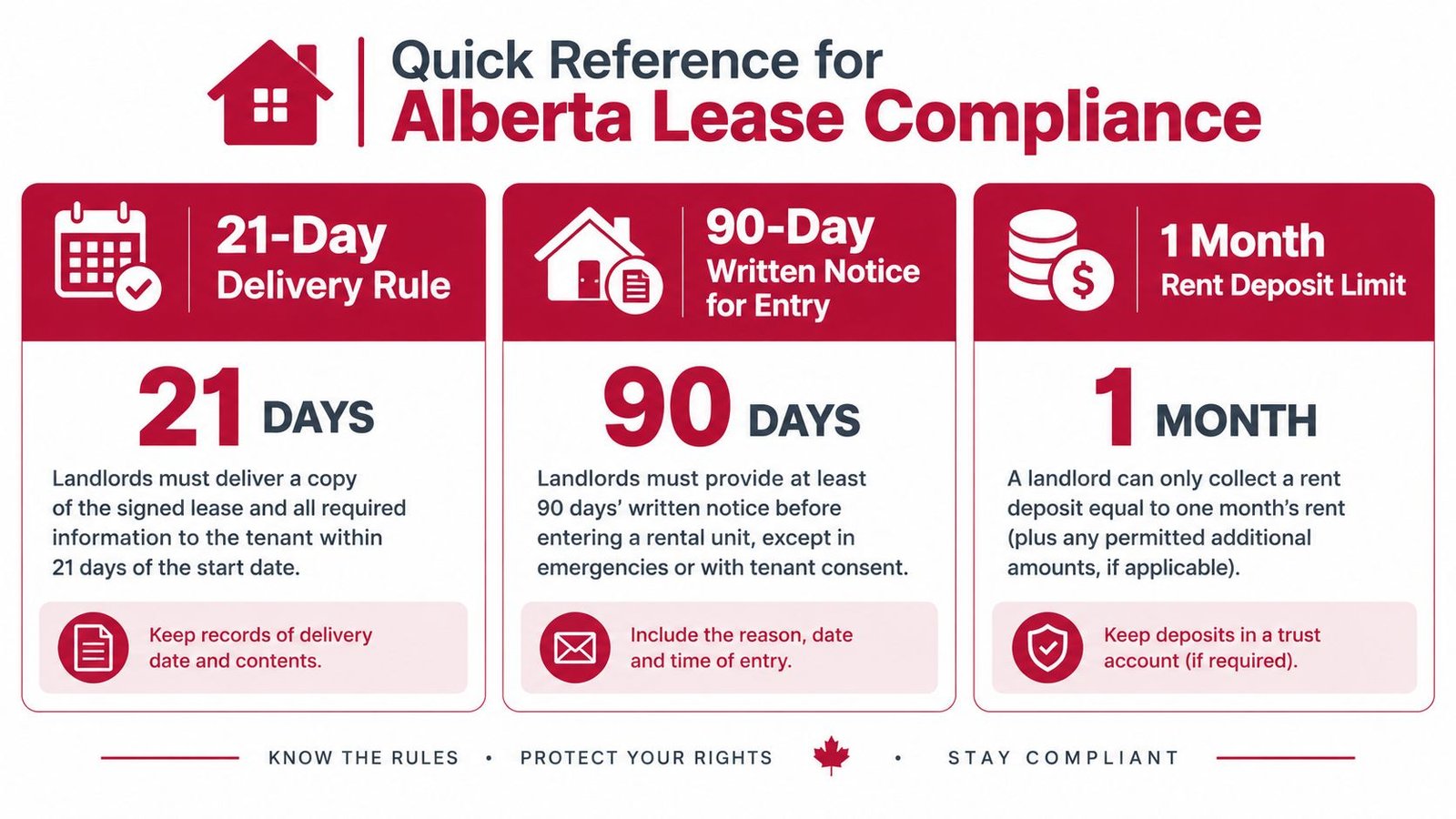
Lease administration becomes easier when the critical dates are visible before the tenancy starts. The owner or manager should maintain a compliance calendar linked to each property and tenant, rather than relying on a general reminder to “follow up later.”
Core limits and deadlines
| Compliance item | Alberta requirement |
|---|---|
| Written agreement | Include the parties, premises, term, rent, payment method, services, occupants, deposit, repairs, insurance, rules, and signatures. |
| Signed lease delivery | Provide the tenant with a copy within 21 days after the tenant signs and returns it. |
| Security deposit | No more than one month's rent at the start of the tenancy. |
| Trust account | Place the deposit in an Alberta interest-bearing trust account within two banking days of collection. |
| Fixed-term rent increase | No increase during the fixed term. |
| Increase timing | Wait at least 365 days from the later of the last increase or the start of the tenancy. |
| Week-to-week notice | 12 full tenancy weeks for a periodic rent increase notice. |
| Month-to-month notice | 3 full tenancy months for a periodic rent increase notice. |
| Other periodic notice | 90 days for other periodic tenancies. |
| Ending a periodic tenancy | Written notice should state the rental address, termination date, and signature. |
| Condo corporation notice | Notify the condominium corporation in writing within 20 days after the tenancy ends. |
The 2026 annual interest rate on security deposits is 0.0%, according to current Alberta housing guidance. That rate is an administration detail older templates may omit, so owners should verify the applicable rate and review their procedures rather than assume a previous form remains current. Alberta also publishes rental vacancy and cost information through its official housing statistics resources, which can support local pricing decisions.
The file should answer five questions
- What was agreed? The final signed lease should be easy to locate.
- Who received what? Keep proof that the tenant received the executed copy.
- When was money handled? Record deposit collection and trust-account transfer dates.
- What condition existed at move-in? Link the inspection report and photographs to the tenancy.
- Which deadline comes next? Track rent review, notices, renewals, inspections, and condo communications.
A landlord who cannot answer those questions quickly may have a documentation problem even if the tenancy is currently quiet. Good administration creates evidence before a disagreement, not after one.
Phone 403-966-6072 to speak with GURIQBAL CHAHAL, MBA, PMP, REAL ESTATE BROKER, about lease preparation, tenant onboarding, inspections, compliance tracking, and ongoing management for an Alberta rental property.
Dreamhouse Realty Ltd. offers Alberta landlords local leasing, tenant placement, lease administration, inspections, rent collection, maintenance coordination, and compliance-focused owner reporting. Visit Dreamhouse Realty Ltd. to arrange a consultation about managing the operational risks behind a residential lease agreement in Alberta.