

A Calgary owner can do everything “right” and still lose money on a vacant rental. The suite is clean, the photos are decent, and the listing is live, yet the inbox fills with incomplete applications while qualified renters move on to better-presented options. In Alberta's changing rental market, tenant placement services are no longer just an administrative convenience. They're a market-positioning decision that affects pricing, exposure, screening quality, compliance, and the cost of an empty unit.
The right placement strategy depends on the property, the neighbourhood, and the current balance between available homes and tenant demand. A landlord who treats every market like the tight conditions of 2023 can overprice a unit, wait too long, and then accept a poor applicant under pressure. A landlord who treats placement as a structured leasing process can adjust earlier and protect both occupancy and long-term asset performance.
Table of Contents
- Why Alberta Landlords Are Rethinking Tenant Placement in 2026
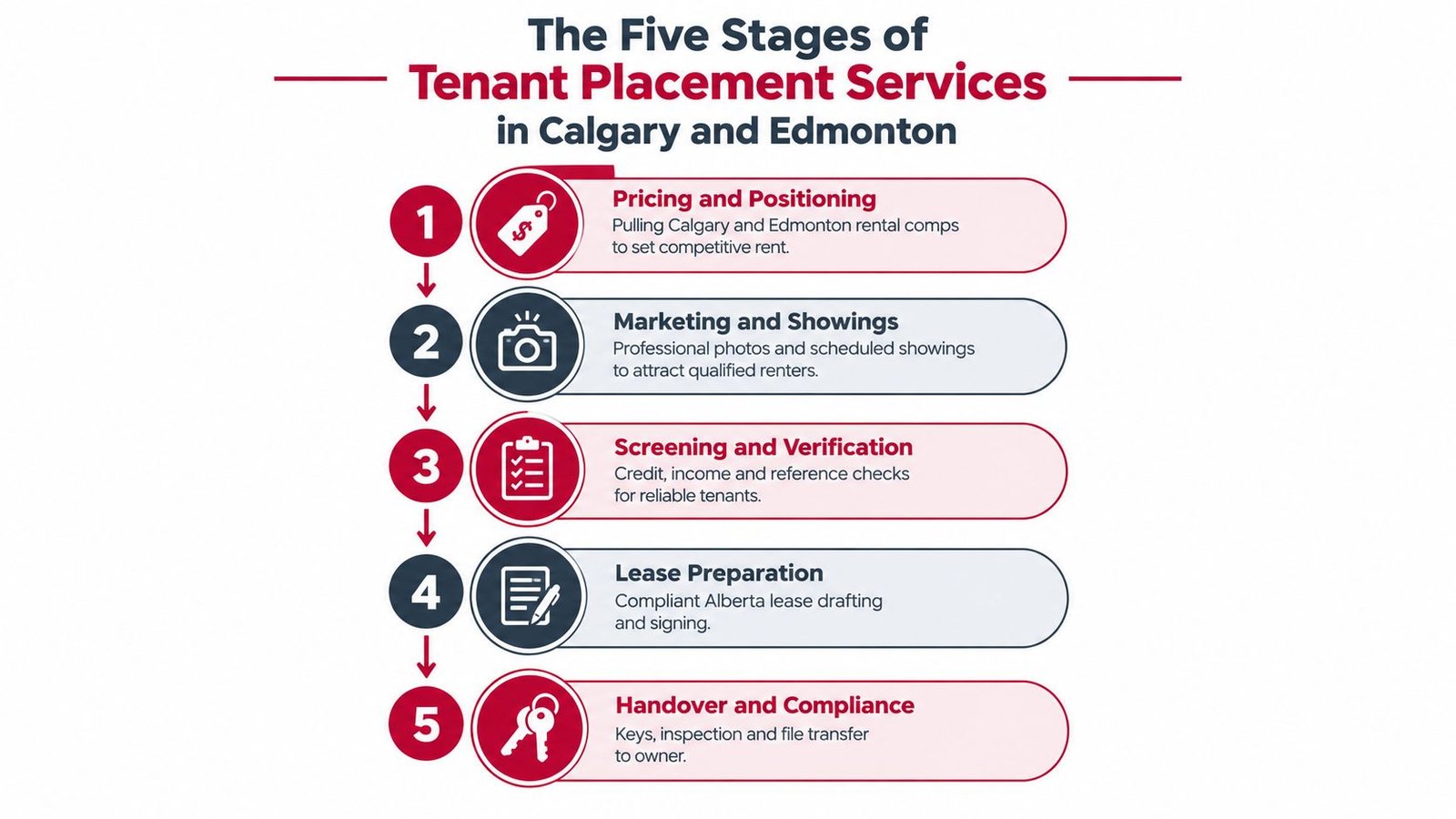
- The Five Stages of Tenant Placement Services in Calgary and Edmonton
- How Applicant Screening Actually Works Under Alberta Rules
- DIY Placement vs a Licensed Alberta Placement Service
- How Tenant Placement Fees Are Priced in Calgary and Edmonton
- Compliance Essentials After the Lease Is Signed
- When Placement Strategy Has to Change With the Market
Why Alberta Landlords Are Rethinking Tenant Placement in 2026
A Calgary landlord with a renovated suite in Skyview Ranch has watched the listing sit for nearly two weeks. There have been only a couple of tentative showings, several inquiries from applicants who haven't read the listing, and no complete application. Every vacant day continues to carry mortgage, utilities, insurance, and operating costs. The owner is tempted to reduce the rent immediately, even though the underlying problem may be weak positioning, poor lead qualification, or an inconvenient showing process.
That situation is different from the market many Alberta landlords remember. CMHC reported that Calgary's purpose-built rental apartment vacancy rate fell to 1.4% in 2023 from 2.7% the previous year, then rose to 4.8% in 2024 according to the CMHC Rental Market Report. The City of Calgary's housing trends data shows the broader market vacancy rate moving from 4.6% in 2024 to 5.1% in 2025 on its housing trends page.

In the tighter period, “list and wait” often appeared to work because tenants had fewer alternatives. In the higher-vacancy environment, pricing discipline, listing quality, applicant qualification, and lease risk carry more weight. A unit can attract plenty of attention and still fail if the rent is above comparable options, the photographs hide the layout, or the owner takes days to respond.
Practical rule: A placement service should be judged by the quality of its market decision, not just by how quickly it produces an application.
One month of avoided vacancy can outweigh a placement fee several times over, before considering the cost of a failed tenancy, turnover, repairs, or another marketing cycle. That doesn't mean every landlord needs a full property manager. It does mean placement deserves the same financial attention as a repair quote or refinancing decision.
The Five Stages of Tenant Placement Services in Calgary and Edmonton
Professional tenant placement follows a sequence. Each stage should produce a clear deliverable, and skipping one usually creates work or risk later.
1. Pricing and positioning
The operator reviews comparable Calgary or Edmonton rentals through sources such as REALTOR.ca, RentBoard, and current MLS-style market information. The objective isn't to test the highest imaginable rent. It's to position the property competitively for a realistic leasing window, while accounting for parking, utilities, furnishing, pet terms, renovations, transit access, and building amenities.
A strong price won't rescue a weak listing, but an inflated price can bury a strong one. Pricing should be revisited when inquiry quality is poor, not only after the property has been vacant for an extended period.
2. Marketing and listing preparation
The listing package should include professional photographs, an accurate floor plan, clear copy, and a short walkthrough video. Distribution may include RentFaster.ca, Facebook Marketplace, Kijiji, brokerage channels, and direct inquiry databases.
A placement manager should also track where leads originate. That can be handled through channel-specific contact methods and campaign tracking, so the owner can distinguish visibility from genuine applications. More views don't automatically mean better leasing results.
3. Showings and lead control
Showings should be scheduled promptly, with staffed open houses where appropriate and one-on-one viewings for serious prospects. Before granting access, the operator can ask basic qualification questions about move-in timing, occupants, pets, employment, and budget.
That protects the owner's time and reduces unnecessary access to the property. It also gives the leasing representative early context for matching applicants to the unit.
4. Screening and verification
The screening file should address credit, income, employment, rental references, and prior landlord history, while respecting Alberta privacy requirements. A consistent process is more defensible than informal impressions formed during a showing.
5. Lease execution and handover
The final stage includes lease preparation, signing, deposit documentation, key handover, inspection coordination, and rent setup. The security deposit cannot exceed one month's rent, and the records surrounding it must be retained for at least three years after the tenancy ends, as outlined in Alberta's security deposit guidance.
A placement service should provide the owner with the signed lease, application materials, screening record, deposit record, inspection documentation, and handover details. Those aren't favours. They're the operating file.
How Applicant Screening Actually Works Under Alberta Rules
Screening should remove identifiable risks without turning the application process into an arbitrary obstacle course. Alberta privacy guidance states that landlords may collect references with the tenant's consent and may request a credit report where there's a direct business requirement and express, verifiable consent, as explained by the Office of the Information and Privacy Commissioner of Alberta.
A practical screening stack starts with income verification. An applicant may provide pay documentation or other income evidence, but the operator must collect and use personal information for a legitimate rental purpose and with appropriate consent. Credit information adds another layer, but it shouldn't be treated as the only measure of ability or reliability.
Employment references should be checked through independently verified contact information where possible. Rental history deserves a direct conversation with prior landlords, including questions about payment patterns, property care, notice, and the reason the tenancy ended. Identity and occupancy details should also match the application and proposed lease.
| Screening Layer | Alberta Rule / Standard | Risk It Removes |
|---|---|---|
| Income verification | Collect information for a legitimate rental purpose and with appropriate consent | Reduces uncertainty about payment capacity |
| Credit review | Request a credit report only with a direct business requirement and express, verifiable consent | Identifies payment concerns and unresolved obligations |
| Employment reference | Verify the employer and contact details independently | Reduces reliance on unverified application information |
| Rental history | Contact prior landlords with the applicant's consent | Surfaces payment, care, notice, and lease-compliance issues |
| Identity and occupants | Match identification, application information, and lease occupants | Limits confusion about who is legally occupying the home |
DIY landlords often skip the uncomfortable parts. They accept an income screenshot without checking the context, call the number printed on an application without independent verification, overlook undisclosed occupants, or avoid asking why a previous tenancy ended. A consistent questionnaire, documented consent, and dated notes make the decision easier to explain if the tenancy later becomes disputed.
Landlords comparing their process with a professional workflow can also review these tenant screening questions. The value of a licensed placement service isn't a magical ability to predict behaviour. It's the disciplined creation of a complete, consistent, and legally defensible file.
DIY Placement vs a Licensed Alberta Placement Service
DIY placement works when the owner is nearby, available, and comfortable handling rejection. A hands-on landlord with one property may manage photographs, inquiries, showings, applications, and the lease without outside help. That owner must still treat privacy, documentation, and Alberta tenancy requirements as seriously as a professional operator.
A licensed service makes more sense when the owner has several units, lives outside Alberta, works unpredictable hours, or doesn't want to manage application disputes. It also provides process continuity when one applicant is declined and another needs to be reviewed quickly.
| Factor | DIY Placement | Licensed Placement Service |
|---|---|---|
| Out-of-pocket cost | Owner pays directly for advertising, photography, screening, lockbox access, and personal time | Owner pays an agreed placement fee, with included and add-on services defined in writing |
| Time to signed lease | Depends on the owner's response speed, availability, and listing quality | A dedicated operator manages inquiries, showings, screening, and document flow |
| Compliance risk | Owner carries responsibility for consent, privacy, lease wording, deposits, and inspection records | The service applies documented procedures, but the owner still needs to understand the agreement and responsibilities |
| Landlord hours | Often spread across evenings, weekends, calls, follow-ups, and file administration | Concentrated into approvals, property access decisions, and review of the completed file |
The cheap model is rarely the lowest-cost model once a vacancy stretches beyond the owner's expected timeline. DIY also has an opportunity cost. A landlord may save a fee while spending evenings on unqualified showings, then make a rushed decision because the property has been empty too long.
Owners who want to understand how leasing support fits within broader operations can review real estate agents and rental services. The decision should be based on proximity, portfolio size, schedule, compliance confidence, and tolerance for vacancy, not on the fee alone.
How Tenant Placement Fees Are Priced in Calgary and Edmonton
Calgary and Edmonton placement quotes generally use one of three structures. A flat fee is straightforward and can work well when the owner wants a defined leasing service. A percentage of one month's rent scales with the property's rental value. A bundled arrangement places leasing inside a broader property management contract, often with a different effective rate than a one-off placement.
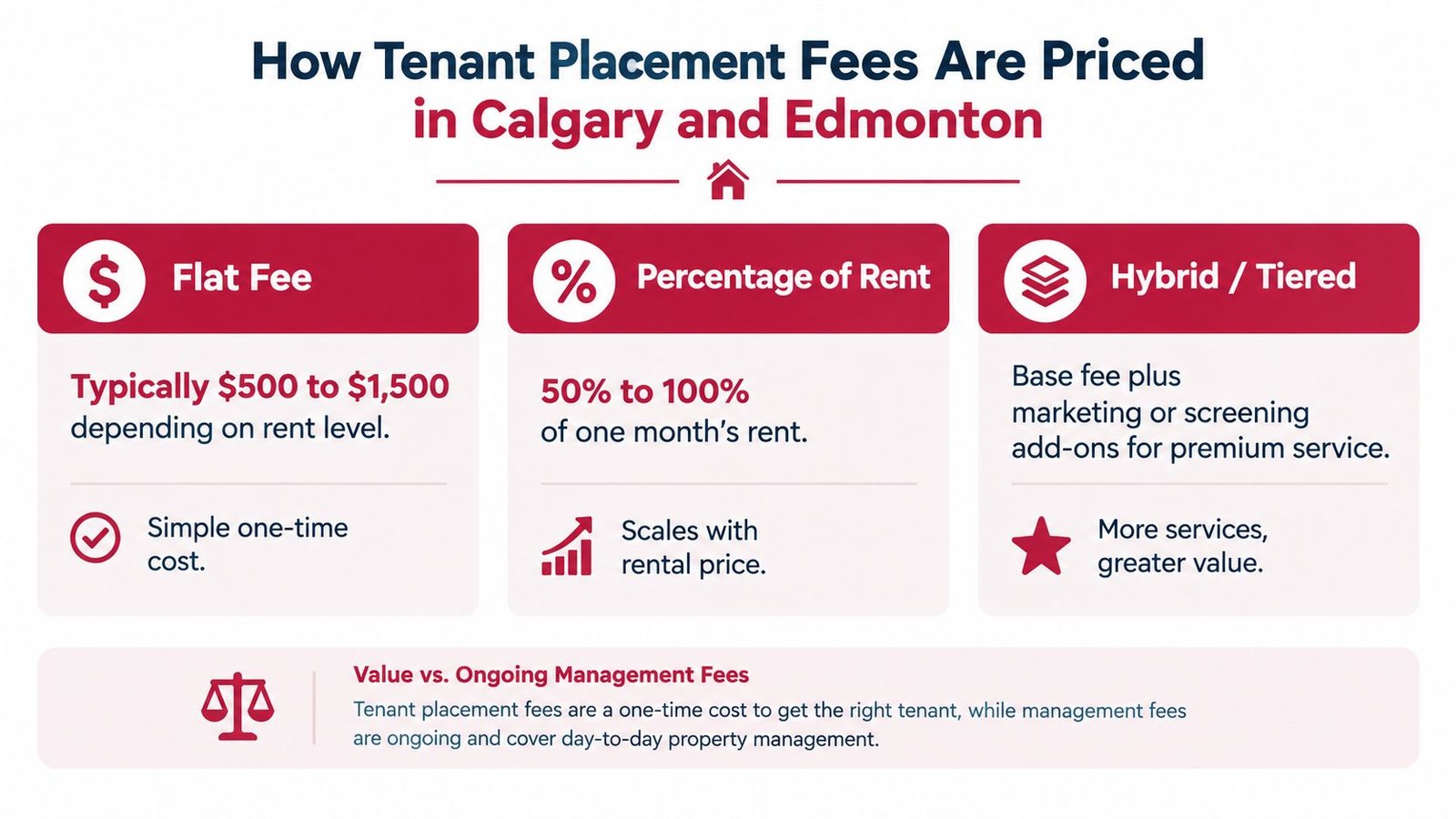
Common quote formats include a flat fee of $500 to $1,500, depending on rent level and service scope, or 50% to 100% of one month's rent, as shown in the supplied Calgary and Edmonton pricing framework. A quote should identify whether photography, advertising, showings, screening, lease preparation, inspection coordination, and failed-application re-marketing are included.
The proper comparison isn't fee against zero. It's fee against the cost of an empty unit and the cost of choosing badly. Calgary's purpose-built vacancy reached 5.0% in 2025, while rented condominium vacancy was 2.2%, according to CMHC's major-centre rental market data. Those different conditions mean a condo and a purpose-built apartment may require different marketing urgency and pricing decisions.
A placement fee is reasonable when it buys a better decision, a faster response cycle, and a cleaner compliance file.
Owners should ask about renewal fees, renewal placement, supplemental marketing, lease amendments, inspection charges, and what happens if the selected applicant withdraws. The property management fees guide can help owners separate one-time placement work from ongoing management obligations.
Compliance Essentials After the Lease Is Signed
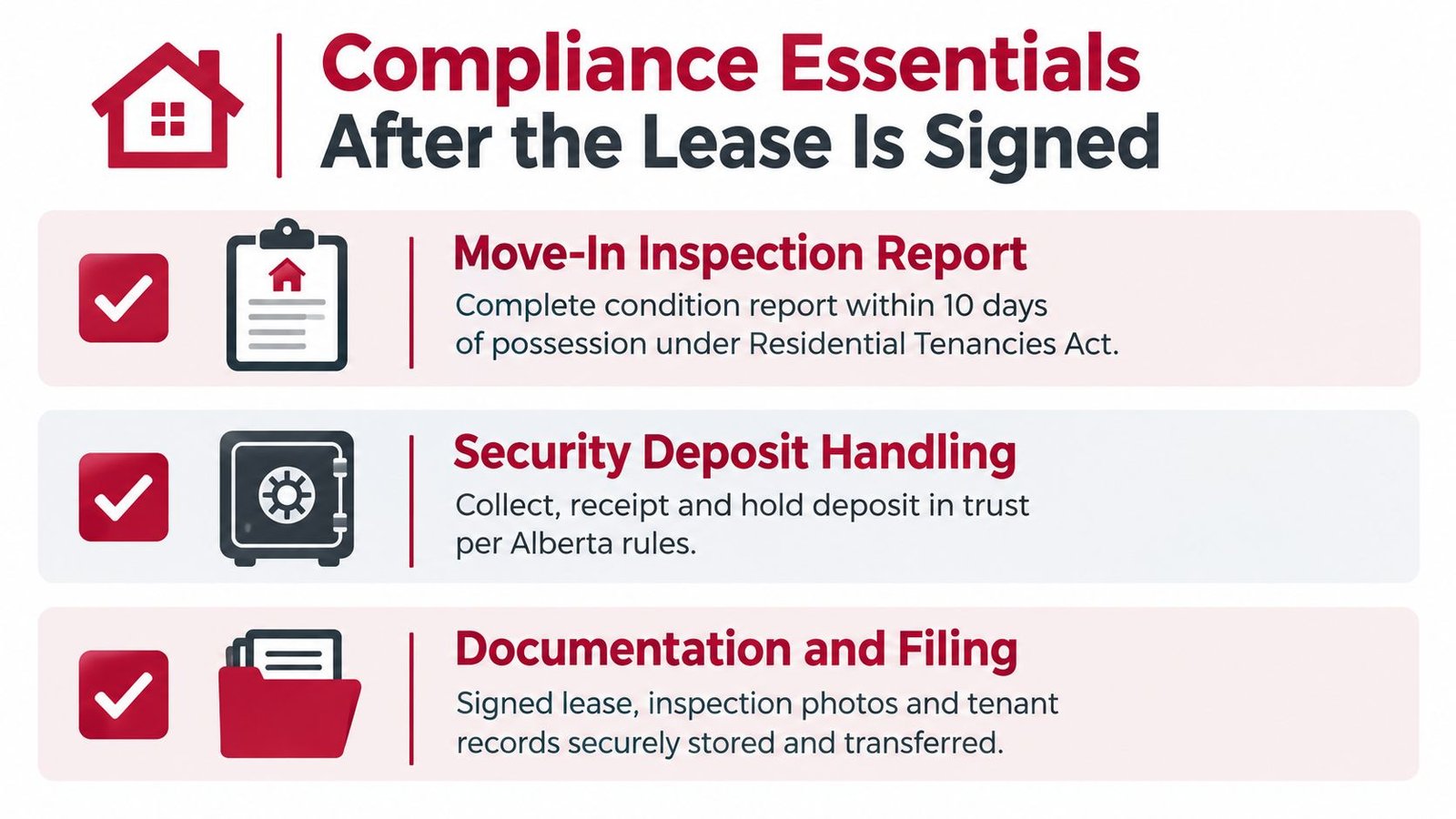
A signed lease doesn't end the owner's responsibility. It starts the documentation phase, where small omissions can weaken the owner's position during a dispute.
Inspection records
Alberta requires landlords and tenants to complete move-in and move-out inspections within one week before or after possession changes. The report must be written, the tenant must receive a copy immediately after the inspection, and the landlord must retain it for three years after the tenancy ends, according to the province's inspection report guidance.
A placement service should coordinate the inspection, record the condition of each area, attach photographs, and transfer the completed file to the owner. If the reports aren't completed correctly, the landlord may be unable to make deductions from the security deposit for damage.
Deposits and records
The landlord must document the date and amount received, deposit details, financial institution information, interest payable and paid, and the final disposition. The security deposit record should sit with the lease and inspection report, not in an unorganised email chain.
Rent increase planning
A landlord can't increase rent until at least one year, or 365 days, has passed since the last increase or the tenancy start date, whichever is later. For periodic tenancies, written notice must include the date, effective date, and landlord signature. The required notice period is 12 full tenancy weeks for week-to-week tenancies, three full tenancy months for month-to-month tenancies, and 90 days for other periodic tenancies, according to Alberta's landlord and tenant guidance.
A complete file gives the owner a defensible record if a dispute reaches the Residential Tenancy Dispute Resolution Service. The most common failure is not dramatic. It's the missing inspection copy, incomplete deposit record, or notice sent without the required details.
When Placement Strategy Has to Change With the Market
Tenant placement strategy should change as vacancy changes. Alberta's market has already moved from Calgary's 1.4% purpose-built vacancy in 2023 to a much looser environment, and the City of Calgary reported 5.1% market vacancy in 2025 in its housing trends information. CMHC-linked projections in the supplied market analysis place Calgary at 5.7% in 2026 and 6.2% in 2027, while Edmonton is projected at 4.5% in 2026 from 3.8% in 2025. Those projections should be treated as forecasts, not guarantees.
| CMHC Vacancy Rate | Placement Tactic | Time-to-Lease Target | Screening Intensity |
|---|---|---|---|
| Tight conditions around 1.4% | Prepare before listing, respond immediately, and make showings easy | Short leasing window | Consistent screening without unnecessary delay |
| Transitional conditions around 2.5% to 3% | Improve photography, highlight amenities, and target employer relocations | Active follow-up and rapid feedback | Documented verification with careful applicant comparison |
| Balanced or softer conditions around 5% and above | Price precisely, consider lawful concessions, and allow a broader search window | Set a realistic target based on competing inventory | Thorough, proportionate screening that avoids needless vacancy |
In a tight market, the landlord's advantage comes from preparation. Photos, repairs, pricing, and lease terms should be ready before the listing goes live, because qualified applicants may not wait. Once vacancy rises, the operator needs to explain why the unit deserves attention. Parking, storage, transit, school access, natural light, utilities, pet terms, and building amenities must appear clearly in the marketing.
The mistake is assuming that stricter screening always reduces risk. In a higher-choice environment, excessive filters can lengthen vacancy without improving tenant fit. Screening should verify income, identity, references, and rental history, but it shouldn't become a collection of preferences unrelated to the tenancy.
Calgary owners who haven't revisited placement strategy since 2023 are paying old-market assumptions against newer vacancy conditions. A thirty-minute review with GURIQBAL CHAHAL at Dreamhouse Realty can turn that gap into a defensible pricing, marketing, and screening plan.
Dreamhouse Realty Ltd. provides tenant placement and residential property management across Calgary, Edmonton, Red Deer, and surrounding Alberta communities, including listing preparation, showings, applicant screening, lease execution, inspections, and compliance documentation. Owners can visit Dreamhouse Realty Ltd. to request a rental consultation with GURIQBAL CHAHAL, MBA, PMP, REAL ESTATE BROKER, at 403-966-6072 and compare a structured placement process with the true cost of handling the vacancy alone.