
You’re staring at two quotes for the same Calgary rental, and one of them looks almost too cheap to be real. The percentage is lower, the sales pitch is smoother, and the contract is buried in fine print. That’s where landlords get burned, because property management fees aren’t just a line on a proposal, they’re a system of charges that either protect your cash flow or eat it.
The right way to judge a manager is simple, compare what you pay while a unit is occupied, what you pay while it’s vacant, and what extra fees show up when the property needs actual work. In Alberta, that distinction matters more than the headline rate.
Table of Contents
Why the Headline Fee Tells Only Part of the Story
You get your first management proposal, scan the monthly rate, and think you’ve done the hard part. Then you notice the leasing fee, the renewal fee, the maintenance markup, the inspection charge, and the vague language around vacancy. That’s when the “cheap” quote stops looking cheap.
The fee sheet is never the whole deal
A landlord who focuses only on the base percentage is usually comparing the wrong number. The actual cost depends on whether the manager charges on collected rent, how often a unit turns over, and what gets billed outside the monthly fee. Industry summaries say the standard service bundle, rent collection, tenant communication, maintenance coordination, and basic reporting, is commonly priced at 8% to 12% of monthly rent DoorLoop’s property management fee overview.
Practical rule: if a proposal is cheaper than the others, assume something has been moved out of the base fee until the manager proves otherwise.
Alberta landlords need to ask a different question
In Alberta, the useful question isn’t “What’s your rate?” It’s “What do I pay when the unit isn’t producing rent?” That’s where lower advertised fees can become expensive, especially if the manager keeps billing during vacancy or adds charges for late rent, leasing, or renewal work.
If you’re still self-managing and comparing that against a professional manager, this self-management cost breakdown is a useful reality check. Many owners discover they’ve been ignoring soft costs, time, follow-up, and vacancy drag, because those never appear on a neat monthly invoice.
A management contract should be treated like an operating budget, not a sales flyer. If a company won’t break down what’s included, assume you’re the one subsidising the missing pieces.
Breaking Down Common Property Management Fee Structures
Alberta proposals usually pull from the same small set of charges, but the packaging changes from one company to the next. One manager hides work inside the monthly rate, another bills each task separately, and another keeps the base fee low so the quote looks cleaner than it is. You need to sort every charge into the right bucket before you compare proposals.
The base fee and what gets added on
The core charge is the monthly management fee, usually a percentage of collected rent. For a Calgary unit renting at CAD 2,000, a common residential benchmark of 8% to 12% of monthly rent collected works out to roughly CAD 160 to 240 per month in base management cost ClearLead Digital’s Alberta fee guide. In the same benchmark, many firms also add a leasing or placement fee of 25% to 50% of one month’s rent, plus maintenance markups of 5% to 15% on vendor invoices.
That structure matters because the first-year bill climbs fast once the unit turns over or needs work. A manager with a modest-looking monthly fee can still end up expensive once tenant placement, renewals, and repairs start moving through the file.
Common fee line items
-
Base Management Fee: This is the recurring charge for rent collection, tenant communication, and day-to-day oversight. Typical range, 8% to 12% of collected rent Bluefield’s fee guide.
-
Leasing or Tenant Placement Fee: This covers advertising, showings, screening, and move-in coordination. Typical range, 25% to 50% of one month’s rent.
-
Setup or Onboarding Fee: This is the one-time admin charge for bringing the property into the manager’s system. It is common, but not universal.
-
Renewal Fee: This covers lease renegotiation and paperwork when a tenant stays on. Some firms fold it into the base fee, others do not.
-
Maintenance Markup: Some managers charge a percentage on top of vendor invoices. That can be acceptable if it is disclosed, but it should never be vague.
-
Inspection or Additional Service Fees: Move-in, move-out, periodic inspections, after-hours calls, and court-related work often sit outside the base fee.
| Fee Type | Typical Range | Example Cost (CAD 2,000 rent) |
|---|---|---|
| Base management fee | 8% to 12% of collected rent | CAD 160 to 240 per month |
| Leasing fee | 25% to 50% of one month's rent | CAD 300-500 |
| Renewal fee | Varies by company policy | Often a separate charge if not bundled |
| Maintenance markup | 5% to 15% on vendor invoices | Depends on repair spend |
| Setup or onboarding fee | Varies by company policy | Usually one-time at start |
| Inspection or extra service fee | Varies by service | Charged when not included in the base fee |
Bottom line: the cheapest quote usually is not the cheapest contract. It is the one that hides the cost the best.
For Calgary and Edmonton owners, the safest move is to ask for a full schedule of charges, then map each charge to a real event, vacancy, renewal, repair, late payment, and dispute. If a fee does not fit a real event, push back.
The Occupied-Door vs Vacant-Door Cost Reality
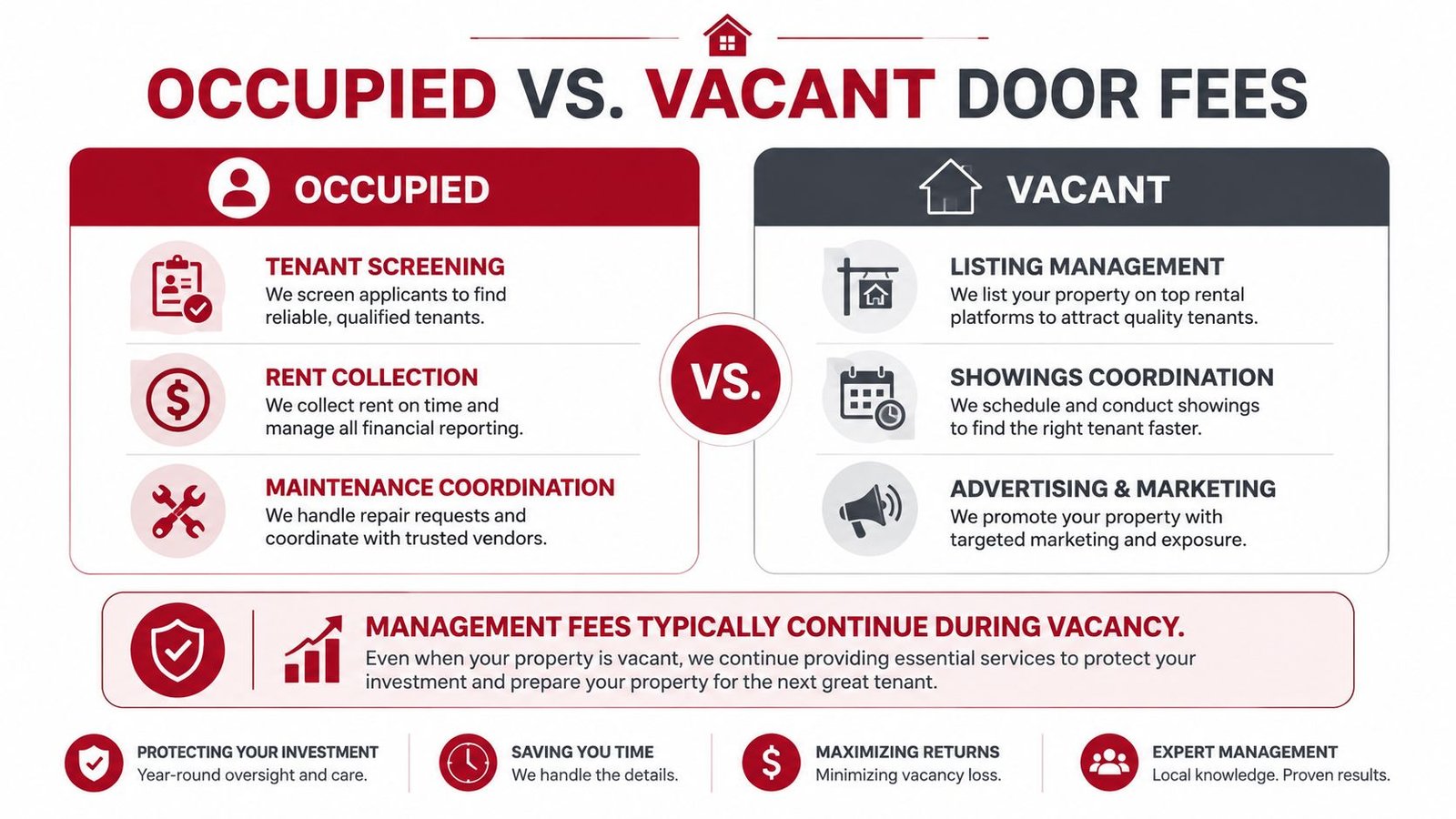
The monthly percentage only tells you what happens when rent is flowing. Alberta landlords lose money when a unit sits empty, and that’s exactly when fee structures start to separate into winners and losers. A manager charging a slightly higher rate on occupied rent can still cost less over a full year if they don’t keep charging through vacancy.
Vacancy is where the real comparison happens
Many owners never ask whether the manager charges while the unit is empty or while rent is late. That’s a mistake. One company might quote 8% and keep billing through vacancy, while another quotes 10% and waives management fees when there’s no rent collected. If vacancy drags on, the supposedly cheaper option can become the expensive one.
CMHC’s latest rental-market reporting shows Calgary and Edmonton have had different vacancy and rent-growth conditions over the last year, which is why occupied-door versus vacant-door pricing matters in Alberta. You’re not buying a rate, you’re buying a cost structure that has to survive real-world turnover and missed payments.
The question to put on the table
Ask every manager one blunt question, “Do I pay when the unit is vacant or rent isn’t collected?” Then ask the follow-up, “What exactly happens during those months?” If they dodge the answer, you already know enough.
A manager who charges a lower percentage but piles on vacancy fees can easily cost more over a year than a company with a cleaner, higher headline rate. That’s why you should compare proposals on an occupied-door basis and a vacant-door basis, not just a monthly percentage.
Practical rule: the best fee structure is the one that stays fair when the unit is empty, not just when it’s performing well.
When you run the numbers, do it on a full-year basis. If one proposal keeps charging during vacancy and another doesn’t, the difference is often bigger than the percentage gap suggests.
What Services Should Be Included in Your Management Fee
A proper management fee should cover the day-to-day work that keeps a rental stable. If a company charges separately for every routine task, you’re not buying management, you’re renting a billing machine. The base fee should be doing real work.
What belongs in the core fee
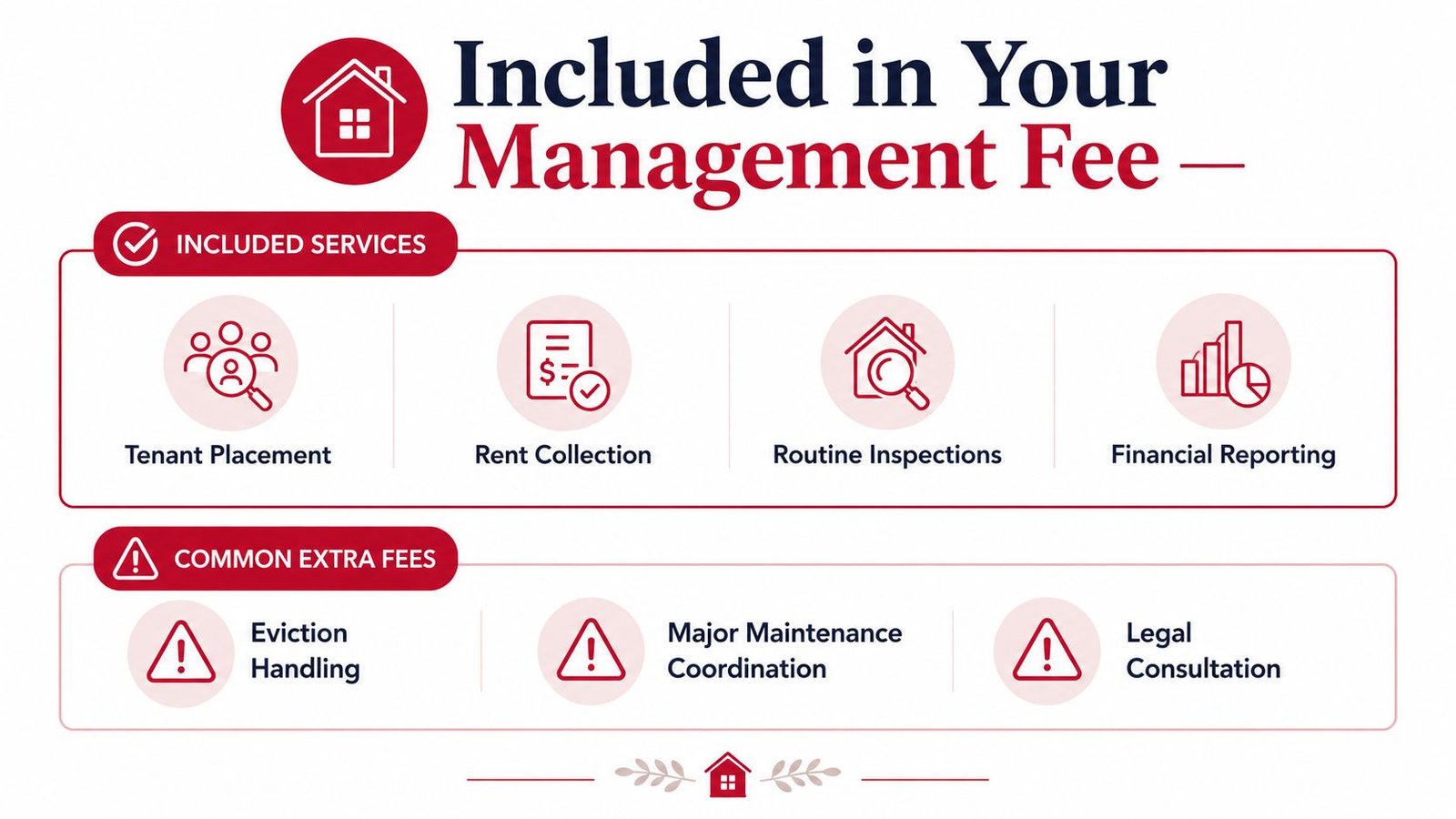
At minimum, expect rent collection and disbursement, basic tenant communication, routine maintenance coordination, monthly financial statements, and compliance work tied to Alberta tenancy rules. Those are the operational basics, not premium extras. If those are all being billed separately, the company is fragmenting the service on purpose.
Dreamhouse Realty Ltd. lists rental consultation, listing preparation, coordinated showings, applicant screening, lease drafting, rent collection, inspections, maintenance coordination, compliance oversight, and owner and tenant portals among its property management services, which is the sort of bundled scope you should look for when comparing managers Dreamhouse Realty Ltd. property management services. That doesn’t make every company equal, but it does show what a fuller operating package looks like in Alberta.
What can reasonably cost extra
Some services deserve a separate fee because they’re not routine. Eviction proceedings, major renovation oversight, extensive marketing campaigns for hard-to-fill units, and legal consultation belong in the “extra” column, not the base management line. The key is transparency. A manager should tell you exactly when those charges apply.
-
Tenant Placement: This should include screening, lease prep, and move-in administration if it’s part of the leasing service.
-
Routine Inspections: These are usually part of proper management unless the contract says otherwise.
-
Financial Reporting: Monthly statements should be standard, not a luxury add-on.
-
Maintenance Coordination: If the manager handles vendor calls and repair follow-up, that should be spelled out clearly.
-
Eviction Handling: This may justify additional fees because it requires time, documentation, and process.
-
Major Maintenance Coordination: Large capital work needs separate terms because it’s project management, not routine management.
-
Legal Consultation: That’s a professional service, and it should be priced as one.
The simplest test is this, if the task happens often and keeps the property running, it should be in the base fee. If it happens rarely and requires unusual effort, it can be an extra charge.
How to Compare Property Management Proposals Side by Side
When you put three proposals on the table, don’t compare them as sales brochures. Compare them as operating contracts. The best way to do that is to make every company answer the same questions in the same order.
Ask for the exact fee trigger
Start with the obvious but often ignored question, “What do I pay when rent isn’t collected?” Then ask whether there’s a vacancy fee, a late-payment fee, a lease-renewal fee, an onboarding fee, and a maintenance markup. If the answer comes back as “it depends,” press for written examples.
A clean comparison sheet should include the base management rate, vacancy treatment, leasing fee, renewal fee, inspection charges, and any extra service line items. If one manager won’t give you a written schedule, strike them off. A landlord who can’t compare the whole cost isn’t really comparing anything.
Use the same questions with every company
Ask this directly: “Show me every fee that can apply in the first twelve months, including vacancy, renewal, maintenance, and dispute work.”
Then ask, “What service level is included in the base fee?” and “What gets billed separately?” That reveals whether the manager bundles real work into one price or unbundles essentials to make the quote look sharper.
A useful way to judge proposals is to line them up by event rather than by category. For example, look at what happens during a vacant month, a renewal, a repair call, and a non-paying tenant situation. Those are the moments that expose the contract.
Watch for the contract language that matters
You want plain terms around termination, notice periods, and invoice approval. If the contract lets the manager charge for any extra task without a clear trigger, that’s a problem. If the manager can add vendor markups without disclosing them, that’s a bigger problem.
The right manager should be able to explain why each fee exists and who benefits from it. If they can’t, the proposal is still a draft, not a decision.
Common Fee Traps and Misleading Pricing Tactics
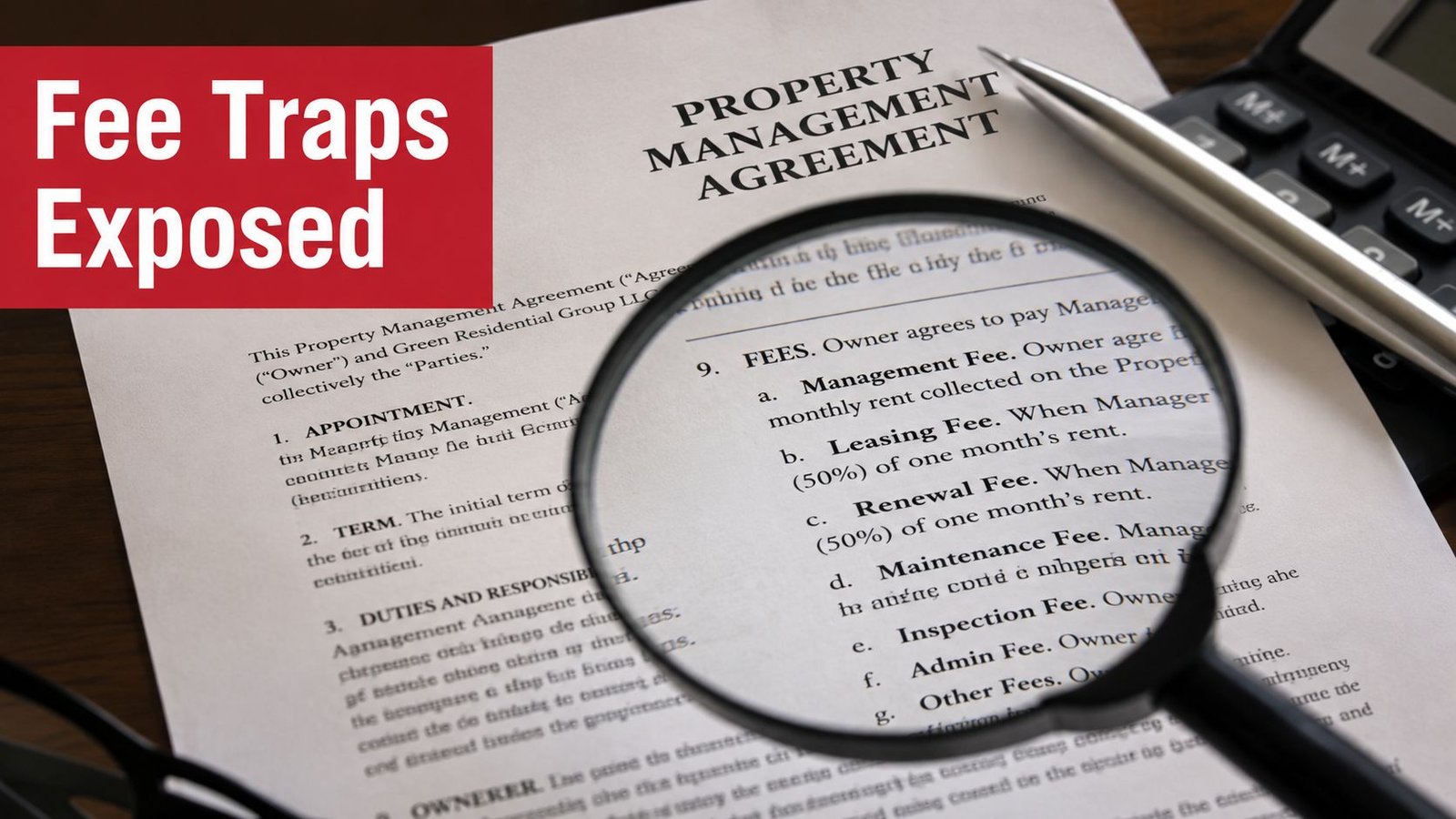
A low quote can still be the expensive option. That happens when the manager keeps the headline rate attractive and moves the cost into vacancy charges, renewal work, maintenance markups, and little fees that only show up after you sign. Alberta landlords get burned here because they compare percentages instead of comparing what the property costs to run over a year.
The usual traps
The most common setup is a low base fee paired with expensive add-ons. Another is a maintenance markup that is described in vague language, then applied every time a vendor invoice moves through the manager’s hands. Lease renewal fees also get buried under labels like “administrative support” or “file handling,” which sounds harmless until the bill arrives.
A lower percentage rate can also mean thinner service. One company prices aggressively and then bills separately for inspections, renewal work, paperwork, and late-rent follow-up. Another keeps those items bundled and charges more up front. Those are not the same deal, especially in Alberta where a vacant unit and a slow repair can wipe out the savings from a cheaper headline rate.
What to read twice
Read every line that refers to “as needed” charges, “coordination” charges, and “administrative” charges. Those phrases give the manager room to bill broadly. You also want the contract to spell out whether vacancy months are charged. On an occupied-door versus vacant-door basis, that single clause can do more damage to your annual return than a small rate difference ever will.
The repair section deserves the same scrutiny. If the manager earns more when repairs cost more, the incentive is wrong. Bluefield’s maintenance markup discussion is useful because it shows how markups can hide in plain sight until you ask for the invoice details. Get that clarity before you sign, not after a problem property has already started bleeding cash.
If you want a blunt reminder of how Alberta landlords get tripped up by weak contracts and lazy assumptions, the Alberta landlord mistakes guide is worth a look before you commit. The point is simple, read the fee language like it will be enforced exactly as written, because it will be.
Practical rule: if the contract is not explicit about vacancy, renewals, and maintenance billing, assume the manager wrote it to protect their revenue first.
Making Your Final Decision on Property Management Fees
The right decision comes from matching the fee structure to the property, the turnover risk, and your own tolerance for chaos. A landlord with a stable long-term tenant can live with a different pricing model than an owner of a higher-turnover condo or small multifamily building. Cost matters, but predictability matters more.
Choose total value, not the lowest quote
A premium fee can make sense if the manager reduces vacancy, handles compliance properly, and keeps maintenance organised. A bargain fee can make sense only if the scope is still complete and the contract is transparent. If you’re comparing a company that bundles service cleanly against one that invoices for every tiny task, don’t pretend those quotes are the same.
Use this final filter before you sign:
-
Service scope: Are rent collection, communication, maintenance coordination, and reporting included?
-
Vacancy treatment: Do fees continue when the unit is empty or rent isn’t collected?
-
Repair billing: Is there a markup, a coordination fee, or both?
-
Turnover costs: What happens at lease-up and renewal?
-
Local competence: Does the manager understand Alberta tenancy rules and tribunal process?
Know when to pay more
Pay more when the manager saves you time, protects the asset, and keeps disputes from spiralling. Pay less when the scope is thin and the property is easy to run. Don’t pay more just because the contract is confusing. That’s not value, that’s friction.
The Residential Tenancies Dispute Resolution Service (RTDRS) is Alberta’s administrative tribunal for many landlord-tenant disputes, and its process runs through an application, a filing fee, and a hearing date from a tribunal officer rather than a straight court filing RTDRS overview. That matters because a manager who works cleanly with notices, records, and evidence can save you from a mess that’s far more expensive than the monthly fee.
Choose the manager who can explain the contract in plain English, stand behind the scope, and show you how they handle vacant months. If they can’t do that, keep looking.
If you want a manager who handles leasing, rent collection, inspections, maintenance coordination, and Alberta compliance with clear owner communication, talk to Dreamhouse Realty Ltd.. They work across Calgary, Edmonton, Red Deer, and surrounding Alberta communities, and they’re set up for landlords who’d rather compare real service than decode hidden fees.