

Alberta property management typically costs 8% to 12% of collected monthly rent for ongoing management, with leasing fees of $400 to $700 and potential maintenance markups of 10% to 20% on trade invoices. The all-in cost is higher than the headline percentage alone.
A Calgary landlord might close on a duplex in Beltline expecting a clean monthly surplus, then receive the first management statement and find leasing, onboarding, inspection, and maintenance-coordination charges sitting beside the advertised management fee. The percentage looked manageable. The invoice tells a different story.
That distinction matters across Calgary, Edmonton, Red Deer, Lethbridge, and smaller Alberta communities. Property management company cost isn't just the recurring fee. It includes the charges attached to finding and retaining tenants, coordinating repairs, documenting condition, handling compliance, and managing vacancy exposure.
Table of Contents
- What Alberta Landlords Pay for Property Management
- Percentage Fees Versus Flat Monthly Rates
- Additional Charges That Increase Your Total Cost
- Real Cost Scenarios for Alberta Rental Properties
- How Professional Management Protects Your Return on Investment
- Evaluating Property Management Proposals Before You Sign
- Next Steps for Alberta Rental Property Owners
What Alberta Landlords Pay for Property Management
For an Alberta landlord, the advertised management percentage is only the first line of the calculation. Ongoing residential management commonly starts at 8% to 12% of collected monthly rent, according to TenantPay's Alberta property management fee guide. A property collecting $2,000 per month would therefore generate approximately $160 to $240 per month in recurring management fees, before leasing, renewal, setup, or maintenance charges.
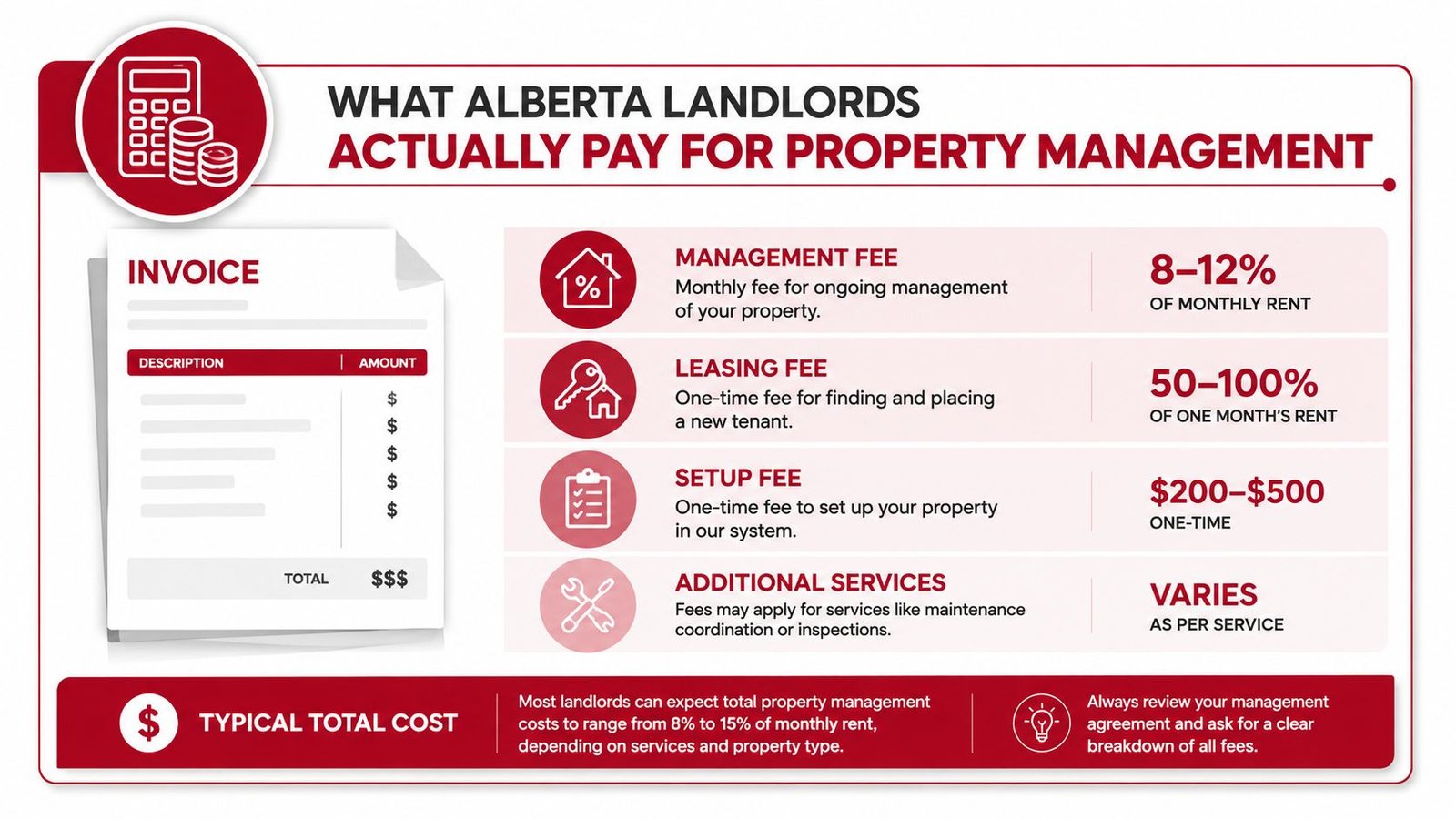
Read the fee basis carefully. Collected rent means the manager usually earns the percentage when rent reaches the owner. A contract based on leased or contracted rent may continue billing against the agreed amount during vacancy or non-payment. For a single-family rental, one missed month can make that distinction more costly than a small difference in the advertised rate.
Build the all-in cost
The recurring percentage does not capture the full cash-flow impact. Add the charges that arise during tenant turnover, lease administration, and repair coordination:
- Tenant placement: Alberta examples commonly quote $400 to $700. Leasing-only services may charge 50% to 100% of one month's rent, as described in Alberta property management pricing guidance.
- Lease renewals: Published Alberta ranges place renewal charges at roughly $100 to $500, depending on the agreement and service scope.
- Maintenance coordination: Some Calgary agreements apply a 10% to 20% markup to trade invoices, according to Calgary property management pricing information.
- Setup and onboarding: Photos, listings, document collection, software entry, and initial inspections may cost extra.
- Vacancy and inspection work: Empty units can require additional visits, marketing, lock changes, cleaning coordination, and condition reporting.
The property type changes the result. A single-family home may absorb one placement fee during turnover. A condo can add access coordination and inspection work. A small multifamily property can multiply leasing, renewal, and maintenance activity across several units. Model each charge against the rent collected, not just the management percentage.
An 8% contract can produce an effective annual cost closer to 12% to 15% of gross rental income in a year involving turnover and repairs. That is a planning estimate based on layering the Alberta fee categories above, not a guaranteed market charge.
Practical rule: Compare the complete annual invoice, including vacancy exposure, rather than the largest percentage in the proposal.
Before signing, require a written schedule showing every trigger, markup, and owner approval threshold. A clear agreement protects cash flow better than a low headline rate.
Percentage Fees Versus Flat Monthly Rates
Alberta managers generally use either a percentage of collected rent, a flat monthly fee per unit, or a hybrid of both. Percentage pricing commonly sits at 8% to 12% of collected rent, while flat pricing gives the owner a fixed operating charge. Condo management guidance for Alberta places some per-unit arrangements around $30 to $50 per unit per month, while Canadian flat-fee models are often described in the $100 to $300 monthly range, as reported by Alberta property management basics guidance.
A percentage structure suits owners who want the manager's compensation tied to revenue received. It can be sensible for a standard single-family home where the service package includes leasing, rent collection, tenant communication, inspections, maintenance coordination, and compliance administration.
A flat fee can make more sense for a higher-rent property or a small portfolio with predictable service demands. The owner gets easier budgeting, but the contract may limit inspections, after-hours response, leasing support, or maintenance administration. The fee is only attractive if the scope remains useful.
A simple annual comparison
The table below compares a 10% percentage fee with a $175 monthly flat fee. It isolates the recurring management charge only, so leasing, renewal, maintenance, and vacancy costs still need separate review.
| Monthly Rent | Percentage Fee (10%) Annual | Flat Fee ($175/mo) Annual | More Economical Model |
|---|---|---|---|
| $1,500 | $1,800 | $2,100 | Percentage fee |
| $2,200 | $2,640 | $2,100 | Flat fee |
| $3,000 | $3,600 | $2,100 | Flat fee |
At $1,500 per month, the percentage model costs less than the stated flat fee. At $2,200 and $3,000, the flat structure is cheaper on the recurring fee alone. The crossover is a budgeting tool, not a recommendation to choose the lowest figure.
Matching the model to the property
A suburban Calgary single-family home may fit percentage pricing because rent collection, tenant support, and turnover activity fluctuate with occupancy. A premium Edmonton condo may favour a flat arrangement if the owner wants predictable administration and the manager provides the same core service regardless of rent level.
Hybrid pricing deserves scrutiny. A manager might advertise a lower percentage but add a monthly administration fee, minimum charge, leasing commission, or inspection fee. Owners who use rental data, listing systems, or other operational software should also understand the broader economics of recurring real estate technology, including scalable real estate API costs, when evaluating whether a management platform's technology charge is included or passed through.
A lower percentage isn't automatically a lower cost. The service scope decides whether the discount is real.
Additional Charges That Increase Your Total Cost
The first management invoice often reveals whether a proposal was transparent. A landlord should request the full fee schedule before authorising a manager, then map each possible charge to a real event in the property's operating cycle.
Leasing and renewal charges
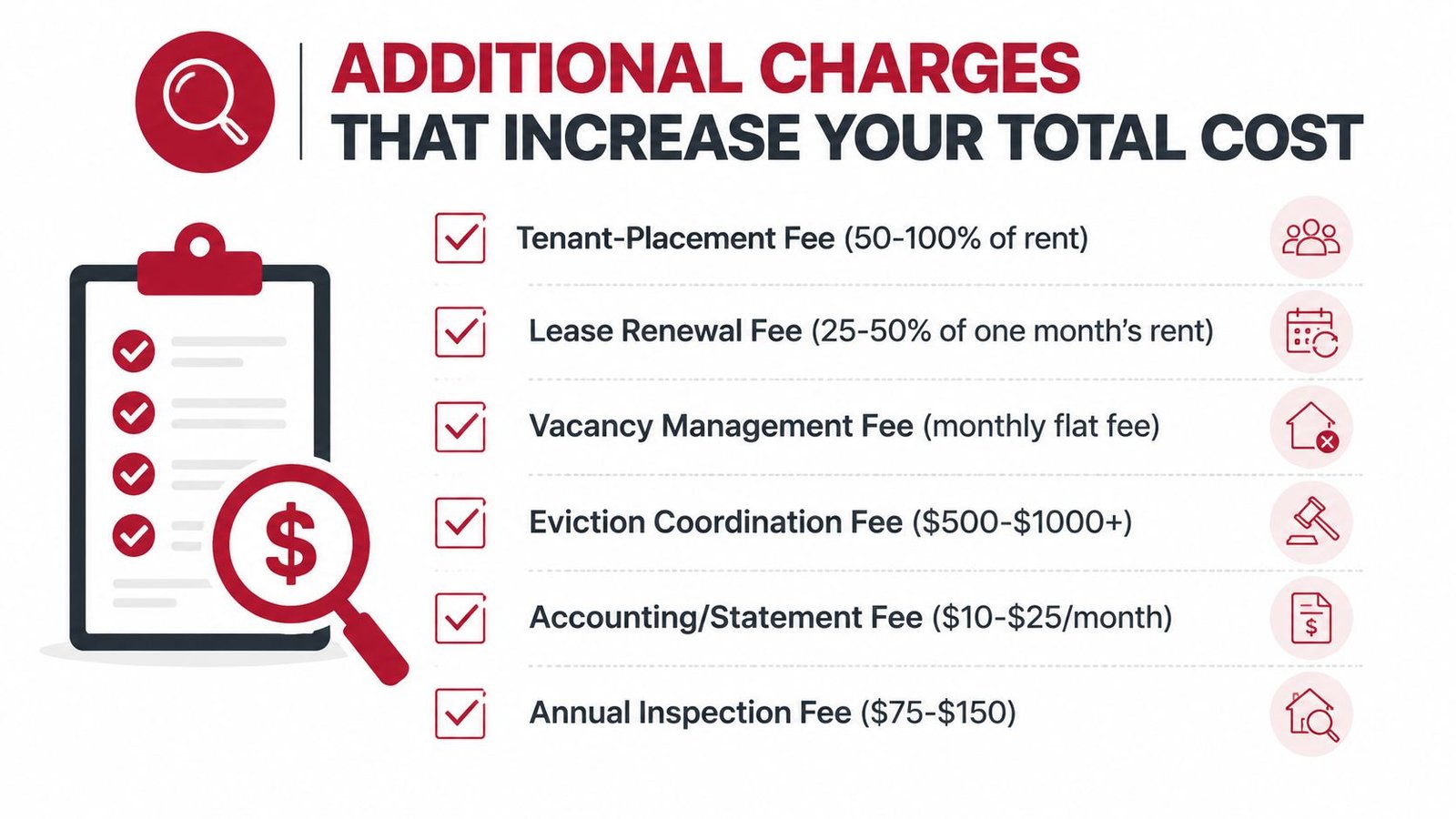
Tenant placement is usually the largest non-recurring fee. Alberta examples commonly place it at $400 to $700, while leasing-only services may use 50% to 100% of one month's rent. The charge can cover listing preparation, advertising, inquiries, showings, screening, lease execution, and move-in coordination.
A renewal fee may apply even when the tenant stays. Alberta pricing examples place renewal charges at roughly $100 to $500, so the agreement should state whether the fee covers market analysis, negotiation, documentation, and updated condition records.
Setup fees can also appear at the beginning of the relationship. They may cover onboarding, photos, listing preparation, document collection, software setup, and initial file review. Some full-service agreements add start-up charges for these tasks rather than including them in the recurring rate.
Maintenance markups and inspection costs
A 10% to 20% maintenance markup on a trade invoice changes the economics of every repair. For example, a $500 plumbing invoice becomes $575 to $600 after the markup, before any separate emergency or project-management charge. Owners should ask whether the manager supplies the third-party invoice, obtains competing quotes, uses affiliated vendors, or applies a cap to the markup.
The agreement may also separate routine inspections from move-in and move-out reports. Other possible charges include eviction coordination, insurance-claim support, renovation oversight, annual inspections, reserve-fund requirements, and special administrative work.
Landlords comparing rental ownership expenses should also distinguish property management charges from condominium or strata obligations. A plain-language explanation of strata fees and their definition can help keep building-level expenses separate from the manager's operating invoice.
Invoice test: If a charge can't be tied to a clearly described service, the proposal isn't ready for signature.
Alberta compliance creates another operational cost category. The province requires a security deposit to be placed into an interest-bearing trust account in Alberta within two days of receipt, according to the Residential Tenancies Act handbook. For 2026, Alberta sets the minimum annual security-deposit interest rate at 0%, as stated by the Government of Alberta. The agreement should explain who handles trust accounting, notices, inspection records, and deposit decisions.
Real Cost Scenarios for Alberta Rental Properties
A useful cost comparison needs a property, a rent figure, a fee model, and clearly stated assumptions. The three examples below use the requested Alberta property types, but they avoid pretending that unspecified renewal fees, special assessments, vacancy periods, or tiered rates have a universal price.
Calgary single-family home
The Calgary example assumes a Panorama Hills home renting for $2,400 per month, a 10% management fee, one tenant placement at $550, and two maintenance callouts subject to 15% markups. The recurring management fee is $240 per month, or $2,880 over a full year. The leasing charge brings the stated annual cost to $3,430 before the underlying repair invoices are known.
The maintenance markup can be calculated, but the repair amounts cannot be invented. If the two trade invoices total R, the markup adds 0.15R, making the annual management-related cost $3,430 plus 0.15R. Gross annual rental income is $28,800, so the known portion equals approximately 11.9%, with the maintenance markup added separately.
Edmonton condo
The Oliver condo assumes $1,650 monthly rent and a $175 monthly flat management fee. That produces $2,100 annually before the lease renewal fee and special-assessment coordination charge. Because neither additional charge has a verified amount in the scenario, the total is best stated as $2,100 plus the renewal and coordination charges, not as a fabricated dollar total.
Gross annual rent is $19,800, making the known recurring management cost approximately 10.6% of gross rent. A manager should identify whether special-assessment coordination is included in condo administration or treated as project work.
Lethbridge four-plex
The four-plex produces $4,800 per month in scheduled rent, based on four units at $1,200 each. Its agreement uses tiered percentage pricing, quarterly inspections, and higher turnover costs, but the scenario doesn't provide the percentage tiers, inspection fee, leasing charge, or vacancy duration.
The annual gross rental income is $57,600. The recurring management cost is therefore $57,600 multiplied by the applicable tiered rate, with inspections, leasing, renewals, maintenance, and vacancy-related costs added separately. This is precisely why owners should avoid accepting a custom multifamily proposal without a sample statement and a full fee schedule.
| Cost Component | Calgary Single-Family ($2,400/mo) | Edmonton Condo ($1,650/mo) | Lethbridge Four-Plex ($4,800/mo) |
|---|---|---|---|
| Gross annual rent | $28,800 | $19,800 | $57,600 |
| Recurring management | $2,880 at 10% | $2,100 at $175/month | Tiered rate not provided |
| Leasing or placement | $550 | Not provided | Higher turnover cost, amount not provided |
| Renewal | Not provided | Charged, amount not provided | Not provided |
| Maintenance | 15% of two trade invoices | Not provided | Not provided |
| Inspections | Not provided | Not provided | Quarterly, fee not provided |
| Known annual cost | $3,430 plus maintenance markup | $2,100 plus listed add-ons | Cannot be calculated without proposal rates |
| Known cost as share of gross rent | About 11.9% before maintenance markup | About 10.6% before listed add-ons | Not calculable |
Owners who want to test whether these charges outweigh the time and risk of self-management can use a structured rental property self-management cost review.
How Professional Management Protects Your Return on Investment
Management fees make sense only when the service protects more cash than it consumes. That protection can come from faster leasing, better screening, proper notices, documented inspections, controlled repairs, and consistent rent collection. It doesn't come from the percentage alone.
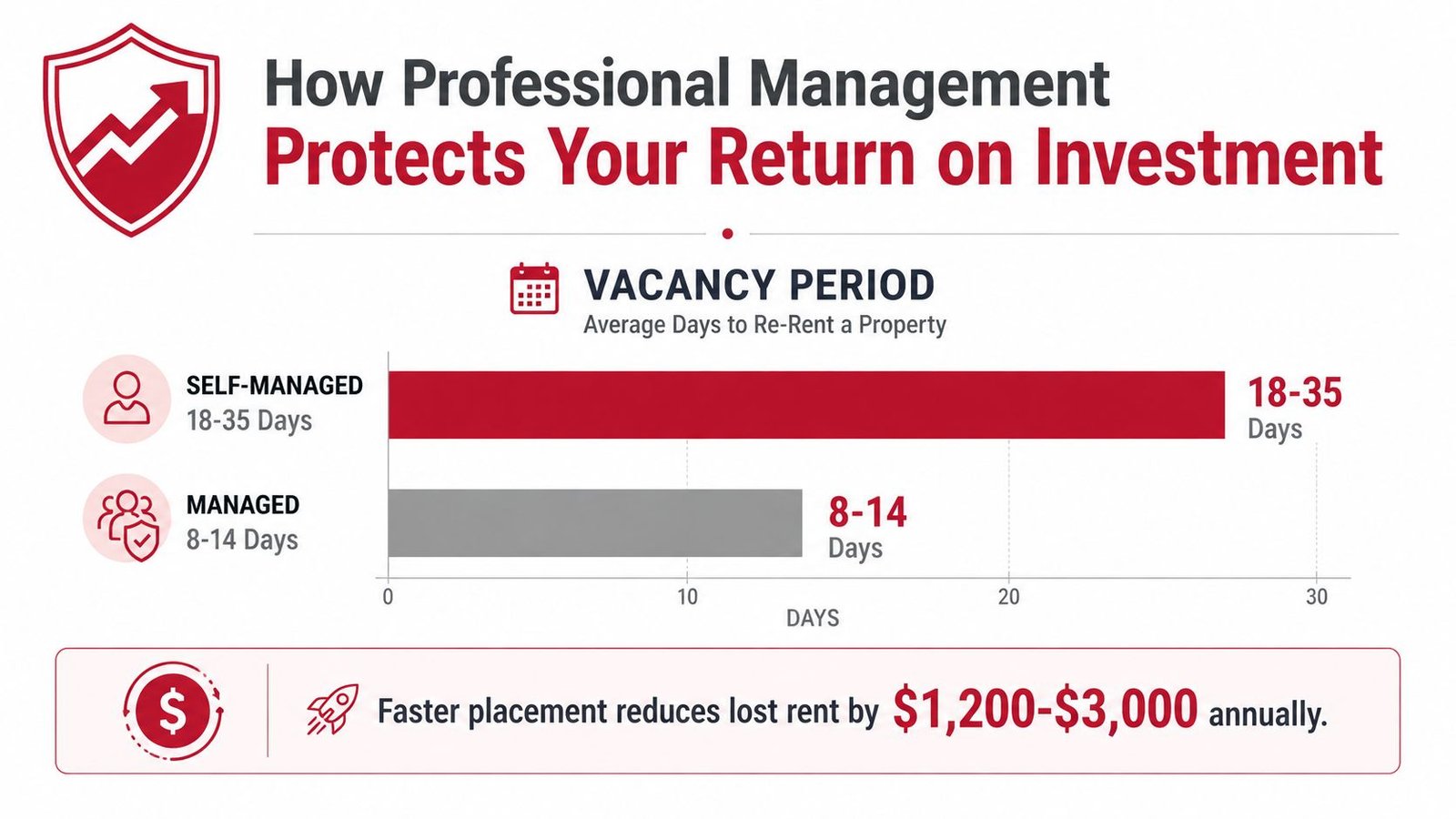
Alberta vacancy conditions vary by city and property type. CMHC-based reporting cited in Alberta market coverage places 2025 vacancy at 3.3% in Calgary and 3.4% in Edmonton, while a separate CMHC-based summary reports Calgary purpose-built vacancy at 5.0% in October 2025, compared with 1.4% in 2023, as new supply entered the market. The conflicting figures reflect different property definitions and measurement periods, so landlords should evaluate the exact submarket rather than rely on one citywide headline. See the regional discussion in Alberta rental market coverage.
The real ROI calculation
Owners should compare the fee against avoidable losses:
- Vacancy exposure: A manager who markets early and responds promptly may reduce the time a unit sits empty, but any promised performance should be supported by the firm's own records rather than assumed.
- Compliance exposure: Alberta landlords must keep premises in good repair and comply with building, health, fire, and safety standards under the provincial tenancy framework.
- Deposit disputes: Alberta guidance says normal wear and tear cannot be deducted from a security deposit, and condition reports help separate ordinary deterioration from tenant damage.
- Maintenance leakage: Clear approval thresholds, documented scopes, and vendor invoices can prevent small repairs from becoming uncontrolled projects.
- Owner time: Showings, arrears follow-up, notices, emergency calls, and contractor access all carry an opportunity cost, even when no invoice records the hours.
For remote owners, the value is operational control from a distance. For owners with several doors, it is consistency. A manager who handles rent collection, inspections, notices, maintenance records, and tenant communication through an organised process can make net income more predictable than a cheaper arrangement that leaves the owner reacting to problems.
Professional management is a risk-control expense first and a convenience expense second.
A landlord should ask for evidence of leasing timelines, maintenance approvals, inspection documentation, and owner reporting. If a company can't explain how its process protects occupancy and the asset, its fee is difficult to justify.
Evaluating Property Management Proposals Before You Sign
A proposal is an operating contract, not a sales brochure. A low percentage may cover only rent collection, while a higher fee may include leasing administration, inspections, compliance records, and maintenance oversight. Compare the full annual cost, especially for Alberta properties where one vacancy, placement fee, renewal charge, or repair markup can change cash flow.
Terms that belong in writing
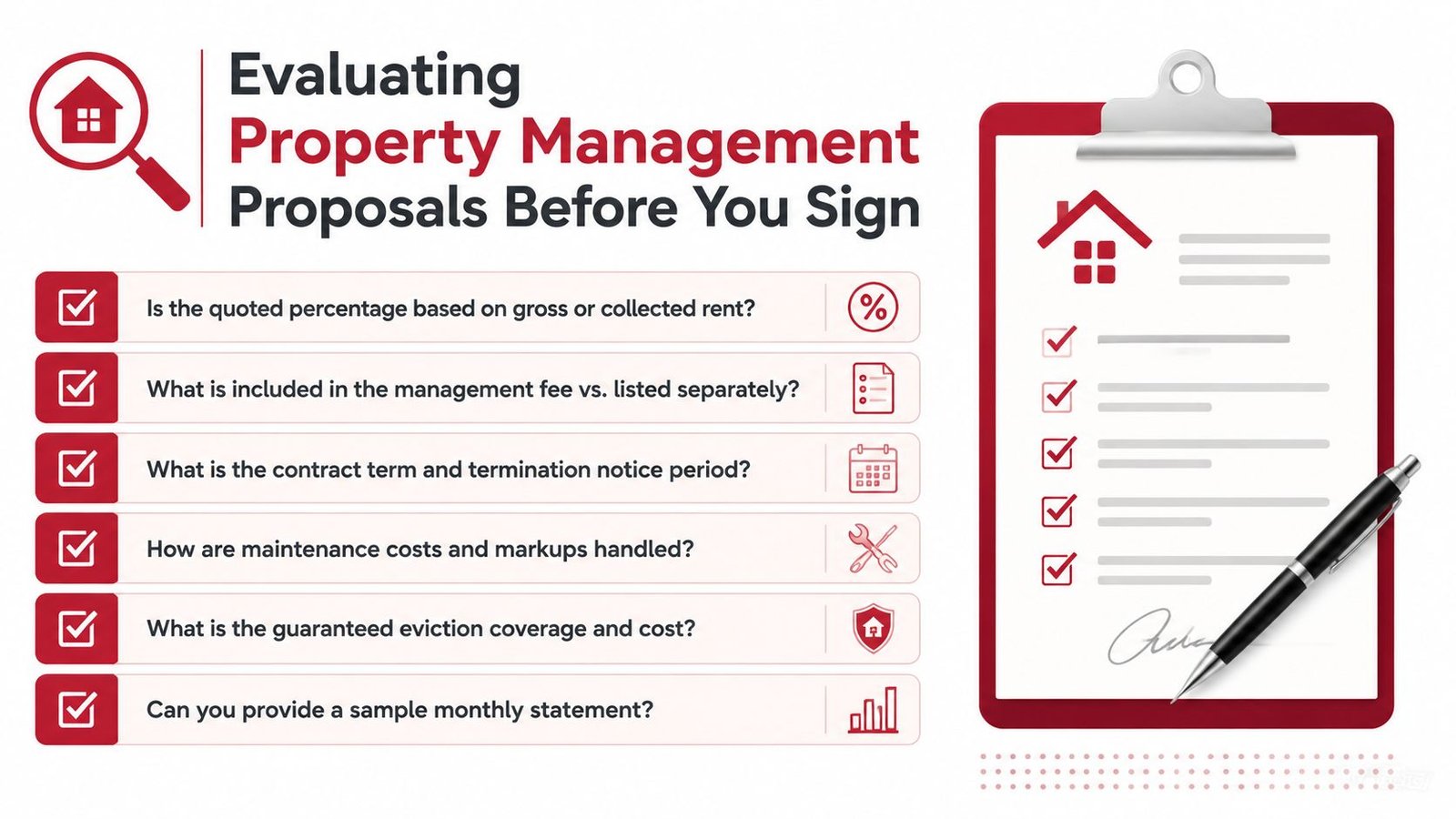
The fee basis must be clear. Confirm whether the percentage applies to gross rent, contracted rent, or rent collected. Also confirm whether the recurring charge continues during vacancy, since that cost affects a single-family home, condo, or small multifamily property differently.
Maintenance terms deserve close attention. Ask what markup or coordination charge applies, which vendors may be used, and where owner approval is required. A renewal may carry its own fee, so the proposal should state what work that charge covers.
Termination language matters too. The agreement should specify the required notice and any payment due if the owner ends it early. Request a sample monthly owner statement showing every possible charge, along with trust-account procedures, inspection templates, vendor-invoice examples, and the communication schedule. Alberta tenancy rules make recordkeeping and deposit handling operating responsibilities, not optional extras.
For a broader service comparison, use this property manager selection guide when checking references and asking process questions.
Red flags in the fine print
Define vague terms such as “administrative fees,” “additional services,” and “market-rate maintenance.” Automatic renewals longer than 12 months need scrutiny. So do undisclosed maintenance subsidiaries or affiliated vendors.
Build a blank annual statement for every candidate. Add the recurring fee, one expected placement, a renewal, routine inspections, likely repairs, and a vacancy sensitivity line. Compare the totals and service descriptions side by side. Transparent pricing does not guarantee perfect service, but evasive pricing makes budgeting unreliable.
Next Steps for Alberta Rental Property Owners
The headline percentage is only the starting point. A realistic property management company cost includes leasing, renewals, maintenance coordination, inspections, compliance administration, and the rent lost while a unit is vacant.
Three actions will produce a more useful answer than collecting advertised rates:
- Audit current cash flow. Use actual rent, turnover history, repair invoices, and owner time to build an annual baseline.
- Request itemised proposals. Obtain at least two local proposals and require each company to state its rent basis, vacancy policy, leasing charges, renewal fees, maintenance markups, inspection scope, and termination terms.
- Compare all-in costs. Judge the expected net return and operational risk, not the monthly percentage in isolation.
Alberta's rental market differs sharply between neighbourhoods and property types. A Calgary single-family home, an Edmonton condo, and a Lethbridge four-plex shouldn't receive the same fee analysis. The right manager is the one whose pricing and process protect occupancy, documentation, maintenance budgets, and compliance together.
Dreamhouse Realty Ltd. provides transparent rental management, tenant placement, inspections, rent collection, maintenance coordination, compliance oversight, and owner reporting for Calgary, Edmonton, Red Deer, and surrounding Alberta communities. Landlords can request a no-obligation fee breakdown for their property by visiting Dreamhouse Realty Ltd., or contact GURIQBAL CHAHAL, MBA, PMP, REAL ESTATE BROKER at 403-966-6072.