
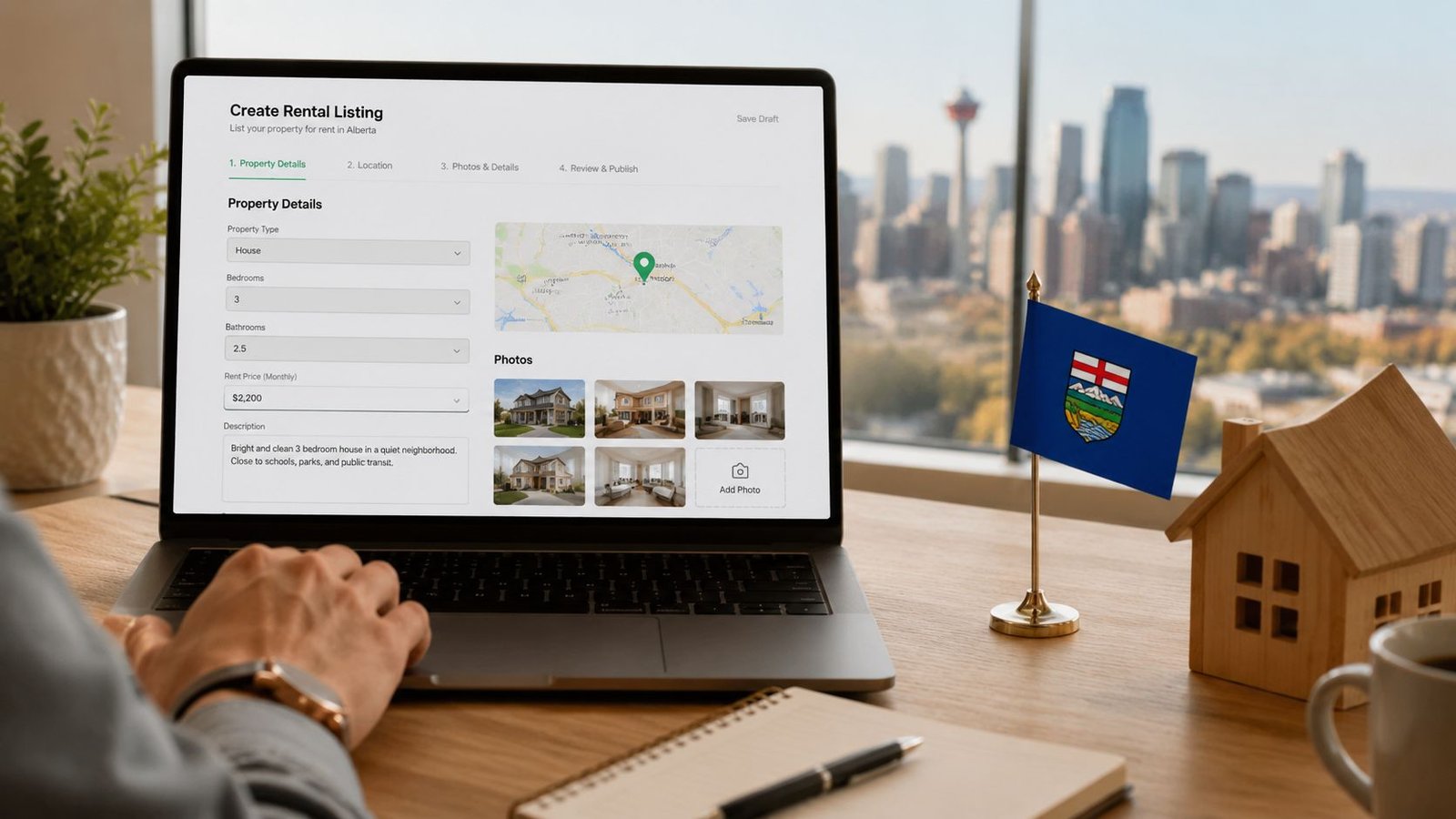
A Calgary landlord can have a clean, well-priced condo sitting vacant while weak classified ads attract little more than vague messages and missed appointments. In a market where Calgary's overall vacancy rate rose from 4.6% in 2024 to 5.1% in 2025, according to the City of Calgary housing trends data, distribution and execution matter as much as the property itself.
A properly handled MLS rental listing gives an owner access to an organised brokerage workflow, public REALTOR.ca exposure, structured property data, and professional inquiry management. It isn't a substitute for accurate pricing, strong photos, or fast responses. It is the foundation that lets those elements work together across Calgary, Edmonton, Red Deer, and other Alberta communities.
Table of Contents
- What an MLS Rental Listing Actually Is in Alberta
- Preparing the Property and the Listing Package
- Creating the MLS Listing Step by Step
- Syndication and Where Renters Actually See Your Listing
- Pricing and Optimization in a Loosening Calgary Market
- MLS Rentals Versus Classifieds and Rental Portals
- Compliance, Documentation, and Getting Your Listing Live
What an MLS Rental Listing Actually Is in Alberta
An MLS rental listing in Alberta is a structured property record entered by an eligible REALTOR® through an association's MLS® system for the purpose of advertising a lease. It isn't a for-sale listing with the price field changed. The broker selects a rental transaction type, completes rental-specific fields, uploads marketing material, and distributes the record through the association's approved public channels.
The Association of Edmonton's rental listing information explains that only members can upload rental listings to its MLS® System. Those listings are entered into Paragon in a workflow similar to for-sale listings, and renters can search them on REALTOR.ca by changing the transaction type to “For rent.” In Central Alberta, the Central Alberta REALTORS® Association also states that listing details and photos appear on its website and REALTOR.ca.
That structure matters because owners can't self-post into a board-operated MLS database. A landlord generally needs an eligible brokerage and a licensed REALTOR® to input, verify, market, and manage the listing. The arrangement creates a professional cost, but it also provides a controlled record with consistent fields, brokerage contact details, and a clearer route for showing coordination.
Why the Calgary vacancy context matters
CMHC reports a 5.0% purpose-built rental vacancy rate for the Calgary CMA in 2025, including 4.4% for one-bedroom units, 5.7% for two-bedroom units, and 4.4% for three-bedroom-plus units. Calgary condominiums in the secondary rental market were tighter, at 2.2% vacancy, according to the CMHC Rental Market Report.
CMHC continues to use 3% vacancy as a balanced-market benchmark, so the purpose-built figure indicates more competition for landlords than a balanced environment. Owners should therefore treat an MLS placement as part of a lease-up system, not as permission to price above comparable homes.
Landlords considering a broker should look for someone who understands rental-specific MLS workflows, not just sales marketing. A Calgary rental real estate agent can help connect the listing record to pricing, showings, screening, and lease execution.
Preparing the Property and the Listing Package
A broker can't rescue a property that looks unfinished online. Before entering Paragon, the landlord and broker should walk through the home as a renter would, starting at the front entrance and checking every detail that appears in photographs or affects the first showing.
Physical preparation comes first
The practical checklist usually includes:
- Deep cleaning: Kitchens, bathrooms, windows, appliances, baseboards, and flooring should be presented in move-in condition.
- Paint and repairs: Touch up marked walls, damaged trim, loose handles, dripping taps, and worn caulking.
- Exterior presentation: For houses and townhomes, deal with grass, snow, entry steps, fencing, and visible storage.
- Mechanical readiness: Arrange HVAC servicing where appropriate and replace burnt-out bulbs so the home photographs evenly.
- Decluttering: Remove personal items and excess furniture before the photographer arrives. Empty rooms can look smaller, but crowded rooms make measurements and circulation difficult to judge.
Photography magnifies flaws. A stained light switch or a dark hallway that seems minor in person can become the first impression on REALTOR.ca.
Build the evidence file
The owner should assemble the compliance certificate, current property tax assessment, condominium board rules where applicable, parking-stall and storage assignments, and any existing tenancy documentation. The broker may need title or tax information for verification, while the manager needs the documents later for accurate disclosures and lease administration.
The listing package should specify room-by-room measurements, included appliances, window coverings, utility responsibilities, lease-term flexibility, pet rules, and smoking restrictions. It should also state who pays water, heat, electricity, and internet. “Utilities negotiable” creates unnecessary questions and can make applicants worry about undisclosed costs.
The house leasing service information reflects the broader work required beyond publishing an advertisement, including preparation, applicant handling, and tenancy documentation.
Decide the presentation budget before photography
The landlord should choose whether the property needs staging, partial staging, or simple professional photography. That decision should be made before the appointment, along with access instructions, parking information, and the exact move-in costs the broker may publish.
The owner should also provide the intended monthly rent, deposit amount, earliest possession date, preferred lease term, showing restrictions, and contact for urgent questions. A complete package lets the REALTOR® write accurately instead of guessing, and accurate copy reduces the chance that a promising applicant withdraws after discovering missing costs or rules.
Creating the MLS Listing Step by Step
A Calgary REALTOR® begins by confirming authority and property details. Before entering the record, the brokerage should hold the landlord's signed MLS rental authorization and a copy of the title or current tax notice. This protects the owner and gives the brokerage a dependable basis for verifying the property.
The Paragon workflow
The listing process generally follows this sequence:
- Open the rental input form. The REALTOR® selects the correct property class and distinguishes among an apartment-style condominium, townhouse, and single-family rental. That classification affects search results and how the record displays.
- Enter the address and internal notes. Public remarks are written for renters. MLS-only notes hold showing instructions and other details for cooperating professionals, rather than the general public.
- Complete the filterable fields. Bedrooms, bathrooms, square footage, parking stalls, pet permission, lease term, and deposit amount must be accurate. Renters commonly narrow their searches using these fields.
- Write the public description. Lead with the strongest feature, then cover location, layout, included items, costs, rules, and possession details. Landlords seeking a useful writing framework can review proven MLS listing description examples. Accurate copy prevents promising applicants from withdrawing after discovering undisclosed costs or rules.
- Upload and order the photos. The first image should answer a renter's basic question about the home. The remaining photographs should follow a logical touring sequence.
- Set and publish the monthly rent. The broker records the price as monthly rent, confirms the listing term, and explains how an extension, cancellation, or price change will be handled.
A standard listing term may be 30 to 60 days, depending on the brokerage agreement and local practice. The agreement should spell out the services included, the fee, inquiry handling, showing arrangements, applicant screening, and the result if the property leases before the term ends.
How the public sees it
Once published, association systems distribute the listing to REALTOR.ca, where participating rental inventory can be searched through the “For rent” transaction type. Renters see the approved rental fields and the brokerage's contact route. Internal showing instructions remain restricted to the professional network.
Review the live record soon after publication. A wrong bathroom count, parking description, pet policy, or utility responsibility can attract unsuitable inquiries and weaken confidence before the first showing. Correcting those fields early is usually faster and cheaper than explaining them repeatedly to applicants.
Syndication and Where Renters Actually See Your Listing
A Calgary rental listing usually begins as a Paragon entry handled by a CREB-member brokerage. From there, approved data feeds can place the record in REALTOR.ca's rental search and expose it to other websites that receive or republish CREB rental data.

The distribution chain may include REALTOR.ca, RentFaster, Rentals.ca, Zumper, PadMapper, and rental meta-search services, although the exact display and availability depend on the receiving platform's feed arrangements. Typical transmitted information includes rent, bedrooms, bathrooms, address presentation, photographs, property details, and brokerage contact information. Some portals mask the full address, truncate remarks, omit fields, or reorder photographs.
Calgary coverage has boundaries
A CREB-member brokerage can place a Calgary listing into the relevant board workflow, but a rental entered outside CREB coverage doesn't necessarily behave the same way. Properties in surrounding communities such as Airdrie or Cochrane may follow different association and syndication arrangements, so the owner should ask the listing REALTOR® exactly where the record will appear.
Showing requests also tend to route through the brokerage rather than directly to the landlord. Depending on the brokerage's systems, booking may involve ShowingTime or CENTRIS-linked tools. The phone number and email displayed on the listing become the inquiry funnel, which is useful only if someone answers promptly and can provide consistent information.
The Calgary house rental market requires more than broad exposure. In a 5.0% purpose-built vacancy environment, MLS visibility can produce reach, but weak pricing, slow replies, or poor presentation can still leave a home sitting. The useful operating measures are inquiry quality, showing attendance, application volume, and the reasons qualified prospects decline.
Practical rule: Wide syndication increases the number of opportunities. It doesn't remove the landlord's responsibility to make the listing credible and easy to act on.
A broker should monitor the listing after launch, correct feed errors, refresh stale remarks when appropriate, and report which channels produce serious applicants. Owners pay for distribution only when the team follows through after the listing goes live.
Pricing and Optimization in a Loosening Calgary Market
A landlord can lose the strongest launch period by pricing from the mortgage payment instead of current rental evidence. Asking rent should come from comparable properties, adjusted for condition, building type, bedroom count, parking, outdoor space, location, and any concession. Calgary's 2025 vacancy context, noted earlier, calls for tighter pricing discipline than a balanced market.
Compare the property that exists, not the property the owner remembers
Pull recent rentals that a prospective tenant would compare. Separate purpose-built apartments from condominium rentals, and distinguish a dated unit from one with updated finishes, in-suite laundry, parking, or a better view. A neighbour's older lease is background information, not a pricing recommendation.
Calculate the tenant's effective benefit when a landlord offers free rent, reduced parking charges, included utilities, or flexible possession. For example, a $2,400 asking rent with one month free over a 12-month term produces a lower effective monthly cost than the headline suggests. The listing should make that trade-off clear rather than hiding it in the remarks.
A useful rent-to-value check can expose unrealistic expectations. If a property worth $600,000 rents for $2,400 monthly, the annual gross rent is $28,800 before expenses. That figure is not a valuation method, but it helps an owner compare the rental return with carrying costs and competing investment options without treating the mortgage payment as market rent.
Use presentation to support the price
Professional photography, a usable floorplan, a virtual tour, a video walkthrough, and 3D Matterport can answer questions before a showing. The headline should name the neighbourhood and lead with the strongest feature. Remarks should state parking, utilities, pet rules, possession, and deposit information plainly.
A 7-day review cycle is a management habit, not a promise of a result. Review inquiry quality, showing attendance, application volume, and the reasons qualified prospects decline. If traffic is weak, check the price, first photograph, copy, showing availability, and competing inventory before changing the strategy.
| Pricing check | What to examine | Practical decision |
|---|---|---|
| Comparable rent | Similar building, layout, condition, and location | Set a defensible asking range |
| Effective rent | Free rent, parking discounts, utilities, or other concessions | Compare the real tenant cost |
| Listing response | Qualified inquiries, showings, and applications | Identify whether price or presentation is limiting demand |
| Owner economics | Gross rent against carrying costs and property value | Set expectations without forcing the market price |
Calgary market conditions can shift quickly, so the asking price should be reviewed against fresh competing inventory rather than left unchanged out of habit. A small, evidence-based adjustment can create more qualified activity than adding another generic advertisement. The City of Calgary housing trends page provides broader local context for that review.
MLS Rentals Versus Classifieds and Rental Portals
MLS works best as part of a layered Calgary marketing plan. It can provide a structured record, brokerage handling, REALTOR.ca rental exposure, and a professional route for showings and applications. It won't automatically make an unsuitable price attractive, and it doesn't replace rental-focused platforms that may produce high local search volume.
| Channel | Reach | Landlord Cost | Tenant Screening | Best For |
|---|---|---|---|---|
| MLS rental listing | Brokerage and REALTOR.ca distribution, with possible downstream portal exposure | Brokerage or listing fee under the service agreement | Often available through the brokerage process | Owners wanting structured exposure and managed inquiries |
| Kijiji | Broad classified audience with variable inquiry quality | Usually low or free posting options | Landlord-managed | Private landlords comfortable handling noise and verification |
| Facebook Marketplace | Casual local audience and fast-moving posts | Usually low or free posting options | Landlord-managed | Owners who can respond quickly and screen carefully |
| RentFaster | Calgary-focused rental audience | Paid options may apply | Landlord or manager-managed | Rental-specific local exposure |
| Rentals.ca | National rental audience | Platform terms apply | Landlord or manager-managed | Additional portal distribution |
Kijiji and Facebook Marketplace can produce volume, but the landlord must handle identity checks, fraud awareness, screening, and appointment coordination. Listings can disappear quickly or attract applicants who haven't read the conditions. Free placement saves advertising spend, but it shifts more administrative work to the owner.
RentFaster is often a natural fit for Calgary rental searches because it is designed around rentals and accommodates private landlords. Rentals.ca can add broader exposure, while MLS creates a professional anchor that supports consistent property information and brokerage-led contact. The most sensible mix depends on the home, price point, and the owner's capacity to manage inquiries.
Compliance travels with the process
A listing channel doesn't remove Alberta tenancy obligations. The security deposit, tenancy agreement, applicant information, inspection records, and advertising statements still need to align. An owner who posts everywhere but gives different utility or pet information on each channel creates avoidable disputes.
The Alberta security deposit guidance states that a security deposit can't exceed one month's rent at the start of the tenancy and can't later be increased because the rent rises. That rule applies whether the tenant first saw the home on MLS, Facebook, or a classified website.
Compliance, Documentation, and Getting Your Listing Live
A fast lease-up is useful only if the documentation is correct. Alberta landlords must treat the rental listing, tenancy agreement, deposit handling, inspections, and advertising statements as one connected record. Information published in Paragon should match the documents the tenant receives, including rent, included services, smoking terms, pet conditions, parking, and possession details.
Deposit administration needs a process
Alberta requires landlords to place security deposits in an interest-bearing trust account in Alberta within two banking days of collecting them. The provincial security deposit interest-rate guidance states that the prescribed interest rate is 0% effective January 1, 2026, and landlords must pay the prescribed interest at the end of each tenancy year unless both parties agree otherwise.
The deposit remains capped at one month's rent, as described in the earlier compliance discussion. Landlords should record the amount received, date collected, account handling, tenant details, and eventual disposition instead of relying on memory or informal messages.
Inspections protect both sides
Move-in and move-out inspections should document the condition of the premises in detail, with photographs where useful. Alberta guidance instructs landlords to retain security deposit records for at least three years after the tenancy ends, and explains that tenants may recover the deposit with interest when there is no damage beyond normal wear and tear and the premises were properly cleaned. The Alberta landlord information guide supports the need for organised records and inspection documentation.
A landlord or manager should have the tenancy agreement, inspection forms, deposit instructions, property rules, and disclosure information ready before showings begin. Tools that help teams automate MLS compliance with AI may assist with checking fields and consistency, but a licensed professional still needs to review the final record and ensure it reflects the actual tenancy terms.
A realistic lease-up sequence
The first stage is preparation, including repairs, documents, photography, pricing, and signed authorization. The next stage is MLS entry and public distribution. Portal pickup can take 24 to 48 hours, depending on the receiving platform and feed process, so the landlord shouldn't judge performance before confirming that the listing displays correctly.
During the following weeks, the broker should track inquiries, showings, applications, objections, and competing listings. If serious prospects aren't progressing, the response should be specific. The team may need to correct a missing field, clarify costs, improve access, revise the price, or change the presentation rather than reposting the same advertisement.
By the end of a 30-day lease-up timeline, the owner should have a documented record of exposure, traffic quality, showings, feedback, and pricing decisions. For owners who want one team to coordinate MLS placement, advertising, showings, screening, lease documents, and Alberta compliance, Dreamhouse Realty Ltd. offers those rental management and tenant-placement services across Calgary and other Alberta communities.
Calgary landlords can contact GURIQBAL CHAHAL, MBA, PMP, REAL ESTATE BROKER at 403-966-6072 for help preparing and placing an MLS rental listing, coordinating tenant inquiries, and managing the lease-up process. Visit Dreamhouse Realty Ltd. to request a rental consultation and discuss the property's pricing, marketing, screening, and documentation needs.