A tenant sends a late-night message about water near the furnace room. The owner is out of province, the property manager is trying to reach a contractor, and the only record is a short text thread. By the time the repair is finished, important details are scattered across a phone, an email inbox, and an invoice that doesn't identify the unit clearly.
That arrangement may feel efficient while the repair is active. It becomes a liability when an owner needs to prove when notice was given, who approved the work, whether the tenant received entry notice, and how the final cost was calculated. In Alberta, a maintenance work order template should function as a repair-control document and a dispute record, not merely a note for a tradesperson.
Table of Contents
- Why a Maintenance Work Order Template Matters in Alberta
- Core Header Fields Every Template Should Capture
- Repair Categories and Who Is Responsible by Default
- Routine vs Emergency Versions of the Template
- Documenting Approvals, Access, and Evidence
- Approval Workflows and Spending Thresholds
- Capturing Labour, Parts, and Total Costs
- Filling Out the Template From Request to Close-Out
- How the Template Supports Alberta Compliance and Disputes
- Digital Tools Versus Paper for Alberta Landlords
- Quick-Reference Checklist for Work Order Records
Why a Maintenance Work Order Template Matters in Alberta
A Calgary landlord in Forest Lawn once faced a familiar problem after a sump pump issue. The repair had been discussed in a text thread, but the record contained no dependable timestamps, tenant acknowledgement, photographs, or invoice trail. When the tenant raised a counterclaim at the Residential Tenancy Dispute Resolution Service, the landlord couldn't demonstrate clearly when the problem was reported, how quickly action followed, or whether the claimed costs were properly supported.
The problem wasn't a lack of effort. The problem was a weak record.
Alberta tenant guidance recommends that repair and maintenance documentation be written, dated, and retained, including requests, acknowledgements, phone-call outcomes, photographs, and receipts. It also recommends retaining photographs, videos, and receipts for at least one year after the tenancy ends where no dispute exists, or longer where a dispute remains active, as outlined in Alberta guidance on documenting unit condition.
A separate Alberta retention requirement matters for inspection-linked records. The RTA Handbook says landlords must provide tenants with a copy of the inspection report at the end of the inspection and keep a copy on file for at least three years after the tenancy ends. A closed work order connected to an inspection should therefore preserve its inspection reference, completion date, and supporting evidence.
Practical rule: A work order should allow a third party to reconstruct the repair without relying on anyone's memory.
A generic North American form often captures only the fault, assigned contractor, and status. An Alberta-ready version must also show notice, access, responsibility, response, evidence, and close-out. That is why the form matters to Calgary, Edmonton, Red Deer, and remote owners alike.
Core Header Fields Every Template Should Capture
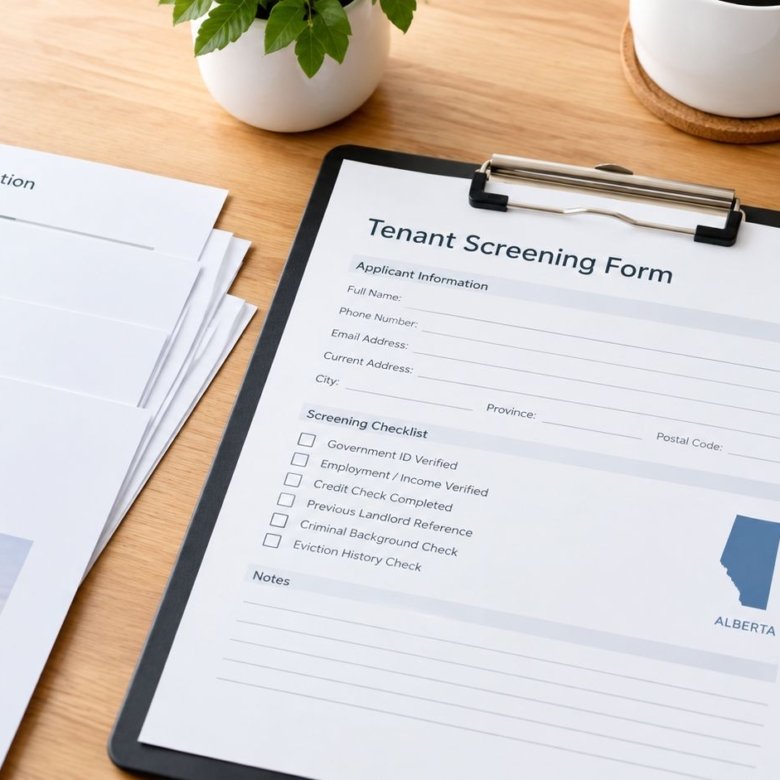
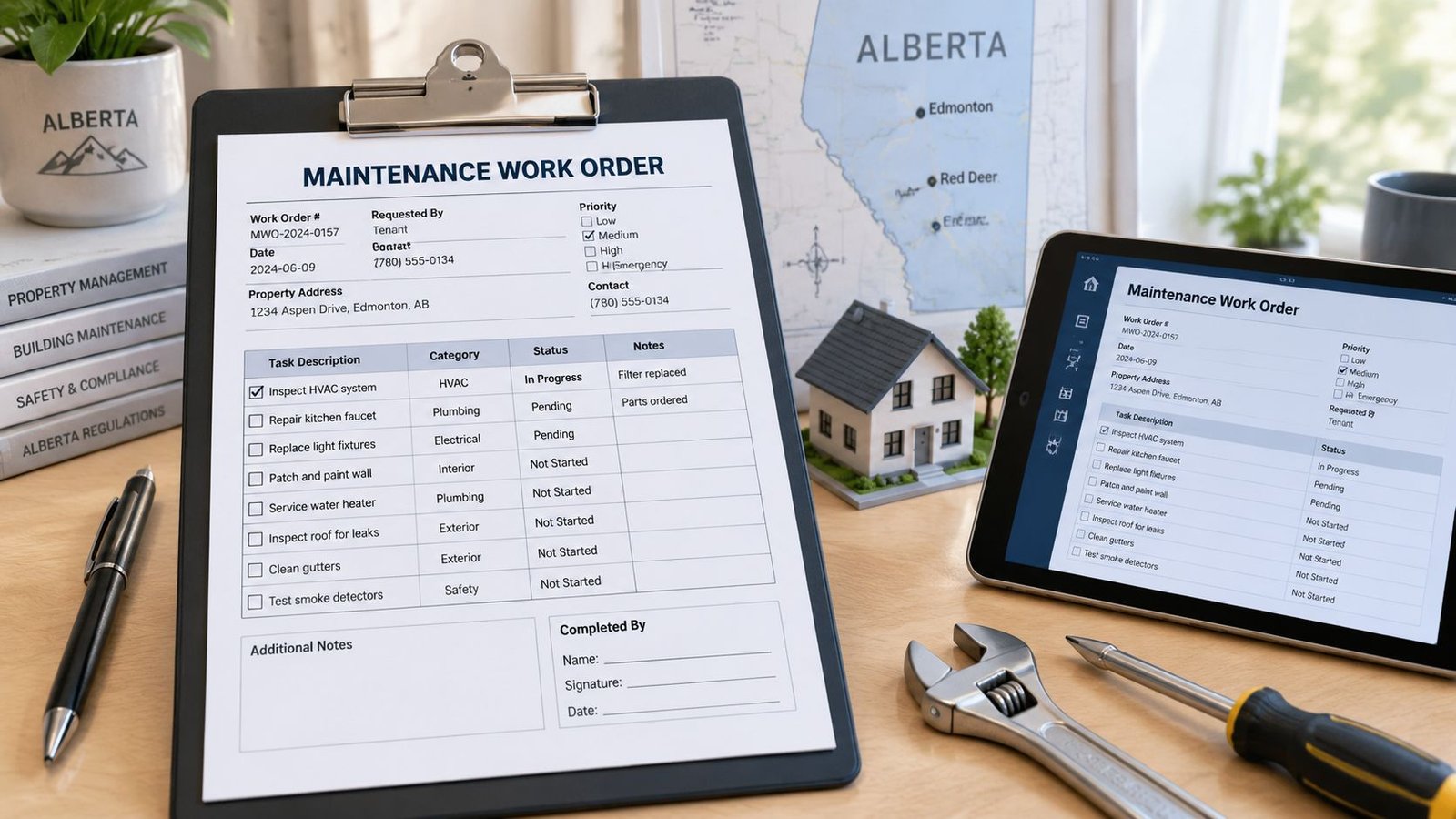
The header should answer the basic questions before anyone opens a toolbox: which property, which tenant, which issue, and which record. A clean identifier also prevents an invoice, photograph, or contractor note from being attached to the wrong unit during an RTDRS matter.
Start with identity and notice
The first block should include:
- Work order number: Use a unique identifier that appears on every email, invoice, photograph folder, and approval.
- Property and unit: Record the complete address, unit number, building name where relevant, and owner or landlord entity.
- Tenant information: Include the tenant's name, preferred contact method, and authorised occupants. This makes later access questions easier to resolve.
- Reported date and time: Capture when the request was received, not merely when staff entered it into a system.
- Access window: Record the times the tenant offered or approved for entry, along with any restrictions.
- Category tag: Route the request to plumbing, HVAC, appliance, structural, electrical, or interior maintenance.
The issue description should preserve the tenant's own wording. A paraphrase such as “minor plumbing concern” can conceal the difference between a drip and active water loss. Include a separate manager assessment so the original report remains distinct from the professional triage.
Add the fields that control risk
The priority flag should state why the ticket is routine, urgent, or emergency. The record should also include the applicable response target, the landlord's approval limit, and a link to the move-in condition report. These fields connect the repair to the tenancy timeline and baseline condition.
Landlords building a broader documentation system can also find project documentation templates for related records, but the maintenance form still needs Alberta-specific tenancy fields. A project document that lacks access notice, tenant communication, and condition-report linkage won't carry the same evidentiary value.
Repair Categories and Who Is Responsible by Default
Responsibility shouldn't be guessed at dispatch. Alberta guidance says the tenancy agreement should identify repair duties, and the default allocation generally places building structure, plumbing, wiring, heating and air conditioning where applicable, and landlord-provided appliances with the landlord. The RTA Handbook also distinguishes common areas and the inside of the premises where the agreement doesn't provide another allocation.
The template should include a responsibility tag at intake, with a reasoned override field. That keeps the first decision visible instead of allowing the charge to change after the invoice arrives.
| System Category | Examples | Default Responsibility | Notes for Template |
|---|---|---|---|
| Structural | Roof leak, window failure, wall, ceiling, floor, or exterior envelope issue | Landlord | Record the affected building element and any habitability concern. |
| Plumbing | Supply lines, fixtures, shutoff valves, drainage, or sewer-related work | Usually landlord | Identify the location of the failure. If tenant-caused damage is alleged, document the facts rather than assuming liability. |
| HVAC | Furnace, heating controls, hot water equipment, air conditioning, and ductwork | Landlord where supplied | Record the system asset and whether the issue affects safe or habitable conditions. |
| Appliances | Landlord-supplied fridge, stove, dishwasher, or similar equipment | Landlord unless the agreement states otherwise | Attach the appliance identifier, diagnosis, and warranty information. |
| Interior upkeep | Minor scuffs, tenant-supplied bulbs, blinds, or damage caused by occupants | May be tenant responsibility | Link any charge to photographs, the agreement, and the condition record. |
A chargeable-damage flag shouldn't become a conclusion by default. It should identify the person responsible under the agreement and Alberta's default rules, then require written justification when the manager assigns a cost to the tenant.
Routine vs Emergency Versions of the Template
Routine and emergency work orders shouldn't be identical. A scheduled repair needs orderly access planning, while an active leak or hazardous condition requires the record to show why normal sequencing changed.
Alberta guidance protects the tenant's peaceful enjoyment, so routine entry should record the notice method, date, and proposed visit window. The ordinary version should also show the vendor dispatch time, appointment confirmation, estimated scope, and any tenant rescheduling.
An emergency version needs an additional access rationale. It should identify the condition, the person who classified it, the time of that decision, the after-hours approver, and the immediate measure taken to reduce risk. Emergency status doesn't remove the need to record communication, cost, scope, or completion evidence.
Conditions that should trigger escalation
A ticket should be reviewed urgently where it involves:
- Active water loss: Water is escaping or causing continuing property damage.
- Loss of heat: The unit has no heat and indoor conditions may create a safety or habitability concern.
- Sewage backup: Wastewater is entering or threatening the premises.
- Gas smell: Occupants may face an immediate safety hazard.
- Electrical danger: Burning odour, sparking, exposed conductors, or another serious electrical concern appears.
- Security breach: A failed lock, broken exterior door, or similar issue leaves the unit unsecured.
The form should record the exact time and decision-maker for the upgrade. A later reviewer needs to see not only that the contractor attended, but why the landlord treated the job differently from a routine request.
| Template Field | Routine Version | Emergency Version |
|---|---|---|
| Priority | Scheduled or standard | Immediate risk classification |
| Entry | Notice method and agreed window | Access justification and emergency contact record |
| Approval | Normal owner or manager route | After-hours authority and pre-authorised limit |
| Dispatch | Standard vendor booking | Immediate vendor call and arrival log |
| Closure | Completion date and follow-up | Same-day mitigation, final scope, and outstanding risk |
Documenting Approvals, Access, and Evidence
A closed order is only as strong as its attachments. The record should contain the tenant's written report, or a transcript or contemporaneous note of a voicemail, with the original date and time preserved. It should also include the entry notice, delivery method, vendor invoice, warranty terms, and any tenant acknowledgement of access or completion.
Photographs should show both the problem and the repaired condition. Original files are preferable to screenshots because metadata can help establish when and where the image was captured. A photo alone doesn't prove the repair scope, so it belongs beside the contractor's diagnosis and completion notes.
Build one retrievable audit packet
Each work order folder should contain:
- Request evidence: Original email, portal submission, text export, or voicemail record.
- Access evidence: Entry notice, delivery confirmation, tenant permission, or emergency-entry explanation.
- Repair evidence: Before-and-after photographs, contractor notes, test results, and follow-up requirements.
- Financial evidence: Quote, approval, invoice, tax detail, warranty, and payment record.
- Condition evidence: A direct link to the move-in or move-out condition report, with the relevant item identified.
The file structure should be consistent across every property. A practical arrangement is property, unit, year, work-order number, then attachments. Remote owners and managers shouldn't need to search a personal phone or a vendor's separate portal to assemble the record.
Inspection documentation deserves its own cross-reference. The Alberta move-out inspection guidance can sit alongside the work-order process, but the closed order should still identify the precise inspection record it supports. Keep the retention marker visible so staff don't delete the packet simply because the repair has been paid.
Approval Workflows and Spending Thresholds
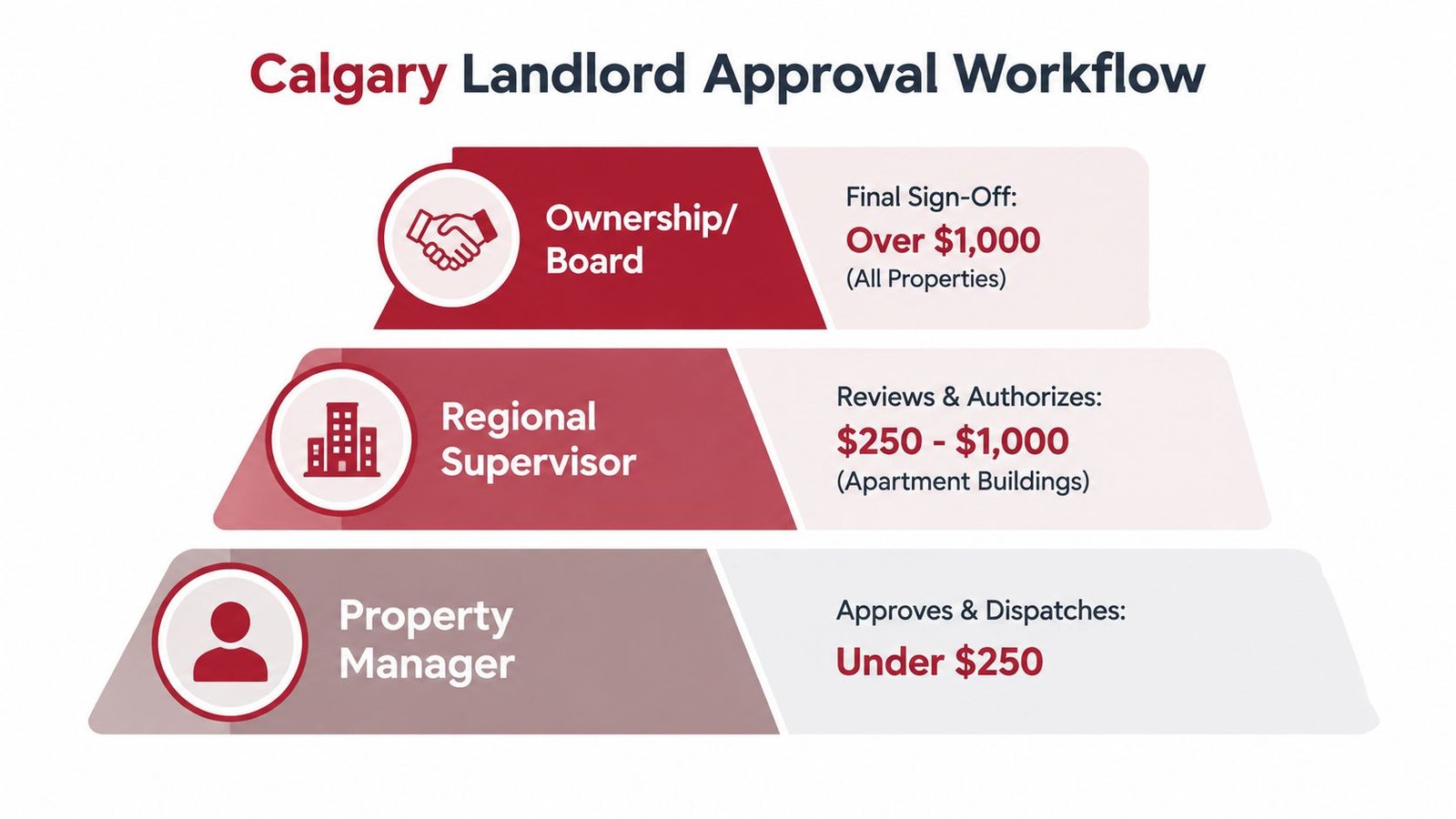
Approval rules should be written before a crisis, not negotiated while water is running through a ceiling. A practical Calgary workflow can use a tiered ladder, provided the owner sets the limits in writing and the manager records every exception.
- Under $250: The property manager approves and dispatches a trusted vendor within the manager's authority.
- From $250 to $1,000: The owner receives notification within 24 hours, and non-emergency work carries a documented quote.
- Over $1,000: Written owner approval is required before work begins, unless an emergency falls within a pre-authorised cap.
- Emergency authority: A landlord may establish a pre-authorised after-hours cap, commonly $1,500 for plumbing or HVAC emergencies, but the amount and decision-maker should appear in the management agreement or approval policy.
The thresholds should be treated as workflow examples, not a substitute for the owner's written instruction. A condo form should add a corporation-approval field, identify any building manager, and show whether the cost relates to a reserve-fund contribution or a unit expense.
Tenant-chargeable work requires a separate evidence path. The order should state why the cost is being assigned to the tenant, preserve the tenant's acknowledgement where available, and connect any proposed deduction to the relevant condition-report entry and tenancy documentation.
Approval rule: When the wall is about to be opened, the approval should already be in writing unless a documented emergency authority applies.
Capturing Labour, Parts, and Total Costs
The cost block should make the invoice understandable without a calculator, email chain, or verbal explanation. Labour belongs on its own rows, with hours and rate separated. Parts should show description, quantity, unit cost, and any markup. Tax, travel, disposal, and tenant chargeback should never be buried in one “total repair” field.
A worked example illustrates the structure. A Calgary emergency plumbing visit involves 2.5 hours at $95 per hour, a $46 fill valve, and a $12 supply line. The subtotal before GST is $295.50, and GST should be calculated and displayed as its own line rather than folded invisibly into the total.
| Line Item | Detail | Amount |
|---|---|---|
| Labour | 2.5 hours at $95 per hour | $237.50 |
| Fill valve | One unit | $46.00 |
| Supply line | One unit | $12.00 |
| Subtotal before GST | Labour plus parts | $295.50 |
| GST | Applied to the taxable subtotal | Record the invoice amount |
| Vendor markup | State the rate or amount separately where applicable | Record the invoice amount |
| Final total | Subtotal, GST, and approved additional charges | Record the invoice total |
The original vendor invoice should be attached without alteration. If the vendor uses a markup, the invoice or work order should identify how it was calculated. A tenant charge should reference the specific move-in condition report line and the documented cause, not the amount the vendor happened to bill.
Filling Out the Template From Request to Close-Out
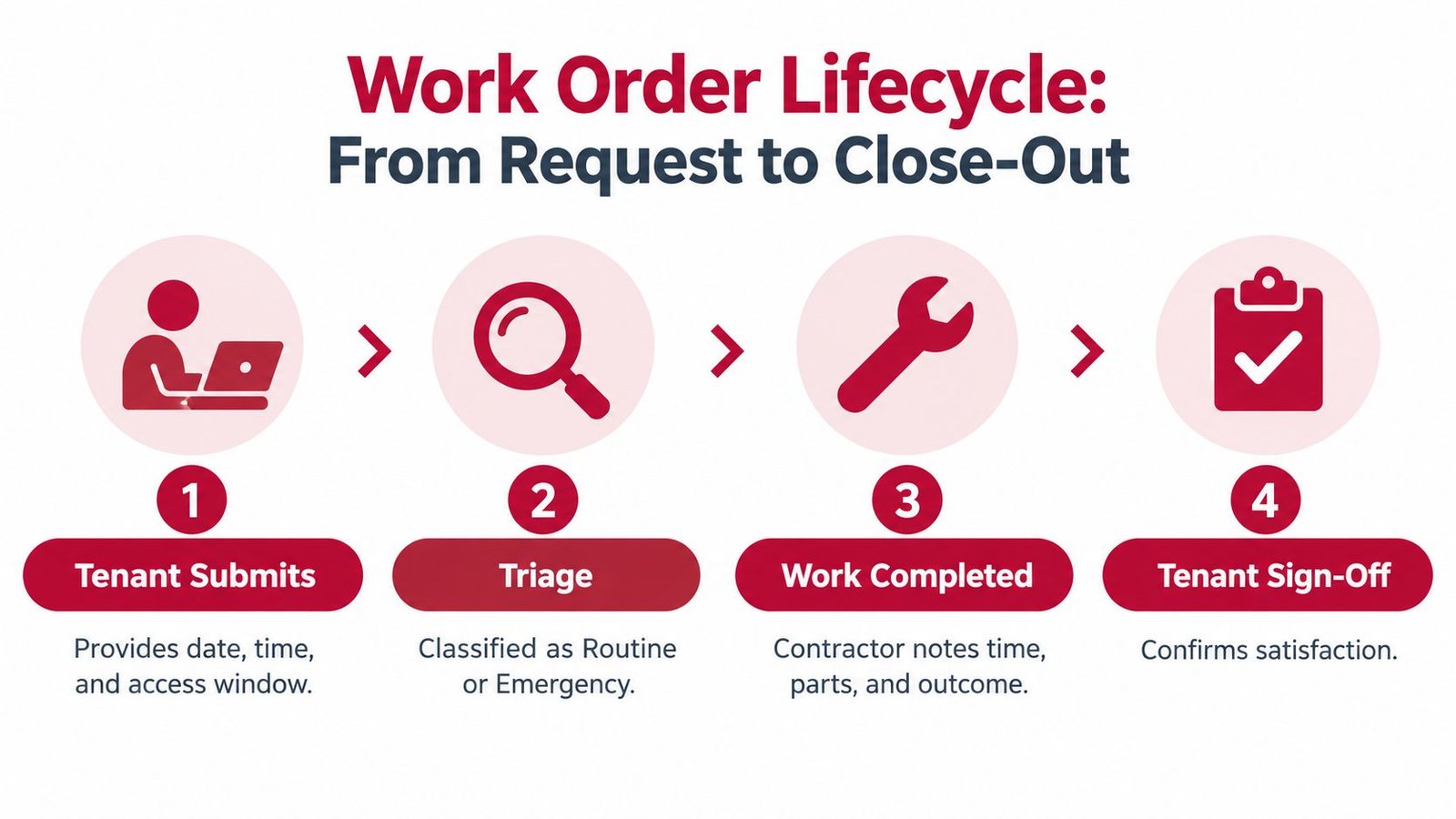
A work order should move in a fixed sequence, even when the repair itself is messy. The following lifecycle keeps the administrative record aligned with the actual job.
- Tenant submits the request. Record the tenant's words, date, time, photographs, contact method, and access window. Preserve the original submission rather than replacing it with a summary.
- Manager triages the issue. Classify the request as routine or emergency, identify the system category, assign responsibility, and record who made the decision.
- Vendor receives the dispatch. Enter the vendor name, instructions, access details, dispatch time, arrival time, and any safety information.
- Technician diagnoses the problem. The contractor should state the cause, recommended scope, parts, labour, and whether the proposed work differs from the approved instruction.
- Approval is updated if scope changes. A quote that crosses the owner's limit needs a documented approval or a recorded emergency exception before additional work proceeds.
- Completion is recorded. Enter the actual labour, parts, invoice, warranty, repair result, and any recurring or follow-up issue.
- Tenant signs the work order. The tenant should confirm access and completion on the order itself where practical, rather than relying only on a separate satisfaction form.
- Manager closes and files the packet. Add final photographs, approval records, invoice, condition-report link, and retention marker to the unit file.
The distinction between completed work and provable work is easy to lose during a busy repair cycle. A resource on work done vs work provable tracking is useful for teams designing close-out controls, especially where contractors work remotely from the owner or manager.
How the Template Supports Alberta Compliance and Disputes
Alberta landlords must keep rental premises habitable at the beginning and throughout the tenancy, with habitability connected to the Minimum Housing and Health Standards under the Public Health Act and Housing Regulation. Landlords must also respect peaceful enjoyment, except where entry is needed for legitimate landlord business.
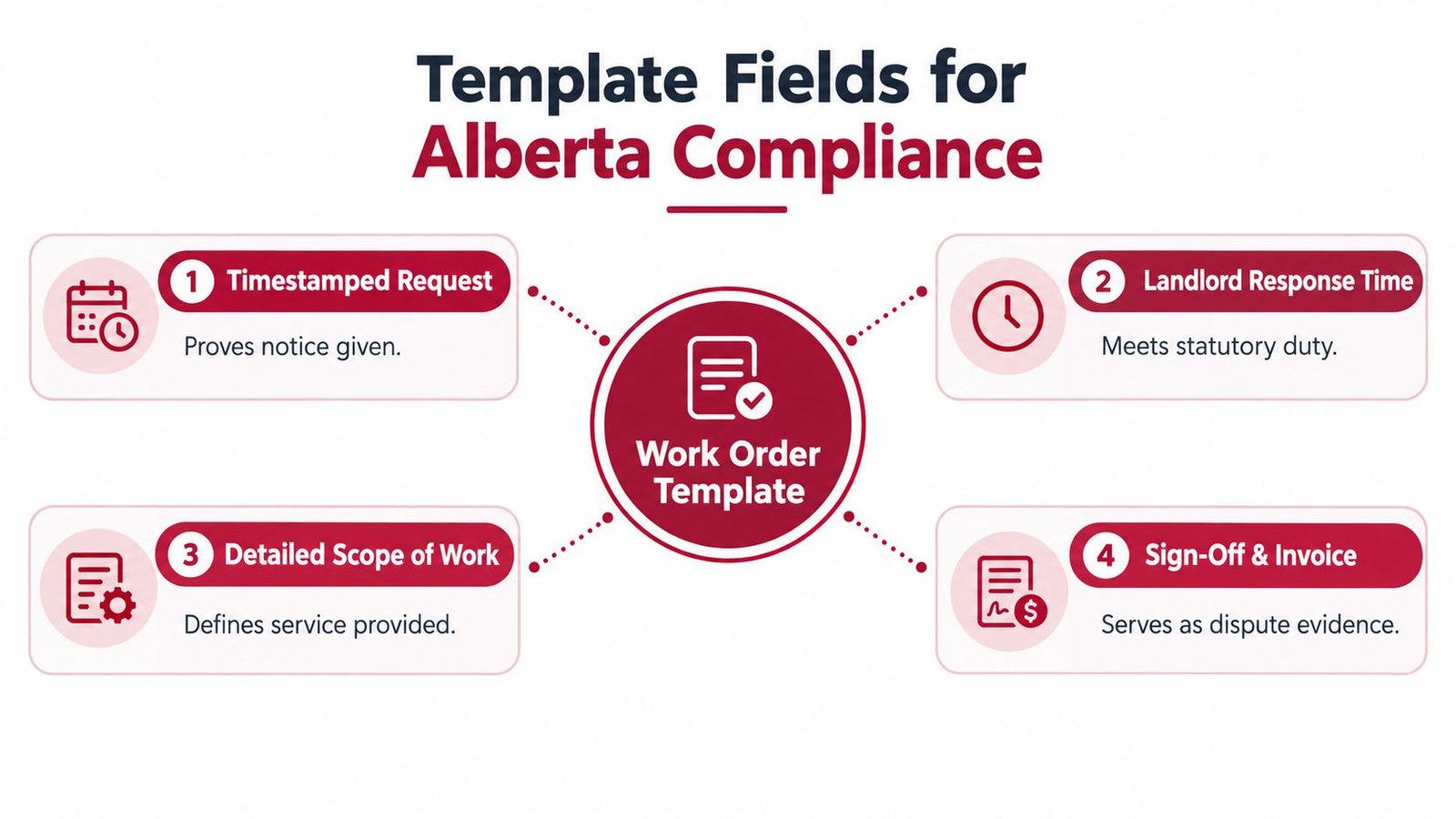
Those duties translate directly into form fields. A dated tenant request establishes notice. Acknowledgement and dispatch timestamps show the response. Priority and triage notes explain why a repair received emergency treatment or a scheduled appointment. Entry notice and access records demonstrate that the repair process didn't ignore the tenant's rights.
Each field should answer an adjudicator's question
- Timestamped request: When did the landlord receive notice?
- Landlord response time: What action followed, and when?
- Detailed scope: What did the contractor inspect and repair?
- Before-and-after photographs: What condition existed before the work, and what changed?
- Approval trail: Who authorised the cost and under what authority?
- Invoice and payment record: Is the amount supported by a genuine vendor document?
- Tenant sign-off: Did the tenant provide access and acknowledge completion?
- Inspection linkage: Was the issue pre-existing, newly caused, or unrelated to the condition baseline?
RTDRS disputes rely on records and supporting evidence, not on a generic form in isolation. The form becomes useful because it connects otherwise separate documents into one chronology.
A defensible work order doesn't prove every allegation automatically. It gives the decision-maker a coherent record to assess.
Landlords who need a consolidated reference should keep the Alberta RTA Handbook available alongside their internal maintenance policy. The template should support the legal duties, not pretend to replace the tenancy agreement, statutory guidance, or professional advice.
Digital Tools Versus Paper for Alberta Landlords
A shared spreadsheet looks like a maintenance system until someone needs the history. Spreadsheet users often lose edit history, compress or detach photographs, store files on one device, and overwrite the original request with a cleaner summary. Those weaknesses become serious when a remote owner needs the complete file during an after-hours furnace failure or a deposit dispute.
Paper has a different strength. A labelled folder is simple, visible, and less vulnerable to accidental overwriting. It becomes difficult when several people need access, photographs arrive by phone, contractors submit electronic invoices, or the owner lives outside Alberta.
| Capability | Paper Folder | Shared Spreadsheet | Maintenance Work Order Template |
|---|---|---|---|
| Original request preservation | Strong if printed promptly | Often weak if text is retyped | Strong when uploads and source messages are retained |
| Edit history | Limited | Depends on platform settings | Built into a controlled workflow where configured |
| Photo management | Physical prints or separate storage | Links can break or become disorganised | Attachments remain associated with the order |
| Remote access | Slow and location-dependent | Convenient but fragmented | Centralised access for authorised users |
| Approval record | Handwritten or attached email | Easy to overwrite or bury | Dedicated approval status, limit, and authorisation fields |
| Retrieval during a dispute | Manual search | Searchable but inconsistent | Indexed by property, unit, order, and status |
A spreadsheet can remain useful as a reporting layer, but it shouldn't be the only evidence repository. The relevant question isn't whether the tool is digital. It's whether the record preserves who changed what, when the request arrived, which files belong to it, and who approved the expense.
A Calgary landlord's system needs review if timestamps are missing, version history is unavailable, or photographs exist only on a contractor's phone. Those are signs that the system records activity, but may not preserve proof.
Quick-Reference Checklist for Work Order Records
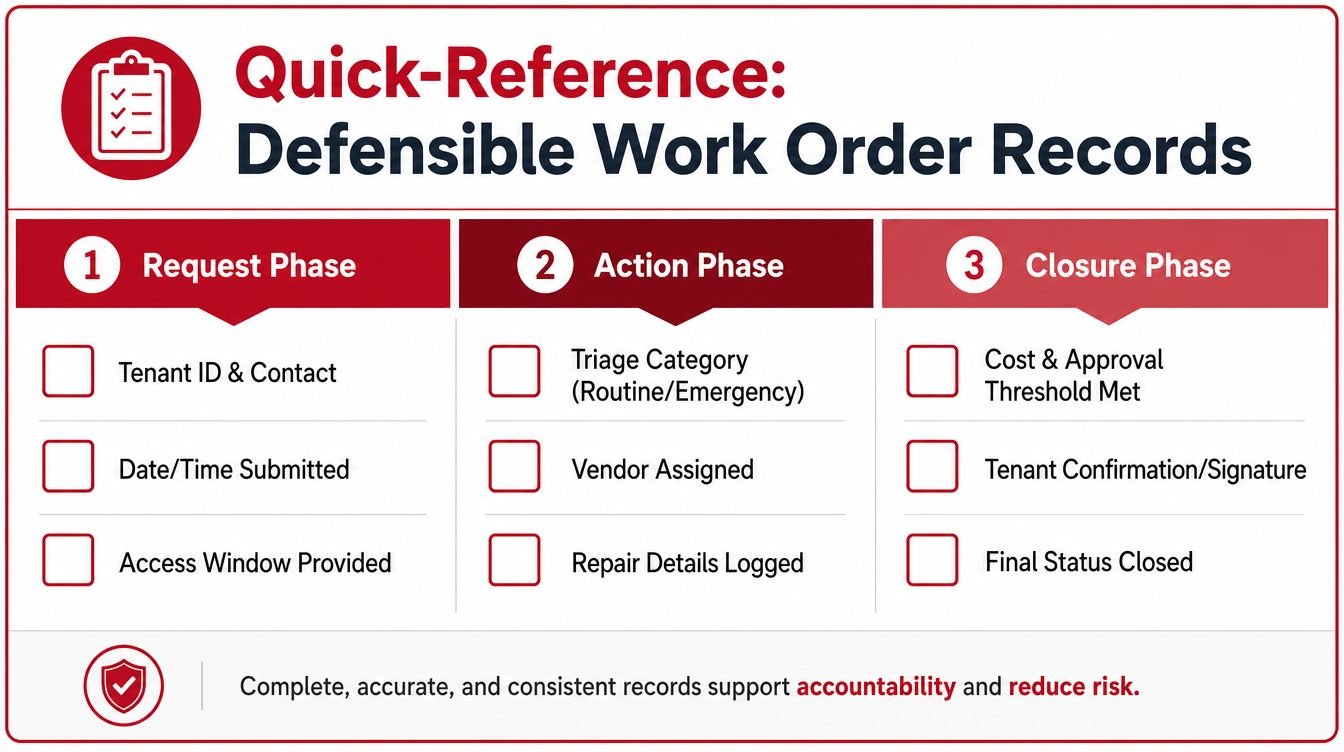
A printed checklist works well beside a filing cabinet or inside a property-management operations manual. It should follow the repair lifecycle so staff can verify the record while the job is still active, not after a dispute has already started.
Request phase
- Tenant identity: Name, contact details, occupants, and unit.
- Original notice: Written request, voicemail note, or portal record.
- Date and time: Exact submission timestamp.
- Location: Property address, unit, room, and affected asset.
- Description: Tenant's own words plus supporting photos or video.
- Access: Requested window, notice method, permission, or emergency rationale.
- Condition link: Move-in report reference and relevant baseline item.
Action phase
- Classification: Routine, urgent, or emergency, with the reason.
- Responsibility: Landlord or tenant allocation under the agreement and Alberta defaults.
- Vendor: Name, contact, dispatch time, arrival time, and contractor notes.
- Scope: Diagnosis, approved work, changed scope, and follow-up requirement.
- Approval: Manager authority, owner notification, quote, or emergency exception.
- Cost capture: Labour, parts, markup, GST, and proposed tenant charge.
Closure phase
- Completion evidence: Finished photographs, test result, and contractor sign-off.
- Tenant confirmation: Access and completion acknowledgement on the work order.
- Invoice packet: Original invoice, warranty, payment record, and approval.
- Final status: Closed, pending follow-up, or reopened.
- Retention marker: Inspection-linked records should remain available for the applicable three-year retention period under Alberta's RTA Handbook, as discussed earlier.
- File location: Property, unit, year, and indexed work-order number.
The same discipline can apply to grounds and seasonal vendor records. Teams comparing broader field-service systems may find top lawn care tools for small crews useful for thinking about dispatch, completion proof, and mobile documentation, even though a tenancy repair file needs additional Alberta evidence fields.
Rent records should remain separate but cross-referenced where a repair charge affects the tenancy account. A documented rent payment receipt process helps keep payment evidence distinct from the work-order packet while preserving the connection between the charge and the ledger.
Dreamhouse Realty Ltd. coordinates Alberta maintenance through documented scopes, trusted vendors, approval controls, inspection records, and owner communications, so each repair is managed as both a service task and an accountable property record. Landlords in Calgary and surrounding communities can visit Dreamhouse Realty Ltd. to discuss full-service rental management, tenant relations, compliance support, and maintenance work-order oversight.