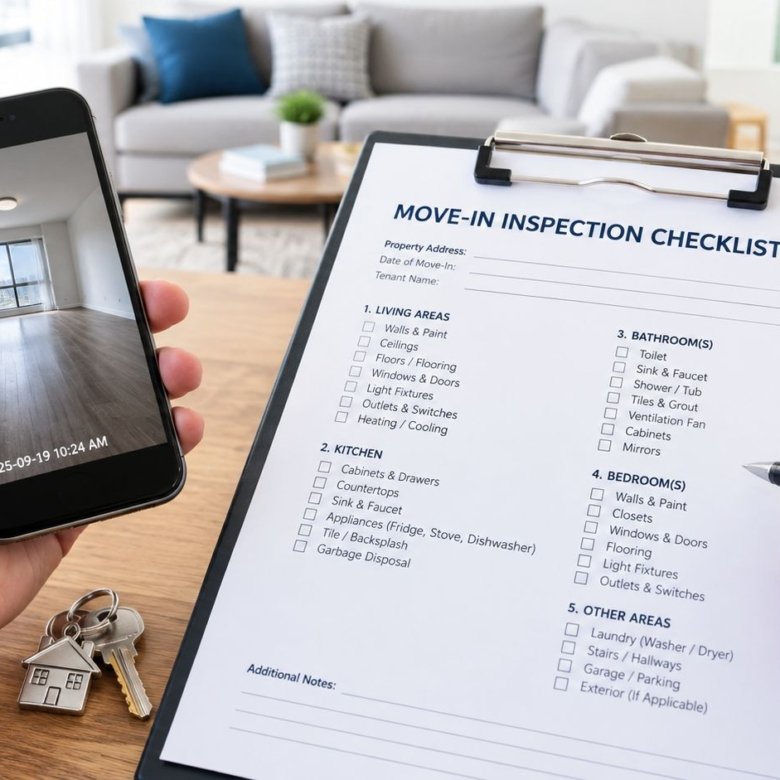
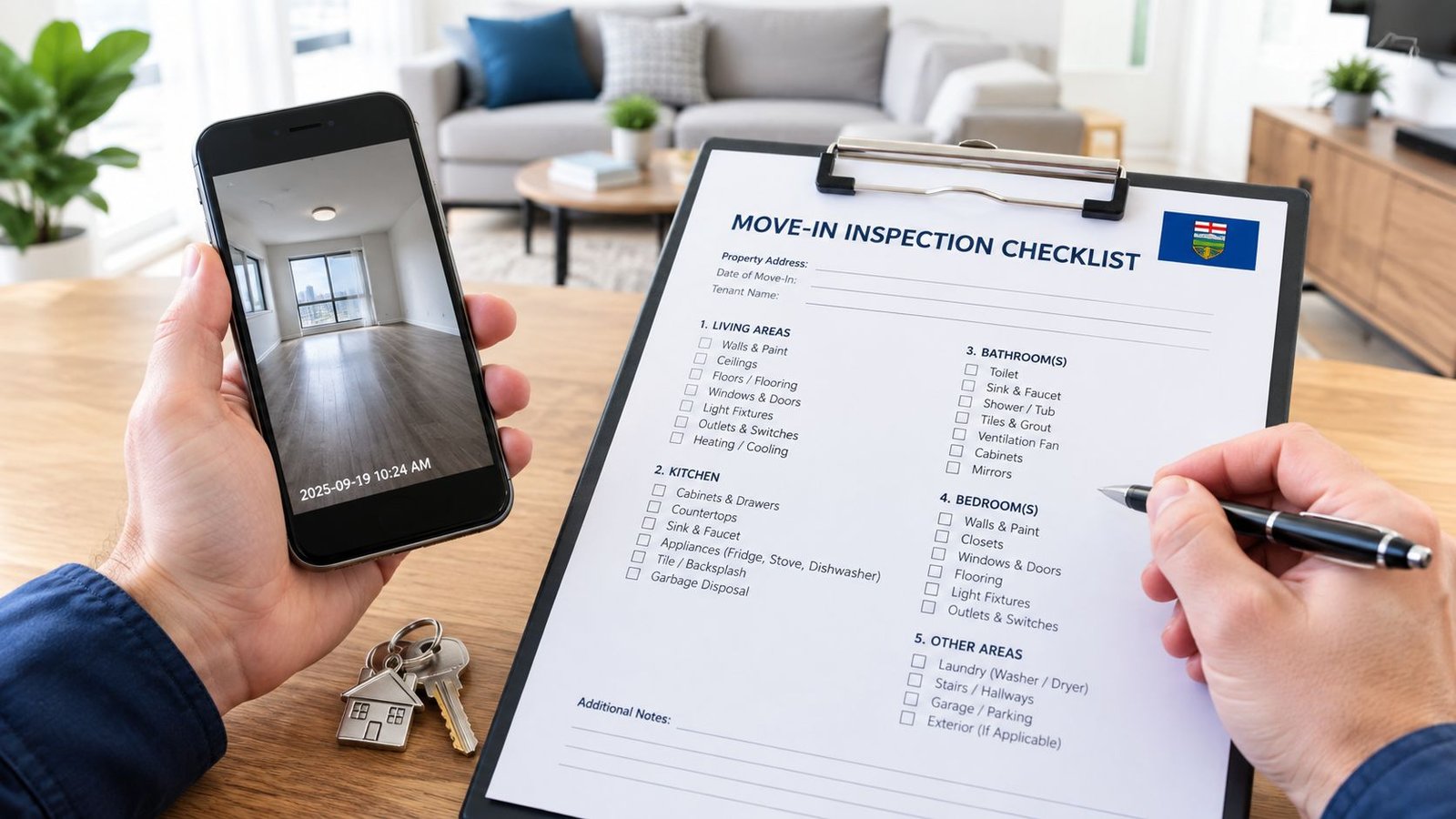
A lot of Alberta landlords only realise how important the inspection report is when a tenant disputes damage after move-in. The keys are already handed over, the tenancy has started, and the owner is trying to reconstruct the unit's original condition from memory, a few phone photos, and a lease package that doesn't prove much.
That's where most deposit problems begin. A proper move in inspection report in Alberta isn't just paperwork. It is the starting evidence for the tenancy, and Alberta treats it that way. For landlords in Calgary, Edmonton, Red Deer, and for owners managing from another province, the practical question isn't whether to do one. It's how to do it in a way that holds up later.
Table of Contents
- When a Calgary Landlord Almost Lost a Deposit Over a Missing Inspection
- What a Move In Inspection Report Is Under Alberta Law
- Landlord and Tenant Responsibilities During the Inspection
- A Room by Room Checklist and Sample Report Format
- Paper vs Digital Evidence for Alberta Rental Inspections
- What Happens When a Tenant Refuses to Sign or Attend
- Storage Rules, Best Practices, and When to Hire a Property Manager
- Common Alberta Landlord Questions About Move In Inspection Reports
- Does the one-week window start at lease start or key handover
- What if the tenant works shifts and can't attend easily
- Do emailed PDFs and timestamped photos help
- Can a landlord rely on a manager's signature alone
- Where does move-out fit into this
- How long should records be kept and what should be redacted
When a Calgary Landlord Almost Lost a Deposit Over a Missing Inspection
A Calgary landlord handed over keys on the first of the month, then flew back to Ontario two days later. Three weeks into the tenancy, the tenant reported a chipped tub, carpet staining in the living room, and scratches on an appliance door. The owner believed some of those issues were pre-existing. He had a lease, a few phone photos, and no signed move-in inspection report.
That is the point where deposit risk gets real.
In Alberta, a landlord can be right about the facts and still lose the argument if the file is weak. A lease proves who rented the unit and when possession started. It does not prove whether the bathtub chip was old, whether the carpet stain was already there, or whether the tenant accepted the unit in that condition. Without a proper inspection record, the security deposit discussion turns into memory against memory.
Alberta's process leaves little room for casual record-keeping. The move-in inspection has to be completed within the legal window around possession, and the tenant needs a copy right away, as noted earlier from the Government of Alberta tenancy guidance. Miss that step, and the landlord gives up the cleanest evidence in the file.
The problem is not only the missing form. It is the missing chain of proof.
- No dated written baseline for the unit's condition
- No tenant acknowledgment tied to specific defects
- No clear package of report, photos, and timestamps that can support a later deposit deduction
Out-of-province owners run into this more than local landlords. They assume a leasing agent's walk-through video or a text message thread will be enough if damage shows up later. Usually it is not. What holds up better is a simple workflow: paper or digital report completed inside the one-week window, room-by-room notes, photos taken the same day, timestamps preserved, signatures captured, and the tenant's copy sent immediately. That can all be done without the landlord standing in the unit.
I have seen owners lose negotiating position fast over this. Once the tenant says, "that was there when I moved in," the landlord needs something better than confidence. A signed report, backed by photos and dates, gives the deposit claim a foundation. Without it, many owners back off deductions they might otherwise have supported.
What a Move In Inspection Report Is Under Alberta Law
A move in inspection report in Alberta is the written record of the rental unit's condition when the tenancy begins. It is not optional. Alberta requires the landlord and tenant to complete both a move-in and move-out inspection report in writing, and the inspection must occur within one week before or after the tenant takes possession, as set out in Alberta's security deposit inspection guidance.
That written requirement matters. A few phone photos without a signed report are useful supporting evidence, but they are not a substitute for the report Alberta law expects.
What the report needs to do
The report should function like a formal condition record, not a casual checklist scribbled at the kitchen counter. Alberta's Residential Tenancies Act materials treat it as a compliance document that supports later deposit decisions.
A workable report should include:
- Property identification: Full rental address and unit description.
- Inspection details: Date of inspection and who attended.
- Condition notes: Room-by-room observations, including visible defects.
- Signatures: Landlord and tenant signatures.
- Delivery: The tenant's copy right after completion.
Alberta's Residential Tenancies Act handbook states that the inspection report must contain specific details, including the inspection date and the names of the people present, and links compliant inspection reports to damage deductions from the security deposit in the RTA Handbook PDF.
Why timing matters more than many landlords think
The compliance window is narrow. The move-in inspection must happen within one week before or after possession. Alberta repeats that same timing across official publications, including the inspection reports publication page.
That means landlords can't treat the inspection as something to “catch up on later” once the tenant is already settled. Once furniture is in, boxes are stacked, and the tenant has started using the premises, the clarity of the evidence drops.
The strongest move-in reports are done before the unit turns into an occupied home.
A good inspection report also becomes the reference point for move-out. If the move-in side is vague, rushed, unsigned, or late, the move-out comparison becomes much harder to defend.
Landlord and Tenant Responsibilities During the Inspection
The cleanest inspections happen when each side knows exactly what they're responsible for. Most conflict starts when one party assumes the other is “handling it.”
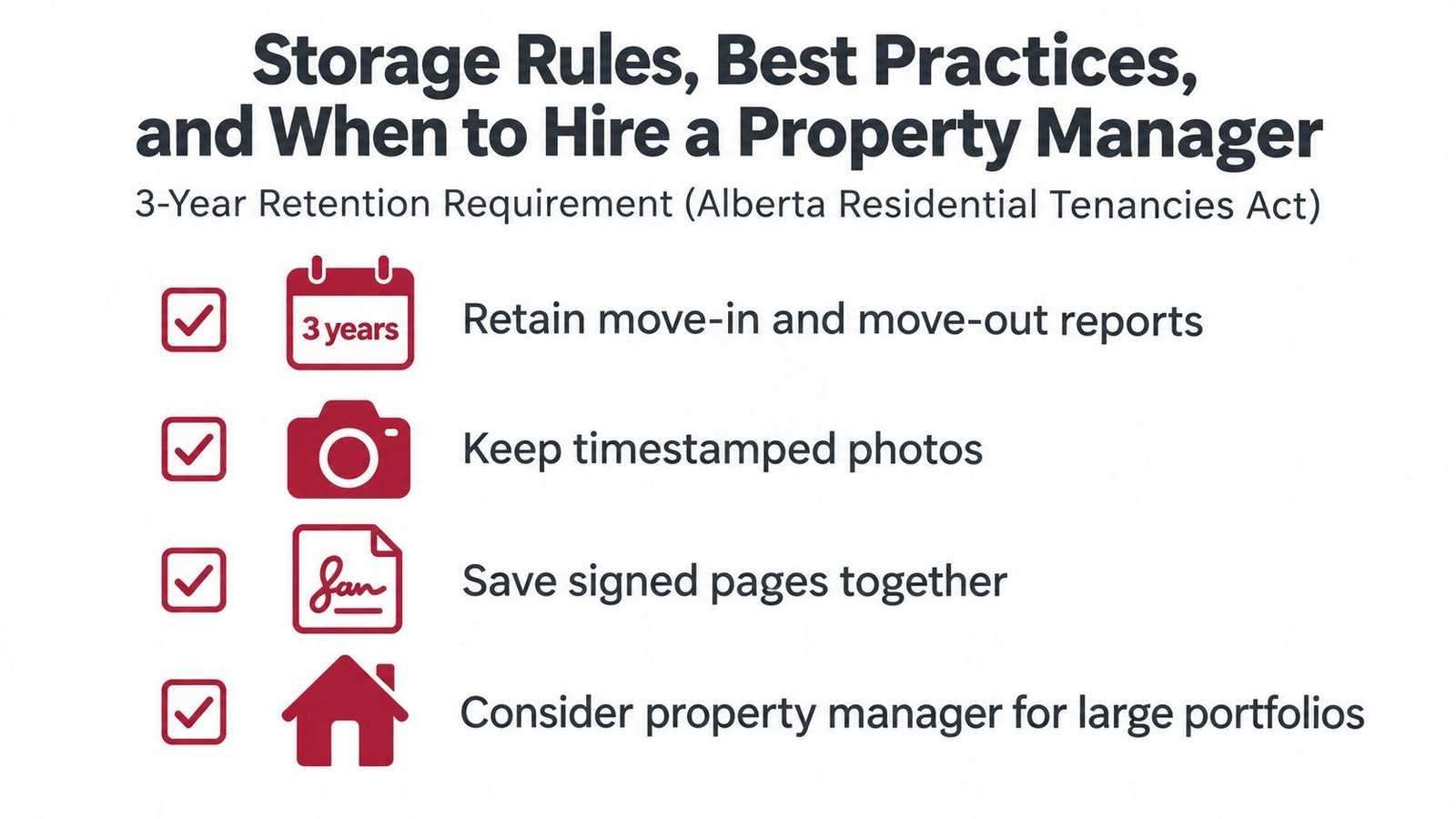
For landlords, the inspection is an operational task. For tenants, it is the chance to challenge inaccuracies before they become accepted condition notes. Alberta guidance also says the landlord must keep copies for three years after the tenancy ends, which raises the stakes for getting the file right from day one, as noted in Alberta's inspection reports guidance PDF.
What the landlord should actually bring
A landlord or property manager should arrive prepared to document, not just look around.
Useful inspection tools include:
- Printed or digital report form: Prepared in advance with the address and room list.
- Smartphone camera: For supporting photos tied to the written notes.
- Flashlight: To catch chips, burns, caulking issues, and appliance damage.
- Outlet tester and appliance checklist: Helpful when confirming working order.
- Meter note section: Useful where utility readings matter at possession.
What the tenant should do during the walk-through
Tenants should inspect carefully, not passively follow along. If they disagree with a note, the better move is to add a written comment rather than refuse to engage.
A tenant in an Edmonton basement suite, for example, might note low ceiling clearance at a stair landing or pre-existing scuffs near a utility-room door on the form itself. That is far better than raising the issue months later after normal use has changed the area.
| Task | Landlord Responsibility | Tenant Responsibility |
|---|---|---|
| Prepare inspection form | Draft and organise the report before the appointment | Review the form carefully during the inspection |
| Attend inspection | Arrive ready to inspect and document all areas | Attend and participate in the walk-through |
| Record condition | Note condition of rooms, fixtures, appliances, and defects | Point out issues the landlord missed or described poorly |
| Sign report | Sign once the written record is complete | Sign, or add written disagreement before signing |
| Copy handling | Give tenant a copy immediately and store records properly | Keep the copy in tenancy records |
| Record retention | Keep copies after tenancy ends as required by Alberta guidance | Keep personal copy for any later dispute |
Useful habit: Tenants should write “noted but disputed” beside an item they disagree with, instead of leaving the report unsigned without explanation.
A Room by Room Checklist and Sample Report Format
A solid inspection report is detailed enough to identify pre-existing issues without turning into a novel. The easiest way to keep it organised is to move through the unit the same way every time, using the same categories in every property.
Landlords who skip categories usually regret it later. The most common omissions are window condition, inside edges of doors, appliance surfaces, under-sink cabinet areas, and small flooring defects near transitions.
Areas that belong on the form
A practical move-in form should cover:
- Entry and hallways: Door condition, locks, flooring, walls, lights.
- Living room and dining area: Walls, ceilings, carpet or flooring, windows, blinds, outlets.
- Bedrooms: Doors, closets, flooring, window coverings, wall damage.
- Kitchen: Fridge, stove, dishwasher, microwave, cabinets, counters, sink, taps.
- Bathrooms: Tub, surround, caulking, sink, vanity, toilet, mirrors, fan.
- Laundry area: Washer, dryer, hookups, floor condition.
- Mechanical and heating: Thermostat, vents, visible filters, baseboard or furnace registers.
- Exterior or access items: Balcony, patio, storage, garage remote, mailbox key, shared entry items where relevant.
For landlords who want a structured starting point, a practical move-in inspection checklist can help standardise the room-by-room layout before adapting it to a specific unit.
Sample condition layout
A form works best when condition ratings are simple and repeatable.
| Area / Item | Condition Rating | Notes |
|---|---|---|
| Front entry door | Acceptable | Minor scuff near handle |
| Living room carpet | Needs Cleaning | Light staining near window wall |
| Kitchen stove | Acceptable | All burners present, surface scratched |
| Bathroom tub | Needs Repair | Small chip on left interior edge |
| Bedroom window blind | Not Working | Slat broken, tilt function stuck |
| Hallway light | N/A | No fixture in this area |
A sample header landlords can copy
A simple Alberta-compliant format might start like this:
- Property address
- Tenant name
- Landlord or manager name
- Inspection date
- People present
- Condition rating key
Acceptable | Needs Cleaning | Needs Repair | Not Working | N/A
Then each room should have two lines that matter most: a condition rating and specific notes. “Bedroom wall damaged” is weak. “North bedroom wall has two anchor holes and paint scuff behind door” is much stronger.
Paper vs Digital Evidence for Alberta Rental Inspections
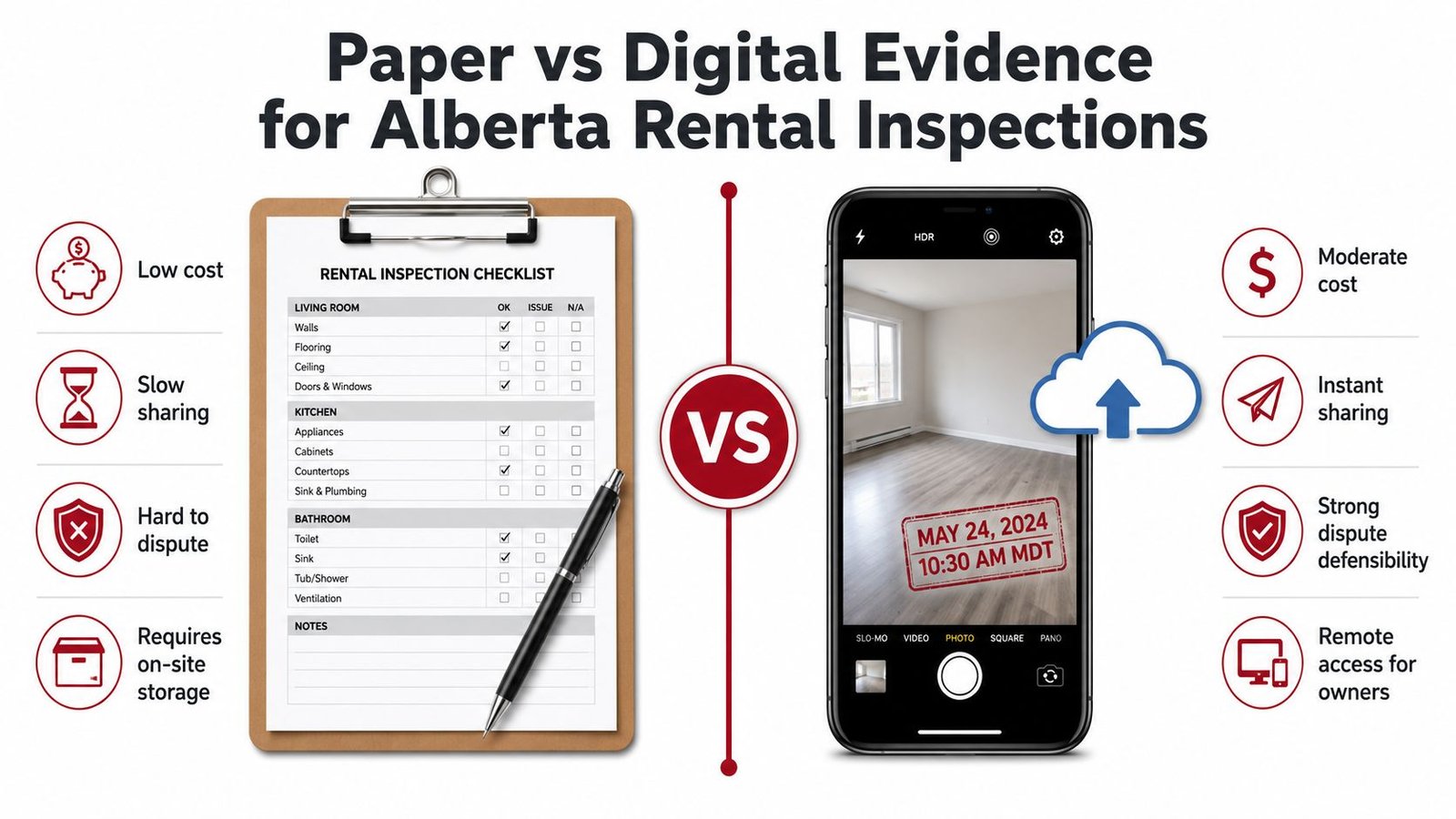
The paper form is still the baseline. It captures signatures, keeps the inspection structured, and gives Alberta landlords a straightforward written record. The problem is that paper alone often isn't enough when the dispute turns on whether a stain was faint or severe, whether a scratch was hairline or deep, or whether the appliance panel was already dented.
That's where digital evidence improves the file.
What paper still does well
Paper or a signed PDF is still useful for:
- Capturing signatures quickly
- Keeping the inspection sequence organised
- Creating a single written summary of condition
- Providing a document that is easy to print and store
For some landlords, especially with one condo or one single-family home, that may be enough if the report is detailed and the tenant receives the copy immediately.
Where digital workflows are stronger
Alberta's official guidance doesn't answer newer operational questions about photo-first inspections, remote owners, or compressed key exchanges, even though those realities are common now, as reflected in Alberta's tenant information publication.
Digital evidence is stronger when it adds:
- Timestamped photos: Helpful for showing the condition close to possession.
- Short videos: Useful for appliance operation, fan noise, or blind function.
- Shared cloud folders: Practical for out-of-province owners who need immediate access.
- Locked PDFs: Better than editable files that can later be altered accidentally.
A handwritten checklist plus labelled photos usually beats either one alone.
The strongest Alberta workflow is usually hybrid. Signed written report. Photo set by room. Same-day file delivery. That approach fits remote ownership far better than relying on memory or a single paper sheet folded into a file drawer.
What Happens When a Tenant Refuses to Sign or Attend
Many landlords assume a refused signature kills the report. It doesn't necessarily. What causes trouble is poor documentation of the refusal.
Alberta guidance highlights the compliance risk when an inspection is incomplete, late, or missing signatures, and notes that the report is the main evidentiary record in later damage or deposit disputes, especially for remote owners, in Alberta's landlord information publication.
If the tenant skips the appointment
If the tenant doesn't attend, the landlord should document every communication attempt and every offered appointment clearly and promptly. Email, text, and calendar confirmations are far better than a vague note that “tenant was unavailable.”
If the tenant attends but won't sign
This is common when a tenant sees defects listed and worries that signing means accepting blame. In practice, refusing to sign usually helps no one. The better approach is to write the disagreement directly on the form.
A landlord should note the refusal factually. Not emotionally. A simple note that the tenant attended, reviewed the report, and declined to sign is stronger than an argumentative comment.
If the dispute escalates
When the file is messy, signatures are disputed, or damage claims are heading toward formal resolution, it may be time to involve the Residential Tenancy Dispute Resolution Service. At that stage, orderly records matter more than forceful emails.
- Keep all messages together
- Preserve the unsigned version
- Preserve the version showing any tenant comments
- Keep all supporting photos in the same file set
Refusal to sign is a problem. Failure to document the refusal is usually the bigger one.
Storage Rules, Best Practices, and When to Hire a Property Manager
A deposit claim often turns on a simple question. Can the landlord produce the move-in file quickly, in full, and in a format that makes sense to a hearing officer or tenant? If the answer is no, the report has much less value than owners expect.
For Alberta landlords, storage is part of the job. The report, the photos, the delivery record, and any follow-up notes should stay together and stay readable long after the tenant has moved out. That matters even more for out-of-province owners, because the person answering a deposit dispute may be relying entirely on a digital file rather than personal memory of the unit.
A practical storage system
The best filing systems are boring and repeatable. Every tenancy gets the same structure, so nothing goes missing during turnover or a later deposit dispute.
Good habits include:
- One folder per property and tenancy: Use the address, unit number, and possession year.
- Final signed report saved as PDF: Keep the signed version locked or non-editable.
- Photos sorted by room and date: Kitchen, living room, bedrooms, bathrooms, entry, exterior, parking, storage.
- Proof the tenant received the report: Save the email, portal log, or text confirmation.
- A backup in a second location: Cloud storage is useful, but keep another copy as well.
Timestamped photos help remote owners because they show condition and sequence. Paper still matters too. The strongest file usually combines both. A written report signed at possession, then a photo set that matches the report room by room.
A routine that holds up under pressure
Turnover days get rushed. Cleaners run late, keys are delayed, and the inspection is the first thing owners cut corners on. That is usually the mistake that comes back at deposit time.
Use a repeatable workflow:
- Book the inspection as soon as possession timing is clear.
- Pre-fill the address, tenant names, and date on the form.
- Walk the vacant unit before the appointment if possible.
- Test visible items that commonly become dispute points, such as lights, appliances, taps, blinds, and doors.
- Take clear photos in the same order as the report.
- Write defects plainly, with location and condition noted.
- Send the completed copy promptly after signing.
- Save the form, photo set, and delivery proof in one file.
That workflow is what lets an owner meet Alberta's one-week inspection window without being in the room personally. A local representative can complete the paper report, capture the photo record, and send a timestamped file package the same day.
When management support makes sense
Some landlords can handle this themselves. Some cannot, at least not consistently.
Problems usually start with distance, not intent. An owner in Vancouver or Toronto may have a perfectly good tenant and still lose a deduction because the inspection file is split across texts, a phone camera, and an unsigned PDF. The issue is not effort. The issue is chain of evidence.
A licensed manager can handle the scheduling, attend the inspection, produce the report, deliver the tenant copy, and store the records in one place. Landlords weighing that option can review what a property manager does during leasing and turnover before deciding whether to hand off the inspection process. Dreamhouse Realty Ltd. is one Alberta option that handles leasing preparation, inspection records, and local coordination for owners in Calgary, Edmonton, Red Deer, and nearby communities.
Common Alberta Landlord Questions About Move In Inspection Reports
A few questions come up repeatedly because Alberta's rules are strict, but daily rental operations rarely run on a perfect schedule.
Does the one-week window start at lease start or key handover
The practical trigger is possession. Alberta's materials say the inspection must be completed within one week before or after the tenant takes possession, so landlords should schedule around actual handover and occupancy, not just the date typed at the top of the lease.
What if the tenant works shifts and can't attend easily
Get the inspection arranged early and communicate in writing. Waiting until possession day usually creates the scheduling problem. A rushed workaround is where reports become incomplete.
Do emailed PDFs and timestamped photos help
Yes, as supporting evidence. They are especially useful for remote owners. The written inspection report remains the core record, and the digital file should support it rather than replace it.
Can a landlord rely on a manager's signature alone
A manager can complete the landlord side if properly authorised, but the tenant's participation and signature still matter for a cleaner evidence trail.
Where does move-out fit into this
The move-in report only proves its full value when it is paired with a proper end-of-tenancy comparison. Landlords dealing with the second half of that process should also understand the Alberta move-out inspection process.
How long should records be kept and what should be redacted
Keep the report set for the required retention period and remove unnecessary personal information before sharing records with third parties. Condition notes, dates, signatures, and tenancy-related property details should remain intact.
Dreamhouse Realty Ltd. handles leasing, move-in documentation, inspections, tenant coordination, and compliance support for Alberta rental owners who want cleaner records and fewer preventable disputes. Landlords in Calgary and other Alberta cities who want help structuring inspection workflows, especially for remote ownership, can visit Dreamhouse Realty Ltd. or contact GURIQBAL CHAHAL, MBA, PMP, REAL ESTATE BROKER, Phone 403-966-6072.