

A Calgary landlord has a vacant townhouse, several promising inquiries, and pressure to approve someone quickly. One applicant appears confident, offers complete-looking documents, and wants the keys as soon as possible. If the owner skips consent documentation or accepts an unverified reference, the vacancy may end quickly, but the resulting arrears, dispute, or forced turnover can be far harder to manage.
A reliable tenant screening Alberta process isn't a gut-feeling exercise or a race to accept the first applicant. It's a documented workflow that verifies identity, income amount, credit information, rental history, and references while respecting Alberta privacy boundaries. The strongest process is thorough enough to support a defensible decision, but measured enough that qualified renters aren't discouraged before they've even viewed the property.
Table of Contents
- Why Tenant Screening Matters More in Alberta Right Now
- What Alberta Landlords Can and Cannot Ask During Screening
- Your Alberta Tenant Screening Workflow From Application to Decision
- How to Evaluate Credit Income and References Without Guesswork
- Documents Scripts and Records That Keep You Compliant
- Next Steps for Confident Compliant Tenant Placement in Alberta
Why Tenant Screening Matters More in Alberta Right Now
A Calgary rental can attract several applicants within days, yet the strongest-looking file may still contain unverified income or an incomplete rental history. Approving quickly can reduce vacancy, but a weak decision record makes arrears, disputes, and lease enforcement harder to manage. Screening should therefore support both the placement decision and the records an owner may need later.
Tenant selection affects more than whether rent arrives on time. It influences communication, property care, lease compliance, inspection outcomes, and the management attention required after move-in. A consistent process gives landlords clear reasons for accepting or declining an applicant and helps apply the same standards across comparable applications.
The market makes this a regular operating task. Slightly more than one quarter of Alberta households were renters in the 2021 census, while a 2025 Alberta rental-intelligence report noted that landlords approve about four in five applicants, alongside a 13.8% application-declined rate and a 7.3% collections rate. Approval, rejection, and collections are ordinary parts of managing rental housing, not signs that a process has failed. (Alberta rental-intelligence visual summary)

A rushed approval creates weak evidence
An applicant may appear able to afford the unit, but an owner who never confirms income, contacts only one reference, or fails to record credit-check consent has created a second problem. If rent later falls behind, the owner must address the tenancy issue while also explaining what was checked, why it was relevant, and whether the same criteria applied to other applicants.
Alberta screening works best as a consent-based application process. With consent, landlords may request relevant supporting records such as pay stubs, a Notice of Assessment, an employer letter, and a credit check. The useful record identifies the information requested, the reason for requesting it, the verification completed, and the basis for the final decision.
Practical rule: A screening outcome should be explainable without relying on appearance, accent, family assumptions, or instinct. Use the same rental criteria for comparable applicants.
Thorough doesn't mean excessive
Asking for every document before a viewing can reduce the applicant pool. In a market with 6–8% vacancy in early Q2 2026, landlords may have room to set standards, but excessive front-end demands can discourage qualified renters and increase the amount of personal information collected.
The better approach is proportionate diligence. Verify payment capacity and rental responsibility with information that is relevant, consented to, and sufficient for the decision. A documented workflow protects the landlord without turning a Calgary, Edmonton, Red Deer, or surrounding-community application into an unnecessarily intrusive investigation.
What Alberta Landlords Can and Cannot Ask During Screening
A Calgary landlord screening a steady applicant and a rushed one faces the same choice, collect only what is tied to tenancy, or drift into questions that create privacy and discrimination risk. Alberta's guidance is clear on that point. Keep the process tied to rental purpose, documented consent, and consistent criteria.
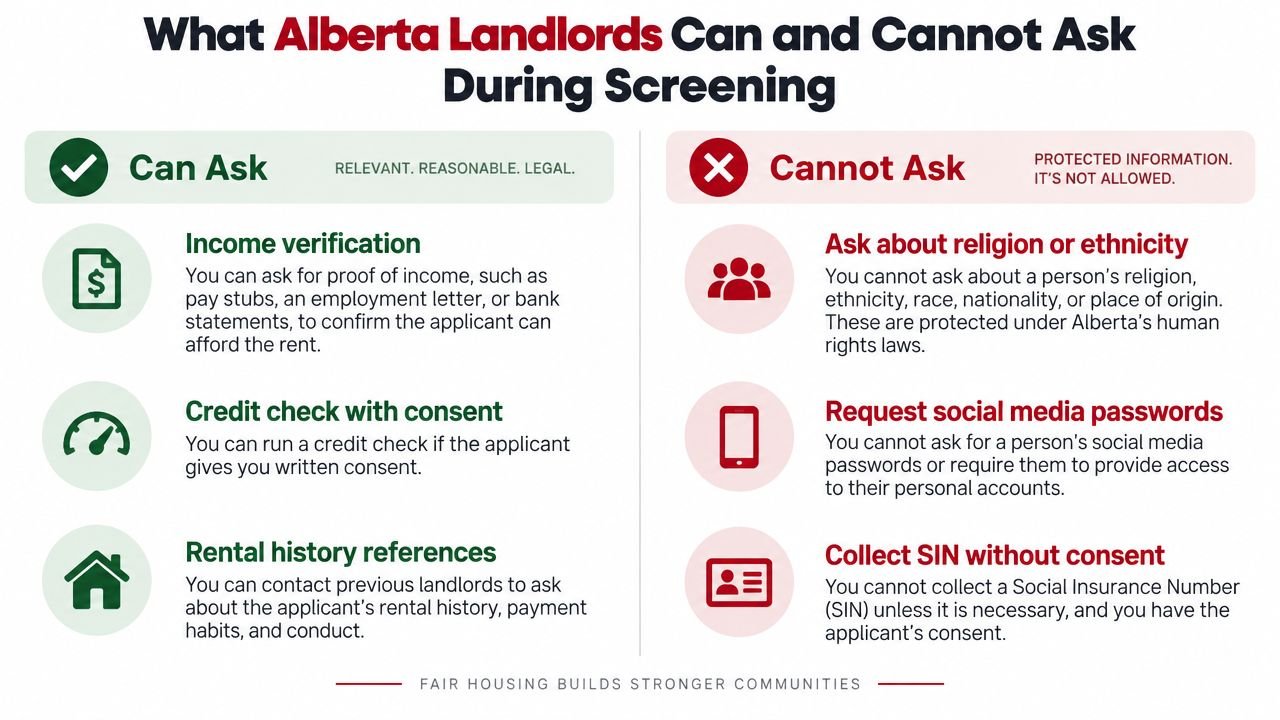
Before ordering a credit report, the landlord needs a direct business requirement and express, verifiable consent. Alberta guidance says that consent may be recorded in writing, by email, or in an audio recording. An applicant can also be asked to obtain their own credit report and share it, which reduces the personal information the landlord handles directly. (Alberta tenant verification guidance)
Information that can support a rental decision
Landlords can ask for identifying details such as the applicant's name, date of birth, driver's licence number, and optional SIN. A SIN should not become a default requirement if it is not needed. With consent, landlords can also ask for a credit check, pay stubs, a Notice of Assessment, an employer letter, or other proof of income. For a broader read on tenancy rules, review Alberta landlord and tenancy guidance.
Income questions need discipline. Alberta guidance allows a landlord to collect the amount of income, but not the source as a screening requirement. The point is whether the applicant can meet the rent, not whether the income comes from employment, support, or another lawful arrangement.
A practical application usually focuses on four areas:
- Income amount: Ask for the amount needed to assess qualification, without forcing disclosure of the source where it is not allowed.
- Rental history: Confirm prior addresses, payment history, property care, and lease responsibility through appropriate references.
- Credit information: Request a report only after recording express, verifiable consent and the business reason.
- Identity details: Collect only the identifiers needed to match the applicant and complete the stated checks.
Keep the rest of the conversation on tenancy. Occupancy, move-in timing, pets where relevant to the property, and past rental conduct are fair screening topics. Religion, ethnicity, family assumptions, and other protected personal characteristics are off limits. Social media passwords and unrelated personal records are also not appropriate. If you need a legal boundary for document use, find permitted use guidelines before asking for records that go beyond the rental file.
Consistency protects the owner
Every applicant should see the same application form, document standard, verification sequence, and decision criteria. If one applicant is asked for income proof and another is approved without it, the landlord has a harder time showing a neutral process later. That risk matters more when vacancy is tight and stronger applicants can choose among multiple units. A stricter pre-screening rule can shrink the pool without improving the decision.
Use the same rules for every comparable applicant. That is the cleanest way to stay within Alberta screening limits and still make a defensible rental decision.
Your Alberta Tenant Screening Workflow From Application to Decision
A good screening workflow starts before the first application lands in your inbox. By the time a serious tenant asks for the unit, the form, consent language, verification checklist, and decision criteria should already be in place. That keeps the process calm and consistent instead of reactive.
Step 1 Build one application path
Use one standard application for every comparable applicant. It should collect identity, contact information, proposed occupants, rental history, income amount, references, and clear consent choices. It should also tell applicants what will be checked and whether a third-party service will handle any part of the process.
The landlord can request a name, date of birth, driver's licence number, and optional SIN, along with consented proof such as pay stubs, a Notice of Assessment, an employer letter, or a credit check. Alberta rental document guidance Keep the form tight. Ask for information that helps you make the rental decision, and leave out data that does not change the outcome.
Step 2 Verify identity and consent
Match the identity details on the application with the supporting records. Before ordering any report, record the applicant's express, verifiable consent and the specific business reason for that check. A checkbox with vague wording is weak support if the applicant later questions the request.
A clean file protects both sides. It shows the applicant what was reviewed, and it gives the landlord a record if the decision is ever challenged.
Step 3 Review financial capacity
Ask for income details and verify them with appropriate records. The goal is to see whether the rent appears manageable in relation to the applicant's stated income, while still allowing for the full picture. One pay stub or one bank statement rarely tells the whole story.
Use the same review method every time. That matters more than trying to make each file feel different.
Step 4 Contact rental references
Call previous landlords using contact details you have confirmed independently where possible. Ask about payment history, property care, lease compliance, and whether they would rent to the applicant again. Record the date, the person contacted, the questions asked, and the factual answers.
Keep the questions short and direct. Long conversations usually produce more opinion than useful evidence.
Step 5 Handle pre-viewing requests carefully
A landlord may want documents before spending time on showings, but asking for a credit report, employment letter, and other sensitive records in the first message can create friction. In a market with tight vacancy, that kind of front-loaded screening can shrink your pool faster than it improves your decision. The better approach is to pre-qualify with neutral questions, show the unit, then request the full application and consented records from serious applicants.
If you need help organising that process, tenant screening and background check support can help structure the file without turning the first contact into an obstacle. The aim is simple, keep the opening stage accessible and the decision stage properly documented.
Step 6 Document the decision
Write a short decision note that lists the criteria reviewed, the evidence received, the references completed, any unresolved concerns, and the final outcome. Keep personal commentary out of it. The note should explain the rental decision in objective terms and stay with the application record.
Owners and managers handling several units can streamline operations with RealEstateCRM by keeping applicant messages, documents, and status updates in one place. That reduces missed steps and makes the file easier to review later.
How to Evaluate Credit Income and References Without Guesswork
A solid Alberta screening file starts with consent, then moves through the evidence in order. I ask for permission before checking credit or contacting references, keep the reason for each check tied to the tenancy, and avoid collecting more personal information than I need. That keeps the process defensible and easier to explain if an applicant later asks why they were declined.
Income is usually the first filter. In practice, a rent-to-gross-income range of about 30–40% helps separate stable applicants from files that need more review, but it is only a guideline. A strong file can still include variable income, as long as the rest of the record supports it. A weak file can look fine on paper and still fail once payment history and references are checked.
Read the file as a pattern
Credit works the same way. A credit score above 650 often supports approval, while a score below 600 usually means I look harder at payment behaviour, deposits, and reference quality. Those are practitioner rules of thumb, not Alberta law. The point is to test whether the story is consistent across the file, not to let one number make the decision.
A thin credit file is not the same as a bad one. Newcomers, younger renters, and people who have used little credit may have limited history but still show reliable income and clean landlord references. The opposite also happens. An applicant with high income can still be a poor fit if the rental history shows late payment, disputes, or unpaid obligations.
| Check | What Good Looks Like | Caution Signal |
|---|---|---|
| Income amount | The amount fits the rent-to-income guideline and appears stable | The evidence is incomplete, inconsistent, or hard to verify |
| Credit | The report shows a steady payment pattern | Repeated missed payments or a score below the threshold need more review |
| Rental references | A prior landlord confirms payment, care, and lease compliance | The reference is vague, unreachable, or conflicts with the application |
| Overall file | The application, documents, and calls tell the same story | Several contradictions remain unresolved |
Use mitigants carefully
A guarantor can make sense when the risk is narrow and explainable, such as limited Canadian credit history with otherwise credible income and references. It should not be used to excuse dishonesty or to override the same standards applied to everyone else.
For a practical comparison of credit-check workflow, see burnt tenant credit screening. If you want a more structured tenant file, credit check support for tenants can help you keep the process organized without turning screening into guesswork.
Documents Scripts and Records That Keep You Compliant
A Calgary rental application can become difficult to defend when approvals, questions, and credit checks are scattered across email, texts, and memory. A documented, consent-based file gives applicants clear expectations and gives the landlord a consistent basis for the decision.
The five-part screening kit
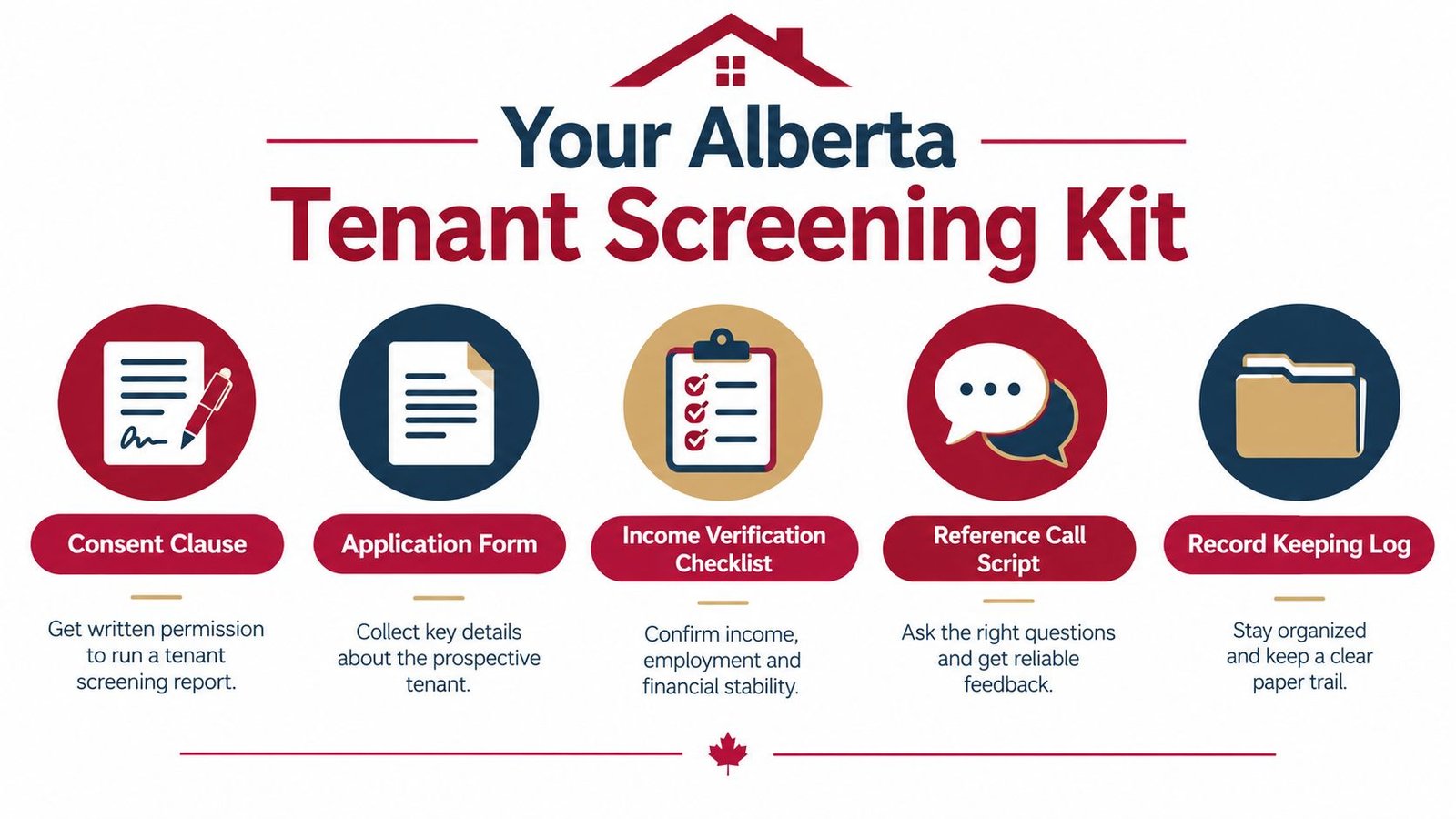
Consent clause: State what information will be checked, why it is needed, whether a third party will be involved, and how the applicant can provide consent. Save the completed consent with the application before requesting a credit report.
Application form: Request identity, income amount, rental history, references, occupants, and other information directly connected to the tenancy. Open-ended questions often produce personal details that do not help assess the rental.
Income checklist: Record the document received, the date reviewed, and whether the income could be reasonably verified against the rent-to-income benchmark used for every applicant. A checklist reduces inconsistent decisions when several applications arrive together.
Reference script: Ask each reference the same practical questions about rent payment, property care, lease compliance, and re-renting. Record factual answers, not labels such as “difficult” or “not a good person.”
Decision log: Note the criteria applied, checks completed, unresolved concerns, and final outcome. If a guarantor or another risk mitigant was used, explain the specific gap it addressed and why the same approach was available to comparable applicants.
Record-keeping principle: The file should show necessity and accuracy, not simply volume. More documents do not automatically produce a better decision.
Answer applicant questions directly
Applicants may ask what will be checked, whether a third party is involved, and how long records will be kept. Answer before collecting sensitive material. Use the information only for the stated rental purpose and follow a clear internal retention policy.
A tenant blacklist is not a government system landlords can search. There is no single government-run tenant blacklist in Alberta. Past issues may appear in references, private databases, credit files, or public records. Review each source for accuracy, necessity, fairness, and lawful handling instead of treating an external label as conclusive. (Alberta privacy guidance for landlords and tenants)
Rental checks through major bureaus have become soft inquiries with no score impact since November 2024, according to announcements from the credit bureaus. That change does not remove the landlord's duties. The information still needs a rental purpose, informed consent, reasonable accuracy, and appropriate retention. A stricter pre-screen that demands excessive documents can also reduce the applicant pool when vacancy is running at six to eight percent, so collect what supports the decision rather than everything available.
Keep the file useful after approval
After approval, limit access to people who need the information for leasing or management. Store documents in a controlled system, separate decision notes from casual messages, and dispose of records under the landlord's documented retention practice. Keep the file organized enough to show why the application met the stated criteria, while removing material that no longer serves a necessary purpose.
Next Steps for Confident Compliant Tenant Placement in Alberta
A sound Alberta screening process has four characteristics: consent before credit, consistent criteria for every applicant, evidence-based interpretation, and a clear record of the decision. It doesn't depend on collecting the maximum possible amount of information. It depends on collecting relevant information in a way that respects privacy and supports a fair rental decision.
Self-management can work for an owner with one property, reliable systems, and time to verify every document and reference. The risk increases when applications arrive together, showings compete with a full-time job, or the owner manages a property from outside Calgary. Missed consent records, inconsistent standards, and poorly stored documents often happen because the process lives in email threads and memory.
Professional support becomes useful when screening must be repeatable across several properties or cities. A licensed property management and real estate brokerage can coordinate advertising, showings, applicant screening, lease preparation, inspections, rent collection, and compliance records. Dreamhouse Realty Ltd. serves Calgary, Edmonton, Red Deer, and surrounding Alberta communities, including owners of single-family homes, condos, townhomes, and small multifamily buildings.
The most reliable placement process protects both sides. Applicants receive clear expectations and a consistent review. Owners receive a documented decision based on income amount, rental history, references, and consented credit information. That balance is more sustainable than either approving on instinct or making the application so demanding that good renters walk away.
GURIQBAL CHAHAL, MBA, PMP, REAL ESTATE BROKER, Phone 403-966-6072, can help Calgary, Edmonton, Red Deer, and surrounding Alberta owners with a free rental consultation, market analysis, and fully managed tenant placement aligned with Alberta tenancy requirements. Visit Dreamhouse Realty Ltd. to discuss a consent-based screening process and practical property management support.