

A Calgary landlord can put two listings side by side and struggle to see a meaningful difference. The suites may have similar finishes, layouts and amenities, yet one could bring condominium fees, board rules and extra leasing administration, while the other sits in a rental building managed under one operator's policies. The deciding issue isn't just what the property looks like. It's who owns and governs it, and how that structure affects the landlord's costs and day-to-day work.
Table of Contents
- Why the Condo vs Apartment Question Trips Up Alberta Landlords
- What a Condo Actually Is in Alberta
- Fees, Reserve Funds and the Full Cost Stack
- Bylaws Insurance and Day-to-Day Operations
- How Alberta Rental Markets Treat Condos and Apartments Differently
- Real Scenarios for Calgary and Edmonton Landlords
- Choosing the Right Option and Getting Alberta-Specific Help
Why the Condo vs Apartment Question Trips Up Alberta Landlords
The condo vs apartment difference is easy to miss because the words describe different things. In Alberta, a condominium is primarily a form of ownership and governance; an apartment usually describes a dwelling type or rental arrangement. A condo unit can be rented, and an apartment building can be owned and operated as rental housing. Similar-looking buildings can therefore carry very different responsibilities for their owners.
That distinction matters in Calgary and Edmonton, where condominium growth has been concentrated. Alberta added 33,455 condominium units between 2011 and 2016, a 15.0% increase. Calgary and Edmonton together accounted for 30,535 of those additional units, or 91.3% of the province's net condominium growth over that period, according to Alberta's census housing report. The ownership structure is especially relevant in the province's largest urban markets, where a landlord may be comparing a rented condominium apartment with a purpose-built rental apartment.
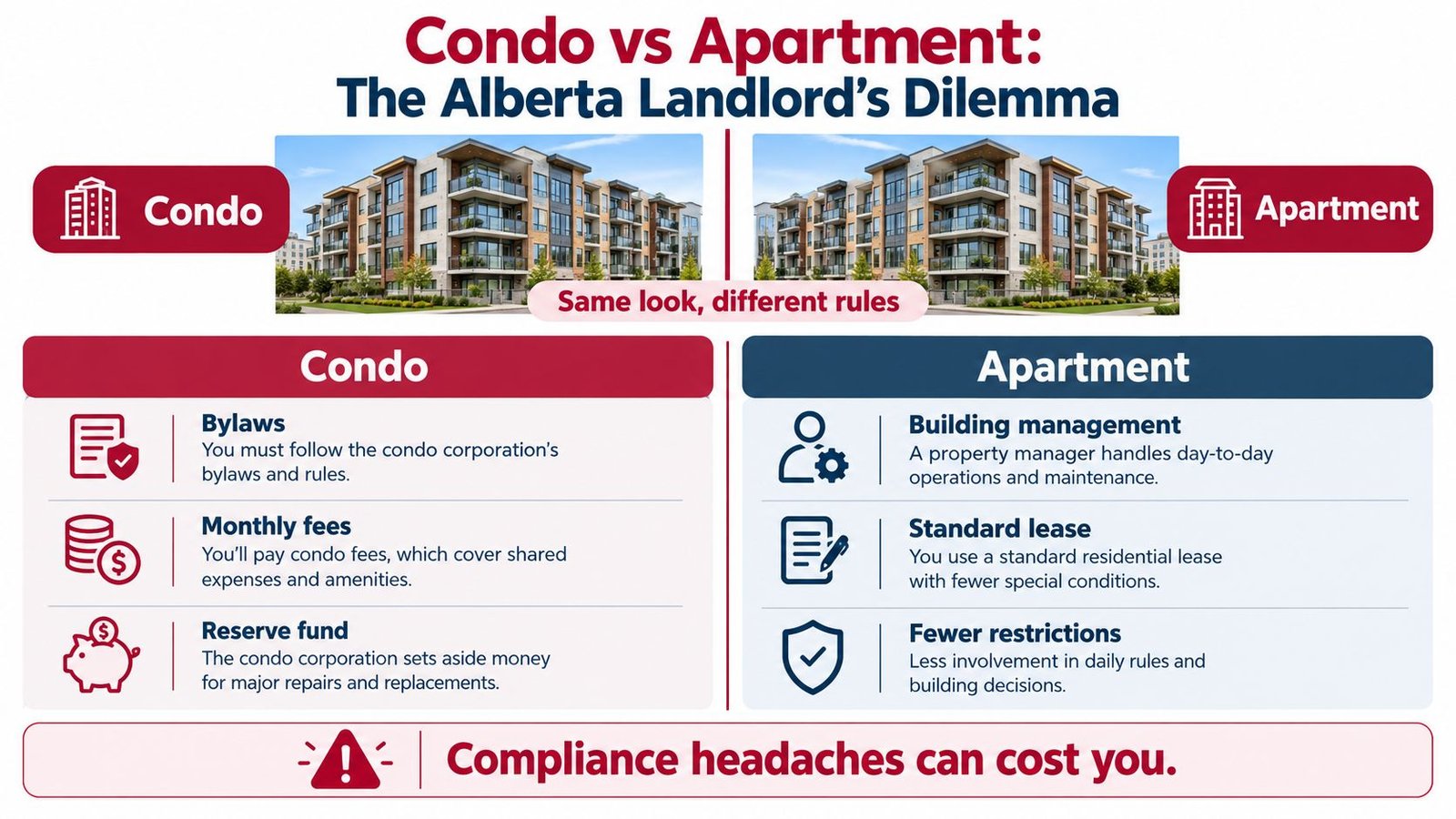
| Dimension | Condominium | Apartment |
|---|---|---|
| What the term describes | An ownership structure for a unit and shared property | A dwelling or building type, often used for rental housing |
| Who governs shared areas | A condominium corporation and its bylaws | Usually the building owner or operator |
| Owner's operating costs | Rent income must be weighed against condo fees and ownership obligations | Building costs sit with the owner or operator and are reflected in the rental business |
| Tenant's experience | A landlord or manager may handle the lease, while corporation rules govern shared spaces | The operator typically manages the lease and shared building operations |
| Main diligence concern | Fees, reserve fund, bylaws, insurance and rental requirements | Building operations, lease terms, maintenance and rental demand |
Start by identifying the title and ownership structure, not by judging the lobby or the finishes. Then establish who sets the building rules, who pays for shared-property repairs, and who handles tenant requests. Finally, model the property using its actual costs and leasing restrictions. That sequence shows whether the unit suits the owner's operating plan, rather than merely looking like a good investment.
What a Condo Actually Is in Alberta
A condominium is a legal ownership arrangement, not a particular architectural style. The purchaser owns a registered unit and shares ownership of the condominium corporation's common elements and assets. Those can include hallways, elevators, structural components, mechanical systems, landscaping and recreational facilities. The corporation governs and maintains common property under its legal framework and bylaws.
The central distinction: A condo describes who owns and governs the property; an apartment describes the dwelling or building form.
An owner who rents out a condo keeps the ownership responsibilities even when a tenant lives in the unit. The tenant pays rent under a tenancy arrangement, while the owner remains responsible for condominium fees and compliance with the corporation's rules. Alberta's condominium basics guide explains the distinction between a privately owned unit and shared condominium property.
A conventional apartment rental works differently from the owner's perspective. The tenant occupies a unit under a lease and doesn't own the dwelling or a share of the building. In a purpose-built rental, one owner or operator typically oversees the building and its shared facilities, rather than relying on a condominium corporation made up of unit owners.
A quick ownership check
Before treating a listing as an apartment investment, a landlord should confirm whether the unit has separate condominium title. If it does, the building's rules and corporation's decisions can affect leasing and operating costs, even if the tenant deals mainly with an individual owner or property manager.
The tenant's view and the owner's view can differ. A renter may experience a condo as a home with a landlord, a lease and amenities. The owner experiences an additional governance layer, with fees and corporation requirements alongside tenancy obligations. That is why the legal structure deserves attention before the purchase price or décor.
Fees, Reserve Funds and the Full Cost Stack

Two units at the same asking price in Calgary can carry completely different monthly economics. The condo owner pays condominium fees on top of the mortgage, and those fees fund the maintenance and replacement of shared property. They may also cover building insurance, some utilities, snow removal and amenity upkeep, and the owner owes them whether or not the tenant ever uses the gym. Alberta's condominium fees guidance explains how corporations set and collect these charges.
The reserve fund sits inside that monthly fee as the corporation's long-term repair account for common property. Alberta requires every condominium corporation to complete a reserve-fund study at least every five years, and the study drives the funding plan for major work such as roofs, parkades and building envelopes. Alberta's reserve-fund requirements set out the study and planning obligations.
When contributions fall short of what the study calls for, owners get hit with increased fees or a special assessment that arrives as a lump-sum demand on top of existing costs. That is a genuine underwriting risk, and it is the part of condo ownership I tell landlords to price in before they get attached to a unit.
A purpose-built apartment owner carries the same categories of building cost, but they sit inside one operating budget rather than a fee schedule set by a corporation of individual owners. In a condo, you do not control the spend. You control only how well you underwrote it. That difference in governance, more than the quality of the finishes, is what separates a strong rental condo from a weak one.
Underwrite the unit with realistic rent against the full stack: fees, insurance, taxes, maintenance, financing and vacancy. A condo that rents for more can still cash-flow worse than a cheaper apartment unit once the fee schedule enters the math.
Documents to review before an offer
- Reserve-fund study and plan: Check the corporation's expected repair schedule, funding assumptions and planned contributions.
- Fee history and current charges: Look for increases and confirm which services the fees cover.
- Board and corporation records: Review meeting minutes for planned work, unresolved disputes and proposed assessments.
- Bylaws and rental rules: Confirm leasing is permitted and note the restrictions that apply to tenants.
- Insurance documents: Separate the corporation's coverage from what the unit owner must carry.
- Unit account information: Check for arrears and for the documents that disclose current fees and other obligations.
The reserve funding for condominiums guide covers how to read these documents in detail. A landlord who cannot review them before writing an offer should treat the monthly fee as an unknown, and price the risk accordingly.
Bylaws Insurance and Day-to-Day Operations
A condo landlord doesn't control every rule that affects the tenant. The corporation's bylaws may set requirements for pets, parking, smoking, amenity use and move-in procedures. A landlord can choose tenant terms, but those terms can't erase the building's rules. Before buying, the owner should read the actual bylaws and confirm how the corporation handles enforcement, approvals and complaints.

Leasing also creates administration beyond the tenancy agreement. An Alberta condo owner must give the corporation written notice of the intent to rent, a service address, the rent amount and the tenant's name within 20 days after the tenancy starts. The owner must notify the corporation in writing within 20 days after it ends. A corporation may require a rental-related deposit of no more than $1,000 or one month's rent, whichever is greater. Alberta's rights and responsibilities guidance sets out these notice and deposit requirements.
Insurance needs the same careful separation. Alberta condominium regulations require specified corporation insurance, including coverage for fire, leakage from fire-protective equipment and lightning, with certain property insured to replacement value. That doesn't mean the unit owner can assume the corporation's policy covers every risk tied to the unit or rental. The owner should confirm the corporation's coverage and arrange suitable owner-unit insurance, including a clear understanding of deductibles and coverage gaps. The Alberta condominium regulations set out the corporation's insurance requirements.
A purpose-built apartment operator normally controls both the lease relationship and shared building operations under one building-wide framework. That can make it easier to coordinate a repair, move-in or rule change. In a condo, a landlord may need to manage tenant communication while also working through the corporation or its manager on common-property issues. For Alberta requirements affecting condominium corporations and owners, review the Condominium Property Act guidance.
Two calendars apply to a condo landlord: the tenancy calendar covers the lease, notices and tenant matters; the corporation calendar covers bylaws, rental notices, building procedures and shared-property decisions.
How Alberta Rental Markets Treat Condos and Apartments Differently
Market data can inform an investment decision, but it can't promise a rent or vacancy outcome for a particular unit. In Calgary, CMHC reported a 5.0% vacancy rate for the primary apartment-rental market in 2025, compared with 2.2% for condominium-apartment rentals. Average primary-market rents were $1,582 for one-bedroom units and $1,914 for two-bedroom units; the average for a two-bedroom condominium apartment was $2,030, about $116 per month higher than the primary-market figure. These are broad benchmarks, not guaranteed returns for an individual property, as reported in CMHC's rental market data for major centres.
That apparent condo premium needs context. CMHC reported that Calgary condominium rental supply increased by 2,647 units, with most of the increase in the West zone, and that condo rentals faced competition from newly completed purpose-built rental buildings. It also identified stronger competition in properties with 25–49 and 100-plus units. An owner should test rent against the unit's location, building age, parking, utilities, amenities, pet rules and condominium fees, rather than applying a citywide premium by default.
The market can move in different directions
Advertised two-bedroom condo rents in Calgary declined 3.6% year over year in Q1 2025, while Edmonton condominium rents rose 2.9%, according to CMHC's 2025 rental market report. Those different movements are a reminder that a provincial label doesn't predict a specific building's performance.
For an owner, the useful conclusion is conditional: a well-located condo with appealing features may rent strongly, but fees, restrictions and competing supply can eat into the advantage. A purpose-built apartment may benefit from unified management and leasing operations, but it still competes for tenants and must be priced for its building and neighbourhood. A long-term rental strategy should use local comparables and a complete cost model, not an assumption that one property category always earns more.
Real Scenarios for Calgary and Edmonton Landlords
An out-of-province investor finds a downtown Calgary condo with a polished interior and plans to rent it long term. Before making an offer, the investor learns that the condominium corporation has a rental-cap bylaw. The unit's location and finish may attract tenants, but the owner still needs to confirm that the unit can be leased under the corporation's rules and understand the notice process. Operating consequence: the rental plan depends on governing documents and compliance, not just market demand.
A local owner compares a newer purpose-built apartment in Edmonton with an older condo in a maturing neighbourhood. The apartment offers one operator for building operations and tenant matters. The condo may appeal to renters who value its location or unit features, but the owner must investigate its reserve-fund planning, fees, bylaws and maintenance history. Operating consequence: the newer rental building may be simpler to administer, while the older condo requires more scrutiny of shared-property obligations before its rent potential can be assessed.
A portfolio landlord holds a Calgary rental condo as the market softens and considers selling. The asking rent looks attractive, but the owner must weigh current income against fees, leasing constraints, maintenance exposure and the effect of market competition. A sale could simplify the portfolio, while holding could make sense if the unit remains rentable and the owner can carry its costs. Operating consequence: the decision should follow property-specific cash flow and governance risk, not a blanket rule that condos should be sold or held.
These examples point to the same discipline. A landlord should establish who controls leasing, who responds to building issues and which costs remain with the owner before comparing expected rent. If the property manager can't get clear answers on those points, the owner shouldn't treat the uncertainty as a minor detail.
Choosing the Right Option and Getting Alberta-Specific Help
A condo can suit a landlord who wants exposure to a specific building and location, has room in the budget for fee changes, and is prepared to follow corporation rules and administration. It can also appeal to tenants seeking a particular layout or shared amenity. The owner should buy only after checking the reserve fund, bylaws, insurance, leasing rules and the building's repair plans.
A purpose-built apartment is generally the cleaner choice for an owner who values unified building management, consistent operating rules and fewer unit-owner obligations to a condominium corporation. That doesn't guarantee lower costs or better returns. The property still needs sound maintenance, competitive pricing and reliable tenant management.
Either option deserves a pause if the owner can't verify that leasing is permitted, can't obtain key financial or governance records, or can't absorb an unexpected repair or fee change. For a condo, unclear reserve planning or restrictive bylaws should weigh heavily. For an apartment investment, weak building operations or a rental model that relies on unsupported rent assumptions should raise the same concern.
For a property-specific review, Alberta landlords can speak with GURIQBAL CHAHAL, MBA, PMP, REAL ESTATE BROKER, on 403-966-6072.
Dreamhouse Realty Ltd. provides rental market analysis, tenant placement, lease administration, maintenance coordination and compliance support for residential rental owners in Calgary, Edmonton, Red Deer and surrounding Alberta communities. Landlords weighing a condominium against a purpose-built rental can discuss the property's operating requirements and next steps by visiting Dreamhouse Realty Ltd..