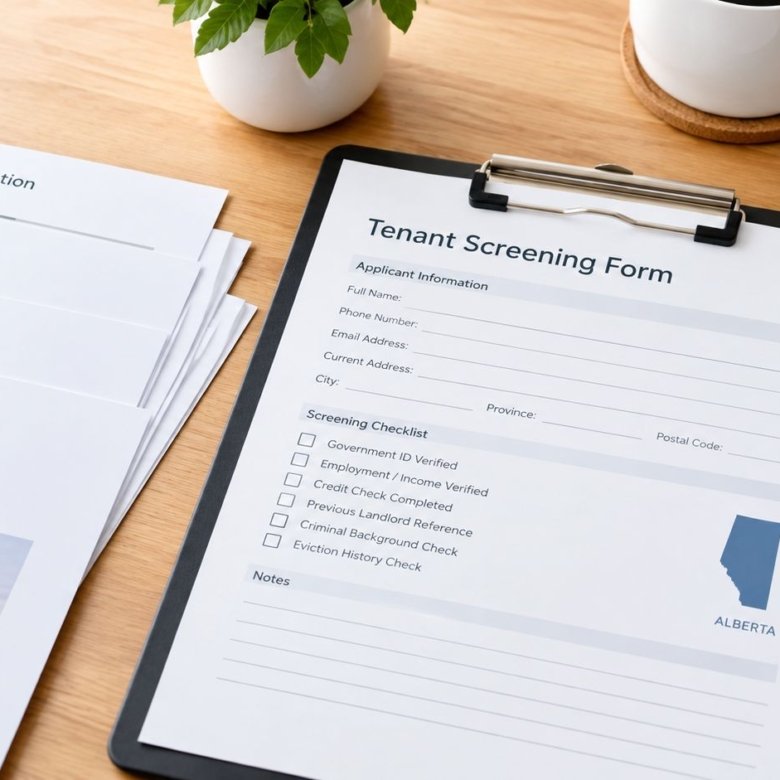

A Calgary condo owner may be preparing to advertise a vacant unit or renew a tenant's lease, only to discover that the lease doesn't answer questions about pets, parking, move-in procedures, building insurance, or who pays after damage. That's because a condo rental has another layer of obligations: the condominium corporation's governing documents and Alberta's condominium legislation.
The Condominium Property Act Alberta is the province-wide framework for condominium ownership and governance. For a landlord, it's a working reference, not just a statute to consult after a dispute. Before advertising, screening applicants, or renewing a tenancy, the owner or property manager needs to know which building documents apply, what the corporation requires, and how to record compliance.
Table of Contents
- Why the Condominium Property Act Matters to Alberta Landlords
- Two Legal Frameworks a Condo Landlord Must Follow
- Duties of the Owners Corporation
- Bylaws, Rules, and Enforcement
- Rental Notices, Deposits, and the Landlord's Paper Trail
- Reserve Funds, Special Assessments, and Owner Cash Flow
- Chargebacks and the 2026 Insurance Deductible Change
- Dispute Paths, Notices, and Board Eviction Authority
- Quick Reference for Common Landlord Scenarios
- Practical Onboarding Workflow for a New Condo Rental
Why the Condominium Property Act Matters to Alberta Landlords
A condo lease is only part of the compliance picture. The Condominium Property Act establishes the framework for creating and operating residential and commercial condominiums, including ownership rights, common-property responsibilities, and condominium-corporation administration. It applies to developers, owners, and people managing condominium property.
Alberta's condominium sector is a substantial part of its urban housing market. In its 2013 consultation, the provincial government said the Act had last been amended in 2000, while the sector had grown in size and complexity. At the time, Alberta had nearly 8,000 condominium corporations, representing hundreds of thousands of residents. Condominiums accounted for nearly 20% of homes sold through the provincial MLS during the preceding year, and nearly one in every three MLS home sales in Calgary and Edmonton. These figures are from the Alberta government's 2013 condominium consultation document.

Put the building file beside the lease
For a rental owner, the Act operates alongside tenancy law and the condominium corporation's bylaws and rules. This means a lease-up file should include more than an application, signed lease, and inspection report. It should also contain the current building documents, proof that the tenant received the relevant rules, and records of notices sent to the corporation.
Out-of-province owners face the same obligations as local owners, but may have less direct access to board communications or building staff. A manager should make the unit's condominium records part of the day-to-day property file, then revisit them before renewing or changing occupants. Owners seeking a broader introduction to the rental-specific issues can consult this condo rental legal guide from Towne and Country Property Management.
Two Legal Frameworks a Condo Landlord Must Follow
A Calgary applicant asks whether a dog can move into the unit. The lease may allow pets, but the condominium's registered bylaws may restrict them or set conditions. Before advertising a feature or approving a request, check which legal framework and building document govern it.
A condominium tenancy involves two overlapping legal frameworks. The Residential Tenancies Act generally governs the landlord-tenant relationship, including rent and tenancy notices. The Condominium Property Act and the corporation's bylaws and rules govern building-specific matters such as common property and building procedures. A lease cannot override those requirements.
Under s. 34 of Alberta's Condominium Property Act, the Act prevails over the Residential Tenancies Act to the extent of any conflict. For a landlord, that makes checking the relevant statutory provision and the corporation's governing documents part of lease-up, not a step to leave until a dispute arises. The Documind guide to statutory interpretation offers plain-language context on reading written laws.
Check the building rule before making a promise
Pet permissions are only one example. Parking, short-term stays, move-in procedures, and shared facilities can also be subject to condominium requirements. A showing promise or lease clause that contradicts those documents can create a dispute with the tenant or corporation.
Before publishing an advertisement, review the current bylaws and rules for the unit. Ask the owner or property manager for the latest versions, then confirm any specific restriction with the corporation when the documents are unclear. Give the tenant the relevant rules and keep a record of what was provided. This makes it easier to show what the tenant was told if a concern comes up later.
The practical test is to match each promise to its governing document. Confirm tenancy terms against tenancy law, and building access or use against condominium documents. That check helps avoid advertising a feature the tenant cannot use, or approving a request the corporation's rules do not permit.
Duties of the Owners Corporation
The condominium corporation is responsible for administering the building's shared affairs. Its work affects a rental owner's costs, access, and obligations, so document review should happen before purchase or lease-up, not only when a problem appears.
Alberta guidance identifies key corporation responsibilities, including maintaining common property, administering insurance, preparing an annual operating budget, and managing reserve-fund planning. The corporation also administers and enforces its bylaws. For an owner who isn't on site, the documents are how the building's decisions become visible.

Request records that connect duties to costs
Start with the current registered bylaws, rules, and enforcement policies. Then request the annual operating budget, recent financial statements, meeting minutes, insurance information, the latest reserve-fund study, and the corporation's reserve-fund plan. Meeting minutes can reveal proposed work or decisions that haven't yet appeared as a charge on the owner's account.
Alberta's government guide to owning a condominium outlines corporation responsibilities, including budgeting, common-property maintenance, insurance, and reserve-fund planning. For landlords, these are underwriting and operations records, not background reading.
A useful file-opening check is straightforward:
- Governance: Keep the current bylaws, rules, and enforcement policies.
- Financial position: Save the budget, financial statements, and reserve documents.
- Building decisions: Review meeting minutes and notices for approved or proposed work.
- Insurance: Obtain the corporation's insurance information and confirm the owner's own coverage.
- Rental setup: Record the corporation's contact details and its process for receiving tenancy notices.
A manager who can't get these records should treat that as an information gap to resolve before advertising or estimating the owner's ongoing costs.
Bylaws, Rules, and Enforcement
Bylaws and rules both shape how a tenant can use the building, but they aren't interchangeable. Bylaws set out how the corporation operates, including matters such as board elections and collection of condominium contributions. A condominium corporation may also adopt rules that supplement its bylaws. Where a bylaw conflicts with the Condominium Property Act or the Condominium Property Regulation, the Act or Regulation prevails.
For a landlord, this distinction matters before a listing goes live. A unit may have a parking stall, but the owner should check whether the stall is assigned and what parking conditions apply. An applicant may have a pet, but the owner needs to verify the building's pet requirements before agreeing to the tenancy. Move-in bookings, alterations, and short-term occupancy also need to be checked against the current documents.
Make the rules part of the tenant package
The corporation must enforce its bylaws and may impose monetary or other sanctions for breaches. A landlord should give the tenant the applicable bylaws and rules, keep evidence of delivery, and explain the building procedures during move-in. An informal verbal summary is a poor substitute when a later dispute concerns noise, parking, pets, or damage to shared areas.
A listing should describe only what the owner can confirm. If the documents are unclear about a feature or restriction, check with the corporation or its manager before representing it as available. For a related discussion of how restrictions may be challenged, see this guide to unenforceable strata bylaws. The working file should also capture later rule updates and show when the tenant was informed.
Rental Notices, Deposits, and the Landlord's Paper Trail
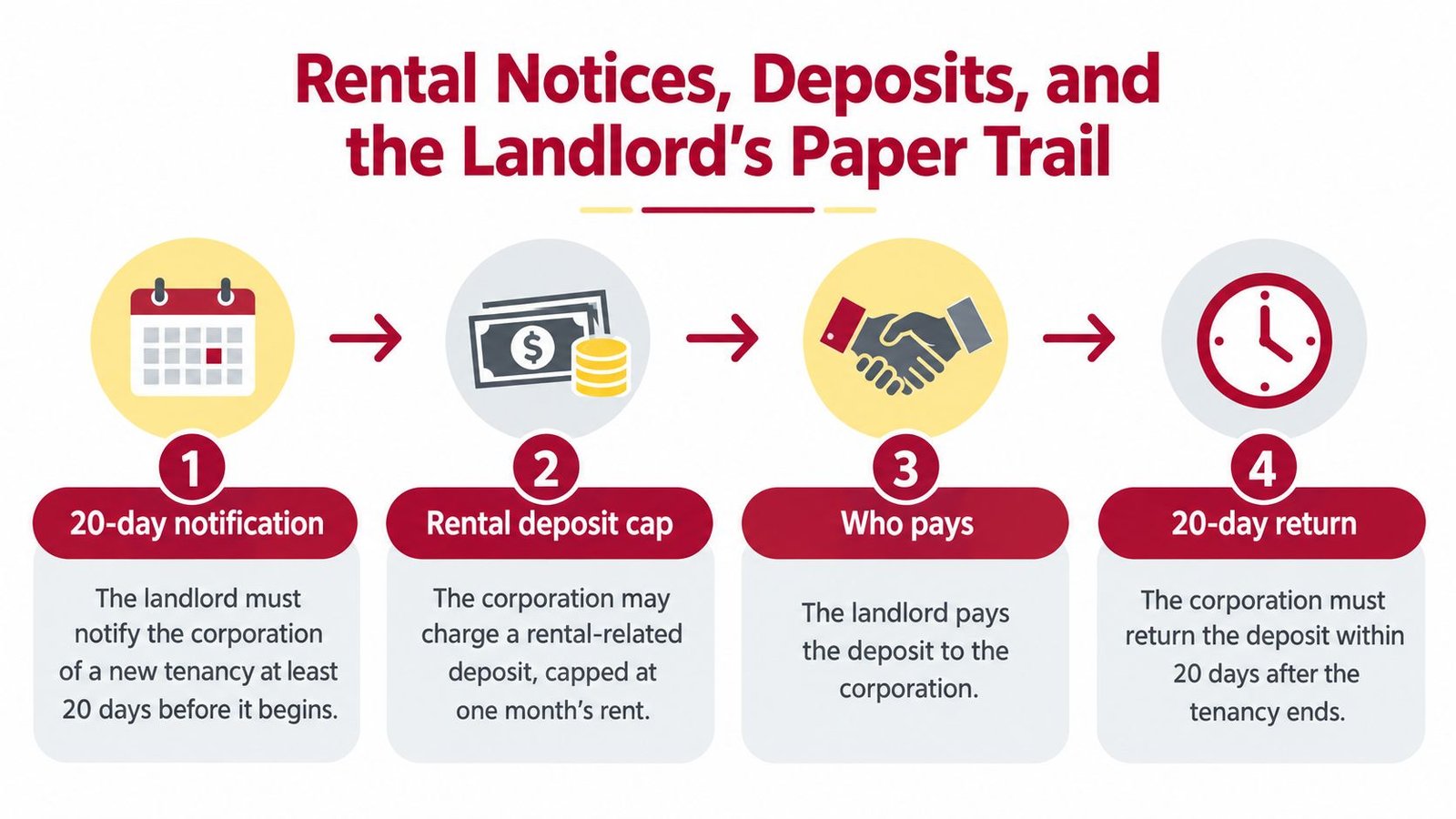
A Calgary condo owner preparing a lease-up should add corporation notices and deposit tracking to the move-in file before handing over the keys. Under the Condominium Property Act, the owner must notify the corporation in writing within 20 days after the tenancy begins, providing the intent to rent, service address, rent amount, and tenant's name. The owner must also give written notice within 20 days after the tenancy ends.
Add the corporation notice to the move-in workflow
If the corporation requires a rental-related deposit, the amount cannot exceed $1,000 or one month's rent, whichever is greater. The owner pays the deposit, not the tenant. The corporation can apply it to tenant-caused damage to condominium property, common property, or exclusive-use property. Once notified that the tenancy has ended, the corporation must return the balance within 20 days and give the owner an itemized statement of deductions.
Build these steps into the property file:
- At move-in: Send written notice with the tenant's name, rent, service address, and intent to rent. Save proof of delivery.
- For the deposit: Record the amount paid by the owner, payment date, and any written terms supplied by the corporation.
- At move-out: Notify the corporation in writing that the tenancy has ended, and retain delivery confirmation.
- After notice: Track the return deadline. Compare any itemized deductions with inspection reports and incident records before disputing a charge.
Keep the notices, tenant identification, rent details, deposit records, and delivery confirmations together. A missed deadline can expose the owner to corporation penalties. A complete file also makes it easier to organize evidence if the tenant or corporation disputes responsibility for damage. Record what was sent, when it was sent, and the corporation's response.
Reserve Funds, Special Assessments, and Owner Cash Flow
Condominium fees are not just a monthly operating expense. A portion supports the corporation's capital replacement reserve fund, which is intended for major repairs and replacement of corporation-owned property and common property, not work performed annually. That fund can affect an owner's cash flow through regular contributions, fee changes, or a special assessment.
Alberta guidance says a new corporation has two years from registration of the condominium plan to complete its initial reserve-fund study and approve a plan. Established corporations are expected to conduct reserve-fund studies every five years and prepare a reserve-fund plan. The corporation may fund required work through monthly contributions, temporary contribution increases, special assessments, borrowing, or a combination of approaches. See the province's reserve-fund guidance.
| Stage | Timing | Owner Action |
|---|---|---|
| Initial study and plan | Within two years of plan registration | Request the study and approved plan |
| Ongoing study cycle | At least every five years | Check the latest study and board plan |
| Funding and capital work | As determined by the corporation | Review contribution history and assessments |
Read the study alongside the budget
A reserve-fund study is a planning document, not a guarantee that no future assessment will occur. Review its recommended work against the current plan, annual budget, recent meeting minutes, contribution history, and any approved or proposed assessment. For an acquisition, these records help reveal whether the current fee appears connected to the building's long-term needs or whether upcoming work could change the owner's costs.
The obligation to contribute or pay an assessment belongs to the owner. Tenants remain subject to the applicable bylaws, rules, and policies through the tenancy arrangement, but they aren't a substitute for the owner's financial planning. For the insurance side of the unit's coverage, this resource on understanding your condo policy can help frame questions for an insurance professional. A further overview of reserve funding for condominiums can help owners understand why the study, plan, and fee history belong together in an investment review.
Chargebacks and the 2026 Insurance Deductible Change
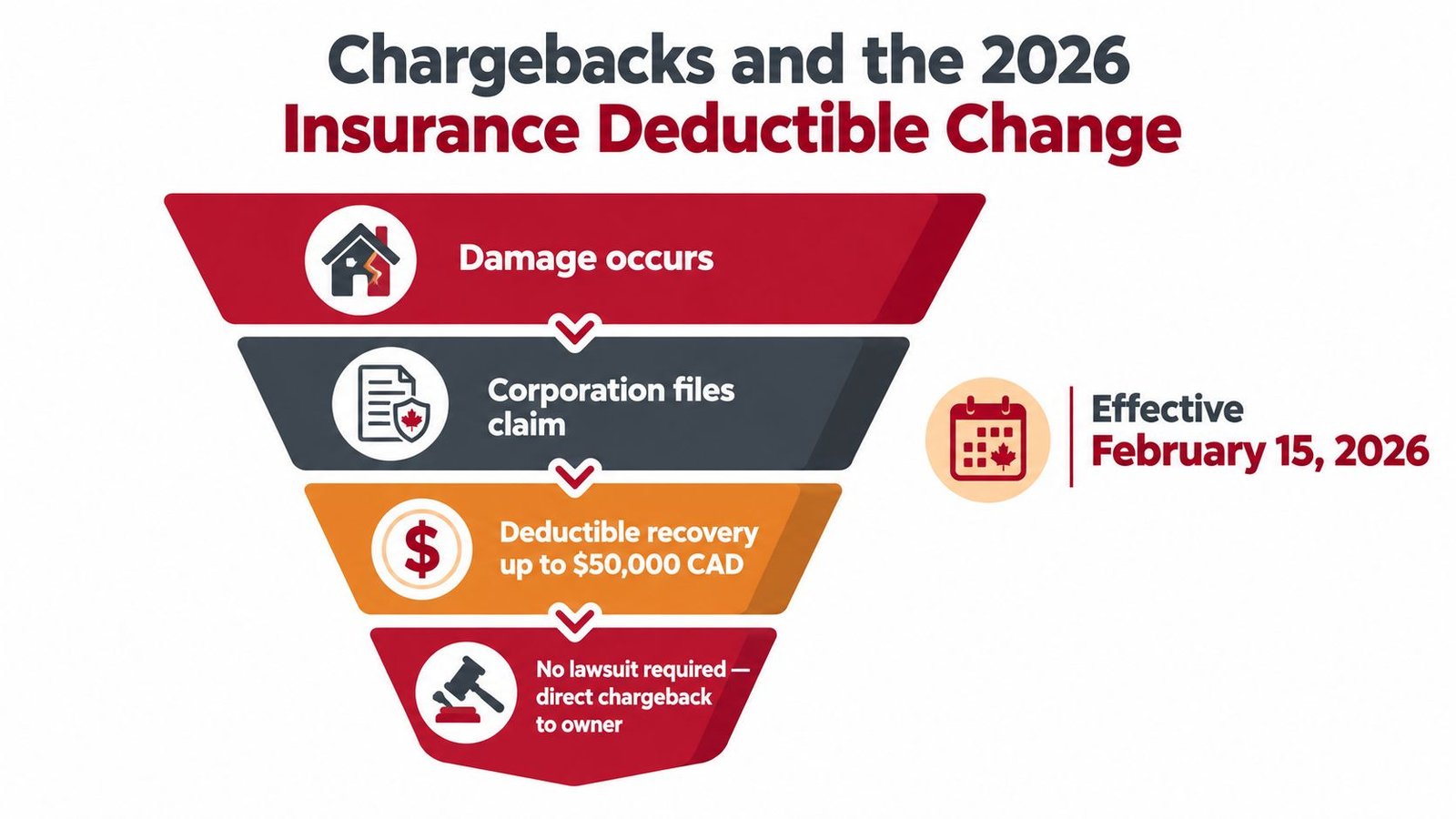
Effective February 15, 2026, Alberta's amendments permit a condominium corporation to recover up to the insurance deductible without filing an insurance claim, subject to a stated maximum of $50,000. The change makes it especially important for a rental owner to separate four questions: what the corporation is responsible for, whether the owner can be charged, whether the tenant may be liable, and what the owner's own condominium insurance covers. The provincial condominium communities guidance describes the amendment.
Follow the chargeback before deciding who bears the cost
Start with the corporation's notice and governing provision. Determine what damage occurred, which property was affected, and why the corporation says the owner is responsible. Then check whether the charge relates to an insurance deductible, whether an insurance claim was filed, and what appeal process and deadline apply.
Next, review the evidence about the tenant's actions. A corporation chargeback to the owner doesn't automatically establish that the tenant is liable. The lease, move-in condition report, photographs, incident records, and communications may matter if the owner considers pursuing a tenant-caused loss under the Residential Tenancies Act. Separately, the owner should ask their insurer whether their policy responds to the charge or the underlying damage. Don't treat the corporation's deductible and the owner's policy as a single expense.
A remote owner should request the incident report, the governing provision relied on, the written notice, invoices or repair documentation, the deductible amount, and the appeal deadline before paying or contesting a charge. This creates a clear record for the corporation process, any tenant claim, and an insurance discussion. The owner can also review this overview of Calgary condo insurance when checking which questions to put to an insurer.
Dispute Paths, Notices, and Board Eviction Authority
A building dispute can move beyond a routine landlord–tenant conversation. Alberta condominium guidance states that a condominium board may require a tenant to leave if the tenant causes damage, other than normal wear and tear, to common property or other corporation property, or violates a condominium bylaw. The board must give written notice to the tenant and serve notice on the unit owner. The owner can't prevent the board from carrying out that eviction authority, as explained in the guidance on renting a condominium.
Respond with records, not assumptions
Consider a noise complaint, a pet breach, repeated parking violations, or damage in a common hallway. The landlord should ask for the complaint details and any supporting records, then compare them with the applicable bylaw or rule and the tenant's file. If the owner receives a notice, record the date, identify any stated response or appeal deadline, and promptly communicate the issue to the tenant in writing.
The tenant package matters before a dispute starts. Provide the relevant rules at move-in, keep proof of delivery, and record any later updates that affect the tenancy. For damage allegations, retain inspection photographs, incident reports, messages, repair invoices, and the corporation's notice. For a conduct complaint, preserve written communications and any response from the tenant.
The owner should not promise that a board notice can be ignored or blocked. If the tenant disputes the allegation or the owner contests the board's action, follow the corporation's stated process and obtain legal advice where needed. Good documentation won't guarantee a preferred result, but it gives the owner a factual basis to respond.
Quick Reference for Common Landlord Scenarios
The fastest way to use condominium law in daily operations is to pair each decision with the document that answers it. An owner who checks the right records before advertising or approving a change is less likely to promise an amenity the building doesn't permit or overlook a notice obligation.
| Scenario | Where to Look | Document to Request |
|---|---|---|
| Advertising a unit | Bylaws, rules, and use restrictions | Current registered bylaws and rules |
| Screening an applicant | Occupancy and building requirements | Applicable policies and tenant information requirements |
| Adding or removing occupants | Corporation notice process and lease | Written procedure and updated tenancy notice |
| Handling pets or parking | Building restrictions and enforcement policies | Pet, parking, and common-area rules |
| Responding to a chargeback | Governing provision and corporation process | Notice, incident report, invoices, and appeal details |
| Anticipating an assessment | Reserve plan and board decisions | Reserve study, budget, and meeting minutes |
| Managing board-driven eviction | Bylaw enforcement and notice process | Written notice to tenant and owner |
Keep the table with the unit's operating file, then update the documents when the corporation issues revised rules, budgets, or notices. The relevant reference may be the Act, a bylaw, a board procedure, or a financial record. Identifying which one governs the decision is the useful first step.
Practical Onboarding Workflow for a New Condo Rental
A repeatable onboarding process prevents lease-up tasks from being handled in the wrong order. Before advertising, obtain and review the current registered bylaws, rules, enforcement policies, move-in procedures, parking information, and any restrictions that could affect the listing. Confirm the corporation's contact and notice process, then review its insurance information, budget, reserve-fund study, reserve plan, and meeting minutes.
Once the unit is ready to market, describe only the features confirmed by the building documents. During screening, verify the applicant's information and discuss the condominium rules that affect occupancy. Before move-in, complete the lease and condition documentation, deliver the relevant bylaws and rules, and keep evidence that the tenant received them. Send the corporation's written tenancy notice within the required period after the tenancy begins, and record any rental-related deposit paid by the owner.
Reusable condo tenancy checklist
- Before listing: Check bylaws, rules, parking, pets, move procedures, and occupancy restrictions.
- Before committing to costs: Review the current budget, reserve records, insurance information, and meeting minutes.
- At lease signing: Include condominium-compliance obligations and document the unit's condition.
- At move-in: Give the tenant the applicable documents and retain proof of delivery.
- During the tenancy: File corporation notices, tenant communications, incident records, and any rule updates.
- At move-out: Notify the corporation, document the condition, and track any deposit return or itemized deduction.
- Before renewal: Recheck the building documents and confirm that the proposed tenancy still fits the current requirements.
For owners managing a condo from outside the city, a property manager can keep these steps organised alongside leasing, inspections, maintenance coordination, and tenant communications. The file should make it easy to see what the owner promised, what the tenant received, and what the corporation was told.
Dreamhouse Realty Ltd. manages rentals across Calgary, Edmonton, Red Deer, and surrounding Alberta communities, including condominiums, townhomes, single-family homes, and small multifamily properties, with tenant placement and compliance oversight built into the operating process. Contact GURIQBAL CHAHAL, MBA, PMP, REAL ESTATE BROKER at 403-966-6072 for a free rental consultation and market analysis, or visit Dreamhouse Realty Ltd. to discuss a condo rental or management plan.