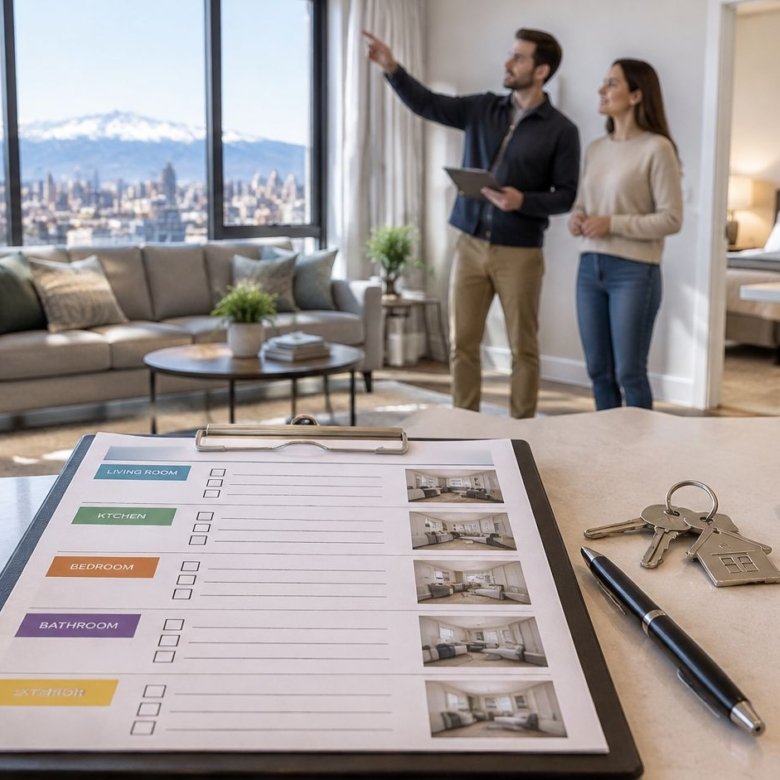
Alberta requires both a written move-in and a written move-out inspection report, each completed within one week before or after the relevant possession change, signed, and copied to the tenant immediately after inspection. An Alberta rental inspection form should capture those dates, the property's condition, signatures or required acknowledgements, and the record of copy delivery.
A Calgary landlord preparing for a turnover may already have keys to collect, cleaners to coordinate, and an incoming tenant waiting for access. The inspection form can look like the easiest task to squeeze into the gap. That's precisely when blank condition boxes, missing attendance records, and photographs without room labels become problems.
A useful form does more than list rooms. It connects what happened at the property with who attended, when the inspection occurred, and how the completed report reached the tenant.
Table of Contents
- Alberta Inspection Rules Under the Residential Tenancies Act
- The Seven-Day Window for Move-In and Move-Out Inspections
- Required Fields Every Alberta Inspection Form Needs
- Printable Room-by-Room Sample Template
- Completing the Form on Move-In and Move-Out Day
- Handling Absent Tenants and Remote Inspections
- Documentation Best Practices and Record Retention
- Self-Managed Versus Professional Inspections Compared
- Next Steps for Calgary and Alberta Property Owners
Alberta Inspection Rules Under the Residential Tenancies Act
For residential tenancies governed by Alberta's Residential Tenancies Act, both inspection reports are mandatory. The written record should describe the premises and identify defects such as scratches, burns, stains, and other damage, rather than declaring the property acceptable. Alberta also expects the landlord and tenant to inspect together and sign the completed report, with a copy supplied to the tenant immediately afterwards, as explained in the province's guidance on responsibilities during a tenancy.
That distinction matters. A checklist marked clean says little about a scratched floor. A photograph of the floor may show the scratch but leave uncertainty about which room it belongs to. The report and its supporting images should work together.
Separate legal requirements from useful supporting fields
A practical form should distinguish between required report elements and additional documentation that helps explain the inspection. Photographs, room-level initials, and a delivery log strengthen the working file, but owners shouldn't assume every useful field is independently prescribed by law.
The same caution applies to signatures. Official materials address required statements and acknowledgements, so a homemade signature line shouldn't be treated as a substitute for checking the applicable wording.
- Written condition record: Describe the premises as observed, including existing defects.
- Participation and acknowledgement: Record attendance and obtain the applicable signatures and statements.
- Tenant copy: Build immediate delivery into the inspection process rather than leaving it as later administration.
- Supporting evidence: Connect photographs and supplementary notes to the corresponding room entries.
For broader context, the Alberta RTA handbook for landlords can help owners organise inspection responsibilities alongside other tenancy obligations.
Why the form belongs in the compliance file
Alberta's guidance warns that a landlord may lose the ability to deduct damage or cleaning costs from the security deposit when inspection-report requirements haven't been satisfied. That's a procedural risk, not merely a problem with untidy paperwork.
Practical rule: A detailed photograph doesn't repair a missing inspection process.
For Calgary single-family homes, condos, townhomes, and small multifamily properties, a standardised form helps prevent omissions. The layout can vary by property, but the person completing it should never have to remember essential compliance steps from memory.
The Seven-Day Window for Move-In and Move-Out Inspections
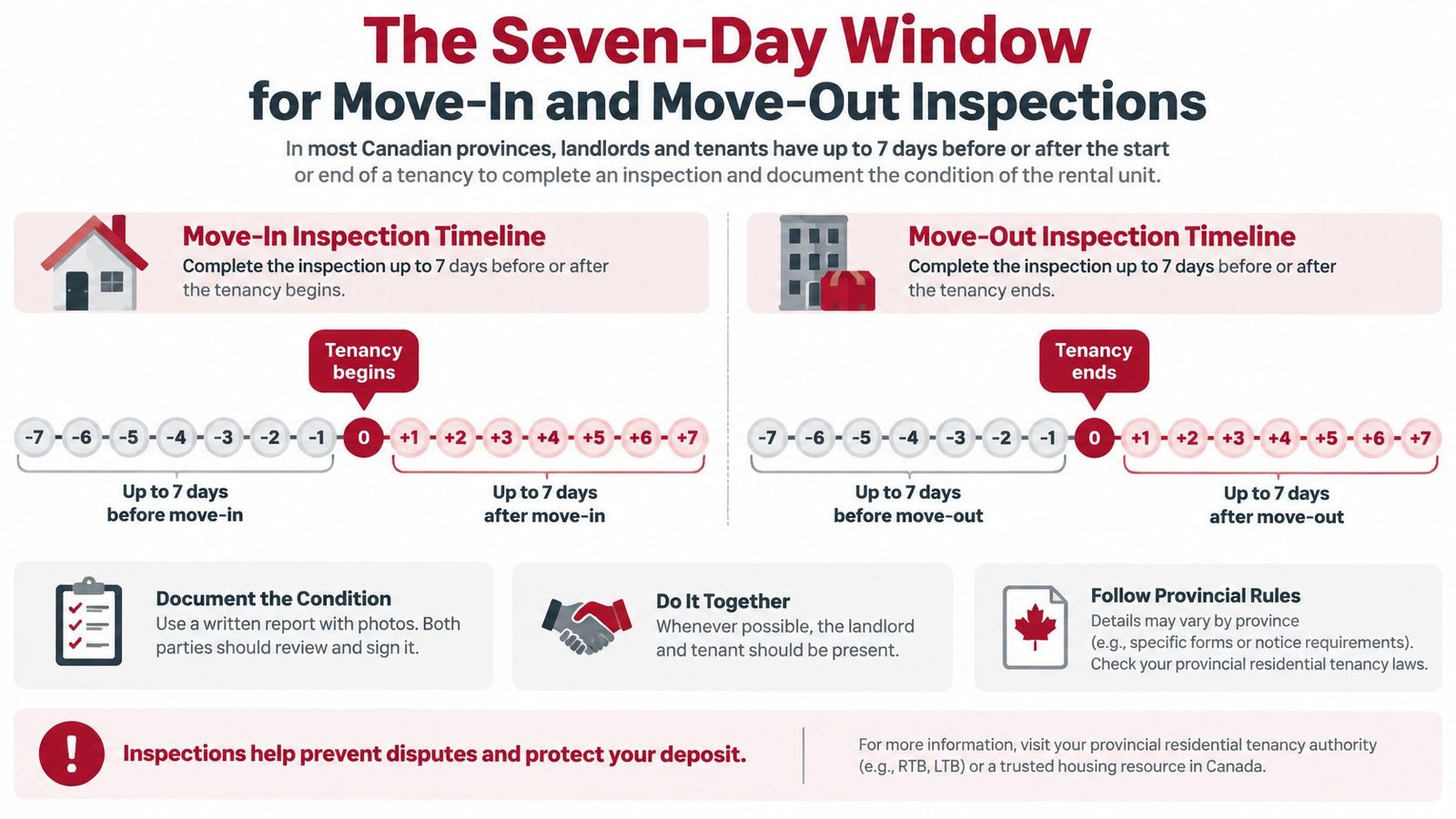
The inspection appointment should be scheduled around possession, not just around the cleaner's availability or the owner's next visit. Alberta requires the move-in inspection within one week before or after possession begins, and the move-out inspection within one week before or after possession ends, according to its official inspection-report guidance.
The timeline below provides a visual reminder of those permitted windows.
Record the event and the appointment separately
A form needs separate entries for the possession change and the inspection itself. When those dates are combined into a general tenancy date box, a later reviewer has to reconstruct what happened.
| Timeline point | Entry on the form | Scheduling purpose |
|---|---|---|
| Before incoming possession | Planned possession date and proposed inspection appointment | Establish the move-in inspection window |
| At the incoming inspection | Actual inspection date, time, and attendees | Record when the baseline was observed |
| Before outgoing possession ends | Expected surrender date and proposed appointment | Establish the move-out inspection window |
| At the outgoing inspection | Actual inspection date, time, and attendees | Record the outgoing condition |
The scheduled appointment should remain distinct from the appointment completed. If a tenant requests a change, preserve the correspondence and update the working calendar without overwriting the original offer.
Build contingency into the calendar
Scheduling at the outer edge of the permitted window leaves little room for a missed appointment, access problem, or incomplete walkthrough. An earlier appointment within the allowed period gives the owner more operational flexibility.
- Confirm possession details: Record when the tenant takes or gives up possession.
- Reserve inspection time: Allow enough time for notes, photographs, review, and completion.
- Flag appointment changes: Keep the original invitation and the revised arrangement.
- Assign responsibility: Identify who will attend, finish the report, and deliver the tenant's copy.
A late-night key handover shouldn't automatically become the inspection appointment. Owners should arrange a compliant inspection separately rather than allowing a convenient access time to dictate the entire process.
The form should also preserve any difference between the expected and actual possession dates. A clear explanation written when the change occurs is more useful than an undated note added after a disagreement.
Required Fields Every Alberta Inspection Form Needs
A usable rental inspection form in Alberta needs an administrative cover sheet and enough space to describe the premises properly. A room checklist without attendance and delivery records is incomplete as a working system; an excellent cover sheet without detailed condition notes is equally weak.
Alberta's information for landlords supports documenting the property's condition, identified damage, parties, and inspection details. The inventory below combines those essentials with recommended evidence-management fields.
Required Fields for an Alberta Inspection Form
| Field | Purpose | Compliance Point |
|---|---|---|
| Property address and unit | Identify the exact premises, including a basement suite or condo unit | Connect the report to the tenancy |
| Landlord, representative, and tenant names | Identify the parties and the person conducting the inspection | Clarify participation and responsibility |
| Inspection type | Mark move-in or move-out | Distinguish the baseline from the outgoing record |
| Inspection date and time | Record when observations occurred | Support verification of timing |
| Possession date | Record the relevant possession change | Connect the appointment to the permitted window |
| Attendees | Identify everyone present and their role | Document participation |
| Opportunities offered | Preserve proposed appointments and responses | Support the absent-tenant process where applicable |
| Room-by-room condition | Describe each included area | Establish a meaningful condition record |
| Identified defects | Specify location and observed characteristics | Avoid vague conclusions |
| Photo references | Match images to written observations | Make supporting evidence traceable |
| Statements and signatures | Include applicable official wording and acknowledgements | Address report-completion requirements |
| Copy-delivery record | Note recipient, method, and delivery time | Document provision of the completed report |
Write entries that another person can locate
A useful hypothetical entry is: Living room, hardwood beside balcony door, visible scratch running parallel to the threshold; see matching floor photograph. Another is: Kitchen counter beside hob, dark burn mark visible on the laminate surface.
Neither entry guesses who caused the defect. Both tell the next reader where to look and what the inspector observed.
- Prefer physical descriptions: State surface, location, appearance, and relevant measurements taken on site.
- Separate uncertainty: If a fixture wasn't checked, mark it not inspected and explain why.
- Avoid shorthand without a key: Abbreviations should mean the same thing to the tenant and manager.
The cover sheet should also identify attached continuation pages. Otherwise, a signed front page can become separated from the room notes that give it meaning.
Printable Room-by-Room Sample Template
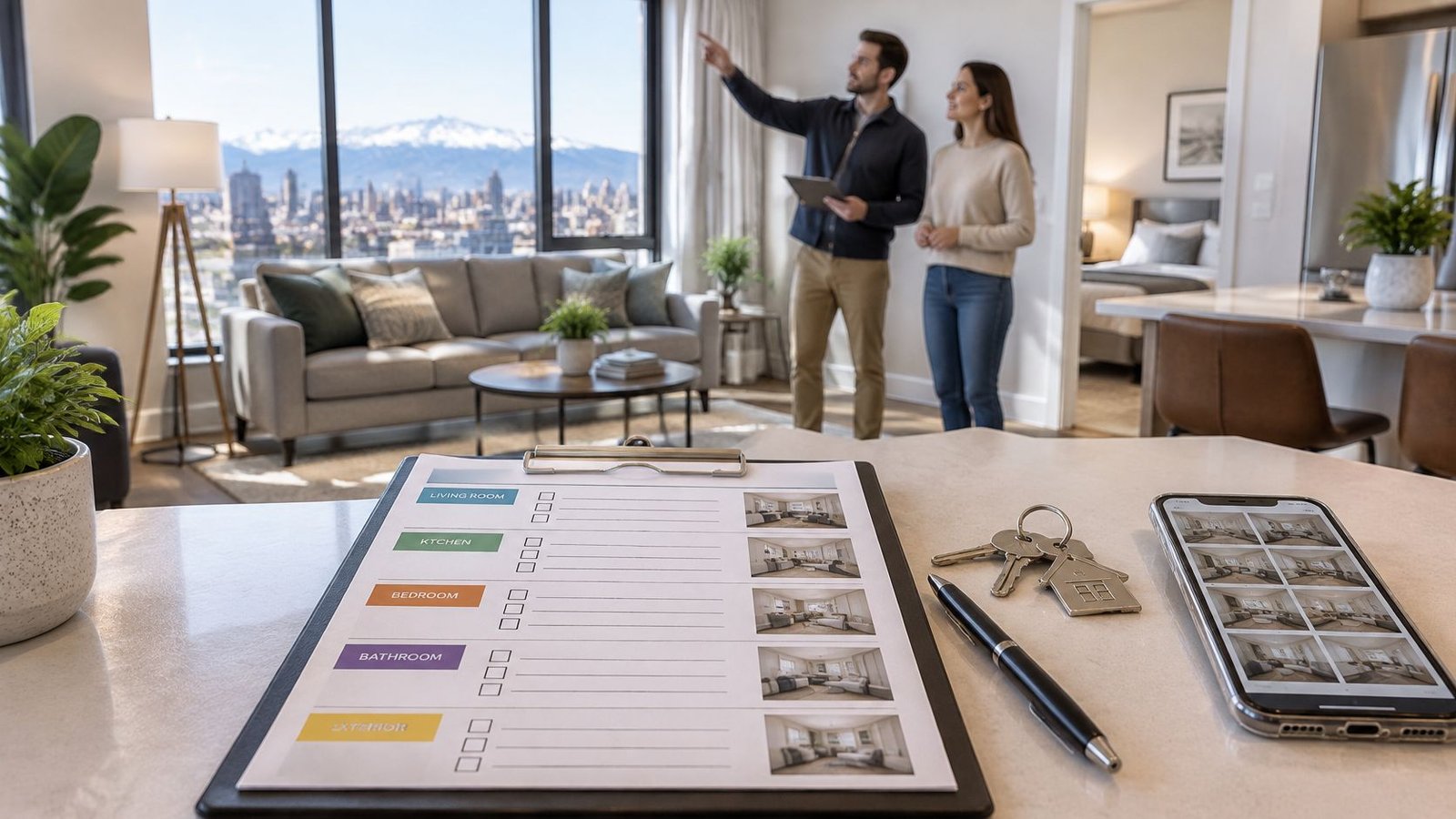
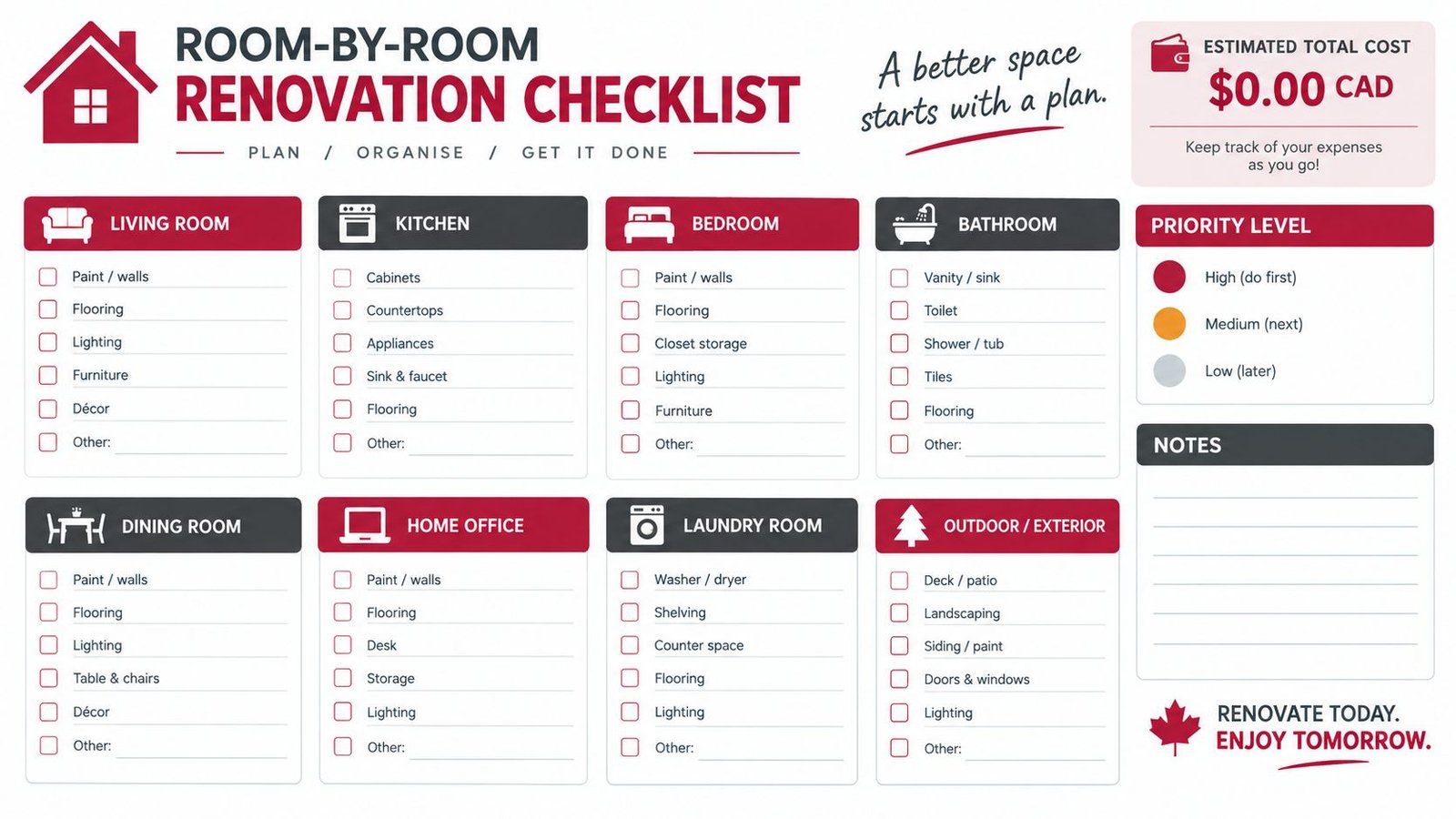
A rental inspection form needs room for specific observations, not just headings. Use the layout below as a working sample, then check that the completed form includes Alberta's required statements and acknowledgements. The linked image is a renovation-planning checklist, not a rental inspection form, so it should not be used as evidence or as a substitute for the room-by-room record.
Property and attendance sheet
| Entry | Space to complete |
|---|---|
| Property address and unit | ______________________________ |
| Inspection type | Move-in / Move-out |
| Landlord or representative | ______________________________ |
| Tenant names | ______________________________ |
| Possession date | ______________________________ |
| Inspection date and time | ______________________________ |
| Attendees and roles | ______________________________ |
| Appointment offers and responses attached | ______________________________ |
Use the same condition key throughout: no visible defect, existing defect recorded, not inspected, or not applicable. Record cleanliness separately from physical condition. A clean counter can still have a chip, stain, or other damage.
Room inspection sheet
| Area | Surfaces and items to review | Condition, cleanliness, and damage notes | Photo reference | Party initials |
|---|---|---|---|---|
| Entry points | Door, frame, threshold, flooring | __________________ | __________ | __________ |
| Living areas | Walls, ceiling, flooring, windows | __________________ | __________ | __________ |
| Kitchen | Counters, cabinets, sink, appliances | __________________ | __________ | __________ |
| Bathrooms | Fixtures, tile, vanity, visible sealant | __________________ | __________ | __________ |
| Bedrooms | Walls, flooring, doors, closets | __________________ | __________ | __________ |
| Laundry | Appliances, floor, surrounding surfaces | __________________ | __________ | __________ |
| Storage | Shelving, doors, walls, floor | __________________ | __________ | __________ |
| Exterior features | Included yard, balcony, garage | __________________ | __________ | __________ |
| Shared spaces | Relevant common access or shared areas | __________________ | __________ | __________ |
Copy the room sheet as needed, and label each bedroom separately. A single “bedrooms” entry can leave uncertainty about which room a note or photograph describes. For each defect, record its location and appearance. If a measurement is taken, include the unit.
- Defect prompts: Look for scratches, burns, stains, cracked fixtures, and worn flooring.
- Visibility notes: State whether a mark is visible in ordinary room lighting or only close up.
- Scope notes: Identify areas that are inaccessible or excluded instead of leaving blank fields.
- Photo references: Give each image a label that matches the relevant room and written observation.
Room initials can confirm that parties reviewed an area, but they do not replace applicable report signatures. Keep observations about shared spaces separate from the condition of the tenant's exclusive premises.
A condition label organises the report. The written description shows what the inspector observed.
Completion sheet
Provide space for tenant comments, applicable official statements, landlord and tenant signatures, and notes about refusal or non-attendance where relevant. Record copy-delivery details and attach the photo index and appointment records to the same file. This keeps the room observations connected to the report and its supporting records.
Completing the Form on Move-In and Move-Out Day
Consider a hypothetical move-in at an Edmonton townhouse. The representative arrives with the property sheet prepared, the tenant attends, and the inspection begins before boxes obscure the rooms. Alberta guidance recommends inspecting together, with the premises generally vacant unless both parties agree otherwise.
The representative records the actual start time and attendees before walking through the property. If furniture or stored items prevent inspection of an area, the report identifies the obstruction rather than treating the hidden surface as inspected.
Follow a repeatable route
The walkthrough starts at the entry and follows the room order printed on the form. At each location, the representative records condition, takes supporting photographs, and invites the tenant to identify anything missed.
A scratched floor is described before the group moves on. If the tenant disagrees with the description, the comments field records that disagreement without turning the inspection into an argument about responsibility.
- Observe before concluding: Describe the mark or defect without assigning a cause that hasn't been established.
- Photograph with context: Capture the room location as well as the close-up detail.
- Check the entry together: Make sure the wording reflects what was seen.
- Mark limitations: Note blocked access, unavailable areas, or items not checked.
For turnover preparation, the landlord cleaning and repair checklist from Canes Cleaners can serve as a separate task-planning aid. Cleaning instructions and contractor tasks shouldn't replace the inspection's record of observed condition.
Finish before everyone leaves
At the end, the representative reviews the completed entries with the tenant, including continuation pages and photo references. Any disagreement remains visible in the report instead of being removed to obtain a signature.
The applicable statements and signatures are then completed, and the tenant receives the finished copy through the chosen delivery method. The representative records that delivery while the details are fresh.
At move-out, the same walkthrough route supports comparison with the original baseline. The inspector should use the original report as a reference, not copy its conclusions automatically.
A prior scratch might be unchanged, more extensive, or no longer visible after a repair. Recording the outgoing observation separately preserves that distinction and avoids rewriting the history of the tenancy.
Handling Absent Tenants and Remote Inspections
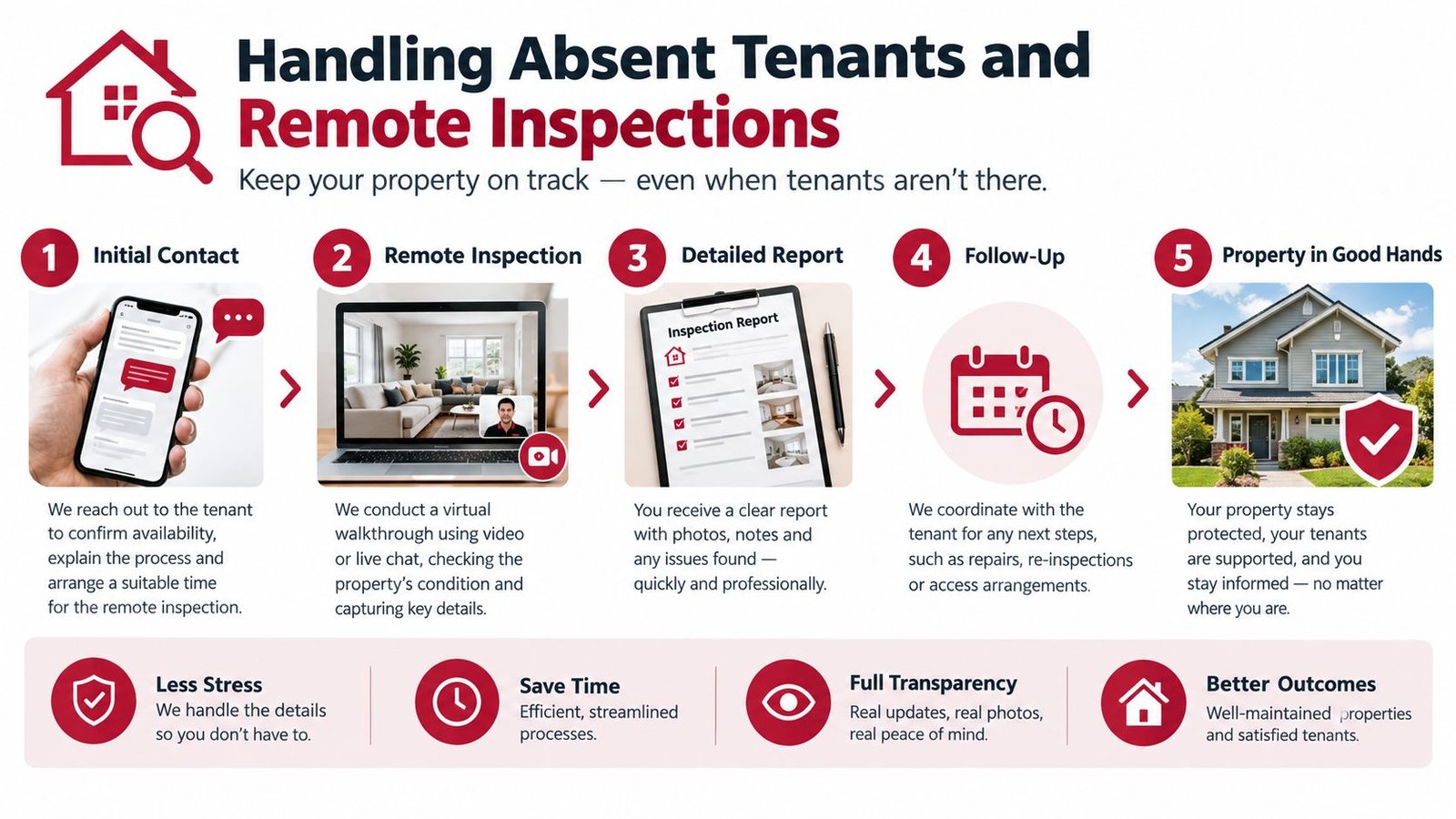
A video call isn't a substitute for Alberta's inspection process. Remote participation, emailed comments, and uploaded photographs can support the file, but owners still need to address attendance opportunities, timing, required statements, signatures, and delivery.
Alberta permits inspection without the tenant only after two opportunities on different days, excluding holidays, between 8 a.m. and 8 p.m., when no adult tenant agrees to participate, as reflected in its guidance on ending a tenancy.
The process below helps remote owners distinguish access arrangements from inspection documentation.
Preserve the decision trail
- Offer compliant appointments: State the proposed dates, times, location, and attending representative clearly.
- Save responses: Preserve acceptance, refusal, requests to reschedule, or the absence of a response.
- Document what occurred: Record who attended and whether an appointment was missed.
- Complete the applicable report process: Use the required statements and accurate attendance notes, without suggesting the tenant agreed when they didn't.
- Deliver and file: Keep the completed report, delivery record, photographs, and correspondence together.
An out-of-province owner can arrange a local representative to conduct the physical walkthrough. The owner's absence shouldn't be confused with the tenant's absence; each raises different practical questions.
Handle access and refusal separately
A lockbox provides access. It doesn't prove that the tenant received proper inspection opportunities or accepted the report.
Similarly, a tenant who attends but refuses to sign is different from a tenant who never attends. The representative should record the refusal, relevant comments, and circumstances accurately, then check the applicable official requirements rather than inventing an acknowledgement on the tenant's behalf.
For cleaning coordination, Aquastar Cleaning Services, LLC's end-of-tenancy cleaning advice for landlords may provide task prompts. It shouldn't be used as authority for Alberta inspection procedure or deposit decisions.
Late-night turnovers need advance planning. The practical solution is to separate key access, cleaning access, and the inspection appointment instead of assuming that a remote video recording resolves every requirement.
Documentation Best Practices and Record Retention
Alberta requires landlords to retain inspection-report records for three years after the tenancy ends, under the official inspection-report guidance cited earlier. The retention trigger belongs in the property's records calendar, not merely in the memory of whoever handled the turnover.
A complete file should remain understandable even if a different manager takes over. That means preserving both the finished report and the material needed to explain how it was completed.
Keep a coherent inspection package
- Completed reports: Store the signed or otherwise appropriately documented versions, including attachments.
- Photo set: Preserve dated originals with room labels and matching report references.
- Appointment history: Keep offered appointments, tenant responses, and attendance notes.
- Delivery evidence: Save the record showing how and when the tenant's copy was provided.
- Condition correspondence: Retain relevant written comments about damage, disagreements, and later clarifications.
A practical folder structure separates move-in, move-out, correspondence, photographs, and subsequent work. The property address and tenancy identifier should appear consistently so that records from neighbouring units don't become mixed.
Use descriptive file names such as living-room-balcony-threshold-move-in rather than relying entirely on a phone's automatically generated image name. Keep an index if photo references on the report use a different naming system.
Preserve originals and make comparisons easier
Photographs should be taken from comparable positions at move-in and move-out. A wide view from the doorway and a clearly located detail image make later comparison easier than unrelated close-ups.
File-handling principle: Preserve the original record, then add explanations separately.
Cropping an image for clarity can be useful, but the original should remain available. Likewise, a later clarification should be dated and stored as an addition rather than replacing the completed report.
Secure digital storage with controlled access is more practical than leaving records across personal phones and email accounts. A physical backup may also be appropriate where paper originals or local operating arrangements require it.
Inspection findings that lead to maintenance should connect to a separate work record. A maintenance work-order template can help track the scope, contractor instructions, and completion evidence without confusing the original condition report with the repair history.
The final test is retrieval: another authorised person should be able to locate the baseline, outgoing report, relevant photographs, and delivery evidence without searching unrelated messages.
Self-Managed Versus Professional Inspections Compared
Self-management can work well when a local owner has reliable availability and follows a documented process. Professional management becomes more useful when distance, competing commitments, or several properties make consistent attendance difficult.
The meaningful comparison isn't owner versus professional as a label. It's whether the person responsible can complete the entire process, including the administrative work after the walkthrough.
| Decision factor | Self-managed approach | Professionally managed approach |
|---|---|---|
| Scheduling | Owner coordinates appointments personally | Local team coordinates within its operating process |
| Documentation | Quality depends on the owner's form and habits | Owners should confirm the team's actual report standard |
| Absent tenants | Owner preserves offers and responses | Representative manages the attendance record |
| Property access | Straightforward for an available local owner | Useful when the owner can't attend |
| Record retrieval | Owner maintains the storage system | Document access should be confirmed before appointment |
| Cost and control | More direct involvement and unpaid owner time | Management fees in exchange for delegated work |
Assess the process before appointing a manager
A management proposal should explain who attends, what the report contains, how photographs are indexed, and how owners receive documents. A promise to inspect isn't enough if the owner can't obtain the completed file later.
Dreamhouse Realty Ltd. is a licensed property management and real estate brokerage serving Calgary, Edmonton, Red Deer, and surrounding Alberta communities. As one management option, it provides routine and move-out inspections with documented condition reports and photo evidence, alongside owner-portal access to documents and service updates.
Owners considering delegation can review property management for small landlords when deciding which responsibilities to retain and which to assign.
Keep cleaning and inspection responsibilities distinct
Hiring cleaners doesn't automatically assign responsibility for the inspection report. The owner or manager still needs to identify who records condition before cleaning or repairs change what can be observed.
For the separate cleaning decision, Eco Clean Solutions' discussion of time savings with professional tenancy cleaning can help frame the trade-off between personal labour and delegated work. Alberta compliance decisions should remain grounded in provincial guidance, not cleaning-service advice.
The strongest arrangement makes ownership explicit. Someone must be accountable for the appointment, report, tenant copy, and final archive, whether that person is the landlord or a local property manager.
Next Steps for Calgary and Alberta Property Owners
The immediate priority is a complete working inspection package, not a more attractive blank form. Owners should copy or print the sample layout, check the applicable official wording, and adapt the room inventory to the actual rental.
A condo may need a balcony and storage entry. A townhouse may include a garage and yard. A small multifamily property needs clear separation between the rented premises and any shared areas documented during the visit.
Prepare the next turnover file
- Adapt the template: Add missing rooms, included features, and sufficient continuation space.
- Confirm responsibilities: Identify the attending representative and the person responsible for final delivery and filing.
- Enter the key dates: Record the expected possession change and schedule within the permitted inspection window.
- Prepare the evidence system: Create the photo labels, attendance record, and delivery field before the appointment.
- Check completion wording: Confirm that the form contains the applicable statements and acknowledgement provisions.
A short practice review can reveal weaknesses before the next tenant arrives. If the form has nowhere to record a disagreement, inaccessible room, or revised appointment, it needs adjustment before it is used.
Decide how the work will be handled
Local owners with dependable availability may prefer to retain the walkthrough and filing responsibilities. Remote owners should arrange local attendance early rather than waiting until travel or access problems arise.
The decision should account for the whole assignment. The visible walkthrough is only part of the work; appointment correspondence, report completion, tenant-copy delivery, and organised storage also require ownership.
An inspection report shouldn't promise a particular deposit outcome. Its purpose is to preserve an accurate, properly completed condition record that can support later decisions.
For an unusual tenancy, disputed attendance history, or uncertainty about the required wording, owners should check current Alberta materials and obtain advice appropriate to the circumstances. General templates are useful starting points, but they can't resolve every factual or legal issue.
The most effective next step is concrete: prepare the property-specific form, assign the inspection responsibility, and confirm the next appointment before turnover activity crowds the calendar. That gives the owner a usable process instead of another document waiting to be completed.
Dreamhouse Realty Ltd. offers inspection coordination, documented condition reporting, and compliance oversight for residential rentals in Calgary and other Alberta communities. Owners seeking support with inspection appointments, absent-tenant documentation, and organised records can visit Dreamhouse Realty Ltd. and contact GURIQBAL CHAHAL, MBA, PMP, REAL ESTATE BROKER, Phone 403-966-6072, to discuss their property's next turnover.