

A Calgary condo owner opens the mailbox, sees a chargeback letter, and realises the building's water loss has become a personal bill. That's a detail frequently overlooked when shopping calgary condo insurance on price alone, the monthly premium is only one side of the risk. The other side is the corporation's deductible, and in Calgary that number can land on a single owner after one claim if the bylaws and policy language line up that way.
The Alberta market has made this worse, not better. Calgary benchmark data shows a typical water deductible of $25,000 based on more than 60 samples, a typical flood or sewer deductible of $50,000, and a minimum earthquake deductible of $100,000 plus about 5% of insured value Rates.ca Calgary condo insurance data. Strata Reports also estimates 1.1 water incidents per 100 units per year and an average repair cost of $11,293 per incident Rates.ca Calgary condo insurance data. That's why the story in Calgary isn't just “what does the policy cost”, it's “how much of the building loss can end up parked on one owner”.

Table of Contents
- The Letter That Surprises Most Calgary Condo Owners
- How Alberta Splits Coverage Between Corporation and Owner
- What the Standard Insurable Unit Description Actually Decides
- Coverages Every Calgary Condo Owner Should Actually Carry
- Why Tenants Need Their Own Condo Insurance Too
- Landlord Condo Insurance for Non-Owner-Occupied Units
- What Calgary Pricing and Deductibles Look Like
- A Practical Checklist for Shopping Calgary Condo Insurance
The Letter That Surprises Most Calgary Condo Owners
The letter usually shows up after the cleanup trucks leave. It says the corporation's insurer handled the building claim, then the corporation is charging back part of the deductible to the owner tied to the loss. That is the point many Calgary owners find out their own unit policy and the corporation's master policy do different jobs.
Why one owner can end up holding the bill
The insurer pays under the corporation's policy, then the corporation checks its bylaws, its insurance certificate, and the loss details to decide whether a deductible gets assigned back. That is where the trouble starts. A loss that looks like a building problem from the hallway can turn into one owner's bill once the board reviews the paperwork.
Practical rule: if the loss started in one unit, or was traced to one unit, the deductible conversation gets personal fast.
Calgary owners see this pattern because shared buildings move risk around very quickly. Magnum York cites Alberta condominium claims data showing insurers paid more in claims than they collected in premiums, along with a high share of condos experiencing claims and a large portion of losses rising above standard limits. That is the backdrop for the chargeback letter. Water losses, fire damage, and other building claims do not stay neatly inside the corporation's file when the bylaws allow recovery from one unit.
Owners and landlords who ignore the corporation side of the policy are taking a real gamble. The better move is to treat the unit policy as protection for the suite and for the deductible exposure that comes with living in a shared building.
How Alberta Splits Coverage Between Corporation and Owner
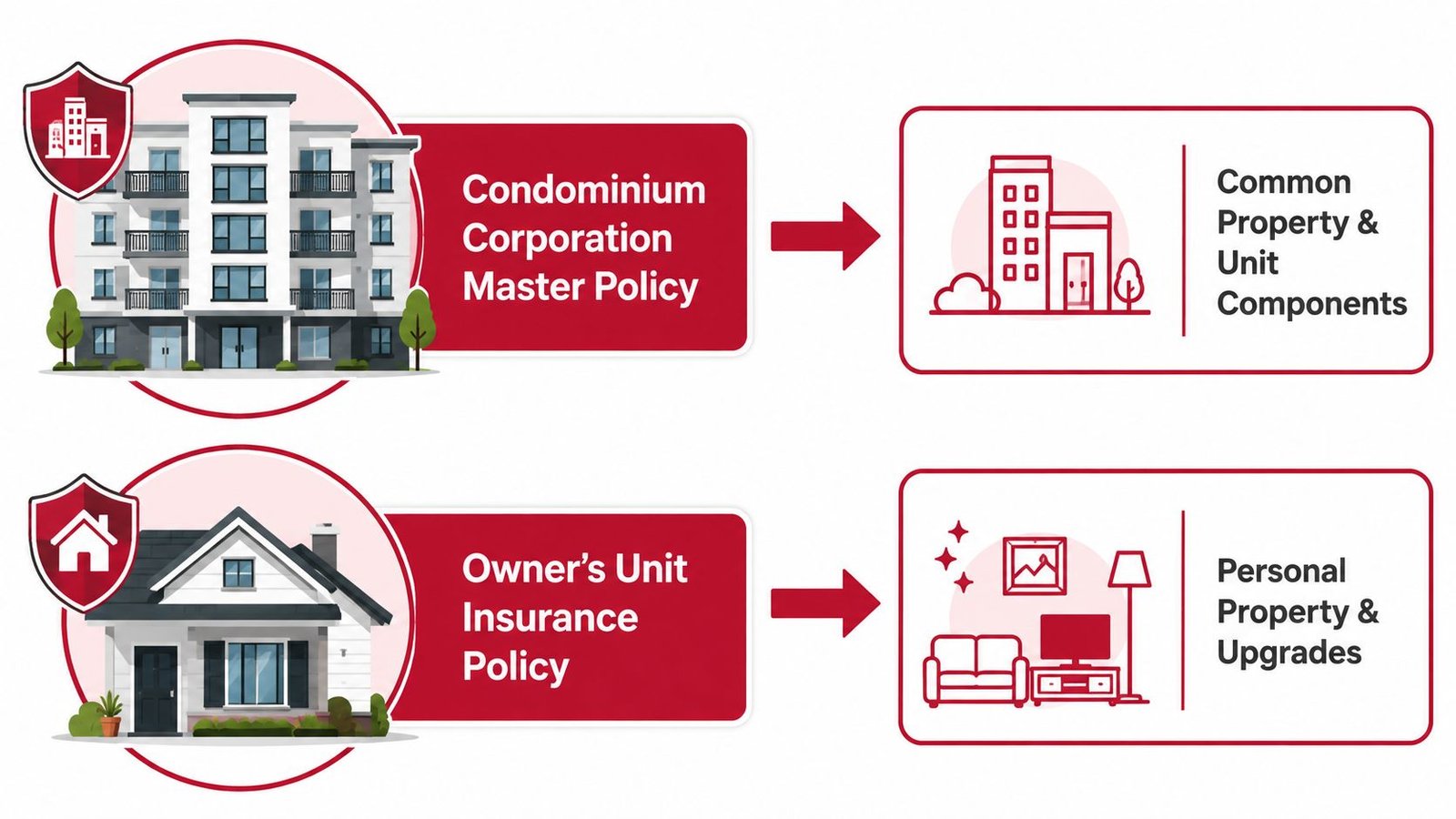
A Calgary owner can end up paying for a building claim through two different paths. The corporation's master policy handles the structure and shared property, then the owner's unit policy handles the suite-level exposure that the corporation does not carry for one person.
That split is where a lot of people get burned. A condo policy is not house insurance, and it should not be treated that way. The master policy protects the building as a whole, while the unit policy covers the items inside the unit, the upgrades the owner paid for, and the personal liability that follows the owner, not the corporation.
Provincial law does not force every owner to buy condo insurance, but that does not make it optional in real life. Lenders expect it. Condo bylaws often require it too CitySearch Calgary. A buyer may technically take title without a unit policy, then run into trouble the moment a mortgage renewal, a board review, or a claim asks for proof of coverage.
Alberta also sets hard rules on what the corporation must insure. The corporation's policy has to be at least at replacement value, and it must cover a set of perils that includes fire, lightning, smoke, windstorm, hail, explosion of gas, flood, sewer backup, sudden and accidental escape of water or steam, riot, vandalism, and other risks required by the bylaws CondoLawAlberta. The corporation must also insure against fraudulent or dishonest acts by a board member or manager, at least up to the reserve fund and operating account balances at the start of the fiscal year.
That structure matters for owners because insurance costs do not stay trapped inside the corporation's file. Shared risks show up in maintenance fees, deductible charges, and reserve planning Condo maintenance fee realities in Calgary. If the board starts a deductible chargeback after a water loss or other claim, one owner can end up carrying a bill that came from a building-wide policy.
What the Standard Insurable Unit Description Actually Decides
The Standard Insurable Unit Description, or SIUD, is the document that turns the coverage split into black and white. Alberta requires the corporation to give the SIUD to its insurer and to all unit owners, and it sets out which fixtures and finishes sit under the master policy and which ones belong on the owner's policy Open Alberta SIUD guidance. If that description is sloppy, the claim gets messy fast. If it is precise, owners know exactly where the corporation's responsibility ends and their own begins.
A suite example that Calgary owners recognise
Take a renovated Calgary condo suite. Builder-grade carpet in the bedroom is one thing, upgraded hardwood flooring is another. The original kitchen faucet may still fall under the corporate description if it is standard, while a designer fixture moves into owner territory. The same applies to cabinets, countertops, and non-chattel appliances, the SIUD needs to spell out what counts as standard and what counts as an owner upgrade.
That distinction matters after a loss. If the corporation's policy restores the suite only to the original standard, the owner with upgraded finishes pays the gap. A unit that looked fully “covered” on paper can still leave the owner short once the repair quote lands.
A board should not hand out a vague policy summary and call it enough. Owners need the actual SIUD before they buy, and again before they renovate.
A practical owner should ask for the SIUD before purchase completion and before any major reno. That single document tells the truth about whether the corporation covers basic finishes only, or whether certain fixtures and improvements move with the owner's policy. In Calgary, that question decides who pays when a loss forces the unit back to standard.
Coverages Every Calgary Condo Owner Should Actually Carry
A Calgary condo policy should close the gaps the corporation policy leaves open. That is the point. The true test comes after a loss, when the building's deductible, the SIUD, and a chargeback land on one owner's desk and the only question left is whether the policy pays.
Four coverages do the heavy lifting, and each one solves a different problem.
| Coverage | What It Pays For | Calgary Loss Scenario |
|---|---|---|
| Contents coverage | Personal belongings like furniture, clothing, electronics, and other moveable property | A burst pipe upstairs soaks the living room and the owner has to replace furniture and damaged personal items |
| Betterments and improvements | Upgrades, renos, and finishes the owner paid for beyond the SIUD standard | The SIUD only restores builder grade, so a renovated kitchen needs the owner's policy to bridge the gap |
| Personal liability | Legal defence and damages if someone is injured or property is damaged in the suite | A guest slips on a wet floor and the owner faces a claim |
| Loss assessment | The owner's share of a corporation chargeback or special assessment tied to a covered loss | The corporation charges back $10,000 of its $25,000 water deductible |
Contents coverage is the first policy feature owners should verify, and it is still the one they overlook most often. A water event can wipe out a laptop, couch, rug, and wardrobe in one shot, and replacement costs add up fast. Without contents coverage, the owner funds the restart alone.
Betterments and improvements deserve the same attention. Calgary owners renovate kitchens, replace flooring, and upgrade fixtures because they expect the suite to feel better now and sell better later. If the corporation only restores the unit to the SIUD standard, the owner's improvements need their own coverage to avoid a shortfall.
Personal liability is where too many owners get caught off guard. If someone gets hurt in the suite, or if the owner damages another unit, the claim can turn expensive quickly. Lenders and condo bylaws often set minimum liability expectations, so owners should confirm the limit instead of guessing.
Loss assessment is the sleeper issue, and it belongs in almost every Calgary condo discussion with a broker. It can pay for a chargeback after a building claim, which matters when the corporation's deductible is high enough to land a meaningful bill on a single owner. One owner can end up holding a charge that is far bigger than a year of premium.
Why Tenants Need Their Own Condo Insurance Too
A tenant who thinks the landlord's insurance will cover everything is setting up a bad day. The corporation's master policy and the landlord's unit policy do not pay for a renter's belongings, and they do not protect a renter who causes damage from being sued. If a tenant floods a unit or injures a guest, the claim can land on both the owner and the corporation, and the tenant can still get pulled into the middle.
What a tenant policy usually covers
A proper renter policy usually starts with contents coverage, then adds liability and additional living expense protection. That matters because a renter's laptop, clothing, furniture, and daily items are not the landlord's responsibility. If the suite becomes uninhabitable, additional living expense coverage helps the tenant avoid paying for temporary housing alone.
Calgary landlords should stop treating tenant insurance as a favour and start treating it as a lease condition. The lease can require proof, and the landlord should keep that proof on file at move-in. Alberta tenancy rules still govern the relationship, but the lease can make insurance a condition of occupancy in practice Dreamhouse Alberta landlord and tenancy resources.
The insurance ask belongs in the lease package, not in a casual conversation after keys are handed over.
Landlord habit that saves trouble: collect the policy declarations page before possession day, not after the first incident.
The landlord should ask for the insurer's name, policy number, effective dates, liability limit, and proof that contents and additional living expense coverage are active. If the tenant cannot produce that, the landlord should not shrug and hope for the best. A rental suite can turn into a liability problem overnight when the wrong person assumes someone else is insured.
Landlord Condo Insurance for Non-Owner-Occupied Units
A rented condo needs a different policy setup from an owner-occupied unit. The landlord carries different risks, because the unit produces income and someone else is living there. If the insurer never knew the suite was rented, a standard condo policy can leave the owner exposed right when a claim gets ugly.
The gaps that show up at claim time
Disclosure is the first weak point. If the policy was written for owner occupancy and the unit is rented, the insurer can reduce coverage or challenge the claim once it reviews the file. Lost rent is the second weak point. If a loss makes the suite unlivable, the landlord needs rental income coverage, or the cash flow stops while repairs drag on.
Landlord contents are the third weak point. A refrigerator, stove, or any other appliance owned by the landlord is not the tenant's property, and it should not be treated that way under the policy. If the condo is insured like a regular owner unit, those assets can sit outside the protection the owner expected.
A landlord-specific condo policy fixes that mismatch by adding rental income protection, landlord contents, and stronger liability protection for tenant-related claims. That setup fits a Calgary investor who wants the policy to match how the unit is used. A suite that sits empty during repairs still carries costs, and the insurance has to account for that.
The difference shows up fast after a loss. If an upstairs flood leaves the suite uninhabitable for two months, the right landlord policy keeps the rent replacement claim in play while the repairs happen. Without that layer, the landlord takes the vacancy hit and the repair disruption at the same time.
For anyone buying a rental unit for the first time, first-time rental property buyer guidance is worth reading before the policy is signed, because the ownership model changes what the insurance needs to do.
Calgary and Edmonton condo bylaws can also limit how many units in a building are rented, and that affects underwriting and sometimes the insurer's appetite for the risk. A landlord who ignores that can end up with a policy that looks fine on paper and turns awkward at renewal.
What Calgary Pricing and Deductibles Look Like
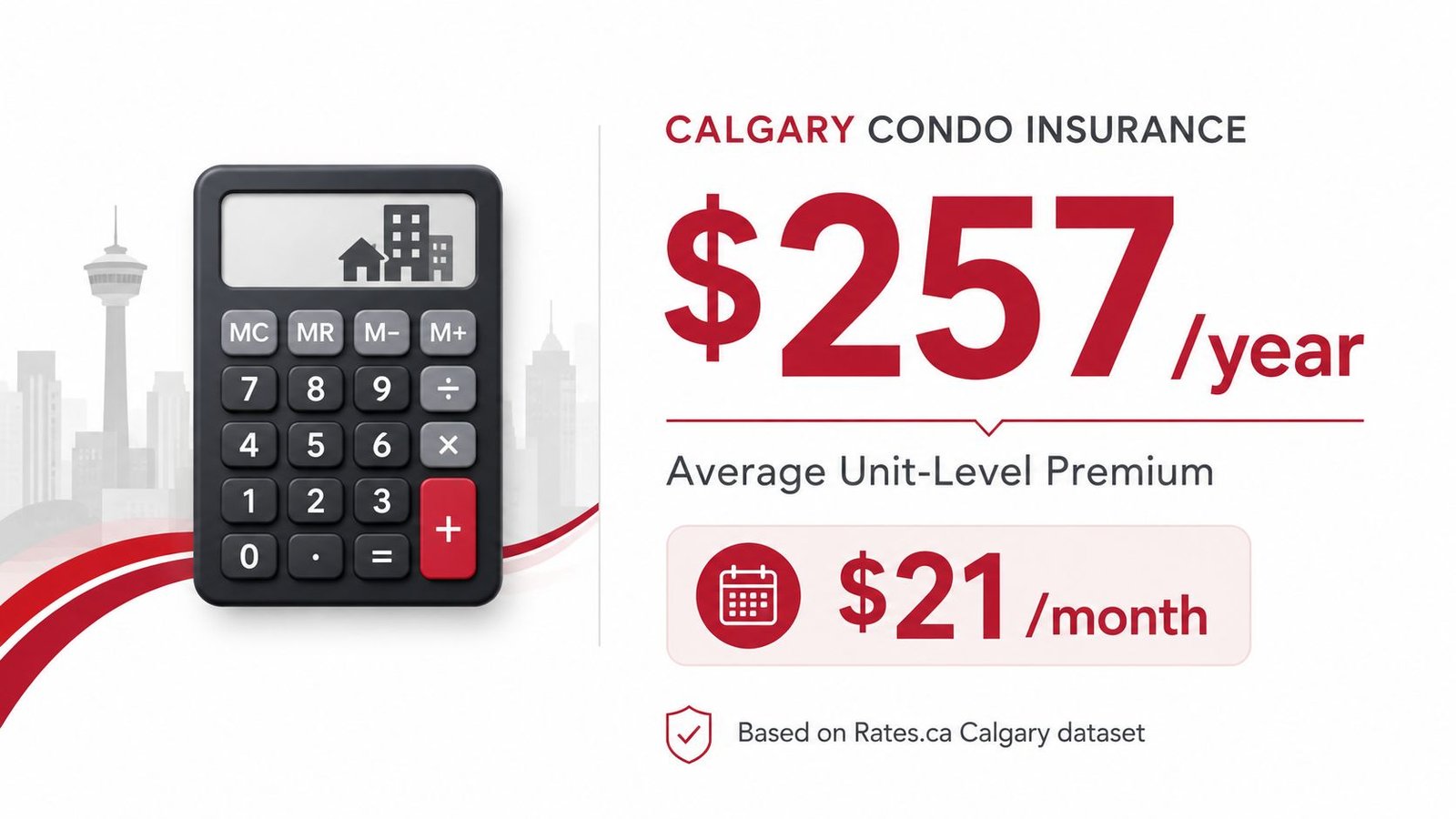
Calgary condo insurance can look cheap on the quote and expensive when the loss lands on the owner. Rates.ca data puts Calgary condo insurance at about $21 per month or $257 per year, with Alberta averaging about $253 per year in the same dataset. That number is small enough to lull people into comfort, right up until the deductible gets charged back after a water claim.
The deductible problem dwarfs the premium
The same Calgary benchmark data shows a typical $25,000 water deductible, a typical $50,000 flood or sewer deductible, and a minimum $100,000 earthquake deductible plus about 5% of insured value. That is the part owners need to focus on. The premium may stay modest, but the self-insured exposure can be much larger than the annual cost of the policy.
The hit comes when the corporation passes a deductible back to one owner. Without loss assessment coverage, that owner can be billed five figures after a single water claim, even if the leak started outside the unit. I have seen owners assume a low premium meant they were protected, then get blindsided by the chargeback letter. A bare-bones policy leaves the owner holding the bill that matters most.
Bottom line: if the broker talks only about monthly price and says nothing about deductible chargebacks, the policy review is incomplete.
Alberta's claim history explains why these deductibles keep climbing. Magnum York cites BFL Canada data showing a 167% loss ratio over 3 years of cumulative data from 2018, with 1 in 3 condos seeing a claim and 54% of losses claimed above $100,000. That is the pressure sitting behind the pricing and deductible structure Calgary owners are dealing with now.
A Practical Checklist for Shopping Calgary Condo Insurance
The right shopping process starts before the policy is bound. Ask the condo corporation for the SIUD, the current insurance certificate, and the deductible schedule. If the documents are vague, push for clarification before closing or renewal, because that paperwork drives the owner's real exposure.
Then ask the broker the uncomfortable questions. Does the policy include loss assessment for corporation deductibles. Are water and sewer backup coverages sub-limited. Does the policy reflect a rented unit or an owner-occupied unit. If the suite is rented, is a landlord-specific condo policy the better fit.
A Calgary owner or landlord should also keep a short checklist in front of the broker:
- SIUD on file: confirm which fixtures and finishes belong to the corporation and which belong to the owner.
- Deductible exposure explained: ask how the unit policy responds if the corporation charges back a deductible.
- Upgrade coverage separated: make sure betterments and improvements are listed clearly.
- Use of unit disclosed: owner-occupied or rental, because the policy form should match reality.
- Tenant insurance required: if the suite is leased, keep the declarations page, insurer name, and policy number on file.
The best question is the simplest one, what happens if a water loss starts next door and the corporation charges back part of the deductible to this owner. If the broker hesitates, keep shopping.
For a clear next step, owners can call GURIQBAL CHAHAL, MBA, PMP, REAL ESTATE BROKER, Phone 403-966-6072 and get a property-management perspective on how these policies behave inside Calgary condo buildings. The cleanest path is to work with a team that already handles lease files, insurance checks, and deductible headaches for owners, not after the claim, but before it starts.