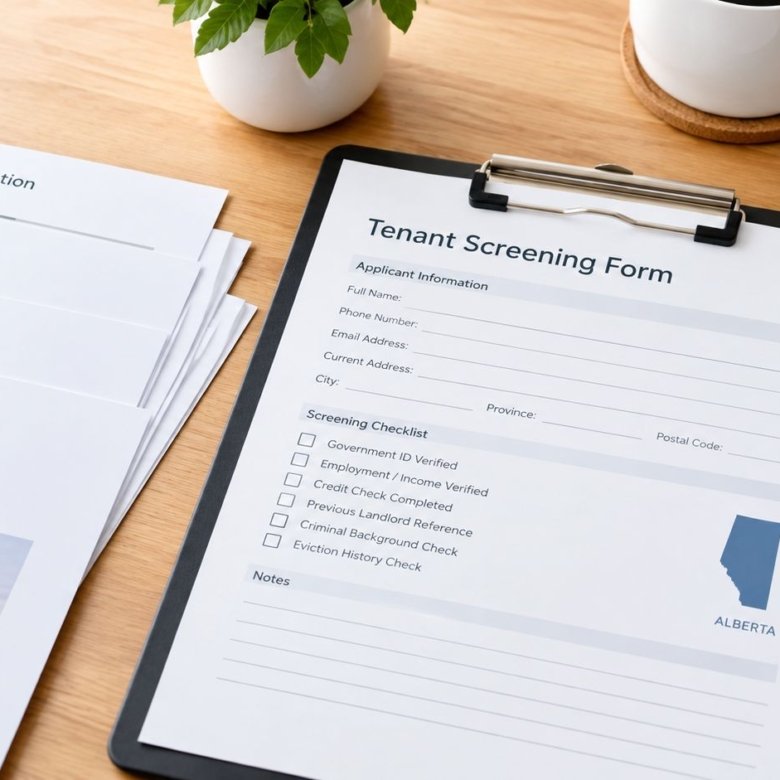

A Calgary landlord can budget for cleaning, key replacement, elevator bookings, and repair work, then discover that the intended “move in move out fee” doesn't cover the actual turnover cost. The problem becomes more serious when a tenant challenges a deduction and the file contains only an invoice, with no signed inspection report or dated photographs.
Alberta landlords need to separate three different issues: the provincial security deposit, fees imposed under condominium corporation rules, and deductions supported by documented damage or unpaid obligations. Treating them as one charge creates avoidable compliance risk, particularly for owners of Calgary condos and for remote investors who rely on a property manager to coordinate the handover.
Table of Contents
- Understanding Move In and Move Out Fees in Alberta
- Legal Limits on Security Deposits and Trust Rules
- Condo Corporation Moving Fees vs Provincial Law
- Mandatory Inspection Timelines and Compliance
- Deducting Cleaning and Repair Costs at Move Out
- Protecting Your Investment with Professional Management
Understanding Move In and Move Out Fees in Alberta
A landlord in Edmonton may call a charge an administration fee because the property needs cleaning, advertising, showings, and lease preparation after a tenant leaves. That label doesn't decide whether the charge is lawful. Alberta's tenancy framework treats the security deposit as the legally defined deposit connected to move-in, while other charges may arise from separate building rules or from documented amounts owed at the end of the tenancy.
This distinction matters in a practical turnover scenario. A tenant leaves a Calgary townhouse with unpaid rent and missing keys. The landlord can't create a new flat “turnover fee” because the re-leasing process took time. The landlord must rely on lawful, documented deductions or on a clearly disclosed charge that comes from an applicable condominium corporation rule, not from an invented addition to the provincial deposit.
Practical rule: A fee name doesn't replace a legal basis. The file should show what the charge is for, who imposed it, and which document authorises it.
The provincial security deposit has a strict ceiling, and the inspection process determines whether certain cleaning or repair losses can later be recovered. Condo corporations create a separate layer of administration, particularly where a building requires elevator reservations, protective measures, security coordination, or move scheduling. Those building charges aren't automatically part of the tenant's statutory deposit.
For landlords, the useful starting point is a written move-in process. A landlord move-in checklist can help organise keys, appliance condition, photographs, utility information, building forms, and tenant acknowledgements before possession changes. A consistent checklist doesn't make an unlawful charge enforceable, but it reduces the omissions that turn an ordinary turnover into a dispute.
The most reliable approach is to identify each cost before the lease is signed. The lease should distinguish the provincial security deposit from any disclosed building charge, while the property file should preserve the inspection reports and evidence needed for any later accounting.
Legal Limits on Security Deposits and Trust Rules
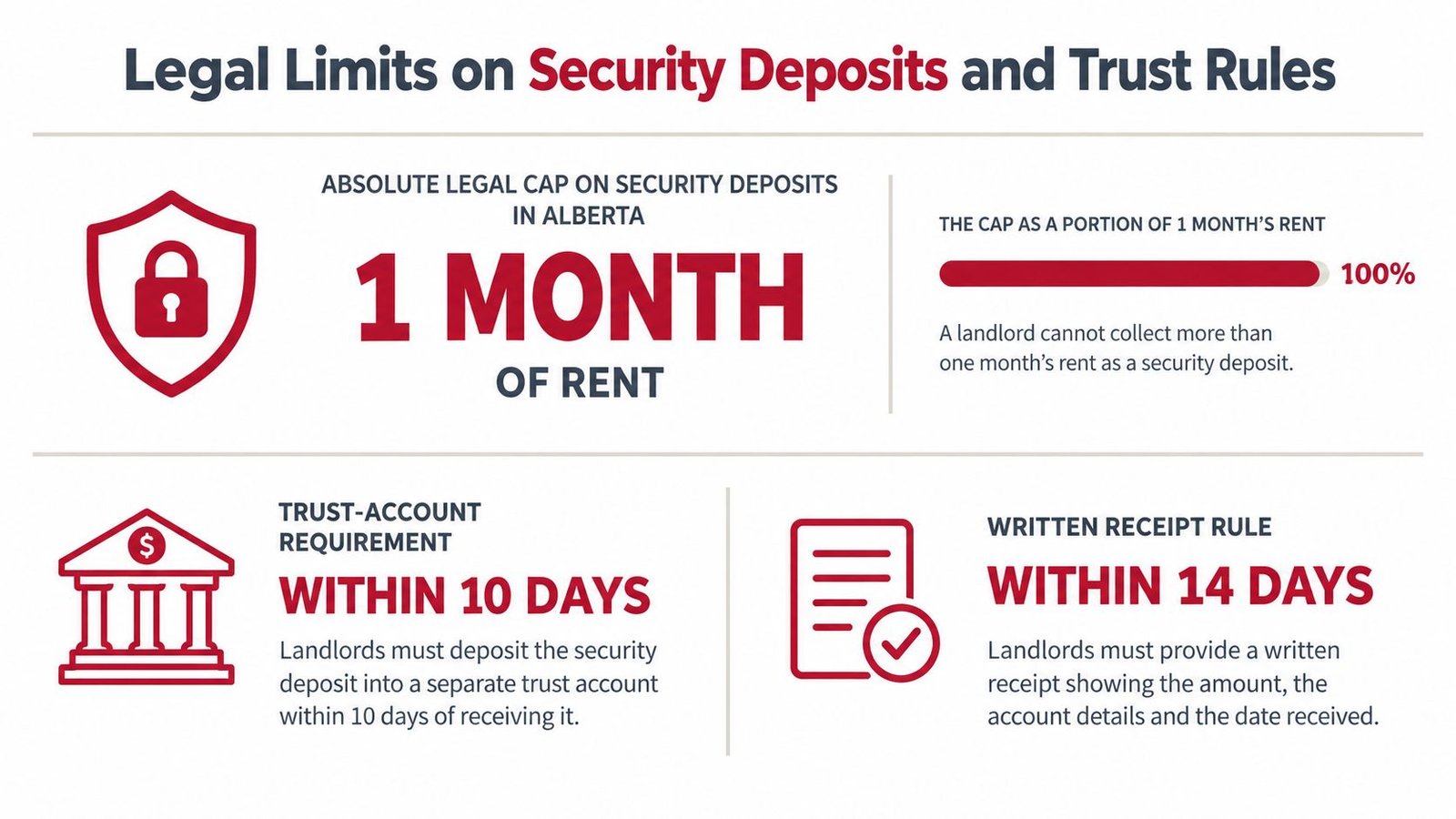
The security deposit is limited to one month's rent at the start of the tenancy in Alberta. The amount can't be increased later if the rent rises, so the original lease date becomes a permanent reference point for calculating the maximum deposit. The Alberta landlord information guide explains the deposit limit and the related handling requirements.
For example, a suite rented at $2,000 per month can have a security deposit of no more than $2,000, regardless of the landlord's expected advertising, cleaning, inspection, or restoration costs. That example isn't a pricing strategy. It demonstrates why landlords shouldn't treat the deposit as a reserve that can be adjusted whenever turnover expenses increase.
Handling the deposit correctly
The deposit must be placed in an interest-bearing trust account in Alberta within two banking days of collection, according to the same provincial landlord guidance. The landlord also has an obligation to pay annual interest unless the tenant waives that interest in writing. This is an operational responsibility, not an informal bookkeeping preference.
The deposit should therefore be tracked separately from operating funds. A useful record includes the collection date, the amount, the tenancy address, the account handling, any written waiver, and the documents delivered to the tenant. Mixing deposit funds with rent receipts or maintenance payments makes reconciliation harder and can weaken the landlord's position if the tenant disputes the final accounting.
The initial lease date also deserves attention during a rent increase. A higher monthly rent doesn't permit the landlord to collect a higher deposit later, so a rent adjustment should not trigger an automatic request for more security. The owner may need to revise internal records, but the statutory deposit ceiling remains tied to the start of the tenancy.
Landlords handling properties across several Alberta cities can use the Alberta landlord and tenancy resource to keep lease administration aligned with provincial requirements. The practical objective is simple: collect only the permitted deposit, hold it in the required manner, and preserve a clear record from collection through final disposition.
Condo Corporation Moving Fees vs Provincial Law
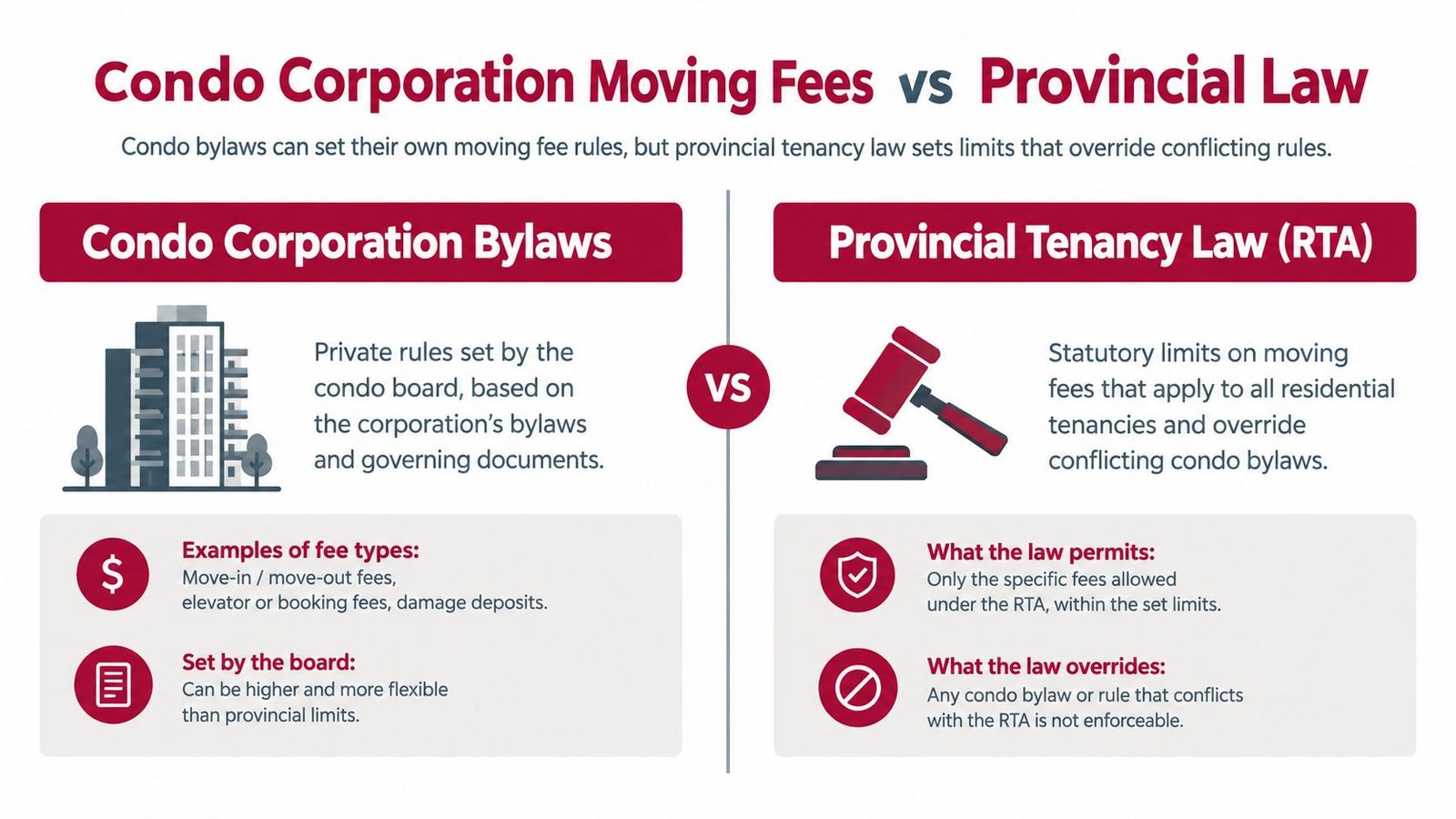
A condominium corporation can impose a moving charge under its building rules even though the Residential Tenancies Act governs the landlord and tenant relationship. These are separate legal and operational channels. The provincial security deposit is regulated by Alberta tenancy law, while a condo corporation's move-in or move-out charge usually comes from bylaws, policies, or a board-approved fee schedule.
Calgary condo buildings may charge for elevator reservations, security attendance, concierge coordination, protective coverings, or a designated moving window. Local reporting has described move-related charges of roughly $50 to $200, while Calgary-focused moving guidance has described refundable damage deposits of about $100 to $200 and non-refundable move-in charges in the range of $100 to $300. These reported ranges are not universal tariffs, and each building's governing documents control the actual amount. The distinction and local examples are discussed in reporting on Calgary condo moving fees.
Two rulebooks, two responsibilities
| Condo corporation requirements | Provincial tenancy requirements |
|---|---|
| May require booking forms, elevator reservations, time windows, or building deposits | Limit the security deposit to one month's rent at the start of the tenancy |
| May impose a non-refundable administrative moving charge under building rules | Require proper handling, inspection evidence, and lawful accounting for the security deposit |
| Usually apply to the person moving or the unit owner under the building's documents | Govern the landlord and tenant relationship under Alberta law |
A landlord should obtain the current building fee schedule before marketing a condo. The lease package should state the amount, payment recipient, refund conditions, booking process, and responsibility for cancellation or damage. Disclosure after a tenant has paid the deposit is a common source of friction because the tenant may reasonably view the building cost as an unexpected onboarding charge.
The landlord also needs to confirm whether the corporation bills the owner, the tenant, or the moving company. A condo board's rule doesn't automatically authorise the landlord to add the same amount to the provincial security deposit. Owners should review potentially conflicting provisions with appropriate legal advice, including resources addressing unenforceable strata bylaws, before relying on a building rule.
A clear lease clause can explain the distinction, but it can't cure a fee that the building doesn't authorise or a charge that conflicts with provincial law. Building coordination works best when the tenant receives the requirements before lease signing and the owner keeps proof of disclosure.
Mandatory Inspection Timelines and Compliance
Inspection reports are the control point for recovering damage and cleaning costs from an Alberta security deposit. The landlord and tenant must complete both the move-in and move-out inspection reports within one week before or after possession changes, and the landlord must provide copies immediately after completion. The requirements and consequences are set out in Alberta's tenancy-ending guidance.
A landlord who skips the inspections may lose the right to deduct damage or cleaning costs from the deposit, even when the unit clearly has problems. The rule prevents a landlord from relying on an after-the-fact assertion that the property was in better condition at the beginning.
A workable inspection sequence
Schedule the move-in inspection around possession. The landlord should invite the tenant to attend, inspect every room, and record existing marks, appliance condition, flooring, walls, windows, fixtures, and supplied items. Date-stamped photographs should support the written notes rather than replace them.
Keep the tenant's copy accessible. The landlord should provide the completed report immediately after the inspection. A tenant portal or organised email record can show when the report was delivered and preserve the version used at the start of the tenancy.
Offer the move-out inspection properly. If the tenant doesn't participate, the landlord can't proceed at a convenient time. The landlord must offer two inspection opportunities on different days, during non-holiday hours between 8 a.m. and 8 p.m., before completing the inspection without the tenant.
Compare like with like. The move-out report should refer back to the move-in record, identify changes, and distinguish ordinary use from damage. Photographs should show the relevant area clearly, while invoices or estimates should identify the work connected to the documented condition.
Evidence decides recoverability. A repair invoice shows what a contractor charged. It doesn't, by itself, prove that the tenant caused the condition or that the landlord completed the required inspections.
Owners should treat the inspection appointment as a scheduled compliance event, not as an informal walkthrough. A missed time window, absent report, or missing tenant copy can turn a recoverable cost into an owner expense. That risk is particularly high when an out-of-province owner depends on a cleaner or contractor to report conditions without a formal inspection process.
Deducting Cleaning and Repair Costs at Move Out
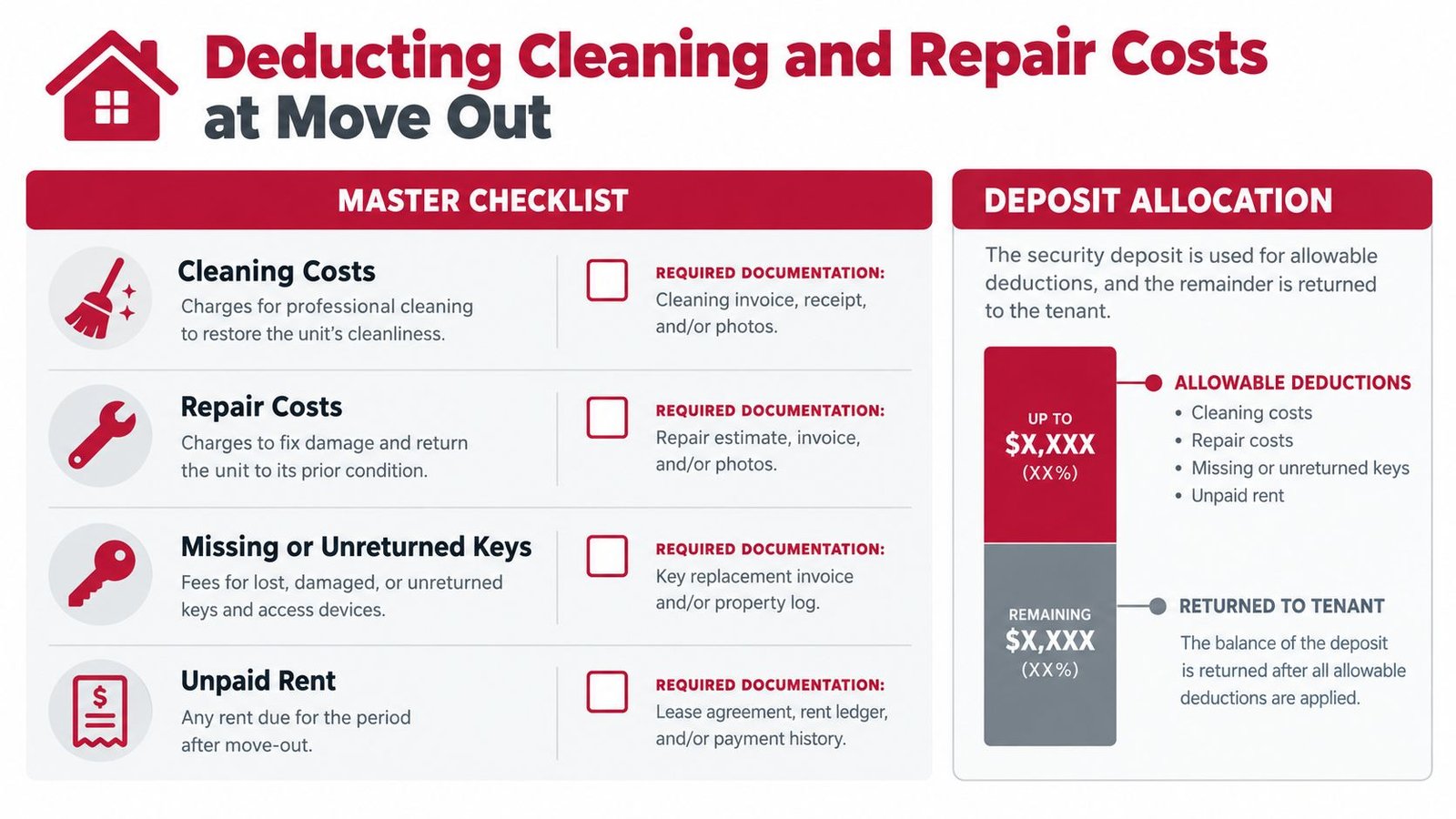
A final deposit accounting should answer three questions: what condition did the tenant return, what amount is owed, and what evidence connects the amount to the tenancy? Alberta rules permit deductions for documented obligations such as unpaid rent, cleaning, repairs, utilities, late fees, legal fees, or missing keys where the applicable requirements are met. The landlord shouldn't treat every turnover expense as a tenant charge.
Build the accounting from the inspection file
The strongest file connects the beginning condition to the ending condition. It contains the move-in report, move-out report, photographs, tenant communications, invoices, receipts, and a calculation showing the deposit balance after each deduction.
- Cleaning costs: Record the specific area and condition, then retain the cleaner's invoice or a documented internal cost.
- Repairs: Identify the damaged item, compare it with the earlier condition, and retain the work order, invoice, or estimate.
- Missing keys: Note the keys issued at move-in and the keys returned at move-out, then document the replacement or rekeying cost.
- Unpaid rent or other amounts: Reconcile the tenant ledger and show how the balance was calculated rather than using a rounded administrative amount.
A professional move-out cleaner can help produce a consistent scope of work and supporting invoice. For owners who need a specialised vendor, Gmaids specialty cleaning is a relevant resource for move-in and move-out cleaning coordination. The cleaning service doesn't replace the landlord's inspection obligations, and an invoice alone doesn't establish that a tenant caused the condition.
Meet the final accounting deadline
If there are no deductions for rent, cleaning, repairs, utilities, late fees, or legal fees, the landlord must return the full deposit plus interest within 10 days after the tenant gives up possession. The deadline and final accounting requirements are described in Alberta's starting-a-tenancy guidance.
Where deductions exist, the landlord should provide a clear statement of account within the required process, showing each amount and the remaining balance. The owner should avoid vague entries such as “turnover” or “administration” because they don't explain the loss or connect it to evidence.
The practical trade-off is clear. A detailed file takes more administrative time at turnover, but a flat fee is faster only when it is lawful and properly authorised. For most cleaning and repair disputes, documentation protects the asset more effectively than a generic move in move out fee.
Protecting Your Investment with Professional Management
Deposit administration, inspection scheduling, condo coordination, vendor access, and final accounting create a chain of deadlines. A single missed step can affect the landlord's ability to recover a legitimate cost. Remote owners face an added problem because the person who sees the unit, the person who schedules the elevator, and the person who prepares the accounting may all be different.
A professional property manager can place those tasks into a repeatable workflow. The useful controls include:
- Lease and disclosure review: Separate the provincial security deposit from building-specific charges and provide the condo requirements before signing.
- Inspection records: Use standard reports, photographs, tenant communications, and possession timestamps in one property file.
- Vendor coordination: Give cleaners and tradespeople written scopes, track invoices, and match completed work to the inspection findings.
- Owner reporting: Provide the final statement, supporting documents, deposit status, and unresolved issues in an organised record.
The value isn't convenience. Standardisation gives the owner a defensible timeline and makes it easier to identify a missing document before a dispute develops. Local coordination also helps when a Calgary condo requires a booking window or when an Edmonton, Red Deer, or surrounding-area property needs a prompt inspection after possession ends.
Dreamhouse Realty Ltd. provides leasing, tenant placement, inspection coordination, maintenance administration, and compliance oversight for residential properties in Calgary, Edmonton, Red Deer, and surrounding Alberta communities. The company also supports owner reporting and vendor coordination, which can be useful for busy landlords, small multifamily owners, and investors living outside Alberta.
GURIQBAL CHAHAL, MBA, PMP, REAL ESTATE BROKER, can be reached at 403-966-6072 for a discussion about deposit handling, inspection documentation, condo moving requirements, and ongoing rental management.
Landlords can contact Dreamhouse Realty Ltd. for property management, tenant placement, inspection documentation, condo move coordination, and compliant final deposit accounting across Calgary, Edmonton, Red Deer, and surrounding Alberta communities. A rental consultation can identify where the current move in move out fee process exposes the property owner to avoidable cost or dispute risk.