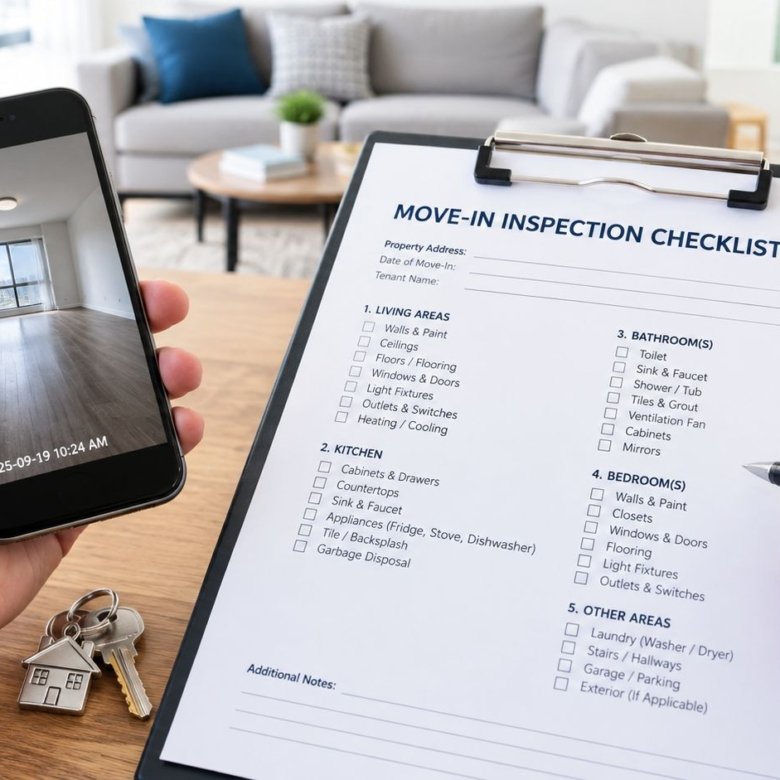
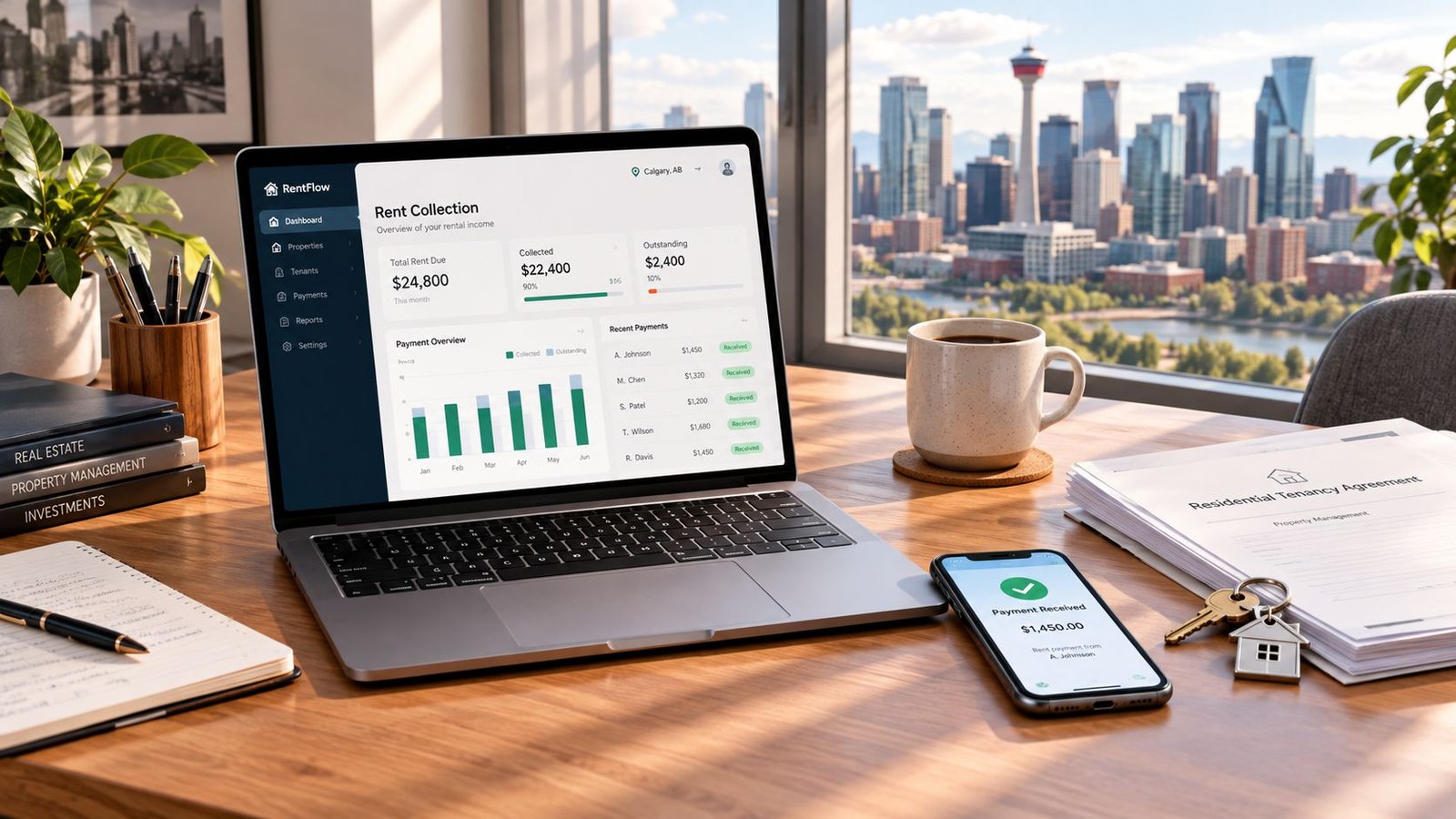
The first of the month arrives, but the rent hasn't. A tenant says the e-transfer was sent, another promises a cheque is in the mail, and the landlord spends the morning checking bank accounts, texts, and spreadsheets. For Calgary owners managing a condo, townhome, single-family rental, or small multifamily property from another city, manual collection quickly becomes a recurring administrative problem.
Rent collection online can reduce that friction, but only when the payment method, tenant instructions, bookkeeping, and arrears response work together. Alberta landlords need a system that respects the Residential Tenancies Act, preserves payment evidence, separates security deposits from operating funds, and provides a clear escalation route when a digital payment fails.
Table of Contents
- Why Calgary Landlords Are Moving to Digital Payments
- Choosing Between Interac e-Transfer and Pre-Authorized Debit
- Onboarding Tenants to Your Online Payment Portal
- Reconciling Monthly Ledgers and Security Deposits
- Handling Arrears and RTDRS Escalation in Alberta
- Streamlining Your Portfolio with Professional Management
Why Calgary Landlords Are Moving to Digital Payments
Alberta law gives landlords and tenants practical flexibility. E-transfers and direct deposit are legal payment options under Alberta's Residential Tenancies Act, alongside cheques, cash, and money orders, as explained in this Alberta guide to lawful rent payment methods. Tenants aren't restricted to one payment method, so a landlord should build a workable process rather than assume every household can use the same banking channel.
That flexibility supports a shift from manual collection to a portal or structured email workflow. A digital transaction can be matched to a tenant ledger, retained with its date and reference information, and reviewed without waiting for an in-person handoff. Cash creates a separate administrative obligation because the landlord must provide a receipt. Online channels therefore offer a cleaner recordkeeping path when the system preserves the payment details properly.
A Canadian renter survey summarised in 2022 found that 39% of renters primarily used a mobile rental or apartment application for rent payments, while 23% primarily used it for property-management communication. Those figures are reported in the Canadian renter survey summary. The practical lesson for Alberta managers is that rent payment is often the tenant's main reason for using a portal, while communication features can support messages, inspections, and service updates.
What digital collection improves
A properly configured workflow can help a landlord:
- Post payments consistently: Portal records reduce the need to enter every payment manually.
- Create a defensible trail: Dates, payer details, payment references, and receipts can be retained with the tenant ledger.
- Support remote ownership: Owners outside Calgary can review collection activity without handling cheques or arranging cash exchanges.
- Trigger timely follow-up: Missed-payment alerts can prompt a ledger check before a small issue becomes a prolonged arrears file.
Practical rule: Digital collection is a compliance and control upgrade, not merely a convenience feature. The platform still needs accurate tenant records, clear payment instructions, and a human review process.
The strongest setup separates payment acceptance from financial oversight. A landlord should know which account receives operating rent, who reviews returned payments, how receipts are issued, and where records are stored. Without those controls, an online portal can move confusion from a mailbox into a dashboard.
Choosing Between Interac e-Transfer and Pre-Authorized Debit
Interac e-Transfer is familiar, accessible, and relatively simple to introduce. The tenant sends funds through online banking, and the landlord matches the payment using the memo, payer identity, and rental address. The weakness is administrative. Tenants can omit the address, use an unexpected name, send the wrong amount, or require follow-up before the payment can be posted confidently.
Pre-Authorized Debit, commonly called PAD or direct withdrawal, works differently. The tenant agrees in advance to a withdrawal arrangement, and the system attempts to pull the scheduled rent from the authorised bank account. That can reduce monthly chasing and manual reconciliation, but it creates a different control problem when a debit is returned, an account has insufficient funds, or the tenant's banking details change.
Alberta landlords can't force e-transfer as the only option when a tenant lacks reasonable banking access, and they can't require automatic debiting of a tenant's account without agreement. Payment methods should be agreed in advance. Owners comparing bank-based payment infrastructure can also review this ACH processor guide for SaaS businesses for general processor terminology, though Alberta rental compliance and tenant consent remain the governing concerns for a residential tenancy.
E-transfer vs PAD for Alberta Landlords
| Feature | Interac e-Transfer | Pre-Authorized Debit (PAD) |
|---|---|---|
| Tenant control | Tenant initiates each payment | Tenant agrees to an authorised withdrawal arrangement |
| Reconciliation | Requires accurate memo fields and payer matching | Usually more structured, but returned debits still need review |
| Missed-payment response | Landlord sees that funds weren't sent or received | Landlord may need to investigate a returned or rejected debit |
| Accessibility | Useful for tenants who bank online but don't want automatic withdrawals | Less suitable for tenants who can't or won't provide an authorisation |
| Administrative load | Repeated reminders and manual matching can be significant | Lower routine effort when authorisations remain valid |
| Compliance point | Must not be imposed as the sole method for tenants without reasonable access | Must not be imposed without prior tenant agreement |
For a small portfolio with tenants who prefer control, e-transfer may be the practical starting point. For a stable tenant base that has agreed to scheduled withdrawals, PAD can create a more predictable workflow. Neither method removes the need to review the ledger, confirm receipt, document failures, and respond according to the lease and Alberta tenancy requirements.
The decision should focus less on a promised “failure rate” and more on where failure becomes visible. E-transfer errors often appear as missing or unmatched payments. PAD issues may appear as returned debits or bank notices. A manager should select the method that the portfolio can monitor consistently.
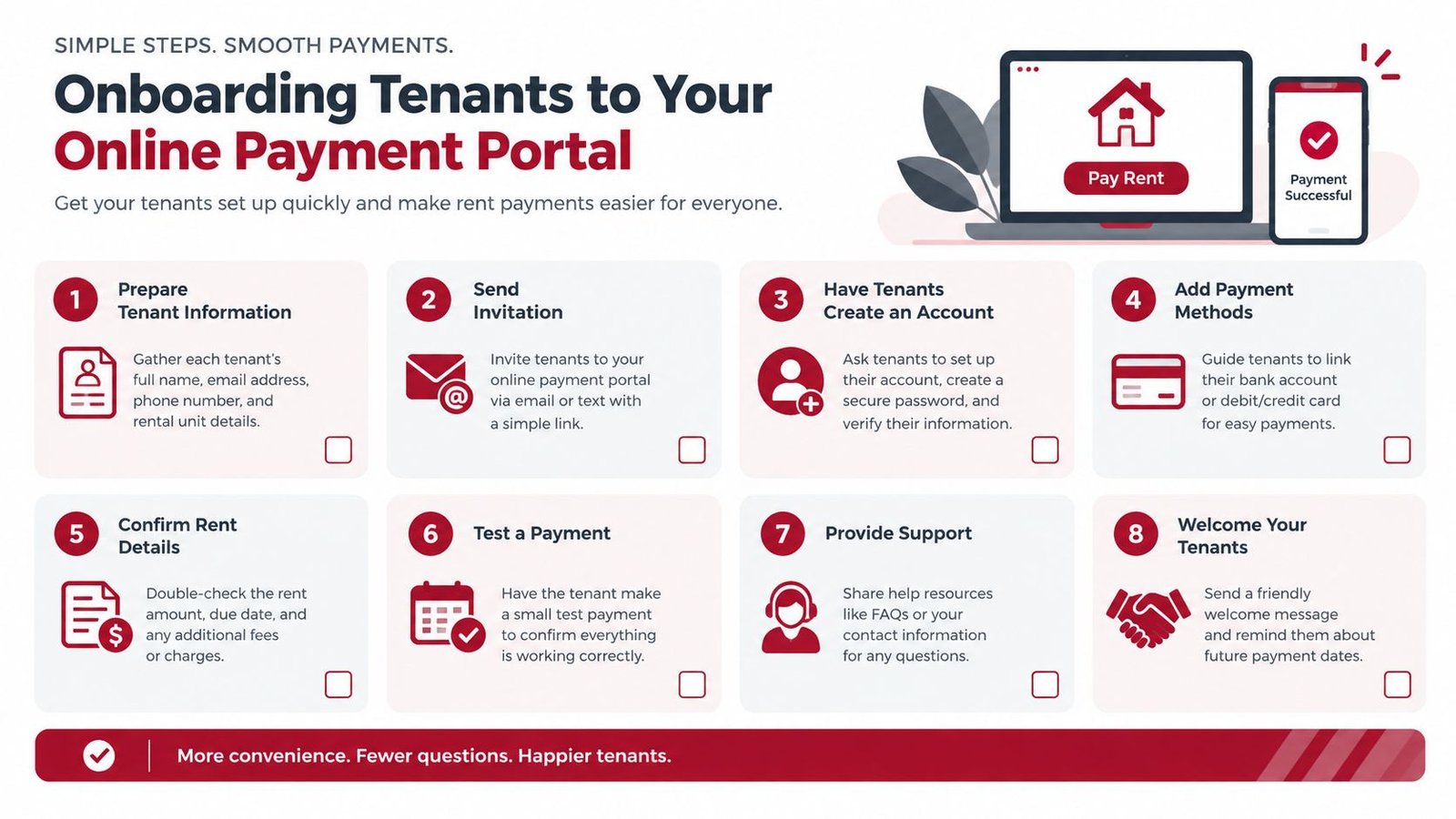
Onboarding Tenants to Your Online Payment Portal
Tenant onboarding should begin before the first payment is due. The lease or payment agreement should identify the accepted methods, the due date, the account or portal instructions, and the information tenants must include with each transaction. Any PAD arrangement should be based on clear tenant authorisation, not an assumption that digital collection gives the landlord permission to withdraw funds.
The payment reference is a small detail with a large bookkeeping effect. A Calgary property management FAQ describes portal payments with recurring or manual monthly options, and it notes that e-transfer instructions can require the rental address in the notes and a standard password. That practical example appears in the provider's Calgary tenant payment information. A landlord should use one consistent reference format across the portfolio, such as the tenant's name and rental address, so an incoming payment can be identified without guesswork.
A practical onboarding checklist
- Confirm the lease details: Verify the legal tenant name, rental address, monthly rent, and due date.
- Explain the available methods: Provide e-transfer, PAD, or other agreed options without presenting one method as mandatory where Alberta rules or access concerns prevent that.
- Issue written instructions: Give the exact email address, account information, portal login process, and payment reference format.
- Require identifying information: Ask tenants to include their name and address in the memo where e-transfer is used. Alberta tenant guidance from the Community Legal Education and Public Legal Information resource also stresses that tenants should keep proof of payment.
- Test portal access: Have the tenant sign in and confirm the correct unit before the first payment.
- Clarify receipts: Explain how the system issues or stores payment records and where the tenant can retrieve them.
- Address card fees transparently: A Calgary provider states that credit-card payments may carry a fee of up to 2.75%, as shown in its Calgary landlord and tenant FAQ. Any fee should be disclosed clearly and reviewed for compliance before implementation.
- Record completion: Save the tenant's selected method, authorisation documents where applicable, and onboarding confirmation.
The landlord should also distinguish rent from refundable deposits during setup. A portal can collect both, but the accounting treatment is not the same.
Reconciling Monthly Ledgers and Security Deposits
Payment arrival isn't the same as completed reconciliation. Each month, the landlord or manager should compare the portal record with the bank activity, confirm the tenant and property reference, post the amount to the correct ledger, and investigate anything that doesn't match. The final file should show the payment date, amount, payer identifier, reference, and any returned-payment information.
Tenants should be able to obtain proof of payment, and landlords should retain their own records. A well-organised rent payment receipt process helps both sides distinguish a completed transaction from an attempted transfer, a pending debit, or a payment that was later returned.
Security deposits require a separate workflow
Alberta security deposits must not be treated as ordinary operating rent. Under the Alberta landlord information guide, a deposit must be placed in an interest-bearing trust account at an Alberta financial institution within two banking days after collection. The deposit also can't exceed one month's rent, including refundable key or pet deposits when those charges form part of the refundable deposit.
At the end of the tenancy, the landlord must return the deposit plus accrued interest within 10 days, or provide a written statement of deductions. Those timelines apply even when rent collection is fully digital. A portal receipt doesn't replace trust-account administration, inspection records, deduction documentation, or the required return process.
Monthly controls that prevent confusion
- Separate transaction categories: Post rent, fees, deposits, and approved deductions to distinct accounts or ledger codes.
- Review exceptions promptly: Investigate unmatched e-transfers, partial payments, returned PADs, and duplicate entries.
- Keep supporting documents together: Store payment confirmations, bank records, notices, inspection reports, and deduction statements with the tenancy file.
- Reconcile owner reporting: Confirm that the owner statement reflects cleared funds, not merely attempted payments.
The cleanest operation treats the portal as one source of transaction evidence and the accounting system as the source of the tenant's running balance. Both need to agree before a month is closed.
Handling Arrears and RTDRS Escalation in Alberta
Online payments don't eliminate late rent. They make the delay easier to identify, provided someone reviews the alerts. An automated reminder may tell a landlord that the expected payment hasn't arrived, but it can't decide whether the issue is a banking error, an incomplete reference, a returned debit, or a genuine failure to pay.
The response should be structured. First, review the tenant ledger and bank activity. Then preserve the relevant payment record, including timestamps, payer identifiers, transaction history, and any returned-debit notice. Contact the tenant through the documented communication channel and apply the lease and Alberta notice requirements consistently.
The RTDRS path after a failed payment
Alberta landlords and tenants can submit applications online through the government's Residential Tenancy Dispute Resolution Service. When arrears remain unresolved, the landlord should assemble a complete file rather than rely on a screenshot showing a missing payment.
A useful escalation sequence is:
- Detect the exception: Review missed-payment alerts and confirm that the funds weren't received or subsequently returned.
- Check the ledger: Verify the amount owing, prior credits, payment references, and any approved arrangement.
- Retain evidence: Save bank-return information, portal records, notices, messages, receipts, and the full transaction history.
- Serve the appropriate notice: Use the notice and timing required under Alberta's tenancy framework.
- Monitor compliance: Record whether the tenant pays, partially pays, or remains in arrears.
- File electronically when required: Submit the RTDRS application through Alberta's eFiling process before the hearing date and attach the supporting records.
- Prepare for the hearing: Present a clear chronology showing the amount due, payment attempts, notices, communications, and current balance.
Evidence matters more than the payment interface. A portal can show what happened, but the landlord still has to prove the tenancy terms, the arrears, the notice history, and the records supporting the claim.
A payment processor won't issue notices or pursue a dispute on the landlord's behalf. The Alberta RTA handbook can help owners organise the relevant tenancy requirements, but a landlord should obtain appropriate legal or professional guidance where the facts are disputed or the consequences are significant.
Streamlining Your Portfolio with Professional Management
A landlord can assemble a portal, establish e-transfer instructions, create a PAD process, reconcile ledgers, maintain a deposit trust workflow, and manage RTDRS documentation. The challenge is consistency. Each property adds another tenant record, bank transaction, maintenance issue, inspection file, and owner report that must remain accurate.
Professional management makes sense when the owner values local oversight more than handling each administrative task personally. A Calgary manager can coordinate rent collection, arrears follow-up, tenant communications, inspections, maintenance vendors, notices, and owner reporting through one operating process. That is especially useful for remote owners and investors with homes in Calgary, Edmonton, Red Deer, or surrounding communities.
Technology should support the process rather than replace judgement. Owners evaluating broader workflow improvements may find this automation for real estate guide for 2026 useful for understanding how automation can fit into property operations. The right system still needs human review for returned payments, trust-account records, tenant access concerns, and formal enforcement.
Alberta property management services can include portal administration, direct deposit disbursements, statement reporting, lease enforcement, inspections, maintenance coordination, and compliance recordkeeping. Dreamhouse Realty Ltd. is a licensed property management and real estate brokerage serving Calgary, Edmonton, Red Deer, and nearby Alberta communities, with services for single-family homes, condominiums, townhomes, and small multifamily buildings.
Owners don't need to choose between convenience and control. They need a rent collection process that records each payment, accommodates lawful tenant choices, separates deposits correctly, and moves quickly when arrears develop.
Dreamhouse Realty Ltd. offers structured rent collection online, tenant and owner portals, arrears follow-up, direct deposit disbursements, compliance coordination, and transparent reporting for Alberta rental properties. Contact GURIQBAL CHAHAL, MBA, PMP, REAL ESTATE BROKER at 403-966-6072, and visit Dreamhouse Realty Ltd. to discuss management for a Calgary, Edmonton, Red Deer, or surrounding Alberta rental portfolio.