You're a landlord and standing at the kitchen table with a bank app open, a tenant asking for proof of payment, and last month's records split between email, paper, and a spreadsheet that no one wants to trust in a dispute. That's usually when the rent payment receipt stops being a form and starts becoming the document that decides whether your file is clean or messy, whether arrears are clear or arguable, and whether a simple payment turns into an avoidable tenancy fight.
In Alberta, the issue isn't whether rent was paid in some informal sense. It's whether you can show, with a record that holds together, who paid, what was paid, when it was received, and what period it covered. That's where generic templates fall short and a proper receipt process does the work.
Table of Contents
Alberta Record-Keeping Rules Under the Residential Tenancies Act
Handling Partial Payments, Late Fees, and NSF Charges on the Receipt
When Self-Management Receipts Are Enough and When a Property Manager Helps
Why a Rent Receipt Matters for Alberta Landlords
A Calgary landlord usually sees the value of a receipt after a file starts to wobble. The tenant says rent was paid. The landlord says the balance is still owing. The bank shows a transfer, but it does not show what month it was meant for, and the spreadsheet has a gap because someone forgot to enter the cash payment from two weeks ago. In that moment, a rent payment receipt stops being admin paperwork and becomes the record that keeps the conversation factual.
The receipt is part of the dispute record
Alberta's Residential Tenancies Act puts real weight on accurate records of rent payments and tenancy documents so disputes can be resolved with documented proof of payment. In day-to-day Calgary, Edmonton, Red Deer, and surrounding-area management, that record supports compliance, arrears tracking, and condition reporting. The province's framework treats rent records as part of the tenancy file, not as optional paperwork.
A clean receipt also protects the landlord's position when the file moves beyond routine bookkeeping. Deposit deductions, late fee challenges, tax support, and ownership transfers all become easier when there is a consistent paper trail. If a file gets reviewed months later, a receipt that states the date, amount, and period covered is much stronger than memory or a screenshot with no context.
Practical rule: if you would need to explain a payment to a tenant, an accountant, or a tenancy adjudicator, put the explanation on the receipt while the payment is still fresh.
The other reason receipts matter is scale. Rental payment records now move through bank transfers, portals, and property management systems, and that shift has made clean documentation part of normal rental administration. Alberta landlords see the same pattern in daily operations, where a receipt has to do more than confirm money changed hands. It has to show who paid, what was paid, when it was received, and what tenancy it belongs to. A well-kept receipt file gives you that thread when the paperwork needs to stand up in an RTA dispute.
If you also keep a strong lease file, the receipt works with it instead of floating on its own. Alberta rental lease agreement example is a useful reference point for matching payment records to the tenancy terms that govern them.
In practice, a receipt is the landlord's proof trail. It turns a payment into evidence that can be followed later, which is what matters when memory is thin and the file has to speak for itself.
Required Fields Every Alberta Rent Receipt Must Include
A defensible receipt is boring in the best way. It doesn't try to be clever or stylish. It just captures enough information that nobody has to guess what the payment covered later. Alberta-facing receipt guidance consistently points to a core set of fields that make the document auditable and dispute-resistant.
Use the same core structure every time
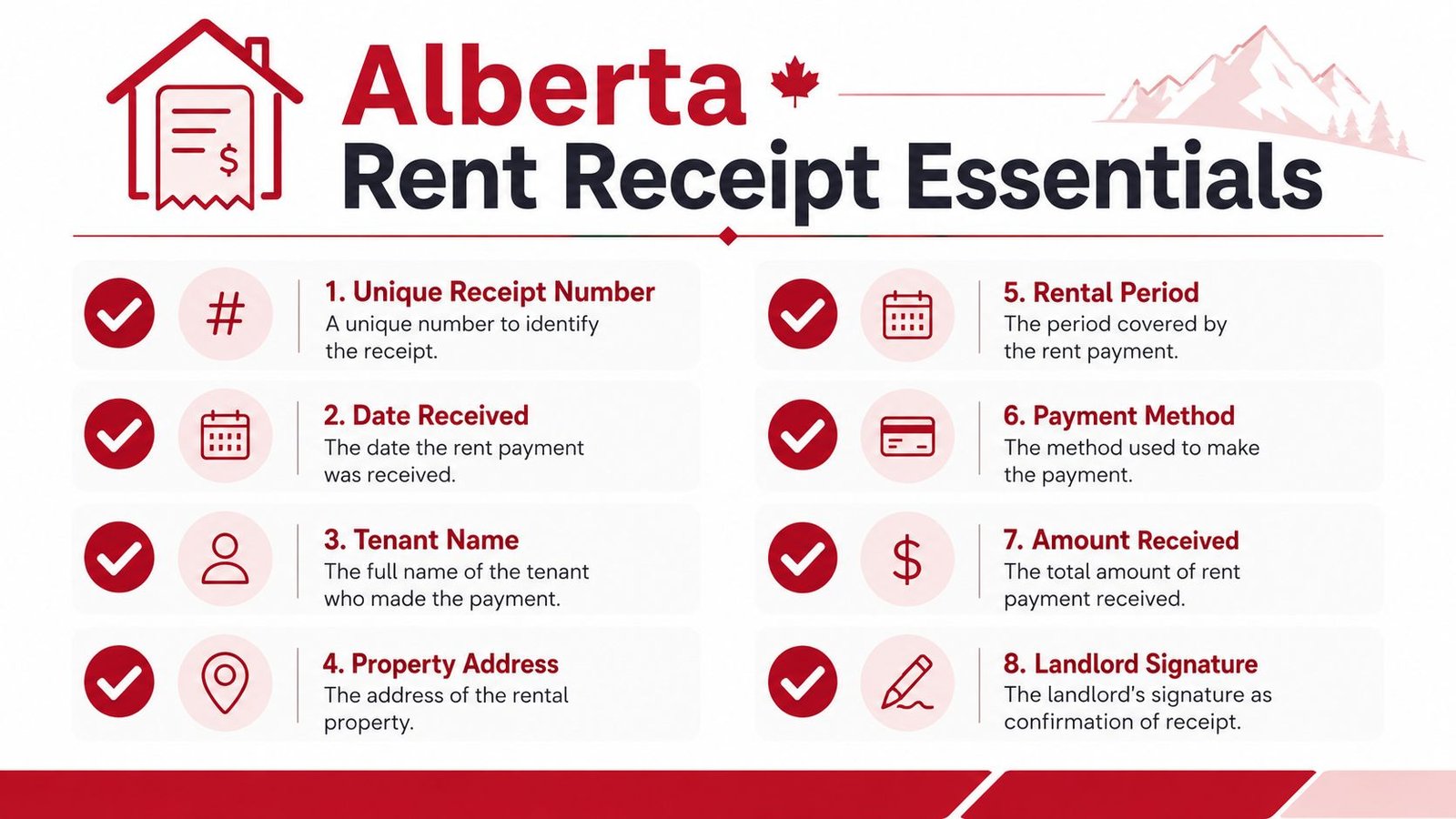
At minimum, the receipt should show a unique receipt number, the date the money was received, the tenant's full name, the full property address including unit number, the exact amount paid to the cent, the rental period covered, any late fee or partial-payment balance, and the landlord or property manager's signature. Those are the fields that make the document traceable in a file review and clear in a dispute. A receipt without a unit number or covered period is the sort of document that invites argument.
One useful habit is to treat the receipt number as a filing key, not decoration. If the same numbering sequence appears on your receipt copy, your ledger, and your portal export, you can follow a payment across the whole tenancy record without guessing which version is current. That matters most when you manage more than one door, or when someone else in your office prepares the month-end statement.
The landlord's signature or the property manager's signature and title also matter more than many online templates admit. A tenant doesn't need a flourish, but they do need a clear indication that the document came from the party who received the money or was authorised to receive it. If the receipt is electronic, the equivalent identifying signer information should still be attached to the file.
Here's the trade-off. The more complete the receipt, the more defensible it is. The more vague it is, the more likely it becomes a conversation starter instead of proof. That's why I prefer a form that looks a little repetitive over one that looks polished but omits the details that protect the file.
For a sample tenancy structure that pairs well with a solid receipt workflow, this rental lease agreement example is useful as a reference point for how lease terms and payment records should align.
Paper Receipts vs Digital Receipts Compared
A paper receipt can still hold up in Alberta if it is filled out properly and filed the same day. A digital receipt is usually easier to search, store, and tie back to a ledger, but it only helps if the file is complete and traceable. For Alberta landlords, the primary question is whether the record, paper or digital, can hold up in a dispute without looking incomplete or improvised.
Defensibility, convenience, and audit trail
A handwritten receipt can be defensible if it is complete, legible, and copied into the landlord's records right away. A photographed handwritten receipt is weaker, because poor image quality, cropped edges, or a handwritten correction can create avoidable doubt. A digitally generated PDF with consistent fields and preserved metadata usually gives a cleaner audit trail.
Email confirmations sit in the middle. They are convenient, and for e-transfers they often provide useful supporting evidence, but they rarely tell the full story on their own. An email from a bank or payment portal can show that money moved, yet still fail to identify the tenancy period, the premises, or whether part of the payment was applied to arrears.
| Receipt Format Trade-Offs for Alberta Landlords | Defensibility | Tenant Convenience | Audit Trail |
|---|---|---|---|
| Handwritten paper receipt | Moderate if complete and copied | High at the counter | Weak unless filed carefully |
| Scanned paper receipt | Better than a loose original | High once sent by email | Moderate if scan quality is strong |
| PDF receipt from a template | Strong if fields are consistent | High for most tenants | Strong, especially with numbering |
| Portal receipt or statement | Strongest for recurring use | Very high once set up | Strong when timestamps are preserved |
| Email confirmation alone | Limited | High | Limited without supporting records |
A practical rule helps here. If the payment is simple and routine, a paper or PDF receipt can work fine. If you manage multiple units, remote owners, or a lot of recurring payments, digital workflows reduce the chance of missing a field or misfiling a record.
A receipt system should make the file easier to explain six months later, not just easier to issue today.
A lot of landlords overestimate convenience and underestimate consistency. A fast email with a bank confirmation is better than nothing, but a standard PDF receipt issued the same way every month is easier to defend because it tells the same story in the same format every time.
Issuing Receipts for Different Payment Methods
The payment method changes how you document the receipt, not whether you document it. Cash needs the most discipline, e-transfer needs the cleanest cross-reference, cheques need status notes, and portal payments need the receipt or statement to be tied back to the tenancy period. If the receipt doesn't reflect the method correctly, it can create confusion even when the money itself was applied properly.
Cash, e-transfer, cheque, and portal payments
For cash, issue the receipt immediately when the money is received. The biggest mistake is waiting until later and trying to reconstruct the payment from memory or a desk note. The receipt should say something like, “Received cash payment for September rent, unit 204, full amount received, no balance outstanding,” and then be signed and dated on the spot.
For e-transfer, include the transaction reference or confirmation number if your bank or portal provides one, along with the exact date received and the period covered. The receipt should not just say “e-transfer received.” It should identify the tenancy and specify whether the payment covered rent in full or only part of the balance.
For cheques, write the receipt when the cheque is received, but note that it is pending clearance if your office practice requires that distinction. A practical phrasing is, “Cheque received for October rent, deposited same day, subject to clearance.” That avoids later confusion if there's a returned cheque issue.
For portal payments, use the portal-generated statement or receipt if it includes the required fields. A portal record that only says “successful payment” is not enough on its own unless it also identifies the tenant, unit, amount, date, and rental period. If your software can export a PDF, save that export with the monthly file.
Immediate-action rule: the person who receives the payment should issue the receipt at the same time, or the same day at the latest. Delay is where disputes start.
The common thread is simple. Each receipt should answer the same basic questions, just with the payment-specific evidence attached. If you can't tell from the document what month the money was for, the receipt is incomplete, even if the amount is correct.
Alberta Record-Keeping Rules Under the Residential Tenancies Act
Receipts sit inside a bigger record-keeping obligation. Alberta's Residential Tenancies Act expects landlords to keep accurate records so payment disputes can be resolved with documentary proof, and that expectation links directly to how you issue and store rent receipts. If your records are consistent, the rent file supports the tenancy file instead of sitting off to the side as a separate chore.
Why deposit handling depends on payment records
Deposit handling makes the need obvious. In Alberta, landlords may not charge more than one month's rent as a security deposit, and they must return the deposit within 10 days after the tenancy ends unless they deliver a written statement of deductions and the remaining balance within that same 10-day window. TenantCloud's Alberta rent collection overview summarises the same deposit and return timing issue landlords need to track, and the practical point is the same, the receipt trail helps show what was paid, what was applied to arrears, and what still remains owing.
That is why good receipt habits are not separate from RTA compliance. A rent receipt helps answer whether rent was paid in full, whether a partial payment was accepted, whether any late fee was charged, and whether a balance carried forward into the next cycle. Without that record, the landlord may have the right answer but no clean way to prove it.
The Act does not need a decorative receipt, and it doesn't reward over-documentation for its own sake. What it does need is a file that supports the landlord's decisions with accurate dates, amounts, and tenancy references. In practice, that means the receipt should match the ledger, the lease, and the notice history.
For landlords who manage properties remotely, this becomes even more important because the person collecting, filing, and reviewing records may not be the same person. A documented process keeps the file coherent when ownership or oversight changes. A useful overview for that situation is this property management in Alberta for remote owners, which pairs the documentation issue with hands-off oversight.
Handling Partial Payments, Late Fees, and NSF Charges on the Receipt
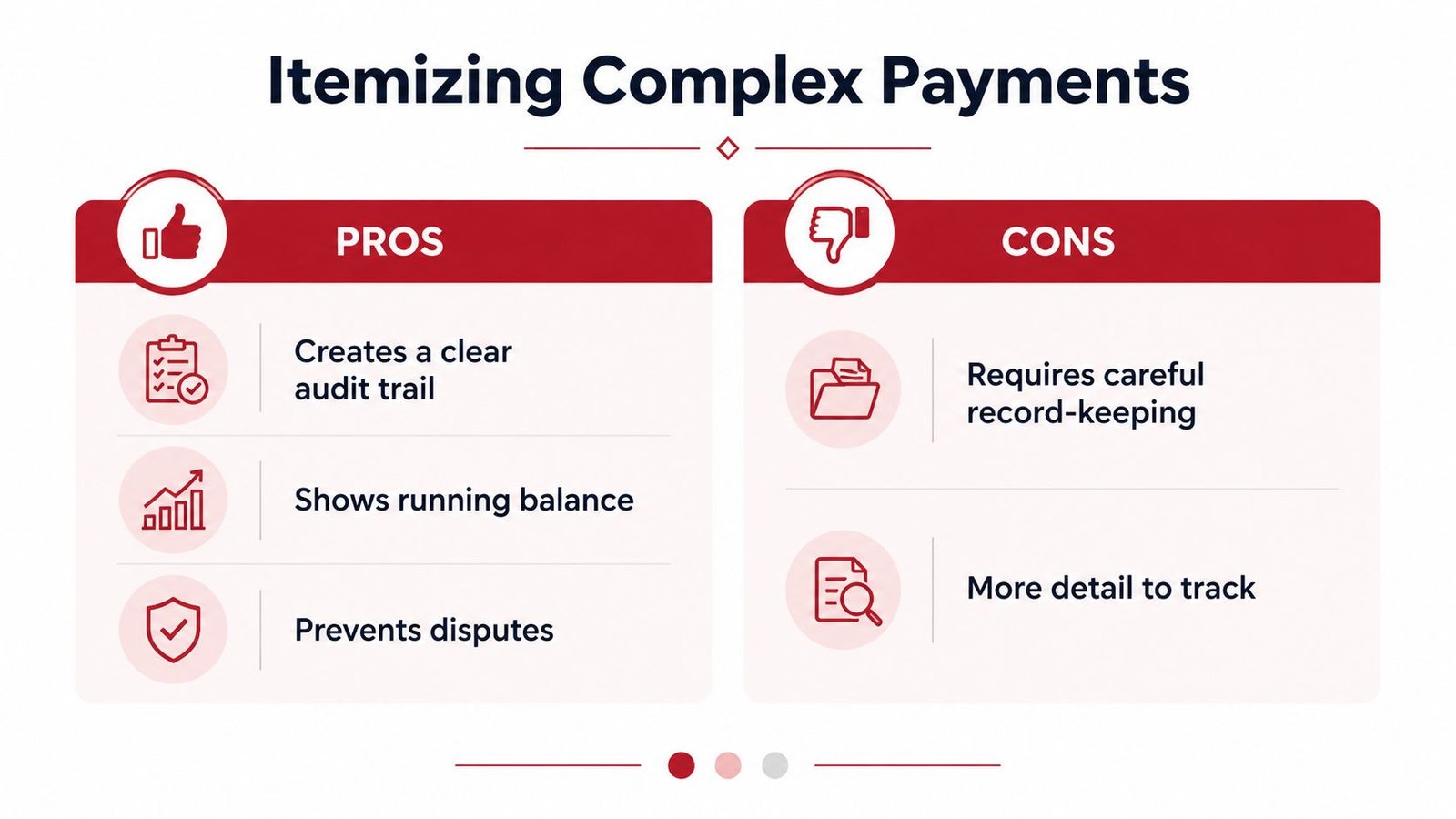
Partial payments are where weak receipts create the most problems. If you accept less than the full amount, the receipt should stop acting like a simple acknowledgment and start working like a running ledger. It needs to show what was due, what was received, what was applied to fees, and what still remains outstanding.
Make the balance visible
A proper receipt for a partial payment should read like this in substance, even if your format looks different, “September rent due, partial payment received, late fee applied, balance remaining.” Leave out the remaining balance, and the tenant can later argue that the payment covered the month in full. Leave out the late fee, and you may weaken the file if that charge is later challenged.
The same approach applies when the payment is late but otherwise complete. The receipt should still show that the rent arrived after the due date and that the late fee was charged under the lease or written policy. That keeps the bookkeeping record clear and helps the arrears history stay consistent.
For an NSF or returned cheque, the receipt trail should show the original payment attempt, the failed clearance, and any NSF fee applied if the tenancy paperwork allows it. U.S. consumer data has shown that late fees and NSF fees can add up quickly, but those figures are U.S.-based and may not reflect Alberta fee structures, so treat them only as a general reminder that small charges can change the shape of a file even when the rent is eventually paid.
Good practice: if you accept a partial payment, write the remaining balance on the receipt before the tenant leaves or the transfer is closed.
The reason this matters is straightforward. An arrears hearing, a collections conversation, or a deposit dispute gets harder when the receipt only shows money received and nothing about what it was meant to cover. Itemisation takes more time, but it saves time later when the file needs to be defended.
How Long Alberta Landlords Should Retain Rent Receipts
A rent receipt is only useful if you can still find it when the question comes up. Most landlords think about retention at tax time, then forget it again until a former tenant asks for a copy or a file is pulled into a dispute. A sensible Alberta practice is to keep receipts long enough that both tax records and tenancy records stay usable.
Keep the file long enough to matter
Canadian landlords generally benefit from keeping rent receipts for at least six years so tax support and tenancy documentation stay aligned. That isn't about hoarding paper forever. It's about making sure you still have the record when a return is reviewed, a payment dispute surfaces, or an ownership transfer raises questions about older tenancy files. Digital storage makes that easier because it centralises older documents without filling a filing cabinet.
Paper-only systems can still work, but they should be backed up. A receipt that lives in one folder, in one office, and nowhere else is one filing mistake away from being gone. Scanning paper receipts into a consistent digital folder structure gives you a second copy and makes retrieval much faster when the tenant, accountant, or new owner needs the record.
A property management portal can do this automatically by keeping statements and receipts under the tenancy profile. That doesn't remove the need for discipline, but it does reduce the risk of a missing month or a misplaced folder. For landlords who want the systems side of that handled for them, the practical issue is less about storage and more about process control.
When you dispose of old records, do it carefully. Remove tenant data only after your retention window has passed, and make sure both paper and digital copies are deleted or shredded in a way that protects privacy. A half-deleted file is not a privacy policy.
When Self-Management Receipts Are Enough and When a Property Manager Helps
A single-property landlord can often manage receipts well enough with a spreadsheet, a bank log, and a repeatable template. The system starts to break when the owner has multiple tenants, multiple payment channels, or no one on site to issue and file receipts consistently. At that point, the question isn't whether the landlord is capable, it's whether the process is still reliable.
The failure modes change as the portfolio grows
With one door, the common failure is forgetting to issue a receipt or missing a field. With two to five doors, the issue is usually inconsistency, one tenant gets a paper receipt, another gets an email, and the file becomes harder to reconcile. Remote owners face a different problem, because they may not see the payment flow in real time and can't correct mistakes quickly.
That is where a property management portal becomes more than a convenience. It creates timestamped records, keeps receipts tied to the tenancy, and reduces the chance that one payment lives in an inbox while another lives in a spreadsheet. For owners who are out of province or just don't want to chase paperwork, that matters.
A good place to compare those options is this guide to choosing the best property manager in Calgary, because the right manager should improve the file, not just collect rent. The point is not to outsource judgment. It's to reduce the administrative gaps that create disputes later.
If the self-managed process is working, keep it. If receipts are regularly late, incomplete, or hard to find, the workflow is already costing you time and credibility. That's when local management support starts to make practical sense.
Rent Receipt Template You Can Use Today
A useful template should be plain enough to copy into Word or Google Docs and structured enough to survive a dispute. Keep the wording direct, keep the fields consistent, and save a copy after every payment. If you use letterhead or a logo, keep it small so it doesn't crowd out the actual record.

Rent Payment Receipt Template
Receipt No.: RP-2025-001
Date Received: 2025-09-01
Tenant Name: Jordan Lee
Property Address: Unit 304, 1234 17 Avenue SW, Calgary, AB
Rental Period: September 1 to September 30, 2025
Payment Method: E-transfer
Amount Received: $1,850.00
Notes: Rent paid in full, no balance outstanding
Received By: A. Manager, Property Manager
Signature: ____________________
If you need a version for partial payments, add a line for balance remaining and fees applied. If you use a company logo or letterhead, keep the core fields unchanged so the receipt remains easy to read and compare month to month.
Quick-Reference Card for Alberta Rent Receipts
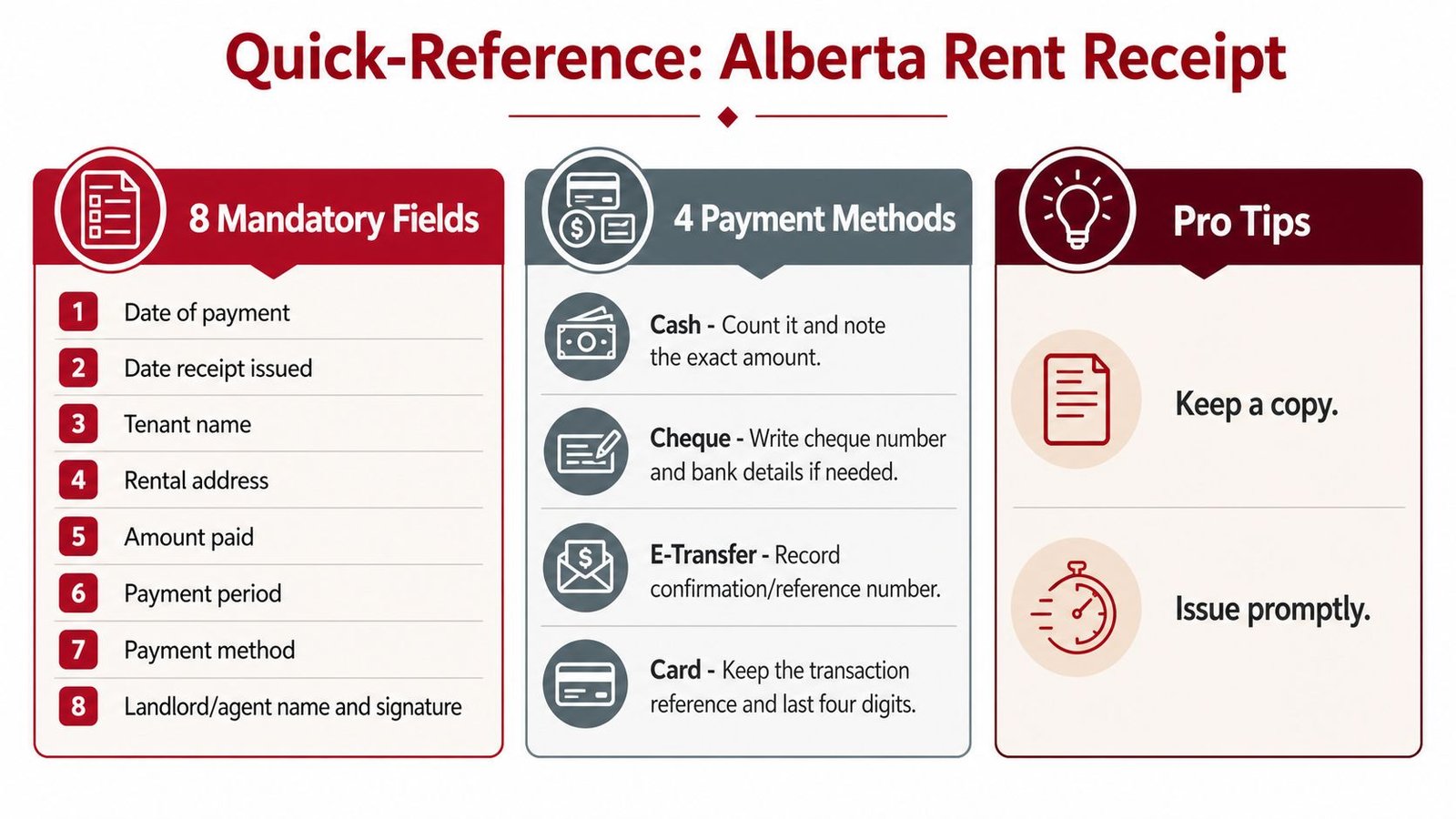
Keep the receipt file simple enough to use under pressure. The eight mandatory fields are the receipt number, date received, tenant name, property address, rental period, payment method, amount received, and landlord signature. For cash, issue it immediately. For cheque, note receipt and clearance status. For e-transfer, attach the transaction reference. For portal payments, save the portal receipt or statement. The security deposit cap is one month's rent, and the return deadline is 10 days after tenancy ends unless deductions are documented in writing. A practical retention window is at least six years, with digital backup preferred.
Common Alberta Landlord Questions About Rent Receipts
Does an e-transfer confirmation count as enough proof? Not by itself. It's useful evidence, but it's stronger when paired with a receipt that names the tenant, address, period covered, and amount applied.
What if a tenant refuses to take a receipt? Keep issuing and filing it anyway. Your records matter even if the tenant declines a copy.
How do I handle multiple roommates on one lease? Put the leaseholder names, or the name used on the tenancy record, and make sure the receipt links to the unit and period rather than to a vague “house payment.”
Do receipts help at tax time? Yes, because they support the payment history behind your records and owner statements. That's especially useful when the file has deposits, arrears, or several payment methods in play.
If you're tired of rebuilding rent records every month, Dreamhouse Realty Ltd. can take the collection, receipt, and documentation workflow off your plate with local Alberta property management that's built for Calgary landlords. Visit Dreamhouse Realty Ltd. to see how a structured receipt process, owner statements, and compliance-focused management can make your rental file easier to defend and easier to run.