

A Calgary landlord can have a clean, well-maintained home sitting empty while inquiries arrive at inconvenient times, showings get delayed, and an applicant's documents remain only partially verified. The property may be ready, but readiness doesn't produce rent. Every vacant day creates a financial gap that no future tenant can recover.
That's why a tenant placement fee should be assessed as a leasing decision, not dismissed as an administrative charge. The right placement service can help set a defensible rent, attract suitable applicants, document the tenancy properly, and reduce the risk that a rushed lease-up creates a longer and more expensive problem.
Table of Contents
- Understanding the Tenant Placement Fee
- Typical Fee Structures in Alberta
- Services Included in Professional Placement
- Legal Limits and Security Deposit Rules
- Evaluating the True Cost of Vacancy
- Negotiating and Choosing the Right Partner
- Securing Your Alberta Rental Investment
Understanding the Tenant Placement Fee
A tenant placement fee is a one-time charge paid by the property owner to a leasing professional or property management company for filling a vacancy. It usually covers the work required to move a property from vacant condition to an executed lease and documented move-in. That work can include pricing advice, listing preparation, advertising, inquiries, showings, applicant screening, lease preparation, signing, and handover.
The fee is different from an ongoing property management fee. Monthly management generally relates to rent collection, tenant communication, maintenance coordination, inspections, notices, reporting, and day-to-day administration after the tenancy begins. Tenant placement concerns the lease-up itself. An Alberta fee schedule illustrates this separation by listing a distinct lease fee alongside a 10% monthly management fee, a $100 + GST lease renewal fee, and separate placement charges for new tenants (Alberta fee schedule).
Why the charge exists
A successful lease-up requires more than uploading an advertisement. A professional must decide how the property should be positioned, respond to prospects, coordinate access, compare applications, verify information, prepare documents, and preserve a clear record of the transaction. A landlord who handles those tasks personally pays with time and accepts the risk of missing important details.
The commercial question is straightforward:
Practical rule: A placement fee makes sense when the service reduces vacancy, improves tenant selection, or lowers compliance risk enough to justify the one-time cost.
A low fee isn't automatically good value. If the provider excludes professional marketing, meaningful income verification, lease drafting, or move-in documentation, the quoted price may only cover a small part of the work. A higher fee can be rational when it buys a complete process and a faster, better-supported lease-up.
What owners should establish first
Before comparing providers, the owner should define the property, the expected rent, the desired service scope, and whether the arrangement is placement-only or full management. Single-family homes, condominiums, townhomes, and small multifamily buildings may need different advertising, showing, and approval processes.
The written agreement should identify when the fee becomes payable, what services are included, which costs are extra, and whether a replacement or re-leasing provision applies. Clear terms protect both sides. They also prevent the common mistake of comparing one provider's complete lease-up package with another provider's basic listing service.
Typical Fee Structures in Alberta
A tenant placement fee should be judged against vacancy exposure, not viewed as a standalone expense. The right structure can help offset lost rent while paying for a compliant, organised lease-up process. Alberta landlords typically choose between a percentage of one month's rent and a fixed dollar fee.
The percentage model commonly ranges from 50% to 100% of one month's rent. Calgary examples often fall around $400 to $700, depending on the property and service scope. A percentage fee rises with the rent, while a flat fee gives the owner a clearer turnover budget.
Alberta Tenant Placement Cost Models
| Pricing Model | Typical Range | Estimated Cost ($2k Rent) |
|---|---|---|
| Percentage of one month's rent | 50% to 100% | $1,000 to $2,000 |
| Calgary flat-fee example | $400 to $700 | $400 to $700 |
| Furnished or unfurnished schedule example | $250 + GST unfurnished, $325 + GST furnished | Depends on the quoted schedule and property |
Ranges reflect the Alberta property management pricing guide and a published Alberta fee schedule.
The $2,000 example makes the difference clear. A 50% placement fee is $1,000, while a full-month fee is $2,000. A Calgary flat fee may be lower or higher than either percentage result, so calculate the actual invoice under each provider's written terms. Compare the fee with the rent likely to be lost during an avoidable vacancy, and confirm that the process supports the landlord's duties under Alberta's Residential Tenancies Act.
The smaller charges that change the total
Renewals can add another cost. The published Alberta schedule lists a $100 + GST renewal fee and limits the listed new-placement charges to two placements per year. Those terms are not universal Alberta rules. They show why the agreement must address renewals, repeated placements, advertising, inspections, administration, GST, and any replacement guarantee before signing.
Ask whether the quoted amount covers one placement only or applies again if an approved tenant leaves early. Also confirm when payment is due, whether advertising costs are separate, and whether the provider charges for a failed application or a lease that does not proceed.
Use browse apartment fee breakdowns to see how rental-related charges can be itemised across property contexts. The provider's written Alberta agreement still controls the service relationship.
For a wider review of Alberta property management fee considerations, compare the total lease-up cost rather than the most attractive headline number. A higher fee can deliver better ROI when it reduces vacancy and prevents compliance mistakes. A low fee is poor value if it leaves the landlord paying for missing services, delays, or an improperly handled tenancy.
Services Included in Professional Placement
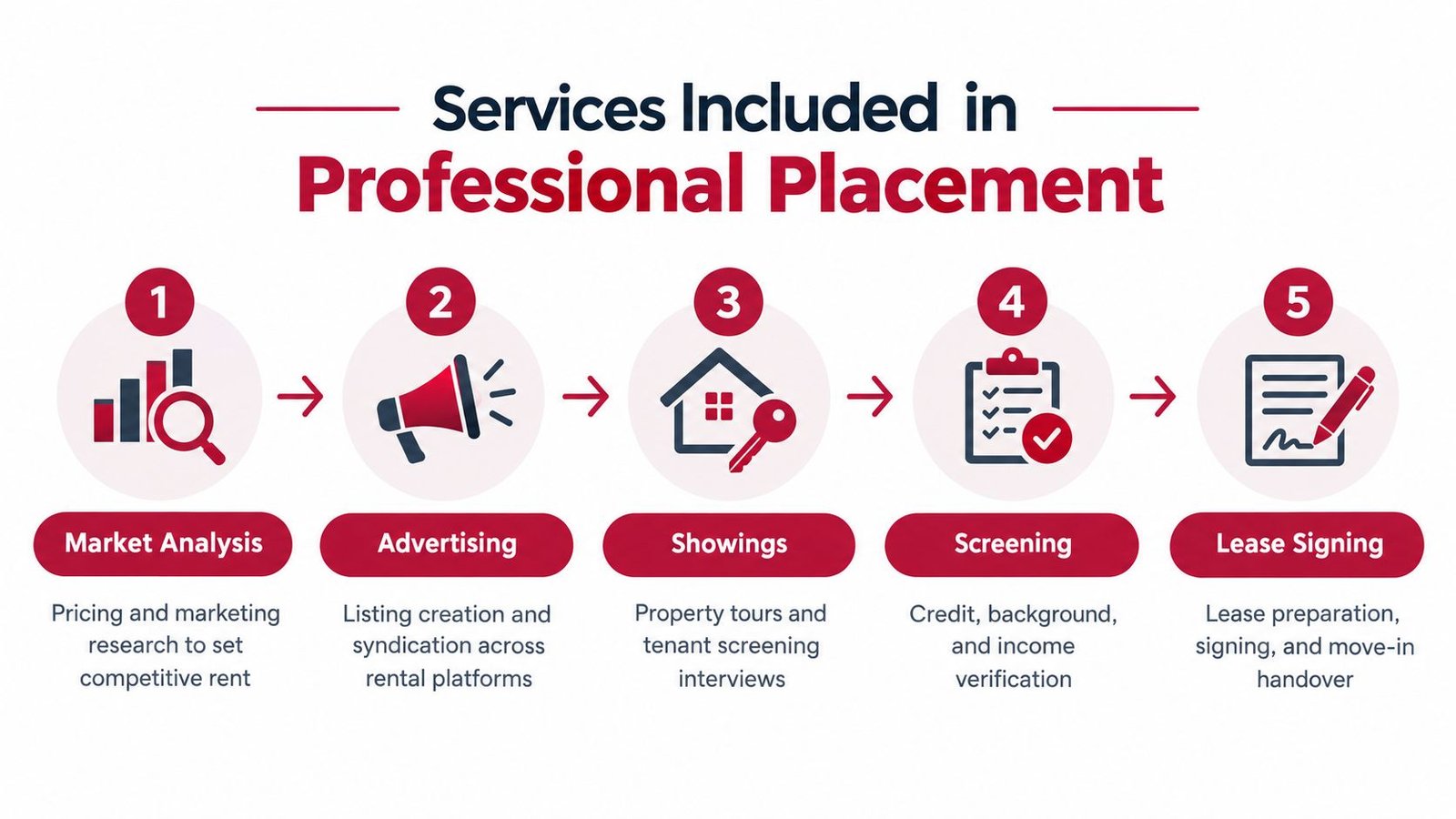
A professional placement process should resemble a controlled transaction, not a single online advertisement. Consider a Calgary home becoming vacant at the end of a tenancy. The leasing team first assesses the property's condition and positioning, then recommends a rent and marketing approach that reflects the home's features, location, and target tenant profile.
From listing to qualified interest
A weak listing creates weak demand. Professional photographs, accurate copy, useful property details, and distribution across relevant rental platforms give suitable applicants enough information to decide whether the home fits. The team then handles inquiries, asks preliminary questions, and schedules showings without leaving the owner to manage every message.
Showings also provide an important filter. An experienced leasing representative can explain the property, identify practical concerns, record applicant feedback, and keep access organised. That helps the owner distinguish a pricing problem from a presentation problem or a mismatch between the home and its intended tenant group.
Screening must go beyond a credit score
The fee earns its value through disciplined screening. A responsible process may include:
- Identity and application review: The team checks whether the application is complete and whether the information is internally consistent.
- Income verification: Reported income should be assessed using reliable documentation and a documented method, rather than accepted casually.
- Employment and reference checks: Employment details and prior rental history help establish whether the applicant can meet the tenancy's obligations.
- Credit and background review: These checks add relevant context, but they should be applied consistently to every applicant under the provider's documented criteria.
A screening process should produce an owner-ready file, not a vague recommendation. The owner should retain approval authority and receive enough information to make a defensible decision without relying on informal impressions.
The lease and handover complete the job
Lease preparation is another material part of the service. The agreement should identify rent, responsibilities, fees, deposit treatment, notice requirements, and other terms in a manner consistent with Alberta tenancy requirements. A service that finds an applicant but leaves the owner to draft documents may not be providing a complete placement package.
Move-in coordination closes the operational gap. The team should arrange signing, confirm funds, transfer keys, and document the property's condition with a signed report and photographs. Owners assessing tenant screening services in Alberta should ask how screening, lease execution, and move-in evidence fit together. Those components work best as one documented workflow.
Legal Limits and Security Deposit Rules
An owner-paid tenant placement fee compensates a manager for leasing work. A security deposit is tenant money, subject to Alberta rules for collection, holding, accounting, and return. Keep the two amounts separate in the agreement, ledger, and payment records. A placement fee can reduce vacancy loss, but only a compliant process protects that return on investment.
Fees must be disclosed properly
Under Alberta guidance, tenant-related fees are permitted only when the residential tenancy agreement sets them out in advance, and refundable fees count toward a combined security deposit cap of one month's rent at the start of the tenancy (Alberta Residential Tenancies Act handbook). The agreement should identify the amount, the event that triggers the charge, and whether the fee is refundable or non-refundable.
Non-refundable application and re-rental fees may be agreed by contract, but unclear drafting creates disputes. Require the manager to list every tenant-facing charge before the lease is signed.
Compliance control: Reject vague terms such as an unexplained “administration” charge. Each fee should have a stated amount, purpose, timing, and treatment under the agreement.
Deposit handling has a fixed standard
Alberta limits the security deposit to one month's rent at the start of the tenancy. The landlord cannot increase it later because rent rises. The deposit must be placed in an interest-bearing trust account in Alberta within two banking days of collection (Alberta security deposit guidance).
The account must be held with a qualifying Alberta financial institution. A manager handling placement and onboarding should maintain a ledger that separates the owner's service invoice from the tenant's deposit and records when the deposit was received and deposited. Make this documentation part of the handover file.
Move-out records protect the owner
The landlord must return the security deposit within 10 days after the tenant vacates and surrenders the premises. If deductions are made, the landlord must provide a detailed written statement within that same period, listing the reasons and amounts. Keep supporting records, including cleaning or repair bills, for any deduction claimed (Alberta move-out deposit guidance).
Condominium rentals require a separate check. Under the Condominium Property Act, a condominium corporation may request a tenant-related deposit of no more than $1,000 or one month's rent, whichever is greater, for damage to condominium or common property (Alberta rights and responsibilities). Provincial guidance states that the Act does not require interest on this condominium deposit, although the corporation may choose to pay it.
Review Alberta landlord and tenancy guidance before authorising the placement process. Confirm whether condominium rules apply, identify every deposit obligation, and keep provincial deposits separate from placement compensation. That discipline prevents a vacancy-saving service from creating a larger compliance bill.
Evaluating the True Cost of Vacancy
Self-management appears cheaper when the owner looks only at the invoice. The calculation changes once vacancy loss, lost time, delayed response, weak screening, and documentation exposure enter the comparison.
A professional placement fee is paid once for a lease-up. Vacancy loss is permanent. If a unit remains empty for an additional month, that rent cannot be recovered by charging the next tenant more or by working longer hours. The owner should compare the quoted fee with the rent at risk, while also considering whether the provider can improve the process without sacrificing screening quality.

The practical comparison
| Self-managed lease-up | Professional placement |
|---|---|
| The owner handles advertising, inquiries, showings, screening, documents, and handover. | The provider coordinates the lease-up workflow and reports decisions and progress to the owner. |
| The owner keeps the service invoice but supplies the labour and accepts the process risk. | The owner pays a defined tenant placement fee for specified work. |
| Delayed responses can reduce applicant interest and extend vacancy. | A coordinated response and showing process can support faster leasing. |
| The owner must maintain consistent screening and compliant records. | The provider should supply documented criteria, screening records, and move-in evidence. |
Neutral Canadian coverage describes tenant placement as a one-time fee typically equal to 50% to 100% of one month's rent, while recent industry coverage says Alberta pricing can sit lower than other regions and can be as low as $400 to $700 in some markets (Canadian property management fee coverage). That contrast supports a practical preference for predictable flat pricing when the scope is complete and the property's rent would make a percentage fee disproportionately high.
Vacancy isn't the only risk
A rushed owner may accept an applicant without consistent verification, use incomplete lease terms, or skip a detailed condition report. Those shortcuts can create disputes that outlast the original vacancy. The owner should treat screening and documentation as financial controls, not paperwork that can be removed to lower a quote.
A placement fee is expensive only when it buys activity without a reliable lease-up outcome or clear compliance process.
Self-management remains viable for an owner with local availability, leasing knowledge, and the ability to respond promptly. Professional placement is usually the stronger choice when the owner is remote, busy, managing several vacancies, or unfamiliar with Alberta's tenancy requirements.
Negotiating and Choosing the Right Partner
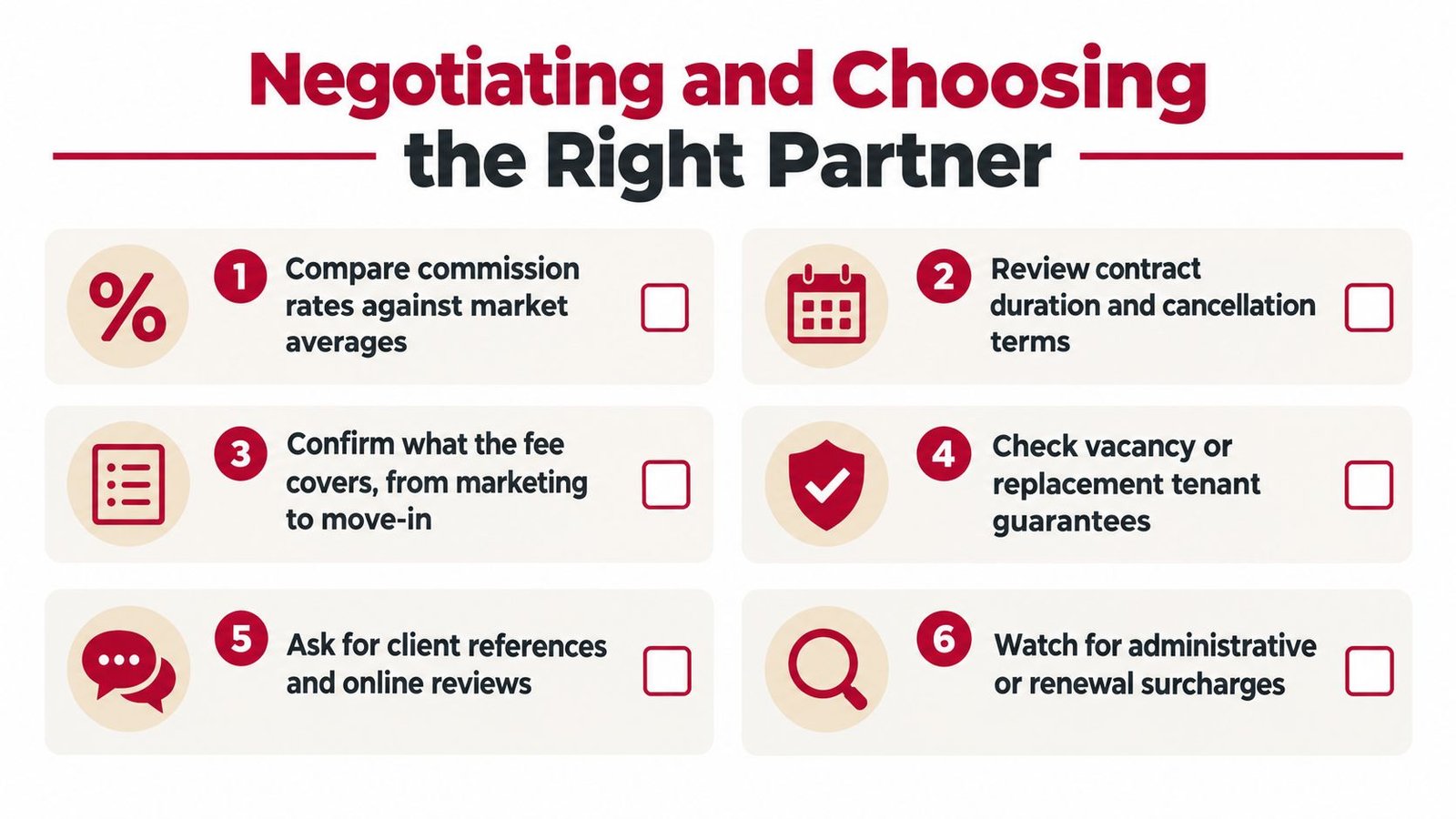
The cheapest proposal often becomes expensive through exclusions. A landlord should ask for a written scope that identifies the rent-setting process, listing channels, photography, showing coordination, screening depth, lease preparation, move-in inspection, and any re-placement protection.
The contract should also explain when the fee is earned. A success-based structure, where payment is tied to a qualified tenant signing, can align the provider's incentive with the owner's objective. Other arrangements may charge for defined work regardless of the final result. Neither is automatically wrong, but the owner should understand the exposure before authorising marketing.
Questions that reveal the real offer
A serious provider should answer these questions without relying on generalities:
- What is included: Does the tenant placement fee cover listing preparation, advertising, showings, applicant screening, lease drafting, signing, and move-in documentation?
- What is excluded: Are photography, application processing, inspections, renewal administration, or re-marketing billed separately?
- How is screening performed: Does the provider verify income, employment, credit, references, and rental history, and are the same standards applied to every applicant?
- Who approves the tenant: Does the owner receive the screening information and retain the final decision?
- What happens after placement: Does the provider offer ongoing management, or does responsibility return to the owner at move-in?
- How are compliance records kept: Can the owner receive copies of the agreement, condition report, deposit records, and communications?
A landlord can also use this guide from BoloSign on lease negotiation for general negotiation principles around defining responsibilities and documenting terms. Its commercial focus means Alberta residential requirements still need separate attention.
Incentives matter
The agreement should not reward unnecessary turnover. A provider that earns repeated placement fees without offering accountable screening, renewal clarity, or owner reporting may have incentives that conflict with stable occupancy. A transparent renewal charge, clearly defined placement cap, and documented replacement policy create a better operating relationship.
Local knowledge also matters. Calgary, Edmonton, Red Deer, and surrounding communities don't have identical property profiles or leasing conditions. The selected partner should understand the neighbourhood, the building type, condominium requirements where applicable, and the owner's preferred risk tolerance.
Securing Your Alberta Rental Investment
A tenant placement fee is best understood as a decision about occupancy, risk, and control. The owner isn't just purchasing an advertisement. The owner is deciding whether to manage the entire lease-up process personally or pay a professional to coordinate pricing, exposure, screening, documentation, and handover.
The strongest value comes from alignment. A provider should help avoid unnecessary vacancy without lowering applicant standards, and should move quickly without treating compliance as an afterthought. The written agreement must make the economics visible, while the leasing file must show how the tenancy was approved and transferred.
Alberta owners should also separate three financial categories from the start:
- Service compensation, which is the agreed tenant placement fee paid to the provider.
- Security deposit funds, which are subject to Alberta's cap, trust-account, and return requirements.
- Condominium-related deposits, where applicable, which may be governed by additional corporation rules.
That separation prevents bookkeeping confusion and makes later disputes easier to manage. It also gives an owner a meaningful basis for comparing property managers rather than choosing solely on the lowest advertised fee.
For landlords in Calgary, Edmonton, Red Deer, and nearby Alberta communities, a rental consultation should address the property's likely rent, marketing position, anticipated turnover, service scope, screening method, lease documents, inspection process, and reporting cadence. Remote owners and small multifamily landlords benefit from the same discipline because distance and portfolio size don't remove legal or operational obligations.
The right partner won't define value by the placement fee alone. The relevant question is whether the service creates a defensible, well-documented tenancy while limiting avoidable vacancy and protecting the owner's long-term rental income.
Dreamhouse Realty Ltd. offers tenant placement, rental marketing, applicant screening, lease drafting, move-in coordination, and ongoing property management for landlords across Alberta. Landlords can visit Dreamhouse Realty Ltd. to request a rental consultation with GURIQBAL CHAHAL, MBA, PMP, REAL ESTATE BROKER, at 403-966-6072.