A reserve fund problem rarely arrives as a neat line item. It arrives as a building envelope report, a failing parkade membrane, or a roof replacement that can't wait for the next budget cycle. In Calgary and across Alberta, a board chair may then face frustrated owners, a reserve account that looks respectable at first glance, and a project cost that makes every previous contribution look inadequate.
That is the practical reality of reserve funding for condominiums. The question is not just whether a corporation has money in the bank. It is whether its balance, contributions, study, and repair schedule work together under Alberta law. Boards that treat the reserve fund as a savings account invite special assessments and conflict. Boards that treat it as a long-term capital plan give owners a better chance of handling major work without financial shock.
Table of Contents
- Why Reserve Funding for Condominiums Suddenly Feels Urgent
- Alberta Legal Rules Boards Cannot Skip
- Reading Your Reserve Fund Study Without Getting Lost
- Setting Contribution Levels That Actually Match the Plan
- Comparing Ways to Close a Reserve Funding Gap
- Presenting Funding Choices to Owners Without a Backlash
- A Practical Checklist for Your Next Board Meeting
Why Reserve Funding for Condominiums Suddenly Feels Urgent
A 25-year-old Calgary lowrise receives an envelope study. The report identifies serious work, and the projected bill is $2.4 million. The boardroom goes quiet because owners haven't paid a special assessment in the past decade, yet the reserve fund can't absorb the project comfortably.
That situation shouldn't be dismissed as alarmism or blamed entirely on one board. Older buildings face accumulated exposure to roofs, windows, balconies, parkades, plumbing, mechanical systems, and building envelopes. When directors defer work, the corporation may avoid an immediate payment, but the underlying component continues to age. A useful explanation of what is deferred maintenance helps owners understand why postponement is a financial decision, not a neutral one.
The pressure is also structural. Alberta's reserve-fund rules require corporations to plan for major repairs and replacement of common property over a long horizon. A building may have operated for years with contributions that seemed manageable because an older study used assumptions that no longer reflect current construction costs, component conditions, or the timing of capital work.
Practical rule: A reserve balance is only reassuring when it is measured against the work the building is expected to need.
The next funding cycle matters because boards usually have three choices:
- Increase contributions early: Owners pay more now, but the corporation builds capacity before the next project.
- Assess owners later: The monthly burden stays lower until a major invoice forces a concentrated payment.
- Borrow or combine tools: The corporation spreads the cost, but accepts financing charges, lender conditions, and default risk.
The right decision depends on the study, the project timeline, the corporation's cash position, and owner affordability. It shouldn't depend on which option sounds least uncomfortable at the next meeting.
Alberta Legal Rules Boards Cannot Skip
Alberta condominium corporations must establish and maintain a capital replacement reserve fund. The province requires a reserve fund study at least every 5 years, and the study must use a planning horizon of 30 years. These requirements are set out in Alberta's reserve fund guidance, which treats reserve funding as a statutory mechanism for major repairs and replacement of common property, not an optional budgeting preference.
New condominium corporations have 2 years from registration to complete the initial reserve fund study and reserve fund plan. Older corporations registered before September 1, 2000 were required to complete the process by September 2002. A board should confirm its corporation's registration history, most recent study date, current plan, and contribution schedule rather than assuming a property manager or prior board handled everything correctly.
What the board must maintain
The study identifies expected capital needs. The plan turns those findings into contributions and funding decisions. Alberta's framework also requires qualified expertise, with eligible providers including professional engineers, professional technologists, certain certified technologists under the ASET framework, registered architects, and members of the Appraisal Institute of Canada with relevant experience, as described in Alberta's condominium information.
The corporation's reserve fund must remain separate from operating funds. Annual reporting must disclose reserve-fund activity to owners. Owners should be able to request the records that show how the corporation is managing the fund, including the study, plan, financial information, and relevant board decisions.
The statutory minimum isn't the same as good governance. An independent review of assumptions, annual reconciliation between the plan and actual spending, and a clear capital-project register are recommended practices. A board that accepts a study but ignores the contribution plan creates a serious governance problem because the corporation has identified a need without acting on the mechanism intended to fund it.
| Requirement | Statutory Minimum | What Good Boards Actually Do |
|---|---|---|
| Reserve fund | Establish and maintain a capital replacement reserve fund | Keep reserve and operating accounts separate and reconcile activity regularly |
| Reserve study | Complete or update the study at least every 5 years | Schedule the next review before the deadline and monitor changing component conditions |
| Planning horizon | Use at least 30 years | Review the full expenditure schedule, not just the next repair |
| New corporation | Complete the initial study and plan within 2 years from registration | Put the deadline on the board calendar and retain provider records |
| Provider | Use a qualified provider recognised under Alberta's framework | Confirm qualifications, scope, assumptions, and independence |
| Owner disclosure | Report reserve-fund activity and provide required records | Share a readable summary, funding choices, and project timing |
A corporation that falls behind weakens its position in lender conversations, insurance renewals, and disputes over special assessments. Directors should also obtain legal advice before relying on a bylaw or voting process. A practical review of unenforceable strata bylaws can help identify why a familiar rule may not withstand scrutiny.
Reading Your Reserve Fund Study Without Getting Lost
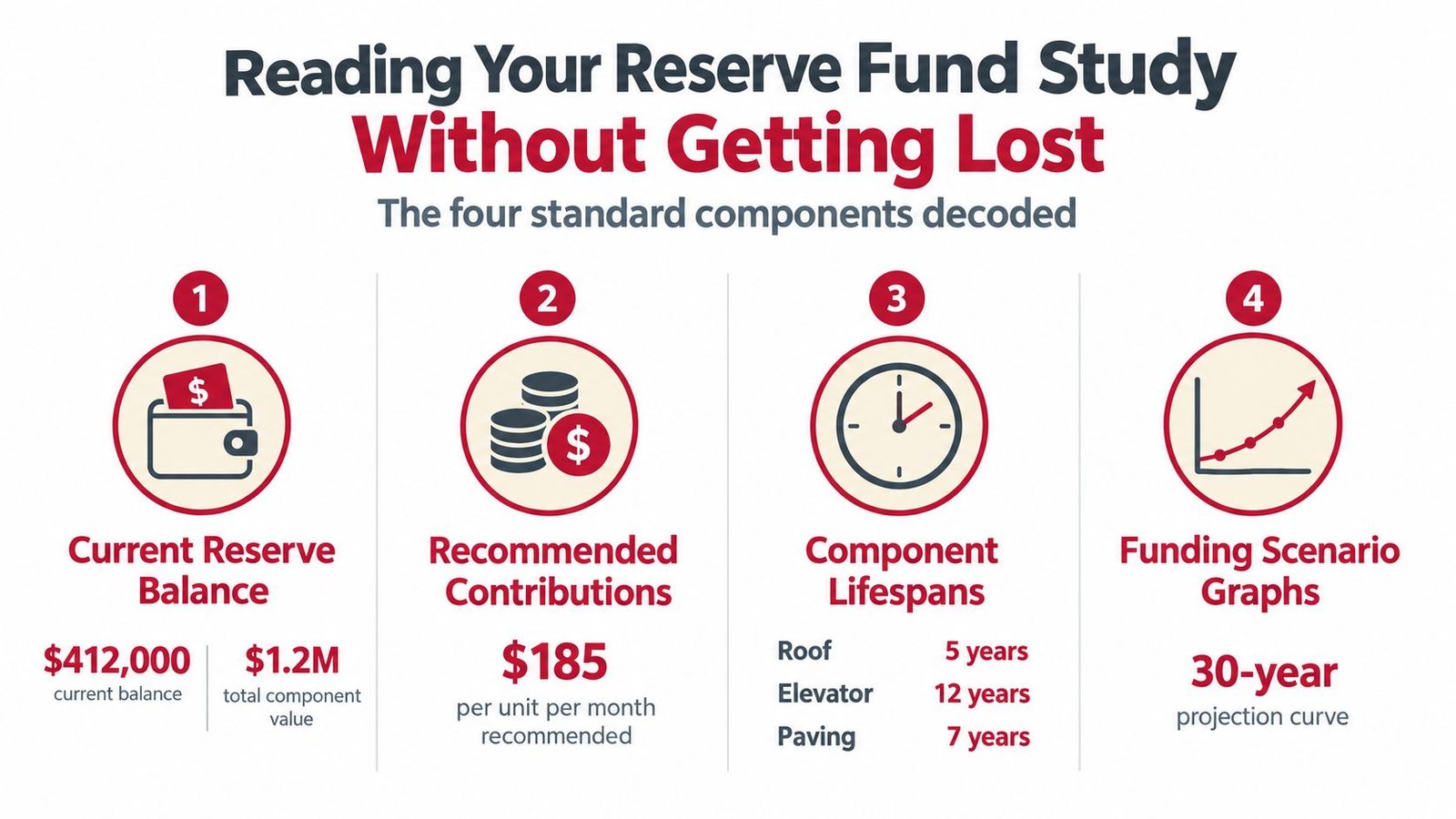
Most owners see only the executive summary of a long reserve fund study. That summary is useful, but it isn't enough for a funding decision. Directors need to understand four outputs and how they interact.
- Current reserve balance: This shows available cash, not adequacy.
- Recommended contributions: This indicates what the study assumes the corporation must collect.
- Capital expenditure forecast: This maps major component work across the 30-year planning horizon.
- Funding scenarios: These show how the balance changes under different contribution strategies.
The headline balance is often the most misleading figure on the first page. A reserve fund of $300,000 could be relatively strong in one small townhouse complex and dangerously low in a larger property facing envelope renewal. The balance only becomes meaningful after directors compare it with the number of units, component replacement costs, project timing, and future contributions.
Per-unit balance provides a useful first test
Recent Alberta condo data report a typical reserve fund balance of about $5,905 per unit across more than 180 sampled buildings. The same dataset reports $5,848 per unit for pre-1980 buildings, $7,141 for buildings from 1980 to 1999, $6,842 for buildings from 2000 to 2015, and $2,840 for buildings built in 2016 or later. Those figures come from Alberta strata statistics.
The vintage differences matter, but they don't create a pass or fail grade. Newer buildings often begin with smaller balances because fewer major components have reached replacement age. Older buildings may hold more cash while facing more immediate repair exposure. The proper test is whether the balance and planned contributions support the study's 30-year expenditure schedule, with enough money remaining after major work for later replacement needs. Alberta's owner guidance explains that reserve fund adequacy depends on the plan, not just the balance.
Every director should be able to state three numbers without searching the PDF: the current balance, the funded position used by the study, and the year of the next major capital event. A one-page owner summary should then show those figures, the recommended contribution, the next projects, and the consequences of each funding option. For readers who want a second explanation of reserve studies, this condominium reserve study guide from Access Management Group offers useful background.
Setting Contribution Levels That Actually Match the Plan
Monthly reserve contributions should follow the capital plan, not the amount owners happen to tolerate this year. A board can use a target balance, a per-unit benchmark, or the study's recommended cash-flow schedule, but the decision must connect current collections to expected replacement costs.
The Alberta benchmark of $5,905 per unit is useful for underwriting, but it isn't a universal target. The study's component inventory and expenditure schedule matter more than a headline average. A building with expensive underground parking or an exposed envelope may require far more funding than a property with fewer costly components.
Two approaches dominate board discussions
Percent-of-replacement-cost funding links contributions to a selected share of the building's estimated replacement value. Directors can explain the method easily because the contribution follows a visible asset-value measure. The weakness is timing. Newer buildings may collect heavily before their components approach replacement age, while older buildings may still need sharp increases if the original percentage was too low.
Straight-line or pooled cash-flow funding smooths contributions around expected expenditures. The study models when work is likely to occur and sets contributions that support the projected cash balance. This can reduce immediate pressure, but it carries risk if costs rise, projects arrive earlier, or the board treats a low near-term contribution as permanent.
| Factor | Percent-of-Replacement | Straight-Line / Cash-Flow |
|---|---|---|
| Communication | Simple to describe to owners | Requires the study's project timeline |
| Early-stage burden | Can be higher in newer buildings | Usually follows expected spending more closely |
| Main risk | The percentage may not match actual components | Delayed increases can create a later gap |
| Best use | A clear benchmark alongside a detailed study | A building with reliable condition and timing data |
| Board discipline | Review replacement values regularly | Update assumptions when project conditions change |
A worked example makes the trade-off clearer. Suppose a building has a replacement value of $12 million, and the study says the corporation is below its recommended funded position. The board should first identify the current balance, the target balance, the next major project, and the annual contribution required to reach the target over 5 annual increases. The board must not invent a contribution rate from the $12 million figure alone because the number of units, component lives, inflation assumptions, existing balance, and project schedule determine the result.
If the study recommends a total annual increase of $X, directors can present five staged annual increases of $X divided across the planned stages, then show the projected balance after each increase. The example is deliberately expressed as a worksheet rather than a made-up dollar answer. A board that cannot fill in those inputs from its own study isn't ready to approve a contribution motion.
Owners also need to understand that condo fees include more than operating expenses. A clear explanation of condo maintenance fees can help distinguish routine operations from long-term capital replacement.
Comparing Ways to Close a Reserve Funding Gap
When a major project arrives before contributions can catch up, the board needs a decision framework. Alberta guidance recognises several ways to address a deficit, including special levies, operating-fund transfers, and other financing methods. The decision should be evaluated against four practical questions: how quickly the money arrives, who bears the cash burden, what interest or penalty cost applies, and what legal approvals or lender conditions may be involved.
| Option | Cash-Flow Impact | Interest / Penalty Cost | Legal Friction | Best Used When |
|---|---|---|---|---|
| Special assessment | Immediate concentrated payment by owners | Usually no borrowing interest, but late-payment consequences may apply | Requires correct authority, notice, and collection process | A defined one-off project needs funding quickly |
| Operating-fund transfer | Reduces operating liquidity and may pressure routine services | No external interest, but may create operating shortfalls | Must respect fund separation and governance requirements | Surplus operating cash is genuinely available |
| Bank loan or line of credit | Spreads payments over time | Interest increases the total project cost | Lender review, security, approval, and default issues | A project is urgent and repayment can be supported |
| Deferred contribution ramp | Smaller immediate increase, with higher future collections | May create escalation or project-financing costs | Requires a defensible plan and owner communication | The funding gap is structural but the project timing allows delay |
A numeric comparison must use the corporation's actual inputs. For example, a $400,000 shortfall divided across 80 units produces a one-time assessment of $5,000 per unit, before considering collection timing or other project costs. A five-year contribution ramp financed at 4% requires a proper amortisation schedule, lender fees, payment timing, and unit-level allocation before anyone can claim it costs less or more than the assessment. Those figures should be calculated from written terms, not announced as a casual meeting estimate.
The trade-offs that matter
A special assessment is the cleanest tool when the work is urgent, discrete, and difficult to spread without risking further damage. It can still create hardship, arrears, and owner anger, especially when the board delayed action.
An operating-fund transfer can work when the operating account has a real surplus after utilities, insurance, maintenance, and contingencies. It isn't a free solution. Draining operating cash can force a second increase when ordinary expenses arrive.
Borrowing makes sense when the project has a clear scope, a defensible repayment plan, and enough predictable revenue to service the debt. It spreads cash flow, but defaulting owners may expose the corporation to collection and lien risk. A contribution ramp is preferable when the study shows a broad funding deficiency rather than one immediate emergency. It gives owners time to adjust, but only if the board protects the schedule from future deferral.
The least disruptive option today can become the most expensive option if it leaves the next board with no room to act.
Presenting Funding Choices to Owners Without a Backlash
Communication is part of the funding decision. A board that presents a reserve increase as a finished verdict invites resistance. A board that presents Option A, Option B, and Option C, with the cost per unit, timing, risk, and consequence of delay, gives owners a decision they can evaluate.
The study shouldn't be dropped into an owner portal without explanation. The board should publish the relevant excerpt, highlight the funded position, identify the next major project, and attach a plain-language summary. Owners need enough evidence to understand the recommendation without being forced to interpret every technical page.
Three tactics prevent avoidable conflict
- Show the project timeline: A 30-year cash-flow chart makes the cost of postponement visible and connects today's contribution to future work.
- Hold the information session early: Questions should be answered before the formal vote, not during a meeting where owners have already chosen sides.
- Put choices side by side: Each option should state the per-unit cost, payment timing, financing charge if applicable, and consequence for future contributions.
A vocal owner can still dominate a meeting, particularly when the proposed increase is large or the study is difficult to understand. The chair should publish speaking rules in advance, give each owner a fair opportunity to ask questions, separate information from debate, and follow the corporation's governing documents and the Condominium Property Act when setting voting procedures.
The board shouldn't silence concerns. It should prevent repetition from replacing analysis. Meeting minutes should record the study date, the recommendation considered, the questions raised, the motion, the vote, and any follow-up assignment. That record protects the corporation's decision-making process and gives absent owners a reliable account of what happened.
Owners rarely need certainty that a funding choice is painless. They need proof that the board compared the alternatives honestly.
A Practical Checklist for Your Next Board Meeting
A productive reserve-fund meeting should end with decisions, owners assigned to follow up, and dates on the calendar. The following agenda works as a one-page handout for a Calgary board, a self-managed corporation, or a landlord reviewing a condo purchase.
- Confirm the study date. Verify the most recent reserve fund study and determine whether the corporation remains within Alberta's 5-year update cycle. If the deadline has passed, trigger the procurement process.
- Review the current balance. Compare actual cash with the study's projection and identify any withdrawals, missed contributions, or project changes.
- Identify the next capital event. Record the component, expected timing, scope uncertainty, and whether a condition review is needed.
- Test the funding model. Compare current contributions with the selected percent-of-replacement or straight-line cash-flow approach. Ask what happens after the next major expenditure.
- Choose the gap-closing tool. Decide whether a special assessment, operating-fund transfer, loan, or contribution ramp fits the timing and affordability of the project.
- Set the contribution motion. State the new monthly per-unit amount, effective date, review date, and assumptions supporting the change.
- Prepare the owner package. Include the relevant study excerpt, funded position, project timeline, alternatives, and payment consequences.
- Document and calendar the follow-up. Record the vote in the minutes, notify owners, retain supporting documents, and schedule the next review before the statutory deadline.
A landlord evaluating an Alberta condo purchase should request the same information before relying on the unit price. Reserve health, upcoming capital work, contribution history, and possible assessments belong beside rent projections and operating expenses. Owners who use a property manager can also ask the manager to track board notices, maintenance records, assessment decisions, and documentation affecting the rental property's cash flow.
For owners seeking condo property management services, the practical value lies in connecting building decisions with tenancy operations. Dreamhouse Realty Ltd. provides rental management, inspections, maintenance coordination, owner reporting, and investor-focused brokerage services across Calgary, Edmonton, Red Deer, and surrounding Alberta communities.
Dreamhouse Realty Ltd. helps Alberta rental owners manage tenant placement, rent collection, inspections, maintenance coordination, compliance records, and owner reporting while keeping an eye on condo decisions that can affect cash flow. Visit Dreamhouse Realty Ltd. or contact GURIQBAL CHAHAL, MBA, PMP, REAL ESTATE BROKER, at 403-966-6072 to discuss property management or condo investment support.