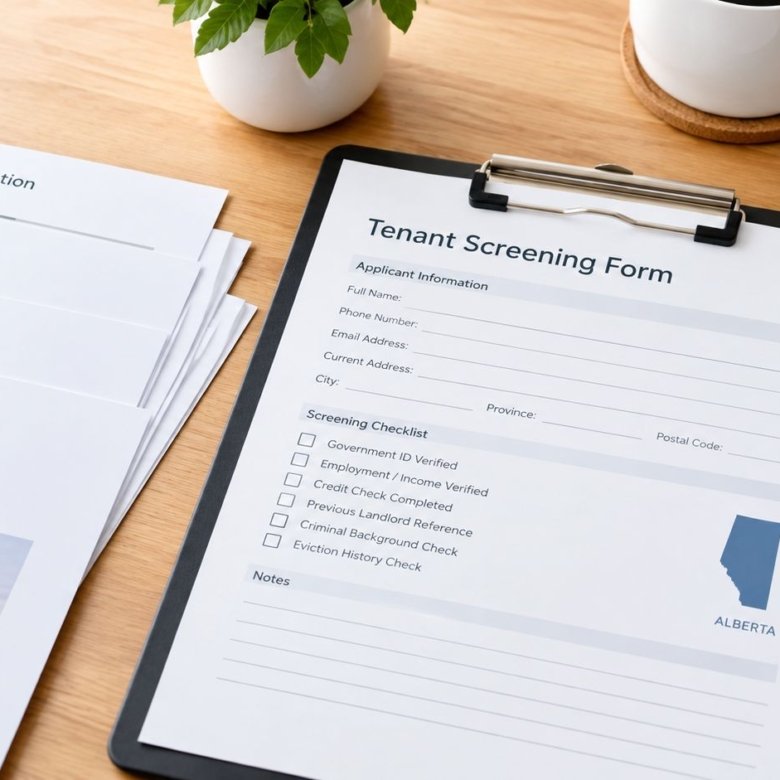

The rental is ready, inquiries are arriving, and a management company has sent over a contract. The owner wants relief from tenant calls and repair coordination, but the agreement leaves important questions unanswered. Can the manager reduce the asking rent, approve a furnace replacement, or charge extra for handling a dispute?
Those questions deserve answers before signing. A property management agreement should connect the owner's expectations to specific authority, service standards, financial controls, and Alberta tenancy obligations. A reasonable management fee doesn't compensate for unclear responsibilities when a tenant moves out or an urgent repair can't wait.
Table of Contents
- What a Property Management Agreement Is
- Key Clauses You Must Understand
- Fee Structures and What They Really Cost
- Owner Responsibilities Under the Agreement
- Manager Obligations and Service Standards
- Alberta Tenancy Law Compliance
- Liability, Insurance, and Indemnification
- Termination and How to End the Agreement
- Sample Agreement Structure and What Each Part Contains
- Negotiation and Review Checklist Before You Sign
What a Property Management Agreement Is
Consider an owner who hires a company to find a tenant for a Calgary condominium. The company advertises the unit, screens applicants, and arranges a signed lease. When a maintenance request arrives afterwards, the owner discovers that ongoing management wasn't included.
That's a scope problem, not necessarily a service failure. A leasing-only agreement should define where tenant placement ends and owner responsibility resumes. A full-service management agreement should extend into rent collection, maintenance coordination, inspections, tenant communications, and financial reporting.
Authority matters as much as services
The agreement should identify the property owner, the brokerage being appointed, and the individual responsible for day-to-day management. It should expressly establish the manager's agency role and distinguish actions the manager may take independently from decisions requiring owner approval.
For background on the broader contract category, LiveDocument's explanation of what is a service contract provides useful context. The property-specific review must go further, addressing control over premises, tenant relationships, and money.

Calgary pricing needs a defined process
CMHC reported Calgary's 2025 purpose-built rental vacancy rate at 5.0%, compared with 2.2% for condominium apartments, with primary-market average apartment rents of $1,582 for one-bedroom units and $1,914 for two-bedroom units, according to its Calgary rental market report.
Those averages provide context, not an asking-rent instruction for a particular home. The contract should require the manager to consider comparable properties, condition, location, parking, and included services before recommending rent.
- Owner control: Identify which pricing decisions require approval.
- Manager discretion: Define any permitted adjustments and concessions.
- Accountability: Require an explanation when inquiries or showings aren't producing suitable applications.
A useful agreement doesn't promise an outcome the manager can't guarantee. It establishes a process the owner can evaluate.
Key Clauses You Must Understand
A contract can name every expected service and still leave the manager's authority unclear. The essential test is whether each clause answers an operating question: who acts, under what conditions, with whose approval, and with what evidence afterwards?
Appointment and scope
The appointment clause should identify the brokerage's authority over the specified property. Signing a tenancy agreement, arranging a repair, and settling a dispute are different decisions. They shouldn't disappear into a broad permission to manage the premises.
The scope of services should describe deliverables rather than aspirations. Marketing should address listing preparation, inquiry handling, and showing coordination. Tenant screening should identify the checks to be performed and who makes the acceptance decision.
Exclusions matter equally. Renovation supervision, insurance claims, condominium meetings, and dispute attendance should be expressly included, excluded, or separately priced.
| Clause | Practical question | Wording that needs clarification |
|---|---|---|
| Appointment | Who may sign on the owner's behalf? | Unrestricted signing authority |
| Services | What work is included? | General promises to oversee everything |
| Term and renewal | When does the commitment continue? | Renewal without a clear notice procedure |
| Compensation | What triggers each charge? | Fees described only as applicable |
| Authority limits | What needs owner approval? | Spending discretion without boundaries |
| Reporting | What information reaches the owner? | Updates provided only when necessary |
Read interacting clauses together
The term clause and termination clause should work together. A stated expiry date offers little flexibility if another provision renews the arrangement automatically and imposes an unclear exit charge.
Likewise, the maintenance clause may require approval while a general authority clause appears to override it. The agreement should state which provision controls if wording conflicts.
For owners considering legal review, HeyAtty's business contract attorney guidance offers general context for approaching commercial agreements. An Alberta lawyer should assess the actual provincial management contract, particularly disputed authority, liability restrictions, or unusual renewal terms.
Practical rule: If a decision could affect rent, property condition, or the owner's legal position, the agreement should identify who controls it.
The strongest wording is usually specific rather than elaborate. A clear approval process is more useful than several paragraphs of undefined discretion.
Fee Structures and What They Really Cost
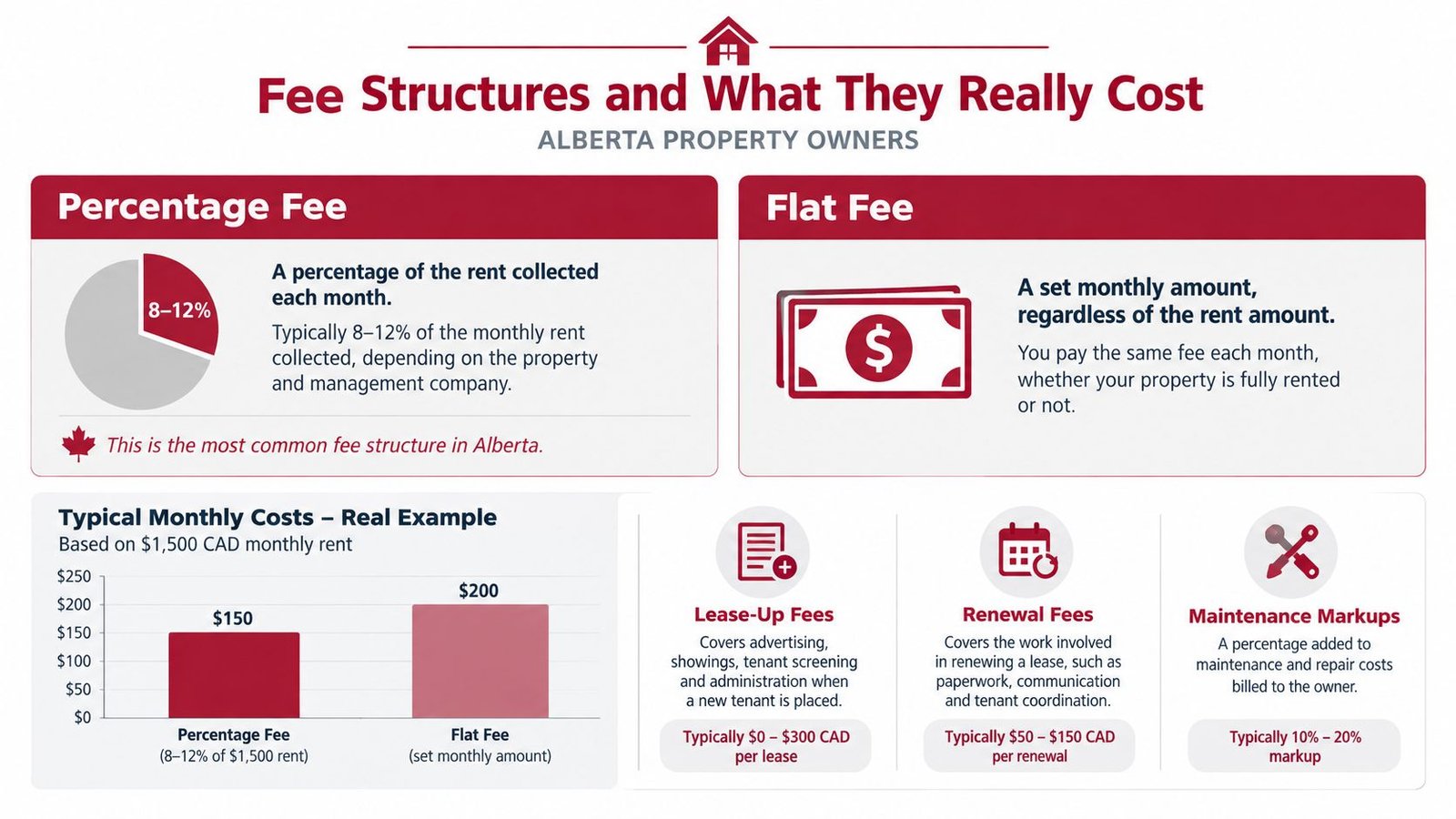
Two proposals land on the same Calgary rental. One quotes, say, 8 percent of collected rent; the other a flat monthly charge that reads lower on paper. Neither figure tells an owner much yet. The comparison only starts once leasing work, vacancy treatment, inspections, and repair markups are priced into each option, and I've watched owners pick the cheaper headline and pay more over a two-year term because everything else sat outside the package.
The calculation base decides what a percentage fee actually charges
A percentage arrangement sounds simple until the schedule defines the base. Rent collected, rent billed, and market rent produce three different invoices, and the differences surface exactly when an owner can least afford them.
If the fee runs on billed rent, the manager still gets paid while a tenant sits in arrears and the file heads toward a Residential Tenancies Act dispute. If it runs on collected rent, compensation drops to zero during a vacancy, which sounds owner-friendly until the agreement bills a separate administration charge for the empty months. Ask the manager to state, in writing, what happens to every fee line during vacancy, arrears, and eviction.
Flat fees carry their own version of this problem. The charge is easy to forecast, but its value depends entirely on the included workload. A flat fee that covers routine management only can cost more than a percentage model once turnovers, hearings, and project oversight get billed separately.
Price the same five situations against every proposal
The fastest way to expose the actual cost is to force both companies through identical scenarios. Run each quote against:
- A normal occupied month. Confirm the base fee, any statement or administration charges, and how the owner distribution is calculated.
- A vacancy between tenancies. Identify which fees pause, which continue, and whether advertising or showing costs are extra.
- A tenant placement. Pin down when the leasing fee is earned: on advertising, on lease signing, or on possession. The trigger matters if a signed tenant backs out.
- A mid-size repair. Separate the contractor's invoice from the manager's coordination charge, and check for markups, minimums, or approval thresholds.
- A contested tenancy issue. Price inspections, document preparation, and hearing attendance, since dispute work is where undefined "special services" charges tend to appear.
A published property management fee schedule gives owners a reference point for this exercise, though the signed agreement governs what gets billed.
Two more questions close most of the remaining gaps. First, does the manager receive vendor rebates or referral fees, and how are they disclosed? Second, who administers the security deposit trust account that Alberta's tenancy legislation requires, and is there a charge for that handling? Transparent compensation is easier to live with than a low headline fee surrounded by undefined extras.
Owner Responsibilities Under the Agreement
Delegating management doesn't supply the manager with information, access, or repair funds automatically. The owner's obligations should be realistic enough that the manager can perform the agreed work without repeatedly chasing missing approvals.
A furnace failure illustrates the trade-off. Requiring owner permission for every action preserves control, but it can leave the manager unable to arrange an urgent response when the owner is travelling or unavailable.
Provide an accurate operating file
Before management begins, the owner should assemble the documents and facts needed to operate the property responsibly.
- Property information: Supply existing leases, tenant contact details, known defects, warranties, appliance information, and relevant maintenance history.
- Access arrangements: Identify keys, entry devices, alarm procedures, and authorised contacts.
- Condominium documents: Provide applicable rules, management contacts, and relevant correspondence for a condominium rental.
- Financial commitments: Identify services the manager will pay and obligations the owner will retain.
- Insurance and lender conditions: Confirm applicable requirements with the insurer and lender rather than expecting the manager to infer them.
The agreement should require updates when those details change. A contractor can't reliably address a recurring leak if the owner hasn't disclosed previous repairs or an outstanding condominium investigation.
Fund decisions and respond
The owner should agree to maintain an operating reserve or another defined funding mechanism. Approval authority and available funds are separate issues: permission to order work doesn't pay the contractor.
The contract should also establish an escalation route when the owner doesn't respond. That might involve an alternate contact, written follow-up, or narrowly defined emergency authority.
An owner who wants tighter approval control should also accept a clear obligation to remain reachable.
Bylaw, condominium, and lender-related responsibilities should be allocated expressly, with professional advice obtained where needed. The manager should flag identified concerns within the agreed service scope; the owner should provide instructions and resources to resolve them.
Consequences for owner non-performance should be stated rather than assumed. Those consequences might include pausing non-essential work or invoking contractual termination rights, subject to applicable obligations and legal review.
Manager Obligations and Service Standards
A Calgary owner signs an agreement promising "round-the-clock response." A furnace fails during a January cold snap, the tenant calls at 11 p.m., and an automated message logs the request. By morning the unit still has no heat, and the owner discovers the contract defined none of it: no response clock, no dispatch obligation, no completion standard.
A workable obligations clause breaks every promise into observable steps: who receives the request, how urgency is classified, when a contractor gets dispatched, and what evidence closes the file.
Acknowledgement starts the clock. Verified completion ends it.
In Alberta winters, heating failures sit at the top of the urgency list, so the escalation clause should name which categories override normal spending approvals and who answers after hours.
Write each service as a deliverable with proof
| Service area | Expected deliverable | Evidence for the owner |
|---|---|---|
| Marketing | Approved listing and coordinated showings | Listing records and leasing updates |
| Screening | Documented applicant review | Decision summary with appropriate information controls |
| Rent administration | Collection and arrears follow-up | Ledger and action history |
| Maintenance | Triage, authorisation, and follow-through | Work orders, invoices, and completion notes |
| Inspections | Scheduled visits and condition documentation | Reports and relevant photographs |
| Owner reporting | Consistent financial and operational updates | Statements and unresolved-item summaries |
Calgary's rental stock makes this scoping exercise harder than a template suggests. CMHC's 2025 vacancy figures differed by 2.8 percentage points between purpose-built and condominium apartments, as recorded in its Calgary housing market dashboard, and each segment demands different handling. Condominium work runs through boards and bylaws, while purpose-built operations deal directly with the asset. An agreement that treats both identically will miss where delays occur. Owners comparing a proposed scope against a typical property manager duties overview can spot missing services before signing.
The clause should also cover what happens when the standard slips: coverage during staff absences or turnover, disclosure of related-party vendors, and a defined route for reporting missed targets to the owner. Security-related work follows the same logic, and Overton Security's security SLA guide for property managers is a useful reference for structuring those discussions, though not a substitute for Alberta tenancy-law advice.
Whether a missed standard amounts to a contractual breach depends on the actual wording and circumstances, not on owner frustration. Standards written as measurable commitments give both parties something enforceable. Standards written as adjectives give them an argument.
Alberta Tenancy Law Compliance
A Calgary owner signs a management contract, the tenant moves in on the first of the month, and the written landlord notice never goes out. Under Alberta's rules that notice carries a fixed deadline, and a clause reading "manager shall comply with all applicable legislation" says nothing about who prepares the document, who checks the date, or who keeps proof of delivery. The agreement should convert each statutory duty into a named task with an assigned party and a paper trail.
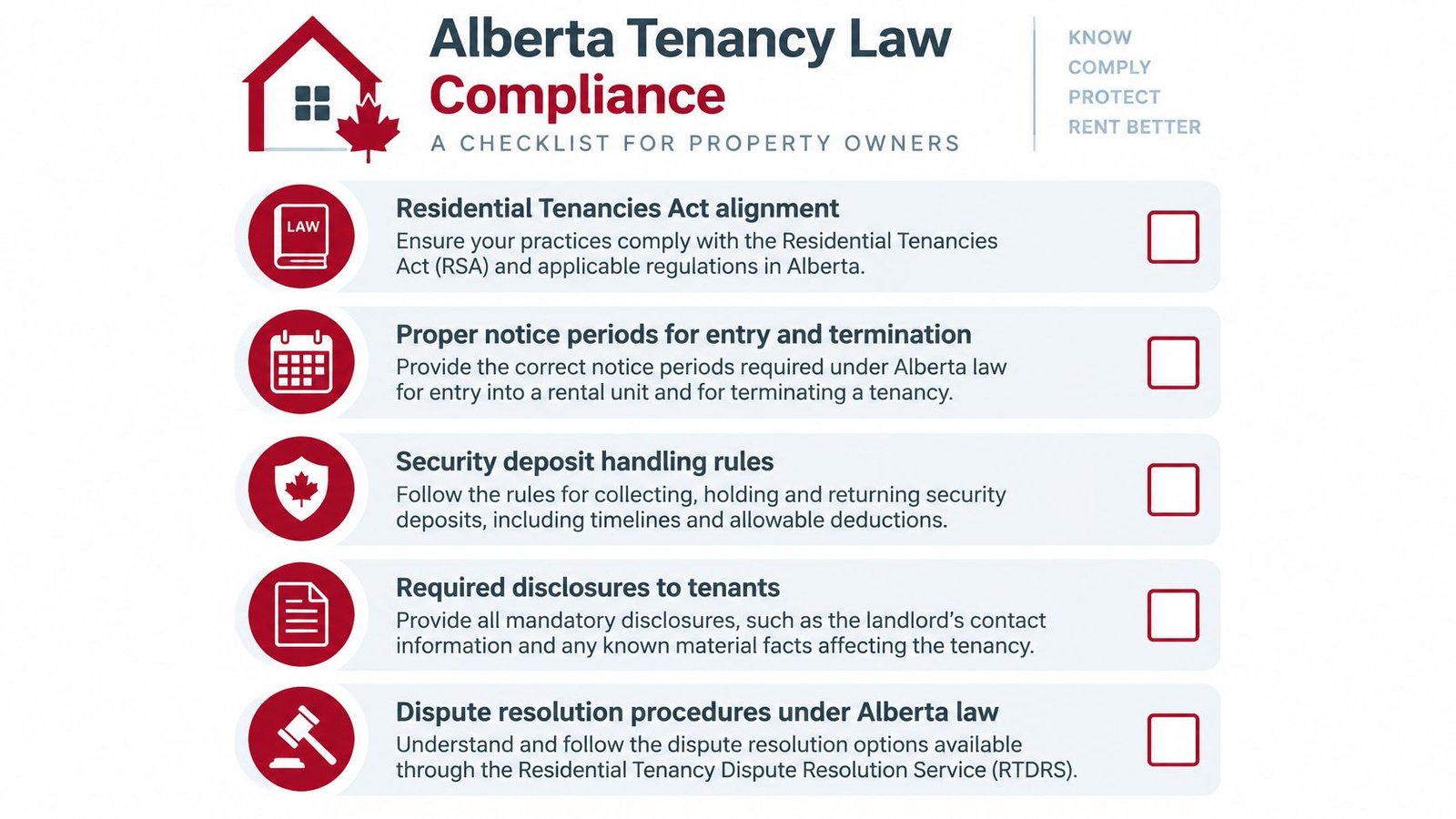
Alberta's Residential Tenancies Act recognises a property manager acting as the owner's agent as a landlord, while Alberta's landlord and tenant information states that compensated leasing, rental negotiation or approval, rent collection or holding, and related advertising generally require licensing through the Real Estate Council of Alberta, and sets deadlines including written notice of landlord within 7 days after tenant move-in and delivery of a copy of the residential tenancy agreement within 21 days of signing.
The contract should therefore name the licensed brokerage, the responsible individual, who holds signing authority, and who sends statutory communications. Delegating the task does not remove the owner's underlying obligation. If the manager misses the 7-day notice, the exposure lands on the owner either way, so the clause should spell out what confirmation the owner receives and when.
Alberta limits a residential security deposit to one month's rent at the tenancy's beginning, and it can't be increased later merely because rent rises, according to the province's information for tenants. Deposit handling belongs in the agreement as its own function: receipt, holding, accounting, proposed deductions, and return administration, with move-in and move-out inspection evidence attached to the deposit file rather than stored in a separate folder nobody can find during a dispute.
Four other workflows deserve the same explicit assignment in the text. Document preparation should identify who uses and updates approved forms. Delivery records should specify how service and tenant receipt get documented. Property access should follow the Alberta notice process instead of unrestricted contractual permission. Dispute handling should define the manager's authority to obtain advice, prepare evidence, and represent the owner within permitted limits.
Owners working through these assignments can use the Alberta RTA handbook overview as a practical reference while reviewing the draft.
A management contract sits on top of the Residential Tenancies Act. It cannot replace it, and internal approval rules cannot override tenant rights. Contested or unusual situations warrant Alberta-specific legal advice.
Liability, Insurance, and Indemnification
Risk allocation becomes meaningful when the agreement distinguishes property problems from management errors. A concealed plumbing defect, an ignored maintenance report, and work ordered beyond authority raise different questions. A blanket statement that the owner accepts all risk doesn't explain those differences.
Separate responsibilities before discussing coverage
The owner should ask an insurance professional about landlord property coverage, premises liability, and loss-of-rent protection appropriate to the property. The manager should identify the insurance relevant to its operations, including professional-error exposure.
The agreement should specify required evidence of coverage, any agreed minimum limits, notification expectations, and treatment of policy changes. Those requirements should follow actual advice and policy terms rather than copied assumptions.
| Issue | Contract question |
|---|---|
| Tenant injury allegation | Who reports the claim and preserves evidence? |
| Contractor-caused damage | Who coordinates the response and obtains records? |
| Alleged management error | What responsibility does the manager retain? |
| Lost rental income | Which party contacts the insurer and documents the loss? |
| Uninsured expense | How is responsibility assessed rather than presumed? |
Insurance and contractual responsibility aren't interchangeable. A promise to reimburse another party may extend beyond available coverage, so the wording deserves insurer and legal review.
Read indemnification narrowly
An indemnification clause allocates specified losses or defence costs between the parties. Owners should examine the triggering events, exclusions, control of the defence, settlement authority, and any obligation to advance costs.
Before accepting an indemnity: The owner should understand whether it covers authorised management activity, the manager's own errors, or both.
A balanced negotiation should address negligence, misconduct, unauthorised commitments, and each party's failure to perform. Liability caps also require scrutiny: a contract may promise detailed services while sharply restricting the remedy for failing to provide them.
The dispute clause should distinguish an owner-manager disagreement from a landlord-tenant proceeding. Mediation or arbitration provisions should identify the process, costs, venue, and treatment of urgent relief. An Alberta lawyer should assess enforceability and the interaction between these provisions rather than leaving either party to discover their effect during a dispute.
Termination and How to End the Agreement
An owner may need to change managers, sell the property, or resume direct management. The exit clause should accommodate those possibilities without creating uncertainty over rent, records, or tenant contacts.
The agreement should distinguish termination for convenience from termination for cause. Convenience provisions address an otherwise functioning relationship that a party wants to end. Cause provisions should identify the relevant breach, notice requirements, and any opportunity to correct it.
Establish the exit mechanics
There's no reason to assume a notice period or cancellation charge from another company's agreement applies. The actual contract should state the notice period, permitted delivery methods, effective termination date, and financial consequences.
- Notice: Identify the receiving party and how receipt is established.
- Outstanding work: Decide who completes authorised repairs and leasing activity.
- Fees: Specify earned charges, disputed amounts, and any expressly agreed exit costs.
- Authority: State when the outgoing manager must stop making new commitments.
- Transition contact: Identify who coordinates communications with tenants and vendors.
A sale-related exit also needs coordination with the transaction's actual circumstances. The management agreement shouldn't be treated as resolving every issue connected with an occupied property sale.
Require a documented handover
Ending management shouldn't leave the owner guessing about tenant balances or unresolved repairs. The outgoing manager should provide an indexed transfer package covering leases, ledgers, inspection records, notices, work orders, keys, access devices, and relevant correspondence.
Deposit custody and accounting deserve explicit transfer instructions. The parties should identify what funds move, who receives them, and how the associated records are reconciled.
| Handover item | Verification needed |
|---|---|
| Financial records | Balances agree with transferred funds |
| Tenant documents | Complete, readable files are accessible |
| Open maintenance | Status, commitments, and invoices are identified |
| Access materials | Keys and devices match the property |
| Tenant communication | New payment and contact instructions are coordinated |
Post-termination duties should also be clear. Confidentiality, record access, final accounting, and cooperation with an existing dispute may need to continue after ordinary management authority ends. The objective is a controlled transfer, not a final invoice.
Sample Agreement Structure and What Each Part Contains
An owner sits down with a proposed agreement for a Calgary townhouse. Fifteen pages, two signature blocks, a stack of schedules. The fastest way to judge it is to trace one ordinary event through the whole document: take a plumbing repair and follow it from the scope clause to the spending limit, the fee schedule, the reporting duty, and the handover procedure that applies if the relationship ends. If any link in that chain is blank or missing, the agreement is unfinished.
Alberta agreements tend to follow a recognizable anatomy, and reading the parts in order shows how authority flows.
- Parties and recitals. Correct legal names, ownership, and a background statement consistent with the operative clauses.
- Property description. Address, included spaces, parking, storage, and stated exclusions.
- Appointment. Which brokerage holds authority and who may sign on its behalf.
- Scope of services. Included tasks and express exclusions.
- Financial provisions. Fees, reserves, reimbursements, and distribution timing.
- Term and termination. Renewal mechanics, notice periods, cause, and exit procedure.
- Risk provisions. Insurance obligations, indemnities, and liability limits.
- General provisions. Notices, amendments, governing law, and dispute resolution.
- Schedules. Inspection formats, reporting samples, approval thresholds, and contact designations.
Recitals deserve a careful read because they frame the deal without carrying operative weight. When the background describes full-service management but the service schedule excludes work the owner assumed was covered, the inconsistency has to be fixed before signing. If a dispute ever reaches arbitration, the operative clauses decide it, and a friendly recital will not fill a gap in the scope clause.
The schedules are where Alberta law gives the document real content. Move-in and move-out inspections must occur within one week before or after the relevant tenancy event, the tenant must receive a signed copy of the inspection report, and security deposits must be held in an interest-bearing trust account, as set out in the Residential Tenancies Act quick reference guide. A workable inspection schedule converts those duties into room-by-room condition fields, timestamped photographs, and a defined procedure for recording tenant signatures or refusals.
Every schedule should be named in the agreement and delivered in completed form before execution. Blank spending limits, missing fee attachments, and references to policies the owner has never received need to be fixed up front. Electronic signing changes none of this: keep the entire signed package, attachments included, so later amendments can be told apart from the original commitments.
Negotiation and Review Checklist Before You Sign
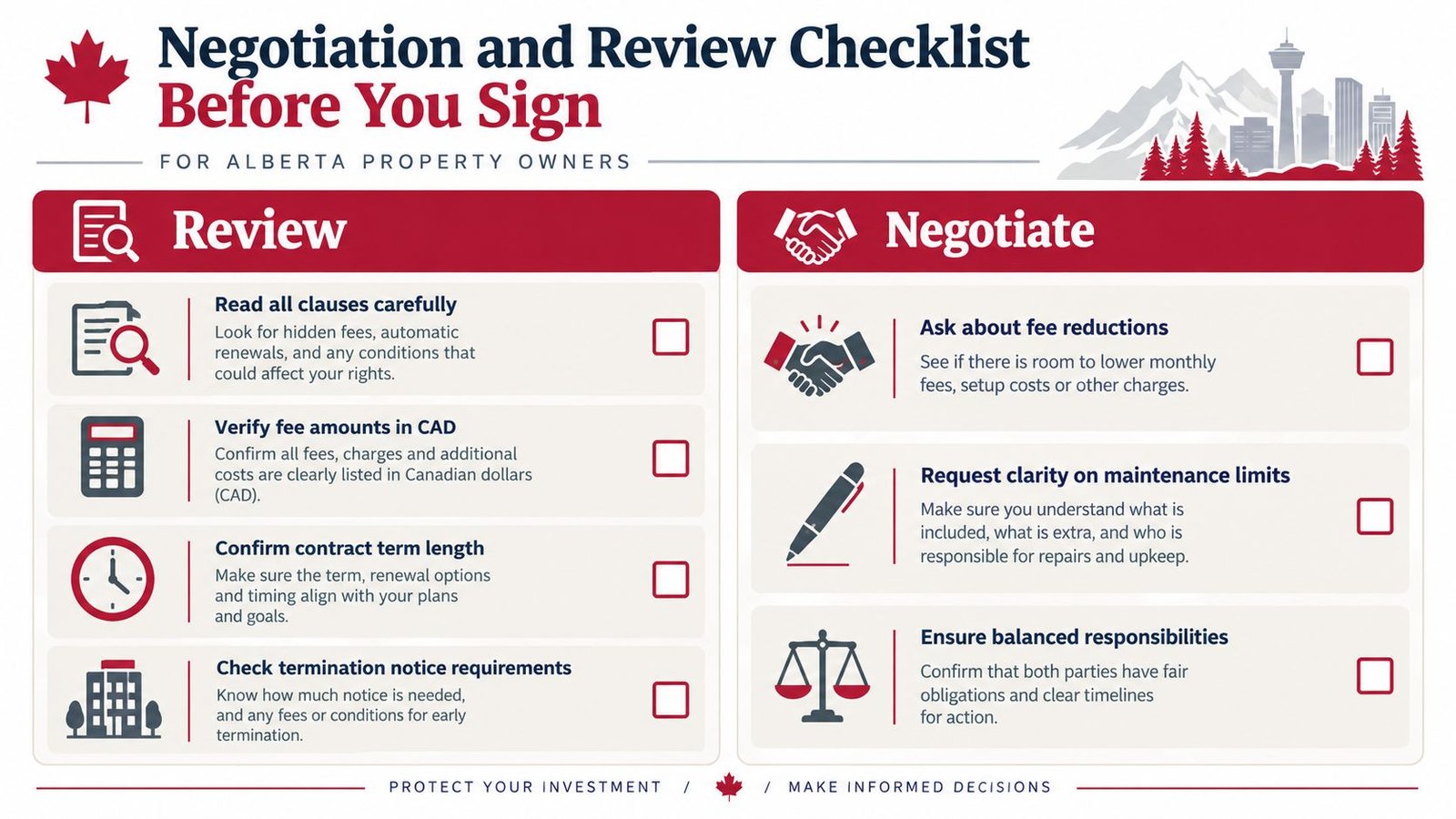
Negotiation should focus on the decisions most likely to create disagreement. Owners gain little from securing a lower base fee if the manager still has undefined spending authority, unclear reporting duties, or an expensive exit provision.
The proposed manager should be able to explain the agreement using ordinary operating situations. A vacant condominium, an overdue rent payment, and a repair requiring owner approval provide useful tests of whether the written process is complete.
Verify before negotiating price
- Licensing: Confirm the brokerage and responsible manager's relevant licensing status.
- Scope: Match the written services to the owner's intended involvement.
- Market approach: Ask what comparable evidence supports the recommended asking rent and how weak inquiry activity is addressed.
- Screening: Request an explanation of verification steps and applicant decision authority.
- Financial visibility: Review a sample owner statement and supporting invoice process.
- Exit readiness: Confirm that records and funds can be transferred through a defined handover.
Inspection accountability deserves particular attention. Under Alberta's inspection-report requirements, a landlord can't deduct damage or cleaning costs from the security deposit if the required inspection-report rules weren't met.
The contract should therefore identify the person responsible for scheduling, attending, documenting deficiencies, obtaining signatures or acknowledgements, storing photographs, and delivering reports. A generic inspection promise leaves too much uncertainty.
Negotiate boundaries, not vague assurances
Owners can request changes to approval thresholds, fee triggers, reporting commitments, renewal mechanics, and termination provisions. Each requested change should be recorded in the agreement or a clearly incorporated amendment.
A verbal assurance isn't a useful substitute for contract wording that both parties can locate and apply.
Red flags include unexplained extras, unilateral changes without a clear process, missing schedules, broad indemnities, and no practical route to obtain records. A manager's refusal to clarify an important provision is itself relevant to the owner's decision.
The final review should test consistency across the whole package. Where authority, insurance, liability, or statutory obligations remain uncertain, Alberta legal advice is a more useful next step than signing on the assumption that problems can be resolved later.
Dreamhouse Realty Ltd. offers residential rental management, tenant placement, and compliance oversight for owners in Calgary, Edmonton, Red Deer, and surrounding Alberta communities. Owners considering a property management agreement can visit Dreamhouse Realty Ltd. to arrange a rental consultation and discuss service scope, fees, approval controls, and reporting. Contact GURIQBAL CHAHAL, MBA, PMP, REAL ESTATE BROKER, Phone 403-966-6072, to discuss the property and the management responsibilities that need to be documented.