

A work order is a documented request that authorizes, assigns and tracks one maintenance or repair task from first report to completion.
Say a tenant in a Calgary rental texts at 9 p.m. that the bathroom ceiling is dripping. The owner contacts a plumber, but the message stays on a phone, the approval stays in a conversation, and the invoice arrives weeks later. When questions arise about the damage, nobody has a complete account of what happened.
Table of Contents
- A Work Order Explained in Plain Language
- Fields Every Alberta Work Order Should Capture
- How a Work Order Moves From Request to Completion
- Rental Maintenance Examples Sorted by Priority
- Record-Keeping Habits That Hold Up in a Dispute
- Linking Work Orders to Inspections and Alberta Rules
- Set Up Your Work Order System Before the Next Repair
- Worked Example of a Completed Work Order
A Work Order Explained in Plain Language
The useful answer to what is a work order goes beyond a form sent to a contractor. It's the repair's evidence file: the record connecting the original complaint to a decision, an approved intervention and a checked result.
An auto shop's job jacket provides a helpful comparison. That folder travels with the vehicle and holds the customer's complaint, the mechanic's diagnosis, the approved quote and the final sign-off. A rental maintenance work order serves the same purpose, except the asset might be a furnace, roof or bathroom supply line.

From a message to a managed repair
For the ceiling leak, the manager first records the symptom rather than guessing at the cause. The contractor's findings can later establish whether the source was a supply connection, drain or another building component.
The City of Calgary's building-permit dataset records application dates, issued or completed dates, current status and work classifications. Although a permit isn't a maintenance order, those fields illustrate a useful lifecycle: identify the problem, classify the work, assign responsibility, monitor progress and close after completion.
A rental work order brings the following details together:
- Issue and location: The reported condition, property, unit and affected area.
- Requested work and responsibility: The proposed task and the person accountable for arranging it.
- Status and timing: What has happened, what remains outstanding and when actions occurred.
- Approvals and costs: Who authorised the work and what spending was accepted.
- Completion evidence: Findings, photographs, tests and confirmation of the outcome.
A tenant's message starts the process; it doesn't authorise every possible repair. A contractor's invoice records a charge; it doesn't necessarily explain why that charge was approved.
A useful starting check is whether the owner's last three repairs contain every element above. Missing details reveal where the process relies on memory.
Fields Every Alberta Work Order Should Capture
The following checklist turns a maintenance request into a record that another manager, contractor or owner can understand without a separate explanation.
Core work order fields and what each one prevents
| Field | What It Records | Why It Matters |
|---|---|---|
| Property and unit | Address, unit number and asset such as furnace, roof or fridge | Lets the owner search repair history by location and system |
| Reported date and time | When the tenant or an inspection flagged the issue | Shows how quickly the request was acted on |
| Defect description | The specific condition, such as a ceiling stain versus an active drip | Stops vague tickets that lead to wrong repairs |
| Priority | Emergency, urgent or routine | Sets response speed and the approval path |
| Tenant access | Entry date, time window and notice given | Supports a clear record of lawful entry |
| Assigned contractor | Vendor name, licence and insurance on file | Shows who is responsible for the work |
| Authorized cost limit | The approved ceiling before work starts | Prevents cost creep without approval |
| Scope of work | What is included and what is excluded | Limits disputes over extra charges |
| Hazard controls | Known hazards and the control chosen for each | Makes safety a condition of starting |
| Completion evidence | Dated after photos, test results and tenant confirmation | Supports verification that the repair was done |
| Final invoice | Actual cost compared with the authorised limit | Feeds owner statements and budget reviews |
The property field should identify the actual equipment where possible. A fridge's model and serial number prevent confusion between appliances and help distinguish repeated failures from unrelated repairs elsewhere in the building.
The reported timestamp establishes the starting point. The defect description then separates observation from diagnosis: an active drip gives a plumber more useful information than a general complaint about a damaged ceiling.
Details that prevent avoidable disagreements
Priority and access fields tell the manager how to proceed without treating scheduling as permission to enter. Contractor details establish accountability, while the spending ceiling and written scope keep a small repair from becoming an open-ended assignment.
Parts and labour requirements belong within the scope or an attached estimate. Hazard controls describe the precautions needed, and completion evidence must match the actual task, not merely show a tidy room.
Alberta's guidance on responsibilities during a tenancy states that landlords must keep premises reasonably safe and in good repair throughout the tenancy and recommends written records of problems, actions and responses. These fields help connect that responsibility to the manager's daily decisions.
Practical rule: A completed field should answer a question, not merely contain text.
Small operations should pay particular attention to the reported time, cost ceiling and completion photos. Without them, the owner may struggle to explain response timing, challenge unapproved spending or demonstrate the repaired condition.
How a Work Order Moves From Request to Completion
A reliable process gives each handoff a clear owner. The broad flow below shows how a reported problem becomes a filed maintenance record.
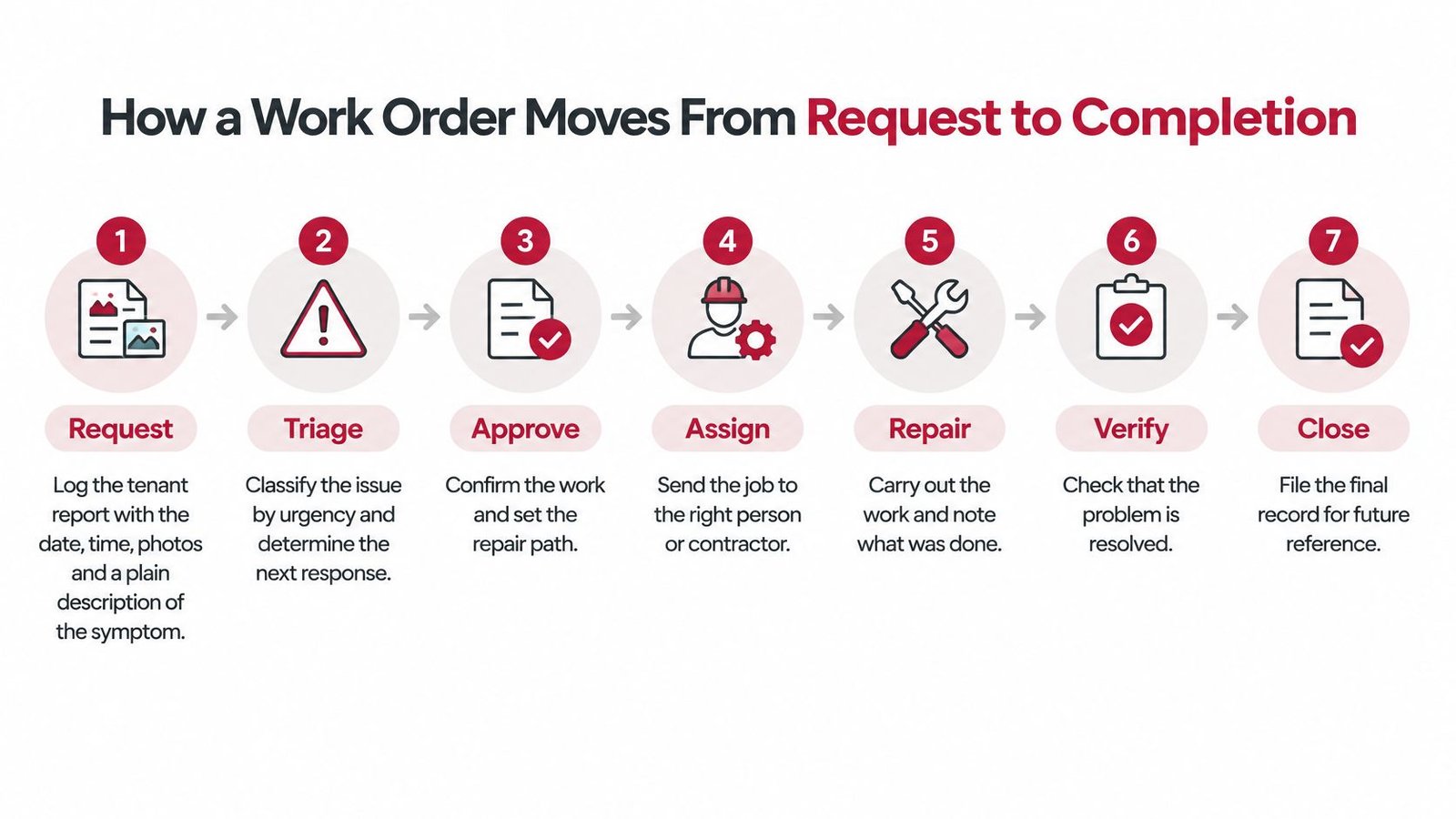
The operational stages
Request. The manager logs the tenant's report, date, time, photos and a plain description of the symptom. Keeping the initial observation intact prevents a suspected cause from being mistaken for a confirmed diagnosis.
Triage. The manager classifies the issue as emergency, urgent or routine, then dispatches emergencies first. Safety and the potential for further damage matter more than the order in which messages arrived.
Hazard gate. Known hazards, isolation requirements, affected occupants and controls are recorded before work starts. Alberta's occupational health and safety assessment template directs parties to review the assessment with workers and eliminate or control hazards before starting the job.
Approval. The manager approves work within the authority established by the owner; spending above that limit requires owner approval. Emergency arrangements should already identify who can authorise immediate protective action.
Dispatch. The vendor receives the written scope, access arrangements and cost ceiling. This prevents the contractor from arriving with only a tenant's phone number and an incomplete description.
Completion. The contractor records findings, work performed, parts used, tests, cleanup and dated photographs. Any restoration still outstanding remains visible rather than disappearing inside a paid invoice.
Verification and close. The manager checks the outcome with the tenant and reconciles the invoice against the approved work. The order closes when the repair is verified and outstanding tasks are resolved or separately assigned.
Tracking the handoffs
For owners organising responsibilities across email, contractors and property files, Fluidwave's guide to building a practical workflow management system provides a useful framework for defining task ownership. The maintenance-specific requirement remains clear: each open order needs someone responsible for the next action.
Useful measures include emergency acknowledgement time, time to make safe, completion cycle time, repeat-call rate and the difference between authorised and final cost. Reviewing these by asset and vendor helps distinguish slow dispatch from parts delays, incomplete scopes or unsuccessful repairs.
A contractor leaving the property isn't the same as a confirmed repair.
Premature closure is a common mistake. A restored service, a successful test and a documented follow-up provide a stronger basis for closing than departure alone.
Rental Maintenance Examples Sorted by Priority
A tenant reports no heat at 6 a.m. in January while the outdoor temperature sits at minus 25 degrees. The manager opens an emergency order, dispatches immediate assistance and keeps the owner informed as work proceeds. Heat loss in those conditions cannot wait in a routine approval queue.
The categories below describe typical patterns, not fixed legal response deadlines. A manager must reassess priority whenever new information changes the risk.
Typical rental repair examples by priority and approval
| Rental Situation | Priority | Approval Needed | Evidence to Keep |
|---|---|---|---|
| Furnace fails in January with no heat | Emergency | Dispatch now, owner informed during work | Photos, technician report, heat-restored confirmation |
| Gas smell or no hot water after a flood | Emergency | Dispatch now | Shut-off action taken, vendor report |
| Toilet leaking through the ceiling below | Urgent | Manager approves within cost limit | Before and after photos, water damage notes |
| Fridge stops cooling and food spoils | Urgent | Manager approves within cost limit | Model and serial number, replacement invoice |
| Dripping kitchen faucet | Routine | Owner approves if above limit | Repair note, parts receipt |
| Loose stair railing in a multi-unit building | Urgent | Owner approves | Photos, hazard controls, completion check |
| Worn carpet found at move-out | Routine | Owner approves quote | Move-out inspection photos, itemized quote |
| Exterior siding or roof damage | Routine to urgent, according to hazard | Owner approves, municipal check may apply | Scope, contractor report, permit check result |
Gas odour calls for immediate safety escalation rather than an ordinary appointment. Flood-related loss of hot water also requires assessment of the affected equipment and surrounding hazards before anyone attempts a restart.
The same symptom can change category
A dripping kitchen faucet is usually routine. Water reaching an electrical panel or light fixture changes the situation because the concern is no longer wasted water or a damaged finish.
Similarly, a loose railing needs interim protection while approval and repair proceed. An approval requirement should not leave tenants exposed to a known hazard.
Priority and maintenance type are different classifications. Dreamhouse Realty Ltd.'s explanation of the main types of maintenance helps owners distinguish reactive repairs from preventive and planned work.
Checking municipal requirements
A roof or structural repair may need more than a contractor booking. Some repairs require a building permit, so the owner should confirm municipal requirements with the City of Calgary before dispatching the contractor. Structural work or a changed layout warrants a scope check at this stage.
Recording the outcome inside the order keeps that compliance step visible in the file.
For a practical spending review, an owner can sort the last ten orders into the table's categories. The useful question is which priority absorbed the most spending and whether earlier planned work could have prevented any emergency expense. A high share of emergency spending usually points to deferred routine work, while a file dominated by routine orders suggests the priority scale is being applied consistently.
Record-Keeping Habits That Hold Up in a Dispute
Can a work order protect an owner? Yes, in a specific way: it can provide a contemporaneous record supporting a reasonable response and fair cost allocation. It doesn't, by itself, prove that a repair was timely, adequate or legally required.
Alberta's guidance on common landlord and tenant problems explains that a tenant facing an ignored repair obligation may seek remedies through the RTDRS or court, including damages, rent reduction, compensation or termination. What carries weight in that process is the documented sequence of actions, not the existence of a ticket.

Habits that preserve a credible history
Seven habits keep that sequence intact:
- Keep the original message: Save the tenant's unedited report with its timestamp so later summaries can be checked against it.
- Log contact attempts: Record missed calls, voicemails and unanswered messages to explain gaps in communication.
- Store photos inside the order: Dated before-and-after images should remain with the repair rather than on a contractor's phone.
- Attach financial records: Keep quotes, invoices and approval emails together so the cost decision can be reconstructed.
- Identify each decision-maker: A short entry should state who approved what and when.
- Use consistent statuses: Labels such as awaiting access, awaiting parts and pending verification explain why an order remains open.
- Preserve corrections: A dated additional note should correct a closed record without deleting the original account.
These habits matter most when one repair crosses several conversations. A tenant may report a leak by text, agree to access by email and confirm the result by phone. Each record belongs in the same file, so the manager can show when the problem was reported, when entry was arranged and when the fix was verified.
A file someone else can understand
Remote owners depend on structure more than memory. A consistent folder per address makes a Calgary, Edmonton or Red Deer repair easy to reconstruct, and unit, room and asset references should match across photographs, inspections and invoices. Anyone opening the folder should be able to trace a single repair from the first complaint to the paid invoice without asking what happened in between.
A useful dispute file explains the sequence without asking the reader to trust anyone's memory.
The order itself should stay factual throughout. A contractor's observation, a tenant's statement and the manager's conclusion belong in separate dated entries, so a reviewer can tell evidence from opinion. Dreamhouse Realty Ltd. maintains an Alberta Residential Tenancies Act reference that supplies the tenancy context a maintenance file sits within.
Linking Work Orders to Inspections and Alberta Rules
A work order gains most of its weight from the records around it. The move-in inspection sets the documented condition, and later reports together with completed orders let a manager judge whether a change reflects ordinary wear, a maintenance failure or possible tenant-caused damage.
Under Alberta's information for landlords, move-in and move-out inspections must occur within one week before or after possession begins or ends, reports must be written, tenants must receive a copy immediately after inspection, and landlords must retain copies for three years after the tenancy ends. Filing related repair records beside those reports keeps the property history readable, though that retention duty belongs to the inspection reports themselves.
Condition records and access records serve different purposes
An inspection should name specific conditions, such as a burn, a scratch or a stained ceiling, rather than dismissing a room as acceptable. Dreamhouse Realty Ltd.'s Alberta rental inspection form guidance helps owners organise that baseline.
Notices must be served using a method the Residential Tenancies Act allows, so the file should record the reason, date, time, delivery method and delivery date for any entry notice.
- Inspection evidence: Establishes the condition recorded at a particular stage of the tenancy.
- Access documentation: Records the arrangements and formal notice associated with entry.
- Repair evidence: Shows the intervention and its verified outcome.
Each record answers a different question. A text message that coordinates access belongs in the file as a communication record; the formal entry notice stands as its own document. An inspection photograph captures condition at one point in time, so a conclusion about damage still depends on the baseline report and the repair history around it.
Connecting the records
Repair responsibilities continue between inspections, so the file should keep growing after move-in day. Where work affects structure or layout, the manager should resolve municipal authorisation questions before scheduling the affected scope.
The filing step itself is plain: attach move-in and move-out reports to the property file, then connect repairs involving the same room or system. The result reads as a condition history instead of a folder of unrelated documents, and that sequence is what makes the file persuasive later.
Set Up Your Work Order System Before the Next Repair

A leak after hours is the wrong time to decide who can approve a plumber, which evidence counts as complete, or where the access notice was saved. Set those rules while the property is quiet, then let the form enforce them.
A manageable setup routine
- Build the template. Include the checklist fields, with reported time, priority, cost ceiling and completion photographs clearly visible. Missing mandatory information should be easy to spot.
- Set authority in advance. Establish priority tiers and the dollar limit above which the owner approves spending. Emergency escalation needs a separate, understood path.
- Connect property records. Attach inspection reports to each property file and use matching room and asset names on repair orders.
- Schedule a monthly review. Review the full open-order list once a month and close only verified work. Emergency and urgent orders still move on their risk level even when the monthly review is weeks away.
For teams already using Microsoft tools, RapidStart's software guidance for Microsoft-based field teams can inform a software shortlist. Judge any tool by whether it preserves approvals, attachments, ownership and an understandable history.
Deciding who will run it
Out-of-province owners and landlords without time for routine follow-up may prefer local management. Dreamhouse Realty Ltd. handles rent collection, maintenance coordination, inspections and tenant communication; its compliance work includes accurate documentation and routine property inspections.
Owners can start a management conversation through the Dreamhouse Realty Ltd. website: https://www.dreamhouse.rentals. A useful discussion would establish how work-order tracking, maintenance coordination and owner updates would operate for the property.
Worked Example of a Completed Work Order
The following hypothetical completed order applies the opening leak scenario. Its times, measurements and costs are illustrative, not quoted service prices or response standards.
The completed record
| Field | Illustrative entry |
|---|---|
| Property and unit | Calgary rental, unit 3; upstairs toilet supply line |
| Reported date and time | Tenant text received at 9:04 p.m.; original message and timestamp saved |
| Defect | Active drip through bathroom ceiling; stain about 30 centimetres wide |
| Priority | Urgent after immediate assessment and containment; bathroom light left off that night; repair dispatch next morning |
| Tenant access | 8 a.m. to noon window; access record contains the actual written notice, delivery method and delivery date confirming applicable requirements were met |
| Assigned contractor | Licensed plumber; insurance certificate on file; drywall restoration separately coordinated |
| Authorized cost limit | $450 approved before work starts |
| Scope | Replace supply line and repair affected ceiling drywall; whole-suite repainting excluded |
| Hazard controls | Qualified professional isolates power to bathroom fixture before work begins |
| Completion evidence | Dated before-and-after photos, satisfactory pressure test result and tenant confirmation the following day |
| Final invoice | $386 checked against the $450 approval and entered for the owner statement |
The overnight scheduling assumes the leak was contained and the immediate hazards addressed. An uncontrolled leak or unresolved electrical danger would require escalation rather than waiting for the morning appointment.
What makes the record complete
The manager checks that the plumbing repair and drywall restoration are both accounted for. The saved evidence explains the initial condition, the approved boundary of the work and the basis for closing, without relying on the invoice to tell the whole story.
Dreamhouse Realty Ltd. offers maintenance coordination, inspections and documented property management for Alberta rental owners, connecting repair requests with approvals and follow-through. Owners seeking a more organised repair history can visit Dreamhouse Realty Ltd. to discuss management for their rental property.