

A brokerage fee in real estate is the negotiated, written payment for licensed services tied to a property transaction, and Alberta sets no standard percentage. The commonly cited illustration of 7% on the first $100,000 plus 3% on the balance is an example only, not a mandatory rate.
Why do two quotes with the same headline percentage leave an Alberta owner with different amounts after tax, leasing costs and renewals? Conventional comparisons stop at the percentage, but landlords in Calgary, Edmonton and Red Deer should rank every quote by net cost, meaning the fee after GST, extras and the work that's included. That single shift changes which offer looks cheapest.
Table of Contents
- What a Brokerage Fee Covers and Who Pays It
- How Brokerage Fees Are Calculated With Real Examples
- Sales, Leasing and Management Fees Compared
- Alberta Rules and Costly Misconceptions
- What Owners Should Negotiate Before Signing
- Get a Written Fee Quote Before You Commit
What a Brokerage Fee Covers and Who Pays It
Think of a brokerage quote like a tailor's quote. A tailor doesn't work from a provincial price list for every alteration. The price reflects the garment, the work promised and the timing agreed for that job, and a brokerage fee works the same way for a sale, a lease placement or ongoing management.
The Definition in Plain Language
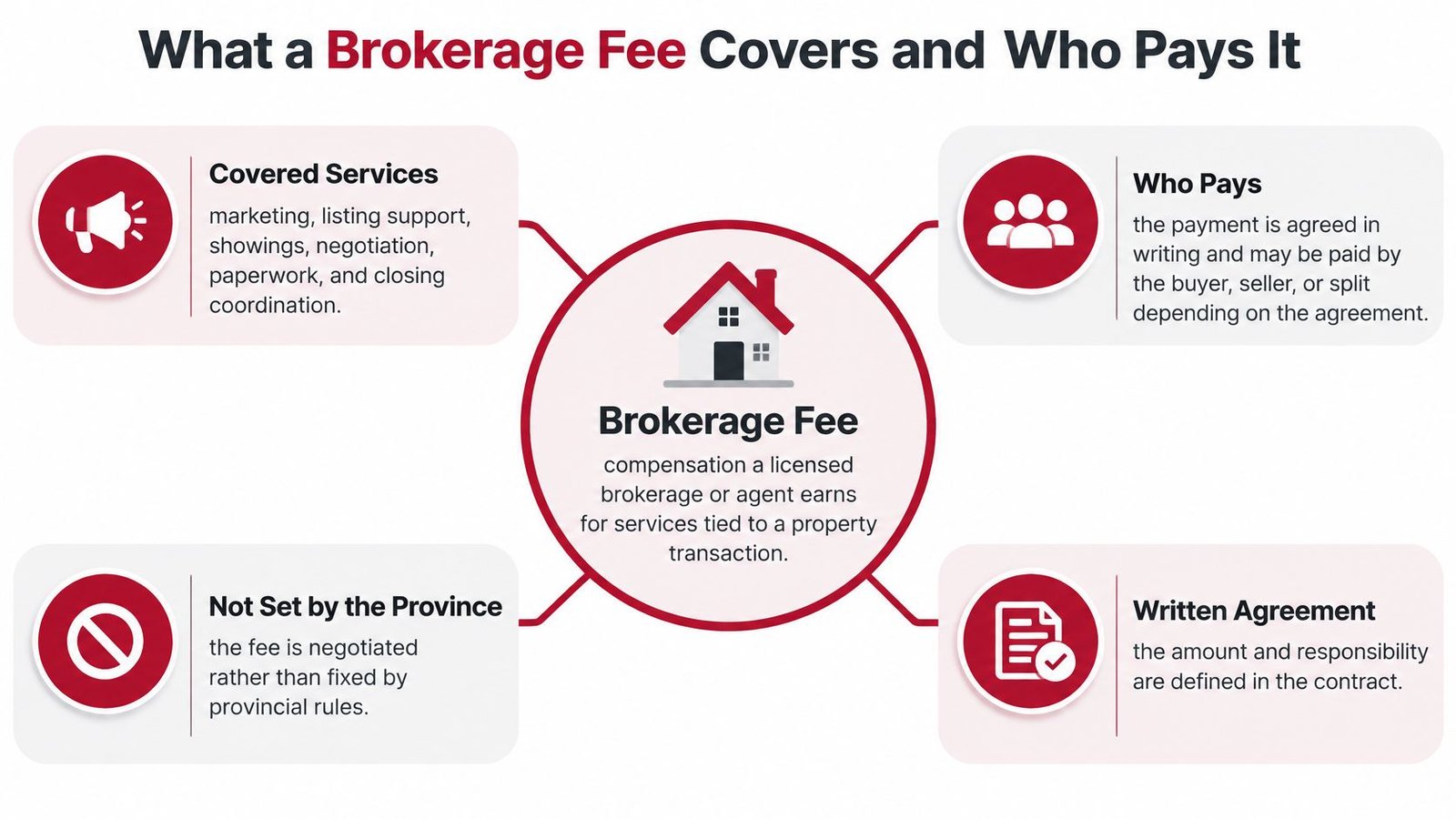
What is a brokerage fee in real estate is best answered as compensation that a licensed brokerage or agent earns for services tied to a property transaction. Those services can include pricing advice, marketing, listing preparation, showings, negotiation, paperwork and closing coordination. The fee isn't fixed by province wide rules, so the signed agreement must state the amount or calculation method, the services covered and the payment trigger.
The Real Estate Council of Alberta advertising guidelines state that commission rates are negotiable between the client and brokerage, and professionals must not imply that a regulator, board or trade association sets a mandatory rate. That distinction matters because a familiar percentage repeated in conversation can sound official when it isn't. Negotiation is part of the arrangement, while clarity about cost is the obligation that protects the owner.
The Three Parts Every Owner Should Identify
- Who is paid: The agreement names the licensed brokerage receiving compensation, and it should also state whether part of the amount goes to a cooperating brokerage. Payment shouldn't be treated as an informal side arrangement.
- For what base: The calculation may use sale price, a leasing fee or recurring management revenue. A percentage is meaningless until the owner knows which dollar figure it applies to.
- When payment is due: A sale fee, a lease signing fee and a monthly management fee have different triggers. The agreement should say whether a failed closing, cancellation or early termination changes the amount owed.
In a typical Alberta sale, the seller pays the commission and the listing brokerage may share part of it with a cooperating brokerage. A buyer can still owe an amount under a buyer representation agreement when another party doesn't fully cover the agreed remuneration. Owners considering a rental purchase shouldn't assume buyer side help is free because the seller's transaction often funds both sides.
Three part test: Every quote should answer who is paid, for what, and when, before its percentage deserves attention.
Tax treatment belongs in that first conversation too. Owners should ask whether a quoted figure includes tax, whether fees are payable under the agreed terms, and whether any disbursements sit outside the main compensation. A clear answer in writing prevents a manageable quote from becoming a larger invoice after closing or lease signing.
How Brokerage Fees Are Calculated With Real Examples
A tiered fee works like a set of steps: one rate applies to the first portion of the sale price, and another applies to the remaining amount. To check the total, calculate each portion separately, add them together, then include GST if it is not already in the quote.
Worked Example at a Calgary Sale Price
A commonly used illustration applies 7% to the first $100,000 and 3% to the remainder. On a $600,000 sale, the first portion costs $7,000. The remaining $500,000 at 3% costs $15,000, for a total of $22,000 before GST.
Alberta's 5% GST adds $1,100, bringing the fee to $23,100 including GST, assuming GST applies to the full fee. If two cooperating sides split the $22,000 equally, each receives $11,000 before GST. That split is only an illustration; the signed agreements determine the actual amounts.
A Second Tiered Example
At $650,000, the same tiered illustration produces a $23,500 commission: $7,000 on the first $100,000, plus $16,500 on the remaining $550,000. The Jim Ang Realty Calgary selling costs guide uses this example. When the sale price rises by $50,000, the fee rises by $1,500 because that added amount is charged at 3%.
The table compares these fee structures before GST. To rank them by net cost, add applicable tax and any separate charges, then check whether each quote covers the same work.
| Sale price | Tiered 7% then 3% | Flat 6% | Flat 7% |
|---|---|---|---|
| $400,000 | $16,000 | $24,000 | $28,000 |
| $500,000 | $19,000 | $30,000 | $35,000 |
| $600,000 | $22,000 | $36,000 | $42,000 |
| $650,000 | $23,500 | $39,000 | $45,500 |
Two Questions Before Trusting Any Total
- Does the total include tax? Compare quotes on the same basis: ask for the fee before GST and the total including GST.
- What amount is the percentage applied to? The agreement should identify the calculation base, such as the gross sale price. A lower rate can cost more if it applies to a larger base or comes with extra charges.
A lower headline percentage does not guarantee a lower bill. Separate marketing, coordination or placement charges can change the final amount, so compare the full cost for the services included.
For rental owners, a tenant placement fee pays for a different service from a sale commission. Compare each fee against its own scope and calculation, then include applicable tax and extras to see the net cost.
Sales, Leasing and Management Fees Compared
A Calgary landlord can meet three different fees over the life of one property, sometimes without realising they are separate purchases. A purchase or sale may involve a brokerage fee, a vacancy creates a leasing task, and occupied months require ongoing management. Keeping those buckets apart is the first step toward a fair quote comparison.
| Fee type | Services it usually covers | Common charging method | When it is typically due |
|---|---|---|---|
| Sale brokerage | Listing, marketing, showings, offers, negotiation and closing support | Negotiated percentage of sale price, possibly shared with a cooperating brokerage | At completion, as the agreement states |
| Leasing fee | Pricing, advertising, showings, applicant screening and lease preparation | Negotiated flat amount or percentage tied to rent, confirmed in writing | At lease signing, as the agreement states |
| Property management | Rent collection, inspections, maintenance coordination, reporting and tenant communication | Percentage of collected rent or flat monthly charge | Recurring, usually monthly |
Why the Same Percentage Can Cost Different Amounts
Alberta sale fees were typically reported at 6% to 7% of the sale price in 2024, equal to approximately $30,000 to $35,000 on a $500,000 home, according to Realtor Fee Calculator. Those figures are a market reference, not an entitlement and not proof of value. A seller still needs to know which marketing, pricing and negotiation services are included before ranking a quote.
Rental fees create a subtler trap. The Alberta tenancy guidance confirms that rental operations involve specific notice and record requirements, so compliance work is a distinct scope rather than an automatic feature of every arrangement. One provider's management quote might include inspections, advertising, tenant placement and maintenance coordination, while another bills those items separately.
The fee base changes the result during vacancy. A percentage of collected rent is calculated only on rent received, while a percentage of scheduled rent may continue to reference rent that's expected but not collected. Owners should ask which base applies, how a vacant month is billed and whether leasing, renewal or inspection charges apply on top.
A useful quote also sets approval thresholds for repairs, reporting frequency and termination terms. Owners reviewing real estate management arrangements should be able to place each service in a single column without guessing where it belongs. Dreamhouse Realty services are subject to separate service agreements that set out terms, fees and responsibilities, which supports that line by line comparison.
Ranking by Net Cost
The practical ranking starts with the annual management amount, then adds the leasing fee, renewal charges, inspection fees, advertising and any maintenance markup. Owners shouldn't stop at the monthly percentage because a property that turns over frequently can trigger repeated placement costs. The highest headline percentage can be the cheaper contract when it includes work that the other provider invoices separately.
Alberta Rules and Costly Misconceptions
A familiar commission percentage is a market convention, not a government-set rate. In Alberta, licensing rules require professionals to be authorized when providing real estate services, while the amount and terms of compensation are addressed through the service agreement. For owners, the practical distinction is simple: check who is licensed, then read how the fee is calculated and paid.
What Disclosure Should Show
The Real Estate Council of Alberta's disclosure guidance explains that clients should receive information about the cost of services, how compensation is calculated, and any third-party compensation. If the final amount is not known, the calculation method and the factors that affect it can help clarify the likely cost.
A headline fee is only one part of the picture. Check whether other compensation or charges sit outside it, and read the agreement to see who pays them and when. That is how a percentage becomes a figure you can compare against the owner's actual cost.
Four Beliefs That Need Correcting
- A familiar percentage is the legal rate. Fees are not set by a government tariff. The written agreement should state the amount or explain how it will be calculated.
- Buyers never pay. A seller may contribute to a buyer's brokerage costs, but the buyer's agreement can still make the buyer responsible for an unpaid balance. Anyone buying a rental should check what happens if the seller contributes less than expected.
- The lowest rate is always cheapest. A lower headline figure can cost more if services or charges are excluded. Compare the total for the same scope, including applicable taxes and extras.
- Money is owed only at closing. The agreement may also set out payment obligations if a transaction is cancelled or does not close. Check the payment trigger and any exit terms before signing.
The fee's net cost depends on more than its percentage. Taxes, separate charges and the services included all affect the total, so compare agreements on the same basis.
Rental owners should also distinguish transaction services from ongoing tenancy administration. A sale or leasing arrangement does not automatically include continuing management tasks; check the agreement's stated scope.
What Owners Should Negotiate Before Signing
Negotiation works best when owners compare net cost for the same scope, not unrelated headline rates. Three written quotes for the same property, expected rent and service list reveal whether a provider has lower costs or is less transparent about extras. Each quote should separate sale, leasing and management charges and state the tax treatment.
| Clause | What to confirm | Red flag |
|---|---|---|
| Fee base | Percentage of collected rent, scheduled rent or a flat amount, stated in writing | Base is unclear or can change without notice |
| Leasing fee | Advertising, showings, screening and lease preparation are listed and priced | Separate charge for every showing |
| Renewals | Whether renewal or re-leasing fees apply | A fee on every renewal with no added service |
| Maintenance markup | Whether vendor invoices carry a markup and the approval threshold | Undisclosed markup or no spending limit |
| Inspections and advertising | Who pays, and whether costs are capped or receipted | Costs billed without receipts |
| Early termination | Notice period and any termination charge | Charge larger than the value of services remaining |
| Taxes | Whether GST is included in the quoted figure | Quote excludes tax without saying so |
Six Negotiation Moves That Change the Total
- Pin down the fee base and trigger. The agreement should state exactly what dollar amount the percentage applies to and when payment becomes due. Ambiguity here affects every later invoice.
- Price the leasing bundle. Owners should confirm whether advertising, showings, screening, lease preparation and renewals are included or billed separately. A flat leasing fee or a waived renewal fee can be negotiated before signing.
- Set spending controls. A maintenance approval threshold, vendor invoice copies and a disclosed markup policy protect cash flow. Owners shouldn't accept open ended authority for repairs.
- Ask about vacancy performance. Expected time to lease, inquiry response, showing capacity and reporting frequency should be discussed before a vacancy begins. Pricing process matters because an empty month can outweigh a small fee saving.
- Test the fee against Calgary market conditions. The CMHC 2025 Calgary Rental Market Report recorded a 5.0% vacancy rate in the purpose built rental market and an average two bedroom rent of $1,914. A higher fee may be justified if stronger pricing and screening shorten vacancy, while a low fee paired with slow leasing can cost more.
- Price the exit before entry. Owners should confirm the notice period, any termination charge and what records are returned at the end. Exit wording is easiest to improve before the contract is signed.
Sellers can apply the same scope discipline to a listing conversation. Reviewing pricing tactics for seller presentations from Virtual Tour Easy can help owners ask sharper questions about price positioning, presentation and the work that supports the asking price. A polished presentation shouldn't substitute for a line by line fee schedule.
A signed property management agreement is where every negotiated concession belongs. Service fees, commissions and payment schedules are set out in each individual management or service agreement, so oral assurances that don't appear in that document leave the owner exposed. Owners should initial the version that contains the final fee base, extras, approval limits and termination terms.
Get a Written Fee Quote Before You Commit
What will the fee cost after taxes and extra charges? Ask for a written quote that separates sales, leasing and management fees, then compare the net cost and scope of each. The quote should state the fee base, payment trigger, included services, GST treatment and cancellation terms.
Dreamhouse Realty Ltd. offers a free landlord consultation that shows how a property compares with competing rentals in its area. The company's website promotes the consultation with a “Get Free Consultation” button. For owners considering different housing formats, find the right tiny home dealer; brokerage and management fees still need to be assessed separately.
Get the quote before a renewal, tenant turnover or listing decision, while there is time to compare terms. Keep the signed agreement with the rent roll so you can check charges against the agreed scope. To request a written breakdown, contact Guriqbal Chahal, Real Estate Broker, Founder and President of Dreamhouse Realty, at 888-348-1800.
Dreamhouse Realty Ltd. sets service fees, commissions and payment schedules out in individual management or service agreements. Request a free consultation and written quote through Dreamhouse Realty Ltd. before committing to a service.