

A Calgary landlord has found a low rise condo that appears to solve several problems at once: a manageable purchase price, a practical floor plan, and a location that should appeal to working tenants. The listing looks straightforward until the condo documents arrive. The monthly fee is higher than expected, the reserve fund study raises questions about upcoming work, and comparable rentals suggest that the advertised rent may be optimistic.
That decision is common across Calgary and other Alberta cities. A low rise condo can be easier to operate than a detached rental, but it isn't automatically a stronger investment. The test is whether the unit still works after condo fees, insurance exposure, vacancy, maintenance, reserve funding, and realistic rent levels are included.
The broader Alberta condo base is substantial and relatively modern. The 2016 Alberta housing profile recorded 33,455 additional condominium units since 2011, a 15.0% increase, compared with national condominium growth of 16.1% over the same period. It also recorded 78,875 condominium-occupied dwellings built from 2001 to 2010 and 41,100 built from 2011 to 2015. Those figures help explain why low-rise condos remain important in established urban neighbourhoods, rather than being a niche format limited to older towers. Alberta's 2016 Census housing profile provides the underlying housing context.
Table of Contents
- Why Alberta Landlords Are Looking at Low Rise Condos
- What a Low Rise Condo Is in Alberta
- Pros and Cons for Landlords and Investors
- Reserve Funds and Building Compliance in Alberta
- The Operator Mindset in a Softening Calgary Market
- Neighbourhood Suitability Across Alberta Cities
- Day to Day Management and Tenant Handling
- Your Next Step as an Alberta Condo Landlord
Why Alberta Landlords Are Looking at Low Rise Condos
A Calgary owner may find a low rise condo near shops, transit, and employment, then discover that the rental case depends on details hidden in the condo documents. The unit may show well, yet a high monthly fee, weak reserve funding, or an optimistic rent assumption can change the result before a tenant moves in.
Landlords consider these properties because they can combine ownership housing, neighbourhood access, and a smaller building footprint. A one- or two-bedroom unit in an established Calgary or Edmonton area may suit professionals seeking a longer-term home. Demand still depends on the exact block, floor plan, parking, storage, condition, and finish level. A convenient address does not compensate for an awkward layout or poor building management.
Operating responsibility starts with utilities. Review the disclosure documents and fee schedule before comparing units. Confirm which services the condo fee covers, how heat and electricity are billed, whether utilities are separately metered, and which costs remain with the landlord. The Axis Meter Solutions condo markets resource can help owners assess metering arrangements and responsibility for consumption.
The purchase price is only one part of the operating model. Condo fees reduce gross rent, insurance terms can affect the budget, and a weak reserve fund may lead to a special assessment. A landlord should also allow for vacancy rather than underwrite the unit at full occupancy. Calgary's overall market vacancy rate rose from 4.6% in 2024 to 5.1% in 2025, according to the City of Calgary, while CMHC reported a 2.2% vacancy rate for the secondary rental market condominium segment in its 2025 Calgary figures. Those measures describe different parts of the market, so they should not be treated as interchangeable.
The operator's task is to test the unit under softer leasing conditions. Compare the condo with a townhouse or detached rental using documented fees, insurance, repairs, vacancy, and achievable rent. This comparison of condos and homes outlines practical ownership differences. The final decision rests on the building records, tenant fit, and whether the cash flow remains workable after those costs are included.
What a Low Rise Condo Is in Alberta
For an Alberta landlord, a low rise condo usually means a multi-unit residential building of roughly four storeys or fewer. Local planning rules may classify buildings differently, so height alone does not determine the operating model. The more useful distinction is scale: fewer shared systems and a smaller common-area footprint than a tower often mean fewer building-level issues to monitor.
The unit is privately owned. Hallways, exterior walls, roofs, landscaping, mechanical equipment, and other shared elements are managed through a condominium corporation. That corporation operates under Alberta's condominium legislation, collects condominium contributions, maintains common property, and makes decisions through its board and owners. A landlord therefore owns the suite but depends on the corporation's records, decisions, and maintenance planning.
A townhome may look similar from the street, while title and repair obligations differ. Depending on the condominium plan and bylaws, a townhouse owner may carry more direct responsibility for exterior elements or land-related obligations. Mid-rise and high-rise buildings generally add vertical circulation, elevator infrastructure, larger shared mechanical systems, and a wider insurance and maintenance footprint.
| Format | Typical Storeys | Governance | Landlord Note |
|---|---|---|---|
| Low rise condo | Roughly four or fewer | Condominium corporation | Smaller shared systems can simplify operations, but the corporation still controls major common assets |
| Townhome | Varies by design | Condominium corporation or other titled arrangement | More home-like layout, with responsibilities that must be confirmed in the documents |
| Mid-rise tower | More than a low-rise building | Condominium corporation | Elevators, larger systems, and broader common-area exposure can increase operating complexity |
Low-rise buildings fit established neighbourhoods because their scale can sit comfortably within existing streetscapes. In Calgary areas such as Beltline, Inglewood, and Killarney, and Edmonton areas such as Oliver and Strathcona, the format can add housing without creating the same vertical profile as a tower. Zoning, construction economics, and neighbourhood compatibility influence where these buildings appear. Familiar surroundings still provide no guarantee of strong rental performance, so the operator must assess tenant demand and competing listings for the specific unit.
What the format changes for an owner
Low-rise condos often provide fewer amenities than larger towers. Owners may deal with fewer shared facilities, less elevator dependence, and a simpler common-area environment. Tenants who want a gym, concierge, rooftop space, or extensive security features may therefore assign less value to the property.
The right comparison is unit-specific: specific unit, specific corporation, specific tenant pool, and specific monthly cost. A modest building with sound records can outperform a newer property with expensive amenities. An older walk-up with deferred maintenance can require more landlord attention than its purchase price suggests. For an investor, the corporation's condition and the unit's leasing profile matter as much as the building's height.
Pros and Cons for Landlords and Investors
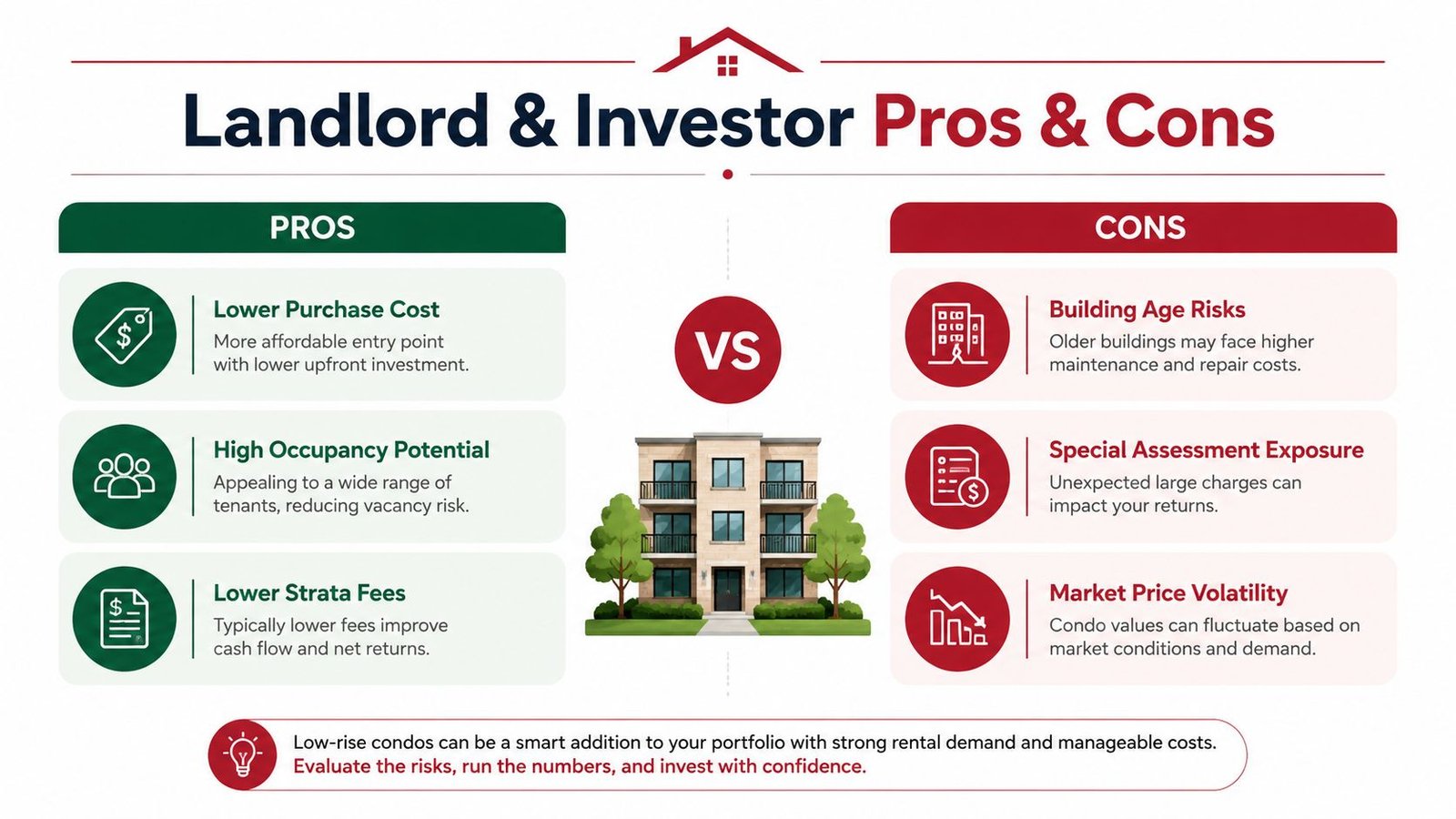
A low rise condo can suit an investor who wants a smaller rental operation than a detached house. The condo corporation usually coordinates exterior work and common-property maintenance, while the owner focuses on the unit, tenant, and monthly financial performance. Budgeting becomes easier when the corporation keeps fees stable and contributes appropriately to future repairs.
Tenant demand depends on the unit's position and leasing profile. A low-rise home near employment, transit, retail, or daily services may appeal to professionals and smaller households who prefer convenience without extensive amenities. Rent remains limited by the local market. Compare the unit with competing listings, condition, parking, pet rules, and tenant expectations before accepting the seller's income projection.
Calgary's 2026 apartment-condominium market makes that discipline more important. Conditions softened from February through June, with more listings, rising inventory, and weaker pricing pressure by June. The Calgary market figures referenced earlier show why an investor should underwrite vacancy and rent carefully rather than rely on appreciation.
The advantages that hold up
- Lower capital scale: A low rise unit may require less capital than a detached rental, though the purchase price by itself does not establish a stronger return.
- Shared exterior responsibility: The corporation normally arranges major common-property work, reducing the landlord's direct role in roofing and exterior maintenance projects.
- Tenant-friendly layouts: Ground-level access, balconies, parking, and smaller communities can appeal to tenants who prefer low-rise living.
- Operational consistency: Strong records and a clear maintenance plan can make recurring costs easier to forecast.
The risks that buyers underestimate
Condo fees can increase as insurance, utilities, repairs, or staffing costs rise. A low fee can signal deferred maintenance or an underfunded reserve, so the amount alone does not establish building quality. Special assessments may create a sudden owner obligation for major repairs. The corporation's insurance deductible can also affect the unit owner when damage starts inside the unit or falls under the governing documents.
Calgary rental conditions vary by segment. CMHC's earlier figures show a gap between the overall vacancy rate and the secondary condominium rental segment. Broad vacancy headlines therefore provide limited guidance. Price the exact unit against comparable buildings, then test the budget for vacancy, turnover, repairs, condo-fee increases, and a realistic rent ceiling.
Practical rule: A low rise condo works when the corporation's records and achievable rent support the purchase. Appreciation should not conceal weak monthly economics.
Reserve Funds and Building Compliance in Alberta
A condo corporation's reserve fund is the financial foundation for major repairs and replacement of common property. Alberta guidance requires a low-rise condo corporation to complete a reserve fund study every 5 years, prepare a reserve fund plan from that study, and report the plan to owners. The initial study is generally due within 2 years of condominium plan registration. The requirements and timing are summarised in Alberta reserve study guidance.
A purchaser should review more than the current fee amount. The most useful documents include the latest reserve fund study, the prior study, the reserve fund plan, engineering or building reports, recent budgets, financial statements, special assessment notices, insurance information, and board or annual general meeting records.
| Indicator | Healthy Reserve Report | Warning Sign Reserve Report |
|---|---|---|
| Funding plan | Contributions align with projected work | Contributions appear below projected needs |
| Asset condition | Major components have documented inspection findings | Roof, heating, doors, or envelope work is vague or deferred |
| Assessment history | Past assessments are explained and resolved | Repeated assessments or unclear outstanding obligations |
| Records | Maintenance and construction records are available | Missing reports or inconsistent explanations |
| Fee outlook | Future increases are modelled and disclosed | Current fees appear low without a credible long-term plan |
The study should be based on an on-site visual inspection and a review of available maintenance and construction records. It should account for depreciating assets such as roofs, heating systems, doors, windows, fire-safety equipment, and building-envelope components. Current building decisions also sit within the National Building Code, 2023 Alberta Edition, declared in force on May 1, 2024, as described by Alberta's building codes and standards information.
The Condominium Property Act requires corporations to establish and maintain a capital replacement reserve fund for major repairs and replacement of corporation property and common property. Alberta guidance states that reserve funds can generally pay for required reserve studies and certain expert reports, but cannot normally fund capital improvements unless authorised by special resolution or required to meet health, building, maintenance, or occupancy standards. The Alberta reserve-fund publication explains that distinction.
Insurance deserves separate review. The owner should understand the corporation's master policy, deductibles, exclusions, and the unit owner's insurance obligations. A practical resource on the subject is Calgary condo insurance for owners. The final budget should convert likely fee increases, reserve exposure, and owner insurance into a monthly per-door cost, so two units can be compared fairly.
The Operator Mindset in a Softening Calgary Market
A softening resale market changes the investment question. The landlord isn't buying a chart. The landlord is buying a unit that must attract a tenant, collect rent, withstand repairs, and remain saleable when the owner eventually exits.
Calgary's supply picture supports a cautious approach. CMHC's 2026 outlook projects Calgary apartment starts rising from 9,034 in 2023 to 11,505 in 2024 and 14,821 in 2025, while rental vacancy moved from 1.4% to 4.8% and then 5.0%. Those are projections and outlook figures presented by CMHC's Housing Market Outlook. More apartment supply can give tenants greater choice and reduce short-term pricing power for older or poorly positioned condos.
The resale side also became more selective. Calgary condo sales fell 28.5% year to date in 2025, while average condo prices remained around $348,500, according to the same outlook source. That combination doesn't describe a uniform collapse. It describes buyers becoming more selective while sellers compete for fewer decisive purchasers.

What the underwriting should measure
A responsible analysis starts with gross rent, then subtracts every recurring cost that belongs to the owner. Condo fees, property tax, insurance, management, repairs, leasing costs, utilities paid by the owner, financing, and a vacancy allowance all belong in the model. The model should also reserve a separate allowance for irregular condo-related costs rather than treating a special assessment as an impossible event.
An owner can test the unit against a 7% to 10% vacancy assumption, but those assumptions should be identified as stress tests, not market facts. The objective is to learn whether the property remains serviceable when lease-up takes longer or a tenant leaves during a competitive period.
A low rise condo is an operating asset first. Resale appreciation is a possible outcome, not a payment plan.
Annual reviews should compare actual rent, inquiry volume, vacancy days, condo fee changes, repair spending, and nearby competing supply. Landlords who document those figures can make decisions earlier, whether that means adjusting the rent, improving presentation, changing a leasing strategy, or selling an underperforming unit.
Neighbourhood Suitability Across Alberta Cities
The block often matters more than the city label. Calgary and Edmonton each have low-rise condo pockets with distinct tenant profiles, building ages, transit connections, parking conditions, and competing supply. Start with the tenant pool you can realistically serve, then identify buildings that fit that demand.
Calgary's resale indicators softened through 2025 and early 2026. Condo benchmark values were reported near $333,500 in June 2025, and the annual average benchmark price later declined to about $303,600 by early 2026. The northeast recorded the steepest declines, while the west district showed relative stability. These figures appear in the Calgary real estate market update.
Edmonton followed a different pattern. Sales eased about 6% year to date in 2025, while average prices rose to roughly $212,672, based on the same market update. Those conditions do not establish better cash flow in Edmonton or automatically make Calgary riskier. Each unit requires its own local analysis of rent, fees, condition, and resale potential. City-level trends alone cannot determine viability.
| Indicator | Calgary Low Rise Condo | Edmonton Low Rise Condo |
|---|---|---|
| Recent resale direction | Softer conditions, with district-level variation | Sales eased while average prices increased |
| Tenant screening priority | Competing apartment supply, commute, parking, and building condition | Transit, institutional access, employment corridors, and unit affordability |
| Main building review | Reserve funding, insurance exposure, and fee trajectory | Reserve funding, fee trajectory, and local tenant turnover |
| Selection principle | Compare the exact quadrant and competing listings | Compare the exact corridor and competing listings |
Matching the building to the tenant
Young professionals may favour Beltline or accessible inner-city Calgary locations, along with Oliver or Strathcona in Edmonton. Walkability, transit, secure parking, work-from-home space, and responsive maintenance can matter more than an extensive amenity package.
Small families may prefer quieter low-rise areas such as Killarney or established northwest and southeast Calgary communities. In Edmonton, west-end corridors and neighbourhoods with practical access to schools and services may fit better. Verify school catchments directly because boundaries and availability can change.
Students can support demand near Whyte Avenue and nearby Edmonton institutions. Their tenancy may involve seasonal leasing, roommate arrangements, higher turnover, noise concerns, or parking pressure. Review the bylaws before relying on this tenant pool, since occupancy, pets, and parking arrangements may be restricted.
Inner-city locations can support rent through convenience. Newer development belts may offer modern finishes while competing directly with newly delivered apartments. A manager should inspect comparable listings, tenant inquiries, walkability, transit, parking, and the corporation's financial record before recommending a purchase. The building's operating costs and leasing evidence should support the decision, not neighbourhood reputation alone.
Day to Day Management and Tenant Handling
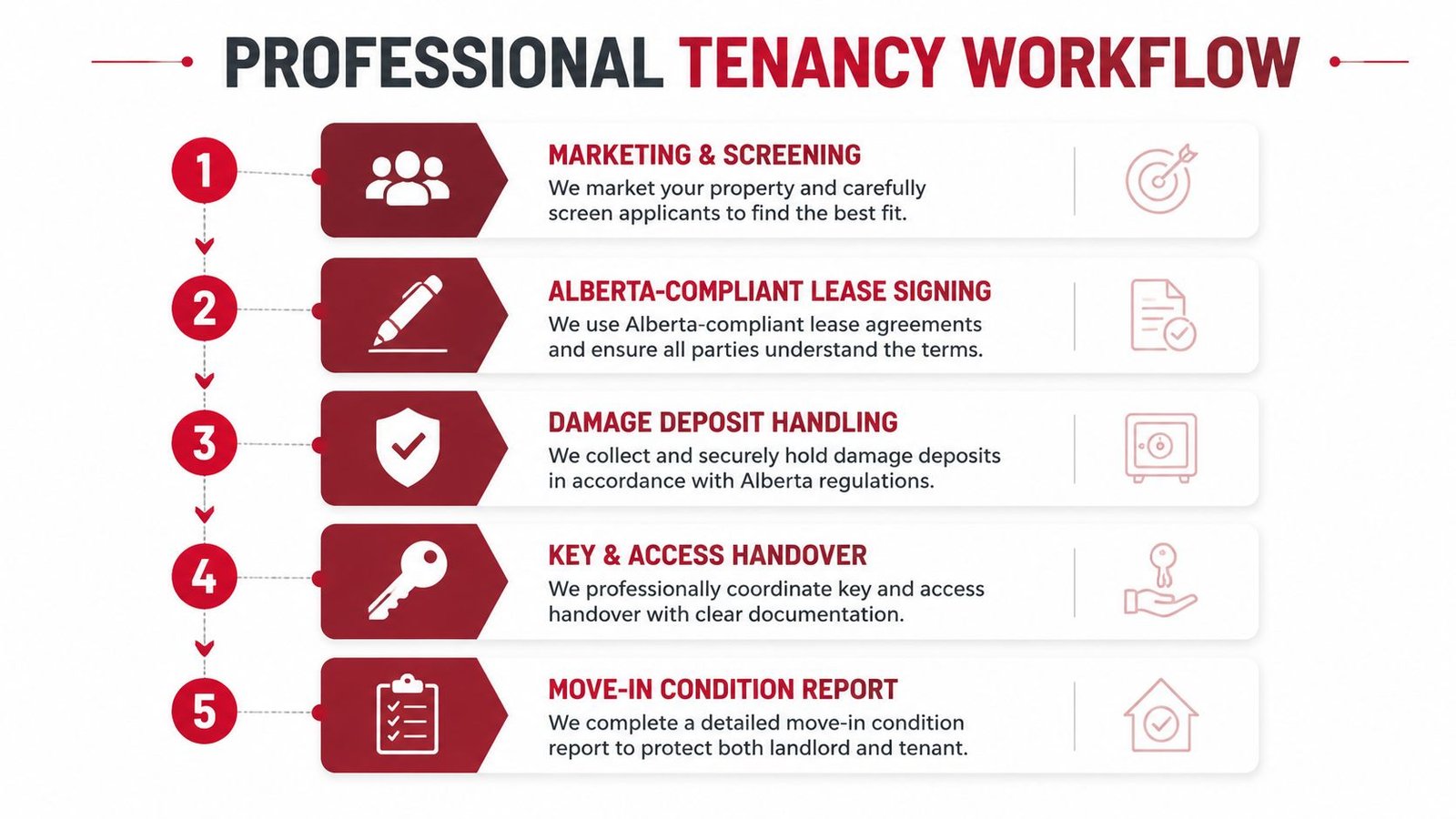
Professional management begins before a listing goes live. The manager confirms the condo corporation's bylaws, rental restrictions, move-in rules, parking allocation, pet provisions, utility responsibilities, and access requirements. The listing then needs accurate photos, a defensible rent position, and screening criteria that comply with Alberta requirements.
Lease execution should be followed by a documented handover. The manager records keys, fobs, parking stalls, mailbox access, appliance condition, flooring, walls, cleaning, heating and cooling equipment, filters, windows, balconies, and any existing damage. A tenant should receive a copy of the completed move-in inspection report.
The compliance details matter
Alberta's Residential Tenancies Handbook states that a landlord can deduct damage from a security deposit only when both written move-in and move-out inspection reports were completed. It also states that normal wear and tear cannot be charged to the tenant, regardless of wording in the tenancy agreement. The Alberta tenancy handbook sets out those inspection requirements.
A manager should treat maintenance requests as a triage system:
- The tenant reports the issue: A portal, email trail, or documented phone record captures the location, symptoms, photographs, and urgency.
- The manager identifies responsibility: Common elements normally go to the condo corporation or its property manager, while in-suite items generally remain the landlord's responsibility, subject to the governing documents.
- The manager protects the building: Water leaks, overflowing fixtures, or heating failures receive immediate attention because damage can spread into neighbouring units and create insurance complications.
- The manager closes the work order: The file should retain approvals, invoices, photographs, contractor notes, and tenant communication.
Rent collection, arrears follow-up, owner statements, lease renewals, and access notices require consistent records. Rent increases need three months' written notice, and the manager must coordinate lawful access for corporation maintenance, fire system inspections, window cleaning, and other scheduled work.
Owners comparing service models may find this guide to choosing a property manager useful. For broader planning around protection and repair responsibilities, BatchData's home warranty analysis offers another resource, although warranty coverage must be assessed against the condo corporation's documents and the unit owner's policy.
Your Next Step as an Alberta Condo Landlord
Before closing, an investor should treat the low rise condo as both a residence and a small operating business. The purchase file should contain the latest reserve fund study, the current reserve fund plan, engineering reports, financial statements, insurance information, fee history, special assessment records, bylaws, rules, and disclosure documents.
The last two AGM minutes deserve particular attention. They can reveal recurring water issues, elevator or envelope concerns, insurance disputes, owner conflict, proposed projects, rental restrictions, and board decisions that aren't obvious from a listing or a single status certificate. Alberta's condominium regulations were amended in 2026, and the consolidated regulation is shown as current through Alberta Regulation 23/2026 as of February 15, 2026, according to the Alberta condominium regulation publication. A purchaser should confirm the current documents and obtain professional legal advice where interpretation is required.
Warning signs include:
- Deferred maintenance: Reports identify major work without a credible funding plan.
- Unclear assessments: The corporation cannot clearly explain past, current, or proposed assessments.
- Fee instability: Contributions rise repeatedly without transparent asset planning.
- Governance friction: AGM records show persistent disputes, unresolved owner complaints, or poor record-keeping.
- Insurance difficulty: Coverage, deductibles, exclusions, or claims history remain unclear.
- Weak tenant fit: The unit lacks parking, access, layout, or location advantages against nearby rental competition.
A reserve fund below a particular funding threshold should not be treated as an automatic rejection without understanding the study's assumptions, component condition, and contribution plan. The investor's decision should reflect the actual replacement schedule, not a generic rule applied without context.
Neighbourhood selection often matters more than a superficially attractive deal. Before committing capital, the landlord should gather the corporation documents, request the last two AGM minutes, verify the realistic rent, and book a consultation with a licensed Alberta property manager who can model cash flow, tenant placement, compliance responsibilities, and the likely exit strategy.
Dreamhouse Realty Ltd. provides licensed property management, tenant placement, inspections, maintenance coordination, rent collection, compliance oversight, and owner reporting for low rise condos across Calgary, Edmonton, Red Deer, and surrounding Alberta communities. Landlords can visit Dreamhouse Realty Ltd. to request a rental consultation and discuss the building documents, operating budget, leasing plan, and management workflow before purchasing or listing a condo.