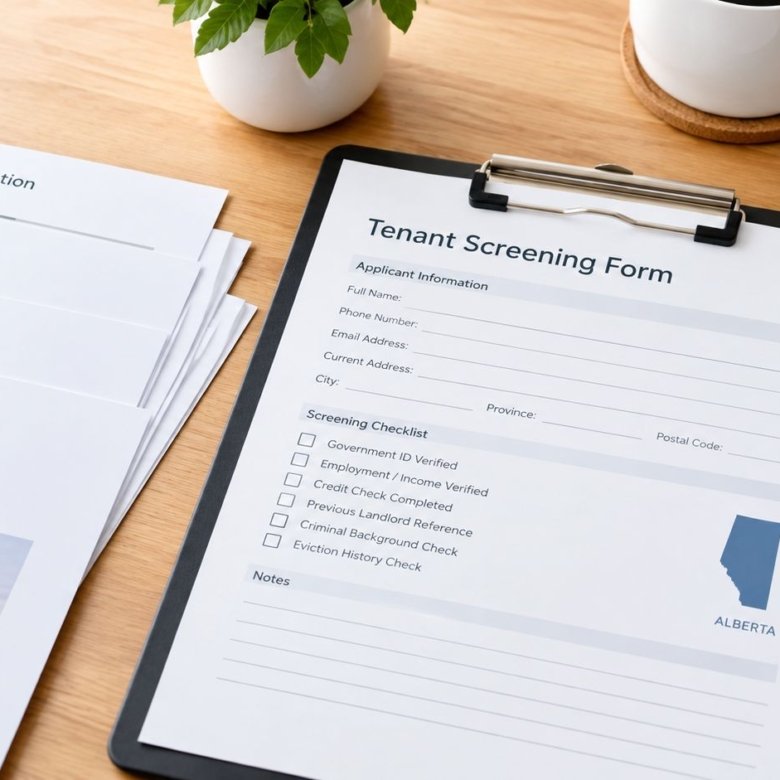

A Calgary landlord receives an RTDRS notice after a tenant disputes the balance shown on an account. The landlord has a spreadsheet, several e-transfer notifications, a bank statement, and a chain of emails. The problem is that the spreadsheet records only payment dates and amounts. It doesn't show which rental period each payment covered, whether a payment was partial, when funds were received, or which document proves each entry.
That gap can turn an otherwise manageable arrears issue into a credibility problem. In Alberta, a rent payment ledger should be treated as an organised evidentiary file, not just a bookkeeping convenience. It should show what was expected, what was received, when it was received, how it was paid, and where the supporting proof can be found.
Table of Contents
- Understanding the Alberta Rent Payment Ledger
- Essential Fields for an Alberta Rent Payment Ledger
- Record-Keeping Best Practices and Retention Rules
- Designing Ledger Entries for Dispute Readiness
- Integrating the Ledger with Security Deposits and Tax Records
- Modern Credit Reporting and Tenant File Access
- Transitioning to Professional Property Management
- Quick Reference Checklist and Next Steps
Understanding the Alberta Rent Payment Ledger
A payment dispute can expose the weakness of an ordinary bookkeeping spreadsheet. One row may show rent received, an amount, and a month. It may not show whether the payment was partial, when the funds became available, which rental period they covered, or which document supports the entry. Reconstructing those details later from bank records, messages, and email creates avoidable dispute risk.
A rent payment ledger is a chronological account for one tenancy and one rental unit. It should let a landlord, property manager, tenant, tax preparer, or RTDRS decision-maker follow the account without relying on personal memory or scattered files. The record should connect expected rent, actual receipts, payment dates, adjustments, and the evidence behind each transaction.
Alberta tenancy requirements operate under the Residential Tenancies Act and related regulations, as outlined in the Alberta landlord and tenant handbook. That framework gives tenancy records more purpose than a general income spreadsheet. A bank deposit can show that money entered an account, but it may not establish which rental period it covered or whether it satisfied the full amount due.
Why a basic spreadsheet falls short
Consider an entry reading, “rent received, $1,500, April.” It becomes difficult to defend if the tenant sent part by e-transfer and paid the remainder by cheque. The same entry leaves uncertainty if funds arrived after the due date, the parties changed the due date in writing, or an initial transfer was rejected and replaced.
A dispute-ready ledger links each transaction to its source document. The supporting file may include the lease, payment confirmation, receipt, bank record, relevant correspondence, notices, and written payment arrangements. Alberta RTDRS guidance identifies leases, agreements, termination notices, receipts, invoices, and photographs as possible evidence, and advises parties to retain receipts and tracking numbers. The Alberta RTDRS evidence guidance supports treating the ledger as an index to dated proof, not as proof that stands alone.
Practical rule: Each ledger line should answer five questions quickly: who paid, how much arrived, when it arrived, what period it covered, and what document proves it.
The evidentiary file behind the numbers
The supporting file should contain relevant applications, inspection notes, correspondence, and payment records. Tenants may also request access to rental records, including payment history and receipts, under applicable privacy requirements and guidance from the Alberta tenant records guidance. PIPA considerations make controlled access, accurate records, and careful handling of personal information part of the file-management process.
If a tenant says a payment was made, the ledger should identify the transaction and its evidence. If the landlord claims a balance remains, it should show the calculation, allocation, and supporting documents. That structure reduces arguments based on memory and gives the file a clearer foundation for RTDRS review, collection activity, or tax reporting.
Essential Fields for an Alberta Rent Payment Ledger
A tenant disputes an arrears balance, and the owner has only a spreadsheet showing rent received. The figures may be accurate, but without the tenancy context, allocation logic, and supporting records, the file is harder to defend at Alberta's RTDRS. Build each ledger so another manager can understand the account and trace every row to evidence without relying on memory.
Start with a separate tenancy header
Give every unit and tenancy its own record, even when one owner holds several properties. A shared running list makes tenant attribution and document matching harder to verify.
The header should include:
- Tenant name: Use the name appearing on the lease and payment records.
- Landlord or agent name: Identify the person or company receiving rent.
- Rental property and unit: Record the full address and unit designation.
- Rental period covered: State whether the ledger covers the full tenancy, a tenancy term, or the months under review.
- Lease reference: Link the ledger to the signed agreement and any written amendment.
The header gives an RTDRS reviewer, owner, or replacement manager the context needed to assess the transaction rows. It also separates tenancy information from accounting labels, which helps protect personal information under Alberta's PIPA framework.
Give every payment a complete transaction record
Record the payment date as the date funds were received or became available according to the payment record. Enter the amount received, not merely the amount expected. Include separate fields for the amount due, any adjustment, and the resulting balance.
Keep rental period covered in its own column. A payment received in one month might apply to an earlier arrears balance, current rent, or a written payment arrangement. The allocation should be clear enough that the tenant, landlord, or adjudicator can follow it without reconstructing the account.
Specify the payment method, such as e-transfer, cheque, cash, or direct deposit. This allows the row to be reconciled with a bank statement, cleared-cheque image, cash receipt, or transfer confirmation. Alberta receipt guidance identifies the amount, payment date, rental period, and payment method as important details, and recognises bank records and e-transfer confirmations as useful supporting proof when a formal receipt is unavailable (Alberta rent receipt and record-keeping guidance).
A landlord preparing receipts can also use this Alberta rent payment receipt resource to check whether the document captures the information needed to match the ledger entry.
Preserve the audit trail
Add a transaction identifier, such as an e-transfer reference, receipt number, cheque number, deposit reference, or document filename. The identifier should lead directly to the source record. A notes field can explain “partial payment,” “payment returned,” “applied to prior balance,” or “due date changed by written agreement.” Notes explain an entry, but they do not replace evidence.
Maintain a transparent running balance. Enter partial payments at the amount received, then show the unpaid amount separately or carry it forward. Do not erase returned payments. Keep the original entry and add a dated reversal or correction linked to the bank record.
Accounting categories can support reporting. A resource on general ledger codes Australia may help owners organise broader bookkeeping categories, but those codes cannot replace Alberta tenancy fields. The evidentiary file still needs dates, allocations, payment methods, identifiers, and documents.
The practical test is simple: each row should show who paid, how much arrived, which period received the credit, and which primary document proves it. That structure turns a bookkeeping spreadsheet into a dispute-ready record.
Record-Keeping Best Practices and Retention Rules
A tenant disputes a balance months after move-out. The owner has a spreadsheet showing rent received, but no clear link to bank evidence, notices, or the deposit calculation. That gap can turn an ordinary bookkeeping issue into a weak RTDRS file. A defensible ledger preserves the financial history, supports the explanation for each entry, and limits unnecessary exposure to personal information under Alberta's PIPA framework.
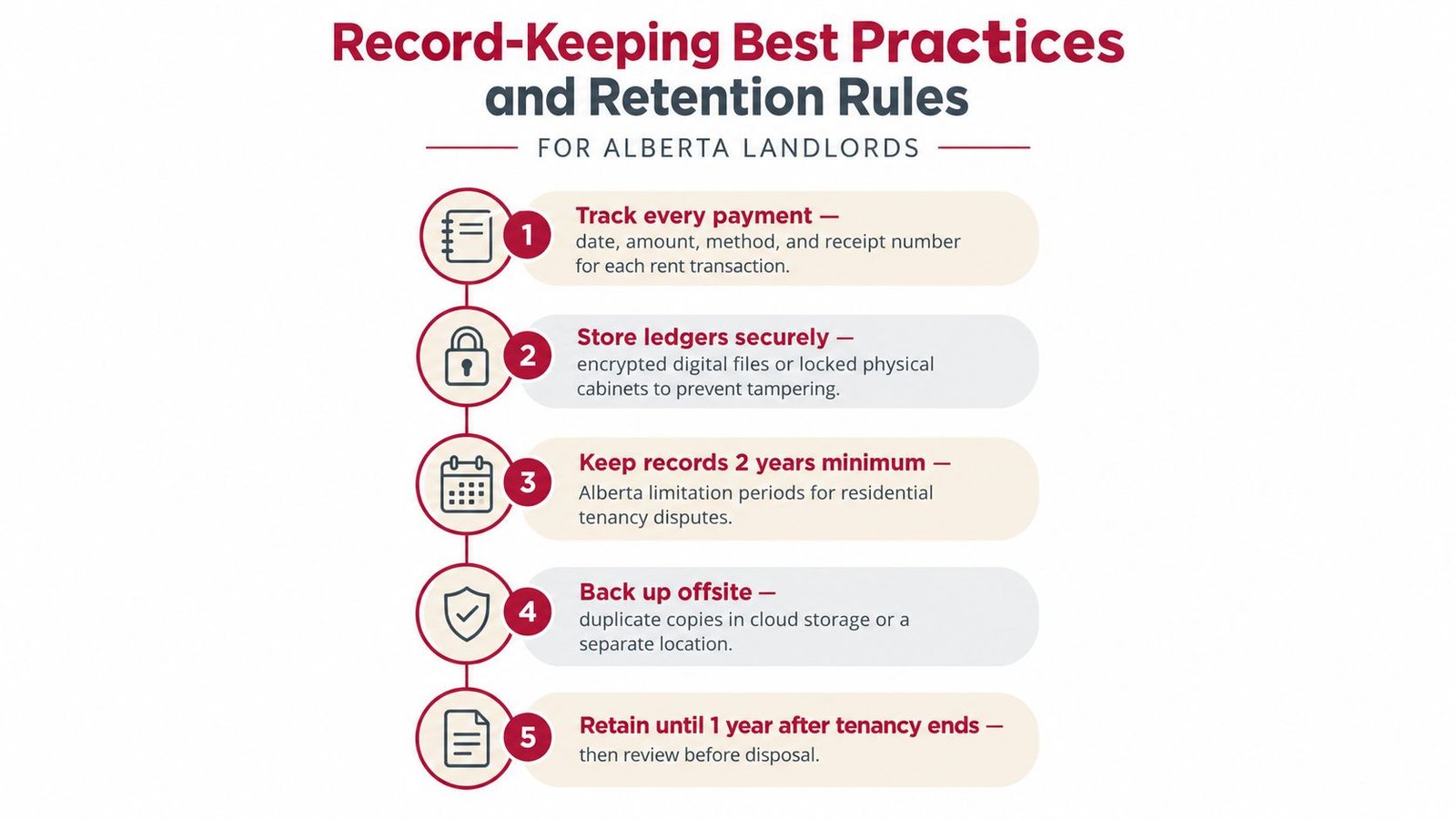
The Residential Tenancies Act framework forms part of the wider tenancy record system. Tax records also need a planned retention period, including the rental-income records and supporting documents required for CRA reporting. Apply the applicable CRA retention period to the tax file, then keep records connected to an unresolved tenancy dispute, claim, collection matter, or audit until the matter is closed.
Use a retention schedule, not a single deletion date
Different records serve different purposes. Security-deposit records in Alberta must be kept for at least three years after the tenancy terminates. The file should show the receipt date, amount, deposit date, financial institution, interest paid, and final disposition, as set out in the Alberta security-deposit information sheet.
Create a written schedule for ledgers, payment confirmations, notices, correspondence, deposit records, and tax documents. Add a legal or business hold when a disagreement, RTDRS matter, collection file, or audit could depend on the records. The hold should suspend routine deletion and identify who can release it.
Protect records under PIPA
Alberta's Office of the Information and Privacy Commissioner advises landlords to collect only the financial information reasonably required to process rent payments and to retain personal information only as long as a legal or business purpose requires it. Once that purpose ends, use secure destruction procedures. The OIPC guidance for landlords and tenants provides the privacy framework for that decision.
Separate the working ledger from unrestricted staff access. Use role-based permissions, dependable backups, and an audit or change history where the software supports it. Store paper files in a locked location. For digital deletion, use a process suited to the storage medium instead of placing old files in an unmanaged folder.
A business document retention guide can help owners structure a written schedule, but Alberta tenancy and privacy obligations control the final policy. Keep the ledger with e-transfer confirmations, cleared-cheque images, bank statements, cash receipts, notices, and relevant correspondence. For broader provincial operating context, consult this Alberta landlord and tenancy resource. The objective is a recorded retention decision for each category, with a review process that protects evidence without keeping personal data indefinitely.
Designing Ledger Entries for Dispute Readiness
The difference between a weak ledger and a strong one usually appears in the exceptions. A full payment made through the usual channel is easy to record. A partial payment, rejected cheque, delayed direct deposit, or changed due date tests whether the system captures what really happened.
The strongest entry preserves the original transaction and adds an explanation supported by a document. It doesn't overwrite history to make the balance look cleaner. A correction should identify what changed, why it changed, when it changed, and who made the change.
Weak vs Strong Ledger Entries
| Entry Type | Weak Ledger Example | Strong Dispute-Ready Example |
|---|---|---|
| Full payment | “Rent paid” | Payment date, rental period, amount received, payment method, transaction identifier, and linked receipt or bank record |
| Partial payment | “Short payment” | Amount expected, amount received, unpaid balance, rental period, method, transfer reference, and dated note explaining the allocation |
| Returned payment | “Cheque failed” | Original cheque entry, return date, bank evidence, reversal entry, replacement payment record, and updated balance |
| Direct deposit | “Deposit received” | Date funds became available, amount, rental period, bank reference, and source statement |
| Due-date change | “Tenant pays later” | Original due date, agreed revised date, parties to the agreement, date of written confirmation, and affected rental period |
| Arrears | “Balance owing” | Each unpaid period, calculation of the balance, payments applied, notices, and linked supporting records |
| Cash payment | “Cash received” | Receipt number, date, amount, rental period, payer, recipient, and signed or otherwise documented acknowledgement |
| Historical correction | “Fixed spreadsheet” | Original value retained, correction date, reason, author, supporting document, and revised balance |
Reconcile rather than rely on memory
The ledger should be updated when a payment is received, not reconstructed at month-end from memory. A reconciliation then compares the ledger with the bank account, payment portal, deposit record, and receipts. Any difference should be investigated while the transaction is still easy to identify.
RTDRS guidance makes the same practical point through its emphasis on receipts, tracking numbers, and documentary evidence. A spreadsheet entry that cannot be traced to a dated source is weaker than an entry supported by a bank record and correspondence, even when the total appears correct.
Evidence principle: The ledger tells the story, but the source documents establish the details.
A remote owner should also record communication that affects payment allocation. If a tenant asks to apply a payment to an earlier balance, or the parties agree to a different payment date, the ledger should link to the written confirmation. A text message or email may provide useful context, but the entry should still show the financial effect clearly.
Corrections require particular care. The original row should remain available in the audit trail, and the corrected figure should be accompanied by an explanation. Deleting an old entry and replacing it without a record creates the appearance of reconstruction, which is precisely what a dispute-ready process should avoid.
Integrating the Ledger with Security Deposits and Tax Records
A tenant pays rent and a security deposit in the same tenancy, but those amounts serve different purposes. Treating them as one balance can create a misleading account and weaken the file during an RTDRS dispute. The rent ledger should show rent charged, payments received, and the resulting balance. A separate deposit record should show money held under Alberta's security-deposit requirements. Tax records should support the owner's reported rental income and expenses.
Keep deposit records distinct
Alberta's security-deposit requirements call for records of the receipt date and amount, the date the deposit was deposited, the financial institution's name and location, interest payable and paid, and the final disposition. The Alberta official landlord information sheet states that these records must be retained for at least three years after the tenancy terminates.
The rent ledger should cross-reference the deposit file without recording the deposit as monthly rent. Keep the tenant and unit identifiers, move-in documentation, financial-institution details, interest calculations, and final disposition in the deposit register. This structure prevents a deposit from being mistaken for rent or used to make an overdue account appear current.
At move-out, connect the deposit register to the inspection report, photographs, notices, correspondence, and final statement. The cross-reference should identify which amounts concern unpaid rent and which concern deductions or other steps in the deposit process. That distinction matters when an RTDRS application requires the owner to explain the account line by line.
Prepare tax records from the same source data
The CRA expects rental-income records to be detailed and supported by source documents. A ledger that separates rental periods, actual receipts, payment methods, reversals, and adjustments gives the tax preparer usable transaction data rather than a list of unexplained bank deposits. Keep statements, receipts, and allocation notes connected to the relevant entries. The CRA-related Alberta rental record guidance also illustrates why rental records should be organized and retrievable.
Track expenses in the accounting system with descriptions that distinguish ordinary operating costs from property improvements. The rent ledger is not an expense register, but its income totals should reconcile with the rental-income portion of the owner's books. Apply PIPA discipline as well: retain only information needed for the tenancy, limit access, and preserve a clear record of corrections.
Owners using a managed portal may find online rent collection services useful for connecting tenant payments with owner statements. Automation reduces manual entry, but human review remains necessary for partial payments, disputed allocations, reversals, and corrections.
Modern Credit Reporting and Tenant File Access
A payment dispute can turn a routine spreadsheet into an exhibit. Alberta tenants may request access to rental records containing payment history and receipts, so landlords should maintain the ledger as a file the tenant, an RTDRS decision-maker, or a privacy reviewer could read without additional explanation (Alberta rental-file access guidance).
Use dated transaction entries rather than personal impressions. A note such as “always late” does not establish what happened. Record whether the issue was a late payment, missed payment, returned payment, or disputed allocation, then connect the entry to the receipt, bank record, notice, or relevant communication. Under Alberta's PIPA framework, limit access to people who need the information and document corrections without concealing the original error.
Rental history can affect credit visibility
Landlord Credit Bureau describes rental records that may include on-time payments, late payments, debt items, verified landlord contact information, and inquiries (Landlord Credit Bureau rental reporting information). Credit reporting arrangements can differ by bureau and platform. A landlord using a rent-reporting service must confirm the applicable consent requirements and submit information that matches the underlying ledger.
The same entry can affect both tenancy administration and a tenant's credit profile. Accurate payments may support a tenant's rental history where consent-based reporting applies. A verified late or debt entry can document a genuine arrears issue. An incorrect entry can harm the tenant, weaken the landlord's position, and create a separate dispute over the report.
Keep definitions consistent across the ledger, notices, and reporting file. Preserve source documents, correct mistakes transparently, and provide tenant access through an appropriate process. A dispute-ready record should show what was charged, what was received, how it was allocated, and why any reported balance remains outstanding.
Transitioning to Professional Property Management
A dispute-ready ledger requires more than a template. Someone must collect the payment, verify receipt, allocate it to the correct period, preserve the source document, reconcile the account, issue the appropriate communication, and retain the file under the relevant privacy and tenancy rules.
That workload becomes difficult for an out-of-province investor, a busy Calgary owner, or a landlord managing several homes across Alberta. Manual processes often fail at the handoffs. A payment may be visible in the bank account but absent from the ledger. A notice may be sent without the balance being updated. A returned payment may be corrected in one system but not another.
What professional oversight changes
A professional property manager can centralise rent collection, owner statements, tenant communications, inspection records, notices, and supporting documents. A portal can give tenants and owners controlled access to statements and files, while standard operating procedures can require staff to record payment methods, rental periods, transaction identifiers, and exceptions.
The value isn't automation alone. A portal may reduce repetitive entry, but trained staff still need to review partial payments, payment plans, returned transactions, and unusual allocations. The manager should also be able to connect a ledger entry to the relevant receipt, bank record, correspondence, or notice when an owner needs to understand an account.
A licensed local brokerage can also coordinate leasing, screening, lease execution, rent collection, arrears follow-up, inspections, maintenance records, and owner reporting. That creates one operating file instead of several disconnected personal systems. The owner retains visibility while the day-to-day evidence gathering takes place locally.
A property manager earns trust through the records produced when a tenancy becomes difficult, not only through the months when rent arrives without a problem.
Owners should assess a management arrangement by asking practical questions. Who reconciles payments? How are partial payments allocated? How are returned payments recorded? Where are receipts stored? How can the owner access statements? What process handles a correction? How are personal records protected and eventually destroyed?
Those answers reveal whether a provider is offering genuine operational control or just forwarding rent notices. For an owner in Calgary, Edmonton, Red Deer, or a surrounding community, the right system should make the account easier to explain before an RTDRS hearing becomes necessary.
Quick Reference Checklist and Next Steps
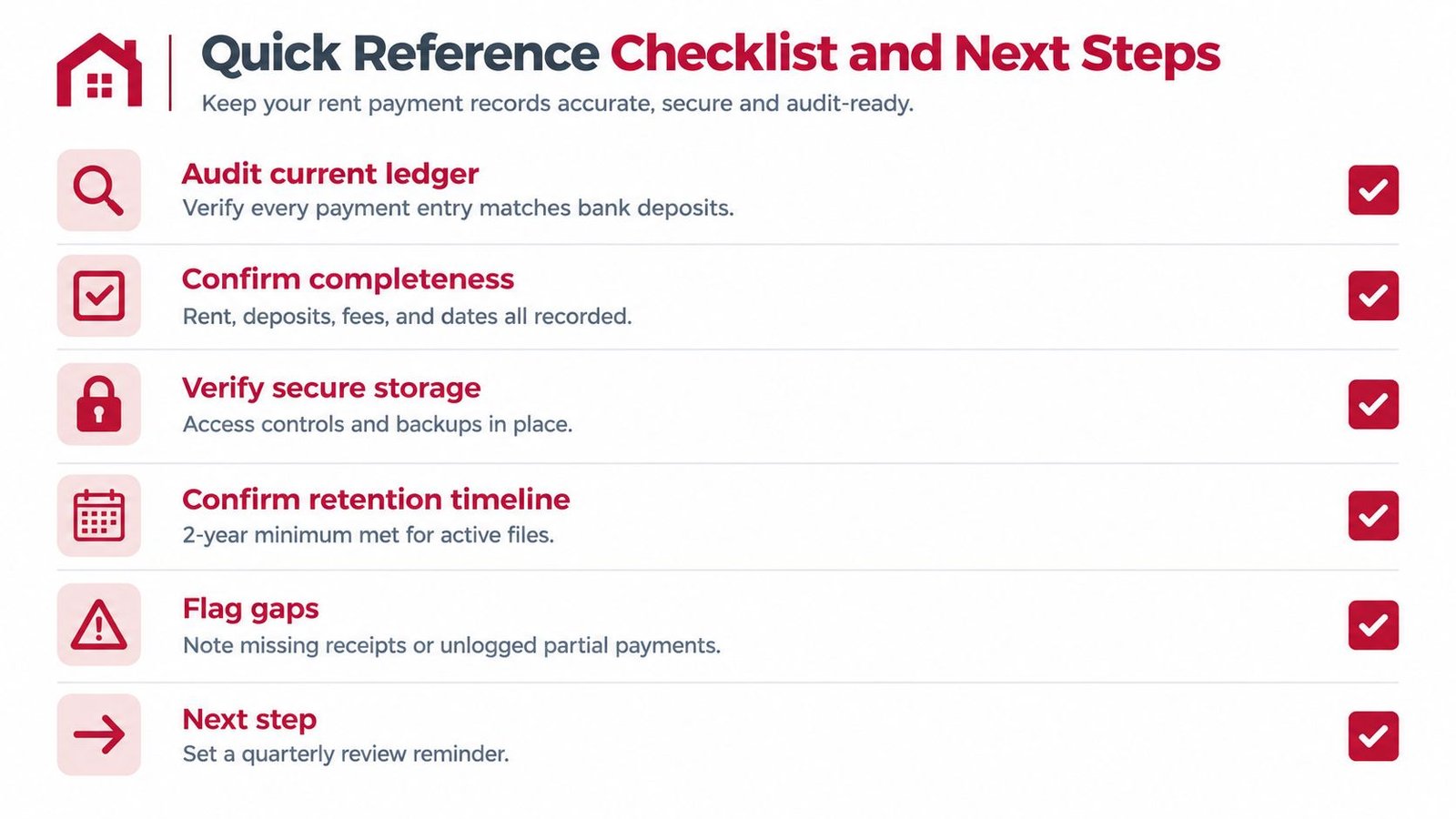
A landlord can audit an existing rent payment ledger without rebuilding the entire record at once. Start with the active tenancies and work backwards through the available bank, portal, receipt, and correspondence records.
Audit the ledger
- Identify each tenancy: Confirm the tenant name, landlord or agent, property address, unit, and rental period.
- Check every payment: Match the date and amount to a bank deposit, e-transfer confirmation, cleared cheque, cash receipt, or other primary record.
- Confirm allocation: Verify that each payment is assigned to the correct rental period and that partial payments carry an identifiable balance.
- Record the method: Add e-transfer, cheque, cash, direct deposit, or another payment method to every transaction.
- Add identifiers: Include receipt numbers, cheque numbers, transfer references, deposit references, or linked filenames.
- Preserve corrections: Keep the original value visible and document the correction date, reason, and supporting evidence.
- Separate deposits: Keep security-deposit transactions in their own record with the required deposit and disposition details.
- Secure the file: Restrict access, maintain backups, and apply a documented retention and destruction process.
Gather the source documents that support the current ledger. A file with a clean spreadsheet but missing payment evidence remains vulnerable. A slightly untidy ledger with every entry linked to a dated primary record can usually be reviewed and corrected more reliably.
Common edge cases
Cash payments should receive a dated receipt showing the amount, rental period, method, and recipient. The ledger should reference the receipt, and the owner should retain the related record rather than relying on memory.
Historical errors shouldn't be hidden by deleting rows. Preserve the original entry, identify the correction, explain why it was made, and attach the evidence that supports the revised balance.
Missing documents should be flagged rather than assumed to be present. A note can identify the gap and the steps taken to locate a bank record, confirmation, or written acknowledgement.
A quarterly review can catch missing documents before a dispute, tax deadline, or move-out makes reconstruction harder. Owners who don't have the time or local capacity to maintain that process can assign the work to a licensed Alberta property management team with defined reporting and record-access procedures.
GURIQBAL CHAHAL, MBA, PMP, REAL ESTATE BROKER, Phone 403-966-6072, can explain how Dreamhouse Realty Ltd. handles rent collection, arrears follow-up, owner statements, tenant records, and Alberta compliance workflows for Calgary and surrounding property owners. Visit Dreamhouse Realty Ltd. to discuss a management process that keeps each rent payment ledger organised, traceable, and ready for review.