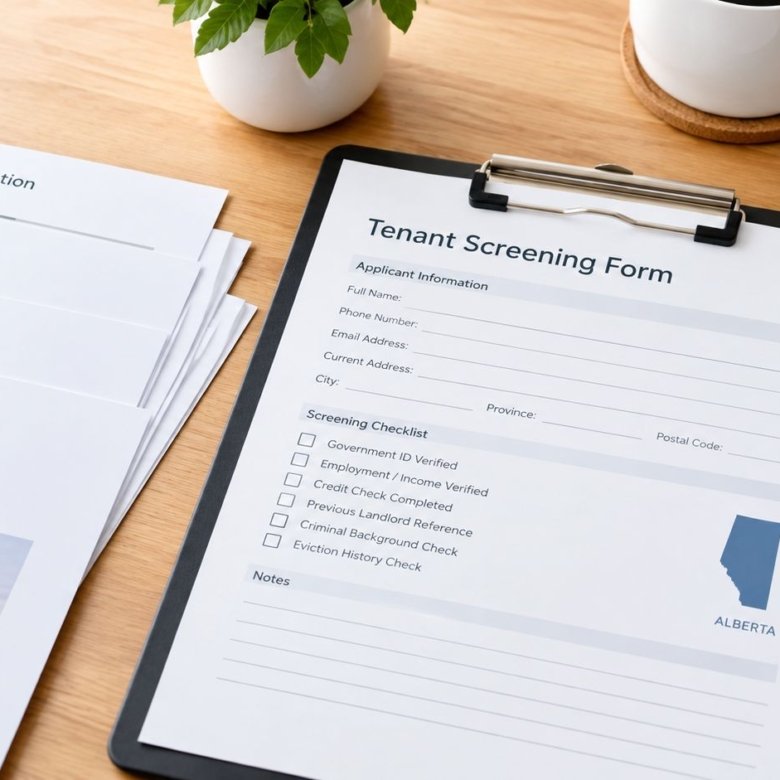

A Calgary landlord is standing in a half-finished rental the day before possession. The baseboards still show paint misses, a switch plate is missing, and the tenant's keys have already been cut. The unit may look nearly ready, but “nearly ready” creates problems when a tenant later reports damage that was present before possession.
The practical answer to rough inspection vs final inspection starts by separating two different jobs. A rough inspection is a landlord's pre-handover defect sweep while work remains accessible. A final inspection documents the completed rental at possession and provides the baseline for the eventual move-out comparison.
That distinction matters in Calgary, Edmonton, Red Deer, and other Alberta markets. Alberta's Safety Codes system treats rough and final checkpoints differently for many permits. Rough work is checked before it's covered, while final inspection confirms completion later, as set out in the provincial inspection table. Rental owners can apply the same logic operationally, even though a landlord's rough walkthrough isn't a municipal Safety Codes inspection.
Table of Contents
- Why Alberta Landlords Confuse Rough and Final Inspections
- Rough vs Final Inspection at a Glance
- Running the Rough Inspection Before Move-In
- Running the Final Inspection at Possession and Move-Out
- Legal Implications of Skipping Either Inspection
- Real Alberta Scenarios Where the Two Stages Matter
- Why the Rough Inspection Is a Landlord's Strongest Defence
- Practical Recommendations and Next Steps for Calgary Owners
Why Alberta Landlords Confuse Rough and Final Inspections
Construction trades use “rough” to describe work inspected before drywall, insulation, flooring, or other finishes conceal it. Alberta's permit framework follows that hidden-work logic. For example, the provincial table distinguishes rough-in or foundation-related checkpoints from final inspection, and it gives different completion windows depending on the type of residential work. The essential principle is simple, verify what will soon be hidden, then verify the completed result.
Rental owners often use the same words less precisely. A “rough inspection” might mean a mid-renovation walkthrough, a pre-listing visit, a move-in check before the tenant arrives, or an informal visit during a tenancy. A “final inspection” might mean possession day, the end of a renovation, or move-out. That loose vocabulary creates a documentation gap.
For lease-up purposes, the useful definition is narrower:
- Rough inspection: A landlord or property manager's pre-handover walkthrough that records builder, contractor, vendor, and pre-existing defects before the unit is presented as complete.
- Final inspection: The completed condition report at possession, followed later by the move-out inspection that compares the unit against the move-in baseline.
The rough stage isn't a substitute for Alberta's mandatory move-in and move-out inspection reports. Those reports must be completed within one week before or after the tenant takes or gives up possession, and the landlord must provide a copy immediately after completion, according to Alberta's inspection report guidance.
Why the distinction protects the file
A half-finished unit contains conditions that shouldn't be attributed to a tenant. Paint touch-ups, unfinished trim, appliance scuffs, flooring defects, and incomplete cleaning belong on a contractor or landlord punch list. If they appear for the first time on the move-in report, the tenant may reasonably argue that the unit was handed over that way.
The opposite problem appears at move-out. Without a pre-handover record, an owner may see a damaged floor or marked wall but lack evidence showing whether it existed before possession. A single generic form saying “good condition” rarely answers that question.
Practical rule: Use the rough inspection to remove pre-existing defects from the tenant's account, then use the final report to establish the condition the tenant actually accepted.
Rough vs Final Inspection at a Glance
The comparison below translates Alberta's construction-stage logic into a rental management process. The rough stage is operational and preventive. The final stage is the formal possession or move-out record that supports a deposit decision.
| Dimension | Rough Inspection | Final Inspection |
|---|---|---|
| Trigger | Lease-up preparation, post-renovation turnover, vacancy return, or contractor completion review | Tenant possession or tenancy end |
| Focus | Defects that can be corrected before handover, including exposed or incomplete work | Visible condition, cleanliness, fixtures, keys, appliances, and tenant-related damage |
| Timing | Before keys are released, with enough time for trades to return | Within Alberta's required inspection window around possession or surrender |
| Who attends | Landlord, property manager, contractor, superintendent, or vendor | Landlord or property manager, tenant, and a witness when appropriate |
| Output | Dated punch list, photographs, repair assignments, and completion notes | Move-in or move-out condition report, photographs, signatures, and supporting records |
| Legal weight | Internal evidence that establishes pre-existing condition | Evidence relevant to deductions, normal wear and tear, and RTDRS disputes |
| Best use | Preventing builder or vendor defects from becoming tenant allegations | Comparing the tenant's accepted condition with the condition at surrender |
Calgary's homeowner electrical guidance makes the underlying distinction concrete. Rough inspection concerns wiring and outlet boxes remaining visible, while final inspection concerns completed devices, fixtures, and energized breakers, as described in the municipal building and electrical guidance. Edmonton and Beaumont apply similar sequencing in grading workflows, where rough grade approval comes before final grade approval under their respective municipal processes.
Owners dealing with renovations should also understand how trades organise work under Alberta requirements. A practical Alberta building trades data resource can help identify the relevant trade context, but it doesn't replace the permit authority, contractor, or property manager's inspection record.
For a rental-specific operating framework, owners can review this property inspection guide for rental homes. The important decision is not whether one stage is “better.” The rough stage prevents confusion, while the final stage creates the possession and surrender evidence Alberta tenancy disputes depend on.
Running the Rough Inspection Before Move-In
A rough inspection should happen early enough that trades can return without delaying possession. For a normal lease-up, scheduling it seven to ten days before the possession date gives the manager time to assign repairs, arrange access, and verify completion. This is an operating recommendation, not an Alberta statutory deadline.
The walkthrough should be systematic. Randomly opening cupboards and taking a few phone photos won't create a reliable baseline. The inspector should move through the unit in the same direction every time, recording room, surface, defect, responsible party, and required action.
A room-by-room sweep
The rough pass should cover the areas most likely to become disputed later:
- Walls and ceilings: Record nail pops, uneven mud, paint misses, patching, damaged corners, and areas awaiting final coats before trim or furniture hides them.
- Flooring: Photograph scratches, lippage, gaps, stains, lifted edges, and movement that suggests a subfloor issue. Note whether flooring is incomplete or awaiting cleaning.
- Plumbing: Run fixtures and inspect under every sink. Check toilet bases and the area around the toilet flange for moisture, movement, or incomplete sealing.
- Electrical: Test accessible outlets, confirm GFCI operation where applicable, and record missing cover plates, loose devices, or unfinished fixtures.
- HVAC: Operate thermostats, check registers for airflow, and note rooms that appear unbalanced or lack functioning equipment.
- Windows and exterior doors: Inspect seals, weatherstripping, locks, latches, drafts, and adjustment. Photograph damaged screens and frames.
- Appliances: Test operation, record serial numbers, and photograph cosmetic damage, missing shelves, dents, and incomplete installation.
The point isn't to perform a municipal code inspection unless the person conducting the visit is qualified and authorised to do so. The point is to identify visible defects and incomplete work before tenant possession, then direct the right party to correct them.
Build a file that survives turnover
Every item belongs on a dated punch list. Photos should show the defect in context and close-up, with room names or unit identifiers in the file name. A contractor invoice, completion email, or sign-off should be stored beside the original defect rather than in a separate inbox.
Separate builder or vendor defects from ordinary preparation items. A scratched cabinet door, incomplete paint repair, and damaged appliance panel may require a contractor claim. Dust, minor cleaning, or a missing consumable may belong to the landlord's turnover checklist. Mixing those categories makes it harder to prove what was fixed before the tenant arrived.
The completed rough file can sit in the lease record as an internal exhibit. It gives the manager a dated explanation for any item that appears on the later move-in form and helps ensure the tenant isn't blamed for a condition already known to the owner. A structured Alberta move-in inspection report can then capture the finished condition separately.
Running the Final Inspection at Possession and Move-Out
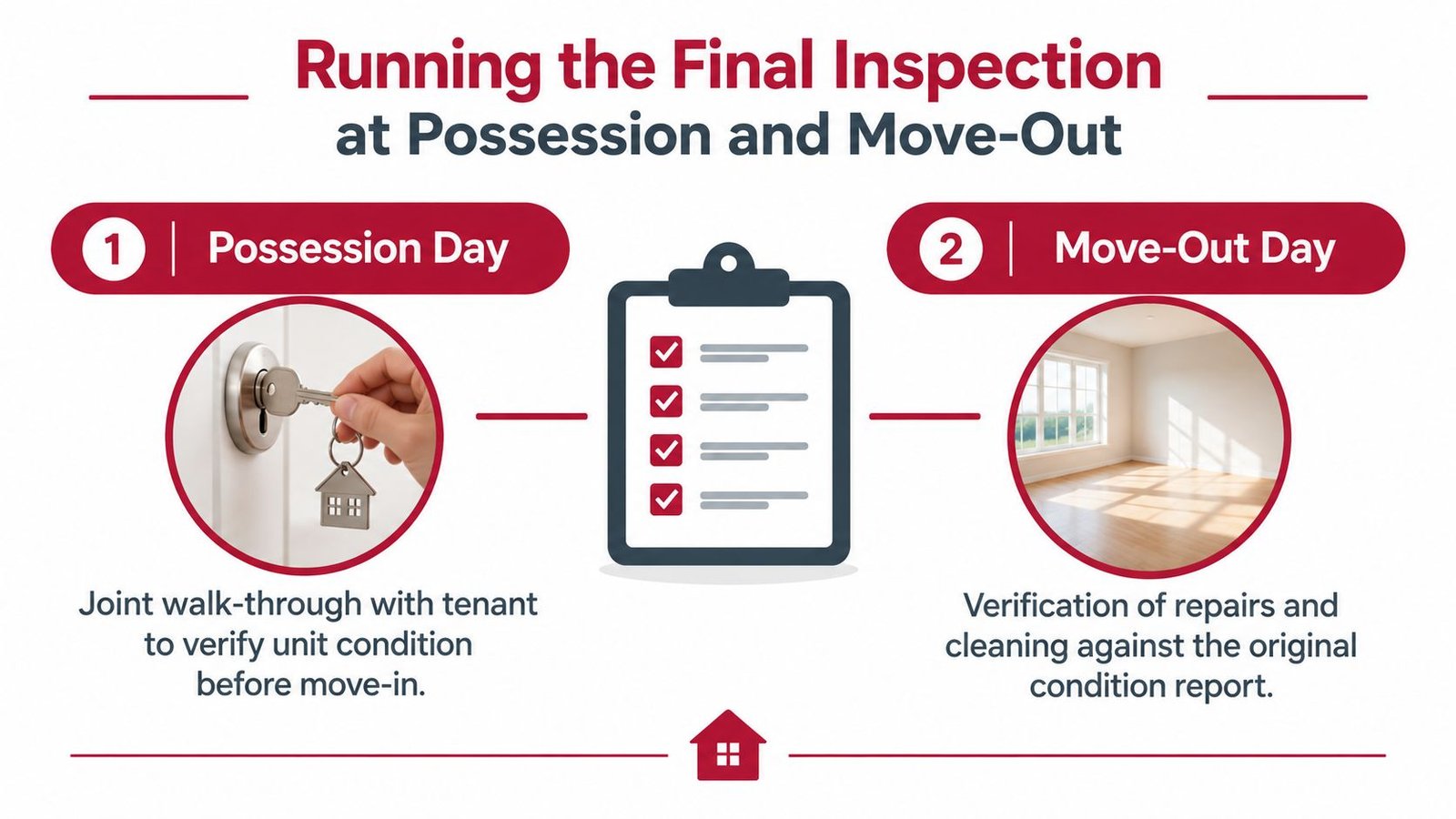
The final inspection has two connected moments, possession and move-out. Both use the same basic room-by-room method, but they answer different questions. At possession, the question is whether the tenant accepts the completed condition. At move-out, the question is what changed during the tenancy and whether the change exceeds normal wear and tear.
Possession day
The landlord or manager should walk through the unit with the tenant wherever practical. The report should identify floors, walls, ceilings, windows, doors, appliances, plumbing fixtures, heating equipment, storage areas, parking, keys, remotes, and cleanliness. Timestamped photographs should support written descriptions rather than replace them.
The Alberta inspection window runs within one week before or after possession. The premises should normally be vacant unless the landlord and tenant agree otherwise, and the landlord must give the tenant a copy immediately after the inspection. The tenant's acknowledgement should be obtained on the report, but a refusal to sign doesn't justify abandoning the documentation. The manager should record the refusal, retain the report and photographs, and provide the copy through a traceable channel.
The possession report should not carry forward unresolved rough-stage defects as if they were new tenant observations. If a repair remains incomplete, label it clearly as pre-existing, outstanding landlord or contractor work, then record the eventual completion date.
Move-out day
At surrender, compare the unit against the move-in report, not against the owner's memory or a freshly renovated ideal. Record cleaning, wall marks, flooring damage, missing items, appliance condition, keys, remotes, and repairable defects. Photograph the same angles where possible, because matched images are easier for a tenant or RTDRS adjudicator to understand.
A move-out walkthrough can be offered jointly. If the tenant doesn't attend, the manager should preserve the invitation, the scheduled time, access record, report, photographs, invoices, and communication history. A move-out inspection resource such as this Alberta move-out inspection guide can help owners organise the process.
Digital inspection platforms can also improve consistency. For example, a landlord may review VerticalRent's pre-move-out inspection approach when designing reminders and documentation steps. The tool matters less than the record. Alberta requires landlords to keep inspection reports for three years after the tenancy ends, and the supporting photographs and invoices should be stored with them.
Legal Implications of Skipping Either Inspection
The legal risk isn't identical at both stages. Alberta's mandatory inspection rule applies to move-in and move-out reports, while the rough walkthrough is a preventative management practice. Skipping the rough stage weakens the evidence. Skipping a required possession or surrender report can restrict the landlord's ability to claim cleaning or repair costs from the security deposit.
Alberta states that if the landlord doesn't complete the required inspection reports, the landlord can't make deductions from the security deposit for cleaning or repair costs. The reports also provide the mechanism for separating normal wear and tear from damage, as explained in Alberta's tenancy guidance.
How the risk develops
A landlord who misses the rough walkthrough may still complete compliant move-in and move-out reports. The difficulty is evidentiary. If the move-in report contains vague descriptions and no photographs, the tenant can challenge whether a defect was present before possession.
A landlord who misses the move-in report has a more serious problem. The owner may know the unit was clean and undamaged, but personal recollection doesn't substitute for the required record. At move-out, the owner's comparison has no reliable tenant-accepted baseline.
A landlord who misses the move-out report may be unable to support deductions even where the tenant clearly left damage. Receipts alone show that money was spent. They don't necessarily show when the damage occurred, who caused it, or whether the condition exceeded ordinary wear.
| Inspection Skipped | Landlord Risk | Typical RTDRS Outcome |
|---|---|---|
| Rough pre-handover walkthrough | Pre-existing contractor defects may be confused with tenant damage | The landlord's file has weaker proof about the condition before possession |
| Move-in report | No reliable record of the condition accepted by the tenant | Cleaning or repair deductions may be barred under Alberta's inspection rules |
| Move-out report | No compliant evidence of the condition at surrender | The landlord may be unable to support deductions from the security deposit |
| Rough and final documentation | Timeline becomes inconsistent and dependent on recollection | The tenant's challenge becomes harder to answer with contemporaneous evidence |
The rough stage should never be presented as a replacement for statutory reports. Its value is that it gives the final reports accurate information. The final reports carry the tenancy documentation, while the rough record explains what happened before the tenant took possession.
Real Alberta Scenarios Where the Two Stages Matter
A renovated Beltline condo can look finished while still carrying a long list of small defects. Flooring may show scratches from trades, painted walls may have uneven touch-ups, and appliances may have cosmetic marks from delivery. If the manager performs a rough pass before handover, those items can be assigned to the contractor and corrected or recorded as landlord-owned conditions.
The possession report then captures the condition the tenant receives. If a flooring mark remains, the report should identify it as pre-existing rather than just ticking a generic “flooring acceptable” box. At move-out, the manager can compare new damage against that specific baseline instead of arguing over whether the tenant caused every visible imperfection.
Consistency across a small multi-family property
A northeast Calgary fourplex creates a different challenge. Several units may turn over at different times, and different managers or contractors may describe similar conditions in different ways. A standard rough checklist, consistent photo sequence, and unit-specific punch list create a pattern that makes one disputed file easier to explain.
The pattern doesn't prove that every charge is valid. It does show that the owner used the same process across units, documented known defects before possession, and completed the required final reports. Consistency also helps identify maintenance problems that affect multiple units, such as recurring flooring installation issues or repeated appliance damage.
Remote ownership
An out-of-province owner may never enter the Calgary property. That owner depends on a local property manager to coordinate the rough walkthrough, confirm contractor completion, attend possession, and inspect the unit at surrender.
The manager's file should make the owner's absence irrelevant to the evidence. It should contain access details, dated reports, photographs, tenant communications, contractor documents, key records, and invoices. If a tenant disputes a deduction, the manager can explain the sequence without relying on an owner who wasn't present.
A clean timeline is more persuasive than a confident recollection. Each report should answer what the unit looked like, when it was observed, who attended, and what happened next.
Alberta's provincial inspection model reinforces why sequencing matters. The rules distinguish hidden-work verification from completion verification, and rental managers can carry that discipline into lease-ups without confusing a private landlord checklist with a formal Safety Codes approval.
Why the Rough Inspection Is a Landlord's Strongest Defence
Many landlords treat the move-in inspection as a single event. That approach satisfies the instinct to document possession, but it misses the earlier moment when the property's condition can be separated into contractor defects, landlord preparation, and tenant responsibility.
A rough inspection creates a dated baseline before the tenant has control of the unit. It can record unfinished paint, exposed installation issues, flooring damage from trades, incomplete fixtures, and appliance defects before those conditions become part of a tenant's lived environment. The final possession report then narrows the baseline to the condition as delivered.
Evidence that answers the real dispute
At RTDRS, the practical question usually isn't whether the landlord remembers the unit as clean. It's whether the evidence connects a specific condition to a specific period. A rough report dated before possession, supported by photographs and contractor sign-off, can show that an issue existed before the tenant's responsibility began.
A single move-in form may still be useful, but generic descriptions are vulnerable. “Good condition” doesn't explain a small floor scratch, a wall patch, or a cabinet defect. Specific notes and matched photographs give the adjudicator a clearer timeline.
The strongest file separates documents by purpose:
- Rough record: Defects found before handover, responsible contractor or vendor, assigned correction, and completion status.
- Possession report: Completed condition presented to the tenant, including outstanding pre-existing items.
- Move-out report: Condition at surrender, compared with possession photographs and notes.
- Supporting evidence: Communications, invoices, repair photographs, access records, and tenant acknowledgements.
The extra coordination is real. Someone must book access, walk the unit, communicate with trades, retake photographs, and close the punch list. But that work is preventive. It reduces the chance that a landlord will later ask a tenant to pay for a defect created during renovation or missed during turnover.
Evidence standard: A dated photograph proves what was visible. A dated report explains what it was. A contractor record shows who was expected to address it.
The rough stage doesn't guarantee a successful deposit claim. It gives the landlord a stronger, more coherent explanation when the tenant challenges responsibility. That is why it deserves a place in every renovated lease-up and vacancy-return process.
Practical Recommendations and Next Steps for Calgary Owners
The right process depends on the property's condition and turnover history. A rough stage makes particular sense after a renovation, after a long vacancy, or during a first lease-up when several contractors have worked in the unit. The final stage belongs on every possession and move-out schedule, whether the property is a condo, townhome, single-family home, or small multifamily building.
A practical operating file should contain:
- A pre-handover punch list: Record defects, photographs, responsible parties, and completion notes.
- A possession report: Complete it within Alberta's inspection window, obtain tenant acknowledgement where possible, and provide the copy immediately.
- A move-out report: Compare the surrendered condition with the possession baseline and document cleaning, damage, keys, and repairs.
- A dated evidence folder: Keep reports, photos, invoices, notices, emails, and access records together for three years after the tenancy ends, as required by Alberta's inspection report guidance.
- A contractor record: Before engaging an unfamiliar trade, owners can review resources such as this background check before hiring a contractor and still verify licences, insurance, scope, and references independently.
Frequently asked questions
How long does a landlord have to return a security deposit in Alberta?
The supplied Alberta inspection guidance confirms the inspection timing and record-keeping obligations, but it doesn't establish a general deposit-return deadline in the verified material for this article. Owners should confirm the current Residential Tenancies Act requirements or obtain legal advice before setting a return schedule.
Can a tenant refuse a joint inspection?
The tenant may decline to participate. Alberta allows an inspection without the tenant present only after the landlord has offered two opportunities on different days, on non-holidays, between 8 a.m. and 8 p.m., and no adult tenant agrees to participate, according to Alberta's ending-a-tenancy guidance. The landlord should retain proof of the invitations and complete the report carefully.
What happens if the tenant skips the move-out walkthrough?
The manager should document the invitation, proceed according to Alberta's attendance conditions, photograph the unit, and give the tenant the completed report immediately after the inspection. The file should also preserve keys, access notes, cleaning records, repair invoices, and all communications.
Owners who want fewer gaps can assign both stages to a Calgary property manager. Dreamhouse Realty Ltd. provides rental setup, possession and move-out inspections, written condition reports, photo documentation, maintenance coordination, and compliance record-keeping for properties across Calgary and surrounding Alberta communities.
GURIQBAL CHAHAL, MBA, PMP, REAL ESTATE BROKER, can help Calgary and Alberta rental owners coordinate rough lease-up inspections, final possession reports, move-out documentation, and RTDRS-ready evidence. Contact GURIQBAL CHAHAL at 403-966-6072, and visit Dreamhouse Realty Ltd. to discuss managed inspections and rental property management.