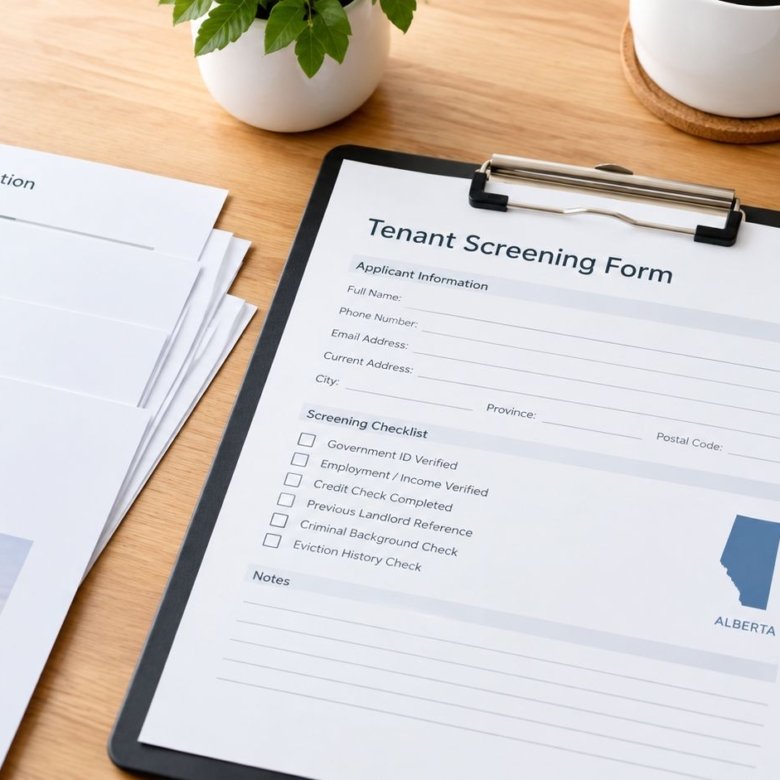

A tenant's unit is causing water damage, rent is overdue, and neighbouring owners are demanding answers. The landlord wants the tenant out immediately, downloads an eviction notice form Alberta landlords commonly search for, and fills it out in a rush. That approach can create a second problem: an incorrectly selected form, defective date, vague reason, or weak service record may delay enforcement instead of solving the original issue.
Alberta's Residential Tenancies Act requires landlords to match the notice to the tenancy and the reason for termination. The notice must also contain required information and be served in a way the landlord can prove. The official Alberta rules for ending a tenancy explain the different notice periods and required notice details.
The practical lesson is straightforward. An eviction notice isn't just a document download. It's the first item in an evidence file that may later need to establish the breach, the premises, the dates, the service method, and the landlord's compliance with the statutory process.
Table of Contents
- Navigating Eviction Notices in Alberta
- Identifying the Correct Government Form
- Calculating Legal Notice Periods
- Mandatory Elements for Enforceability
- Documentation and Proof of Service
- RTDRS vs Provincial Court Pathways
- Professional Management for Compliance
- Final Compliance Checklist and Resources
Navigating Eviction Notices in Alberta
The flooding example shows why speed and accuracy must work together. A landlord may have photographs of a damaged ceiling, messages from a neighbouring property manager, repair invoices, and tenant communications. Those records support enforcement only after the landlord identifies the proper termination ground and calculates the date correctly. The notice is the first item in an evidence file, not merely a document download.
Alberta's official guidance recognises different notice periods for different circumstances. A serious situation involving significant damage or violence can require at least 24 hours, while an unauthorized occupant can involve at least 48 hours or 14 days, depending on the applicable circumstances. A substantial breach generally requires at least 14 days, subject to the statutory requirements and facts of the case. Landlords should confirm the applicable rule in the province's official tenancy termination guidance before serving the notice.

A valid notice must be in writing and identify the rental address, termination date, landlord's signature, reasons for eviction, and any rent due. For unpaid rent, it must state that the tenancy will continue if the tenant pays the arrears on or before the termination date. Leaving out one required element can give the tenant a technical basis to challenge the notice, even where the underlying breach is well documented.
Practical rule: Treat the notice as the beginning of the file, not the end of the dispute.
Landlords in Calgary, Edmonton, Red Deer, and surrounding communities must also distinguish between fixed-term and periodic tenancies. A fixed-term tenancy generally ends when the agreed term expires, without a termination notice, while a periodic tenancy follows statutory notice rules. That distinction helps prevent an unnecessary notice or a notice based on the wrong tenancy type.
Owners who self-manage should review this Alberta landlord and tenancy resource before taking action. Keep the lease, rent ledger, incident records, photographs, communications, notice, proof of service, and a clear chronology together. If the matter reaches RTDRS or court, consistent records can matter as much as the form itself.
Identifying the Correct Government Form
Alberta requires landlords to use prescribed forms. The applicable government materials identify Form 1, Form 2, Form 3, Form 4, Form 5, and Form 6, with each form tied to a specific tenancy or termination situation. The Residential Tenancies Act termination forms provide the government's form framework and should be checked before service.
Form selection starts with the facts in the file. Confirm whether the tenancy is periodic or fixed-term, identify the event being relied on, and determine whether the landlord can serve a notice or must seek an order from the Residential Tenancy Dispute Resolution Service, commonly called RTDRS, or the court. A form chosen from memory can create a preventable dispute, especially if the wording does not match the evidence.
The main form categories
Use the table as a screening tool, then compare the completed notice with the current government document before delivering it.
| Form | Use case | Notice period | Key requirement |
|---|---|---|---|
| Form 1 | Landlord's notice to terminate a periodic tenancy | Depends on the tenancy type and statutory ground | Written notice with the premises, reason, termination date, and signature |
| Form 3 | Landlord's notice to terminate for substantial breach | At least 14 clear days for a substantial breach under the applicable rule | Specific breach details, proper date calculation, and supporting evidence |
| Form 4 | 24-hour notice to terminate tenancy | At least 24 hours in qualifying serious circumstances | Facts must support the serious statutory ground |
| Form 5 | Notice involving a person who isn't a tenant | Depends on the applicable unauthorized-occupant rule | Identify the non-tenant situation accurately |
| Form 6 | Tenant's notice relating to substantial breach | Applies to a tenant-issued notice | Used by the tenant, not as a substitute for a landlord form |
The Alberta RTA handbook distinguishes Form 1, Form 3, and Form 4 as landlord termination tools and explains that the applicable notice structure depends on the tenancy and legal ground. It also sets out examples such as one full tenancy week for a week-to-week tenancy, one full tenancy month for a month-to-month tenancy, or 90 days for a year-to-year tenancy.
Why form selection matters
Match the form to the allegation and preserve the records that support it. A rent-arrears notice does not establish a damage claim, while a periodic-tenancy termination notice does not replace the particulars required for a breach allegation. The wrong document can force a landlord to restart the process, even when the underlying conduct is real.
Before service, compare the form with the current government material, confirm the statutory ground, and verify that the signer has authority to act for the landlord. Save the completed notice as a fixed copy, along with the lease, rent ledger, incident records, photographs, communications, and delivery evidence. That file gives RTDRS or the court a way to connect the selected form to the facts behind it.
Calculating Legal Notice Periods
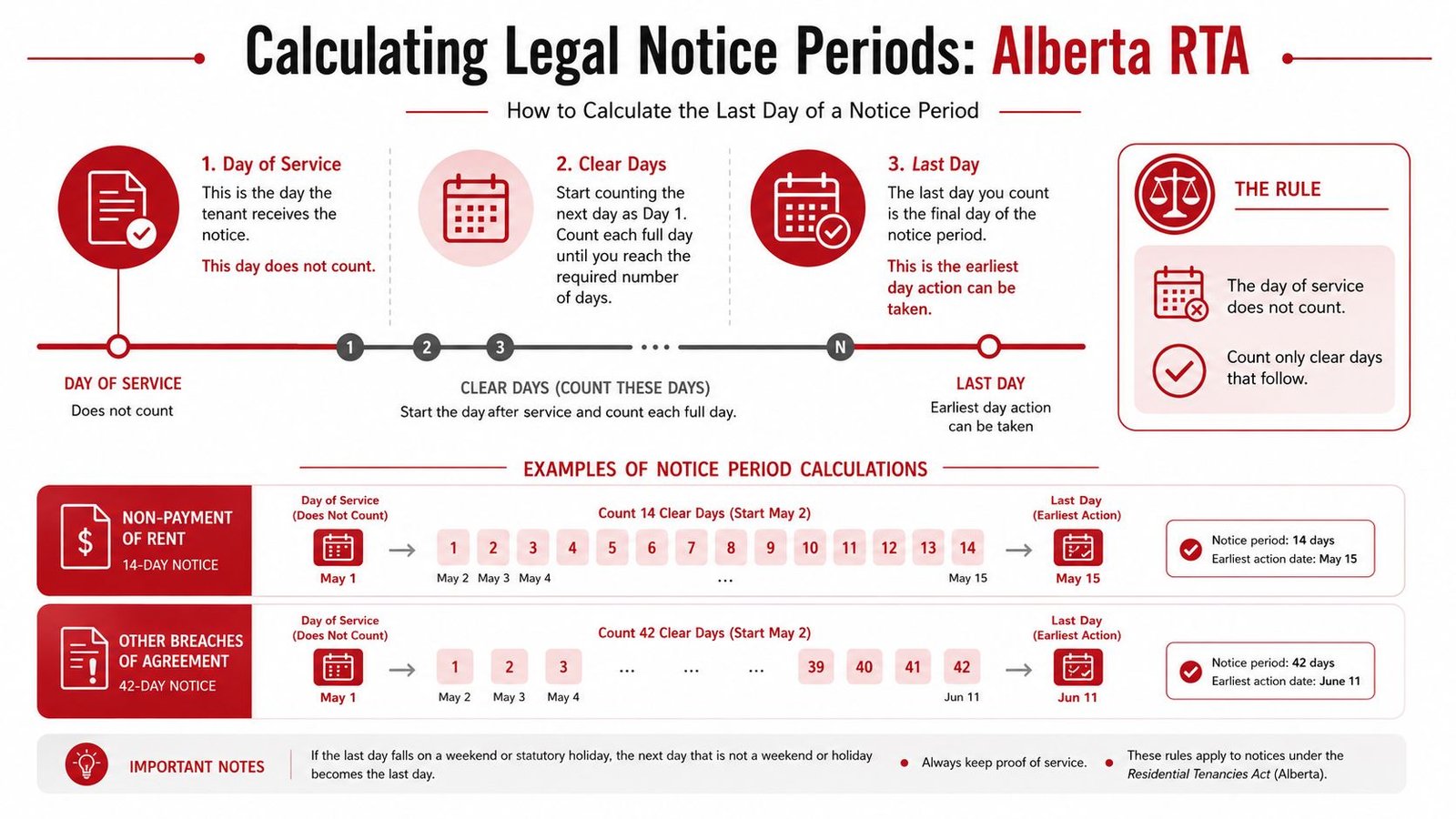
A valid form can still fail if its termination date is wrong. Calculate the date from the tenancy structure and the statutory rule, then preserve the calculation with the notice. For a 14-day notice, the law counts 14 clear days. The service date and the tenancy-end date sit outside that count, producing a minimum window of 16 calendar days. The governing requirements appear in the Alberta Residential Tenancies Act.
For example, if a qualifying 14-day notice is served on March 1, March 1 is excluded and the termination date is not one of the clear days. The earliest termination date in this example is March 16, not March 15. Record the working in the file, including the calendar used to reach the result. A saved calculation is easier to defend than a date copied from memory or a generic online calculator.
Count from the tenancy structure
Short-period notices for substantial breach require precise clear-day counting. Periodic-tenancy termination follows the tenancy cycle instead. For a monthly tenancy, the landlord must serve the notice on or before the first day of the notice period, and the period covers three consecutive tenancy months, under the Alberta Residential Tenancies Act.
Service after the first day of a monthly period can move the effective termination date later. The date follows the tenancy cycle and the statutory rule, not an arbitrary count from the day the landlord decides to terminate. Check the lease, confirm the tenancy type, and calculate before arranging service.
A reliable calculation record
The property file should show:
- Service date: Record when the tenant received the notice or when lawful service occurred.
- Notice category: Identify the statutory ground and the applicable notice period.
- Excluded dates: Mark the service date and termination date when the rule excludes them from clear-day counting.
- Calendar result: Write the calculation and retain the calendar or worksheet used.
- Review point: Have another person verify the date before service.
A one-day error can give the tenant a technical defence and force the landlord to restart the process. Accurate records protect the enforceability of the notice.
Mandatory Elements for Enforceability
An eviction notice can fail even when the tenant's breach is genuine. The document must identify the correct parties, premises, statutory reason, and required action clearly enough for the tenant, the RTDRS, or a court to understand what happened and what deadline applies. Use the current Alberta government form and keep the completed version with the tenancy file.
The notice should match the tenancy agreement on every material detail. Compare the landlord's legal name or authorised agent information, each tenant's name, the full rental address, and the specific unit where relevant. In a multi-unit property, an incomplete address can create doubt about which premises the notice concerns. The reason should identify the applicable ground and describe the relevant facts, such as the incident, date, location, and effect on the property or other occupants.
Confirm that the termination date fits both the notice rule and the tenancy type. If unpaid rent is included, state the amount due and include the required wording that the tenancy continues if the tenant pays the arrears by the termination date. The landlord or authorised agent must sign before service. Retain the signed copy, every page of the form, and any statutory information provided to the tenant.
Run one final file audit before delivery: compare the parties and address with the lease, test the stated reason against the statutory ground, verify the termination date against the recorded calculation, check the rent figure and payment wording, confirm the signature, and preserve the exact version served. A rental lease agreement example can help identify mismatches in names, address, term, and payment details. For broader background on understanding document legality, use that resource separately from Alberta's official tenancy materials.
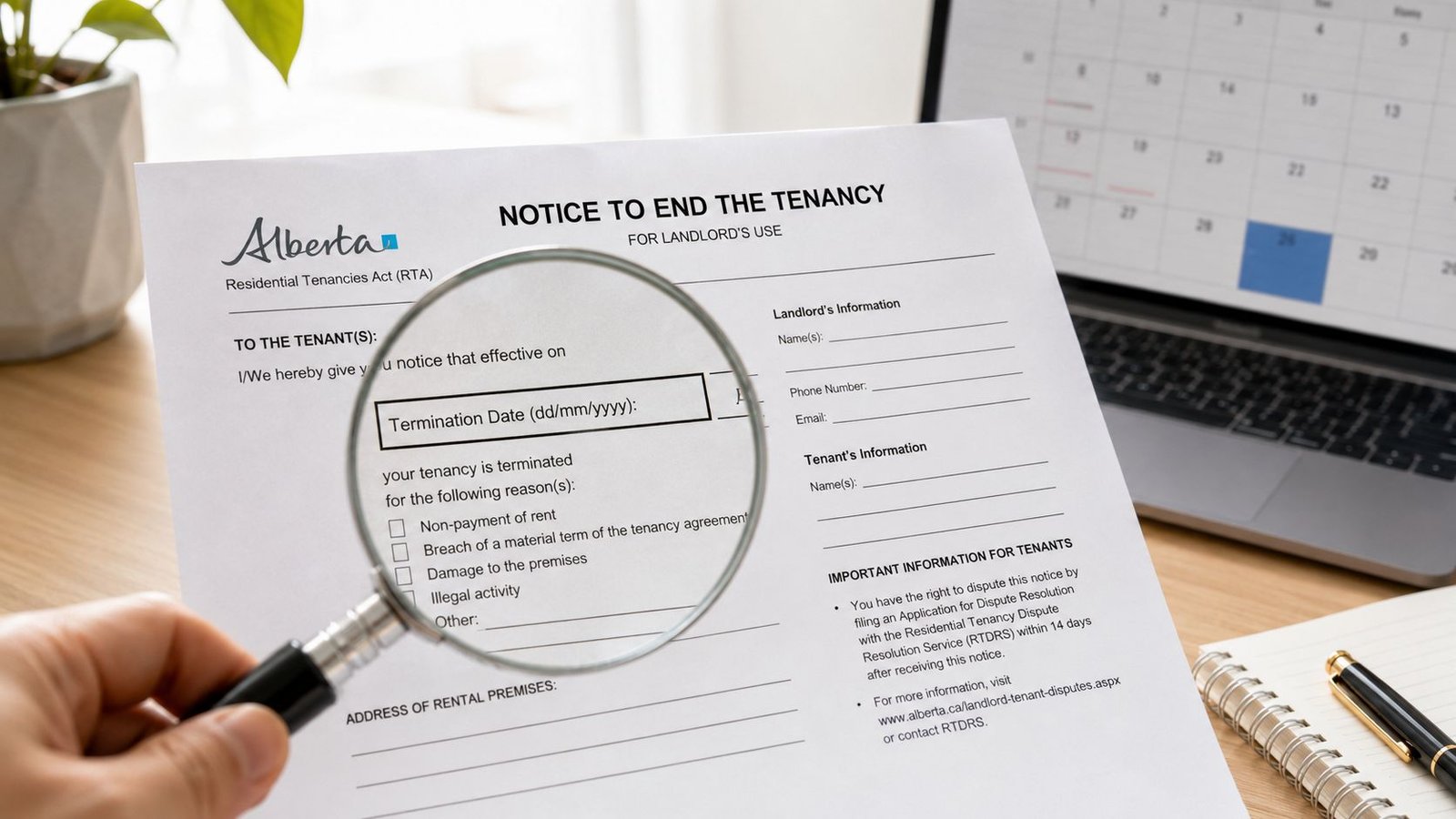
Any discrepancy should be corrected before service. Once delivered, the landlord should be able to produce the exact signed notice and show that its contents matched the tenancy record at the time it was served.
Documentation and Proof of Service
A tenant may refuse the notice, dispute where it was posted, or deny receiving it. Without a reliable delivery record, a landlord can struggle to prove service even when the underlying breach is genuine. Delivery should therefore be treated as an evidentiary event, not merely an administrative task.
Prepare the proof alongside the notice. The file should identify the exact document served, the date and time, the delivery method, the location, and anyone who witnessed or can confirm the event. Use Alberta's current RTDRS forms and documents when preparing records for the dispute-resolution process.
Build an evidence trail
Organise the evidence around the service method:
- Personal delivery: Keep a copy of the signed notice. Record the date, time, location, recipient, and any refusal. A witness can provide a statement describing what occurred.
- Registered mail: Retain the Canada Post receipt, tracking information, delivery status, and a copy of the exact document mailed.
- Posting at the premises: Photograph the notice in place, record when and where it was posted, identify the door or other location, and preserve a witness statement where possible.
- Incident evidence: Store photographs, repair records, payment ledgers, inspection reports, and relevant communications in chronological order.
- Service declaration: Complete the applicable certificate or affidavit of service while the details remain clear. Reconstructing the event later weakens the record.
Evidence standard: A tribunal decision-maker should be able to understand the service event without asking the landlord to fill gaps from memory.
Keep the notice, photographs, delivery receipts, messages, and witness records together in one dated file. A routine handoff can become difficult to prove if the landlord cannot identify which version was delivered or who received it.
Digital messages may support the chronology, but a text message or email does not automatically replace a legally recognised service method. If the tenant's address or contact information is uncertain, a trusted reverse address search may assist with administrative verification. It does not replace statutory service or proof that the notice reached the tenant.
A notice pushed under a door or left in an unsecured location can create an avoidable dispute. Choose the method permitted for the circumstances, document every attempt, and retain the original service records with the exact notice served.
RTDRS vs Provincial Court Pathways
A tenant may dispute the notice or remain after the termination date. The landlord then needs an enforceable remedy, not another copy of the notice. The Residential Tenancy Dispute Resolution Service and Alberta Provincial Court offer different routes, and the appropriate choice depends on the claim, jurisdiction, evidence, and order required.
RTDRS is designed for residential tenancy disputes and provides a specialised process for landlords and tenants. Provincial Court may be more suitable where the dispute is procedurally complex, falls outside the RTDRS framework, or requires a remedy that the specialised process cannot provide. Jurisdiction, evidence, and enforcement considerations should determine the choice, not perceived speed alone.
Compare the available routes
| Criteria | RTDRS | Provincial Court |
|---|---|---|
| Forum | Specialised residential tenancy dispute-resolution process | Formal court proceeding |
| Best fit | Clear residential tenancy disputes supported by organised records | Matters requiring court jurisdiction or more complex proceedings |
| Evidence | Notice, lease, ledger, incident records, photographs, and service proof | The same core evidence, prepared for formal court disclosure and presentation |
| Decision-maker | RTDRS decision-maker under the service's process | Provincial Court judge |
| Order and possession | A successful order may require follow-through for enforcement | Court orders may proceed through the court's enforcement mechanisms |
| Tenant response | The tenant can dispute the landlord's application and present evidence | The tenant can defend the claim and raise relevant issues within the court process |
The RTDRS route often fits a straightforward unpaid-rent or breach file when the landlord has a valid notice and reliable records. A Provincial Court application may fit claims involving complicated issues, matters beyond RTDRS jurisdiction, or remedies the service cannot grant. Check Alberta's current forms, jurisdictional limits, and procedures before filing. The official RTDRS forms and documents should take priority over older landlord advice.
A recent RTDRS hearing illustrates the cost of a small calculation error. A landlord's application was dismissed because the fourteen-day clear-day calculation counted the day of service, producing a termination date one day too early. The file may have contained a genuine breach, but the defective date prevented the landlord from obtaining the requested result.
Winning the order isn't the final operational step
A favourable decision does not authorise a landlord to change locks, remove belongings, or force a tenant out personally. If the tenant remains, enforcement may require a civil enforcement agency and a bailiff acting under the appropriate writ or order.
The same documentation discipline matters after filing. Keep the signed order, notice, service records, rent ledger, and communications together so the enforcement provider can identify the legal basis for possession without reconstructing the history.
A landlord who records the breach but cannot prove service may lose at the first procedural stage. A landlord who obtains an order but delays lawful enforcement can face further vacancy, repair, and communication problems.
Decision principle: Select the forum after reviewing the remedy, jurisdiction, and evidence, not simply the tenant's behaviour.
Professional Management for Compliance
A landlord can have clear evidence of unpaid rent or property damage and still lose time when the notice is defective. Common failures include using the wrong form, calculating the termination date incorrectly, or serving the document without preserving proof.
Professional management is most valuable before service. Dreamhouse Realty Ltd. maintains a pre-served notice checklist that cross-references the lease term with the statutory notice period before any document is printed, reducing the probability of date-calculation errors. The file should also preserve the rent ledger, inspection photographs, relevant communications, and the facts supporting the chosen termination ground.
That discipline matters for Calgary owners with several properties, remote owners outside Alberta, and landlords handling recurring arrears, serious damage, or safety concerns. A rejected notice can restart the process while repairs, vacancy planning, tenant communications, and evidence collection continue.
Owners comparing providers should review what to look for in a property manager for licensing, record-keeping, escalation procedures, inspection standards, and communication practices. A responsible provider will not promise an instant eviction. It will explain the decision, preserve the supporting record, and identify weaknesses before service.
The trade-off is management cost versus owner time, exposure, and operational complexity. A capable landlord may handle a straightforward, uncontested matter independently. A contested or high-risk file can justify professional oversight, particularly where a missing record or inconsistent timeline could undermine an otherwise valid claim. The manager's distinct value is evidence continuity, from the first incident record through any later dispute, rather than the tenant's behaviour alone.
Final Compliance Checklist and Resources
Before serving an Alberta eviction notice, check the file, not only the form:
- Correct form: It matches the tenancy type and termination ground.
- Accurate details: Tenant names, rental address, and unit information match the agreement.
- Specific reason: The statutory ground and supporting facts are stated clearly.
- Correct date: The termination date follows the applicable notice rule.
- Required wording: Rent details and any payment-to-continue-tenancy statement appear where required.
- Signature: The landlord or authorised agent has signed.
- Proof of service: Keep the delivery method, date, recipient details, photographs, tracking records, and witness evidence.
- Evidence file: Organise the lease, ledger, incident records, inspections, photographs, and communications by date.
- Next step: Identify whether RTDRS or Provincial Court is the suitable enforcement route if the tenant contests or remains.
Use Alberta government resources to verify the form and legal requirements, including the Residential Tenancies Act text, RTDRS forms and documents, and residential tenancy agreement guidance. Alberta's laws information also helps landlords locate current provincial guidance. A fixed-term tenancy generally ends without notice when its term expires, subject to the agreement and applicable rules.
Dreamhouse Realty Ltd. provides Calgary and Alberta landlords with rental management, tenant placement, rent collection, inspections, maintenance coordination, and compliance-focused notice and record-keeping support. Visit Dreamhouse Realty Ltd. to discuss a documented approach to eviction notices, RTDRS preparation, and day-to-day property management with GURIQBAL CHAHAL, MBA, PMP, REAL ESTATE BROKER, at 403-966-6072.