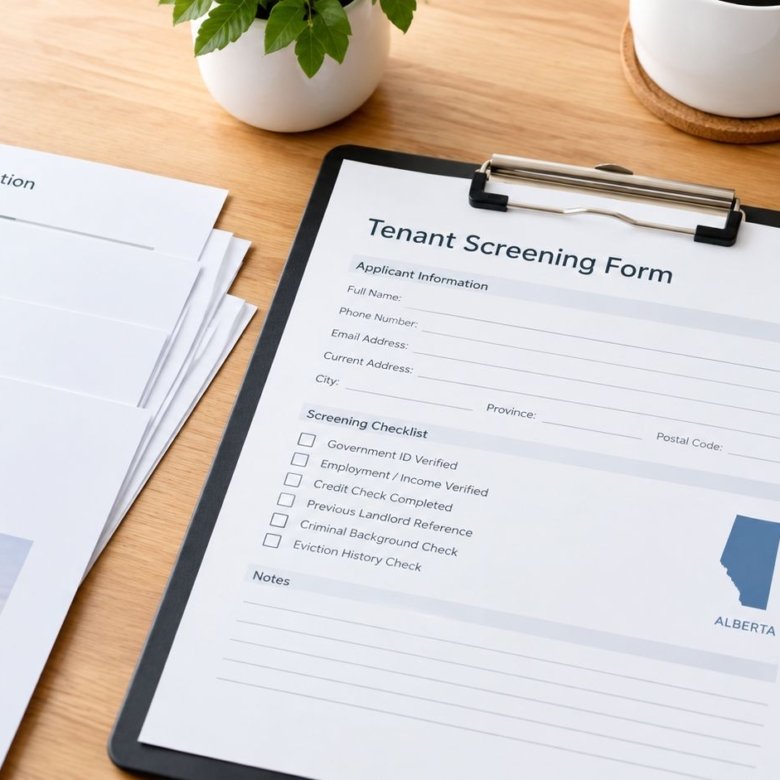

A landlord in Calgary usually sees the problem too late. A tenant says they have insurance, the suite looks fine on move-in day, and the premium sounds low enough to keep everyone happy. Then a claim happens, and the issue is not whether the policy was cheap. It is whether it covered the tenant's belongings, liability, and temporary living costs when the unit became unliveable.
| Policy Tier | Monthly Premium | Annual Cost | Contents Limit | Liability Limit |
|---|---|---|---|---|
| Budget | Low $20s | Low $200s | Often tightly capped | Usually the baseline |
| Standard | Mid $20s to mid $30s | Mid $300s to low $400s | More usable for typical renters | Usually stronger than budget |
| Comprehensive | Mid $40s and up | Higher annual cost | Better for higher-value belongings | Higher ceiling and broader protection |
That table is the core conversation behind cheapest tenant insurance Calgary searches. The cheapest quote is only useful if it still works when a tenant files a claim, and that is where a lot of bargain policies fall apart. Calgary landlords who understand that difference protect their buildings, their timelines, and their own patience.
Table of Contents
- Why Calgary Landlords Should Care About Tenant Insurance
- What Tenant Insurance Covers in Alberta
- What Cheap Tenant Insurance Looks Like in Calgary
- Comparing Cheap Standard and Higher-End Calgary Policies
- How Calgary Renters Can Lower Their Premium
- Real Calgary Scenarios Where Cheap Insurance Falls Short
- Advising Your Tenant on the Right Calgary Policy
Why Calgary Landlords Should Care About Tenant Insurance
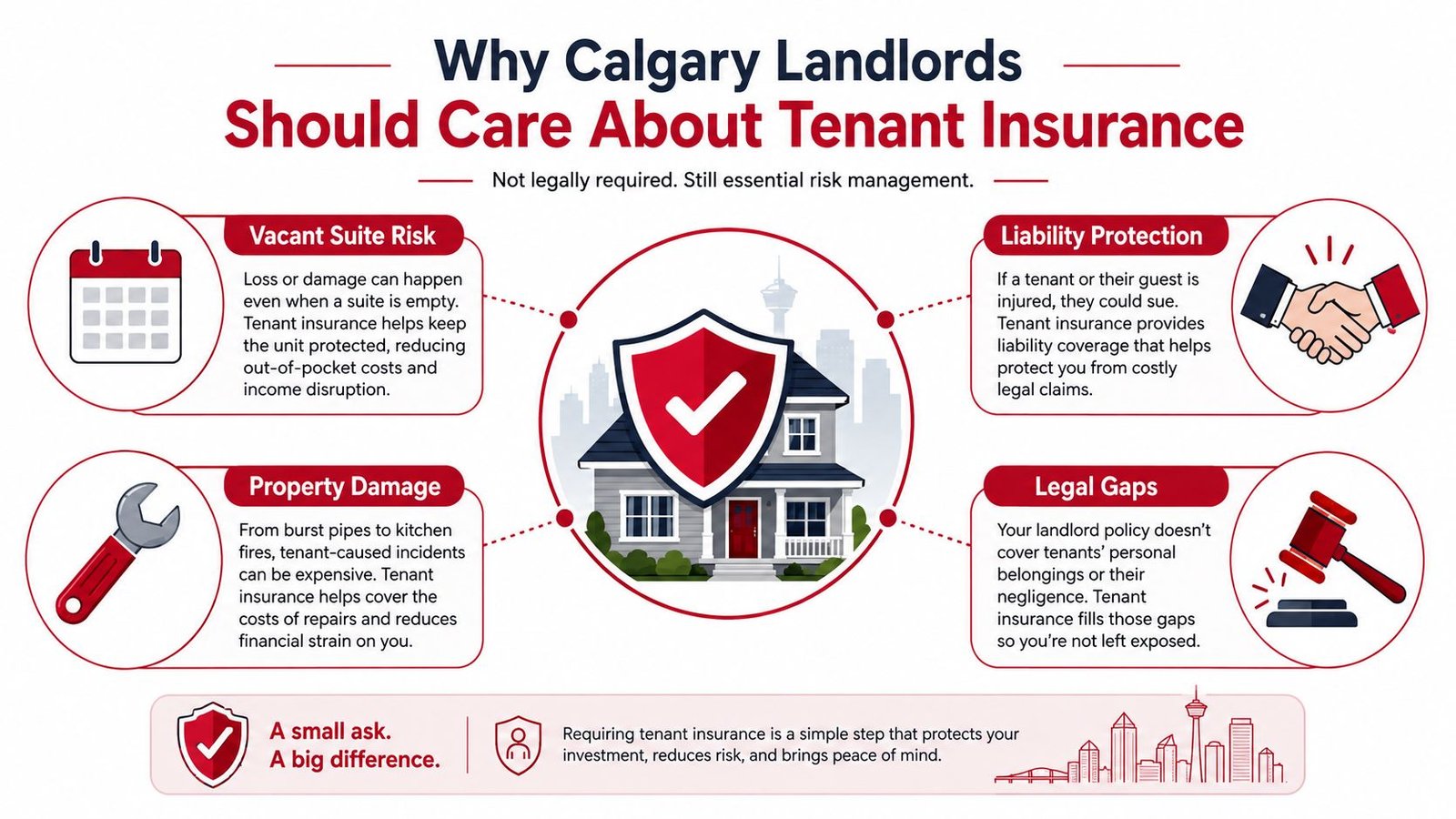
A landlord does not manage tenant insurance because it is trendy. The job is risk control. A tenant policy can soften the fallout when a fire, leak, or theft turns into a dispute about who pays for what, and that matters even when the lease does not make insurance mandatory.
The Alberta government's tenant materials are blunt about the security deposit side of the equation. A deposit can be collected at the start of the tenancy, but it cannot exceed the first full month's rent, and it cannot be increased later even if rent goes up, while ordinary wear and tear is not a valid use of the deposit security deposit rules. That means the deposit is a narrow tool, not a catch-all repair fund. If a renter has no insurance, the landlord has fewer practical buffers when a loss affects the suite or neighbouring units.
The Calgary reality behind the policy
Calgary adds its own pressure points. Freeze-thaw cycles punish plumbing, and older neighbourhoods can see sewer-backup and water issues that quickly become expensive claims. CMHC reported that the Calgary CMA purpose-built rental vacancy rate reached 4.8% in 2024 CMHC rental market report, and the City of Calgary later reported market vacancy rising from 4.6% in 2024 to 5.1% in 2025 City of Calgary vacancy reporting. When a suite is damaged or empty, every delay hurts more.
Practical rule: a landlord should treat tenant insurance as part of the onboarding standard, not as a polite suggestion after the lease is signed.
For owners who want a broader risk picture, a separate landlord insurance comparison for owners helps frame how the tenant's policy and the owner's own coverage fit together. Dreamhouse Realty Ltd. also publishes Alberta landlord and tenancy guidance, which is useful when the conversation turns from “Should the tenant buy insurance?” to “Who pays when something goes wrong?”
What Tenant Insurance Covers in Alberta
A Calgary tenant policy is four coverages bundled together. Landlords should care about the structure because the gap between a useful policy and a token one usually sits in the details, not the premium.
| Coverage Component | What It Pays For | Typical Calgary Default |
|---|---|---|
| Contents coverage | Tenant belongings damaged by covered losses | Modest starting limit |
| Liability coverage | Damage the tenant is legally responsible for | $1 million is common |
| Additional living expenses | Hotel and meal costs if the suite is unliveable | Usually included in some form |
| Endorsements | Sewer backup, overland water, replacement-cost options | Often optional |
Contents, liability, and living expenses
Contents coverage pays for the tenant's belongings, not the building. That matters because landlords often hear “insurance” and assume every loss is covered. It is not. A tenant's couch, laptop, clothing, and bike fall under contents coverage. The building itself stays the landlord's problem unless the tenant caused the damage and liability applies.
Liability is the part landlords should watch most closely. If a tenant's negligence damages the unit or affects another suite, liability coverage helps pay the claim. In Calgary, many landlords prefer $2 million liability instead of the bare baseline, because apartment living stacks risk into shared walls, shared plumbing, and shared consequences. For units where condo rules and rental rules overlap, a separate guide on Calgary condo insurance helps clarify where tenant coverage stops and owner obligations begin.
Endorsements are where cheap policies get stripped down
Optional endorsements are not decorative extras. Sewer backup and overland water matter in Calgary more than many tenants expect, especially in older buildings and lower suites. Replacement-cost contents matter too, because actual cash value pays less once depreciation kicks in. A three-year-old laptop does not keep its original value, and cheap policies often rely on that depreciation.
A low premium can still be a weak policy if it leaves out the loss most likely to hurt a renter in Calgary. That is the hidden tradeoff behind the cheapest quote.
What Cheap Tenant Insurance Looks Like in Calgary
Cheap tenant insurance in Calgary usually looks attractive because the monthly price is easy to swallow. The catch is simple, the lowest quote often buys tighter limits and fewer useful add-ons. Recent pricing snapshots put Alberta's average tenant premium at $22.10 per month, only about 36 cents above the national average of $21.74, while a separate city comparison reported Calgary at $212.73 annually versus Alberta at $218 annually in 2025 Alberta tenant insurance pricing snapshot Calgary tenant pricing comparison. That tells you the floor is already low. Calgary renters are not getting a miracle discount.
What the lowest quote usually hides
Independent Calgary quote data shows how narrow the cheapest end can be. A July 2025 Calgary sample reported a lowest premium of $25 per month, or $301 per year, for high-rise and basement-apartment profiles, while average rates sat in the $39 to $45 per month range, or $471 to $537 per year LowestRates.ca Calgary tenant data. The gap matters. The bargain quote is available, but it is usually built for price first and usefulness second.
| Policy Tier | Monthly Premium | Annual Cost | Contents Limit | Liability Limit |
|---|---|---|---|---|
| Budget Tier | About $15 to $22 | About $180 to $265 | Often $20,000 to $25,000 | Usually $1 million |
| Standard Tier | About $25 to $35 | About $300 to $420 | Often $40,000 to $50,000 | Often stronger |
| Higher-End Tier | Above $35 | Higher annual cost | Higher limits | Higher ceiling |
Why Calgary pricing shifts so much
Price moves with the building, not just the tenant. Postal-code risk, building age, and whether the suite sits in a wood-frame low-rise all push the quote around. A one-bedroom in a newer concrete tower can price very differently from a basement suite in an older structure, and that difference usually reflects claim frequency, not square footage.
Budget policies also tend to keep deductibles high, so the insurer can hold the premium down. That works on paper until a smaller claim comes along and the deductible swallows most of the payout. Cheap policies fail there. They look fine until the tenant needs them for something modest, then the value disappears fast.
Comparing Cheap Standard and Higher-End Calgary Policies
Budget, standard, and Calgary tenant policies are not interchangeable. They often look similar on a quote screen, but the coverage shape changes fast once the fine print appears. That is why the cheapest premium can be the least useful one for a tenant who owns real furniture, electronics, or work gear.
Where the money goes
Budget policies around $18 to $25 per month usually keep limits tight. Contents coverage commonly lands near $25,000, liability may sit at the lower end, and the deductible is often $1,000. Sewer backup is frequently missing, and replacement-cost contents is not the default. That setup can work for a minimalist renter, but it is weak for anyone with a proper living room, a bike, or a home office.
Standard policies around $30 to $40 per month are where many working tenants get a more rational balance. Contents coverage often rises to $50,000, liability usually sits at $1 million or better, and the deductible can move closer to $500. The annual cost is higher, but the policy behaves like insurance instead of a hopeful receipt.
Policies from $45 to $60 per month are for tenants with more to lose. They commonly bring contents limits above $100,000, stronger liability ceilings, and more flexibility around endorsements. For a furnished suite, a tenant with expensive electronics, or anyone with substantial personal property, this tier is not indulgent. It is practical.
| Coverage Feature | Budget Tier | Standard Tier | Comprehensive Tier |
|---|---|---|---|
| Contents limit | Around $25,000 | Around $50,000 | $100,000+ |
| Liability ceiling | Lower baseline | $1 million common | $2 million common |
| Deductible | $1,000 | $500 | $250 |
| Sewer backup | Often excluded | Sometimes optional | More often available |
The policy that usually makes sense
For most Calgary renters, the middle tier is the sweet spot. It avoids the false economy of the cheapest quote while skipping the premium jumps that come with features a normal tenant may never use. A landlord advising a tenant should push them away from the budget trap and toward the tier that covers a real-life loss without forcing them into overbuying.
How Calgary Renters Can Lower Their Premium
A renter in Calgary can shave the premium without turning the policy into a joke. Start with the coverage structure. A quote that looks cheap because it strips out protection is a bad deal for a tenant and a headache for the landlord.
The levers that usually work
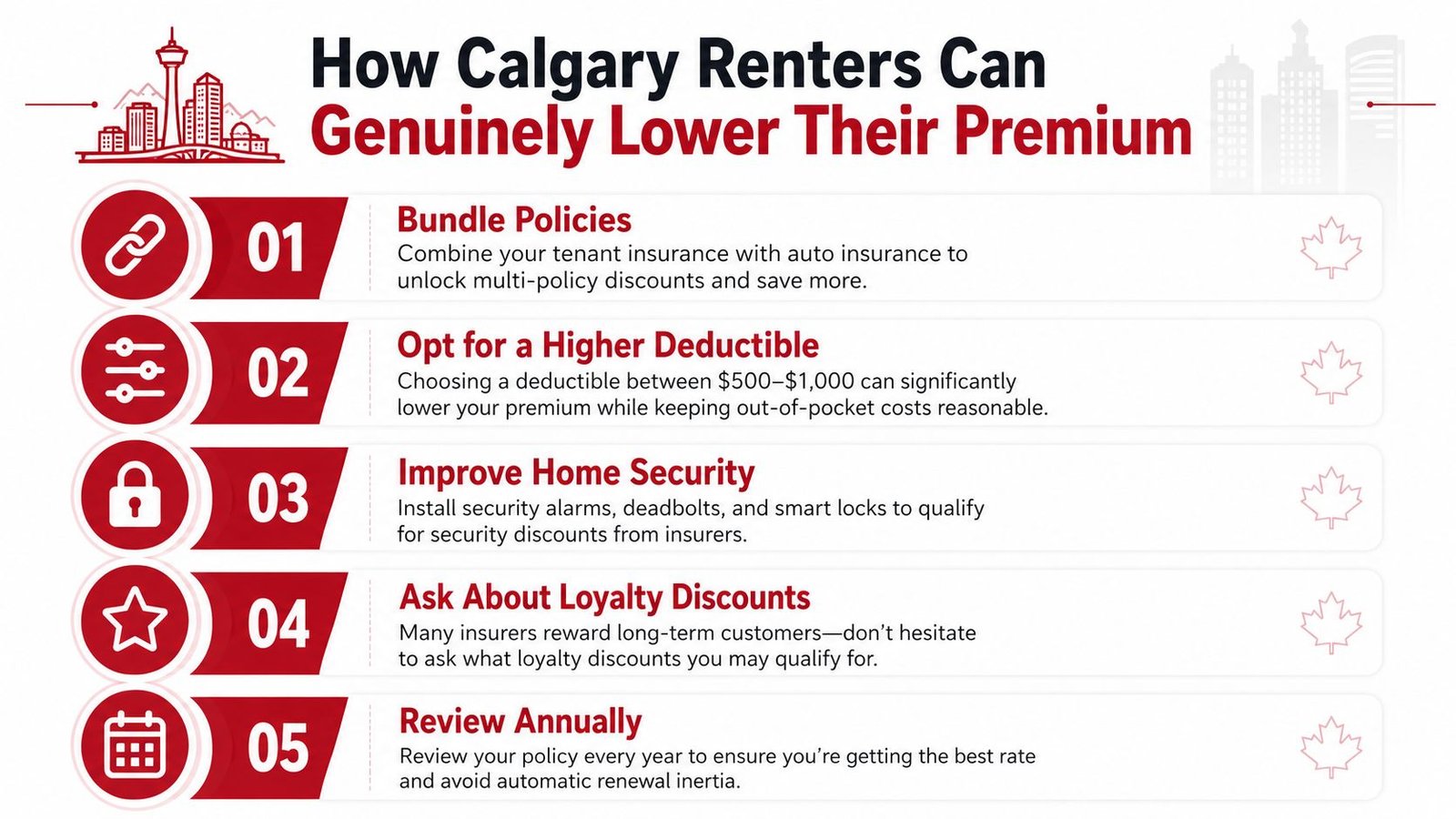
Bundle tenant and auto insurance with the same insurer if the pricing holds up. Raise the deductible only if the tenant can cover it without panic. Keep the contents estimate honest, because padding the number wastes money and does not help a claim. Ask about professional, student, or other available discounts. Paying annually can also cut instalment fees that add to the bill.
Those are real savings. They lower the price without hollowing out the policy.
Simple rule: save on friction, not on protection.
Deductibles deserve a hard look. Moving from $500 to $1,000 can trim the premium, but only if the tenant can absorb that first hit when something goes wrong. If they cannot, the lower quote is fake savings.
Where savings turn into false economy
Some cuts are just self-inflicted losses. Dropping sewer backup in an older 1970s apartment building with ageing stack pipes is poor budgeting. Skipping liability because the tenant has no pets is also a mistake, because liability covers accidental damage and injuries, not just animals.
Landlords should steer tenants toward the right tradeoff, not the cheapest sticker price. For a useful framework on rate trimming, see how to reduce premiums. The point is simple, keep the policy workable and avoid paying less for coverage that fails when it matters.
Real Calgary Scenarios Where Cheap Insurance Falls Short
A low premium looks clever right up until a claim is denied or underpaid. Calgary's rental stock gives plenty of examples where the cheapest policy does exactly what cheap policies are designed to do. It keeps the upfront cost low and shifts the pain somewhere else.
The Beltline fire that exposed low contents limits
A Beltline tenant paid roughly $22 per month for a policy that capped contents at $25,000. After a kitchen fire, the replacement cost for electronics, furniture, and clothing came to roughly $48,000, so the tenant was underinsured by more than half. The premium looked sensible on move-in day, but the policy did not match the value of the unit's contents.
The basement suite flood that was outside the policy
A Dover Glen basement renter had a policy that excluded sewer backup. A spring 2024 storm flooded the unit, and the insurer denied the $22,000 claim because the loss fell outside the coverage. An extra $5 to $8 per month for the right endorsement would have changed the outcome. This is exactly why landlords should care about coverage structure, not just the headline premium.
The theft claim that never got filed
A Mission walk-up tenant carried a cheapest-tier policy with a $1,000 deductible. After a theft loss worth $3,500, the tenant could not justify filing the claim because the deductible swallowed too much of the payment. The policy technically existed, but it was too blunt to be useful for a smaller loss.
For move-out or turn-over situations, Dreamhouse Realty Ltd. also keeps a practical move-out inspection checklist style of documentation in mind, which helps separate damage, wear, and tenant responsibility before tempers flare.
Advising Your Tenant on the Right Calgary Policy
A landlord does not need to become an insurance broker to be useful. A simple, consistent checklist during lease signing does most of the work. It keeps the conversation practical and prevents the tenant from buying a policy that only looks cheap.
The decision framework that actually works
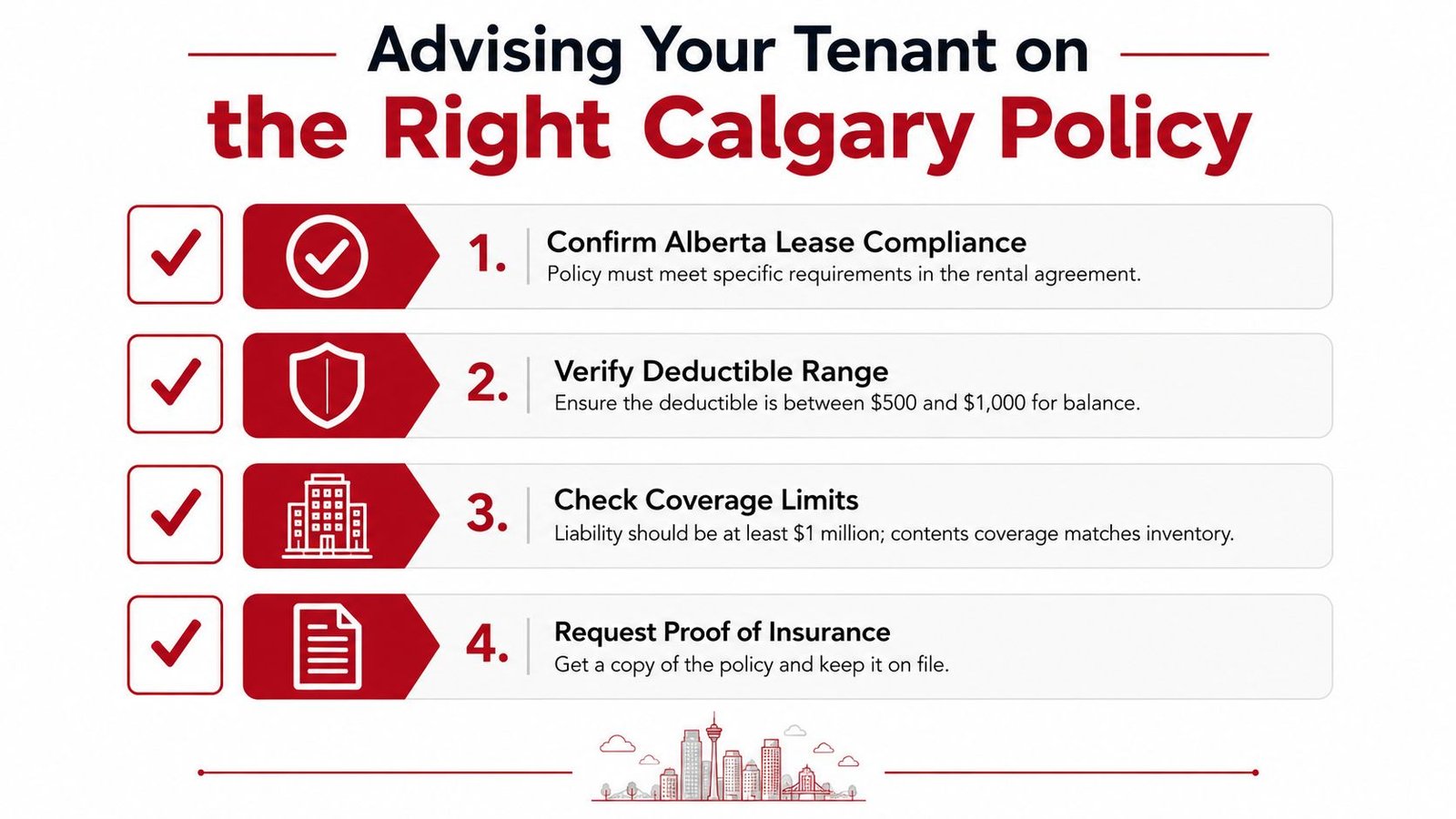
- Confirm Alberta lease compliance. The policy should line up with what the rental agreement expects, and the tenant should know what proof the landlord wants on file.
- Verify the deductible range. For most renters, a deductible between $500 and $1,000 is the right balance between price and claim usability.
- Check coverage limits. Liability should be at least $1 million, and contents coverage should match the inventory in the unit.
- Request proof of insurance. A copy of the declarations page should sit with the rental file, so the landlord knows the insurer, policy number, and coverage dates.
A wise landlord asks for three Calgary quotes within the same week, because pricing changes and stale comparisons mislead people. The tenant should read the declarations page, not the teaser rate. That one habit catches weak deductibles, missing endorsements, and low limits before move-in.
What to watch for on the declarations page
Shared-loss language deserves a close look, as do exclusions for water damage and policies that do not name any additional insureds where needed. If the policy excludes the kind of loss most likely to hit the building, it is not a cheap policy. It is a fragile one.
A tidy written summary at the end of the conversation helps everyone. It turns insurance from a vague checkbox into part of the landlord's standard Calgary onboarding routine, which is where it belongs.
Dreamhouse Realty Ltd. handles Alberta rental management, tenant placement, and compliance support for Calgary owners who want the paperwork and risk checks done properly. For landlords who want a cleaner process around tenant insurance, inspections, and lease setup, visit Dreamhouse Realty Ltd. and ask how their team fits insurance proof into day-to-day rental management.