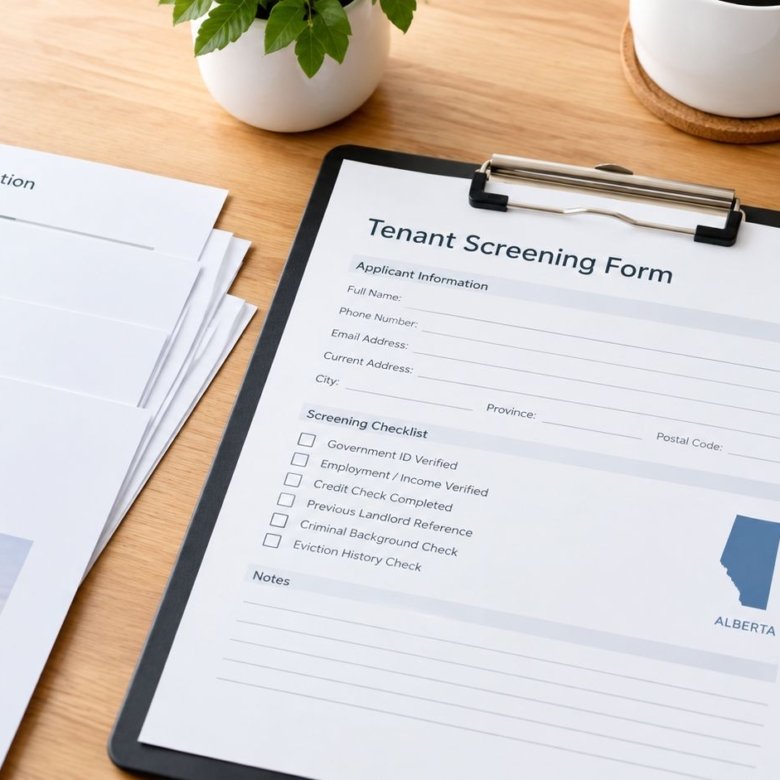

A Calgary landlord can do everything that feels reasonable, serve a notice, wait for the tenant to leave, and still arrive at RTDRS without a valid case. A missed termination date, an incomplete unpaid-rent notice, or weak proof of service can turn a straightforward possession application into a delay that costs time, rent, and control of the property.
Evicting a renter in Alberta is a document-management exercise before it becomes a hearing. The owner must identify a lawful ground, issue the correct notice, calculate the date properly, serve every required tenant, preserve evidence, apply through the right channel, and obtain an enforceable order. Alberta's process moves quickly in some situations, but it doesn't forgive casual paperwork.
Table of Contents
- When Eviction Goes Off Track in Alberta
- Legal Grounds for Eviction Under Alberta Law
- Notice Templates and Alberta-Specific Timelines
- Filing the Application at RTDRS or Court
- What Happens at the Eviction Hearing
- Enforcing the Order and Recovering Possession
- Best Practices to Reduce Eviction Risk
When Eviction Goes Off Track in Alberta
A typical Calgary file starts with a February rent payment that never arrives. The landlord serves a notice, waits for the tenant to respond, and eventually files at RTDRS months later. At the hearing, the arrears are obvious, the lease is signed, and the tenant hasn't left. Then the adjudicator spots the problem: the original notice ended on the wrong date.
The application doesn't succeed because the tenant owes money. The landlord may need to re-serve the notice and begin the sequence again. Alberta guidance recognises that a substantial breach notice can be as short as 14 days, but the date, wording, and service method still need to comply with the rules. The Alberta eviction guidance for landlords and tenants describes eviction as a legal process involving notice, adjudication, and enforcement, not a private arrangement between an owner and renter.
The sequence matters
A landlord should treat the file as a chain:
- Lawful ground: The facts must support the ground selected.
- Correct notice: The notice must use the required wording and termination date.
- Proper service: The landlord must prove how and when each tenant received it.
- Application: The notice must expire before the possession application is advanced.
- Hearing: The evidence must establish the breach and the landlord's compliance.
- Enforcement: A possession order must be converted into lawful physical possession.
RTDRS isn't a forum for repairing a defective notice after the fact. An adjudicator can refuse an application because the landlord's documents don't establish jurisdiction or compliance, even where the underlying complaint appears credible.
Practical rule: A tenant's apparent agreement to move out doesn't replace a possession order when the tenant remains in the unit.
Historical Alberta enforcement data shows why owners should take the process seriously. An Alberta Law Review article recorded 1,151 eviction files opened and 1,092 enforced by civil enforcement agencies from April 2015 to March 2016, summarised by the authors as roughly three households evicted per day in Alberta (Alberta eviction research). The figures are historical, but the operational lesson remains current: eviction becomes structured and time-sensitive once the tenant doesn't leave voluntarily.
Legal Grounds for Eviction Under Alberta Law
The first question isn't “How fast can the renter be removed?” It's “What lawful basis supports ending the tenancy?” Alberta landlords commonly rely on non-payment of rent, serious damage, illegal activity, threats to safety, or another material breach of the tenancy agreement. The Residential Tenancies Act governs ordinary residential tenancies, while the Mobile Home Sites Tenancies Act can apply where the tenancy concerns a mobile-home site.
Serious breaches and lesser breaches
Non-payment of rent is the most common trigger. A landlord still needs a written notice that identifies what is owed and gives the tenant the required opportunity to remedy the default. The notice cannot just announce that the tenancy is over without addressing the statutory condition that payment may preserve the tenancy.
Substantial damage, illegal acts, and conduct that endangers the landlord, other tenants, or people on the property require disciplined evidence. Photos, incident reports, written complaints, inspection records, and communications are more useful than a general statement that the tenant is “causing problems.”
Late rent, repeated disturbances, cleanliness issues, pets, or unauthorised occupants may be treated differently depending on the facts and the lease. A landlord should usually document the breach, issue a written warning where appropriate, and give the tenant a clear opportunity to correct a non-serious problem before seeking termination.
Periodic tenancies and cause-based termination
A periodic tenancy can end through proper notice where the law permits that type of termination. That isn't the same as terminating for cause. Once the landlord relies on tenant misconduct or default, the application must connect the facts to the correct statutory or contractual ground.
The statutory grounds identified for cause-based termination include:
- Non-payment: Rent remains unpaid under the tenancy.
- Material covenant breach: The tenant breaches an important lease obligation.
- Illegal acts: The tenant engages in unlawful activity connected to the premises.
- Endangerment: Conduct creates a safety risk.
- Income misrepresentation: The tenant misrepresents income where that fact is legally relevant.
- Landlord's own use: The landlord needs the property for an authorised personal purpose.
The landlord's application should state the ground plainly, identify the supporting facts, and attach the documents that prove those facts. RTDRS doesn't grant possession because an owner is frustrated or because the relationship has deteriorated. The decision turns on the legal ground and the landlord's proof.
Eviction grounds under Alberta law at a glance
| Ground for Eviction | Notice Period | Serious or Non-Serious Breach |
|---|---|---|
| Unpaid rent | Use the applicable written notice and statutory timing | Serious |
| Substantial damage | Can involve a short substantial-breach notice | Serious |
| Illegal activity | Depends on the circumstances and applicable notice | Serious |
| Safety threat or endangerment | Depends on the circumstances and applicable notice | Serious |
| Material lease covenant breach | Notice must identify and support the breach | Serious or fact-dependent |
| Late rent, disturbances, pets, or unauthorised occupants | Warning and opportunity to correct may be required | Often non-serious or fact-dependent |
| Landlord's own use | Proper statutory notice and supporting facts required | Not a tenant breach |
Notice Templates and Alberta-Specific Timelines
The notice is the foundation of the file. If it's defective, a strong application can collapse before the adjudicator considers the tenant's conduct.
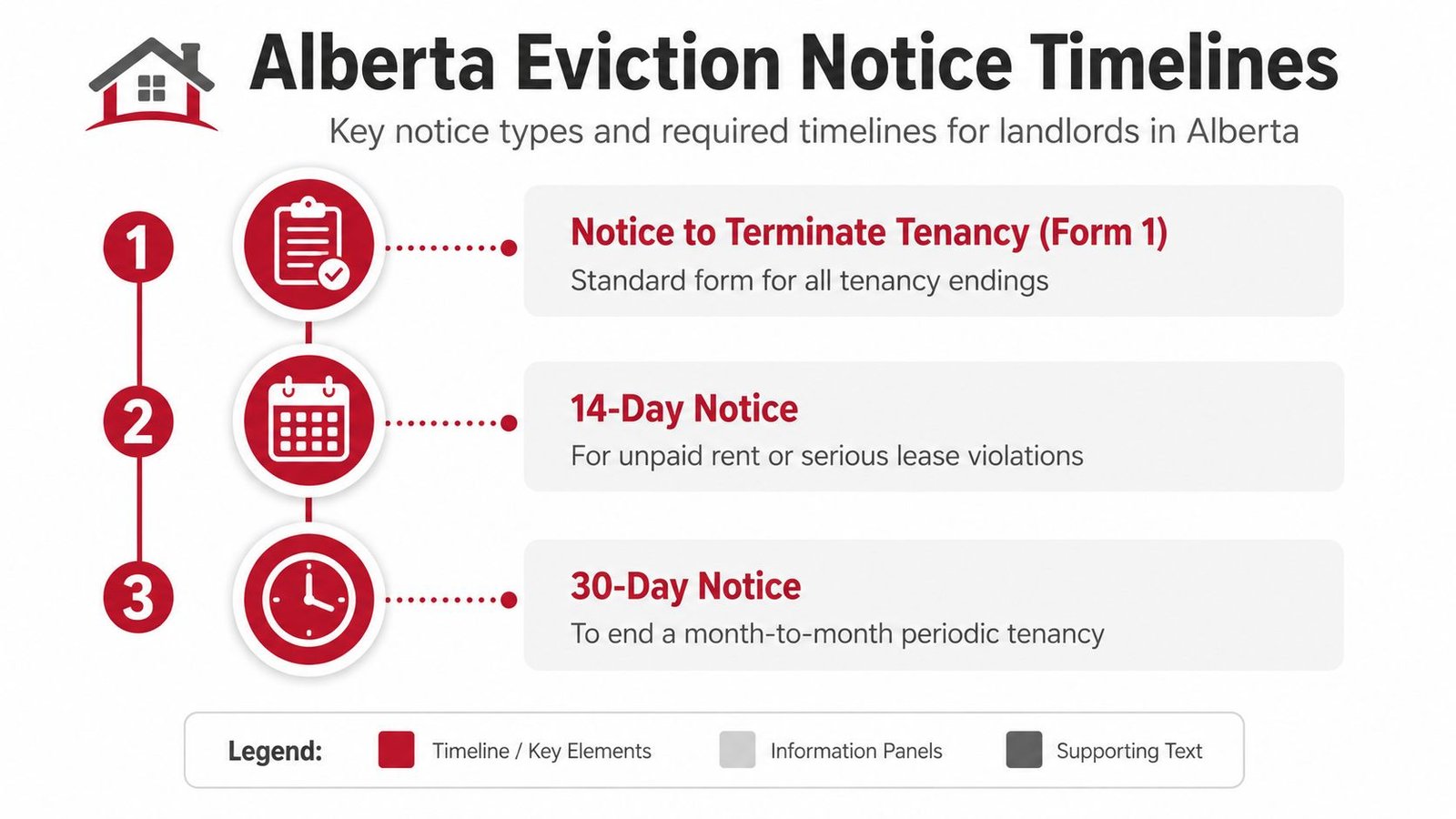
Alberta landlords commonly work with the Notice to Terminate a Tenancy, Form 1, a 14-Day Notice for unpaid rent or a material breach where applicable, and a 30-Day Notice for ending a periodic tenancy where the statutory requirements are met. The correct form depends on the tenancy type and the reason for termination, so an owner shouldn't copy a generic internet template and assume it fits an Alberta property.
Count the days, not the intention
The Alberta government explains that a 14-day breach notice is counted as 16 calendar days because the issue date and the termination date are excluded from the calculation (Alberta's tenancy-ending guidance). This is one of the most common Calgary filing failures. The landlord may think the tenant has been given two full weeks, while the notice ends too early.
For unpaid rent, the notice must be written and must state that the tenancy will continue if the tenant pays all rent due on or before the termination date. Omitting that remedy language can create a validity problem even where the rent ledger is accurate.
A practical notice should identify:
- The landlord and every tenant named on the lease.
- The rental address and unit.
- The precise breach or amount outstanding.
- The date the notice is issued and served.
- The correct termination date.
- The tenant's right to remedy unpaid rent where required.
- The landlord's signature.
- The method and date of service.
For a non-monetary breach such as an unauthorised pet, excessive clutter, or an unapproved occupant, the notice should describe the conduct with enough detail that the tenant understands what must change. “Lease violation” is weak. A dated description tied to the relevant lease clause is much stronger.
Service creates the evidence trail
Hand delivery, posting the notice on the rental unit door, and mailing are recognised service approaches, but the effective timing can differ by method. The landlord should record who served the notice, when it was served, where it was left, and what happened. A photograph of a posted notice, a service declaration, and a contemporaneous communication log can prevent an avoidable dispute.
The Alberta eviction notice form guide can help owners organise the notice stage, but a property-specific file still requires careful date calculation and proof.
A landlord shouldn't backdate a notice, alter a date after service, or assume the tenant's silence confirms receipt. Each of those shortcuts gives the tenant a procedural argument that can delay possession.
Filing the Application at RTDRS or Court
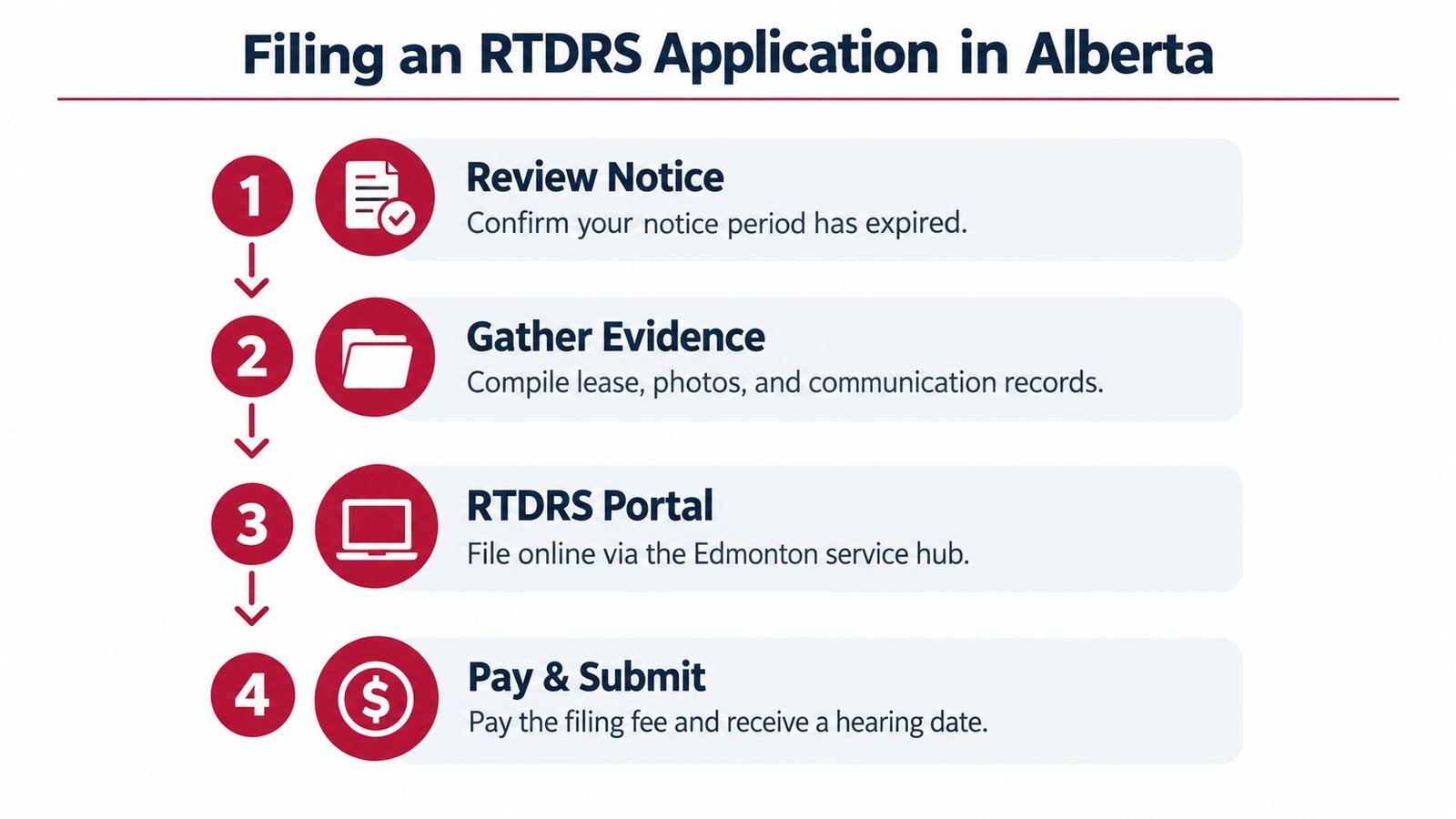
Once the notice period has expired and the tenant remains, the landlord must convert the paperwork into an application. The Residential Tenancy Dispute Resolution Service operates as the main administrative route for many Alberta residential disputes, and the province identifies RTDRS or court as formal channels for ending a tenancy in serious breach situations (Alberta tenant handbook).
Build the application around the order requested
The landlord should decide whether the application seeks:
- Possession only, where the immediate priority is recovering the unit.
- Possession plus a monetary claim, where the landlord also seeks arrears, damages, or another recoverable amount.
The RTDRS online filing process is handled through the provincial service structure associated with Edmonton, even when the property and hearing concern Calgary. Filing fees apply, and the landlord should confirm the current amount through the official portal rather than rely on an old form or advice from another file.
The Court of King's Bench may be more suitable where the dispute is complex, the claim exceeds the practical scope of RTDRS, or the landlord needs a court remedy that the tribunal process can't provide. That decision deserves legal advice when the facts involve serious damage, disputed ownership, complicated corporate structures, or multiple proceedings.
Upload a coherent evidence bundle
The adjudicator should be able to understand the file without searching through a disorganised email chain. A clean bundle normally includes:
- Signed lease: Include amendments, addenda, pet agreements, and occupancy terms.
- Notice and proof of service: Show the exact notice served and how delivery occurred.
- Payment ledger: Record rent charged, payments received, dates, and outstanding amounts.
- Breach evidence: Add photographs, inspection reports, incident records, and relevant messages.
- Written submission: Give a short chronology, identify the legal ground, and state the order requested.
The most damaging filing errors are mundane. Wrong tenant names, missing signatures, an application filed before the notice expires, an unclear amount owing, or an unsigned consent form can cause the file to be returned, adjourned, or weakened at the hearing.
For Calgary owners, a practical Alberta landlord and tenant resource can support early file organisation. It shouldn't replace checking the current RTDRS requirements or obtaining legal advice where the consequences are significant.
What Happens at the Eviction Hearing
The landlord's chair at a Calgary RTDRS hearing is less dramatic than many owners expect. The adjudicator normally wants a clean answer to a small set of questions: Was there a tenancy? What obligation was breached? Was the notice valid? Was it served correctly? Did the tenant remain after the lawful termination date?
The landlord should answer from the documents, not from irritation. A long history of difficult conversations may feel persuasive, but an adjudicator usually needs the signed agreement, payment records, notices, service proof, and evidence that connects the alleged conduct to the legal ground.
Paper evidence usually controls the room
Tenant testimony can matter, especially where the tenant disputes service, payment, repairs, or the condition of the property. Still, an owner who arrives with a dated ledger and organised exhibits has a stronger platform than one who relies on memory.
Common tenant responses include:
- Notice service dispute: The tenant says the notice wasn't delivered properly or wasn't received.
- Payment or cure argument: The tenant says arrears were paid or that payment was made through the RTDRS process.
- Repair counterclaim: The tenant alleges that unresolved maintenance affected rent, use, or habitability.
- Adjournment request: The tenant asks for more time to review evidence, obtain records, or respond.
The adjudicator may ask short, pointed questions about dates and documents. Repeated requests for the notice issue date, service date, or termination date usually signal that the timeline is under scrutiny. The right response isn't an argument about fairness. It's a page reference and a precise answer.
Defects can end the hearing before the merits
A landlord may be sent away to re-serve and refile when the notice expires on the wrong date, a co-tenant wasn't properly served, or the notice lacks a required signature. The tenant's breach can be real and still fail to produce possession if the landlord didn't establish procedural compliance.
An oral ruling may be delivered during the hearing, but the written order is the document that controls the next step. A Conditional Order can make possession dependent on compliance with stated conditions. A Possession Order authorises the landlord to pursue the lawful enforcement process when the tenant doesn't leave.
A favourable hearing impression isn't possession. The written order and lawful enforcement steps are what return control of the unit.
Enforcing the Order and Recovering Possession
An RTDRS possession order doesn't mean the landlord can change the locks that afternoon. If the tenant remains, the landlord must use the enforcement route rather than self-help measures.
The usual process involves filing the order with the Court of King's Bench, paying the required filing fee, requesting a writ of possession, and working with the sheriff's civil enforcement branch or a private civil enforcement agency to schedule the lockout. The exact administrative steps and costs should be confirmed with the court or enforcement provider because they can change.
Keep the lockout lawful
A landlord shouldn't remove a tenant, block access, shut off services, or place belongings outside without the authority required for enforcement. Acting without a valid writ can expose the owner to a claim, additional delay, and cost-shifting risk.
Enforcement timing depends on whether the tenant leaves voluntarily, the court processing stage, and the enforcement agency's workload. A landlord should plan for a process that can take ten to thirty days from order to lockout, rather than promise an immediate recovery. That range is an operational planning estimate, not a guaranteed statutory deadline.
The tenant's belongings also require care. Items left behind can't be treated as rubbish. The landlord should document what remains, protect the property, follow applicable storage and notice requirements, and obtain advice before disposal or sale. A possession order doesn't erase duties connected with personal property.
Separate possession from money recovery
A possession application and a monetary award solve different problems. Once possession is secured, the landlord can pursue the monetary portion through the appropriate Alberta enforcement or civil-claims route. The payment ledger, invoices, inspection records, photographs, and written communications should already be organised for that purpose.
| Enforcement Options After an RTDRS Possession Order | Where to File | Typical Timeline | Approximate Cost |
|---|---|---|---|
| Voluntary move-out | Direct coordination with the tenant | Depends on the agreed date | No enforcement fee, but any agreement should be documented |
| Court filing and writ of possession | Court of King's Bench | Can extend beyond the order date | Court and enforcement fees apply |
| Sheriff civil enforcement | Through the court enforcement process | Scheduled according to availability | Enforcement charges apply |
| Private civil enforcement agency | Civil enforcement provider after required court steps | Depends on scheduling and file readiness | Provider and court charges apply |
| Monetary award enforcement | Appropriate Alberta civil enforcement route | Depends on debtor response and enforcement options | Filing and enforcement charges apply |
A documented Alberta move-out inspection checklist helps separate possession, condition, and financial claims. The landlord should record the unit's condition immediately after lawful recovery, preserve photographs, and avoid mixing a damage dispute with an unauthorised lockout.
Best Practices to Reduce Eviction Risk
Most eviction headaches begin before the first missed payment. A weak move-in report, informal rent records, scattered text messages, and undocumented concessions leave the landlord trying to reconstruct the tenancy after the relationship has already deteriorated.
The practical defence is a documented operating system. A landlord should manage the home as an asset with repeatable controls, not as a personal arrangement that runs on memory and goodwill.
Build the record before conflict starts
A reliable file includes:
- Move-in condition report: Describe each area and attach dated photographs.
- Traceable rent records: Use receipting and payment methods that create a clear ledger.
- Single communication channel: Route repair requests and tenancy issues through a defined contact process.
- Written warnings: Describe the breach, identify the required correction, and record the response before serving a termination notice where appropriate.
- Inspection history: Carry out lawful inspections and preserve the reports, photos, and tenant communications.
- Concession records: Put payment plans, extensions, waived charges, and promises in writing.
Every text message that changes the practical arrangement should be summarised in the file. If the landlord accepts partial payment, grants extra time, or agrees to a repair deadline, the record should state exactly what was agreed and what remains outstanding.
A property manager can also centralise notices, inspections, rent collection, maintenance records, and owner reporting. Owners who need administrative support may find Legal assistants useful for document organisation, provided legal advice and representation are obtained from the appropriate qualified professional.
Call before serving, not after dismissal
Dreamhouse Realty Ltd. provides residential leasing and property management support in Calgary, Edmonton, Red Deer, and surrounding Alberta communities, including lease administration, rent collection, inspections, maintenance coordination, tenant communications, and compliance record-keeping. GURIQBAL CHAHAL, MBA, PMP, REAL ESTATE BROKER, can help owners review the file before a notice is served, identify missing documents, and organise the next lawful step.
Owners facing arrears, repeated breaches, or a disputed move-out should contact GURIQBAL CHAHAL at 403-966-6072 and visit Dreamhouse Realty Ltd. to discuss property management, leasing, and Alberta tenancy compliance support before an avoidable paperwork error delays possession. A rental property is an asset, and its notices, inspections, payment records, and enforcement decisions should be managed with the same discipline as its finances.