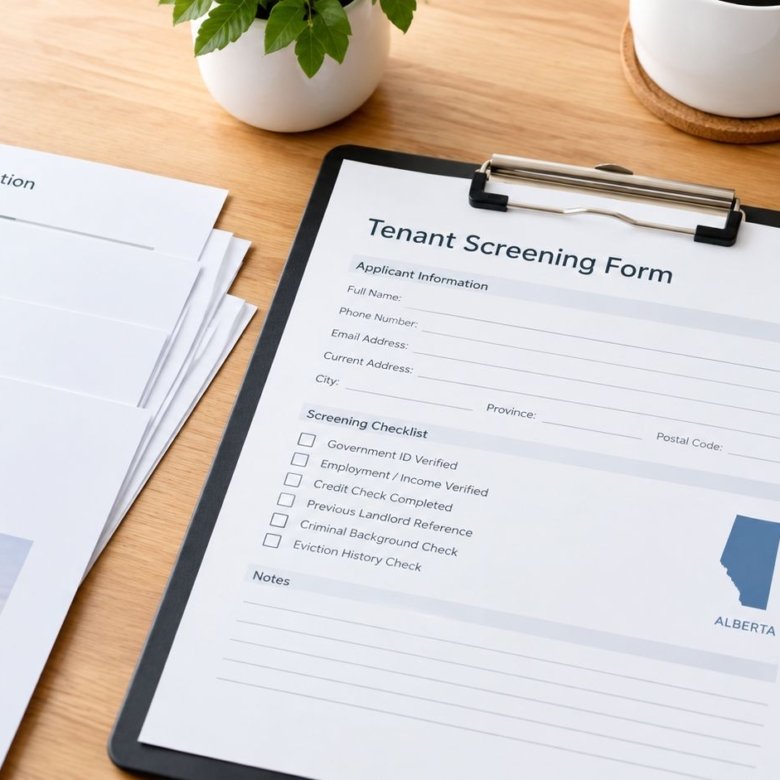

A tenant in a second-floor Eau Claire condo calls the landlord at 2 a.m. A braided washing-machine hose has ruptured, water is running into the suite below, and the condominium corporation is coordinating emergency restoration. The landlord assumes the building's insurance will handle the problem. Then the corporation's deductible notice arrives, followed by questions about damaged flooring, tenant relocation, lost rent, contents, and liability.
That's where condo homeowners insurance becomes more than contents coverage. Alberta landlords face a specific exposure when damage originates in their unit, because the condominium corporation may recover its insurance deductible from the unit owner, subject to a statutory maximum. A rental condo also carries risks that an owner-occupied unit policy may not address correctly, including tenant-caused damage, fair rental value, improvements, and the owner's liability to occupants and neighbouring units.
This guide is for Calgary investors and rental-property owners across Alberta. It focuses on the coverage split between the corporation and the unit owner, the deductible chargeback that catches landlords off guard, and the practical steps needed to place a landlord-focused policy before a claim exposes the gaps. A landlord who also relies on structured maintenance records, inspections, and a property management scheduling platform has a better chance of documenting prevention and responding quickly when a water loss occurs.
Table of Contents
- Why Alberta Condo Landlords Need the Right Policy
- How Condo Insurance Differs from Regular Homeowners
- What the Condo Corporation Covers and What You Cover
- The $50,000 Deductible Chargeback Alberta Owners Face
- Key Endorsements That Close Common Coverage Gaps
- Standard Owner Policy Versus Landlord-Focused Coverage
- Choosing the Right Condo Homeowners Insurance in Alberta
- Mistakes to Avoid and Next Steps for Calgary Owners
Why Alberta Condo Landlords Need the Right Policy
A tenant's washing-machine hose can turn a contained maintenance issue into a building-wide insurance event. In the Eau Claire example, water moves from the rental suite into the unit below, damages finishes, disrupts occupancy, and forces the corporation to decide whether the loss falls under its master policy. The landlord still has to answer for the suite's contents, non-standard improvements, tenant displacement, and any bill the corporation lawfully directs back to the owner.
The central mistake is treating a rental condo like a detached house or an owner-occupied apartment. A landlord-focused condo policy must coordinate with the corporation's master policy while addressing the owner's separate financial interest. The corporation generally insures the building and standard insured elements, but it doesn't insure the landlord's furniture, appliances supplied to the tenant, rental income, or every improvement inside the unit.
The exposure starts with the building deductible
Alberta law allows a condominium corporation to recover its insurance deductible from an owner when damage originates in or from that owner's unit or an exclusive possession area. The owner's exposure is capped at $50,000, and the corporation may pursue the deductible without proving negligence in the circumstances described by Alberta condominium insurance guidance (Alberta condominium information, Alberta Condominium Property Act insurance guidance).
That rule changes the insurance conversation. A policy with attractive contents coverage but weak deductible or loss-assessment protection can leave a landlord personally exposed after a burst supply line, appliance leak, or fire. A corporation deductible of $30,000 may be recoverable in full, while a corporation deductible above the statutory ceiling can still leave the owner exposed up to $50,000 (Alberta condo deductible explanation).
Rental use changes the underwriting
An insurer needs to know that tenants occupy the unit. A resident-owner policy may assume the named insured lives there, maintains the property personally, and has no lost-rent exposure. Those assumptions can affect claims handling, eligibility, and the response to tenant-caused damage.
The landlord should provide the corporation's insurance documents, the Standard Insurable Unit Description, the bylaws, the lease details, and an inventory of owner-supplied contents to the broker. The cheapest quote is irrelevant if it treats a rented suite as a personal residence.
How Condo Insurance Differs from Regular Homeowners
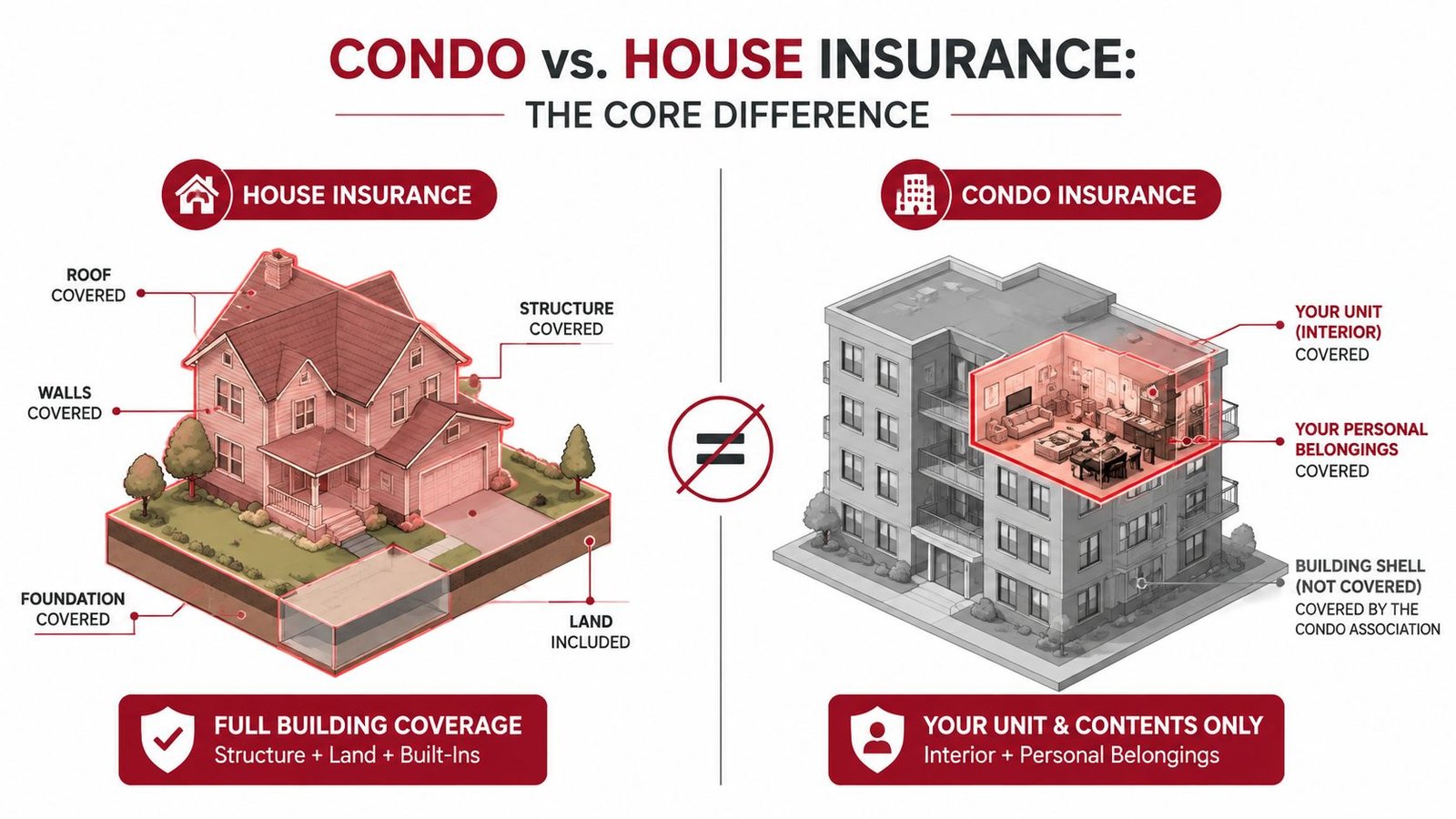
A detached-home policy usually follows one simple picture. One owner insures the land, foundation, roof, exterior walls, interior finishes, household belongings, and personal liability under one policy. The insurer evaluates the entire property as a single insured residence.
A condo reverses that arrangement. The corporation insures the shared building and common property, while the unit owner insures the private financial interests inside the unit. The owner's policy is therefore a top-up layer, not a miniature detached-home policy.
The shell belongs to the corporation
Alberta's condominium framework requires the corporation to maintain property insurance for units in the building at their full replacement value, subject to a reasonable deductible agreed by the board and insurer. That regulatory baseline defines the corporation's master-policy obligation, but it doesn't eliminate the unit owner's need for private insurance (Alberta condominium insurance resources).
The corporation's policy generally addresses the shared structure, common assets, and insured standard-unit elements. The unit-owner policy addresses the owner's personal property, improvements and betterments, liability, additional living expenses, and exposures connected to the individual suite.
Three consequences matter to landlords
- Structure limits differ: A condo owner usually doesn't insure the entire building's replacement value. The owner insures the interior items and improvements assigned to the owner by the corporation's documents.
- Contents limits follow actual assets: The right limit reflects the furniture, electronics, appliances, décor, and other property supplied by the landlord, not the value of the building.
- Liability follows the unit: Incidents originating in the suite, including water losses, can create obligations involving the unit owner even when the corporation handles the larger building claim.
A landlord should never assume that the corporation's insurance will replace upgraded flooring, custom cabinetry, supplied appliances, or lost rent. Those are separate questions answered by the SIUD, bylaws, lease arrangements, and the owner's policy wording.
What the Condo Corporation Covers and What You Cover
Alberta's Condominium Property Act and Condominium Property Regulation establish the corporation's obligation to maintain property insurance for the building and units at full replacement value, subject to the applicable deductible. The practical boundary still depends on the building's governing documents, especially the Standard Insurable Unit Description, or SIUD.
The Alberta government describes the SIUD as the document that explains what the corporation's insurance covers. It gives owners a defined reference point instead of forcing them to guess where the master policy ends and private coverage begins (Alberta SIUD and condominium insurance publications).
Read the SIUD before setting limits
A Calgary high-rise might identify standard flooring, paint, cabinetry, electrical fixtures, plumbing trim, and window coverings as standard insured unit elements. Another building's documents or bylaws may treat some finished features differently, particularly where an owner has replaced original materials with upgraded products.
That distinction affects a rental owner twice. First, it determines the amount of improvements and betterments coverage required. Second, it affects how a claim is adjusted when a tenant damages a finished feature that falls outside the corporation's standard baseline.
| Coverage Item | Corporation Policy | Unit Owner Policy |
|---|---|---|
| Shared structure and common property | Generally insured under the master policy | Not insured as a full building by the unit owner |
| Standard unit elements | Covered according to the corporation's insurance documents and SIUD | Owner must verify boundaries and insure any excluded elements |
| Personal belongings | Not intended to replace the owner's or tenant's private contents | Covers owner-supplied contents and eligible personal property |
| Improvements and betterments | May not cover non-standard owner upgrades | Covers qualifying upgrades excluded from the standard unit |
| Personal liability | Addresses corporation-level interests and policy terms | Protects the owner against covered unit-related liability |
| Additional living expenses or lost rent | Not the landlord's private rental-income protection | May cover tenant relocation costs or fair rental value, subject to wording |
| Deductible chargeback | Corporation may recover an applicable deductible from the owner | Requires suitable deductible or loss-assessment protection |
A landlord dealing with a disputed building claim may also need a public adjuster for condo owners who understands the interaction between a master policy, the SIUD, and the unit policy. Owners should also understand recurring ownership costs, including what strata fees cover, because fees and insurance are separate obligations.
The $50,000 Deductible Chargeback Alberta Owners Face
The most important Alberta-specific fact is straightforward. When damage originates in a unit or an exclusive possession area, the condominium corporation can recover its insurance deductible from the unit owner, and the owner's liability is capped at $50,000 (Alberta condominium insurance guidance).
The rule focuses on the origin of the damage, not solely on proven fault. A leak beginning at a washing-machine connection, dishwasher supply line, toilet, or other fixture can create a chargeback issue even where the owner didn't intend the loss. The corporation may recover the deductible without filing an insurance claim for the full loss, which makes the chargeback a direct financial exposure rather than an ordinary damages lawsuit (Alberta condo insurance governance explanation).
Worked scenario with a $30,000 deductible
A supply line fails in a rented unit and water damages three suites. The corporation's deductible is $30,000. If the loss originates in the landlord's unit, the corporation may recover the full deductible from that owner, subject to the governing documents and statutory limits.
The amount above the deductible may be handled through the corporation's master policy, but the landlord can still face separate costs for owner-supplied contents, excluded improvements, tenant relocation, lost rent, and any uninsured portion. The landlord's policy needs to address those categories independently.
Worked scenario with a $75,000 deductible
A fire begins in a rental unit where the corporation carries a $75,000 deductible. The owner's statutory exposure remains capped at $50,000, but that doesn't make the event affordable. The landlord may also have to fund damaged contents, temporary accommodation or relocation obligations, repairs to excluded improvements, and lost rental income where the policy doesn't respond.
| Scenario | Corporation Deductible | Damage Above Deductible | Chargeback to Unit Owner | Owner Out-of-Pocket |
|---|---|---|---|---|
| Supply-line leak damages three suites | $30,000 | Master-policy claim may address covered damage above the deductible | Up to $30,000 if the loss originates in the unit | Any uninsured contents, improvements, relocation, lost rent, or other excluded costs |
| Fire begins in rental unit | $75,000 | Master-policy claim may address covered damage above the deductible | Capped at $50,000 under Alberta's rule | Chargeback up to the cap, plus policy gaps and uncovered rental costs |
The two levers are clear: increased condo unit-owner deductible coverage and loss-assessment coverage. The landlord should compare those limits against the corporation's actual deductible, not rely on a generic default. A Calgary condo insurance resource can help owners frame the right questions before renewal.
The statutory cap doesn't guarantee complete protection. The corporation's bylaws, the SIUD, the cause of loss, and the policy wording still determine which costs fall where.
Key Endorsements That Close Common Coverage Gaps
A base condo policy often answers the basic questions, but rental owners need to test the unpleasant scenarios. The right endorsement isn't valuable because it sounds thorough. It's valuable because it responds to a specific bill that the base policy leaves behind.
Start with the building's deductible
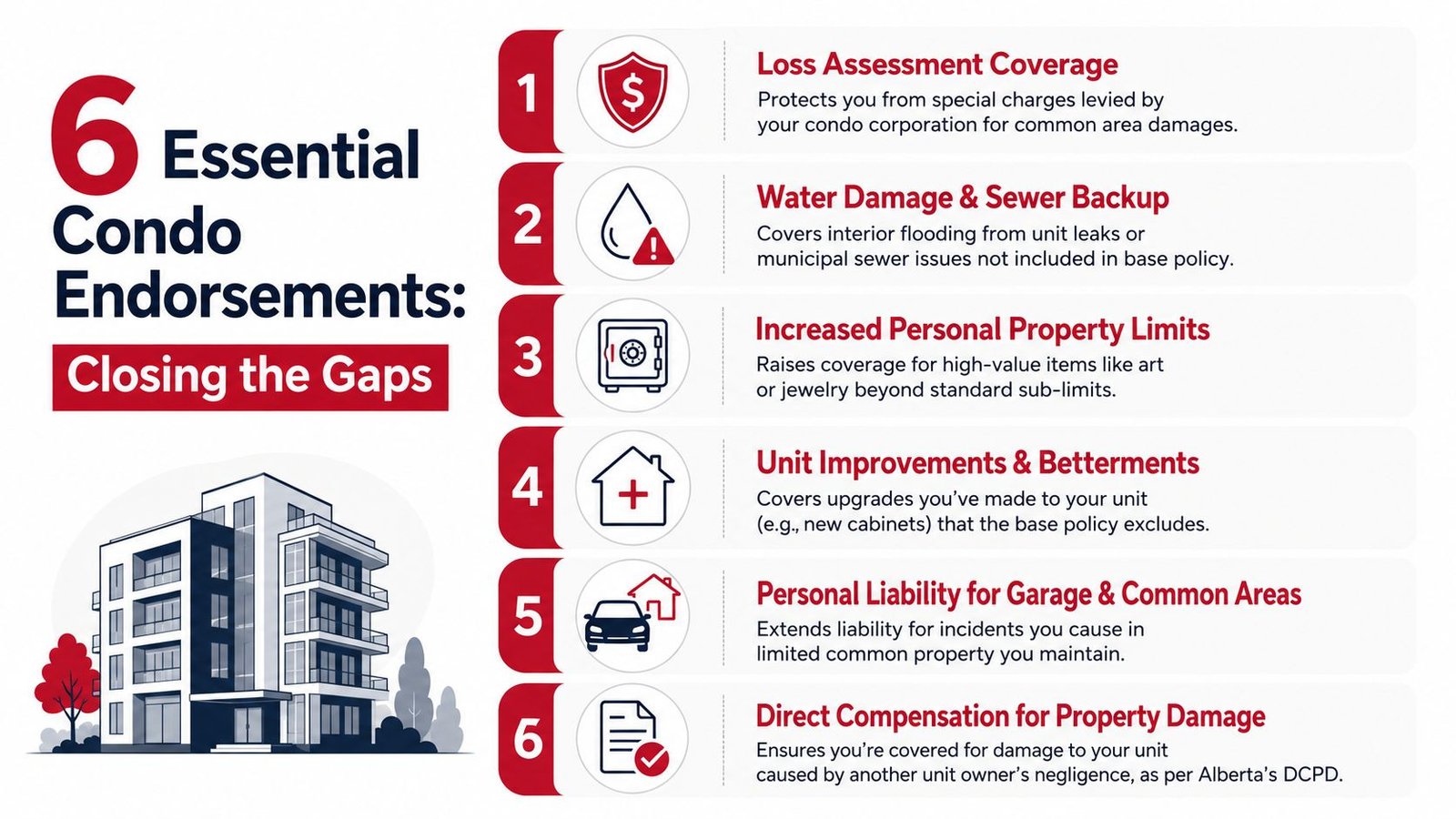
Loss assessment coverage can respond to eligible charges imposed on the owner after a covered corporation loss. The landlord should ask whether the endorsement covers the corporation's deductible, shared damage assessments, or both, and whether the wording applies when the loss originates in the insured unit.
Water damage and sewer backup coverage deserves separate attention. A condo water event can affect more than one suite, so a modest limit may disappear quickly. Owners comparing sewer backup coverage options should confirm exclusions, deductibles, limits, and whether the policy distinguishes sudden escape of water from backup through drains or sewers.
Match the policy to rental operations
- Landlord or rental-use coverage: Confirms that the insurer knows tenants occupy the unit and addresses rental-related assumptions.
- Improvements and betterments: Protects non-standard flooring, cabinets, fixtures, built-ins, and other owner-funded upgrades outside the corporation's baseline.
- Additional living expenses and fair rental value: Separates the tenant's accommodation needs from the landlord's lost rental income during covered repairs.
- Bylaw or ordinance coverage: Helps with increased reconstruction costs required by post-loss building rules. Alberta guidance includes a $15,000 minimum for the relevant bylaw coverage requirement in the circumstances described by the applicable policy framework, so the broker should verify the wording and limit rather than assume it is sufficient.
- Liability for tenant and common-area incidents: Addresses injuries, property damage, and incidents connected to the rental operation that the corporation's policy may not cover for the individual owner.
- Increased contents limits: Protects owner-supplied appliances, furniture, electronics, and other rental contents that standard sub-limits may restrict.
The corporation's certificate of insurance and bylaws should be reviewed before limits are selected. A large contents limit won't solve a deductible chargeback, and generous liability coverage won't replace a missing fair-rental-value endorsement.
Standard Owner Policy Versus Landlord-Focused Coverage
A standard unit-owner policy is designed around a person living in the condo. A landlord-focused policy starts with a different question, whether the owner's financial interest remains protected while another household occupies the suite.
Consider a tenant-occupied two-bedroom condo in Mount Pleasant or Evanston. The building may be properly insured, but the owner still needs protection for supplied appliances, tenant-related liability, rental income, and the unit's non-standard finishes. A resident-owner policy can describe the risk inaccurately from the first day of the lease.
| Feature | Standard Unit Owner Policy | Landlord-Focused Condo Policy |
|---|---|---|
| Named insured | Resident owner | Owner or rental entity with the correct financial interest |
| Occupancy | Owner-occupied | Tenant-occupied rental unit |
| Tenant-caused loss | May contain restrictions or incorrect occupancy assumptions | Underwritten for rental use and tenant-related events |
| Lost rent | Often not the central exposure | Fair rental value or rental-income protection may be available |
| Tenant injury liability | Personal residence framing | Landlord liability framing coordinated with the rental operation |
| Improvements | Based on the owner's private finishes | Matched to the SIUD, upgrades, and betterments |
| Deductible chargeback | May be limited or require an endorsement | Deliberately matched to the corporation's exposure |
| Contents | Resident's belongings | Owner-supplied appliances, furniture, and other rental contents |
The landlord should disclose the lease arrangement, property manager involvement, tenant turnover, and any furnished contents. The right policy may cost more than a resident policy, but the comparison must be made against claim suitability, not premium alone. A cheap policy that excludes the actual rental use isn't economical.
Choosing the Right Condo Homeowners Insurance in Alberta
The buying process should begin with documents, not quotes. The landlord should request the latest Standard Insurable Unit Description and the corporation's insurance summary from the condominium manager or board. The SIUD identifies what the corporation's policy covers, while the insurance documents reveal the master-policy deductible and the boundaries that shape the unit policy (Alberta SIUD guidance).
Use this landlord checklist
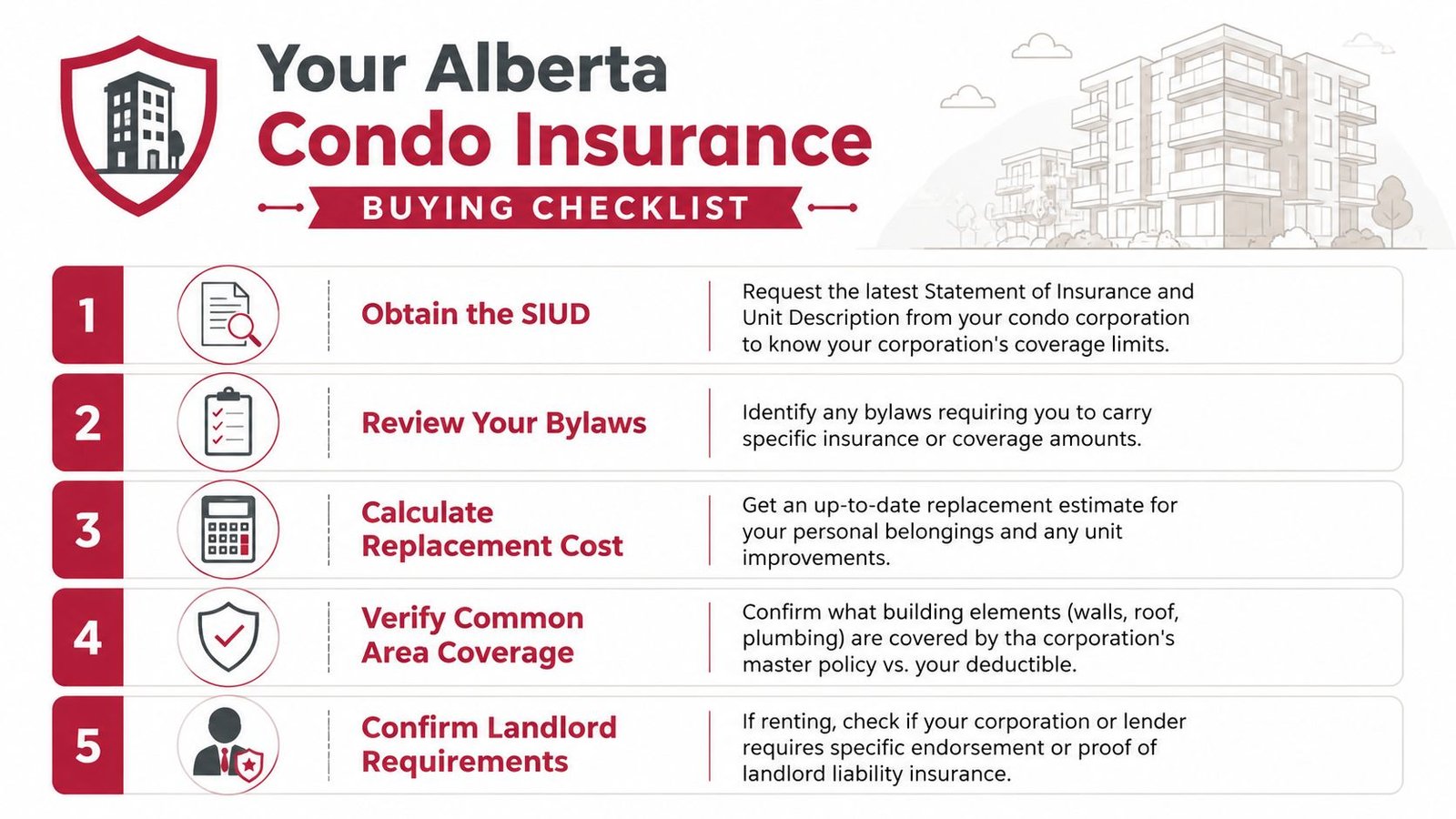
- Obtain the SIUD: Mark every item the corporation treats as standard, including flooring, cabinetry, paint, fixtures, plumbing trim, and window coverings.
- Review the bylaws: Look for chargeback provisions, insurance obligations, exclusive possession areas, rental restrictions, and requirements affecting tenants.
- Inventory owner property: List supplied appliances, furniture, electronics, décor, and maintenance equipment. Contents coverage should reflect replacement needs, not the apparent size of the suite.
- Choose valuation carefully: Ask whether contents and betterments are settled on replacement cost or actual cash value. Depreciation can materially change a claim payment.
- Match deductible protection: Compare the policy's deductible chargeback and loss-assessment limits with the corporation's master deductible. Alberta owners should benchmark protection to the statutory exposure of $50,000 where the building's risk requires it (Alberta deductible chargeback guidance).
- Test water coverage: Confirm escape-of-water, sewer-backup, and related deductibles and limits. Don't assume an above-grade suite has no water exposure.
- Quote the correct occupancy: Have the broker quote the unit as tenant-occupied and identify any furnished or short-term rental arrangements accurately.
- Coordinate the claims process: Ensure the landlord, property manager, tenant, corporation, and insurer know who reports the loss and who documents the damage.
A broker should compare more than the premium. The quote should be tested against the SIUD, corporation deductible, rental use, owner contents, improvements, liability, fair rental value, and water-loss wording. Owners should obtain options from insurers licensed in Alberta and include a specialist familiar with multi-unit rentals.
Mistakes to Avoid and Next Steps for Calgary Owners
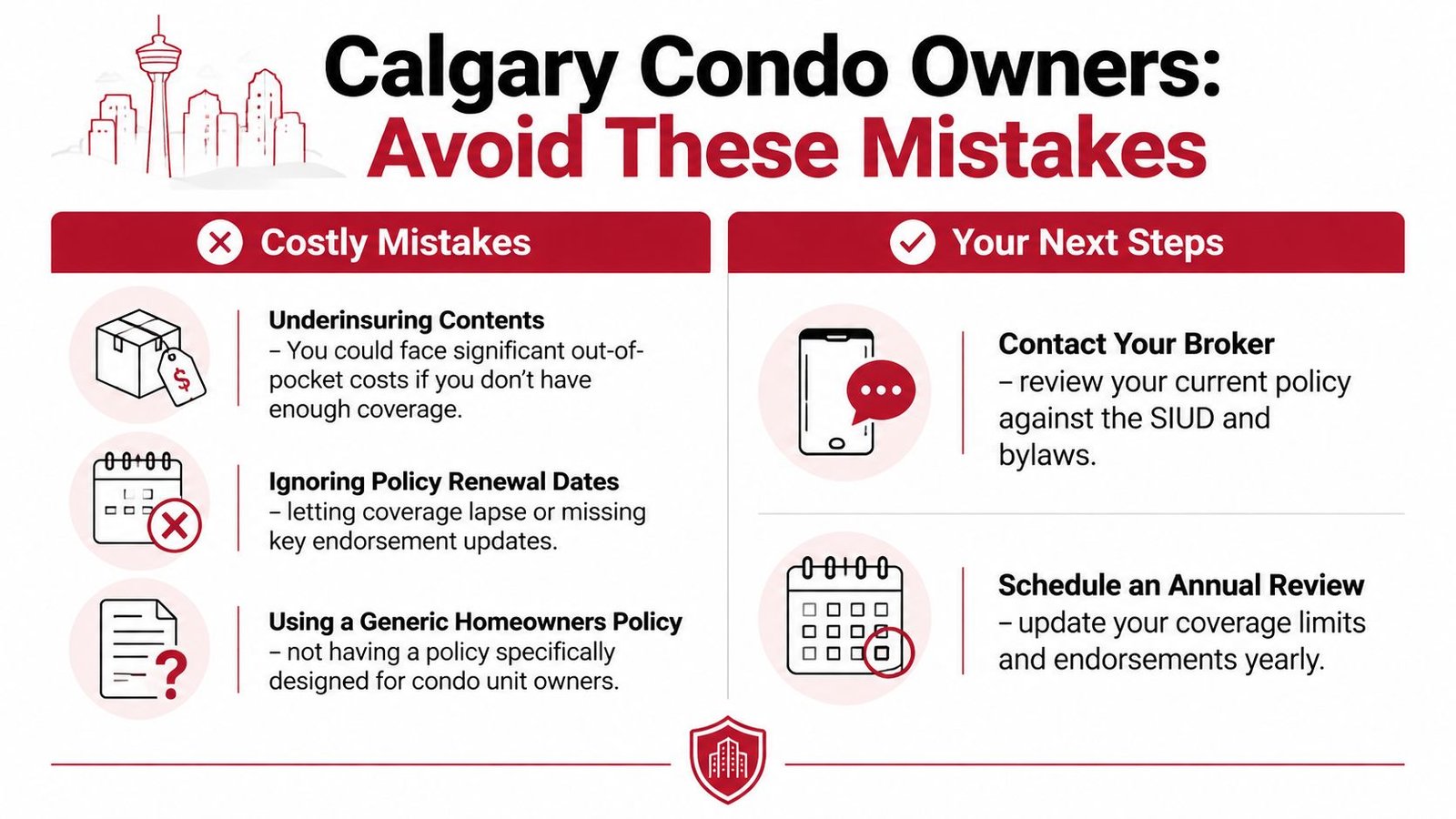
The most expensive errors usually happen before the first claim. A landlord underestimates the value of supplied contents, ignores the corporation's deductible, or assumes the tenant's renter's insurance will protect the investment. It won't replace the landlord's improvements, lost rent, or deductible chargeback exposure.
A tenant's policy may protect the tenant's belongings and personal liability, depending on its wording. It doesn't turn the landlord into an insured, and it doesn't replace the owner's need for landlord-focused condo homeowners insurance.
Avoid these decisions
- Underinsuring contents: A small suite can contain costly appliances, electronics, furniture, and fixtures supplied by the owner.
- Ignoring the corporation deductible: Alberta's chargeback mechanism can expose the owner to $50,000 when damage originates in the unit or an exclusive possession area (Alberta government condominium information).
- Naming the wrong insured: The owner, corporation, or holding entity must be identified correctly. Naming only the tenant leaves the landlord's financial interest exposed.
- Skipping sewer backup: Building height doesn't eliminate risks from internal plumbing, shared systems, or drainage events.
- Using a generic homeowners policy: A resident-owner form may not reflect tenant occupancy, rental income, or landlord liability.
- Letting coverage drift: Renewals should account for new flooring, appliances, renovations, changes to the corporation deductible, and revised bylaws.
Owners who rent in Alberta also need a clear operating process for inspections, repairs, notices, and tenant communication. A practical reference on Alberta landlord and tenancy responsibilities can support that operating side, but it doesn't replace insurance advice or a review of the corporation's documents.
Calgary landlords should request a condo insurance review before renewal, not after a loss. The review should pull the SIUD, identify the corporation deductible, model the chargeback exposure, verify rental occupancy, and compare landlord-focused coverage with insurers licensed in Alberta.
Dreamhouse Realty Ltd. offers Calgary, Edmonton, Red Deer, and surrounding Alberta owners tenant placement, inspections, maintenance coordination, rent collection, compliance support, and structured owner reporting that help connect insurance planning with daily rental operations. Visit Dreamhouse Realty Ltd. to arrange property management support and discuss how the rental asset's insurance, tenant, and maintenance processes can work together.