

A first-time buyer in Calgary can spend a weekend comparing two similar listings and still feel stuck. One property looks safer on paper, the other looks easier to finance, and both seem just expensive enough to make the numbers feel fragile. That's the stress point for a First Time Rental Property Buyer in Alberta, because the first deal is less about finding a place and more about proving the property can survive rent shortfalls, repairs, tenancy rules, and an owner's learning curve.
The market backdrop makes that harder. Alberta landlords are underwriting against a rental system where prices and rents have stayed high, while the province's rental supply remains tight in key cities, so the margin for error is slimmer than it used to be. The smart response is not to hunt harder. It's to test the deal like a small business, then decide whether the right answer is self-management or a licensed Calgary property manager.
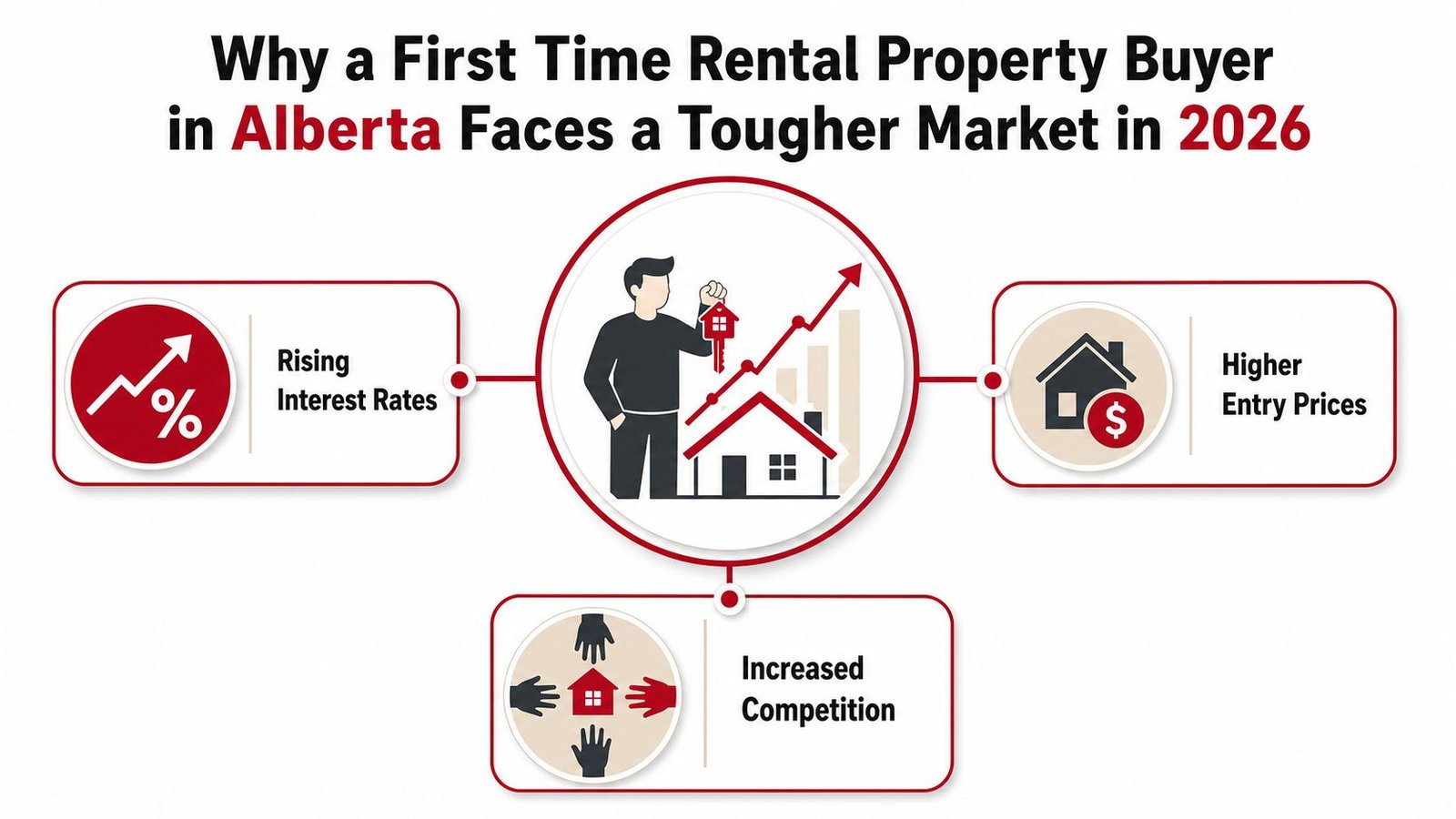
Why a First Time Rental Property Buyer in Alberta Faces a Tougher Market in 2026
A nervous buyer often starts with the wrong question. Instead of asking whether one Calgary listing “feels” better than another, the better question is whether either one can survive a bad month, a delayed tenant, or a surprise repair without blowing up the owner's budget. That's why the first purchase should be treated like the launch of a small operating business, not a personal home with rent on the side.
The four decisions that really matter
The first decision is deal math, because a rental can look fine on a mortgage calculator and still fail once operating costs are included. The second is financing, because lenders now care about structure, reserves, and income support much more than optimistic assumptions. The third is Alberta tenancy compliance, because a strong file and a weak file can look identical on the day the tenant moves in, then behave very differently in a dispute. The fourth is management, because self-managing and hiring a professional solve different problems and create different risks.
Practical rule: if a property only works when everything goes right, it doesn't work.
That idea matters in Calgary and Edmonton, where high prices and active rental demand can tempt buyers into stretching just to win a listing. But a stretched purchase is not the same thing as a strong rental. It only takes one vacancy, one notice mistake, or one major repair to expose a deal that never had enough cushion.
A first-time buyer also needs to remember that the rental market is not a side quest. Alberta's tenant pool is large enough that small shifts in affordability, vacancy, or borrowing costs can change cash flow quickly. For a new owner, that means the deal has to be survivable before it can be exciting.
A useful starting point is to compare the property against the tenant experience too, not just the purchase price. A landlord who is trying to understand likely tenant expectations in Calgary should review the realities of turnover, responsiveness, and move-in readiness in tenant expectations in Calgary. The point is simple, the property has to work for both the lender and the renter.
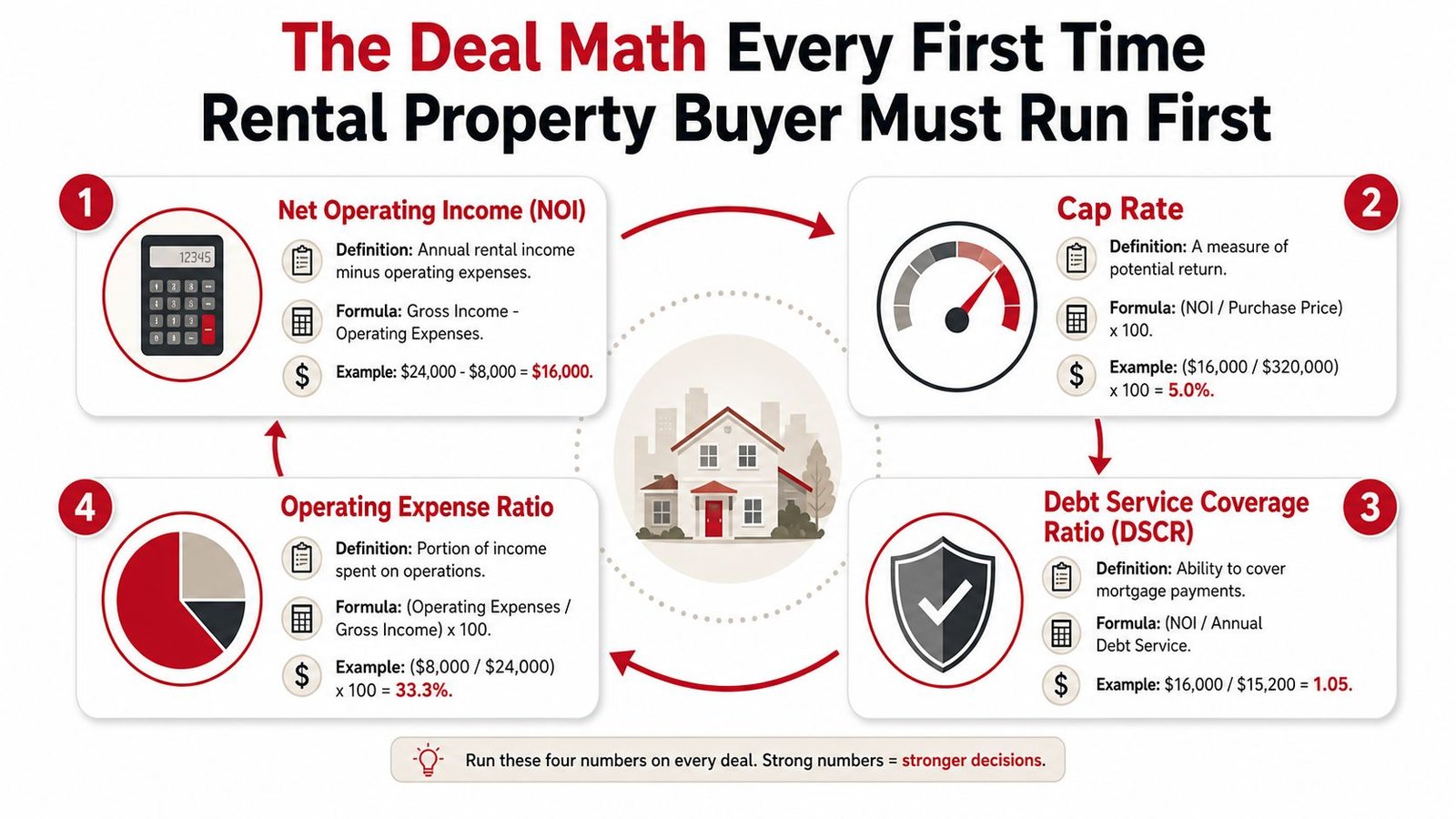
The Deal Math Every First Time Rental Property Buyer Must Run First
The cleanest way to avoid a bad first deal is to reduce it to four numbers. If those numbers don't work, the property doesn't work, no matter how nice the kitchen looks. A spreadsheet is boring, but it's cheaper than learning about bad math after possession day.
Start with NOI before anything else
Net operating income, or NOI, is the money left after operating expenses but before debt. In plain language, it shows what the property produces before the mortgage is paid. The basic formula is gross rental income minus operating expenses.
Here's a simple illustration: if a property collects $24,000 in annual rent and spends $8,000 on operating costs, NOI is $16,000. That's the figure a buyer should carry into the rest of the analysis, because it tells the owner whether the asset itself is healthy.
Cap rate and DSCR tell different stories
Cap rate measures potential return relative to purchase price, and the formula is NOI divided by purchase price, multiplied by 100. Using the same example, $16,000 divided by $320,000 equals 5.0%. That doesn't mean the deal is good or bad on its own, it just shows how hard the property works before financing.
DSCR, or debt service coverage ratio, shows whether the property can cover its debt. The formula is NOI divided by annual debt service. In the example, $16,000 divided by $15,200 equals 1.05. That looks barely positive, but it also tells a cautious buyer there is very little room for vacancy, repairs, or slower rent collection.
A property can feel affordable and still be fragile.
That's where the operating expense ratio helps. It shows how much of gross income disappears into operations. The formula is operating expenses divided by gross income, multiplied by 100. In the example, $8,000 divided by $24,000 equals 33.3%. A buyer who only looks at the mortgage payment misses that number completely.
For a Calgary first-time buyer, two similar properties can behave very differently. One condo may have lower monthly carrying costs but higher fees and weaker DSCR. Another may look pricier upfront but carry better rent and healthier margins. A buyer comparing both should model the numbers carefully before writing an offer, using tools like investment property listings and analysis support.
A quick checklist before the offer
- Gross rent: use realistic rent, not the highest hoped-for number.
- Operating expenses: include taxes, insurance, repairs, vacancy, and management.
- NOI: calculate it before thinking about the mortgage.
- DSCR: test whether the property can carry its own debt.
- Cap rate: compare the return against the price being paid.
If the deal only works with perfect occupancy and no repairs, it's too thin for a first purchase.
Financing Reality After Canada's Mortgage Rule Tightening
Financing usually becomes the gatekeeper for the first rental, not deal hunting. A buyer can find a decent property and still get stopped by lender rules, reserve expectations, or a file that only works if every assumption is generous. The easiest way through is to think in two layers, the property has to work, and the borrower has to look stable enough for the lender.
Why two qualifying numbers matter
Lenders tend to look at both the property and the borrower, even when the rental income is central to the decision. That means the buyer's own income picture still matters, but so does the rent the property can reasonably produce. The practical point is that one strong number doesn't rescue a weak one.
A first-time investor should also expect to show liquidity. Industry guidance commonly treats 3 to 6 months of payments as the kind of reserve cushion that helps absorb repairs, turnover, and arrears without forcing a rushed sale, and conservative buying matters even more when the local market is tight. That reserve isn't a luxury. It's part of the file.
Compare the usual financing paths
| Path | Typical Minimum Down | Lender Treatment of Rent | Reserve Expectation | Best Fit For |
|---|---|---|---|---|
| Conventional rental mortgage | Higher than owner-occupied financing | Partial rental income support, lender dependent | Liquidity buffer expected | Buyers with clean documentation and stable income |
| HELOC on a primary residence | Depends on available home equity | Rent still needs to support the deal | Strong personal liquidity still matters | Owners who have usable equity and can tolerate added risk |
| Partner or partner-financing structure | Depends on the agreement | Depends on how the lender underwrites the file | Usually higher caution from everyone involved | Buyers who need shared capital or shared risk |
The table matters because a first purchase is rarely just about the rate. It's about which structure gets the deal closed without forcing the owner into a brittle monthly budget. A HELOC can create flexibility, but it also puts a primary residence at risk. Partner financing can enable a purchase, but the legal and relationship terms need to be clear before any money moves.
Reserve rule: if the accounts are empty after closing, the purchase was too aggressive.
That's the part many beginners miss. A lender approval is not the same as a comfortable rental business. The buyer still needs money left over for a hot water tank, a lease-up delay, or a repair that arrives at the wrong time.
Choosing the Right Property Type and Calgary Neighbourhood
A first rental buyer often falls in love with the wrong feature, like a renovated kitchen or a pretty balcony, and forgets that tenants pay for function, location, and predictability. Product type and neighbourhood shape who rents there, how long they stay, and what the owner has to spend to keep the place rentable. The house that looks best on a tour isn't always the one that produces the cleanest return.
Match the unit to the renter, not your taste
A single-family home can appeal to families who want stability, but it usually demands more capital and more upkeep. A condo can be easier to buy, yet condo fees, bylaws, and special-assessment risk can change the economics quickly. A townhome sits somewhere in the middle, while a small multifamily property can spread vacancy risk across more than one unit.
A Calgary example makes the trade-off clearer. A two-bedroom condo in a commuter-friendly area may attract mobile tenants who value transit access and lower maintenance, but the owner has to absorb fees and follow building rules. A detached house in a family-oriented pocket may command a different tenant profile, but the owner also takes on lawn care, exterior maintenance, and a larger repair surface.
Neighbourhood choice changes the cash flow
The right neighbourhood depends on the renter pool, not on the buyer's personal preference. A street near commuting routes, schools, or service employment can produce different turnover patterns than a quieter family area. That affects vacancy risk, the cost of tenant changeovers, and how often the owner needs to market the unit again.
Buyers should also model at least two property types before they make an offer. One may look slightly better on paper, but the operating expense load can be very different once condo fees or maintenance are added. The point is to compare the business case, not just the listing photos.
- Model the rent: use a realistic tenant profile for the neighbourhood.
- Model the costs: include the expenses that belong to the property type.
- Model the exit: think about who would buy or rent it later.
- Avoid personal bias: a buyer's favourite layout doesn't pay the mortgage.
A property that fits the local tenant base is easier to hold through year one. A mismatch creates churn, and churn eats margin.
Self-Manage Versus Hiring a Licensed Calgary Property Manager
The management decision looks simple from a distance. Keep the fee and do it yourself, or pay a professional and hand over the workflow. In practice, the better choice depends on time, tolerance for stress, and how well the owner can keep files compliant under Alberta rules.
Self-management saves money, until it doesn't
Self-management keeps control in the owner's hands and avoids the management fee. That's the obvious upside. The less obvious cost is the owner's time, because the phone doesn't only ring during business hours, and vacancies don't wait for a convenient weekend.
Self-managing also means the owner has to learn leasing, screening, notices, inspections, and arrears handling from scratch. A missed notice or a sloppy condition report can create a dispute that costs far more than the savings on fees. That risk is easy to underestimate when the place is still empty and tidy.
What a licensed manager changes
A licensed Calgary property manager can turn those moving parts into one workflow. That typically includes tenant screening, lease drafting, rent collection, move-in and move-out inspections, maintenance coordination, and compliance tracking. It also creates a paper trail, which matters when a landlord needs to defend a decision later.
One option in Calgary is Dreamhouse Realty Ltd., which provides rental management and tenant placement for Alberta landlords. It fits buyers who want a licensed team to handle the operational side while they focus on acquisition and holding.
| Criteria | Self-Management | Hiring a Licensed Manager |
|---|---|---|
| Monthly cost | Lower cash outlay | Management fee applies |
| Time commitment | High | Lower for the owner |
| Compliance risk | Higher if the owner is inexperienced | Lower if the workflow is strong |
| Net return | Can improve if the owner executes well | Can improve if turnover and mistakes are reduced |
The right answer isn't the same for every first-time buyer. Someone living next door with a flexible schedule may be fine managing a simple condo. A busy investor, an out-of-town owner, or a buyer with a more complex property often gets more value from structured support.
For buyers comparing providers, the Calgary property manager selection guide is a practical starting point. The main question isn't whether management costs money. It's whether the owner's time and compliance risk cost more.
Alberta Tenancy Rules and First-Year Compliance Essentials
A rental can be profitable and still become a headache if the paperwork is loose. Alberta tenancy compliance is not busywork. It is the framework that decides whether the owner can prove what happened, when it happened, and what was agreed. That matters more in year one, when the file is still being built.
The notice and record-keeping habits that matter
Alberta's provincial tenancy guidance says a landlord must give at least 365 days' written notice for a fixed-term tenancy that is renewed or converted to periodic if the tenancy is not continuing on the same basis. That rule is easy to ignore at the start and expensive to discover later. A landlord who leaves notices to memory is building risk into the file from day one.
Security-deposit handling, move-in inspections, and move-out inspections should also be documented carefully. Photos, signed condition reports, and dated communication records create a paper trail that can support the owner if there's a disagreement over damage or deductions. The owner who keeps tidy records has a much better chance of defending a claim.
Why the management choice affects compliance
A licensed manager typically builds those steps into the process. Notices are drafted from the right template, inspections are scheduled, and documents are stored in a system that the owner can review later. A self-managing owner can do all of that too, but only if the system is created before problems start.
Clean files settle arguments faster.
That's the key lesson here. The first-year goal is not just rent collection. It's creating a defensible record that shows the landlord acted consistently and followed the Alberta framework.
A practical habit is to keep every critical document in one place, including the lease, screening notes, inspection photos, deposit records, and all notices. When something goes wrong, the owner shouldn't have to reconstruct the story from memory. The file should already tell it.
Your 12-Month First-Rental Action Plan and Getting Started
A first rental works better when the owner treats the first year like a sequence of checkpoints instead of one big closing-day event. Each checkpoint reduces uncertainty, and each one makes the next decision easier. That's especially true for a first-time buyer who is still learning how the lender, the tenant, and the property all interact.
A practical 12-month timeline
- Before the offer, run the numbers on NOI, cap rate, and DSCR, then compare at least two property types.
- Before closing, confirm the financing path, reserve cash, and the management plan.
- During possession week, complete the move-in inspection, set up rent collection, and organise the file.
- In the first 30 days, focus on tenant placement, lease execution, and clear communication.
- By the first quarterly inspection, check the property condition and document any repairs early.
- At mid-year, review reserves, rent collection, and turnover risk.
- At month 12, review the renewal rules, the file, and whether the property still fits the owner's portfolio.
That sequence keeps the owner from reacting too late. A rental is easier to steer when the paperwork, the cash cushion, and the property condition are reviewed on purpose, not after a problem surfaces.
The best first-year outcomes usually come from honest decisions made at the start. If the numbers were thin, the financing was stretched, the property type was mismatched, or the management plan was vague, the year will feel harder than it should. If those four decisions were sound, the owner has a real chance to hold the property with less stress.
A buyer who wants help with pricing, demand, and timelines in Calgary, Edmonton, or Red Deer can use a licensed Alberta team instead of guessing alone. For a rental consultation, contact GURIQBAL CHAHAL, MBA, PMP, REAL ESTATE BROKER, Phone 403-966-6072.
Dreamhouse Realty Ltd. helps Alberta landlords with rental pricing, tenant placement, inspections, compliance, and day-to-day property management. If a first rental is close to becoming a real deal, Dreamhouse Realty Ltd. can help a buyer sanity-check the numbers, understand the local demand, and hand off the operational work before year one gets messy.