

For a typical Calgary rental, owners should expect recurring management fees between 8% and 12% of monthly rent collected, plus placement fees of 25% to 100% of one month's rent. Vacancy and maintenance reserves are equally important parts of the total cost picture.
A landlord can receive a management proposal that looks affordable, then discover that leasing, inspections, maintenance coordination, vacancy, and compliance administration sit outside the headline percentage. A Calgary owner with a rental home, condo, townhome, or small multifamily property needs an operating model that shows what the property earns, what management handles, and where additional costs can arise.
The practical question isn't only, “What percentage does the manager charge?” It's, “What will this property cost to operate when the unit turns over, a repair is needed, or a statutory deadline matters?”
Table of Contents
- Understanding Rental Property Management Cost in Alberta
- How Property Management Fee Structures Work
- What Drives Your Management Cost Higher or Lower
- Sample Annual Management Cost Scenarios for Alberta Properties
- Why Management Cost Should Be Judged Against Vacancy and Risk
- How to Evaluate Property Managers and Compare Real Value
- Making a Confident Decision About Property Management
Understanding Rental Property Management Cost in Alberta
A Calgary landlord reviewing a spreadsheet may see rent collected, mortgage payments, insurance, and a proposed management fee. The initial percentage can appear straightforward until a tenant leaves. The owner may then face advertising, showings, screening, inspection documentation, cleaning, repairs, lease preparation, and lost rent before the next tenant moves in.
That is why rental property management cost should be treated as a complete operating picture rather than a single line item. The recurring fee generally covers work such as rent collection, tenant communication, maintenance coordination, owner reporting, and routine oversight, but agreements differ in how they treat leasing, renewals, inspections, emergency attendance, and vendor coordination. Calgary fee structures may also separate placement charges from monthly management, as outlined in this Alberta property management service overview.

The headline fee is only the first layer
A useful proposal should distinguish predictable charges from costs triggered by an event. Predictable charges may include recurring management and owner reporting. Event-based costs may include tenant placement, lease renewal administration, inspection attendance, advertising, maintenance coordination, emergency response, or dispute-related work.
The difference matters because a lower monthly percentage can come with more add-ons. A higher percentage may include work another company bills separately. Neither structure is automatically better. The comparison only becomes meaningful when each manager provides an itemised schedule and explains when every charge applies.
Practical rule: Compare the estimated annual cost of managing the property, not the percentage printed at the top of the proposal.
The sections that follow examine fee structures, market and property factors, sample annual budgets, vacancy risk, compliance work, and the questions owners should ask before signing. The aim is simple: give Calgary and other Alberta landlords a way to compare management value without mistaking a low advertised rate for a low total cost.
How Property Management Fee Structures Work
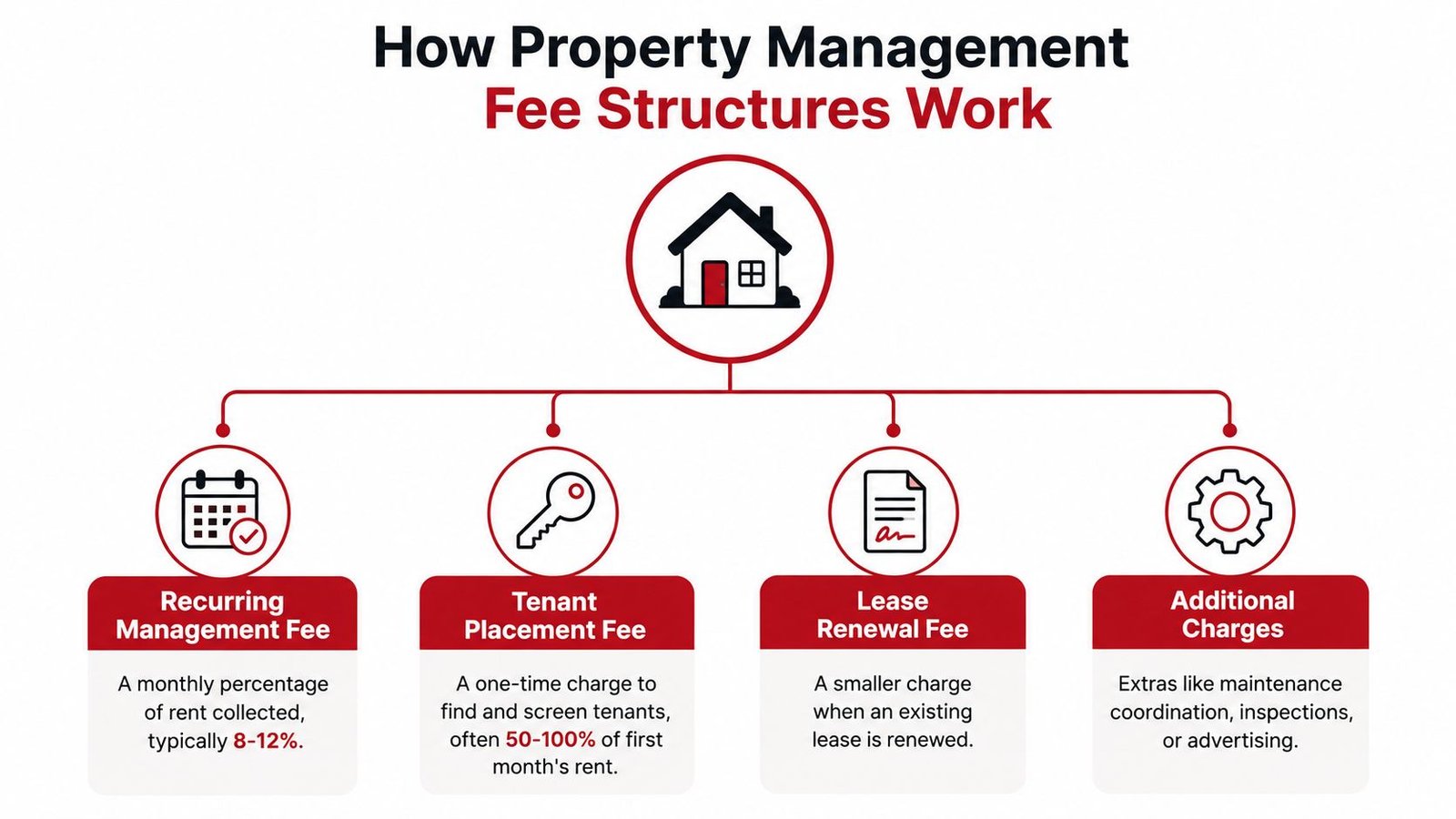
Property management proposals usually combine recurring fees with charges that occur when a property is leased, renewed, inspected, or repaired. A landlord should read the proposal as an operating contract, not as a rate card.
Recurring management and leasing charges
The recurring management fee is generally calculated as a percentage of rent collected. For a Calgary property renting at CAD 2,000 per month, the commonly quoted 8% to 12% range produces a base management expense of CAD 160 to CAD 240 monthly, or CAD 1,920 to CAD 2,880 annually, before taxes and additional services. A 10% fee equals CAD 200 monthly and CAD 2,400 annually, according to this Calgary property management fee guide.
Tenant placement is separate in many agreements. Reported Alberta fee guides cite 25% to 50% of one month's rent, while some Calgary market summaries cite 50% to 100% of the first month's rent. On a CAD 2,000 rental, that creates a possible placement charge from approximately CAD 500 to CAD 2,000, depending on the agreement and service scope.
A landlord should ask whether the placement fee includes listing preparation, photography, showings, application processing, screening, lease execution, and move-in documentation. The answer affects the true cost of filling a vacancy.
Renewals, inspections, and maintenance
Renewal fees vary by company. Some managers include renewal administration in the recurring fee, while others charge when they prepare a market review, communicate with the tenant, and execute renewal documents. The proposal should state whether a renewal charge applies even when the tenant stays and no physical turnover occurs.
Inspection charges deserve similar scrutiny. Move-in and move-out condition reports create an important record of the property's condition. Periodic inspections may also help an owner identify maintenance issues before they become more disruptive, particularly when the owner lives outside Alberta.
Maintenance coordination can be included, charged as a separate administrative fee, or connected to vendor pricing. The manager should explain who approves work, whether invoices are passed through at cost, how emergency work is handled, and whether any vendor relationship affects the owner's choice.
How charges stack up
A property can incur recurring management throughout the year, then generate placement costs when a tenant leaves. GST also changes the cash amount paid. Alberta services are generally subject to 5% GST, so a CAD 2,400 annual management fee becomes CAD 2,520 including GST, excluding separate leasing or maintenance charges.
The strongest proposals show:
- Included services: Rent collection, tenant communication, reporting, inspections, or maintenance coordination covered by the base fee.
- Triggered charges: Placement, renewal, emergency attendance, advertising, or dispute administration billed only when the event occurs.
- Pass-through costs: Vendor invoices, advertising costs, or repairs charged to the owner with clear documentation.
- Approval rules: The dollar threshold or circumstances under which the manager can authorise work without prior approval.
Two managers can quote the same percentage and deliver very different financial results. An itemised proposal, such as the one a landlord may review alongside this tenant placement fee explanation, makes the comparison far more useful than a headline rate.
What Drives Your Management Cost Higher or Lower
The same management percentage doesn't create the same financial result for every Alberta property. A detached home in Calgary, a condominium with strict building procedures, and a duplex owned by someone outside the province may require different levels of coordination even when their monthly rents are similar.
Vacancy changes the calculation
Calgary's rental conditions have shifted. Search results citing CMHC survey data report that purpose-built rental vacancy rose from approximately 1.4% in 2023 to 5.0% in 2025, with a forecast of about 5.7% for 2026 in this Calgary rental market reporting. For a CAD 2,000 monthly rental, a 5.0% vacancy allowance represents CAD 1,200 of annual revenue exposure, while 5.7% represents CAD 1,368.
Those figures aren't a reason to accept every proposed fee. They show why leasing speed, realistic pricing, applicant screening, and tenant retention belong in the cost discussion. A manager who prices a property too high may produce a flattering rent estimate and a longer vacancy. A manager who prices accurately may protect effective income even if the advertised rent looks less ambitious.
Property characteristics affect service intensity
Older homes often need more vendor coordination and closer follow-up. Condominiums may require communication with building management, access arrangements, and compliance with building procedures. Small multifamily properties can involve multiple occupants, shared systems, and more complicated turnover scheduling.
Owner location matters as well. A local landlord may attend a showing, meet a contractor, or inspect a repair personally. An owner outside Alberta may need the manager to arrange everything from emergency access to photographic documentation. Local maintenance guidance, including Northpoint Construction maintenance services, can help an owner understand the difference between routine upkeep and larger property-condition work.
Rent level and property type matter
Calgary market summaries report vacancy differences by rent segment, with the highest-rent quartile at 6.7% compared with 4.4% for the lowest-rent quartile. City reporting also identified year-over-year rent movement of 16.5% for detached rentals, while multi-residential rents fell 9.6% and other units fell 8.0%. These figures appear in the CMHC rental market reports for major centres.
The practical conclusion is that a generic fee assumption can't capture rent-setting risk. The right comparison considers property type, likely turnover, condition, location, owner distance, and the manager's process for responding when demand changes.
Sample Annual Management Cost Scenarios for Alberta Properties
A workable budget separates scheduled rent from collected rent, vacancy, management, maintenance, leasing, GST, and capital work. The following models use a CAD 2,000 monthly rental as the single-unit example. They apply the recurring management and reserve assumptions described in the Calgary rental property operating model. The totals are planning illustrations, not quotations for a particular property.
For the single-family and condominium examples, the model uses CAD 24,000 gross scheduled annual rent, a 5% vacancy allowance, 10% management, and maintenance reserves within the cited 5% to 10% of gross rent range. The duplex illustration treats two comparable units as CAD 48,000 gross scheduled annual rent, using the same vacancy and maintenance approach. Leasing charges, capital replacements, taxes, insurance, utilities, and mortgage payments remain outside these operating totals.
| Property Type | Gross Scheduled Rent | Vacancy Reserve | Management Fee | Maintenance Reserve | Estimated Annual Total |
|---|---|---|---|---|---|
| Single-family home | CAD 24,000 | CAD 1,200 | CAD 2,400 | CAD 1,200 to CAD 2,400 | CAD 4,800 to CAD 6,000 before GST and leasing |
| Condominium | CAD 24,000 | CAD 1,200 | CAD 2,400 | CAD 1,200 to CAD 2,400 | CAD 4,800 to CAD 6,000 before GST and leasing |
| Small multifamily or duplex property | CAD 48,000 | CAD 2,400 | CAD 4,800 | CAD 2,400 to CAD 4,800 | CAD 9,600 to CAD 12,000 before GST and leasing |
Reading the scenarios correctly
The single-family and condominium rows share the same rent assumption, but they don't imply identical real-world costs. A condo may have building access procedures or bylaw-related coordination. A detached home may place more responsibility on the manager for exterior issues, trades, and emergency attendance.
The duplex model scales scheduled rent and reserves for two comparable units, but turnover won't necessarily occur evenly. One vacant unit can affect cash flow while the other continues producing rent. Shared systems can also create maintenance decisions that don't arise in a standalone condominium.
GST adds to the management charge. On a CAD 2,400 annual management fee, the total becomes CAD 2,520 including GST, before separate placement, renewal, inspection, or maintenance charges. A placement charge on a CAD 2,000 unit may range from CAD 500 to CAD 2,000, so the annual budget should show leasing as a separate turnover line rather than hiding it inside a monthly average.
Budgeting principle: Keep vacancy, maintenance, leasing turnover, and capital expenditures visible. A single blended percentage makes it difficult to see which assumption changed the result.
Older homes, remote ownership, and properties with more frequent turnover should be stress-tested separately. The owner should also distinguish operating repairs from capital replacements, because a recurring reserve won't predict every major replacement.
Why Management Cost Should Be Judged Against Vacancy and Risk
A low management percentage isn't automatically the least expensive choice. The owner pays for an empty property through lost rent, ongoing carrying costs, repeated advertising, utility exposure, cleaning, repairs, and the time required to restart the leasing process.
A full two-week vacancy on a CAD 2,000 monthly rental represents approximately CAD 1,000 in forgone rent, before cleaning, repairs, advertising, or leasing charges, according to the Calgary vacancy and management cost analysis. That makes the manager's leasing process financially significant. Accurate pricing, prompt inquiry response, organised showings, careful screening, and a documented move-in process all affect the owner's exposure.
Rent-setting risk can outweigh fee differences
Calgary's vacancy movement makes old assumptions unreliable. A property priced for a tighter market may sit while the owner waits for an applicant willing to meet the target. A lower price supported by strong presentation and fast follow-up may produce a better effective result, even after allowing for the management fee.
The useful comparison is total leakage:
- Days vacant: Rent lost while the unit is unoccupied.
- Rent reductions: Adjustments required after the initial asking price fails to attract suitable applicants.
- Concessions: Any agreed reduction that affects collected income.
- Leasing costs: Placement, advertising, showings, and turnover administration.
- Bad-debt exposure: Losses created by weak screening or poor arrears follow-up.
The manager's job isn't to maximise the advertised rent in isolation. It is to protect effective income while placing a suitable tenant under a process the owner can document and defend.
Compliance creates financial exposure
Alberta's Residential Tenancies Act handbook covers inspection reports, security deposits, fees, rent increases, entry, termination, normal wear and tear, and abandoned goods. A missed requirement can create extra travel, delayed turnover, disputes, unrecoverable damage, or work that must be repeated.
A security deposit also has operational implications. Alberta limits the initial deposit to no more than one month's rent, so a CAD 2,000 monthly rental has a maximum initial deposit of CAD 2,000. Collected deposits must be placed in an interest-bearing trust account at an Alberta bank, treasury branch, credit union, or trust company within two banking days, as explained in the Alberta tenancy-starting guidance.
Risk isn't an abstract line on the spreadsheet. It appears as lost rent, repeated work, incomplete records, delayed possession, or a dispute that could have been prevented with a better process.
Management earns its place in the budget when it controls these practical risks. The percentage remains important, but it should be judged beside vacancy performance, documentation quality, maintenance oversight, and the clarity of owner reporting.
How to Evaluate Property Managers and Compare Real Value
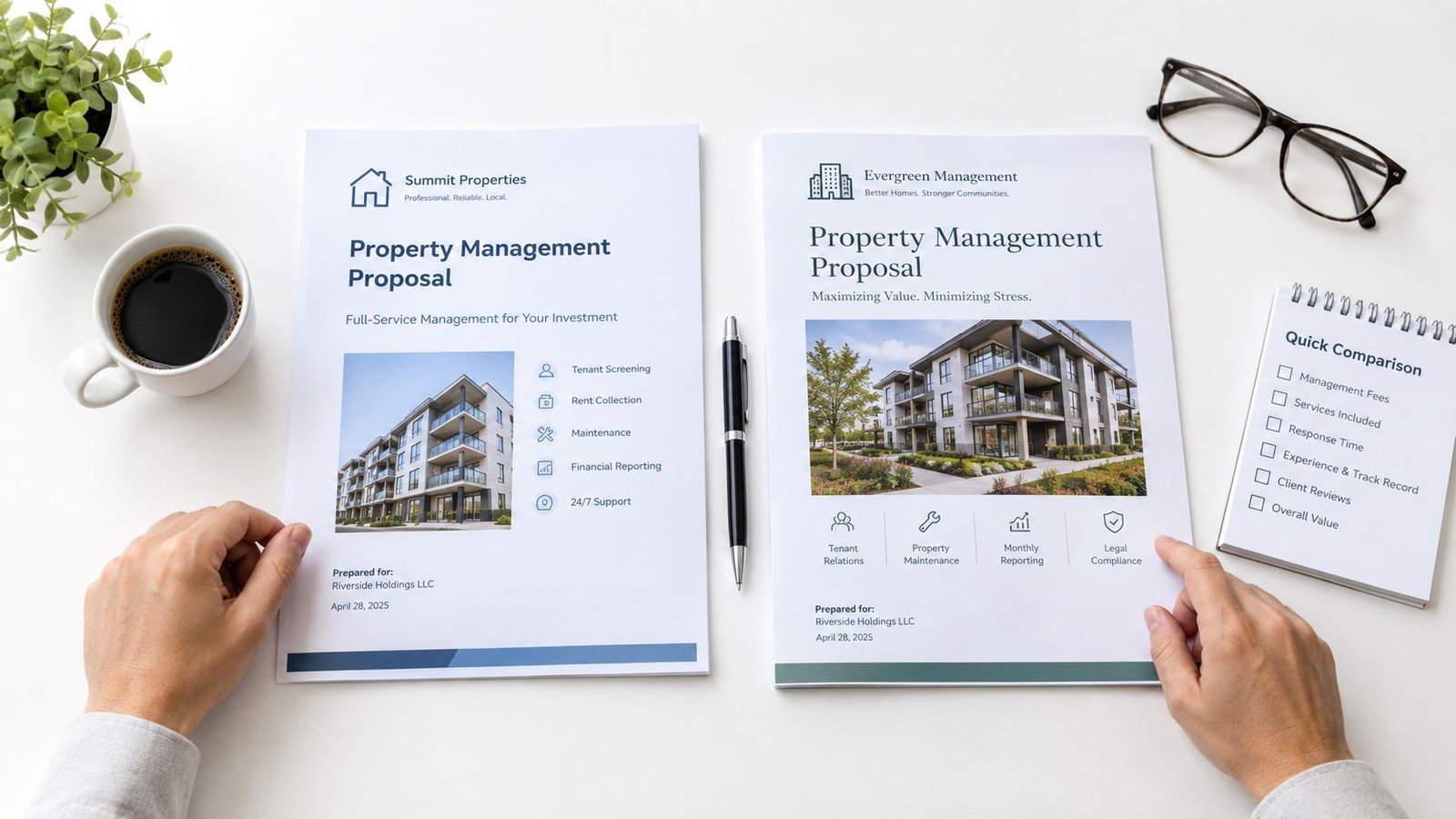
A landlord comparing proposals should ask for the same information from every manager. Without a consistent checklist, the lowest percentage often wins before the owner understands what the contract excludes.
Ask for an itemised agreement
The proposal should identify the recurring fee, placement charge, renewal treatment, inspection scope, maintenance coordination, advertising, emergency response, dispute administration, and any pass-through expense. It should also state whether management is charged during vacancy, how rent collection is defined, and when the owner receives statements and supporting documents.
For practical comparison, owners can request:
- Service scope: Which tasks are included in the recurring fee?
- Turnover process: Who markets, shows, screens, documents, and leases the property?
- Maintenance controls: Who selects vendors, approves work, reviews invoices, and handles emergencies?
- Inspection records: Are move-in, move-out, and routine inspections included?
- Reporting cadence: What statements, photos, invoices, and work-order updates will the owner receive?
- Termination terms: How can either party end the agreement, and what happens to an active tenancy?
A landlord reviewing broader expense categories may also find the Scottish landlord allowable expenses guide useful as a reminder to separate operating expenses from tax and accounting questions. The rules differ by jurisdiction, so Alberta owners should use it only as a categorisation prompt, not as Canadian legal or tax advice.
Verify compliance handling
Rent administration requires more than changing a figure in software. Alberta landlords can't increase rent until at least 365 days have passed since the tenancy began or since the last increase, whichever is later. The rule applies to fixed-term and periodic tenancies. For periodic tenancies, the written notice must include the date, effective date, and landlord's signature. Notice periods are 12 full weeks for week-to-week tenancies, three full months for month-to-month tenancies, and 90 days for other periodic tenancies. Required notices may be delivered personally or by registered mail, as set out in this Alberta rent-increase guidance.
The agreement should clarify whether the manager tracks anniversary dates, prepares notices, documents delivery, and reports the effective rent change. Owners can also use this guide to choosing a property manager to assess communication, local coverage, documentation, and operating fit.
A remote owner should favour a manager who can provide evidence of completed work, not just verbal reassurance. Clear records reduce uncertainty and make the fee easier to evaluate.
Making a Confident Decision About Property Management
Rental property management cost is best understood as the price of maintaining income, property condition, compliance, and owner visibility. The recurring percentage matters, but vacancy, turnover, maintenance reserves, leasing charges, GST, and documentation can change the annual result more than a small difference in the advertised rate.
A sound comparison starts with the property's actual profile. A detached home, condominium, and duplex carry different coordination demands. A local owner and an out-of-province owner also need different levels of attendance, reporting, and emergency support. The proposal should reflect those realities instead of applying one generic number to every rental.
Owners who want a practical starting point can request a free rental consultation and market analysis from GURIQBAL CHAHAL, MBA, PMP, REAL ESTATE BROKER, at 403-966-6072. The discussion should focus on achievable rent, expected leasing conditions, included services, likely turnover costs, and a transparent annual operating model.
Dreamhouse Realty Ltd. provides residential rental management, tenant placement, inspections, maintenance coordination, compliance administration, and owner reporting for Calgary, Edmonton, Red Deer, and surrounding Alberta communities. Landlords can visit Dreamhouse Realty Ltd. to request a rental consultation and compare their property's full management cost before signing an agreement.