
A Calgary landlord buys a detached home expecting a straightforward rental: collect rent, handle the occasional repair, and watch the property appreciate. The first tenancy quickly exposes the gap between that assumption and daily operations. The furnace runs harder than expected, the tenant asks who pays for utilities, a fence issue becomes a dispute, and a planned rent increase is invalid because the timing or notice was wrong.
A single family house can be an excellent Alberta rental, but it isn't a passive asset. The owner controls an entire building, including its roof, exterior, heating system, plumbing, yard, insurance exposure, and compliance records. That concentration creates privacy and tenant-retention advantages, but it also creates costs that an apartment owner may share across a building or that a townhouse owner may manage through a condominium structure.
Table of Contents
- The Hidden Reality of Owning a Single Family House in Alberta
- What Counts as a Single Family House in Alberta
- Why Single Family Houses Cost More to Manage Than They Appear
- Alberta Rental Rules Every Single Family House Landlord Must Know
- Single Family Houses Versus Other Rental Types in Alberta
- How to Run a Single Family House Rental Like a Business
- When Professional Property Management Makes Sense for Single Family Rentals
- Next Steps for Alberta Single Family House Landlords
The Hidden Reality of Owning a Single Family House in Alberta
A new Calgary owner may price a detached rental by comparing nearby advertisements, sign a lease quickly, and assume the property is ready for a smooth year. The first winter reveals a poorly sealed back door and an aging furnace. The tenant expects the owner to address the high gas bill, while the owner believes the tenant accepted the utility responsibility. At renewal, the owner tries to raise rent before the legally permitted interval has passed.
None of these problems begins with bad intent. They begin with an incomplete operating plan.
The mistake starts before move-in
The phrase single family house sounds simple, but it can hide important questions. Is the property genuinely one dwelling, or does it contain an unauthorised basement arrangement? Does the lease assign utilities clearly? Does the owner understand which repairs belong to the landlord? Were the premises documented properly before possession?
A detached structure on its own lot still has to be operated within Alberta's tenancy rules and applicable municipal requirements. A private yard doesn't remove the need for written procedures, records, inspections, or timely notices.
Practical rule: A detached rental should be underwritten as a complete operating system, not just as a mortgage attached to a house.
The owner who treats the property as a business usually catches problems early. That means checking the heating envelope before marketing, documenting every room and exterior feature, setting a realistic maintenance reserve, and writing utility obligations in plain language. It also means pricing for the actual neighbourhood, not relying on a province-wide impression that detached homes are automatically scarce.
The Alberta market still supports strong tenant demand for family-oriented housing, but the asset carries more moving parts than its listing description suggests. A landlord who understands the dwelling form, operating costs, market position, and legal process can protect both cash flow and the tenant relationship.
What Counts as a Single Family House in Alberta
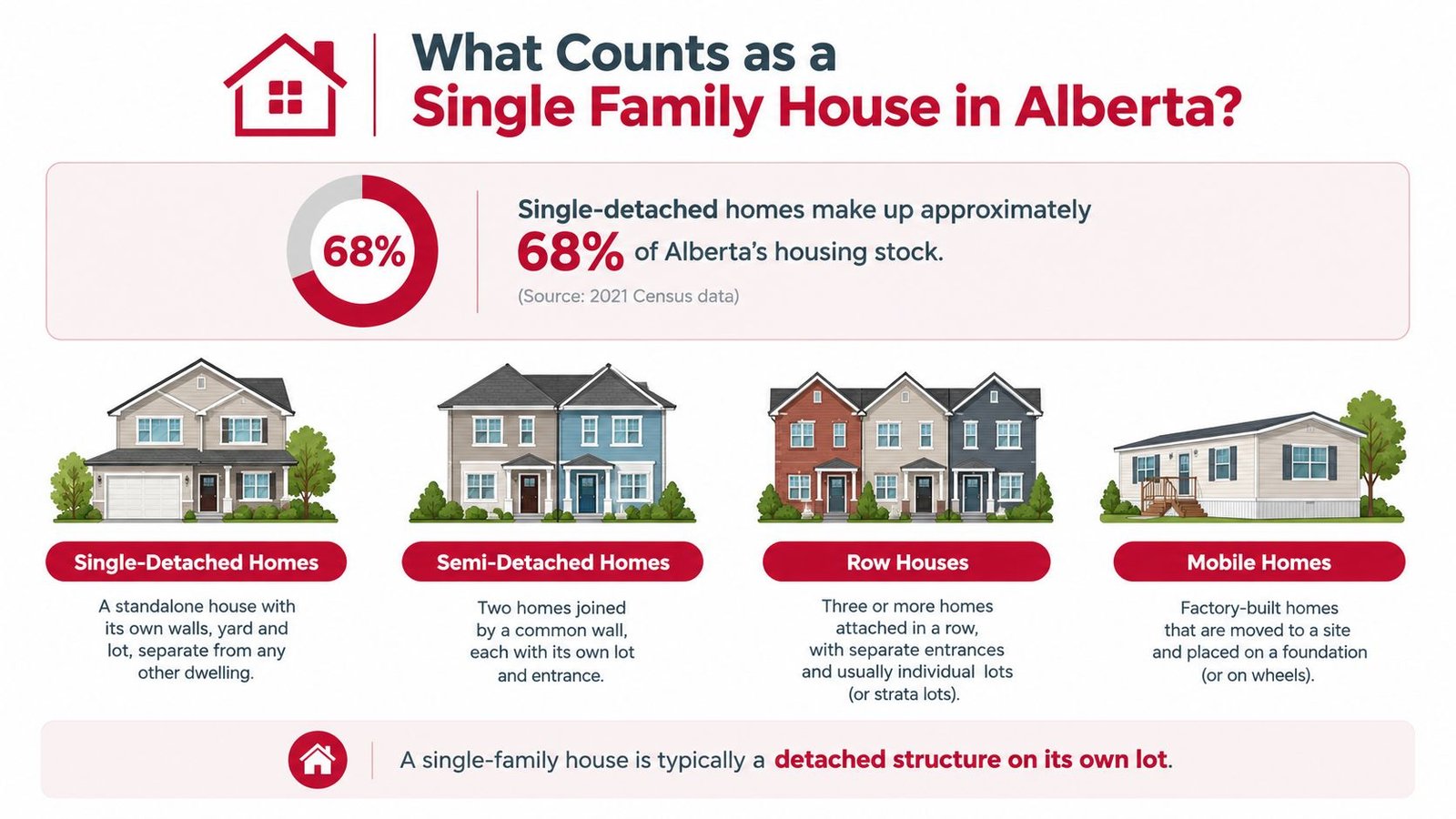
A landlord can call a property a single family house, but the operating reality depends on how the home is configured and occupied. In rental practice, the term usually means a self-contained dwelling intended for one household, most often a detached structure on its own lot. The tenant generally controls the interior and may use the yard, without sharing corridors, entrances, mechanical systems, or common facilities with a larger building.
The label does not settle the compliance question. A detached home may include a basement, but separate living arrangements can indicate that the property functions as more than one unit. Zoning, permits, building standards, fire safety, and tenancy classification must be checked separately. Ask directly: Is the property one dwelling, or does it contain an unauthorised basement arrangement? Confirm the answer before advertising or signing a lease.
Alberta's housing pattern
Detached homes remain a major part of Alberta's rental supply. Single-detached houses accounted for 60.9% of occupied private dwellings in Alberta in 2021, compared with 61.9% in 2016 and 63.5% in 2011, according to Statistics Canada's Alberta Census housing data. Alberta's housing stock is becoming more varied, yet detached homes remain the largest category.
Household size helps explain the demand. In the 2016 Census summary, 79.4% of Alberta households with four or more people lived in single-detached houses, compared with 38.1% of one-person households, as reported in the same Statistics Canada Census Profile. Families often want the bedrooms, storage, outdoor space, and neighbourhood setting that detached rentals provide.
Calgary had a smaller share. Single-family houses represented 55.0% of Calgary homes in 2021, a decline of 2.45% over the previous five years, according to the Alberta Regional Dashboard's Calgary housing data. Edmonton was closer to balance, with 196,535 single-detached houses among 396,400 occupied private dwellings, or 49.6%, in the 2021 Census Profile.
For an owner, classification determines the operating plan. A detached house rented as one home needs a lease, inspection process, maintenance plan, and utility allocation suited to that arrangement. If the property operates as multiple units, get professional advice before marketing it. Misclassification can create avoidable compliance, cost, and tenant-management problems.
Why Single Family Houses Cost More to Manage Than They Appear
Detached homes concentrate expenses in one owner's account. An apartment landlord may benefit from shared building systems and established common-area processes. A townhouse owner may have some exterior responsibilities governed by a condominium corporation. The single-family owner receives the full benefit of privacy and control, but also carries the full exposure when the roof, furnace, drainage, fence, windows, or yard requires attention.
Energy is the clearest example. An Alberta energy-efficiency study estimates that single-family detached homes account for 77% of total residential electricity consumption, while more than 75% of residential electricity and natural gas use comes from single-family detached homes overall, according to the Alberta energy-efficiency potential study.
Heating exposes weak underwriting
The same study identifies space heating and water heating as dominant natural-gas demands. Appliances, lighting, and space heating account for about 71% of residential electricity use, and the reported 2019 base case places single-family space-heating load at about 1,520 kWh per household, or 88.91 GJ. These figures point owners toward the right inspection priorities: air leakage, attic insulation, windows, ducting, thermostat control, and furnace performance.
A landlord who budgets only for cosmetic turnover misses the largest controllable operating risks. A house with a weak envelope can create tenant complaints, high utility bills, frozen plumbing concerns, and premature equipment wear. Preventive work may be less visible than a new kitchen, but it protects the asset's operating margin.
Alberta household benchmarks reinforce the point. The Alberta Utilities Consumer Advocate cost comparison tool places a small single-family dwelling with several occupants in the 350 to 575 kWh per month electricity range and the 1.9 to 15.6 GJ per month gas range. Large, heavily occupied homes can exceed 800 kWh per month and 28.8 GJ per month. NRCan reports Alberta household energy intensity at 124.8 GJ per household, the highest provincial figure, while single-detached homes had dwelling-type energy intensity of 122.8 GJ per household.
Owner's warning: A utility bill is an operating signal. Persistent outliers deserve an inspection, not an automatic assumption that the tenant is careless.
Insurance and repairs add another layer. A detached property concentrates roof, siding, sewer, hail, drainage, and exterior maintenance exposure at the unit level. Owners should track the age and condition of major systems, clarify tenant and landlord responsibilities, and keep records of repairs. A realistic reserve should reflect the house's actual lifecycle condition, not an optimistic generic allowance.
Alberta Rental Rules Every Single Family House Landlord Must Know
Detached homes don't receive a simpler legal regime because they have one entrance or one household. Alberta landlords still need a disciplined process for rent changes, tenancy notices, and condition inspections. The paperwork protects the owner when it is accurate, timely, and consistent.
Start with rent timing
Under Alberta's Residential Tenancies Act guidance, rent can't be increased until at least 365 days have passed since the later of the tenancy start date or the last rent increase, as explained in Alberta's guidance for landlords and tenants during a tenancy. A rent increase also can't occur during a fixed-term tenancy.
For a periodic tenancy, the notice must be written, dated, and signed by the landlord, and it must state the effective date of the increase. Owners should record the tenancy start date, the most recent increase, the notice date, and the effective date in one calendar. A casual email sent at the wrong time can create an avoidable dispute.
A landlord preparing a lease or renewal can also use this Alberta RTA handbook for landlords as a practical reference, while confirming any current legal requirements before serving notice.
Match the notice to the tenancy
Notice periods depend on the type of periodic tenancy. Alberta guidance sets the minimum at 12 full tenancy weeks for week-to-week, 3 full tenancy months for month-to-month, and 90 days for other periodic tenancies, as outlined in the Residential Tenancies Act handbook.
The owner should identify the tenancy type before drafting the notice. Counting from the wrong date or using an informal message can undermine an otherwise valid decision. A property manager should maintain templates, a notice calendar, and proof of delivery.
Inspect both ends of the tenancy
Move-in and move-out inspections aren't optional administration. Alberta Service Alberta guidance says the landlord and tenant must inspect the premises within one week before or after move-in and within one week before or after move-out, according to Information for tenants from Service Alberta.
The report should describe walls, flooring, appliances, fixtures, windows, doors, yard areas, and existing damage. Photos should support the written record, with dates and clear file organisation. At move-out, the manager should compare the condition against the original report rather than relying on memory.
The supplied visual URL contains a mismatch in its path, so the exact pre-uploaded asset cannot be reproduced without altering the provided address. However, the operative requirements remain clear: serve lawful notices, document the property, respond to maintenance obligations, and retain records. These steps reduce confusion before a disagreement becomes a claim.
Single Family Houses Versus Other Rental Types in Alberta
A detached rental wins on privacy, storage, outdoor space, and household control. It loses on cost concentration. Apartments can offer more predictable building-level operations, while townhomes may place some exterior work within a condominium structure. Condos introduce their own risks, including bylaws, corporation decisions, and fees, so the comparison isn't just detached versus easy.
Calgary's market also requires sharper pricing. The City of Calgary reports that the market vacancy rate increased from 4.6% in 2024 to 5.1% in 2025, according to Calgary's housing trends information. The city's housing review also reports that vacancy improved to 5% in 2025 from 1.4% in 2023, while apartment and purpose-built rental activity changed the competitive environment. In Q3 2025, Calgary recorded 17,342 year-to-date total housing starts, while single-family starts fell 14% to 1,195 units, according to the Calgary Housing Review for Q3 2025.
Operational comparison
| Property Type | Maintenance Focus | Vacancy Risk Trend | Management Complexity |
|---|---|---|---|
| Single-family house | Roof, envelope, furnace, plumbing, yard, exterior | More exposed to neighbourhood pricing and competing apartment supply | High, because one owner carries the full property |
| Apartment | Interior suite, appliances, building procedures | Can compete on amenities and location | Moderate, with building systems and policies |
| Condo | Interior suite, appliances, bylaws, corporation coordination | Influenced by fees, rules, and competing inventory | Moderate to high, because responsibilities can overlap |
| Townhome | Interior, limited exterior, yard, corporation requirements | Sensitive to local supply and tenant preferences | Moderate, depending on the condominium structure |
The SFR asset class overview provides useful background on single-family rental properties as an investment category. Alberta owners should go further and test the individual address. A detached home near schools, transit, employment, and daily services may retain tenants well, but a high asking rent in a softening submarket can erase that advantage.
The risk is concentrated, not automatically lower
A single-family house doesn't spread a major repair across multiple suites. One furnace failure can affect the entire tenancy, and one roof problem can create a large owner expense. The property may still produce strong long-term value, but the owner needs accurate condition records, local leasing evidence, and a response plan for vacancies.
The correct question isn't whether detached housing is good. It's whether the rent, tenant demand, insurance, maintenance profile, and compliance workload justify the specific acquisition.
How to Run a Single Family House Rental Like a Business
A professional operating plan begins before the listing goes live. The owner should price from current neighbourhood evidence, define utility responsibility in the lease, screen applicants consistently, and schedule inspections rather than treating them as an afterthought.
Use five controls:
- Price deliberately: Compare the house with nearby detached rentals, townhomes, and apartments competing for the same household.
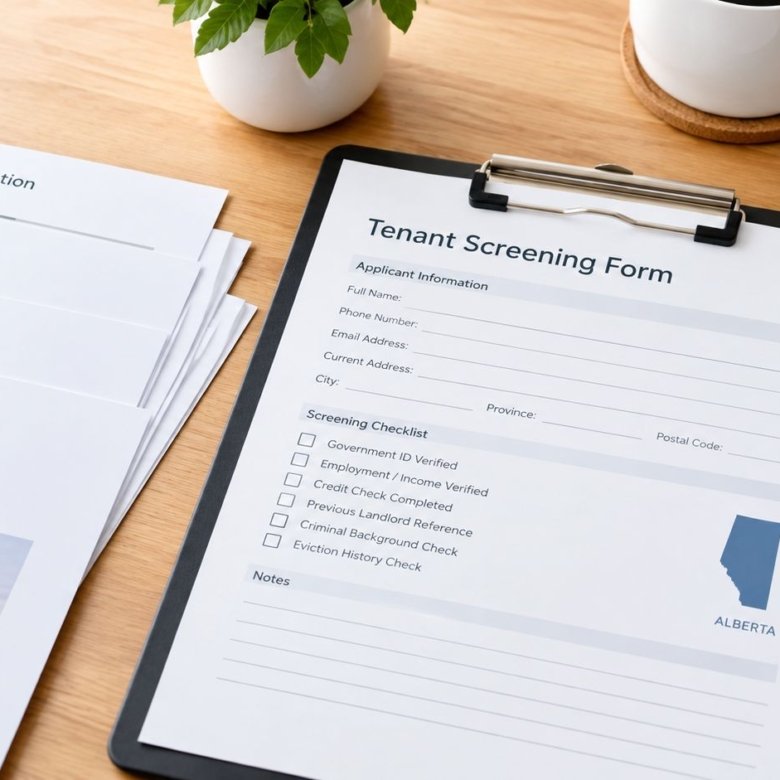
- Screen consistently: Verify income, credit, references, and rental history using the same documented criteria for every applicant.
- Write the lease clearly: State rent, utilities, maintenance expectations, yard duties, notice procedures, and access rules in plain language.
- Track the building: Maintain a calendar for furnace servicing, filters, exterior checks, inspections, and lease dates.
- Watch cash flow: Review rent collection, repairs, utility trends where applicable, insurance, and vacancy costs together.
A simple example shows why this matters. A tenant reports a draft and an unusually high heating bill. A reactive owner dismisses the complaint until renewal. A disciplined manager records the issue, checks the envelope and furnace, confirms the lease allocation, and preserves the communication trail. The owner may avoid a larger repair, a renewal dispute, or a vacancy caused by discomfort.

For owners who need structured leasing support, leasing a house in Alberta involves more than placing an advertisement. It requires market positioning, showings, applicant review, documentation, and a clean handoff into ongoing management.
When Professional Property Management Makes Sense for Single Family Rentals
Professional management makes sense when the owner can't reliably handle four pressure points: pricing, compliance, maintenance, and tenant communication. A remote owner may struggle to attend inspections. A busy professional may delay notices or repair approvals. An investor with several properties may lose visibility into which house is generating repeated costs.
A practical 2026 checklist is straightforward:
- Audit the lease file. Confirm dates, utility terms, inspection reports, notices, and communication records.
- Benchmark operating costs. Investigate heating and electricity outliers before they become renewal or maintenance problems.
- Test the leasing plan. Review the asking rent, listing quality, showing response time, and applicant screening process against local competition.
- Choose the service level. Keep tasks in-house only when the owner can perform them promptly and document them properly.
A full-service manager can coordinate marketing, screening, lease execution, rent collection, inspections, maintenance vendors, compliance records, tenant communication, and owner reporting. That doesn't remove ownership risk, but it gives the owner a defined process for handling it.
Alberta property management services can be evaluated alongside other local providers by comparing scope, communication standards, inspection procedures, maintenance approval controls, and reporting. The right choice is the one that matches the property's complexity and the owner's availability.
Next Steps for Alberta Single Family House Landlords
A single family house remains a foundational Alberta housing asset, especially for households seeking privacy and space. The investment becomes defensible only when the owner prices it accurately, inspects it properly, controls utility and maintenance risks, and follows the Residential Tenancies Act process.
Owners should review every active lease, confirm the timing rules for future rent changes, check that move-in and move-out reports are complete, and examine heating and electricity patterns for unexplained outliers. Calgary landlords should also test current pricing against the local vacancy environment instead of assuming that detached housing automatically commands a scarcity premium.
The next practical step is an operating review of the property, not another generic market forecast. A qualified manager can identify documentation gaps, maintenance exposure, leasing weaknesses, and whether the current arrangement supports predictable ownership.
Dreamhouse Realty Ltd. serves Calgary, Edmonton, Red Deer, and surrounding Alberta communities with residential leasing and property management for single-family homes, condos, townhomes, and small multifamily buildings. GURIQBAL CHAHAL, MBA, PMP, REAL ESTATE BROKER, can be reached at 403-966-6072 to discuss the property's current position and management needs.
Dreamhouse Realty Ltd. provides rental consultations, tenant placement, screening, lease preparation, inspections, maintenance coordination, compliance oversight, rent collection, and owner reporting for Alberta rental properties. Landlords can visit Dreamhouse Realty Ltd. to arrange a consultation about operating a single-family house with stronger documentation, clearer controls, and local oversight.